
Disorders Related To Vibration Exposure 1 Vibration occurs
Disorders Related To Vibration Exposure 1
Ø Vibration occurs when mechanical energy from an oscillating source is transmitted to another structure. Ø Occupational vibration has both acute & chronic effects on workers health & the ability to work. Cumulative vibration trauma most often occurs with work history at least 2000 hours of exposure (usually 8000 hours). 2
Effect Of Vibration Depend On: 1. Frequency of vibration expressed in Hertz. 2. Direction & intensity (acceleration) of vibration. 3. Duration of exposure. 4. Human resonance: • Every part of the body has its own natural vibration level, as well as the body as a whole. When vibration of the same frequency is applied, resonance (Tone, Echo, Amplification) of that vibration occurs often with adverse effect. 3
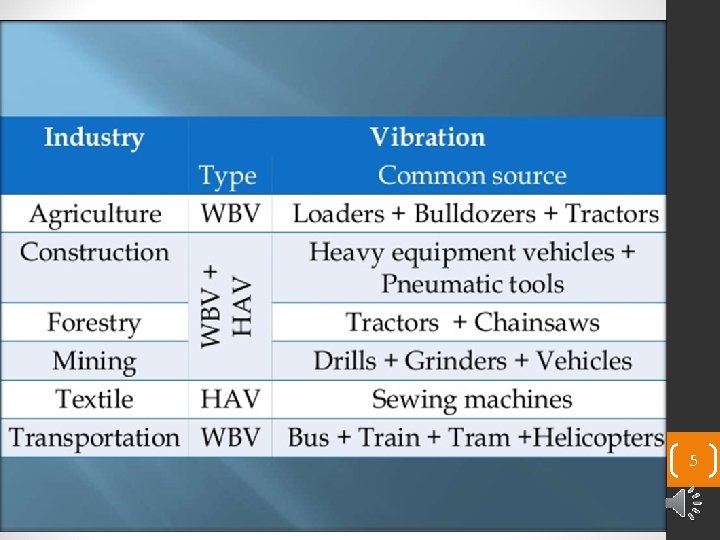
Types of human vibrations can be divided into: 1. 2. Whole Body Vibration (WBV) which is usually transmitted to the entire human body through some supporting structure, such as vehicle seat or building floor. Segmental or Hand Arm Vibration (HAV) and usually affect locally specific body part e. g. hands by vibrating tool. Although WBV & HAV are usually distinct, some workers may be exposed to both types e. g. (if the worker using a hand tool place it closely to his abdomen while doing his job. 1) Whole body vibration (WBV): 1. High risk group: truck & bus drivers, heavy equipment operators, miners, farmers & constructor workers). üWBV is a form of cumulative trauma; it can be regarded as a generalized stressor, and may affect multiple body systems evidenced by the higher incidence of musculoskeletal, neurological, circulatory, digestive disorders than the normal population. 4
5
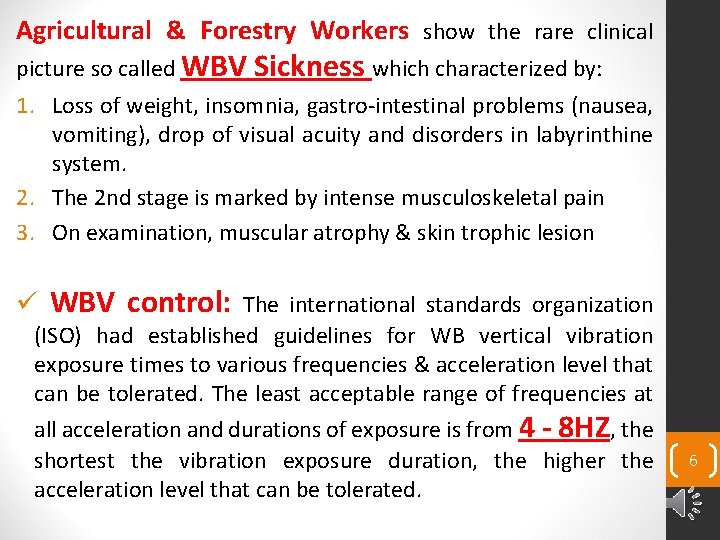
Agricultural & Forestry Workers show the rare clinical picture so called WBV Sickness which characterized by: 1. Loss of weight, insomnia, gastro-intestinal problems (nausea, vomiting), drop of visual acuity and disorders in labyrinthine system. 2. The 2 nd stage is marked by intense musculoskeletal pain 3. On examination, muscular atrophy & skin trophic lesion ü WBV control: The international standards organization (ISO) had established guidelines for WB vertical vibration exposure times to various frequencies & acceleration level that can be tolerated. The least acceptable range of frequencies at all acceleration and durations of exposure is from 4 - 8 HZ, the shortest the vibration exposure duration, the higher the acceleration level that can be tolerated. 6
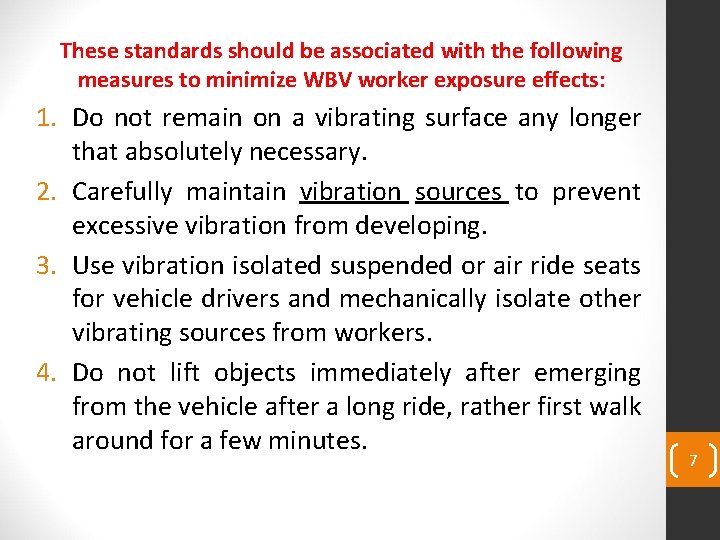
These standards should be associated with the following measures to minimize WBV worker exposure effects: 1. Do not remain on a vibrating surface any longer that absolutely necessary. 2. Carefully maintain vibration sources to prevent excessive vibration from developing. 3. Use vibration isolated suspended or air ride seats for vehicle drivers and mechanically isolate other vibrating sources from workers. 4. Do not lift objects immediately after emerging from the vehicle after a long ride, rather first walk around for a few minutes. 7
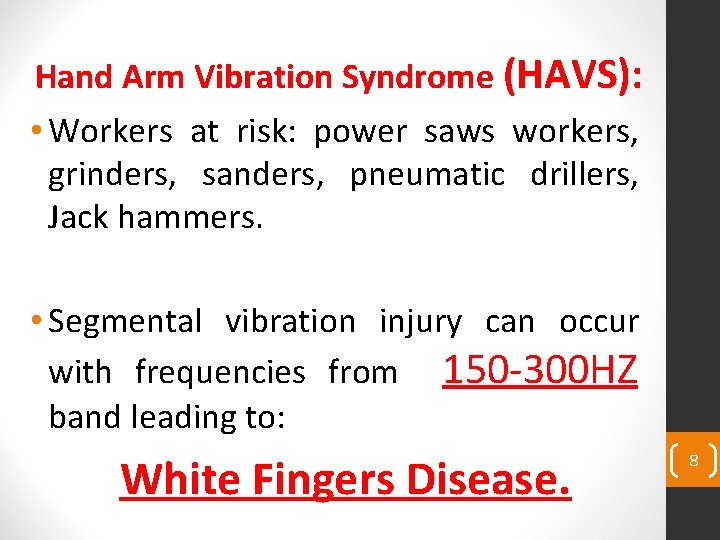
Hand Arm Vibration Syndrome (HAVS): • Workers at risk: power saws workers, grinders, sanders, pneumatic drillers, Jack hammers. • Segmental vibration injury can occur with frequencies from 150 -300 HZ band leading to: White Fingers Disease. 8

9
Effect may be either acute or chronic (cumulative) & the risk is increased with exposure to cold with strenuous physical operation, emotional stress, use of vasoactive drugs & smoking. v. White Finger Disease is characterized by spasms of digital arteries (Raynaud's phenomenon) caused by: 1. Damage of peripheral nerves and perineural connective tissue deposition. 2. Vascular damage (extensive damage to digital arterial intimal, arterial muscle wall with narrowing of the lumen, extensive connective tissue deposition in perivascular tissue & micro vascular occlusion. 3. Excess connective tissue deposition in subcutaneous tissue. 10
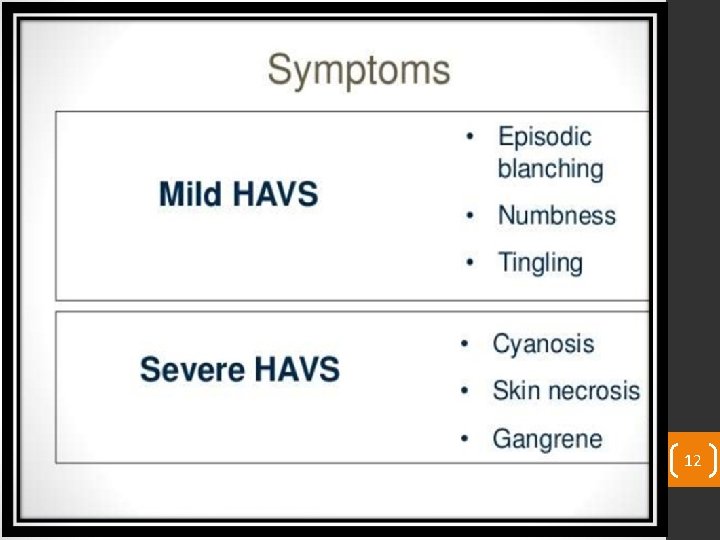
Clinical Picture: 1. Early symptoms consist of numbness followed by tingling of the fingers which later begin to turn white in cold environment or touching cold objects. At first the symptoms are easily reversible after removal from exposure. 2. Intermittent attacks of blanching often starts in winter with the tip of one finger but progressively extend to other finger tips & bases of all fingers on the exposed hand. 3. With continuous exposure, blanching & cyanosis may occur also in summer season. 4. Return of blood circulation at the end of the attack is associated with red flush, pain, throbbing & parasthesia. 5. In more advanced cases, degeneration of the hand bones & cartilage may occur, resulting in joint stiffness, restriction of motion and arthralgia, trophic skin changes and gangrene. 6. The greater the intensity of vibration, the shorter the latent period between exposure & appearance of symptoms & signs. 11
12
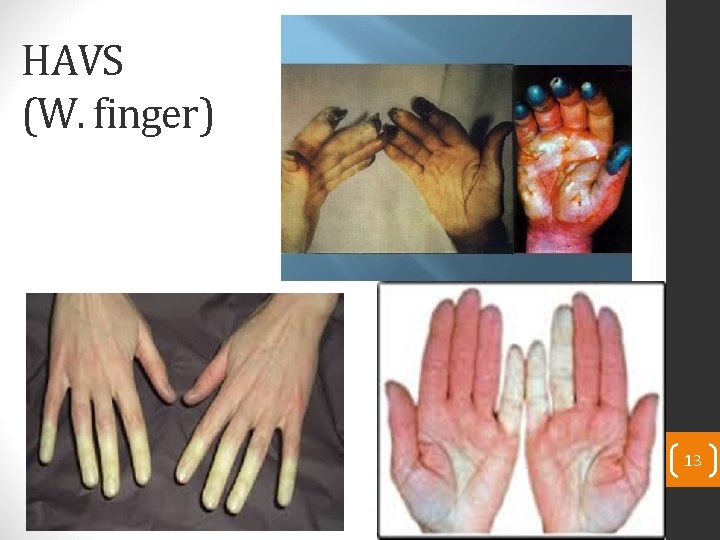
HAVS (W. finger) 13
Hand-arm Vibration Control: 1. Pre employment examination, those with Raynaud's disease, phenomenon must not work with vibratory hand tool. 2. Workers should use A/V gloves which use special viscoelastic materials to damp a broad spectrum vibration & keep the hands warm, dry & prevent cuts and lacerations. Also gloves should be changed if the hands get wet. 3. Let the tool do the work, grasping it as lightly as it is safe to do so, allowing the tool to rest on the work piece when possible. 4. Use the tool only when absolutely necessary. 5. Avoid continuous work for long time, allow 10 -minutes vibration-free rest break for every hour continuous work. 6. Avoid smoking while particularly using the tool. 7. Instruct workers about the early signs & symptoms of HAVS & to see the physician promptly if they develop. 14
- Slides: 14