
Disorders of the CalciumSensing Receptor Hengameh Abdi MD
Disorders of the Calcium-Sensing Receptor Hengameh Abdi, MD Endocrine Research Center Research Institute for Endocrine Sciences Shahid Beheshti University of Medical Sciences 14 April 2016
2 Agenda q Introduction q Familial Hypocalciuric Hypercalcemia q Neonatal Severe Hyperparathyroidism q Acquired Hypercalcemic Disorders of the Ca. SR q Autosomal Dominant Hypocalcaemia with Hypercalciuria q Hypoparathyroidism due to Ca. SR Antibodies
3 Introduction § Activating or inactivating mutations in the calciumsensing receptor (Ca. SR) gene result in altered calcium sensing and therefore inappropriate PTH release with respect to the serum calcium concentration.
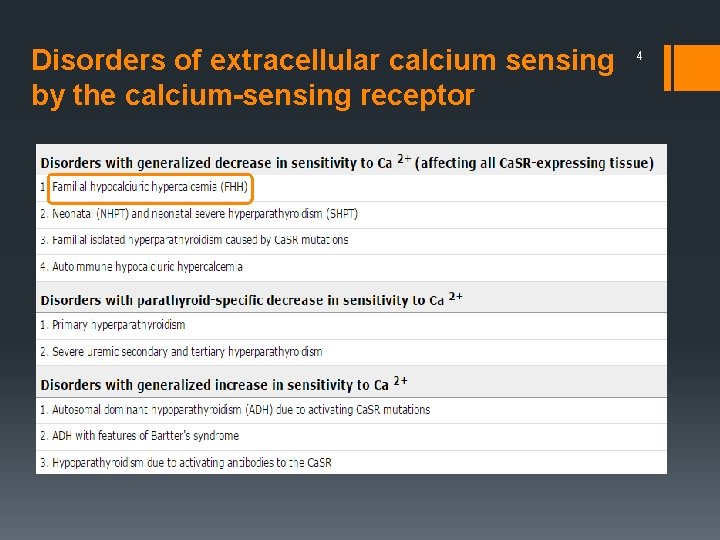
Disorders of extracellular calcium sensing by the calcium-sensing receptor 4
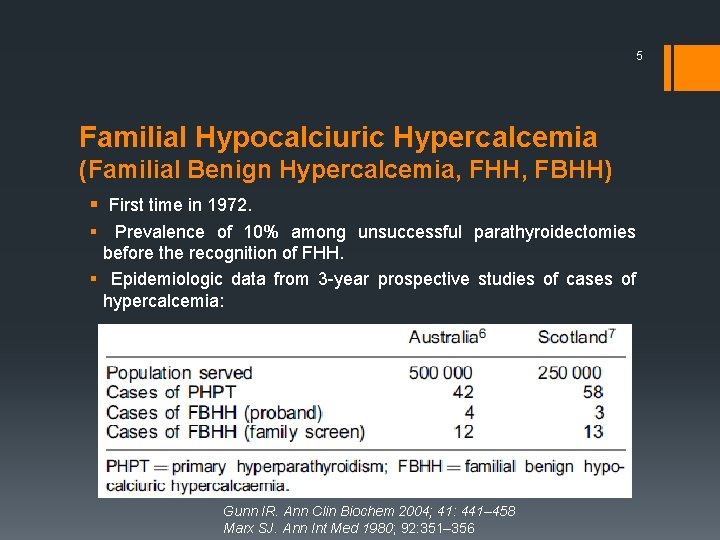
5 Familial Hypocalciuric Hypercalcemia (Familial Benign Hypercalcemia, FHH, FBHH) § First time in 1972. § Prevalence of 10% among unsuccessful parathyroidectomies before the recognition of FHH. § Epidemiologic data from 3 -year prospective studies of cases of hypercalcemia: Gunn IR. Ann Clin Biochem 2004; 41: 441– 458 Marx SJ. Ann Int Med 1980; 92: 351– 356
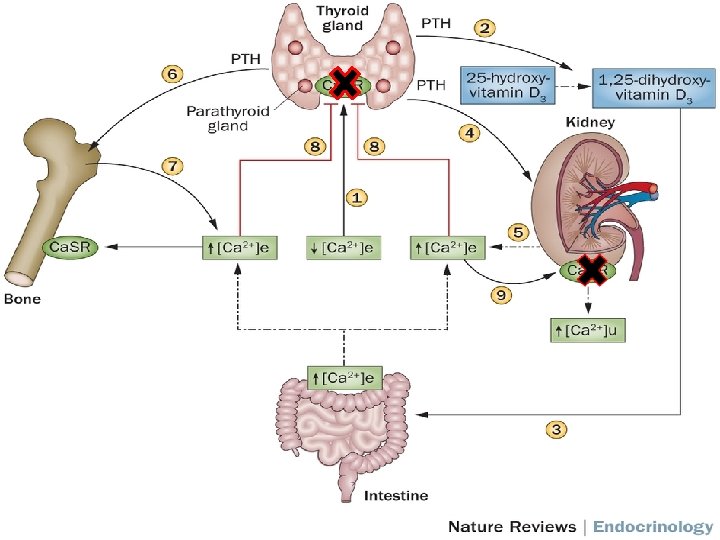
6 Familial Hypocalciuric Hypercalcemia (Genetic) § Autosomal dominant inheritance with high penetrance. § Genetically heterogeneous with 3 variants with similar clinical features: § FHH 1: loss-of-function mutations of the Ca. SR gene on 3 q 21. 1. The most common form. § FHH 2: loss-of-function mutations in the GNA 11 gene on 19 p 13. § FHH 3: loss-of-function mutations in the AP 2 S 1 gene on 19 q 13. § The result of these mutations is fewer normally functioning receptors on the parathyroid or renal cell surface.
7
8 Familial Hypocalciuric Hypercalcemia (Pathophysiology) § The relative insensitivity of the Ca. SR to calcium effectively "resets" not only parathyroid but also kidney to maintain mild to moderate hypercalcemia. § The net effect: § § Hypercalcemia (mild, persistent, non-progressive) Inappropriately normal (80%) or high serum PTH level Hypocalciuria (Ca/Cr clearance ratio* <0. 01) Frequently high normal levels of serum magnesium or frank hypermagnesemia *Ca/Cr clearance ratio: urine Ca/urine creatinine x serum creatinine/serum Ca, performed on blood sample and random or 24 -h urine specimen.
9 Familial Hypocalciuric Hypercalcemia (Clinical findings) § Typically asymptomatic. § Benign clinical course. § Occasional cases chondrocalcinosis. of pancreatitis or
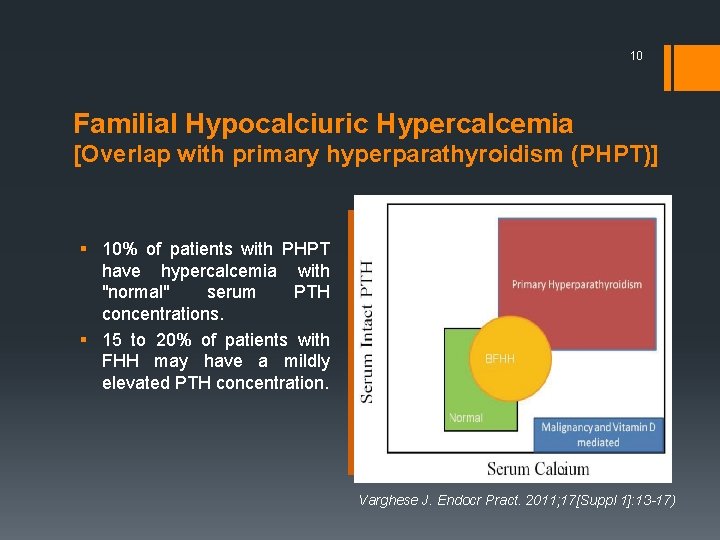
10 Familial Hypocalciuric Hypercalcemia [Overlap with primary hyperparathyroidism (PHPT)] § 10% of patients with PHPT have hypercalcemia with "normal" serum PTH concentrations. § 15 to 20% of patients with FHH may have a mildly elevated PTH concentration. Varghese J. Endocr Pract. 2011; 17[Suppl 1]: 13 -17)
11 Familial Hypocalciuric Hypercalcemia (Overlap with primary hyperparathyroidism) § In patients with PHPT, the Ca/Cr clearance ratio is usually between 0. 01 and 0. 05 and most often >0. 02. However, the Ca/Cr clearance ratio may be <0. 01 in 10 -20% of patients with PHPT, particularly those with concomitant vitamin D deficiency. § Affected family members in occasional FHH families are hypercalciuric.
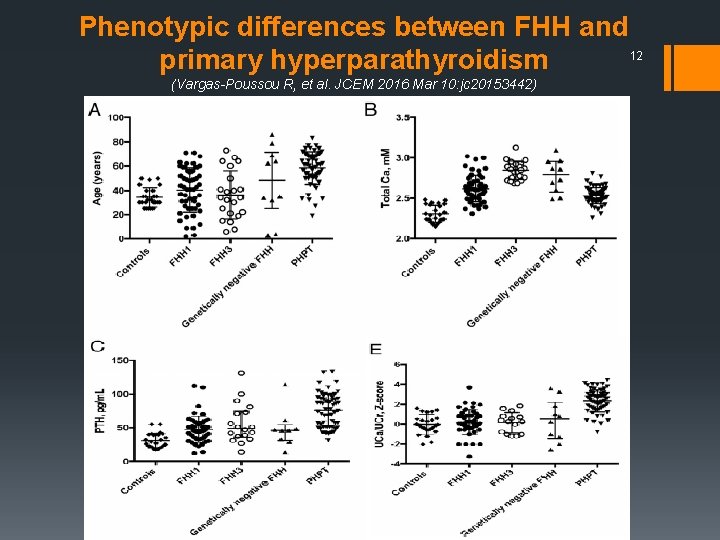
Phenotypic differences between FHH and 12 primary hyperparathyroidism (Vargas-Poussou R, et al. JCEM 2016 Mar 10: jc 20153442)
13 Familial Hypocalciuric Hypercalcemia (Distinction from primary hyperparathyroidism) § The absence of symptoms. § Laboratory findings typical of FHH in the proband. § A history of familial hypercalcemia with hypocalciuria, sometimes with previously unsuccessful parathyroid surgery, in other affected family members, including young children. § Even if the family history is negative, this does not rule out familial involvement and serum and urinary calcium determination should be performed in several first degree relatives, if possible.
14 Familial Hypocalciuric Hypercalcemia (Distinction from primary hyperparathyroidism) § Ca. SR mutational analysis, although available, is not routinely performed. § Mutational analysis may be of benefit in distinguishing FHH from PHPT in the following clinical settings: • Families with familial isolated hyperparathyroidism • Patients with overlap in the Ca/Cr clearance ratio, namely between 0. 01 and 0. 02 • Patients with the phenotype of FHH whose parents are both normocalcemic (ie, FHH possibly caused by a de novo Ca. SR mutation) • Atypical cases where no family members are available for testing • Infants or children <10 y/o (in whom neonatal hyperparathyroidism and FHH are the most common causes of PTH-dependent hypercalcemia. )
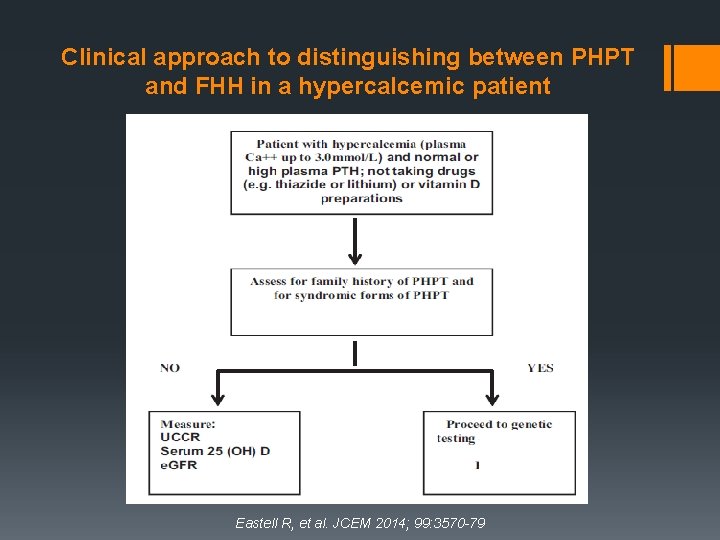
Clinical approach to distinguishing between PHPT and FHH in a hypercalcemic patient Eastell R, et al. JCEM 2014; 99: 3570 -79
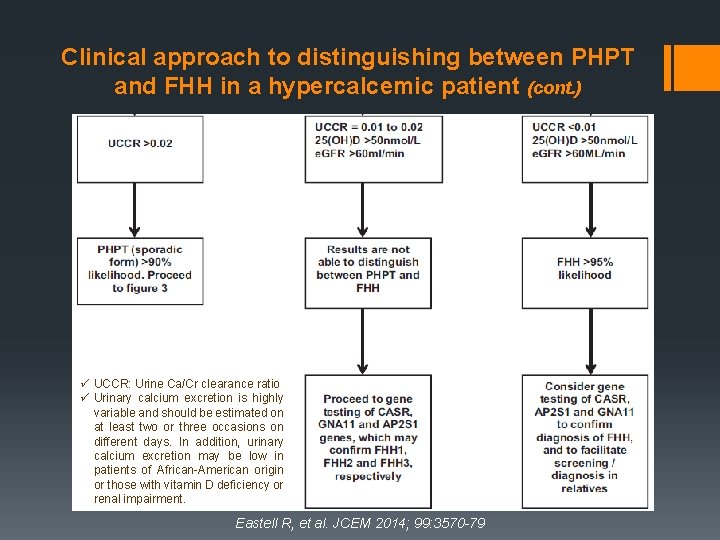
Clinical approach to distinguishing between PHPT and FHH in a hypercalcemic patient (cont. ) ü UCCR: Urine Ca/Cr clearance ratio ü Urinary calcium excretion is highly variable and should be estimated on at least two or three occasions on different days. In addition, urinary calcium excretion may be low in patients of African-American origin or those with vitamin D deficiency or renal impairment. Eastell R, et al. JCEM 2014; 99: 3570 -79
17 Familial Hypocalciuric Hypercalcemia (Management) § No intervention (failure of parathyroidectomy concentration) to normalize serum calcium § Affected family members should be identified and counseled to avoid parathyroid surgery, sometimes undertaken because of a mistaken diagnosis of primary hyperparathyroidism.
18 Neonatal Severe Hyperparathyroidism (NSHPT) § A very rare autosomal recessive condition due to homozygous inactivating mutation in the Ca. SR gene. § Offspring of consanguineous FHH 1 families. § Serum PTH concentrations as much as 10 -fold higher than normal. § Usually severe hypercalcemia (serum calcium >15 mg/d. L). § Relative hypocalciuria.
19 Neonatal Severe Hyperparathyroidism § Rachitic changes often occur and bone x-rays may reveal marked demineralization and subperiosteal resorption with multiple fractures. § Respiratory failure, failure to thrive. § This disorder can be fatal without immediate parathyroidectomy, although case reports have described the use of pamidronate and cinacalcet as a "rescue" therapy to stabilize infants with NSHPT prior to surgery or after failed surgery.
20 Acquired Hypercalcemic Disorders of the Ca. SR § Autoimmune hypocalciuric hypercalcemia § Primary hyperparathyroidism § Secondary and tertiary hyperparathyroidism Ø Expression of the Ca. SR protein is commonly reduced in adenomas from patients with primary hyperparathyroidism and/or severe secondary hyperparathyroidism due to chronic kidney disease. Although the pathogenetic importance of this change is uncertain.
21 Autoimmune Hypocalciuric Hypercalcemia § Clinical features of FHH without Ca. SR mutations. § Circulating antibodies to the extracellular domain of the Ca. SR that stimulate PTH release from dispersed human parathyroid cells in vitro. § Multiple clinical autoimmune manifestations, including antithyroid antibodies, anti-gliadin antibodies. § Variable effects of treatment with glucocorticoids.
22 Hypocalcemic Disorders of the Ca. SR § Autosomal dominant hypocalcemia type 1 (ADH-1) § Bartter syndrome type 5 (i. e. , ADH with a Bartter-like syndrome) § Autoimmune hypoparathyroidism (AH)
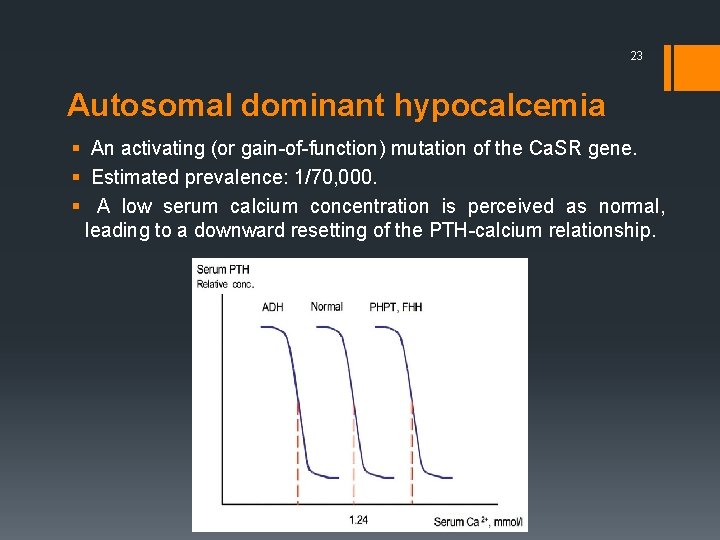
23 Autosomal dominant hypocalcemia § An activating (or gain-of-function) mutation of the Ca. SR gene. § Estimated prevalence: 1/70, 000. § A low serum calcium concentration is perceived as normal, leading to a downward resetting of the PTH-calcium relationship.
24 Autosomal dominant hypocalcemia (Biochemical Features) § Serum calcium concentration usually in the range of 6 to 8 mg/d. L, but as low as 5 mg/d. L in occasional families. § Normal (or only slightly low) serum PTH concentrations. § High or high normal urinary calcium excretion. § Recurrent nephrolithiasis and nephrocalcinosis, particularly during treatment with vitamin D and calcium supplementation. § No previous normal serum calcium values. § Low serum magnesium concentration (in some).
25 Autosomal dominant hypocalcemia (Clinical Findings) § The majority of patients are asymptomatic and therefore are not diagnosed until adulthood, when hypocalcemia is incidentally noted. § Children in particular may become symptomatic with seizures and neuromuscular irritability during periods of stress, such as a febrile illness, and may be mislabeled as having febrile seizures.
26 Autosomal dominant hypocalcemia (Diagnosis) § Distinction from idiopathic hypoparathyroidism may be difficult: § Familial nature. § High urinary calcium excretion. § Tendency of patients to develop renal complications during treatment with calcium and vitamin D supplementation.
27 Autosomal dominant hypocalcemia (Treatment) § Only in symptomatic patients. § Treatment to the point where symptoms disappear. § Cautious calcium and vitamin D supplementation with monitoring of urinary calcium excretion. § Thiazide diuretic as a possible adjunct. § Oral Ca. SR antagonists (calcilytics)…in development
28 Bartter Syndrome Type 5 § More marked gain-of-function in the Ca. SR than ADH. § Classical features of the Bartter syndrome (i. e. , hypokalemic metabolic alkalosis, hyperreninemia, and hyperaldosteronism). § Additional hypocalcemia.
29 Autoimmune Acquired Hypoparathyroidism § Autoimmune hypoparathyroidism is a common feature of polyglandular autoimmune syndrome type I. § Autoantibodies to the extracellular domain of the Ca. SR in 20% of patients who have acquired hypoparathyroidism in association with autoimmune hypothyroidism. § Mostly in women.
30 Conclusion: § Inherited abnormalities of the Ca. SR gene can cause either hypercalcemia or hypocalcemia. § It can be challenging in the clinical setting to distinguish FBHH from PHPT and ADHH from idiopathic hypoparathyroidism because of the common biochemical features. Nevertheless, it is important to make this distinction since clinical management may be dependent on knowledge of the underlying pathophysiology. § Careful clinical assessment combined with biochemical testing and family studies will result in a confident diagnosis in many cases.
31 References: § Thakker RV, et al. Regulation of Calcium Homeostasis and Genetic Disorders that Affect Calcium Metabolism. In Endocrinology. 7 th ed. Jameson JL, De Groot LJ, Ed. Elsevier Saunders, 2016. § www. omim. org § Edward M Brown. Disorders of the calcium-sensing receptor: Familial hypocalciuric hypercalcemia and autosomal dominant hypocalcemia. Up. To. Date 21. 6 § Gunn IR, Gaffney D. Clinical and laboratory features of calciumsensing receptor disorders: a systematic review. Ann Clin Biochem 2004; 41: 441 -458

Thanks for Your Patience!
- Slides: 32