
Disorderinduced anomalous electrical transport in LCMO microbridges Christianne
Disorder-induced anomalous electrical transport in LCMO microbridges Christianne Beekman Heeg II, 21 -05 -2008 together with I. Komissarov, S. Kelly, F. Galli and J. Aarts
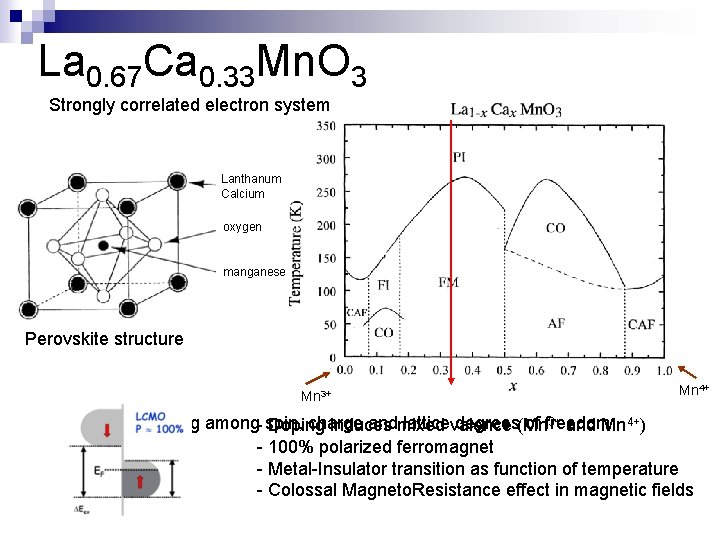
La 0. 67 Ca 0. 33 Mn. O 3 Strongly correlated electron system Lanthanum Calcium oxygen manganese Perovskite structure Mn 3+ Mn 4+ 3+ and Mn 4+) Coupling among- spin, charge andmixed latticevalence degrees(Mn of freedom Doping induces - 100% polarized ferromagnet - Metal-Insulator transition as function of temperature - Colossal Magneto. Resistance effect in magnetic fields
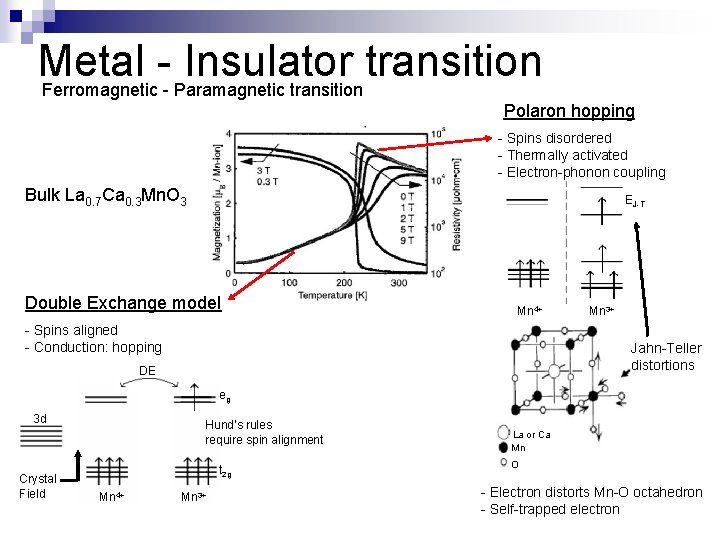
Metal Insulator transition Ferromagnetic - Paramagnetic transition Polaron hopping - Spins disordered - Thermally activated - Electron-phonon coupling Bulk La 0. 7 Ca 0. 3 Mn. O 3 EJ-T Double Exchange model Mn 4+ - Spins aligned - Conduction: hopping Mn 3+ Jahn-Teller distortions DE eg 3 d Crystal Field Hund’s rules require spin alignment t 2 g Mn 4+ Mn 3+ La or Ca Mn O - Electron distorts Mn-O octahedron - Self-trapped electron
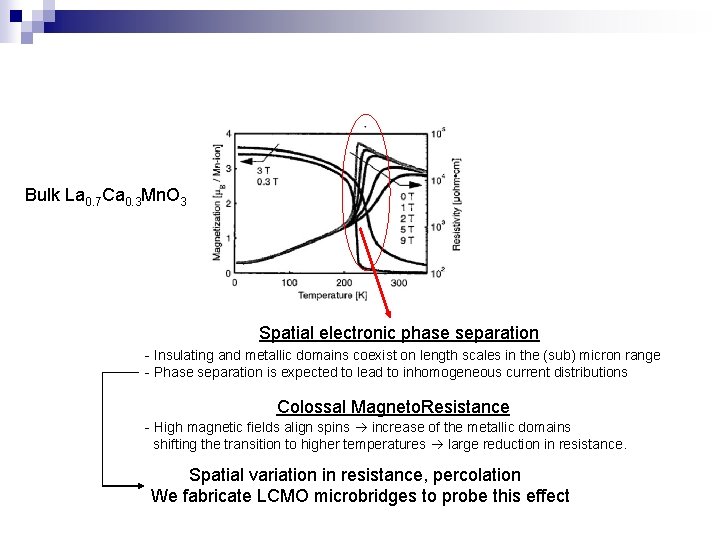
Bulk La 0. 7 Ca 0. 3 Mn. O 3 Spatial electronic phase separation - Insulating and metallic domains coexist on length scales in the (sub) micron range - Phase separation is expected to lead to inhomogeneous current distributions Colossal Magneto. Resistance - High magnetic fields align spins increase of the metallic domains shifting the transition to higher temperatures large reduction in resistance. Spatial variation in resistance, percolation We fabricate LCMO microbridges to probe this effect
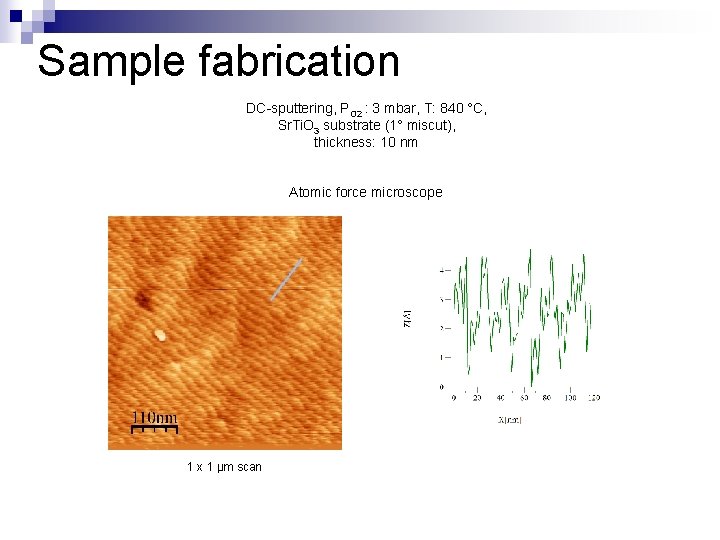
Sample fabrication DC-sputtering, PO 2 : 3 mbar, T: 840 °C, Sr. Ti. O 3 substrate (1° miscut), thickness: 10 nm Atomic force microscope 1 x 1 μm scan
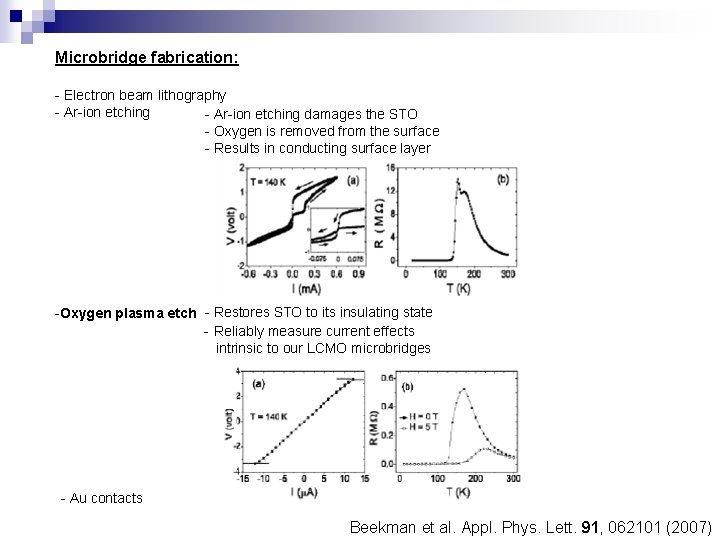
Microbridge fabrication: - Electron beam lithography - Ar-ion etching damages the STO - Oxygen is removed from the surface - Results in conducting surface layer -Oxygen plasma etch - Restores STO to its insulating state - Reliably measure current effects intrinsic to our LCMO microbridges - Au contacts Beekman et al. Appl. Phys. Lett. 91, 062101 (2007)
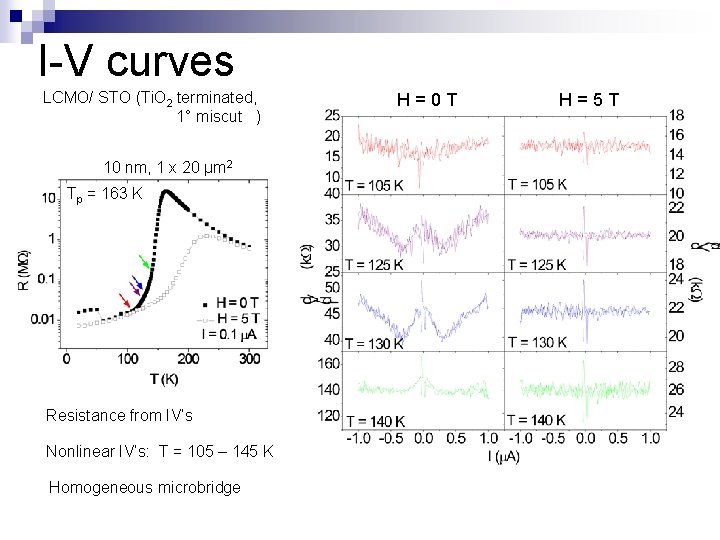
I-V curves LCMO/ STO (Ti. O 2 terminated, 1° miscut ) 10 nm, 1 x 20 μm 2 Tp = 163 K Resistance from IV’s Nonlinear IV’s: T = 105 – 145 K Homogeneous microbridge H=0 T H=5 T
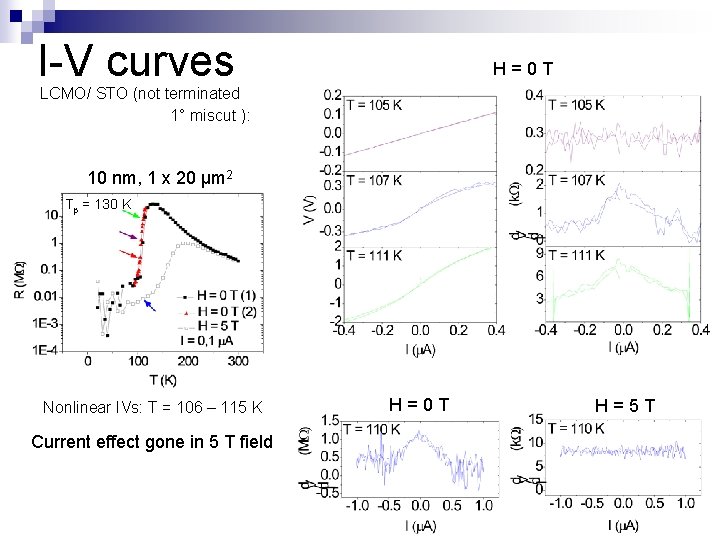
I-V curves H=0 T LCMO/ STO (not terminated 1° miscut ): 10 nm, 1 x 20 μm 2 Tp = 130 K Nonlinear IVs: T = 106 – 115 K Current effect gone in 5 T field H=0 T H=5 T
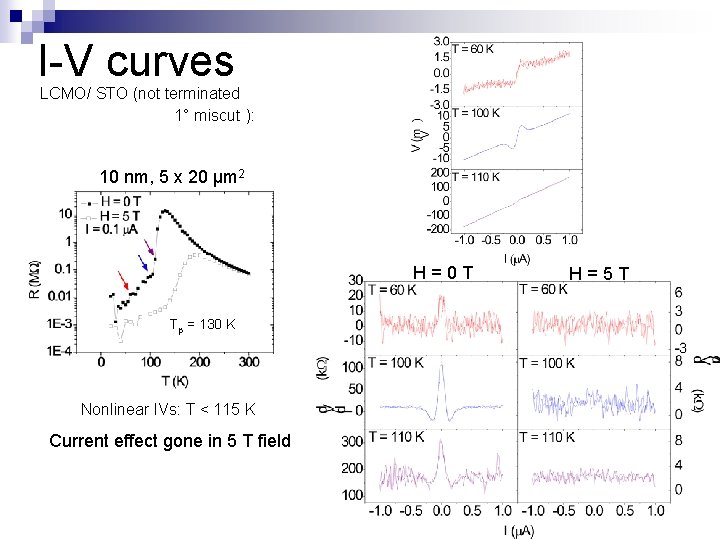
I-V curves LCMO/ STO (not terminated 1° miscut ): 10 nm, 5 x 20 μm 2 H=0 T Tp = 130 K Nonlinear IVs: T < 115 K Current effect gone in 5 T field H=5 T
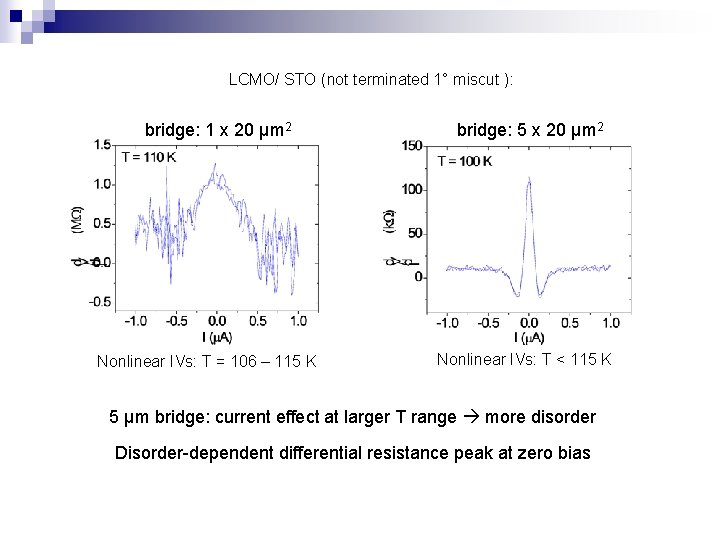
LCMO/ STO (not terminated 1° miscut ): bridge: 1 x 20 μm 2 Nonlinear IVs: T = 106 – 115 K bridge: 5 x 20 μm 2 Nonlinear IVs: T < 115 K 5 μm bridge: current effect at larger T range more disorder Disorder-dependent differential resistance peak at zero bias
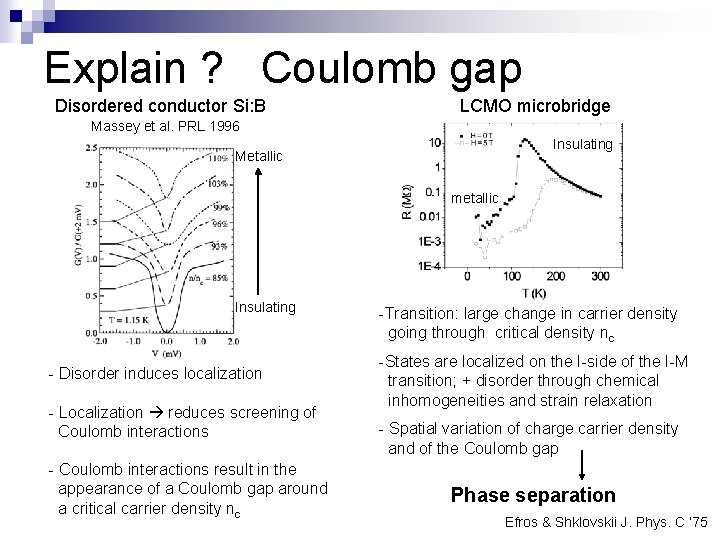
Explain ? Coulomb gap Disordered conductor Si: B LCMO microbridge Massey et al. PRL 1996 Insulating Metallic metallic Insulating - Disorder induces localization - Localization reduces screening of Coulomb interactions - Coulomb interactions result in the appearance of a Coulomb gap around a critical carrier density nc -Transition: large change in carrier density going through critical density nc -States are localized on the I-side of the I-M transition; + disorder through chemical inhomogeneities and strain relaxation - Spatial variation of charge carrier density and of the Coulomb gap Phase separation Efros & Shklovskii J. Phys. C ‘ 75
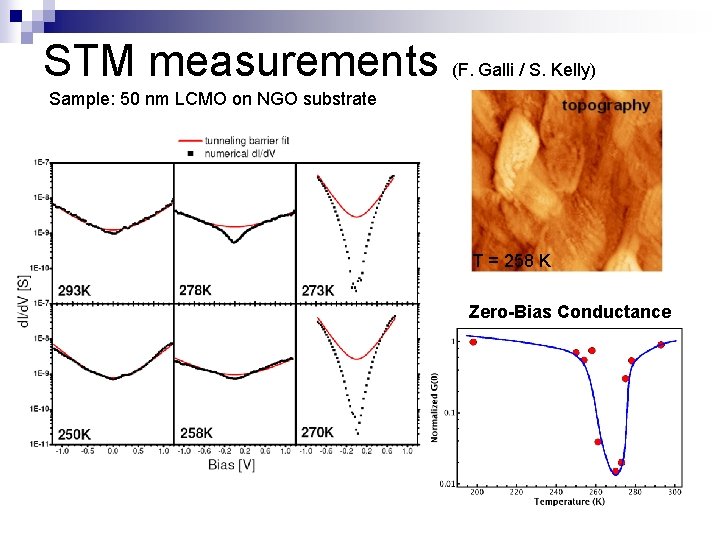
STM measurements (F. Galli / S. Kelly) Sample: 50 nm LCMO on NGO substrate T = 258 K Zero-Bias Conductance
Conclusion We studied transport properties of LCMO microbridges on STO substrates Nonlinear I-V characteristics: differential resistance peak at zero bias Disorder and the large change in carrier density results in Coulomb gap formation in and below the M-I transition Spatial variations in the Coulomb potential leads to phase separation
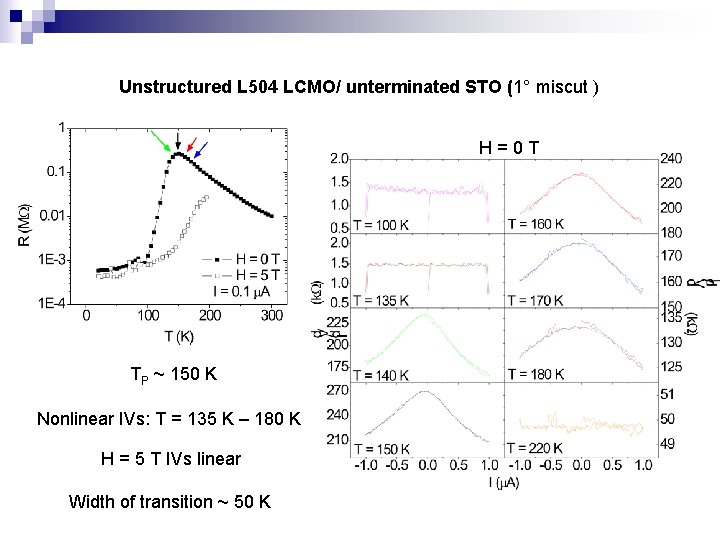
Unstructured L 504 LCMO/ unterminated STO (1° miscut ) H=0 T TP ~ 150 K Nonlinear IVs: T = 135 K – 180 K H = 5 T IVs linear Width of transition ~ 50 K
- Slides: 14