
Dislocations Colloids Dislocations Line defects in 3 D
- Slides: 32
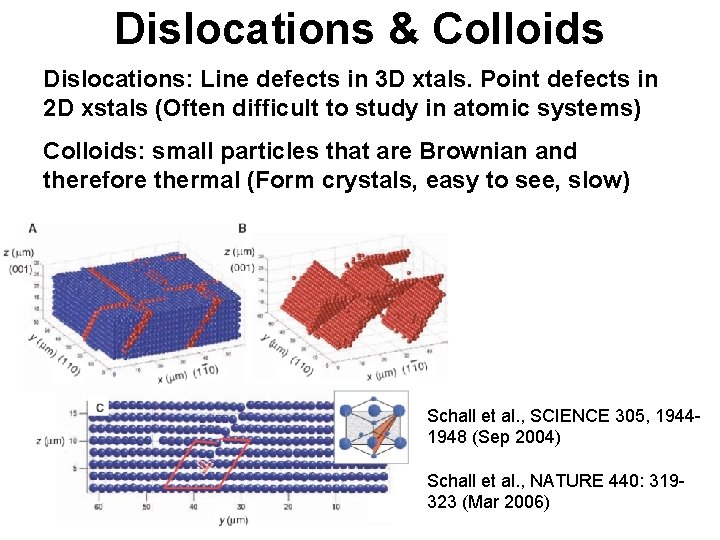
Dislocations & Colloids Dislocations: Line defects in 3 D xtals. Point defects in 2 D xstals (Often difficult to study in atomic systems) Colloids: small particles that are Brownian and therefore thermal (Form crystals, easy to see, slow) Schall et al. , SCIENCE 305, 19441948 (Sep 2004) Schall et al. , NATURE 440: 319323 (Mar 2006)
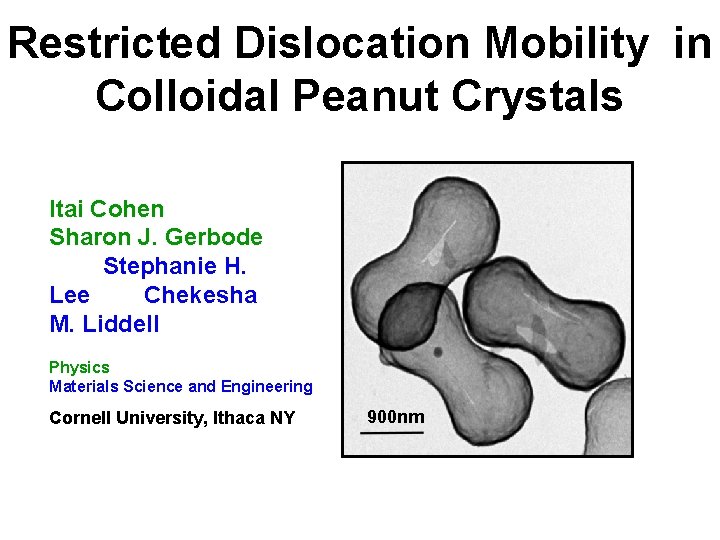
Restricted Dislocation Mobility in Colloidal Peanut Crystals Itai Cohen Sharon J. Gerbode Stephanie H. Lee Chekesha M. Liddell Physics Materials Science and Engineering Cornell University, Ithaca NY 900 nm
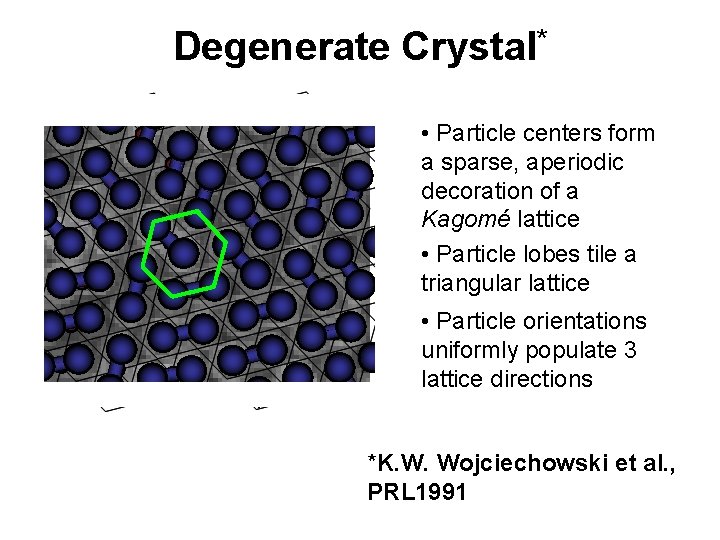
Degenerate Crystal* • Particle centers form a sparse, aperiodic decoration of a Kagomé lattice • Particle lobes tile a triangular lattice • Particle orientations uniformly populate 3 lattice directions *K. W. Wojciechowski et al. , PRL 1991
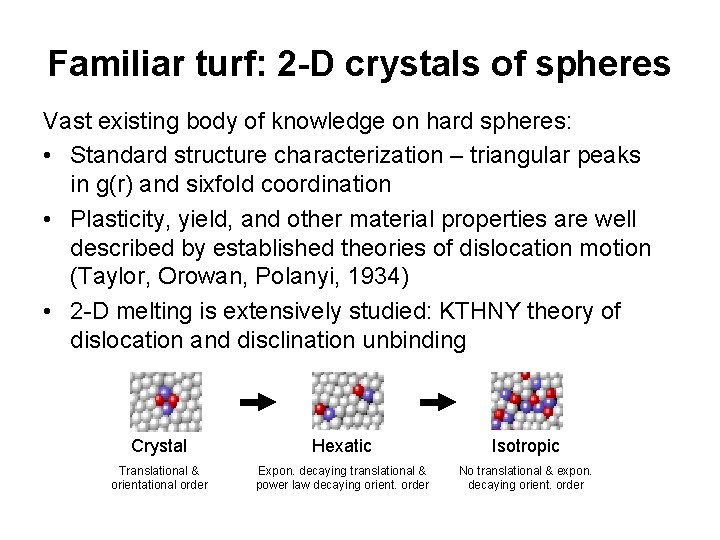
Familiar turf: 2 -D crystals of spheres Vast existing body of knowledge on hard spheres: • Standard structure characterization – triangular peaks in g(r) and sixfold coordination • Plasticity, yield, and other material properties are well described by established theories of dislocation motion (Taylor, Orowan, Polanyi, 1934) • 2 -D melting is extensively studied: KTHNY theory of dislocation and disclination unbinding Crystal Hexatic Isotropic Translational & orientational order Expon. decaying translational & power law decaying orient. order No translational & expon. decaying orient. order
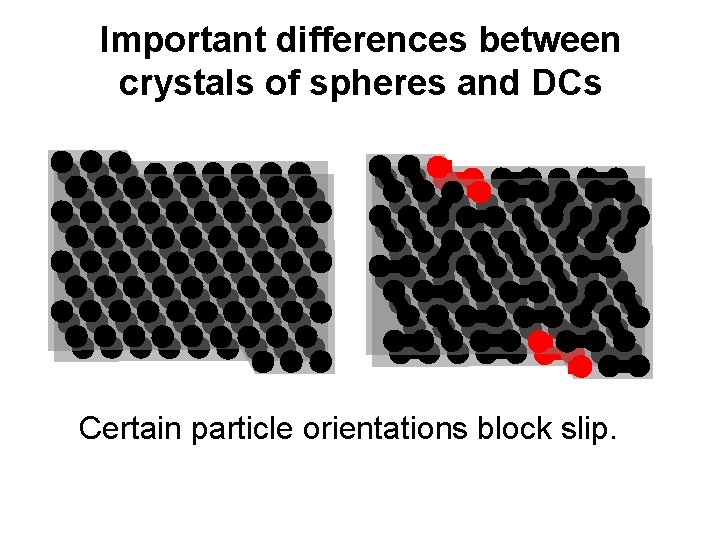
Important differences between crystals of spheres and DCs Certain particle orientations block slip.
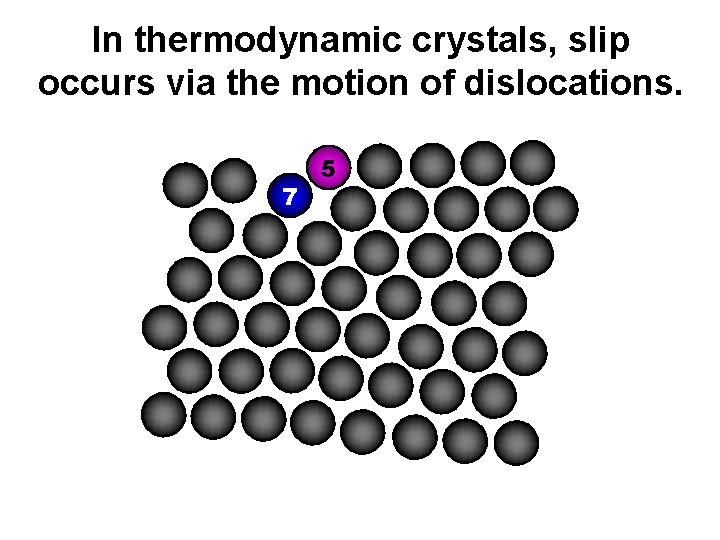
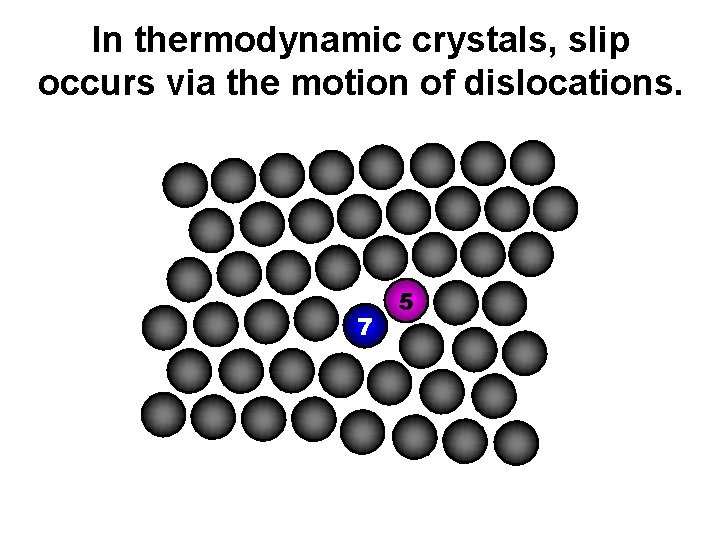
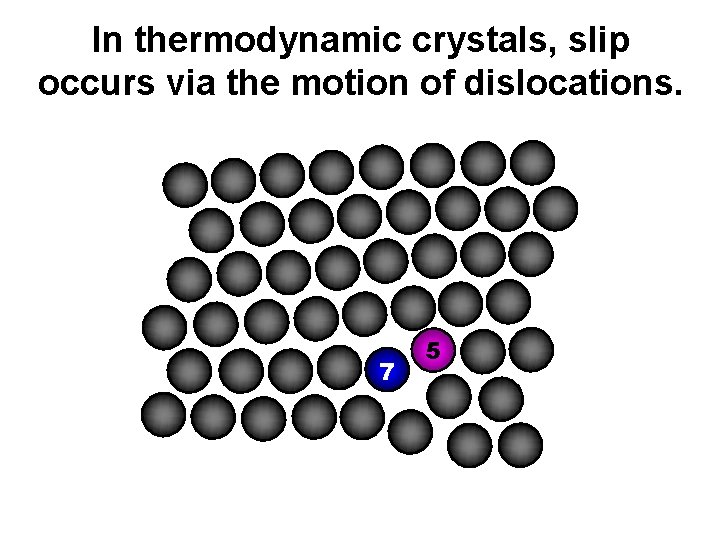
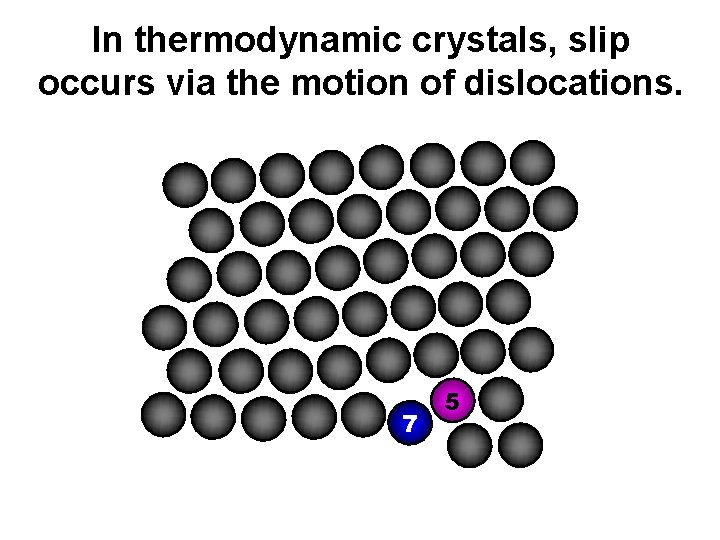
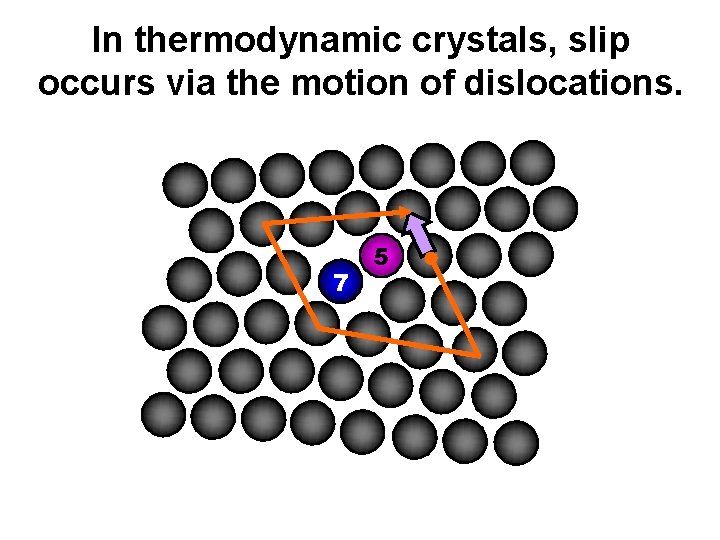
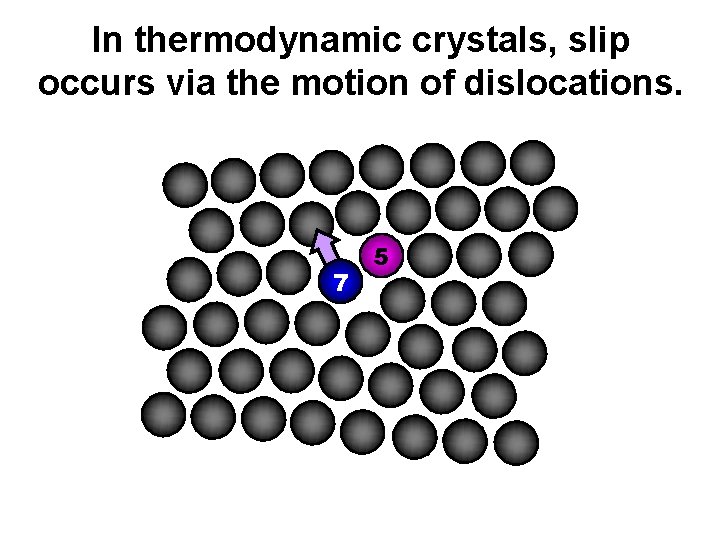
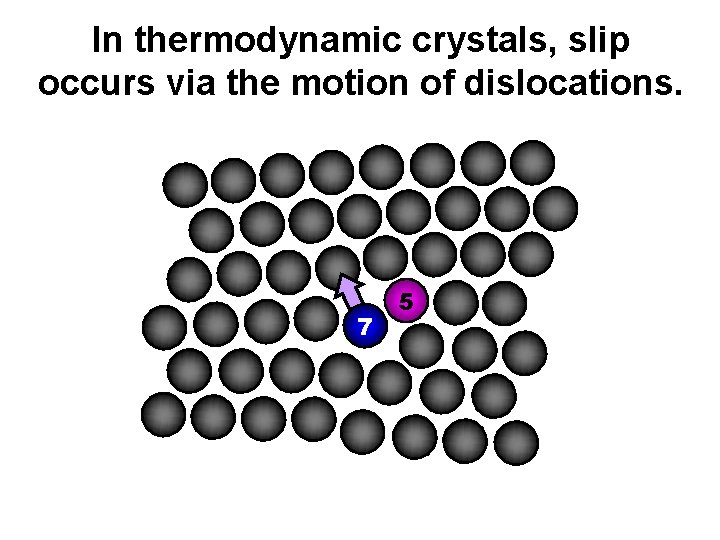
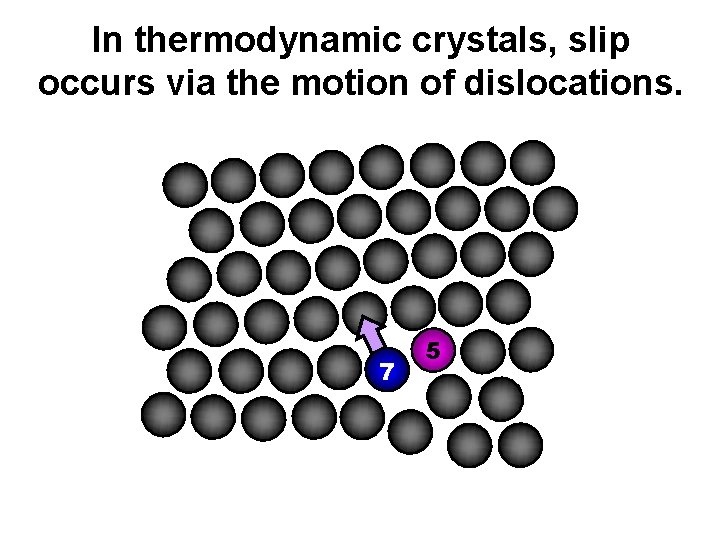
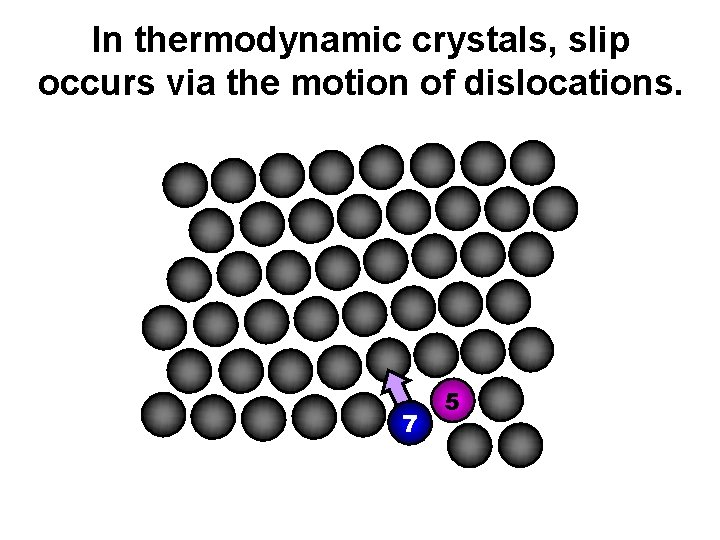
In thermodynamic crystals, slip occurs via the motion of dislocations. 7 5
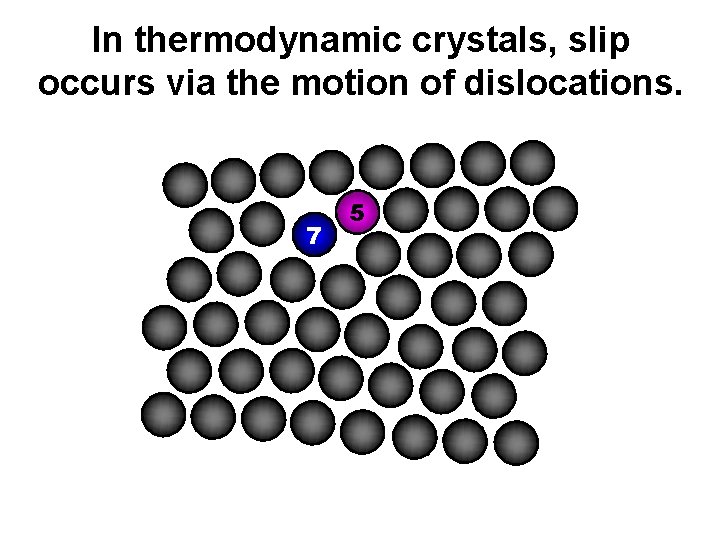
In thermodynamic crystals, slip occurs via the motion of dislocations. 7 5
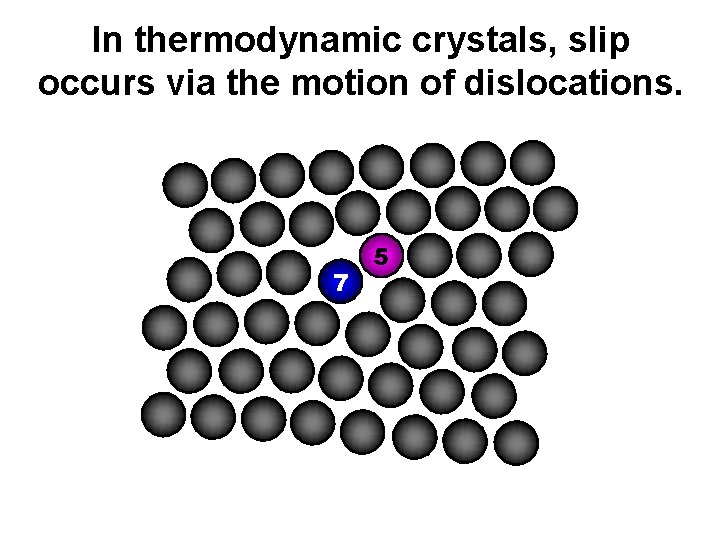
In thermodynamic crystals, slip occurs via the motion of dislocations. 7 5
In thermodynamic crystals, slip occurs via the motion of dislocations. 7 5
In thermodynamic crystals, slip occurs via the motion of dislocations. 7 5
In thermodynamic crystals, slip occurs via the motion of dislocations. 7 5
In thermodynamic crystals, slip occurs via the motion of dislocations. 7 5
In thermodynamic crystals, slip occurs via the motion of dislocations. 7 5
In thermodynamic crystals, slip occurs via the motion of dislocations. 7 5
In thermodynamic crystals, slip occurs via the motion of dislocations. 7 5
In thermodynamic crystals, slip occurs via the motion of dislocations. 7 5
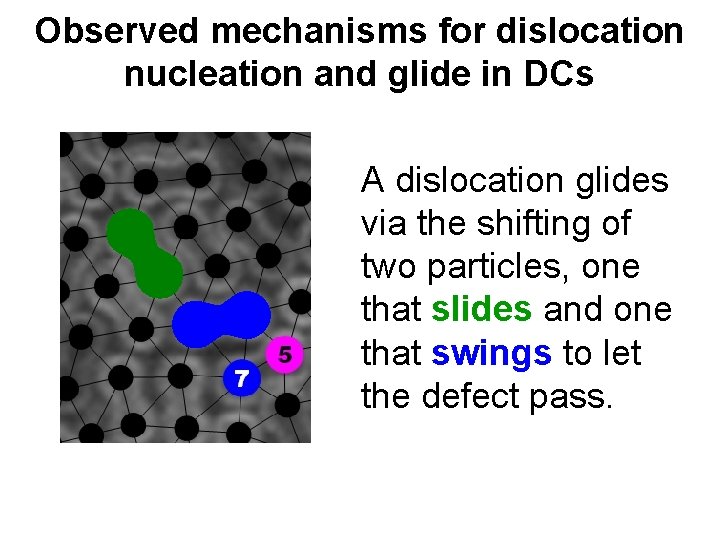
Observed mechanisms for dislocation nucleation and glide in DCs 5 7 A dislocation glides via the shifting of two particles, one that slides and one that swings to let the defect pass.
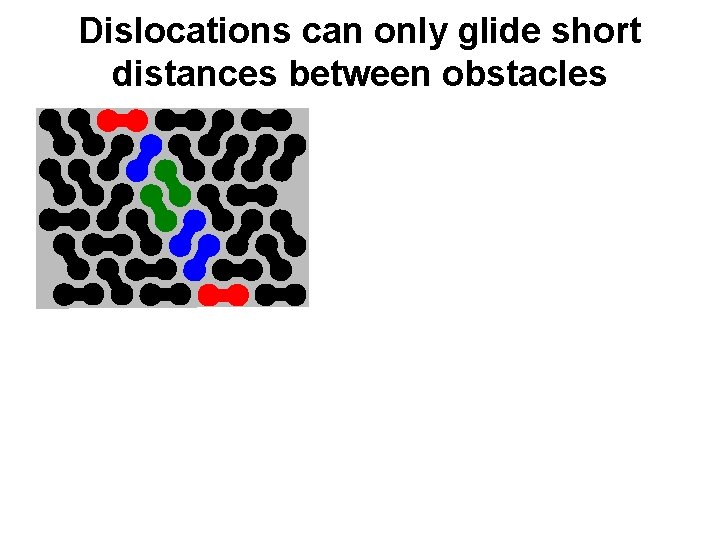
Dislocations can only glide short distances between obstacles
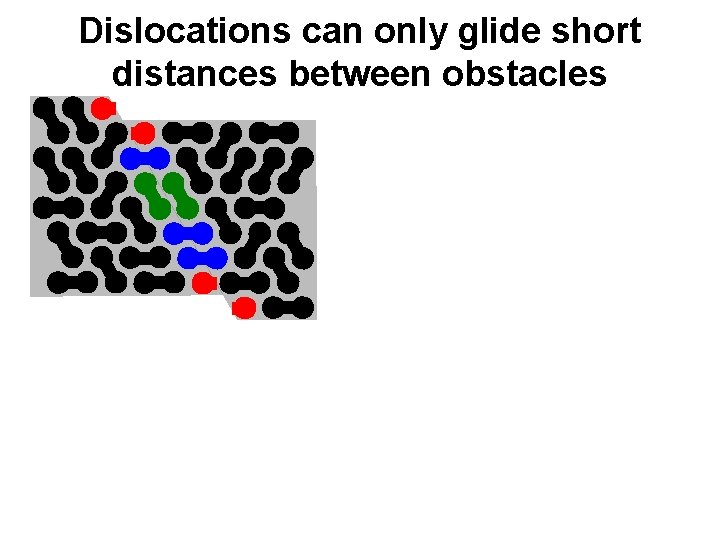
Dislocations can only glide short distances between obstacles
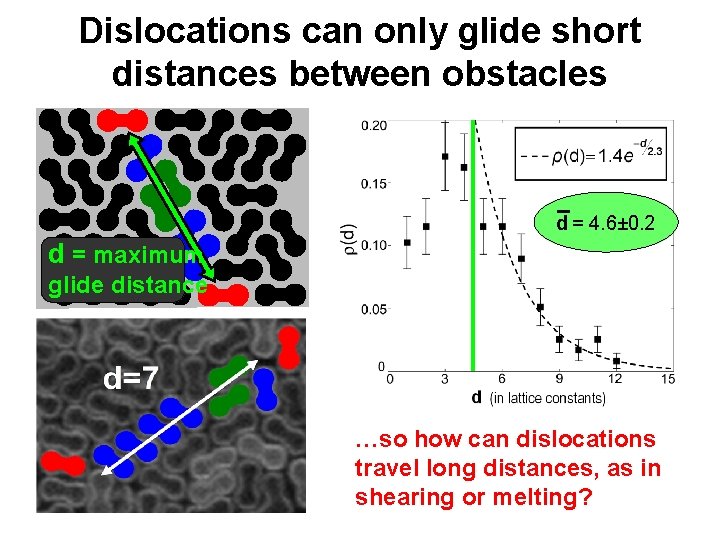
Dislocations can only glide short distances between obstacles d = 4. 6± 0. 2 d = maximum glide distance …so how can dislocations travel long distances, as in shearing or melting?
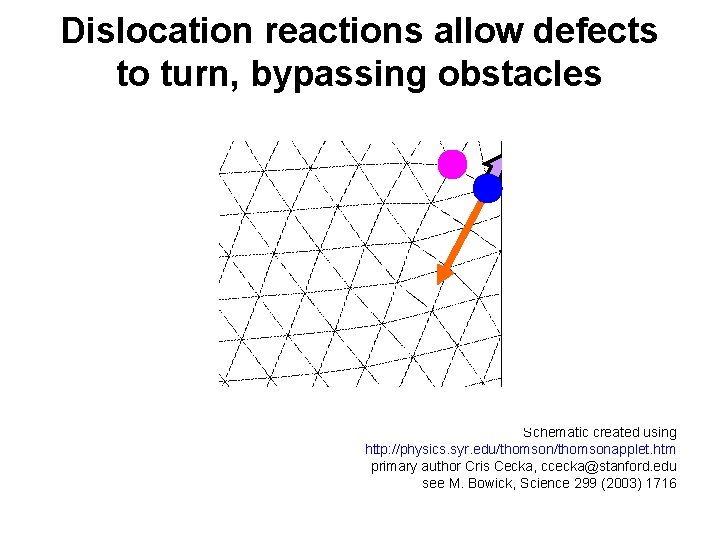
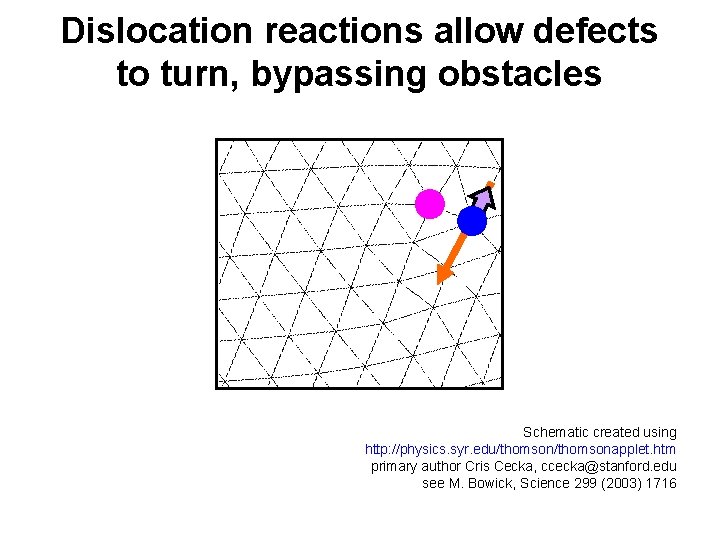
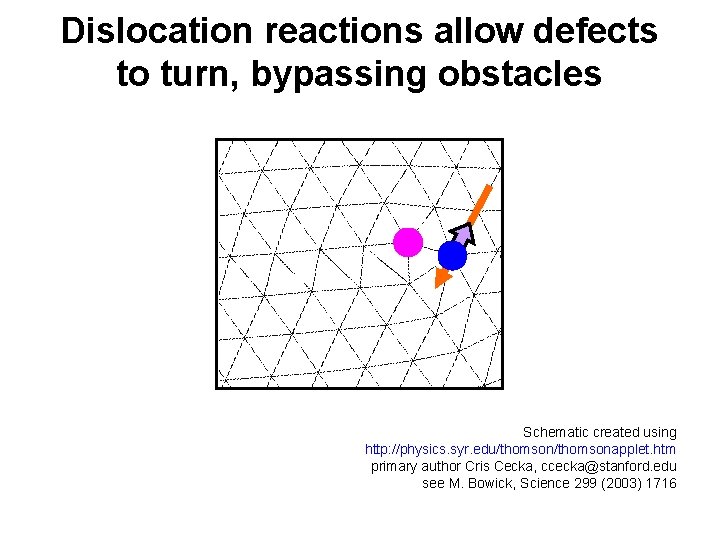
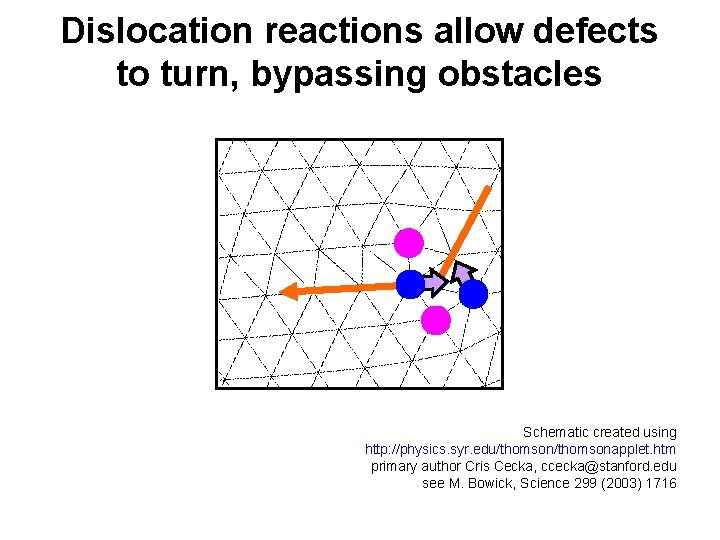
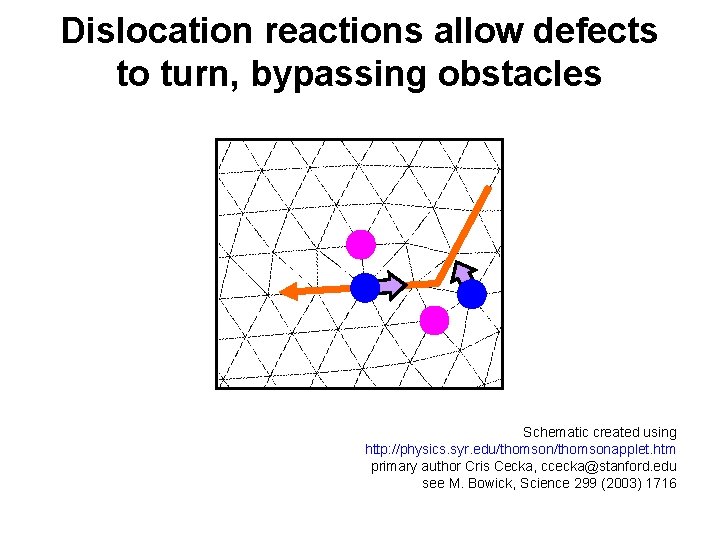
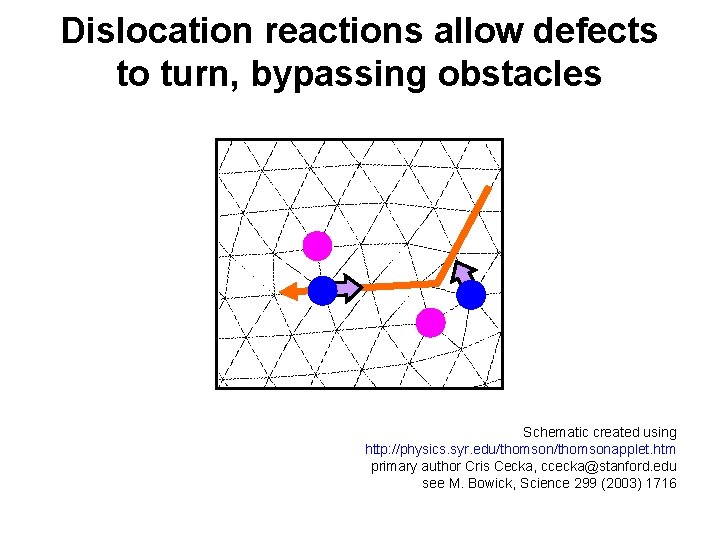
Dislocation reactions allow defects to turn, bypassing obstacles Schematic created using http: //physics. syr. edu/thomsonapplet. htm primary author Cris Cecka, ccecka@stanford. edu see M. Bowick, Science 299 (2003) 1716
Dislocation reactions allow defects to turn, bypassing obstacles Schematic created using http: //physics. syr. edu/thomsonapplet. htm primary author Cris Cecka, ccecka@stanford. edu see M. Bowick, Science 299 (2003) 1716
Dislocation reactions allow defects to turn, bypassing obstacles Schematic created using http: //physics. syr. edu/thomsonapplet. htm primary author Cris Cecka, ccecka@stanford. edu see M. Bowick, Science 299 (2003) 1716
Dislocation reactions allow defects to turn, bypassing obstacles Schematic created using http: //physics. syr. edu/thomsonapplet. htm primary author Cris Cecka, ccecka@stanford. edu see M. Bowick, Science 299 (2003) 1716
Dislocation reactions allow defects to turn, bypassing obstacles Schematic created using http: //physics. syr. edu/thomsonapplet. htm primary author Cris Cecka, ccecka@stanford. edu see M. Bowick, Science 299 (2003) 1716
Dislocation reactions allow defects to turn, bypassing obstacles Schematic created using http: //physics. syr. edu/thomsonapplet. htm primary author Cris Cecka, ccecka@stanford. edu see M. Bowick, Science 299 (2003) 1716
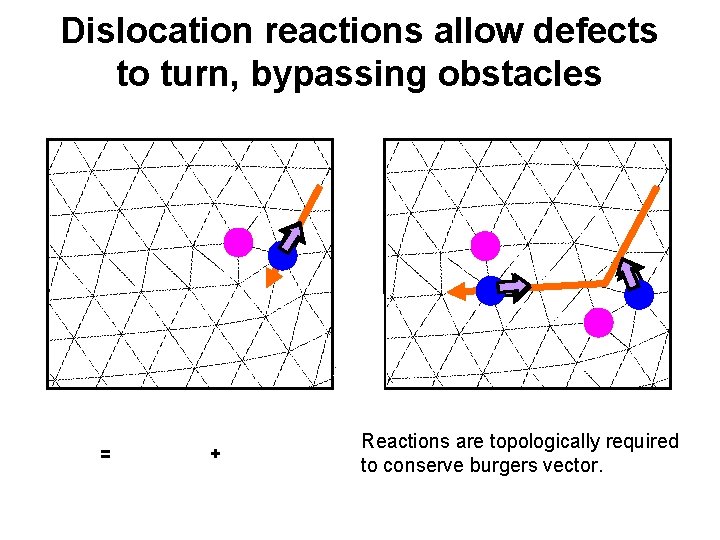
Dislocation reactions allow defects to turn, bypassing obstacles = + Reactions are topologically required to conserve burgers vector.
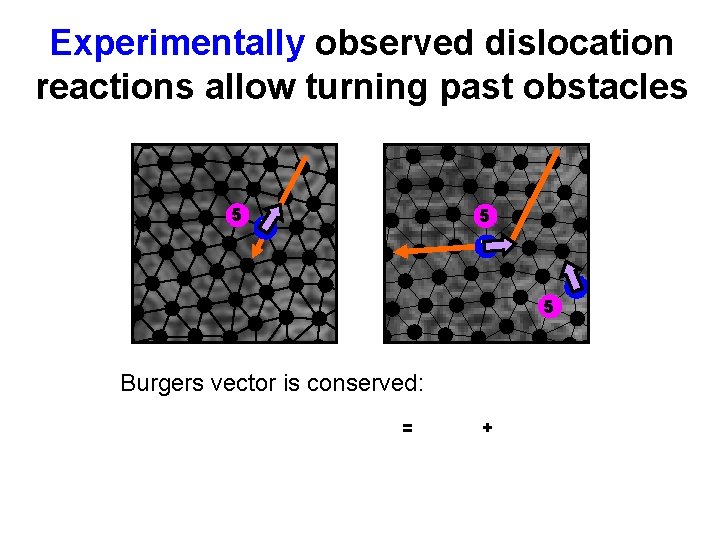
Experimentally observed dislocation reactions allow turning past obstacles 5 5 z 7 7 5 Burgers vector is conserved: = + 7
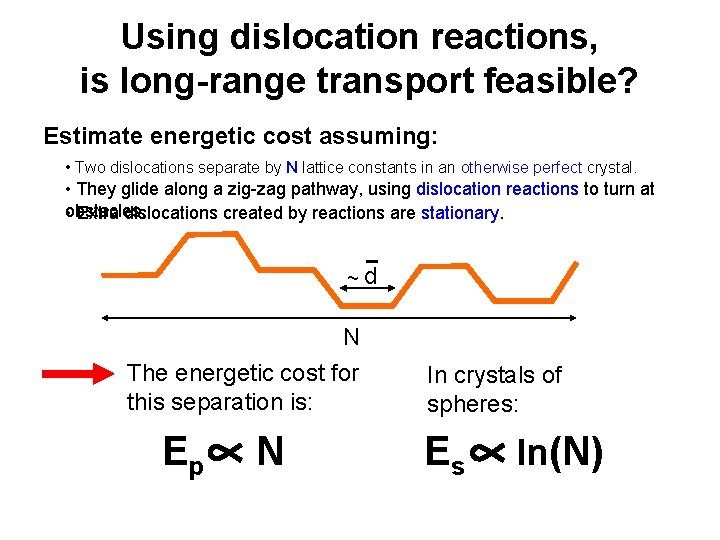
Using dislocation reactions, is long-range transport feasible? Estimate energetic cost assuming: • Two dislocations separate by N lattice constants in an otherwise perfect crystal. • They glide along a zig-zag pathway, using dislocation reactions to turn at obstacles. • Extra dislocations created by reactions are stationary. ~d N The energetic cost for this separation is: Ep N In crystals of spheres: Es ln(N)
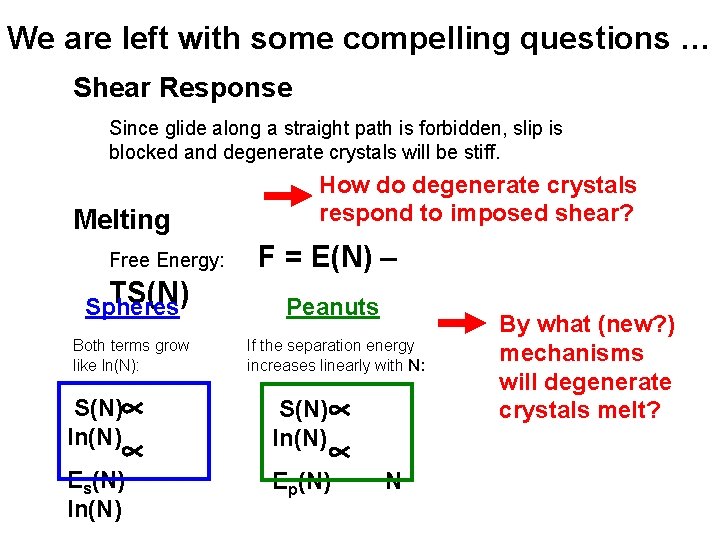
We are left with some compelling questions … Shear Response Since glide along a straight path is forbidden, slip is blocked and degenerate crystals will be stiff. Melting Free Energy: TS(N) How do degenerate crystals respond to imposed shear? F = E(N) – Spheres Peanuts Both terms grow like ln(N): If the separation energy increases linearly with N: S(N) ln(N) Es(N) ln(N) Ep(N) N By what (new? ) mechanisms will degenerate crystals melt?
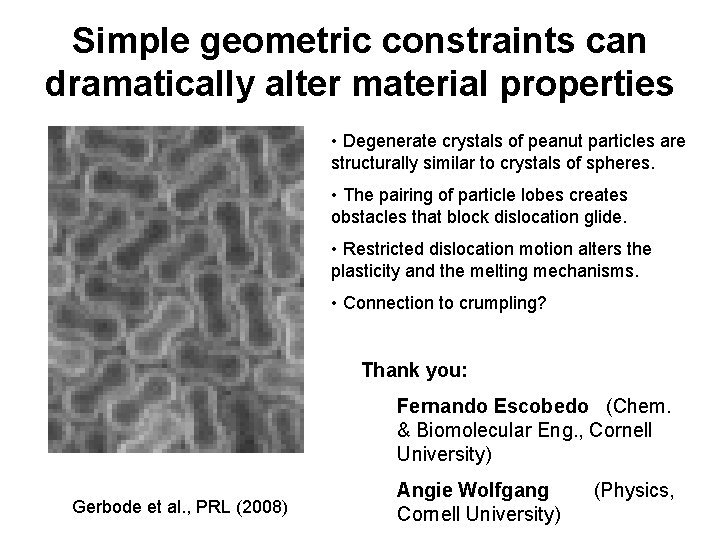
Simple geometric constraints can dramatically alter material properties • Degenerate crystals of peanut particles are structurally similar to crystals of spheres. • The pairing of particle lobes creates obstacles that block dislocation glide. • Restricted dislocation motion alters the plasticity and the melting mechanisms. • Connection to crumpling? Thank you: Fernando Escobedo (Chem. & Biomolecular Eng. , Cornell University) Gerbode et al. , PRL (2008) Angie Wolfgang Cornell University) (Physics,
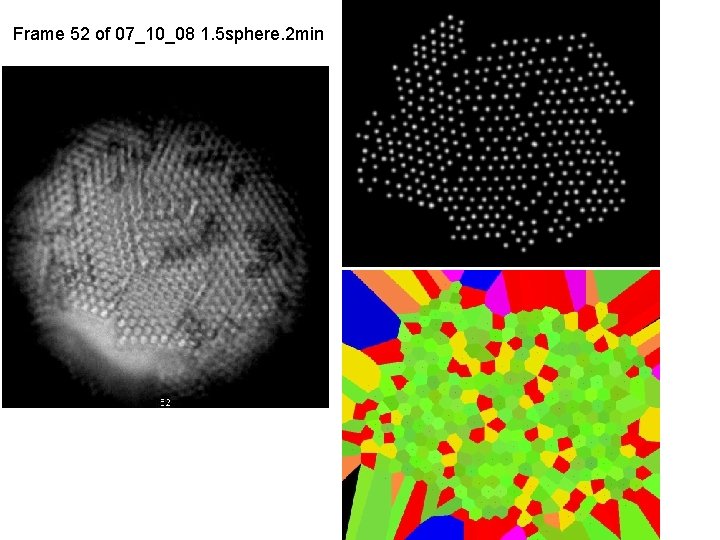
Frame 52 of 07_10_08 1. 5 sphere. 2 min