
Disk Drive Performance factors that affect the performance
- Slides: 14
Disk Drive Performance
factors that affect the performance of disk • Disk Service Time : Time taken to complete an I/O request • Depends upon • seek time, • rotational latency, • data transfer rate.
Seek time or Access time • Time taken to position the R/W heads across the platter with a radial movement(the time taken to reposition and settle the arm and the head over the correct track)- 3 to 15 milliseconds • lower the seek time, the faster the I/O operation. Full Stroke Average Track-to-Track • Seek time has more impact on the read operation of random tracks rather than adjacent tracks • short-stroking
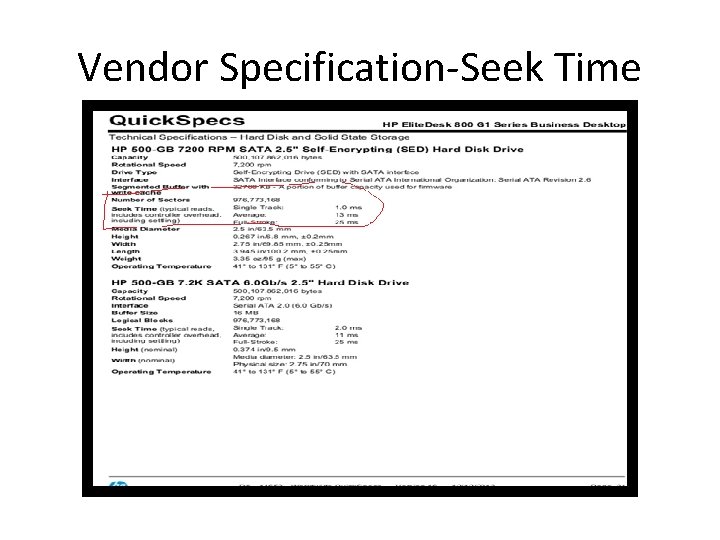
Vendor Specification-Seek Time
Rotational Latency • time taken by the platter to rotate and position the data under R/W head is called rotational latency. • latency depends on the rotation speed of ? • Average rotational latency 5. 5 ms for a 5, 400 -rpm drive 2. 0 ms for a 15, 000 -rpm drive
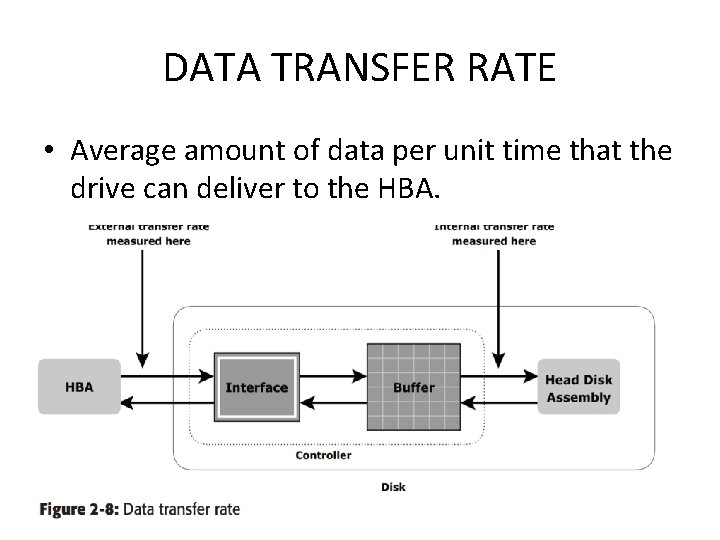
DATA TRANSFER RATE • Average amount of data per unit time that the drive can deliver to the HBA.
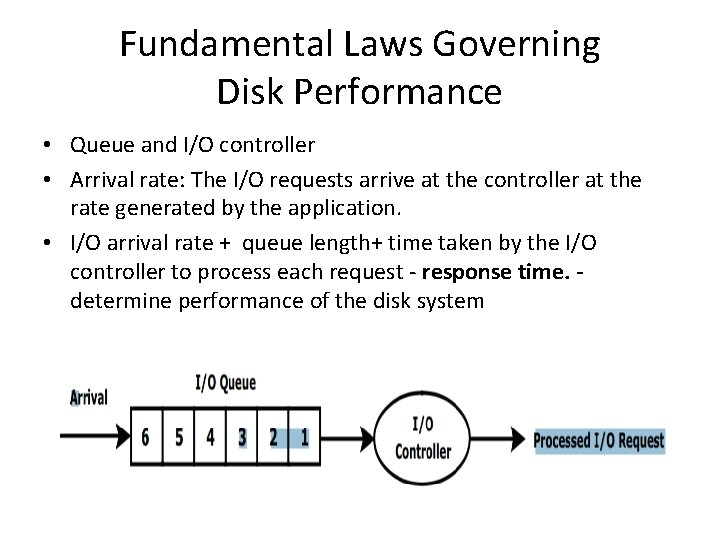
Fundamental Laws Governing Disk Performance • Queue and I/O controller • Arrival rate: The I/O requests arrive at the controller at the rate generated by the application. • I/O arrival rate + queue length+ time taken by the I/O controller to process each request - response time. determine performance of the disk system
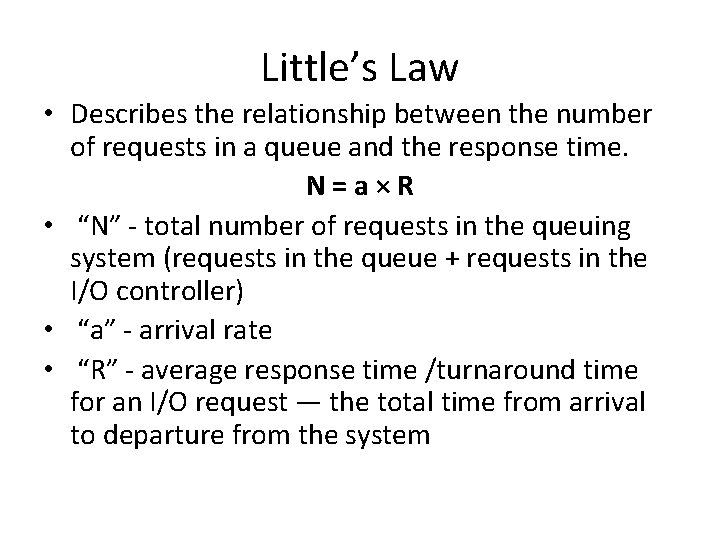
Little’s Law • Describes the relationship between the number of requests in a queue and the response time. N=a×R • “N” - total number of requests in the queuing system (requests in the queue + requests in the I/O controller) • “a” - arrival rate • “R” - average response time /turnaround time for an I/O request — the total time from arrival to departure from the system
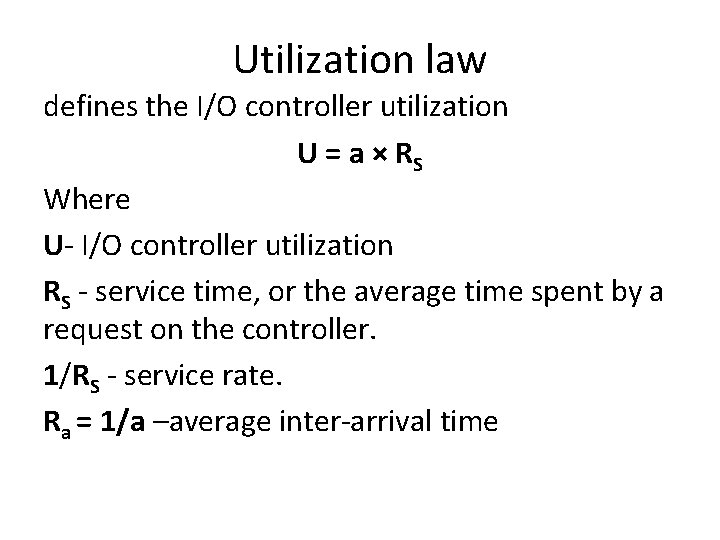
Utilization law defines the I/O controller utilization U = a × RS Where U- I/O controller utilization RS - service time, or the average time spent by a request on the controller. 1/RS - service rate. Ra = 1/a –average inter-arrival time
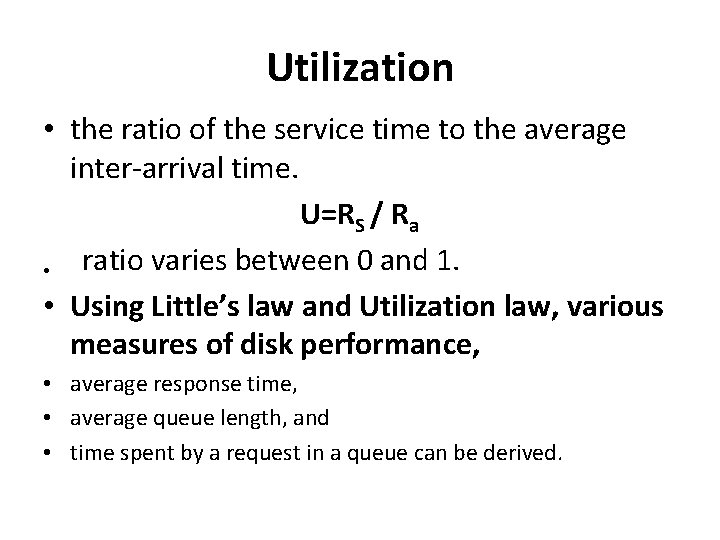
Utilization • the ratio of the service time to the average inter-arrival time. U=RS / Ra • ratio varies between 0 and 1. • Using Little’s law and Utilization law, various measures of disk performance, • average response time, • average queue length, and • time spent by a request in a queue can be derived.
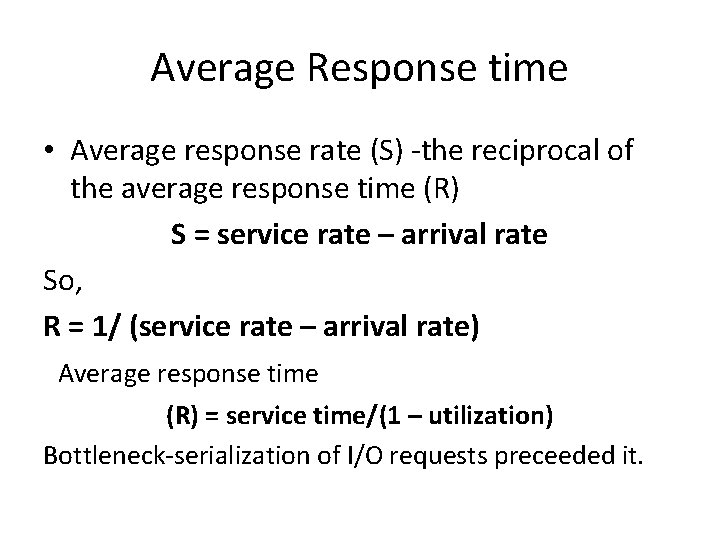
Average Response time • Average response rate (S) -the reciprocal of the average response time (R) S = service rate – arrival rate So, R = 1/ (service rate – arrival rate) Average response time (R) = service time/(1 – utilization) Bottleneck-serialization of I/O requests preceeded it.
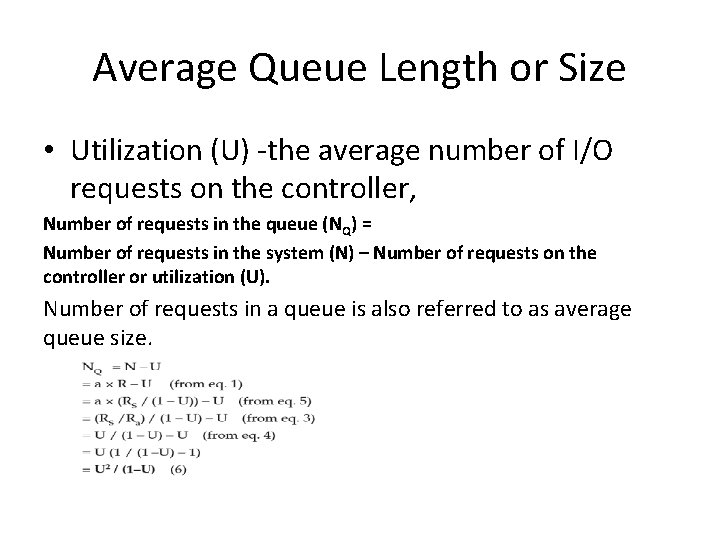
Average Queue Length or Size • Utilization (U) -the average number of I/O requests on the controller, Number of requests in the queue (NQ) = Number of requests in the system (N) – Number of requests on the controller or utilization (U). Number of requests in a queue is also referred to as average queue size.
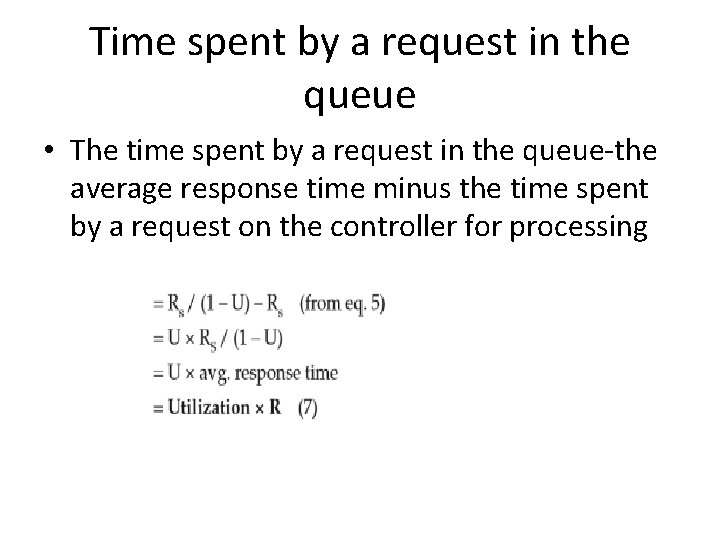
Time spent by a request in the queue • The time spent by a request in the queue-the average response time minus the time spent by a request on the controller for processing
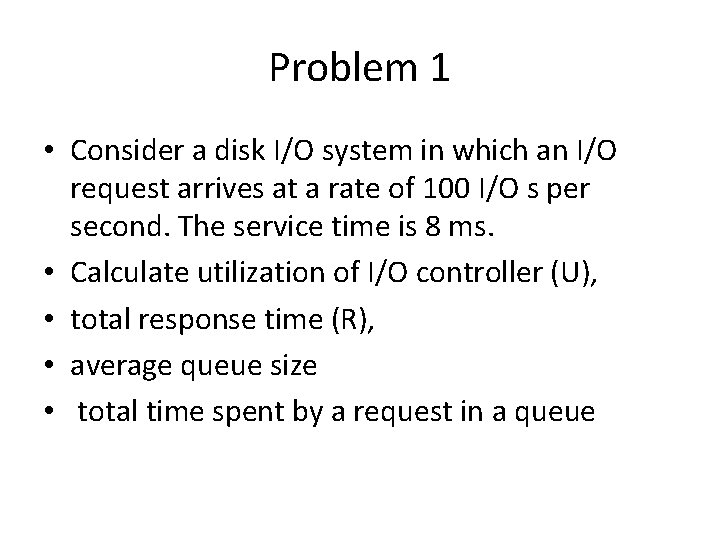
Problem 1 • Consider a disk I/O system in which an I/O request arrives at a rate of 100 I/O s per second. The service time is 8 ms. • Calculate utilization of I/O controller (U), • total response time (R), • average queue size • total time spent by a request in a queue