
Disk Basics CS 537 Introduction to Operating Systems
Disk Basics CS 537 - Introduction to Operating Systems

Hard Drive Technology track platter read arm cylinder read head sectors track

Hard Drive Technology • Modern Statistics – – – – – capacity: 20. 5 GB sector size: 512 bytes speed: 7200 RPM platters: 3 heads: 6 cylinders: 17, 688 media transfer rate: 35 MB/sec interface transfer rate: 14. 1 - 23. 4 MB/sec cost: $127. 00
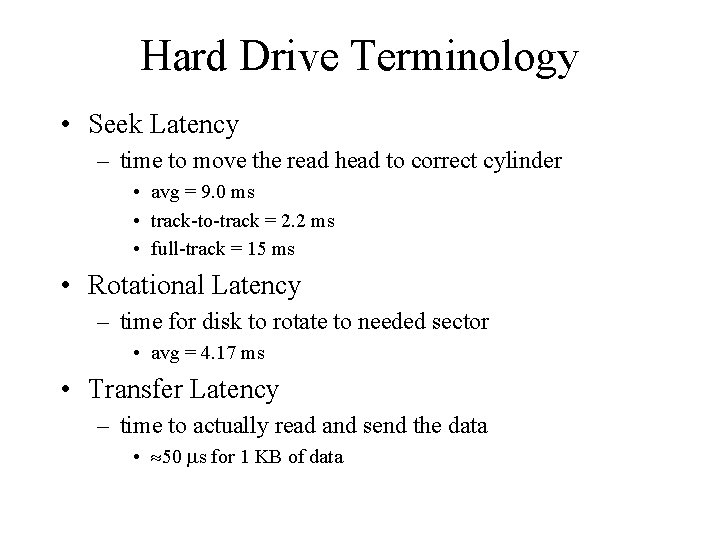
Hard Drive Terminology • Seek Latency – time to move the read head to correct cylinder • avg = 9. 0 ms • track-to-track = 2. 2 ms • full-track = 15 ms • Rotational Latency – time for disk to rotate to needed sector • avg = 4. 17 ms • Transfer Latency – time to actually read and send the data • 50 s for 1 KB of data
Disk Access • Cannot access any random byte on a disk – this would be called random access (RAM) • However, don’t have to access them sequentially – have to go through all data to get to desired data (tape drive) • Disks must be accessed per sector – each sector is 512 bytes – this is called direct access
Reading from Disk • To read a single byte from disk – provide address of sector • cylinder, head, sector number – seek to location of data on disk – read entire sector into memory (512 bytes) – index into memory to grab the necessary byte
Writing to Disk • To write a single byte out to disk – read entire sector into memory – modify the necessary byte in memory – seek back to disk location – write the entire sector back to disk • Notice 2 times avg. latency required to write a single block
Disk Performance • Disk is a mechanical device – extremely SLOW!! • Can use DMA and context switching to hide latency – this will only help so much • Want to interact with physical disk as little as possible • Reading and writing a single byte is a bad idea
Prefetching Blocks • If the user wants data in sector 23, odds are they will eventually want data in sector 24 – this assumes intelligent placement of data on disk to start with - more on this later • Amortize the latencies by reading in sector 23 and sector 24 – when user does actually want sector 24, already in memory • Most disks are read in a page at a time – 4 KB of data (8 sectors)
Disk Buffering • If byte 55 of sector 26 is modified, high probability byte 56 of sector 27 will also be modified • Usually wait awhile to write back a sector that is currently in memory – hopefully wait until all data that will be modified is modified – again, allows amortization of latencies over a large number of writes
- Slides: 10