
Disengaged Families Why They Are and How to

![What We Know Most challenges [with disengagement] originate from the beliefs and perceptions of](https://slidetodoc.com/presentation_image_h2/1606faa2c43c89ed5eb8826eecdd1933/image-5.jpg "What We Know Most challenges [with disengagement] originate from the beliefs and perceptions of")

- Slides: 32
Disengaged Families: Why They Are and How to Change the Course Dr. Steve Constantino @drsconstantino drsteveconstantino. com
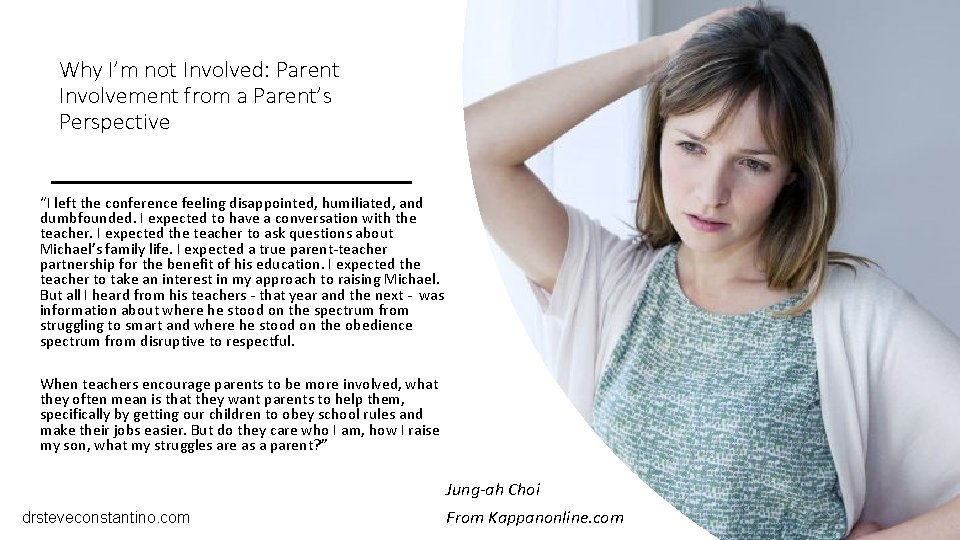
Why I’m not Involved: Parent Involvement from a Parent’s Perspective “I left the conference feeling disappointed, humiliated, and dumbfounded. I expected to have a conversation with the teacher. I expected the teacher to ask questions about Michael’s family life. I expected a true parent-teacher partnership for the benefit of his education. I expected the teacher to take an interest in my approach to raising Michael. But all I heard from his teachers - that year and the next - was information about where he stood on the spectrum from struggling to smart and where he stood on the obedience spectrum from disruptive to respectful. When teachers encourage parents to be more involved, what they often mean is that they want parents to help them, specifically by getting our children to obey school rules and make their jobs easier. But do they care who I am, how I raise my son, what my struggles are as a parent? ” Jung-ah Choi drsteveconstantino. com From Kappanonline. com
For Reflection A student is struggling in school. The teacher makes repeated attempts to contact the child’s family in order to inform them of the issues. Regardless of what effort the teacher makes, there is no response. In a last-ditch effort, a letter is sent home requesting a conference. The letter goes unanswered. What your first thoughts are about this scenario and what you believe to be true regarding the issue is part of the equation of disengagement. drsteveconstantino. com
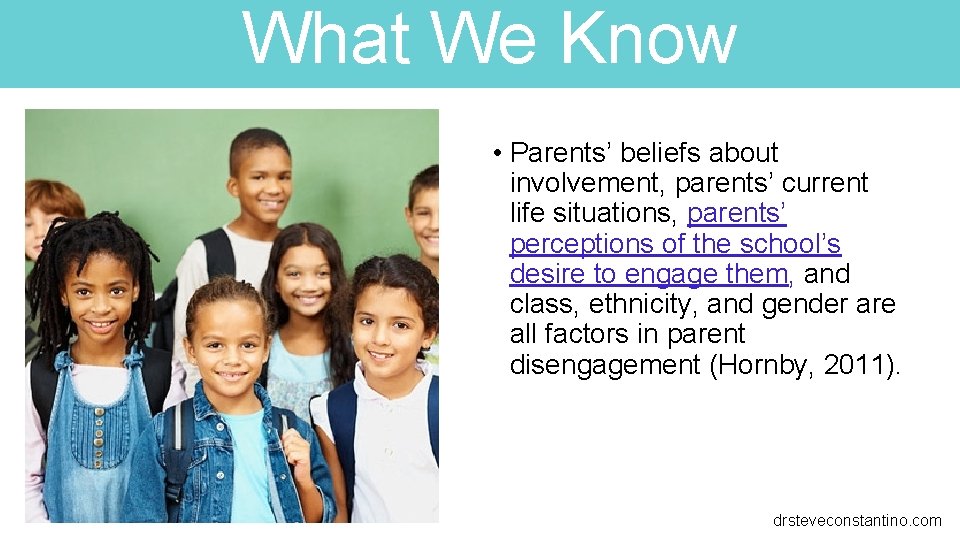
What We Know • Parents’ beliefs about involvement, parents’ current life situations, parents’ perceptions of the school’s desire to engage them, and class, ethnicity, and gender are all factors in parent disengagement (Hornby, 2011). drsteveconstantino. com
What We Know Most challenges [with disengagement] originate from the beliefs and perceptions of both families and school personnel (Liontos, 1992). drsteveconstantino. com
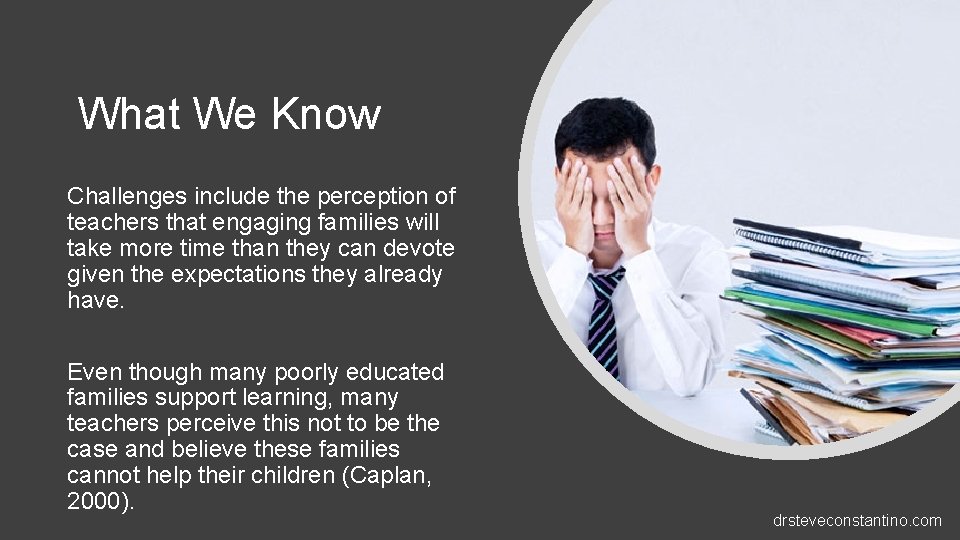
What We Know Challenges include the perception of teachers that engaging families will take more time than they can devote given the expectations they already have. Even though many poorly educated families support learning, many teachers perceive this not to be the case and believe these families cannot help their children (Caplan, 2000). drsteveconstantino. com
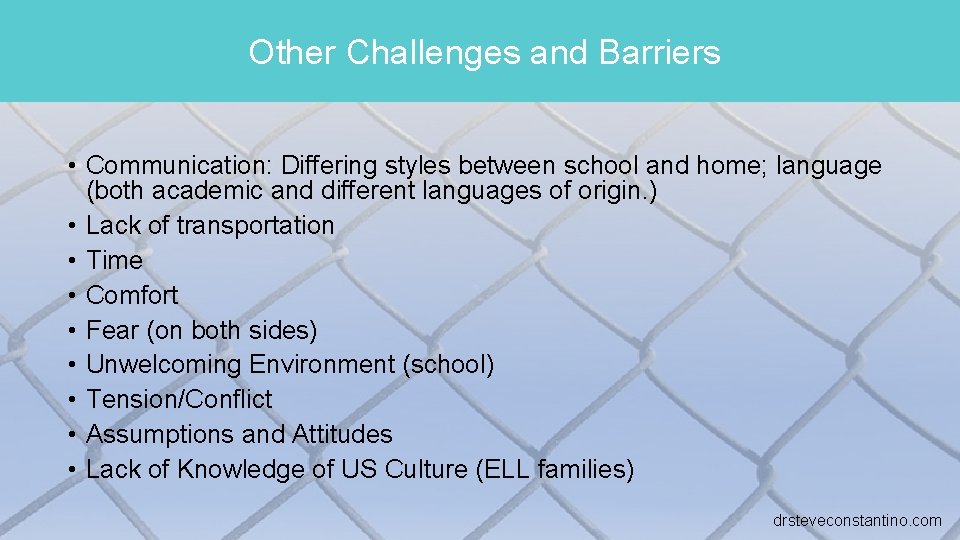
Other Challenges and Barriers • Communication: Differing styles between school and home; language (both academic and different languages of origin. ) • Lack of transportation • Time • Comfort • Fear (on both sides) • Unwelcoming Environment (school) • Tension/Conflict • Assumptions and Attitudes • Lack of Knowledge of US Culture (ELL families) drsteveconstantino. com
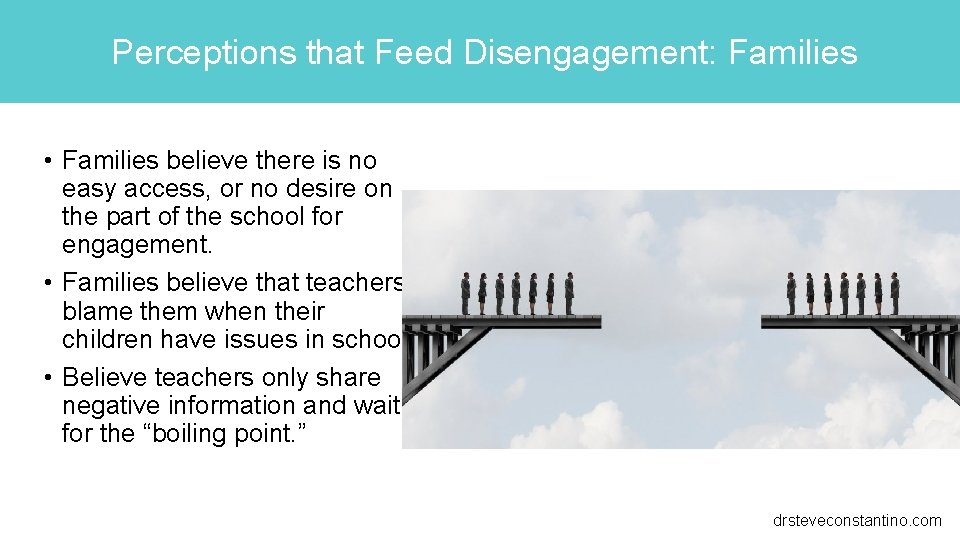
Perceptions that Feed Disengagement: Families • Families believe there is no easy access, or no desire on the part of the school for engagement. • Families believe that teachers blame them when their children have issues in school. • Believe teachers only share negative information and wait for the “boiling point. ” drsteveconstantino. com
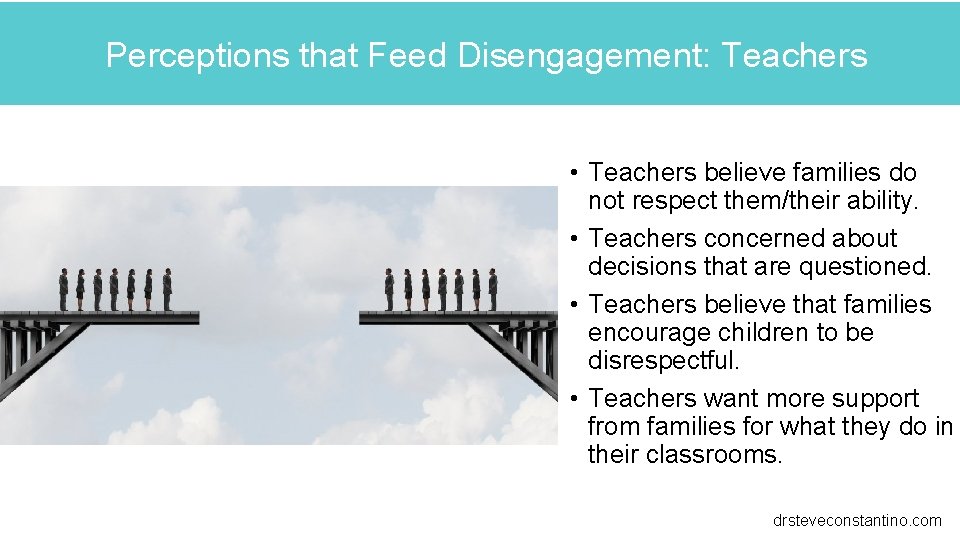
Perceptions that Feed Disengagement: Teachers • Teachers believe families do not respect them/their ability. • Teachers concerned about decisions that are questioned. • Teachers believe that families encourage children to be disrespectful. • Teachers want more support from families for what they do in their classrooms. drsteveconstantino. com
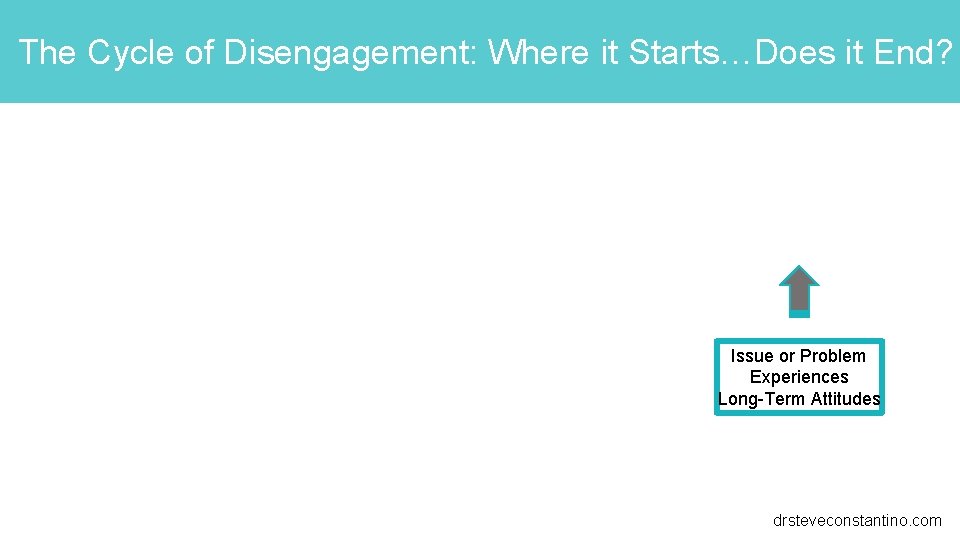
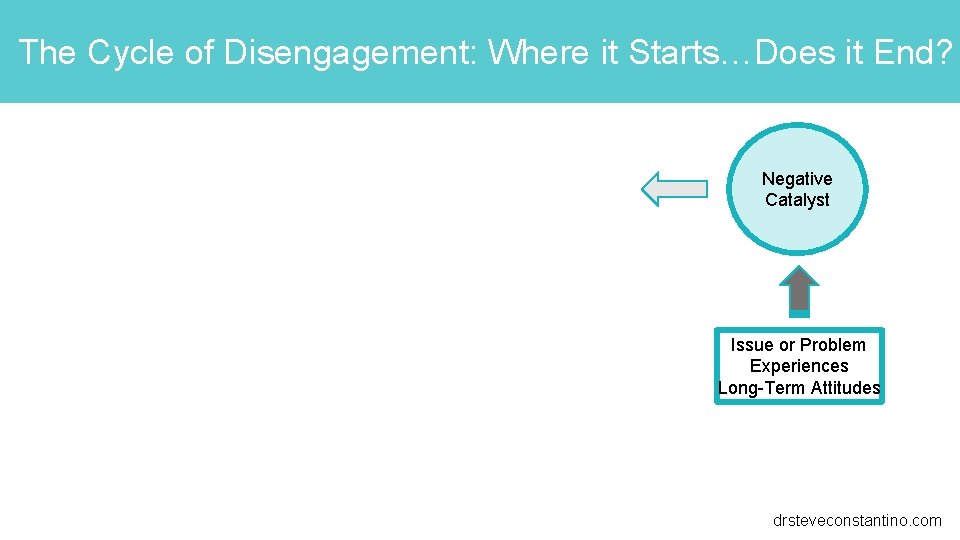
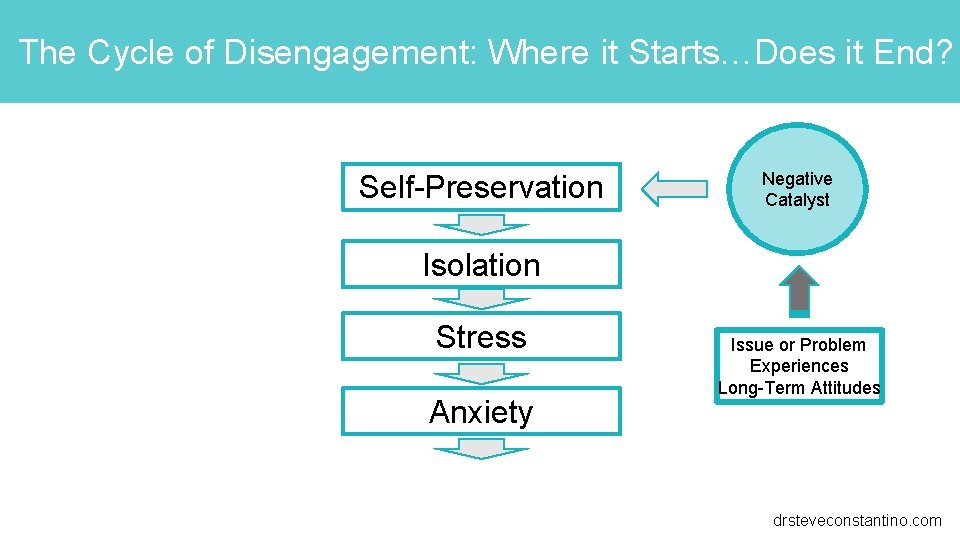
The Cycle of Disengagement: Where it Starts…Does it End? Issue or Problem Experiences Long-Term Attitudes drsteveconstantino. com
The Cycle of Disengagement: Where it Starts…Does it End? Negative Catalyst Issue or Problem Experiences Long-Term Attitudes drsteveconstantino. com
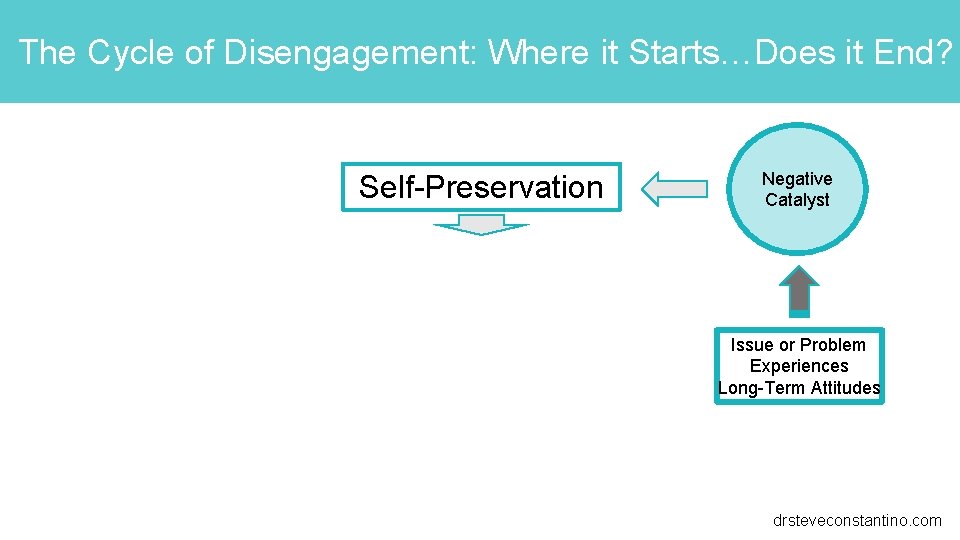
The Cycle of Disengagement: Where it Starts…Does it End? Self-Preservation Negative Catalyst Issue or Problem Experiences Long-Term Attitudes drsteveconstantino. com
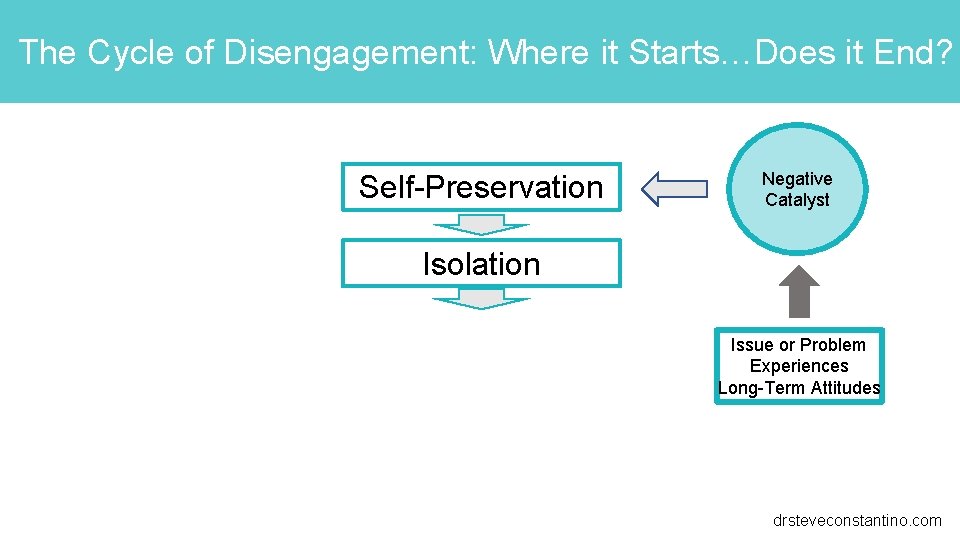
The Cycle of Disengagement: Where it Starts…Does it End? Self-Preservation Negative Catalyst Isolation Issue or Problem Experiences Long-Term Attitudes drsteveconstantino. com
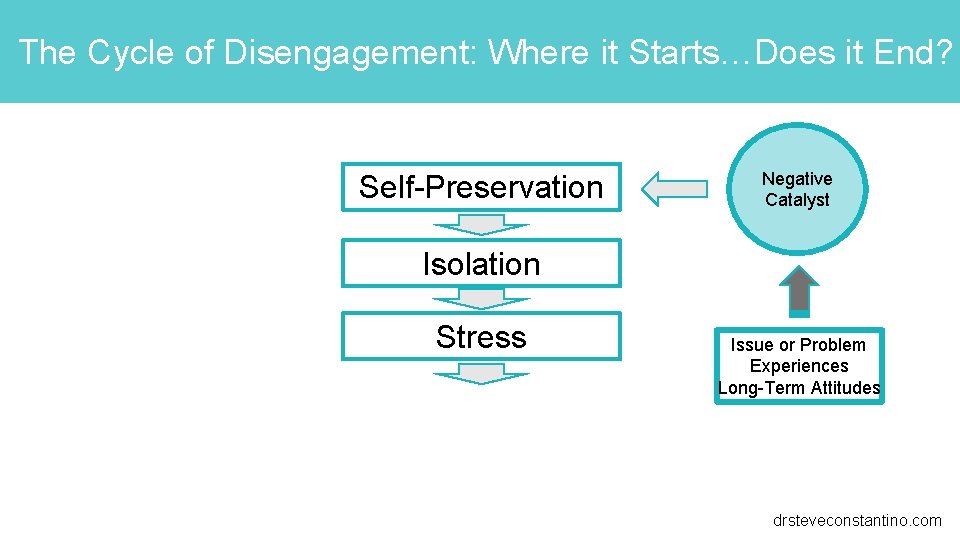
The Cycle of Disengagement: Where it Starts…Does it End? Self-Preservation Negative Catalyst Isolation Stress Issue or Problem Experiences Long-Term Attitudes drsteveconstantino. com
The Cycle of Disengagement: Where it Starts…Does it End? Self-Preservation Negative Catalyst Isolation Stress Anxiety Issue or Problem Experiences Long-Term Attitudes drsteveconstantino. com
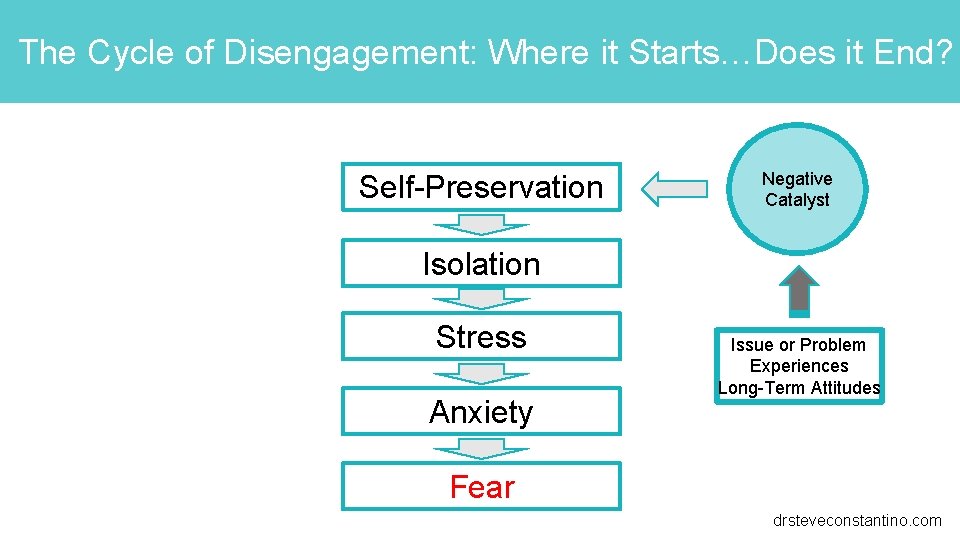
The Cycle of Disengagement: Where it Starts…Does it End? Self-Preservation Negative Catalyst Isolation Stress Anxiety Issue or Problem Experiences Long-Term Attitudes Fear drsteveconstantino. com
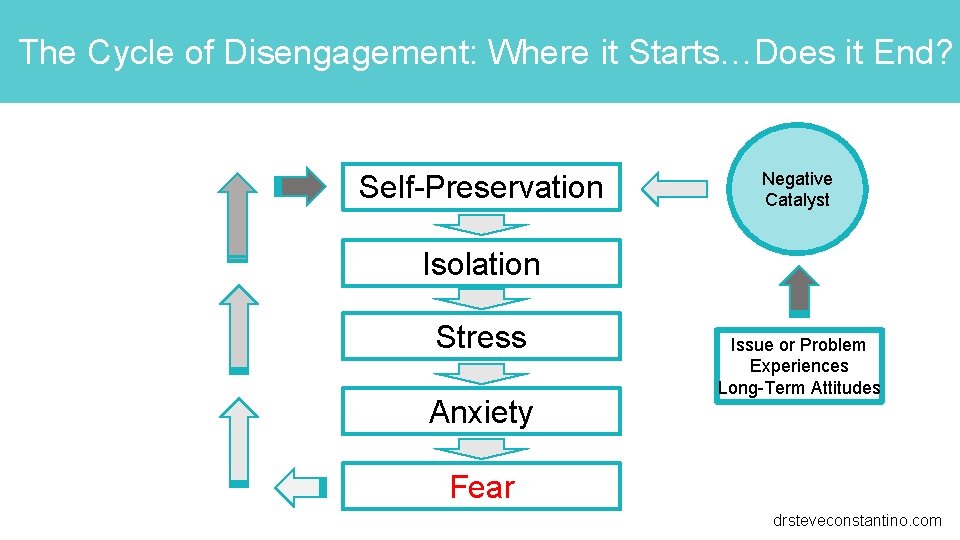
The Cycle of Disengagement: Where it Starts…Does it End? Self-Preservation Negative Catalyst Isolation Stress Anxiety Issue or Problem Experiences Long-Term Attitudes Fear drsteveconstantino. com
Breaking the Cycle: How to Change the Course Toward Engagement drsteveconstantino. com
How to Change the Course Toward Engagement The percentage of families who are truly apathetic toward their children’s education is: (select one) 1. 10% 2. 7% 3. 1% 4. 19% drsteveconstantino. com
How to Change the Course Toward Engagement • Be careful of assumptions. On a cold January day, a forty-three-year-old man was sworn in as the chief executive of his country. By his side stood his predecessor, a famous general who, fifteen years earlier, had commanded his nation’s armed forces in a war that resulted in the defeat of Germany. The young leader was raised in the Roman Catholic faith. He spent the next five hours watching parades in his honor and stayed up celebrating until three o’clock in the morning. 1933 From Simon Sinek’s “Start With Why. ” drsteveconstantino. com
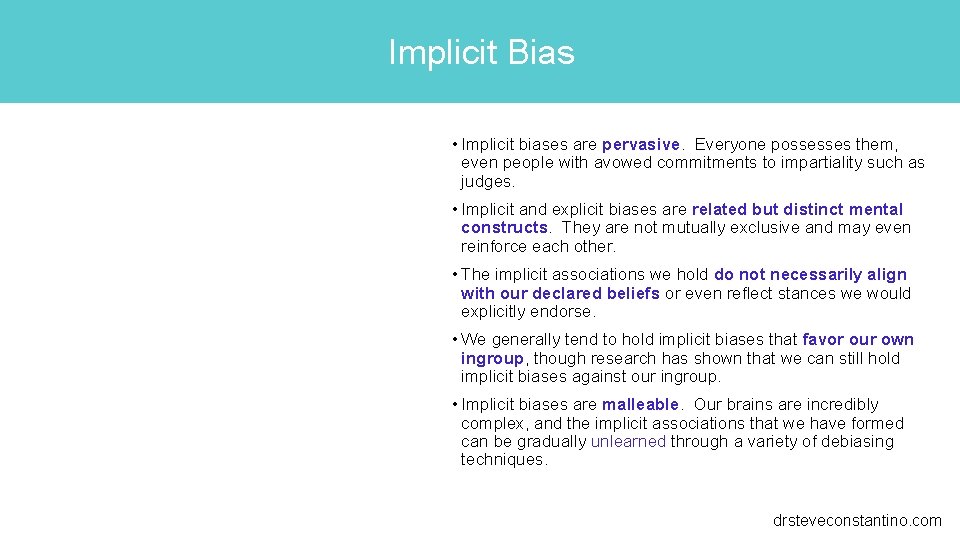
Implicit Bias • Implicit biases are pervasive. Everyone possesses them, even people with avowed commitments to impartiality such as judges. • Implicit and explicit biases are related but distinct mental constructs. They are not mutually exclusive and may even reinforce each other. Implicit Bias • The implicit associations we hold do not necessarily align with our declared beliefs or even reflect stances we would explicitly endorse. • We generally tend to hold implicit biases that favor our own ingroup, though research has shown that we can still hold implicit biases against our ingroup. • Implicit biases are malleable. Our brains are incredibly complex, and the implicit associations that we have formed can be gradually unlearned through a variety of debiasing techniques. drsteveconstantino. com
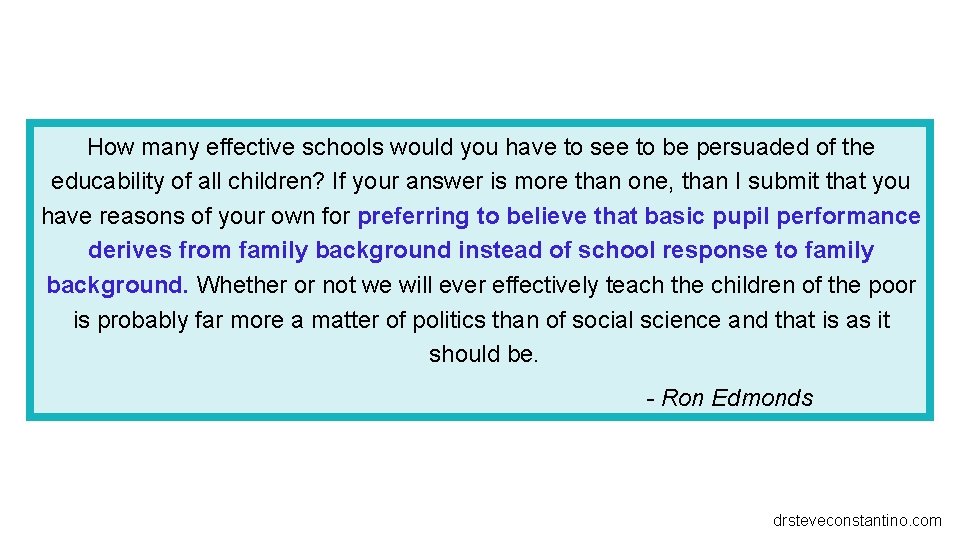
How many effective schools would you have to see to be persuaded of the educability of all children? If your answer is more than one, than I submit that you have reasons of your own for preferring to believe that basic pupil performance derives from family background instead of school response to family background. Whether or not we will ever effectively teach the children of the poor is probably far more a matter of politics than of social science and that is as it should be. - Ron Edmonds drsteveconstantino. com
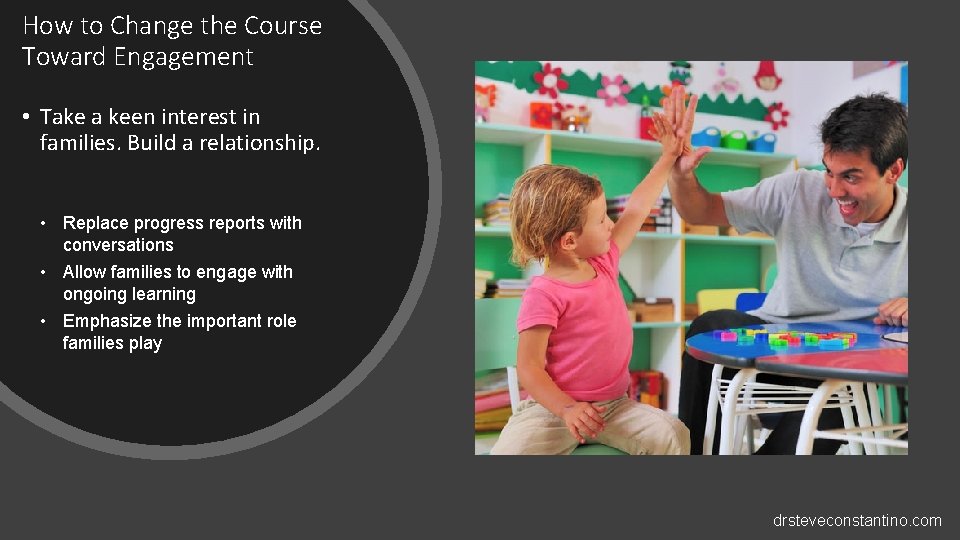
How to Change the Course Toward Engagement • Take a keen interest in families. Build a relationship. • Replace progress reports with conversations • Allow families to engage with ongoing learning • Emphasize the important role families play drsteveconstantino. com
How to Change the Course Toward Engagement Understand the Golden Rule of Engagement: Before they will come to you, you must go to them. Outreach. drsteveconstantino. com
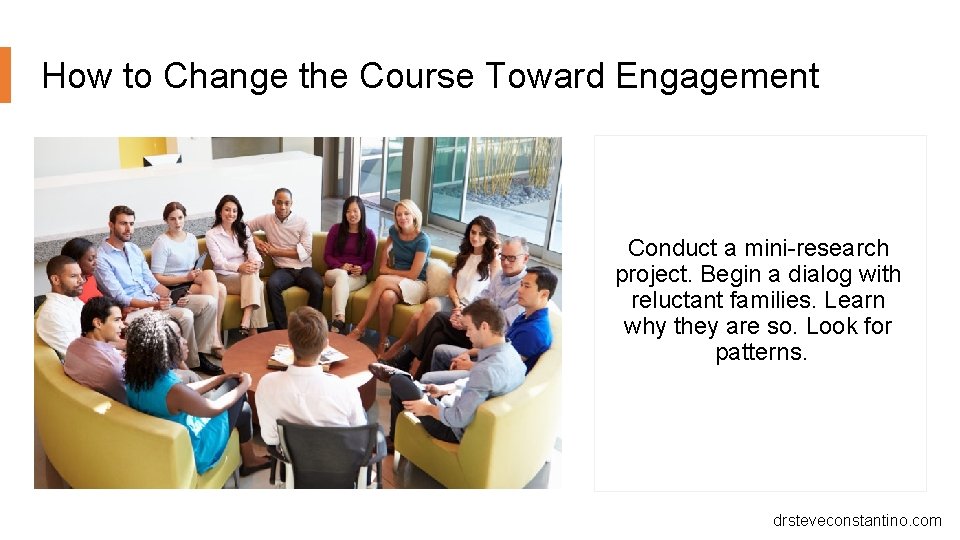
How to Change the Course Toward Engagement Conduct a mini-research project. Begin a dialog with reluctant families. Learn why they are so. Look for patterns. drsteveconstantino. com
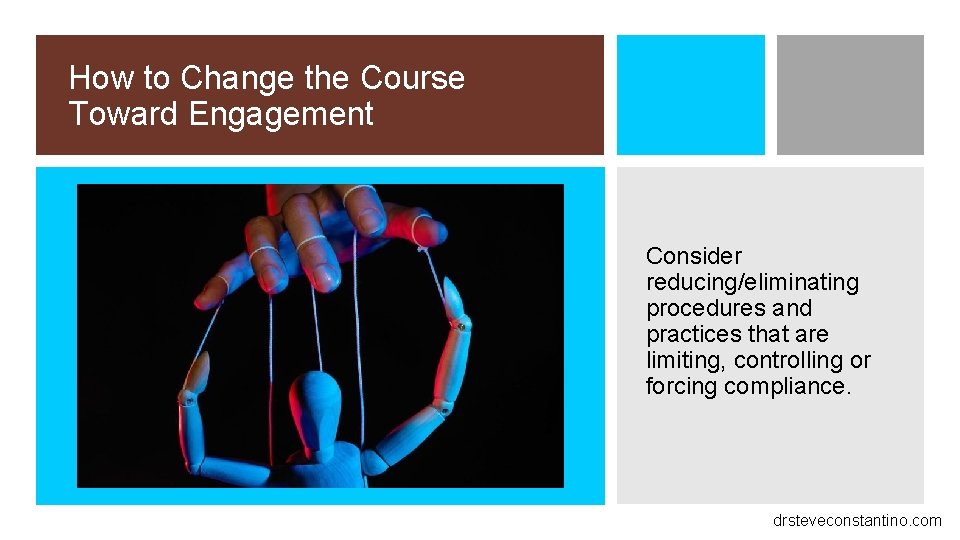
How to Change the Course Toward Engagement Consider reducing/eliminating procedures and practices that are limiting, controlling or forcing compliance. drsteveconstantino. com
How to Change the Course Toward Engagement Invisible Engagement: Engagement you do not see, but of which you see the results. drsteveconstantino. com
How to Change the Course Toward Engagement • Engagement has nothing to do with culture or economics. Believe that every family wants what is best for their children. • Communicate your desire and the value you place on dialog, communication and engagement. • We must be the catalyst in the process for repairing severed relationships. • Don’t make homework the sole vehicle for engagement. • Keep communication current and allow for two-way. • The right thing to do is always the hardest thing to do. drsteveconstantino. com
How to Change the Course Toward Engagement • Yes, some families are difficult. Remember, anger is always a mask for fear. Find the fear. Reassure families. • Promote efficacy in small ways. Communicate to families what their children are learning, give them questions to ask or conversations to have. Provide a mechanism for reporting back. • No show’s? Contact them. Underscore the importance of their engagement. • Don’t give up: They expect you to do just that. It’s happened plenty before. • Understand that re-engagement is not an overnight process. drsteveconstantino. com
Every family desires that their children exceed them in their quality of life We can make it happen. Engage EVERY Family
Every Child Every Family Every Teacher Every Day
Disengaged Families: Why They Are and How to Change the Course Thank you for attending! Book Signing Today! 4: 30 P. M. Outside of Room A 308 drsteveconstantino. com