
DISEASES OF SKIN BY DR SONAM BHATT ASSISTANT
DISEASES OF SKIN BY- DR SONAM BHATT ASSISTANT PROFESSOR VMD BASU PATNA
INTRODUCTION • Largest organ of the body • Provides a protective barrier against the environment, regulates temperature, • 3 major layers: the epidermis or outermost layer, the dermis or middle layer, and subcutis or innermost layer • Other - skin appendages (such as hair and claws) & subcutaneous muscles & fat
SKIN LESIONS • Primary lesion- directly reflected on the skin & are independent in origin • Secondary lesion –may owe their origin from the course of primary lesions or from some remote areas other than skin. Ex: FMD, RP • Primary lesion: 2 types; Localised & generalized
PRIMARY SKIN LESIONS • Macule (macula spot): circumscribed flat top having difference of spot): color from surrounding • Not elevated above skin surface • Macular lesion extending over more than one centimeter in diameter is patch • Produced by vasodilation; less pigmentation or hyperpigmentation

• Papule (pimple): solid elevation over the skin around or less than one centimeter in diameter. • Size may vary pin head to pea • Pink or red in color • Swelling is caused by cellular infiltrations, metabolic products, allergic response or hyperplasia • May originate from follicle or non-follicle • Follicular papule: result of bacterial, fungal & parasitic infection • Non- follicular : allergic in origin • Elevated flat topped papules are known as lichenoid

• Plaque: solid elevation with flat top having the diameter of more than a centimeter • Observe in acute allergic condition • Lesions are predominantly noticed over neck, thorax & referred as vegetation • Nodule (tubercle): solid circumscribed mass extending into dermis is nodule • Larger papule greater than one cm are considered as nodules • Appear as a result of inflammatory or neoplastic reactions • Larger lesion is known as node • Hypoderma bovis produces nodular lesion in cattle
• Vesicle(bulla): small fluid filled elevation of the superficial epithelium of the skin • Fluid consists of serum & lymph which accumulate between epidermal or dermal layers • Large vesicle is known as bulla • Soft in character & fragile in nature • Mostly observed as a result of viral infection, contact irritants or autoallergy • Ex- pox lesion • Superficial thin walled vesicle with surrounded erythema is known as impetigo
• Pustule: vesicles filled with pus • May result due to inflammation • May be considered as superficial minute abscess • May originate from bacterial infection or a vesicle of pox lesion may turn into pustules due to secondary bacterial infection • Wheal (urticaria, hive): circumscribed semisolid elevated round or flat topped lesions • Due to allergic reaction • Insect bites, stings or allergen may induce wheal
SECONDARY SKIN LESIONS • Scale(squame, flake): excessive accumulation of discarded keratinous debris over the skin surface • Remains as bran like deposition over the skin • It is the discharge of sebaceous & sweat glands which are dried up. This dried up materials form thin layers & fall of which is known as dandruff or pityriasis • Ex- ectoparasitic or mycotic infection, nutritional deficiency
• Crust (scab) – dried discharge of exudate on the skin • Ex – sheep scab, dermatophyllosis, ringworm crust • Crust which result from slough due to burn is known as eschar • Erosion : loss of superficial layer of the skin without any breach of the basement membrane. • Healing tendency • Ulcer : breach in the continuity of epidermis • Less healing tendency to heal • May result due to break down of vesicles or pustules

• Excoriation – superficial erosion of the skin • Occurs due to pruritis • Mechanical damage by scratching is responsible for excoriation • Ex- Sarcoptes scabies • Scar : it is formed by the proliferation of fibrous tissue in an area replacing healed up lesions • it is devoid of hairs & atrophic • Scar is formed following traumatic damage, ulceration, surgical intervention & cauterisation
• Lichenification: thickening & hardening of tissues • Results due to chronic inflammatory process • May develop following self-inflicted trauma or ectoparasitism • Lichenification manifested with manifested hyperplastic changes of stratum spinosum is known as acanthosis • Fissure (crack, rhagade): spilt of the skin • Elasticity of the skin is lost in this condition • Chap: small fissure extending to the subcutaneous layer • Pigmentation

Other histological lesions : • Parakeratosis- imperfect keratinisation of corneal layer • Seen in pigs due to deficiency of skin • Hyperkeratosis : excessive thickening of stratum corneum • Occur due to inflammation, dietary deficiency or traumatisation • Acne : inflammation of hair follicle
PRURITIS ( ITCHING) • Sensation that gives rise to the desire of scratching • Peripheral or central in origin • Peripheral pruritis: • Many ectoparasite eg sarcoptes, notoedres, ticks etc may produce irritation of epidermis & resultant itching • Deep seated lesions do not produce itching • Mainly observed in muco- cutaneous junction (plenty of pain receptors )
• Central pruritis: stimulation of itching centre in the medula may initiate scratching reflexes • Depends on structural configuration as observed in pseudo rabies in pig or scrapie in sheep • Diseases like hepatitis, diabetes mellitus, nervous form of ketosis may produce itching in animals
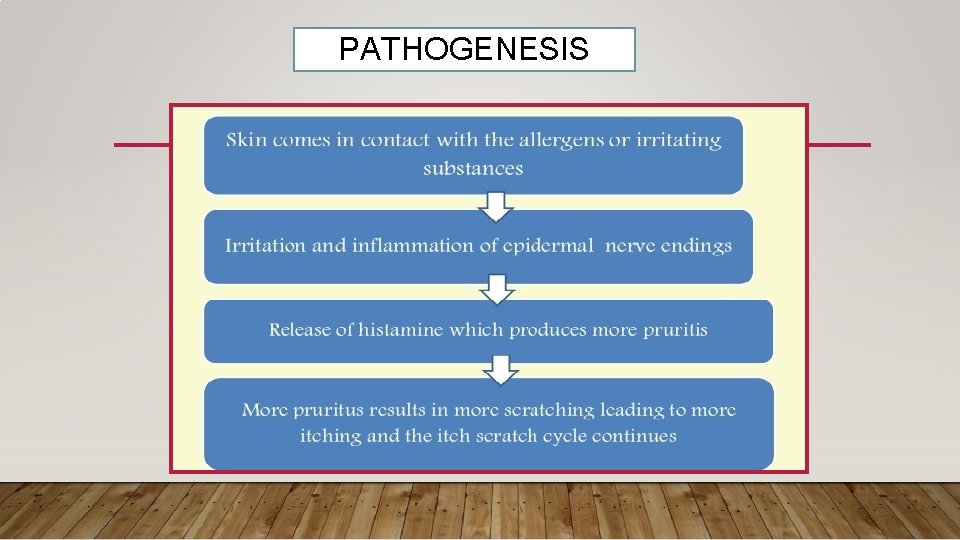
PATHOGENESIS
MANAGEMENT OF PRURITUS • In peripheral origin, skin scrapings should be examined for ectoparasites & appropriate acarisidal treatment should be extended • Central origin can be controlled by sedative • Application of soothing agents • Use of antihistaminics or corticosteroids • Regulation of diet. Addition of essential fatty acids in the diet

- Slides: 18