
Diseases of Immunity 1 Hypersensitivity Reactions Normally a



- Slides: 28
Diseases of Immunity (1)
Hypersensitivity Reactions Normally, a balanced system optimizes the eradication of infecting organisms without serious injury to host tissues. n However, immune responses may be inadequately controlled or inappropriately targeted to host tissues, and in these situations, the normally beneficial response will cause of disease. n
Hypersensitivity Reactions n n n The term hypersensitivity is used to describe immune responses which are damaging rather than helpful to the host. WHY? This term originated from the idea that individuals who mount immune responses against an antigen are said to be "sensitized" sensitized to that antigen, and therefore, pathologic or excessive reactions are manifestations of "hypersensitivity. " hypersensitivity
CAUSES OF HYPERSENSITIVITY REACTIONS Autoimmunity. n Reactions against microbes. n Reactions against environmental antigens. n
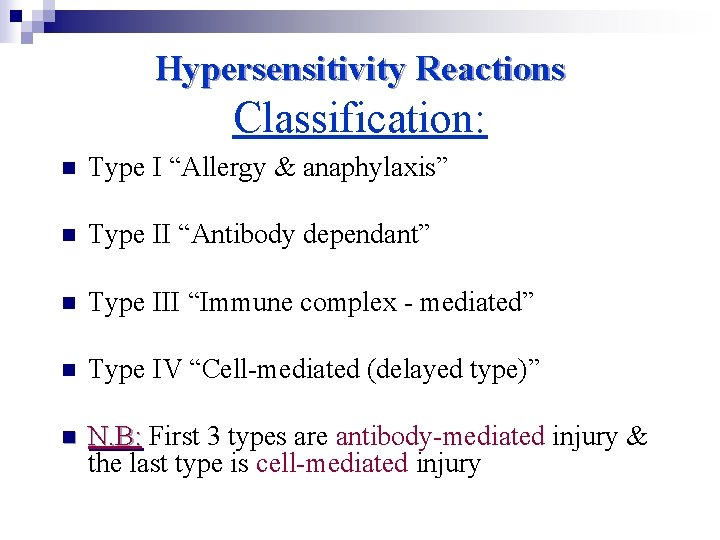
Hypersensitivity Reactions Classification: n Type I “Allergy & anaphylaxis” n Type II “Antibody dependant” n Type III “Immune complex - mediated” n Type IV “Cell-mediated (delayed type)” n N. B: First 3 types are antibody-mediated injury & the last type is cell-mediated injury
n. Type I Hypersensitivity Reaction ALLERGIC REACTION n ANAPHYLACTIC REACTION n
Type I Hypersensitivity Definition : n It is rapidly developing immunologic reaction occurring within minutes after the interaction of an antigen (allergen) with Ig. E antibodies bound to surface of mast cells or basophils in individuals previously sensitized to the antigen n
Type I Hypersensitivity n n n Antigen is usually exogenous , environmental and is called allergen Allergens may be introduced by inhalation, ingestion, touch, or by intravenous injection. The reaction is mediated by Ig. E produced by previously sensitized B lymphocytes. . Ig. E binds to the main effector cells ; the mast cell (in tissues) or basophils (in blood). The initiated reaction passes through 2 phases an early one and a late one.
Type I Hypersensitivity: Phases n n As Seen in the localized reactions Initial response: ¨ Characterized by; ¨ Vasodilatation, ¨ Vascular leakage, and ¨ Smooth muscle spasm ¨ Increased glandular secretions ¨ These changes become evident within 5 to 30 minutes after exposure to an allergen and subside in 60 minute. is mainly mediated by histamine released by MAST CELLS. ¨ It
Type I Hypersensitivity: Phases n Late-phase reaction: ¨ Develop in 2 to 8 hours later without additional exposure to antigen and lasts for several days. ¨ Characterized by intense infiltration of tissues with eosinophils, neutrophils, basophils, monocytes, and CD 4+ T cells, and tissue destruction. ¨ Occurs under effect of esinophils and neutrophils chemotactic factors released by mast cells.
Type I Hypersensitivity: Clinical Manifestations n The resultant reaction can occur as a systemic disorder or as a local reaction depending on the route of entry of allergen
Type I Hypersensitivity clinical presentation Local reactions: n n Antigen is confined to a particular site Skin contact Localized cutaneous swellings (urticaria, hives) and eczema, Ingestion Allergic gastroenteritis (food allergy) diarrhoea Inhalation bronchospasm allergic rhinitis, and bronchial asthma.
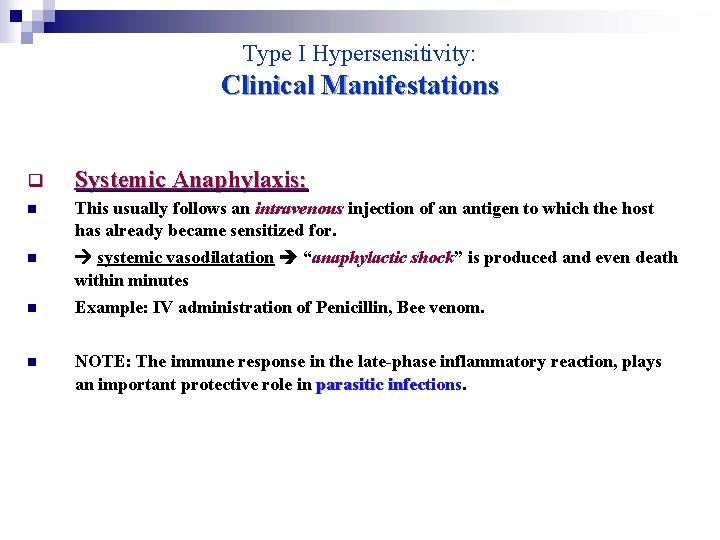
Type I Hypersensitivity: Clinical Manifestations q Systemic Anaphylaxis: n This usually follows an intravenous injection of an antigen to which the host has already became sensitized for. systemic vasodilatation “anaphylactic shock” is produced and even death within minutes Example: IV administration of Penicillin, Bee venom. n n n NOTE: The immune response in the late-phase inflammatory reaction, plays an important protective role in parasitic infections
n. Type II Hypersensitivity reaction
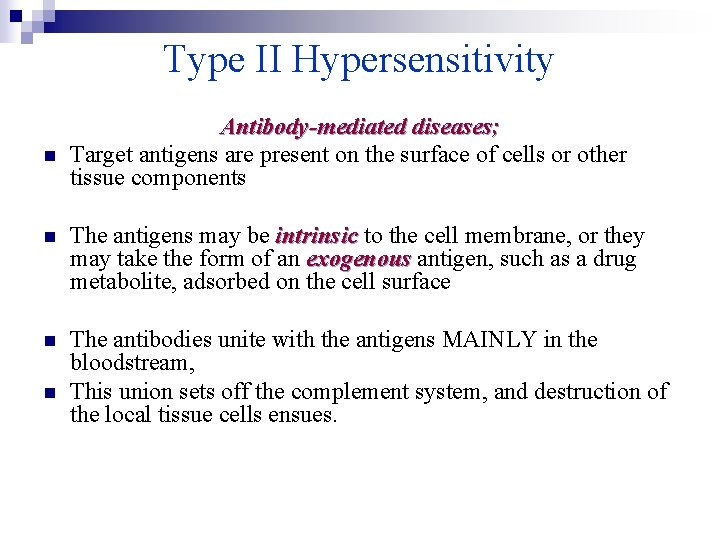
Type II Hypersensitivity n Antibody-mediated diseases; Target antigens are present on the surface of cells or other tissue components n The antigens may be intrinsic to the cell membrane, or they may take the form of an exogenous antigen, such as a drug metabolite, adsorbed on the cell surface n The antibodies unite with the antigens MAINLY in the bloodstream, This union sets off the complement system, and destruction of the local tissue cells ensues. n
Type II Hypersensitivity Mechanism n A, Opsonization n B, Inflammation n C, Antireceptor antibodies
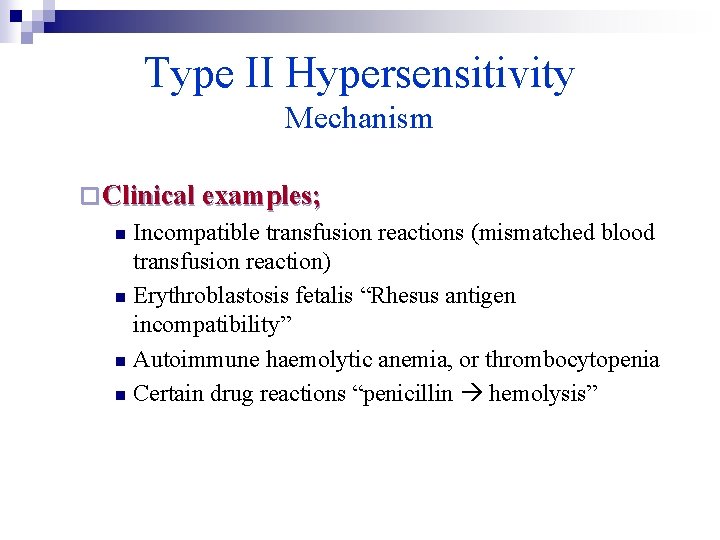
Type II Hypersensitivity Mechanism ¨ Clinical examples; Incompatible transfusion reactions (mismatched blood transfusion reaction) n Erythroblastosis fetalis “Rhesus antigen incompatibility” n Autoimmune haemolytic anemia, or thrombocytopenia n Certain drug reactions “penicillin hemolysis” n
n. Type III Hypersensitivity reaction
Type III Hypersensitivity Immune Complex - Mediated n n n Type III hypersensitivity is mediated by the deposition of antigen-antibody complexes formed in blood vessels. The antigens may be ¨ Exogenous antigens, antigens such as bacteria, or viruses ¨ Endogenous antigens, antigens such as DNA. Immune complexes deposit in blood vessels in various tissue beds , they have the ability to fix complement and trigger the subsequent injurious inflammatory reaction (either systemic or Localized )
Systemic Immune Complex Disease Mechanism n Favoured sites of immune complex deposition are; n Renal glomeruli, Joints, Skin, Heart, Serosal surfaces, Small blood vessels n n n
Type III Hypersensitivity Examples Autoimmune diseases as: n Systemic lupus erythematosis n Scleroderma n Sjogren syndrome
n. Type IV Hypersensitivity reaction
Type IV Hypersensitivity (Cell Mediated) n n n Two types of T-cell reactions are capable of causing tissue injury and disease: (1) delayed-type hypersensitivity (DTH), initiated by TH 1 -type CD 4+ T cells (2) direct cell cytotoxicity, mediated by cytotoxic CD 8+ T cells that are responsible for tissue damage.
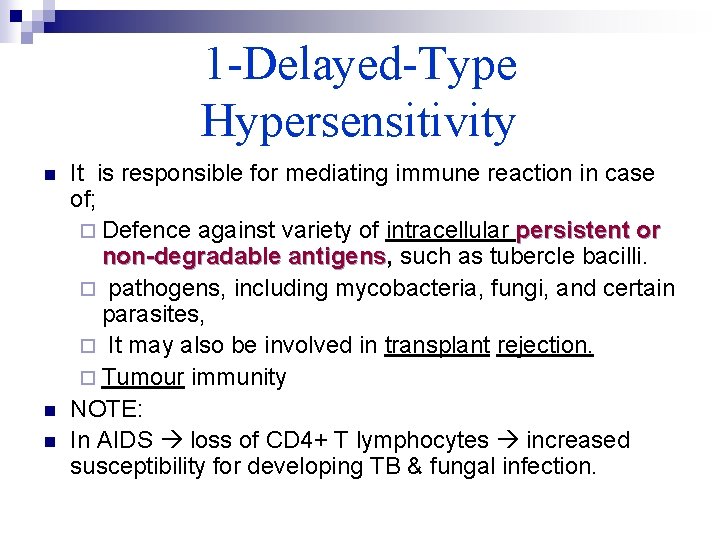
1 -Delayed-Type Hypersensitivity n n n It is responsible for mediating immune reaction in case of; ¨ Defence against variety of intracellular persistent or non-degradable antigens, antigens such as tubercle bacilli. ¨ pathogens, including mycobacteria, fungi, and certain parasites, ¨ It may also be involved in transplant rejection. ¨ Tumour immunity NOTE: In AIDS loss of CD 4+ T lymphocytes increased susceptibility for developing TB & fungal infection.
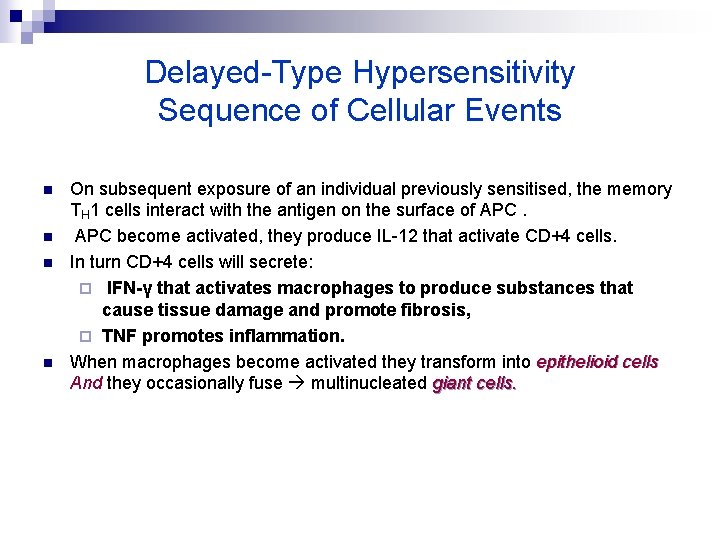
Delayed-Type Hypersensitivity Sequence of Cellular Events n n On subsequent exposure of an individual previously sensitised, the memory TH 1 cells interact with the antigen on the surface of APC become activated, they produce IL-12 that activate CD+4 cells. In turn CD+4 cells will secrete: ¨ IFN-γ that activates macrophages to produce substances that cause tissue damage and promote fibrosis, ¨ TNF promotes inflammation. When macrophages become activated they transform into epithelioid cells And they occasionally fuse multinucleated giant cells.
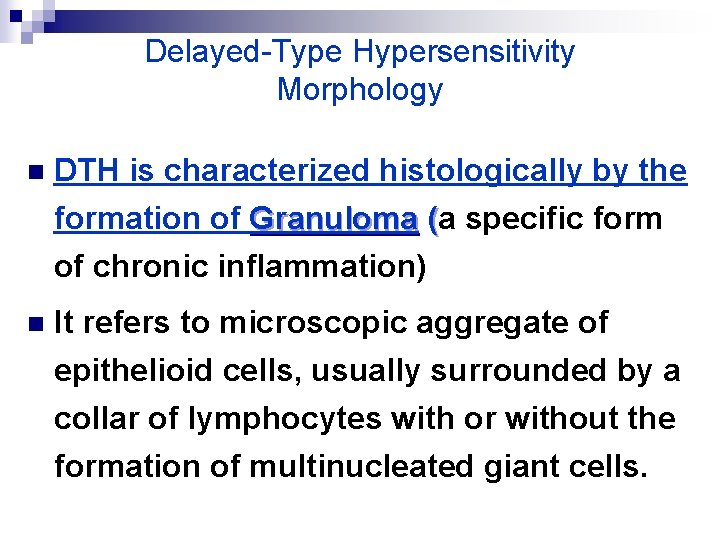
Delayed-Type Hypersensitivity Morphology n DTH is characterized histologically by the formation of Granuloma (a ( specific form of chronic inflammation) n It refers to microscopic aggregate of epithelioid cells, usually surrounded by a collar of lymphocytes with or without the formation of multinucleated giant cells.
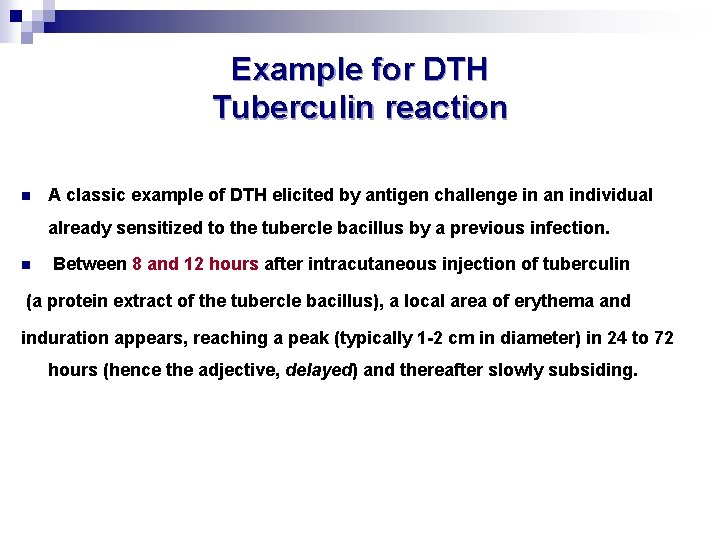
Example for DTH Tuberculin reaction n A classic example of DTH elicited by antigen challenge in an individual already sensitized to the tubercle bacillus by a previous infection. n Between 8 and 12 hours after intracutaneous injection of tuberculin (a protein extract of the tubercle bacillus), a local area of erythema and induration appears, reaching a peak (typically 1 -2 cm in diameter) in 24 to 72 hours (hence the adjective, delayed) and thereafter slowly subsiding.
2 - Direct cell cytotoxicity n In this variant of type IV hypersensitivity, sensitized CD 8+ T cells kill antigen-bearing target cells n These effector cells are called cytotoxic T lymphocytes (CTLs) n They mediate their action through class I MHC molecule, where they directly lyse infected cells or stimulates their apoptosis. n It plays an important role in graft rejection, resistance to virus infections, and possibly tumor immunity