
DISCUSSION What is wisdom What does it mean
- Slides: 20
DISCUSSION What is wisdom? What does it mean to be wise? How, where or from whom/what does one learn wisdom? How does literature relate to wisdom? © Cambridge University Press 2014
ISRAEL’S WISDOM • Capacity to live life well • Live with insight into how Yahweh’s world works • Aptitude for right making right decision • Character development and formation • Knowledge and experience • Ethical behavior and decision-making • Books: Job, Proverbs, Ecclesiastes • Wisdom Psalms, Song of Songs, etc. © Cambridge University Press 2014
WISDOM IN THE ANE • Wisdom literature is well attested throughout the ANE for an astonishingly long period of time • Standard Wisdom – collections of proverbs that assume regular and predictable patterns of life can be observed and recorded and are based on retribution theology, usually optimistic • Speculative Wisdom – dialogues or reflections on the meaning of life that may challenge or question retribution theology, typically pessimistic © Cambridge University Press 2014
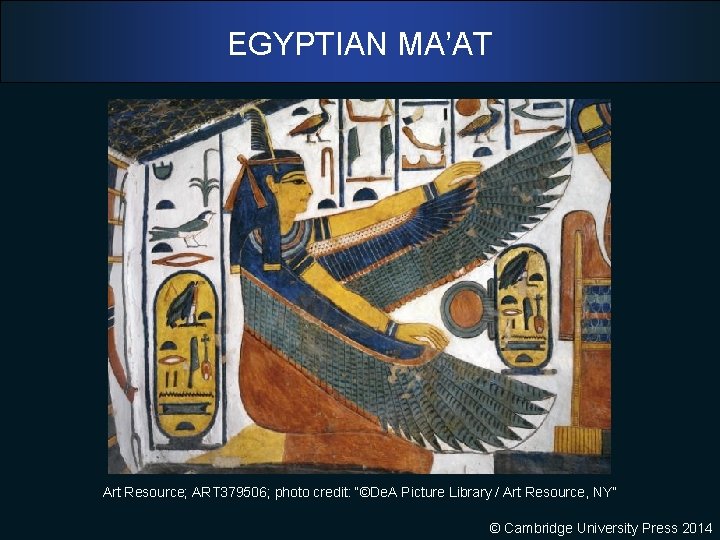
EGYPTIAN WISDOM • Generally produced standard wisdom literature • Concept of ma’at was established by divine power at creation and represents a balance of “justice” and “truth” • Those who live according to ma’at will prosper • Primarily served as instruction for young protégés preparing to serve in the royal court • Examples: Instructions of Ptahhotep and Instructions of Amenemhet © Cambridge University Press 2014
EGYPTIAN WISDOM Instructions of Amenemope • Thirty chapters focused on two basic themes 1. The ideal “silent” man vs. the “heated” man 2. The contrast between honesty and dishonesty • The compiler of the “words of the wise” in Proverbs 22: 17 -24: 22 was dependent on this document for organization and some material © Cambridge University Press 2014
EGYPTIAN MA’AT Art Resource; ART 379506; photo credit: “©De. A Picture Library / Art Resource, NY” © Cambridge University Press 2014
MESOPOTAMIAN WISDOM • Generally produced speculative wisdom lit due to the harsh realities of Mesopotamian life • Sought to answer questions about death and the suffering of the righteous • Addressed the question of theodicy – the attempt to vindicate the goodness and justice of God in the face of evil and suffering in the world • Examples: Man and His God, The Poem of the Righteous Sufferer, Babylonian Theodicy © Cambridge University Press 2014
MESOPOTAMIAN WISDOM The Poem of the Righteous Sufferer • Most extensive treatment of theodicy from Mesopotamia • Monologue from the “Babylonian Job” but the author is not convinced of his innocence The Babylonian Theodicy • Dialogue between two friends on divine justice • Sufferer observes suffering among the godly while the ungodly prosper • His friend says it is wrong to challenge the gods © Cambridge University Press 2014
ISRAELITE WISDOM • Emerges from religious principles and is perceived as a result of a relationship w/Yahweh • “The fear of Yahweh, that is wisdom” - Job 28: 28 • Proverbs is the OT example of standard wisdom literature • Job is the OT example of speculative wisdom literature © Cambridge University Press 2014
THE BOOK OF JOB • Literary masterpiece; culmination and climax of speculative wisdom literature • Focus is on theodicy • Job likely means “Where is the divine father? ” • Series of poetic dialogues framed by narrative • Not connected to any particular period in Israel’s history; gives the book a timeless quality © Cambridge University Press 2014
THE BOOK OF JOB • The Accuser (the Satan) challenges Job’s character; Yahweh permits him to afflict Job with the loss of everything • Job experiences devastating losses but maintains his faith • Job experiences physical sufferings but Job will not curse God • Job’s friends arrive to console him, accuse him of wrongdoing and encourage him to confess his sins © Cambridge University Press 2014
THE BOOK OF JOB • Job maintains his innocence and challenges God to answer • Elihu’s argues that humans cannot find God and should stop looking • Yahweh answers and illustrates the wondrous and mysterious ways of his creation • Implication is that he did not order the world in a mechanical way along the lines of simplistic retribution theology © Cambridge University Press 2014
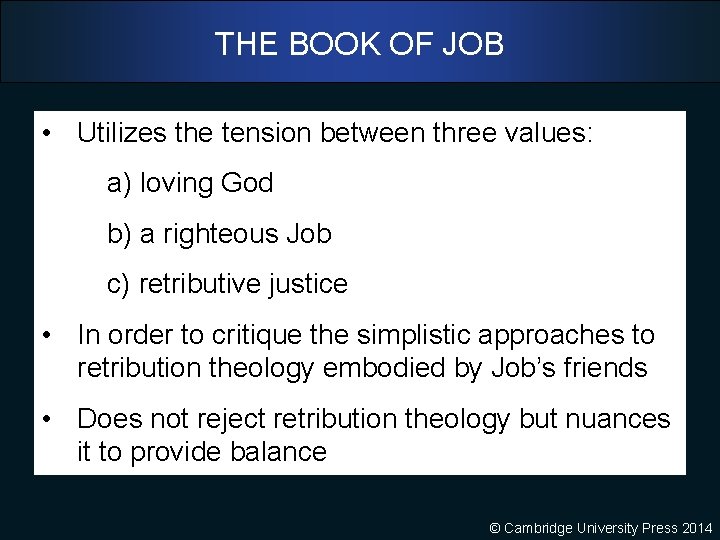
THE BOOK OF JOB • Utilizes the tension between three values: a) loving God b) a righteous Job c) retributive justice • In order to critique the simplistic approaches to retribution theology embodied by Job’s friends • Does not reject retribution theology but nuances it to provide balance © Cambridge University Press 2014
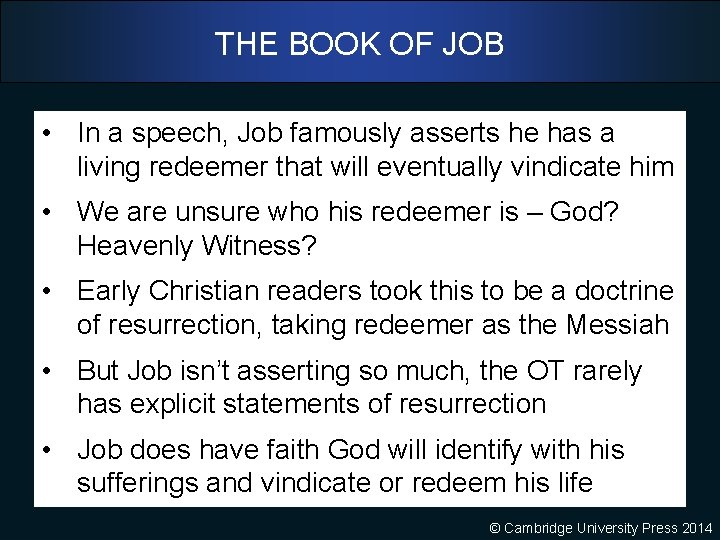
THE BOOK OF JOB • In a speech, Job famously asserts he has a living redeemer that will eventually vindicate him • We are unsure who his redeemer is – God? Heavenly Witness? • Early Christian readers took this to be a doctrine of resurrection, taking redeemer as the Messiah • But Job isn’t asserting so much, the OT rarely has explicit statements of resurrection • Job does have faith God will identify with his sufferings and vindicate or redeem his life © Cambridge University Press 2014
DISCUSSION Why do bad things happen to good people? © Cambridge University Press 2014
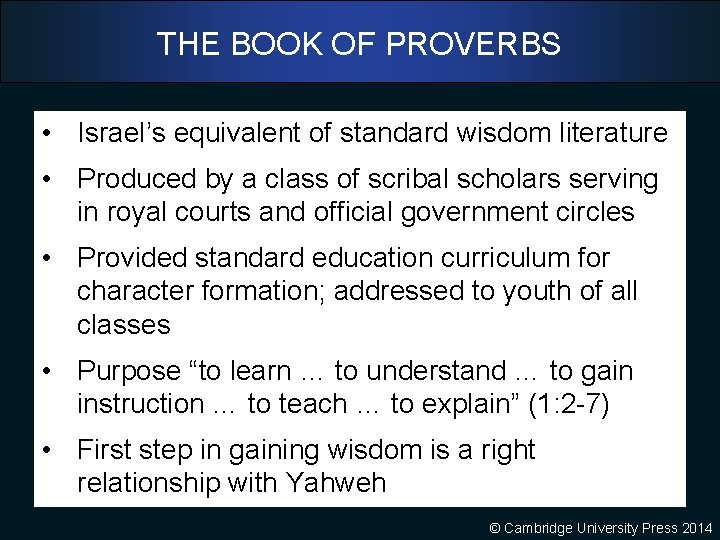
THE BOOK OF PROVERBS • Israel’s equivalent of standard wisdom literature • Produced by a class of scribal scholars serving in royal courts and official government circles • Provided standard education curriculum for character formation; addressed to youth of all classes • Purpose “to learn … to understand … to gain instruction … to teach … to explain” (1: 2 -7) • First step in gaining wisdom is a right relationship with Yahweh © Cambridge University Press 2014
THE BOOK OF PROVERBS • Associated with Solomon (1: 1, 10: 1, 25: 1) • King Hezekiah’s officials collected and copied the proverbs noted in 25: 1 • “The words of the wise” in 22: 17 -24: 22 is an adaptation of The Instruction of Amenemope • Words of Agur son of Jakeh (30: 1 -9) • Miscellaneous collection (30: 10 -33) • Words of King Lemuel (31: 1 -9) • Acrostic about the woman of strength (31: 10 -31) © Cambridge University Press 2014
WISDOM AND MONOTHEISM • Distinctive theological perspective • Job and Proverbs do not address “salvation history” (i. e. Abraham, Exodus, Sinai, etc. ) • Embodies a different mode of divine revelation based on observations of everyday life and human experience rather than historical acts • Doctrine of creation is central • Implicitly monotheistic © Cambridge University Press 2014
WISDOM AND MONOTHEISM • No other deities are mentioned besides Yahweh • Assumes a single God is behind all things – creating, directing, instructing, bringing order and diversity • God is the singular, unifying principle beneath the diversity of human experiences • God is not only one but God is also good and loving • But if this is true, how does one explain evil and suffering? © Cambridge University Press 2014
WISDOM AND MONOTHEISM • For polytheists, bad things happen when power among the gods is not balanced • But monotheists, must take into account the singularity of the one creator God • OT (particularly Job) calls for faith beyond one’s ability to comprehend the ways of God. • God is all-powerful and all-loving; Job is righteous; retribution theology cannot be applied rigidly • Sometimes we have no explanation for suffering © Cambridge University Press 2014