
Discussion Questions n What defines a computer What

- Slides: 33
Discussion Questions n What defines a computer: What is the simplest definition of a computer you can come up with? n What defines a modern computer? n n What was the first computer? n If you don’t know, make a guess
Definition of Computer
Definition of a Computer Information Processor n Input and Output n
Definition of Modern Computer Inputs, outputs, processes and stores information n Physical: Keyboard, monitor, etc. – are these necessary components? n
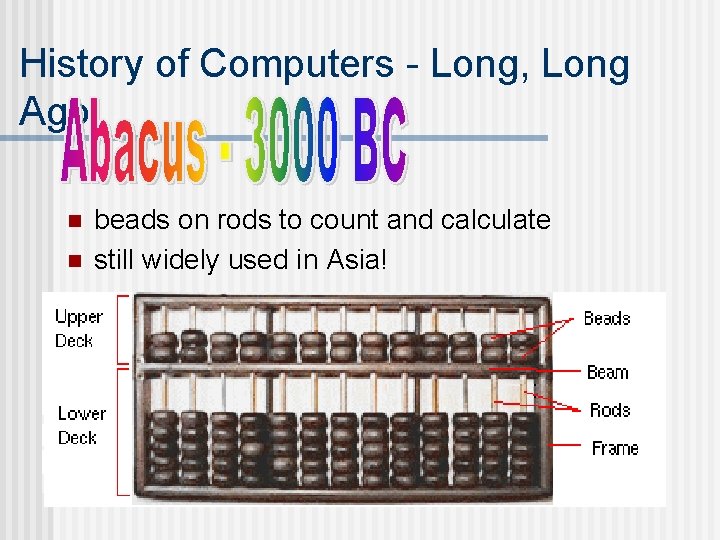
History of Computers - Long, Long Ago n n beads on rods to count and calculate still widely used in Asia!
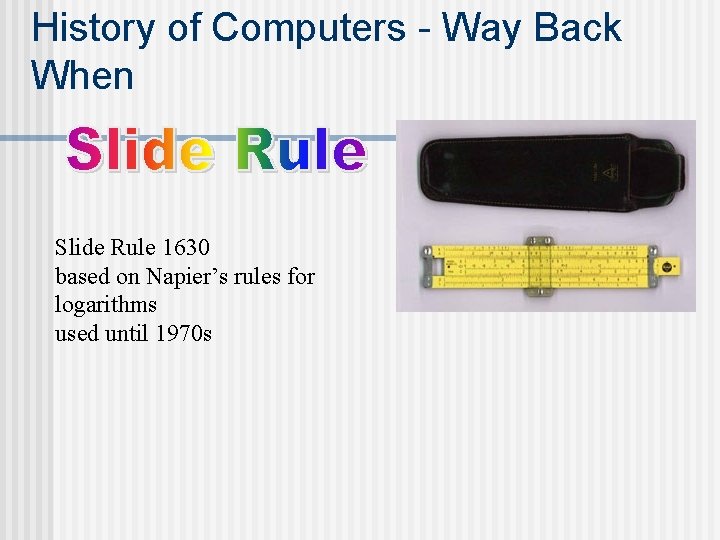
History of Computers - Way Back When Slide Rule 1630 based on Napier’s rules for logarithms used until 1970 s
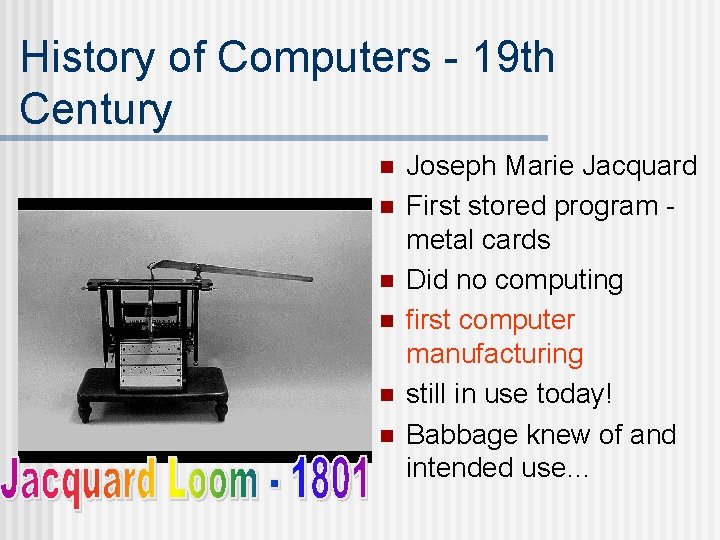
History of Computers - 19 th Century n n n Joseph Marie Jacquard First stored program metal cards Did no computing first computer manufacturing still in use today! Babbage knew of and intended use…
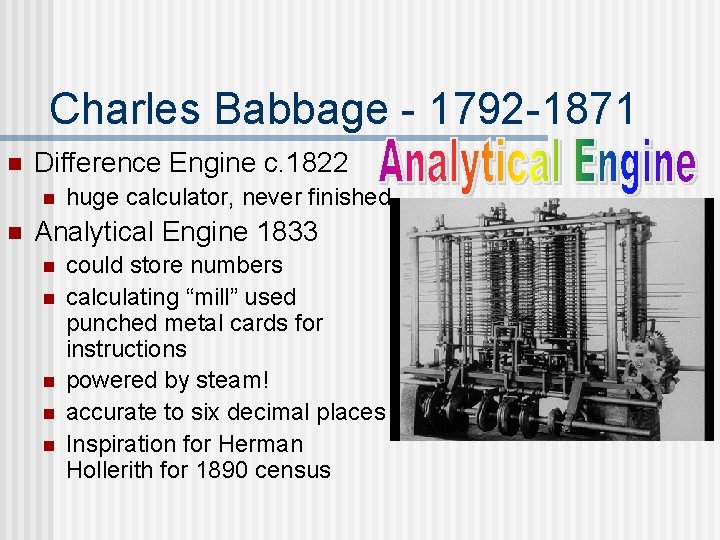
Charles Babbage - 1792 -1871 n Difference Engine c. 1822 n n huge calculator, never finished Analytical Engine 1833 n n n could store numbers calculating “mill” used punched metal cards for instructions powered by steam! accurate to six decimal places Inspiration for Herman Hollerith for 1890 census
Discussion Question n What was the biggest advance that led to modern computers? Electricity n Transistor n Microchip n Data storage n
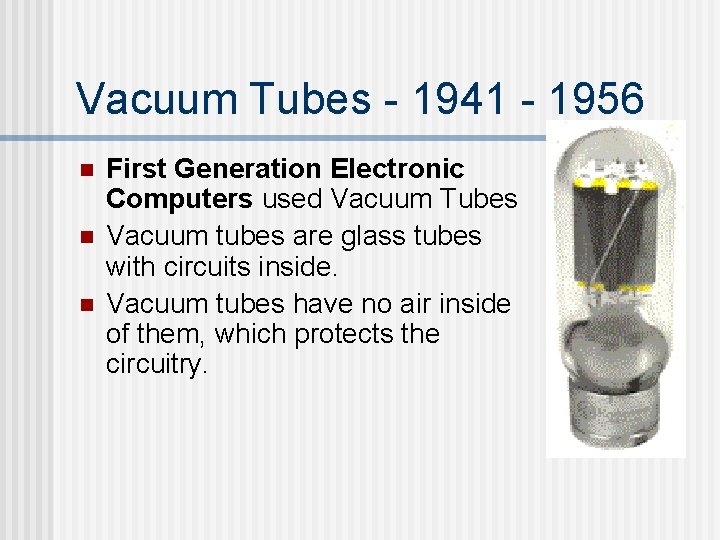
Vacuum Tubes - 1941 - 1956 n n n First Generation Electronic Computers used Vacuum Tubes Vacuum tubes are glass tubes with circuits inside. Vacuum tubes have no air inside of them, which protects the circuitry.
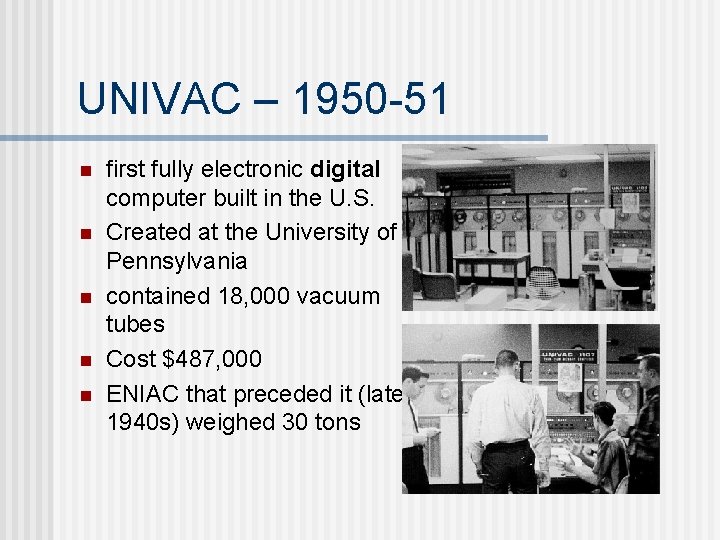
UNIVAC – 1950 -51 n n n first fully electronic digital computer built in the U. S. Created at the University of Pennsylvania contained 18, 000 vacuum tubes Cost $487, 000 ENIAC that preceded it (late 1940 s) weighed 30 tons
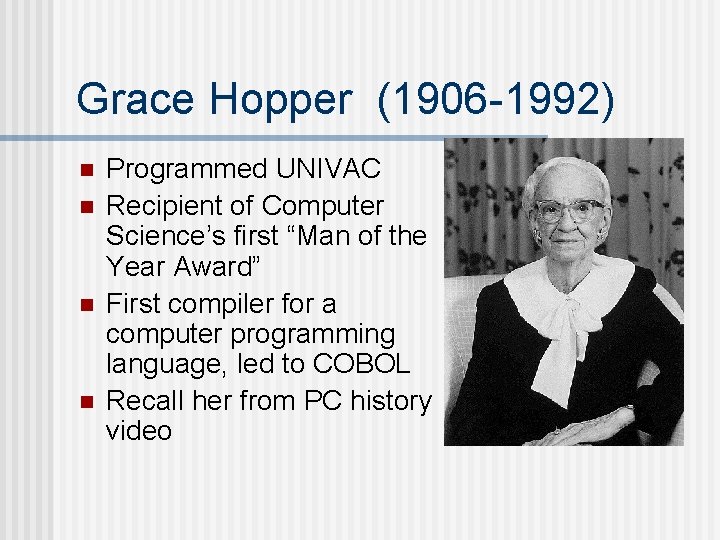
Grace Hopper (1906 -1992) n n Programmed UNIVAC Recipient of Computer Science’s first “Man of the Year Award” First compiler for a computer programming language, led to COBOL Recall her from PC history video
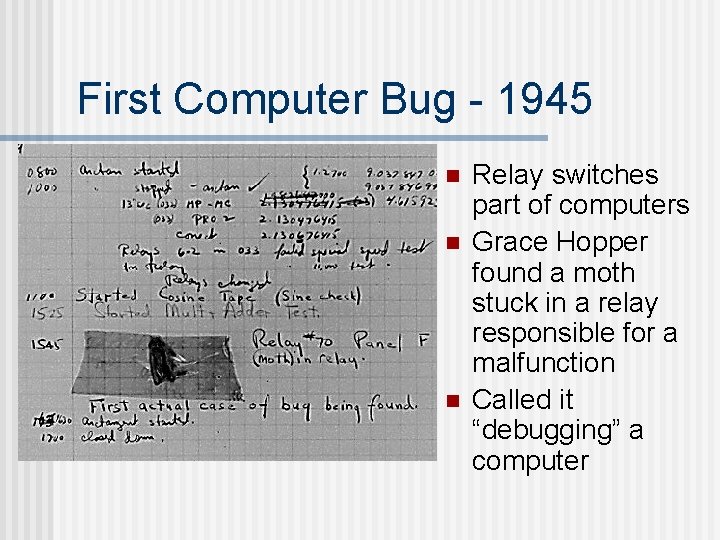
First Computer Bug - 1945 n n n Relay switches part of computers Grace Hopper found a moth stuck in a relay responsible for a malfunction Called it “debugging” a computer
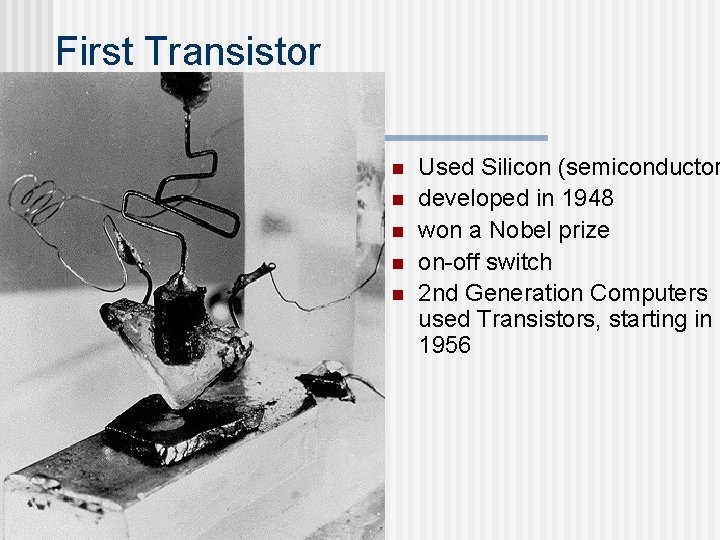
First Transistor n n n Used Silicon (semiconductor developed in 1948 won a Nobel prize on-off switch 2 nd Generation Computers used Transistors, starting in 1956
Second Generation – 19651963 1956 – Computers began to incorporate Transistors n Replaced vacuum tubes with Transistors n Note introduction of the Integrated Circuit n n Jack Kilby (1958 – Texas Instruments) and Robert Noyce (Fairchild Semiconductors) separately invented the IC or integrated circuit at the same time.
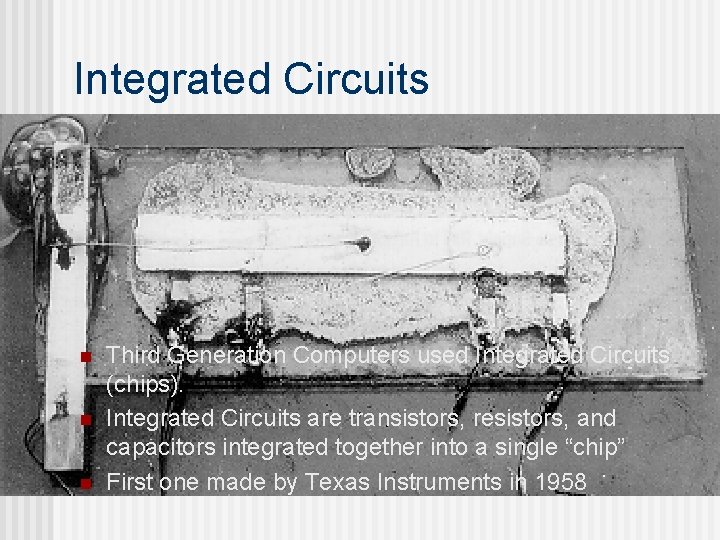
Integrated Circuits n n n Third Generation Computers used Integrated Circuits (chips). Integrated Circuits are transistors, resistors, and capacitors integrated together into a single “chip” First one made by Texas Instruments in 1958
Operating System Software – Instructions for Computer n ‘Operating system’ is set of instructions loaded each time a computer is started n ‘Program’ is instructions loaded when needed n
Third Generation – 1964 -1971 n Integrated Circuit n Operating System n Getting smaller, cheaper n
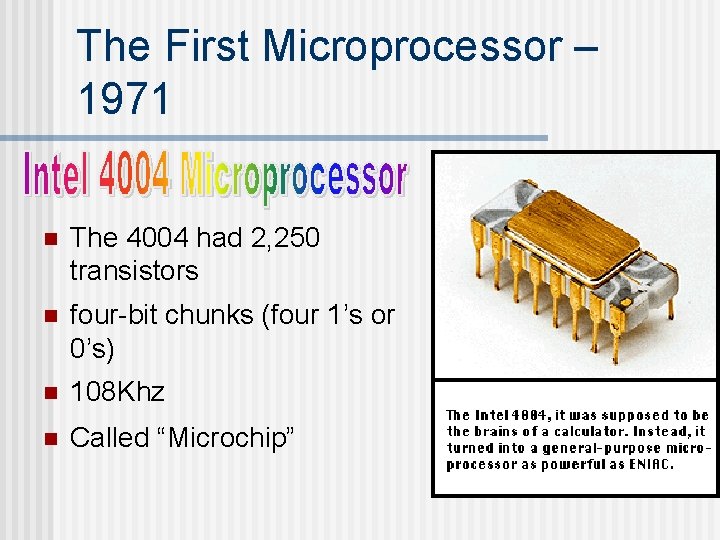
The First Microprocessor – 1971 n The 4004 had 2, 250 transistors n four-bit chunks (four 1’s or 0’s) n 108 Khz n Called “Microchip”
What is a Microchip? n Very Large Scale Integrated Circuit (VLSIC) n Transistors, resistors, and capacitors 4004 had 2, 250 transistors n Pentium IV had 42 MILLION transistors n n n Each transistor 0. 13 microns (10 -6 meters) Modern Pentium -- 624 or 504 million
4 th Generation – began 1971 MICROCHIPS! n Getting smaller and smaller, but we are still using microchip technology n
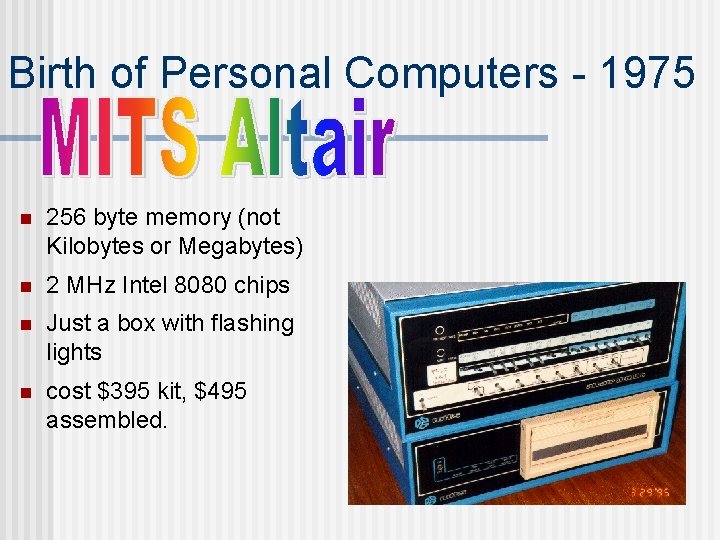
Birth of Personal Computers - 1975 n 256 byte memory (not Kilobytes or Megabytes) n 2 MHz Intel 8080 chips n Just a box with flashing lights n cost $395 kit, $495 assembled.
Over the past 50 years, the Electronic Computer has evolved rapidly. Connections: n Which evolved from the other, which was an entirely new creation • • vacuum tube integrated circuit transistor microchip
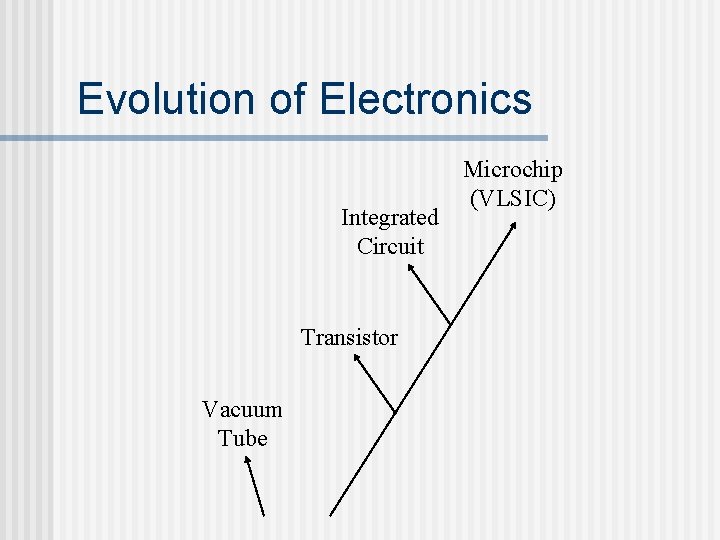
Evolution of Electronics Integrated Circuit Transistor Vacuum Tube Microchip (VLSIC)
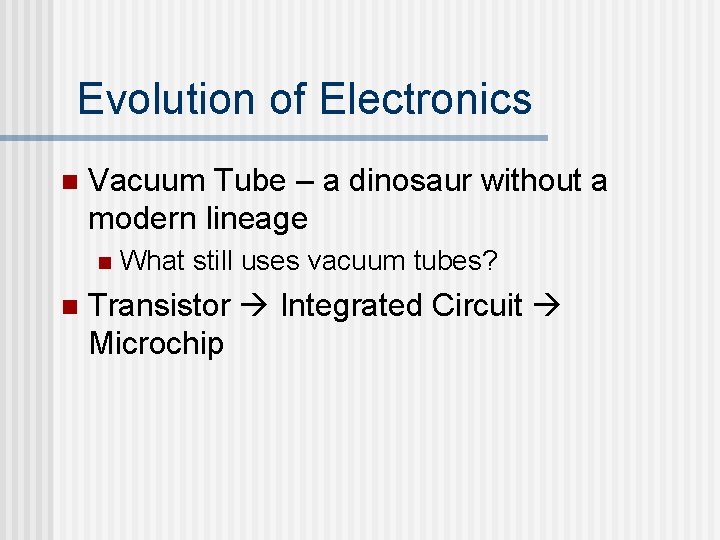
Evolution of Electronics n Vacuum Tube – a dinosaur without a modern lineage n n What still uses vacuum tubes? Transistor Integrated Circuit Microchip
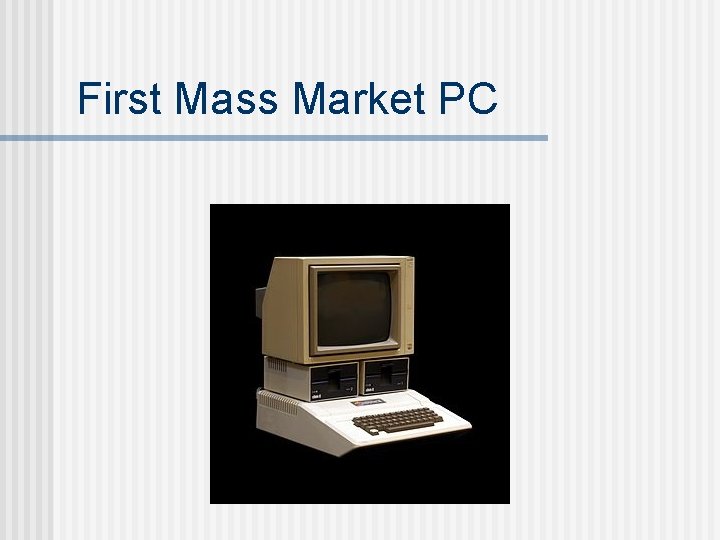
First Mass Market PC
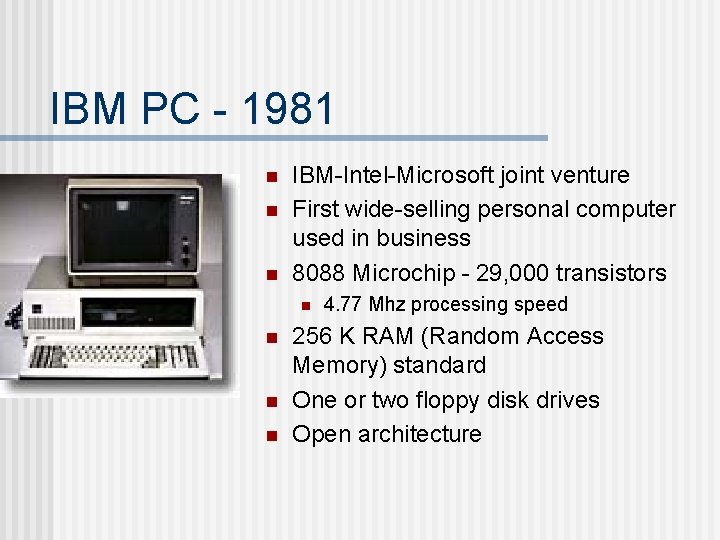
IBM PC - 1981 n n n IBM-Intel-Microsoft joint venture First wide-selling personal computer used in business 8088 Microchip - 29, 000 transistors n n 4. 77 Mhz processing speed 256 K RAM (Random Access Memory) standard One or two floppy disk drives Open architecture
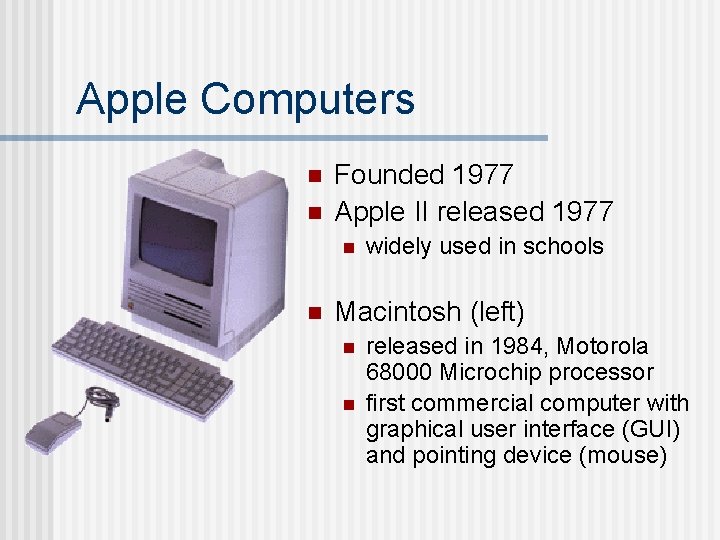
Apple Computers n n Founded 1977 Apple II released 1977 n n widely used in schools Macintosh (left) n n released in 1984, Motorola 68000 Microchip processor first commercial computer with graphical user interface (GUI) and pointing device (mouse)
Along the way, 80 s & 90 s n Timex Sinclair n Texas Instruments TI computer n Radio Shack, TRS 80 n Commodore 64 / 128 n Commodore Amiga n Along with ‘compatibles’—Compaq, Dell, e. Machines, Gateway, etc.
Commodore recently n C 64 recreation n C 64 x Extreme n. Amiga
1990 s: Pentiums and Power Macs n n n n Early 1990 s began penetration of computers into every niche: every desk, most homes, etc. Faster, less expensive computers paved way for this Windows 95 was first decent GUI for “PCs” Macs became more PC compatible - easy file transfers Apple effort at licensing OS (Power Computing) Mac conversion to Intel chip Prices have plummeted n n $2000 for entry level to $400 -$500 $6000 for top of line to $1000 -$1500
21 st Century Computing Great increases in speed, storage, and memory n Increased networking, speed in Internet n Broadband growth n Netbooks / i. Pad / tablets n Smart Phones n Impact of touch technology n 3 G to 4 G (3 -5 Mbps / 8 -10 Mbps) n
What’s next for computers? n Use your imagination to come up with what the coming years hold for computers. n n n n What can we expect in two years? What can we expect in twenty years? Voice interface? Siri? Google App Cloud computing growth True ubiquity? Interface to almost all activities? Automation applications ###