
Discussion on ILC detector maintenance needs Ron Settles
- Slides: 36
Discussion on ILC detector maintenance needs Ron Settles MPI-Munich/Desy Some thoughts on • Calibration • Z-peak @Lep 2 => ILC • B-map • Push-pull frequency • Detector maintenance examples • Aleph • (SLD, L 3) • Disaster/Upgrade scenarios • What else? 18/09/2007 Ron Settles MPI-Munich/DESY IRENG 07 Workshop, SLAC 17 -21 Sept 2007 1
Z-peak • At Lep 2 , all experiments - except Opal - requested ~ 1 -2 days running at the Z-peak during a year for calibration, usually because some incident (eg, beam-loss) had damaged some subdetector which had to be recalibrated. • At Lep 1 (and SLC) this wasn’t necessary because we were running at the Z-peak and taking “calibration data” (incidentally, also used for real physics) all the time. • Therefore only the Lep 2 experience can give is a guess as to what to plan for at the ILC. 18/09/2007 Ron Settles MPI-Munich/DESY IRENG 07 Workshop, SLAC 17 -21 Sept 2007 2
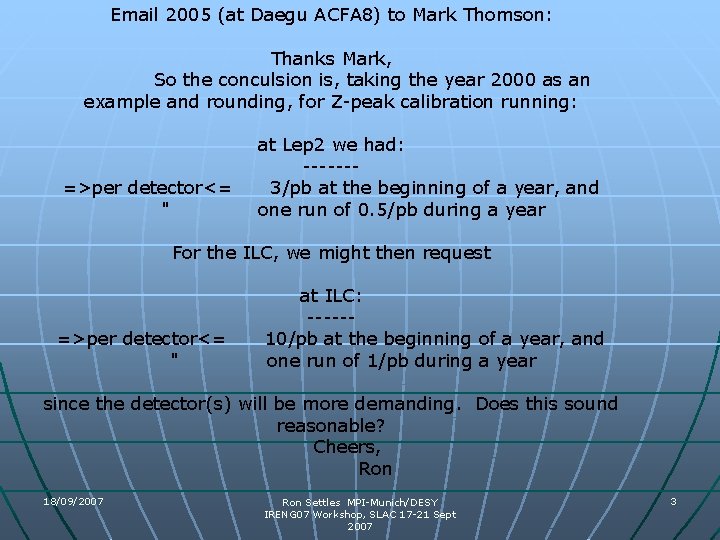
Email 2005 (at Daegu ACFA 8) to Mark Thomson: Thanks Mark, So the conculsion is, taking the year 2000 as an example and rounding, for Z-peak calibration running: =>per detector<= " at Lep 2 we had: ------3/pb at the beginning of a year, and one run of 0. 5/pb during a year For the ILC, we might then request =>per detector<= " at ILC: -----10/pb at the beginning of a year, and one run of 1/pb during a year since the detector(s) will be more demanding. Does this sound reasonable? Cheers, Ron 18/09/2007 Ron Settles MPI-Munich/DESY IRENG 07 Workshop, SLAC 17 -21 Sept 2007 3
Z-peak • So a fundamental question for the ILC machine is: how easy/difficult will it be to run at the Z-peak, if e. g. datataking is at 250 or 350 Ge. V (c. m. s. ) that year? 18/09/2007 Ron Settles MPI-Munich/DESY IRENG 07 Workshop, SLAC 17 -21 Sept 2007 4
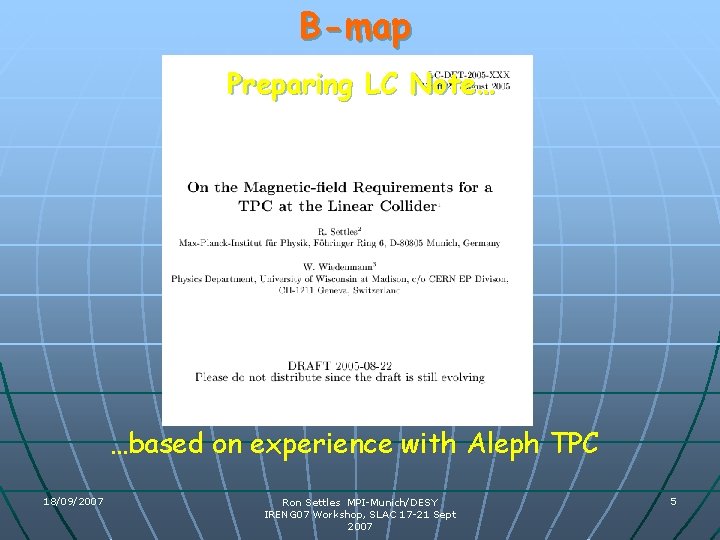
B-map Preparing LC Note… …based on experience with Aleph TPC 18/09/2007 Ron Settles MPI-Munich/DESY IRENG 07 Workshop, SLAC 17 -21 Sept 2007 5
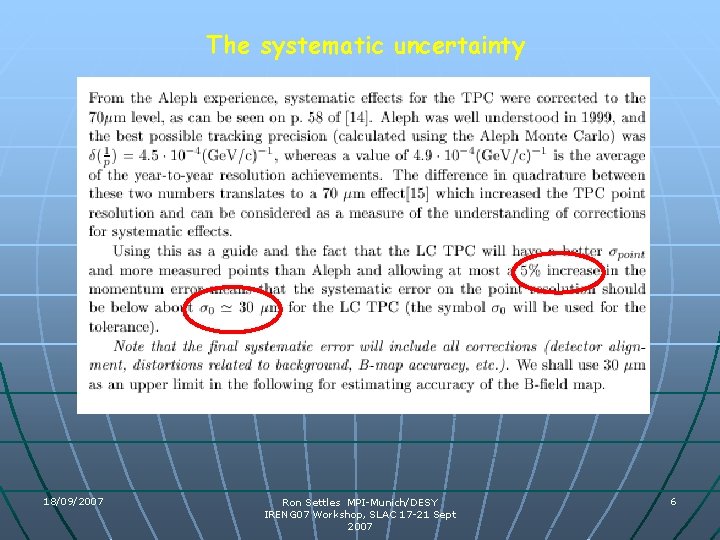
The systematic uncertainty 18/09/2007 Ron Settles MPI-Munich/DESY IRENG 07 Workshop, SLAC 17 -21 Sept 2007 6
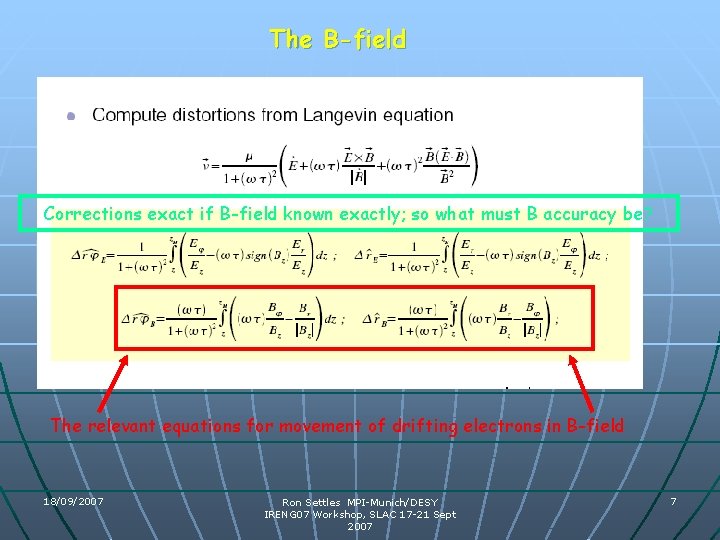
The B-field Corrections exact if B-field known exactly; so what must B accuracy be? The relevant equations for movement of drifting electrons in B-field 18/09/2007 Ron Settles MPI-Munich/DESY IRENG 07 Workshop, SLAC 17 -21 Sept 2007 7
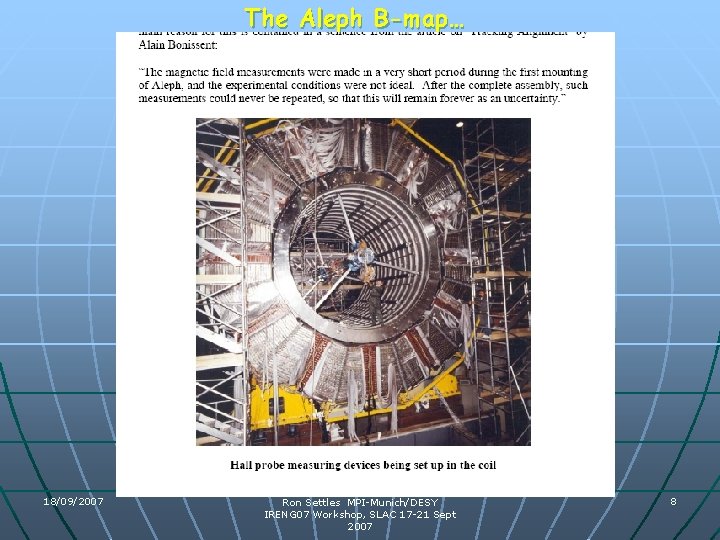
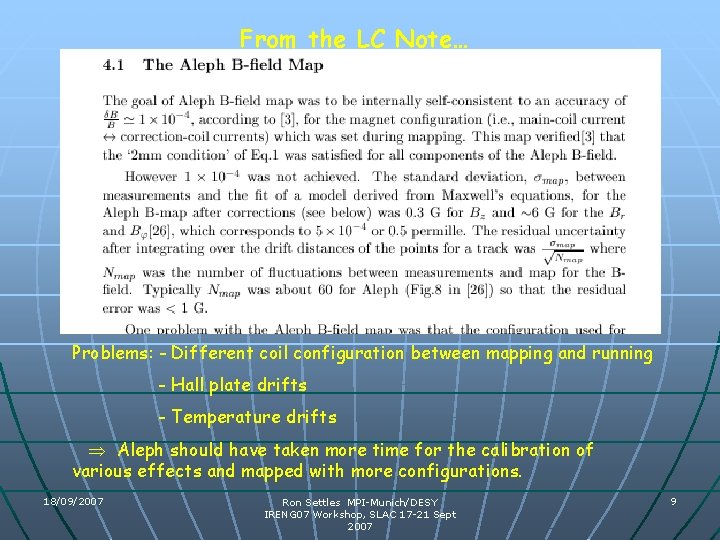
The Aleph B-map… 18/09/2007 Ron Settles MPI-Munich/DESY IRENG 07 Workshop, SLAC 17 -21 Sept 2007 8
From the LC Note… Problems: - Different coil configuration between mapping and running - Hall plate drifts - Temperature drifts Aleph should have taken more time for the calibration of various effects and mapped with more configurations. 18/09/2007 Ron Settles MPI-Munich/DESY IRENG 07 Workshop, SLAC 17 -21 Sept 2007 9
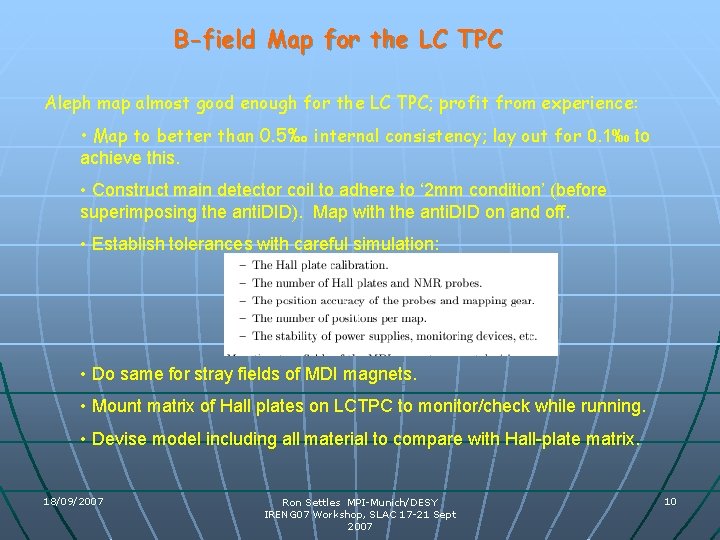
B-field Map for the LC TPC Aleph map almost good enough for the LC TPC; profit from experience: • Map to better than 0. 5‰ internal consistency; lay out for 0. 1‰ to achieve this. • Construct main detector coil to adhere to ‘ 2 mm condition’ (before superimposing the anti. DID). Map with the anti. DID on and off. • Establish tolerances with careful simulation: • Do same for stray fields of MDI magnets. • Mount matrix of Hall plates on LCTPC to monitor/check while running. • Devise model including all material to compare with Hall-plate matrix. 18/09/2007 Ron Settles MPI-Munich/DESY IRENG 07 Workshop, SLAC 17 -21 Sept 2007 10
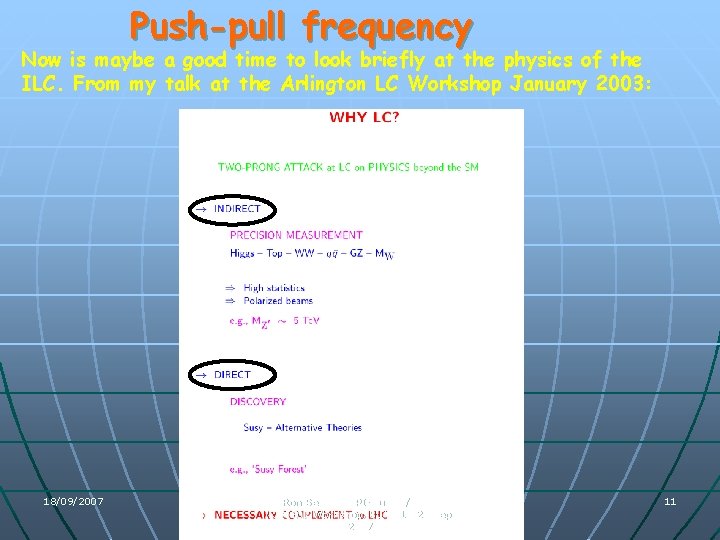
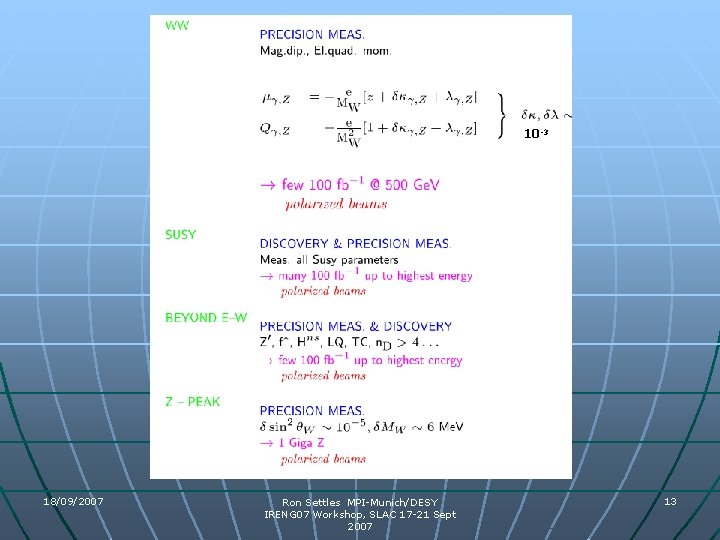
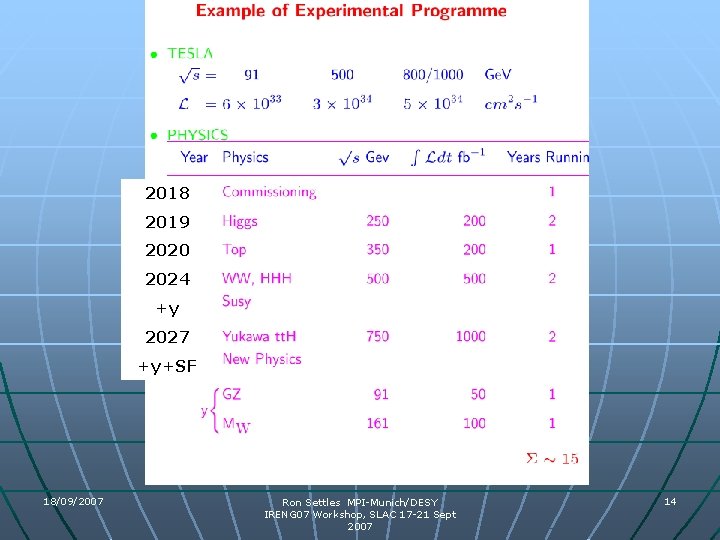
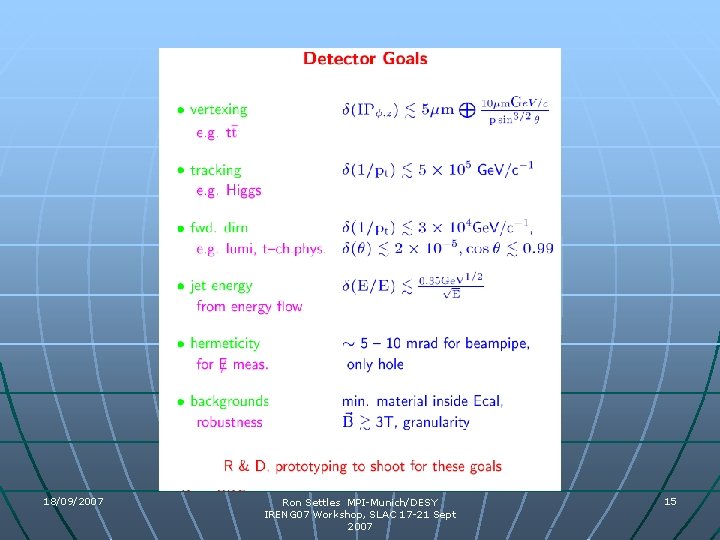
Push-pull frequency Now is maybe a good time to look briefly at the physics of the ILC. From my talk at the Arlington LC Workshop January 2003: 18/09/2007 Ron Settles MPI-Munich/DESY IRENG 07 Workshop, SLAC 17 -21 Sept 2007 11
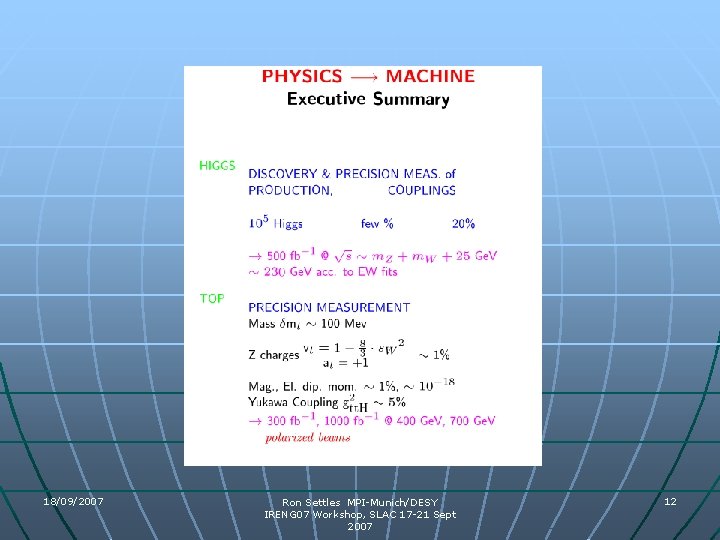
18/09/2007 Ron Settles MPI-Munich/DESY IRENG 07 Workshop, SLAC 17 -21 Sept 2007 12
10 -3 18/09/2007 Ron Settles MPI-Munich/DESY IRENG 07 Workshop, SLAC 17 -21 Sept 2007 13
2018 2019 2020 2024 +y 2027 +y+SF 18/09/2007 Ron Settles MPI-Munich/DESY IRENG 07 Workshop, SLAC 17 -21 Sept 2007 14
18/09/2007 Ron Settles MPI-Munich/DESY IRENG 07 Workshop, SLAC 17 -21 Sept 2007 15
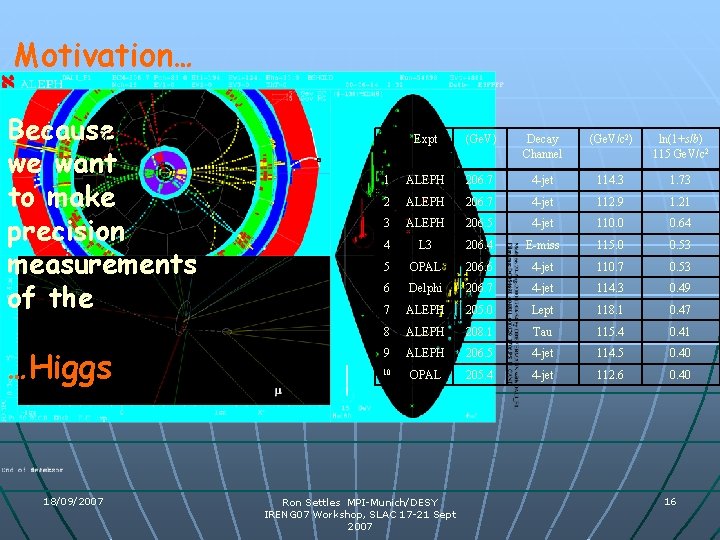
Motivation… Because we want to make precision measurements of the …Higgs 18/09/2007 Expt (Ge. V) Decay Channel (Ge. V/c 2) ln(1+s/b) 115 Ge. V/c 2 1 ALEPH 206. 7 4 -jet 114. 3 1. 73 2 ALEPH 206. 7 4 -jet 112. 9 1. 21 3 ALEPH 206. 5 4 -jet 110. 0 0. 64 4 L 3 206. 4 E-miss 115. 0 0. 53 5 OPAL 206. 6 4 -jet 110. 7 0. 53 6 Delphi 206. 7 4 -jet 114. 3 0. 49 7 ALEPH 205. 0 Lept 118. 1 0. 47 8 ALEPH 208. 1 Tau 115. 4 0. 41 9 ALEPH 206. 5 4 -jet 114. 5 0. 40 10 OPAL 205. 4 4 -jet 112. 6 0. 40 Ron Settles MPI-Munich/DESY IRENG 07 Workshop, SLAC 17 -21 Sept 2007 16
To make progress in understanding, we have to distinguish two different phases: (1) Running for precision measurements (2) Running for discovery 18/09/2007 Ron Settles MPI-Munich/DESY IRENG 07 Workshop, SLAC 17 -21 Sept 2007 17
DISCUSSION (1) Precision measurements -Here frequent change is not so important; once a year is enough unless a detector problem crops up. -A well calibrated detector is essential. For this Z-peak running is one of the most valuable tools we have. At Acfa 8, Mark Thompson and I made the following gestimate for ILC based on Lep 2 experience: -- 10/pb Z-peak at the beginning of a year (after detector maintenance, meaning it had been taken apart and put back together -- 1/pb Z-peak later in case of incidents/accidents during a year. -A similar procedure was followed at Lep 2 every year and was valuable/necessary for all 4 detectors. (At Lep 1 we were running on the Z-peak all the time and therefore were taking calibration data all the time. ) (2) Discovery -Here a frequent change is important, and therefore the change should be as rapid as possible. (For example, at Lep 2 we did this, went through a “Higgs-discovery” mode, where— this is an example for the machine and not the detector--went through frequent cycles of filling to the highest possible energy, running for an hour or two, then refilling rapidly after a beam loss, in 1 -2 hours typically. ) -But we have to remember that at the ILC good MDI teams and a lot of planning/training/experience will be needed to achieve the fastest possible “Formula-1 -Pitstop”-type switch. 18/09/2007 Ron Settles MPI-Munich/DESY IRENG 07 Workshop, SLAC 17 -21 Sept 2007 18
(Aleph) detector maintenance examples • Coil failure • TPC carbon-fiber saga 18/09/2007 Ron Settles MPI-Munich/DESY IRENG 07 Workshop, SLAC 17 -21 Sept 2007 19
Coil failure story told by Pierre Lazyrus at http: //alephwww. cern. ch, click on The Aleph ‘Experience’ for details (and other stories) • At the beginning of January 1994, the coil was at room temperature and a last pressure test showed a very large leak. • Tests indicated that the leak was close to the inlet, 10 m or so from it. • We first opened the valve box, to find that two of the three supports of the 500 l helium vessel were broken; fortunately one was still intact and the piping was keeping the vessel in place quite well, but unfortunately, no leak • The cryogenics chimney connecting the valve box to the vacuum vessel was open and found perfectly tight, but at this moment it was possible to hear the leak when pressurizing the screen pipe. • With the aid of an endoscope and a mirror it was possible to see the leak just at a piece called bibraze, between the aluminium pipe on the screen and the stainless steel pipe coming from the manifold, about 30 cm inside the vacuum vessel. 18/09/2007 Ron Settles MPI-Munich/DESY IRENG 07 Workshop, SLAC 17 -21 Sept 2007 20
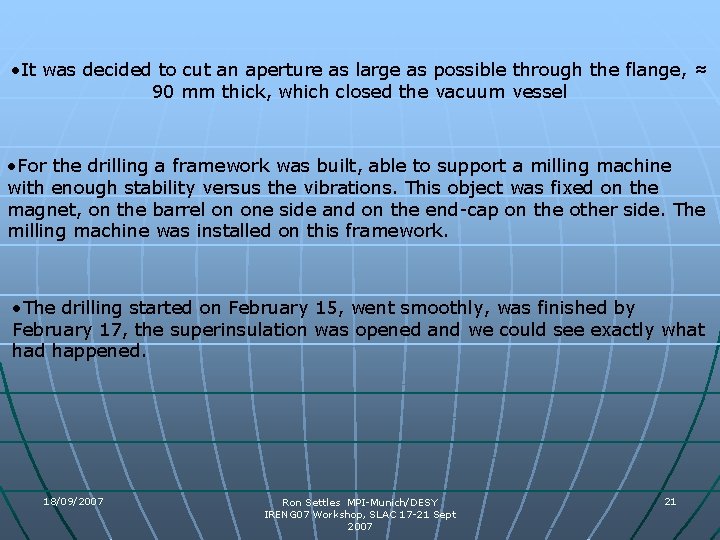
• It was decided to cut an aperture as large as possible through the flange, ≈ 90 mm thick, which closed the vacuum vessel • For the drilling a framework was built, able to support a milling machine with enough stability versus the vibrations. This object was fixed on the magnet, on the barrel on one side and on the end-cap on the other side. The milling machine was installed on this framework. • The drilling started on February 15, went smoothly, was finished by February 17, the superinsulation was opened and we could see exactly what had happened. 18/09/2007 Ron Settles MPI-Munich/DESY IRENG 07 Workshop, SLAC 17 -21 Sept 2007 21
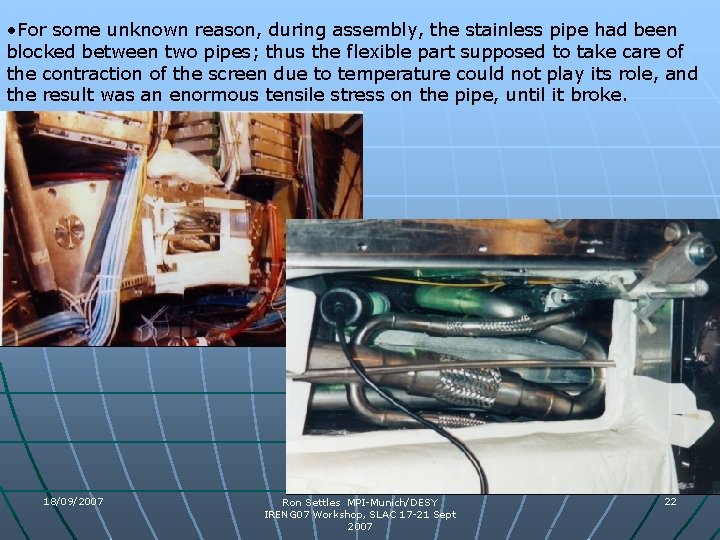
• For some unknown reason, during assembly, the stainless pipe had been blocked between two pipes; thus the flexible part supposed to take care of the contraction of the screen due to temperature could not play its role, and the result was an enormous tensile stress on the pipe, until it broke. 18/09/2007 Ron Settles MPI-Munich/DESY IRENG 07 Workshop, SLAC 17 -21 Sept 2007 22
• Meanwhile, at Saclay, a piece was prepared and tested to replace the broken part. • Finally on March 8 th the new junction was put in place, glued on the screen pipe and then welded at the other end on the manifold. At 16. 45 the repair work was over!!! Conclusion We were very lucky!, because the leak was reachable without doing really major work on Aleph. footnotes 1, 2 ------------footnote 1: Had the leak been somewhere inside the coil cryostat, we would have had to completely dismantle Aleph; from inside out: beam pipe, Si. CAL, LCAL, VDET, ITC, TPC, ECAL, COIL, the open the cryostat, fix the leak, and the reinstall everything in the reverse order. This would have taken at least a year, so that we would have missed all of 1994 data-taking! footnote 2: 1994 was the year of acquiring the highest Z statistics for the SM precision measurements at Lep 1… 18/09/2007 Ron Settles MPI-Munich/DESY IRENG 07 Workshop, SLAC 17 -21 Sept 2007 23
TPC carbon-fiber saga (a. o. t. ) Werner’s talk contains many details, see http: //www. mppmu. mpg. de/~settles/tpc/Cern_LC. pdf 18/09/2007 Ron Settles MPI-Munich/DESY IRENG 07 Workshop, SLAC 17 -21 Sept 2007 24
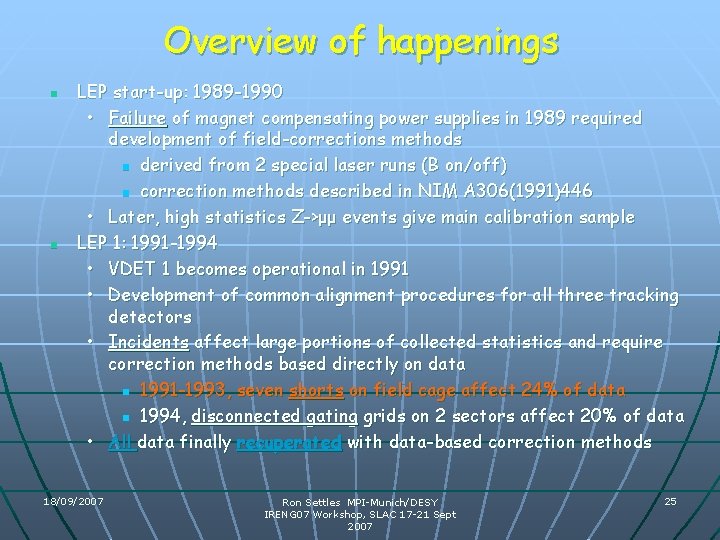
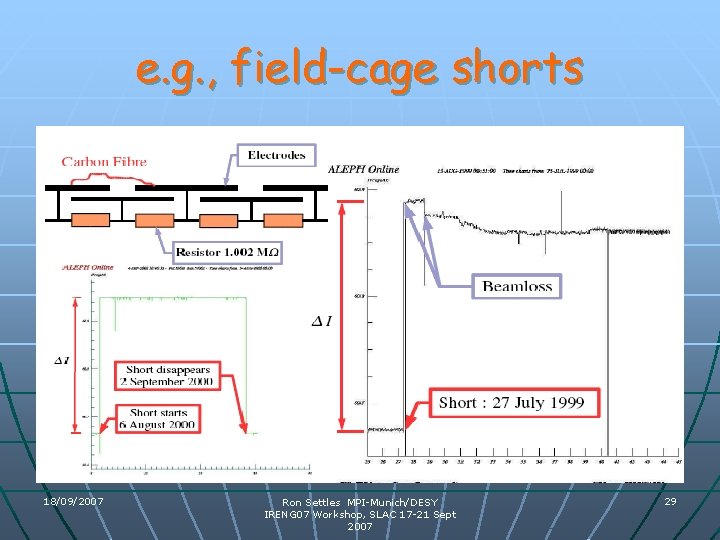
Overview of happenings n n LEP start-up: 1989 -1990 • Failure of magnet compensating power supplies in 1989 required development of field-corrections methods n derived from 2 special laser runs (B on/off) n correction methods described in NIM A 306(1991)446 • Later, high statistics Z->μμ events give main calibration sample LEP 1: 1991 -1994 • VDET 1 becomes operational in 1991 • Development of common alignment procedures for all three tracking detectors • Incidents affect large portions of collected statistics and require correction methods based directly on data n 1991 -1993, seven shorts on field cage affect 24% of data n 1994, disconnected gating grids on 2 sectors affect 20% of data • All data finally recuperated with data-based correction methods 18/09/2007 Ron Settles MPI-Munich/DESY IRENG 07 Workshop, SLAC 17 -21 Sept 2007 25
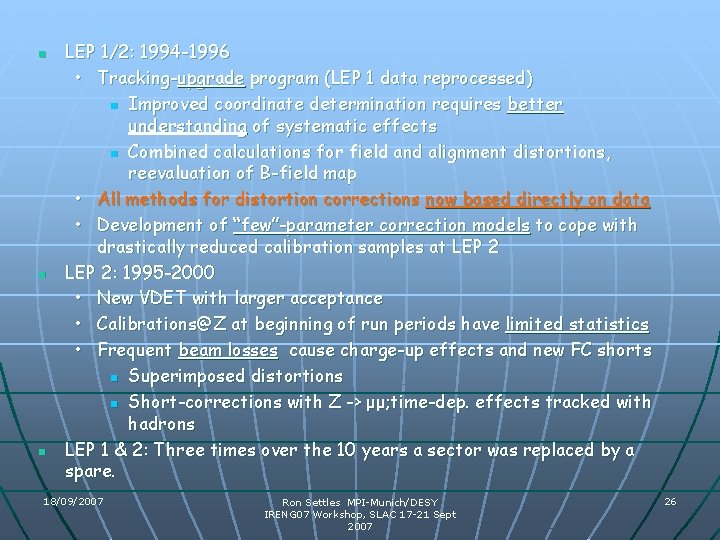
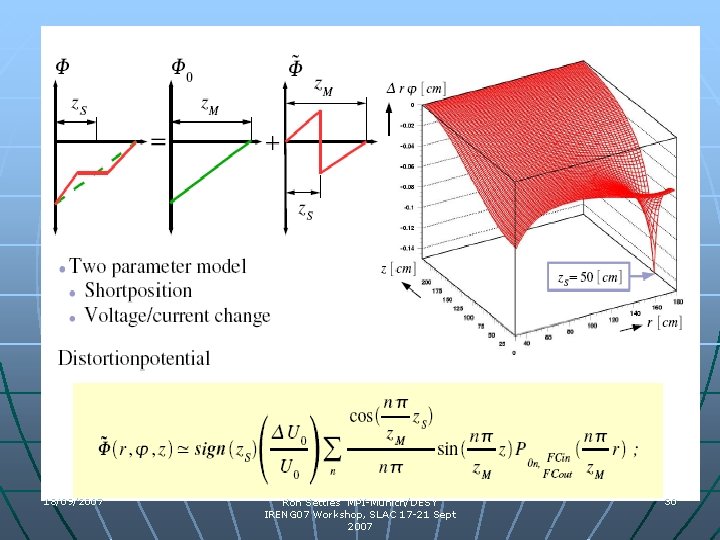
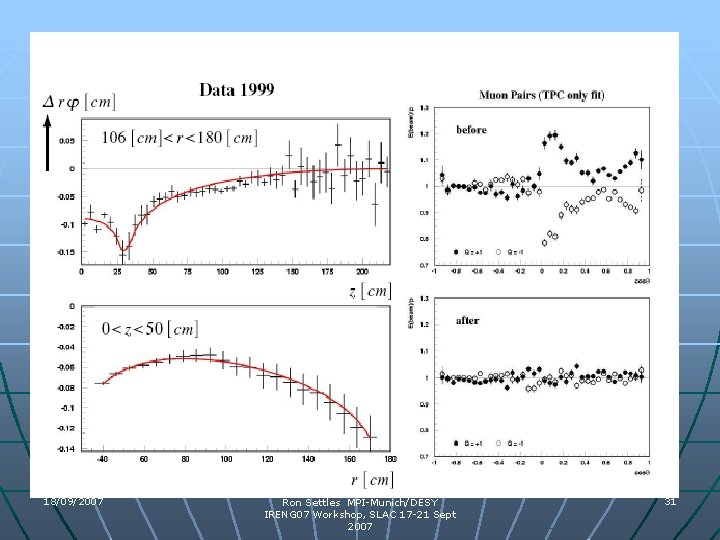
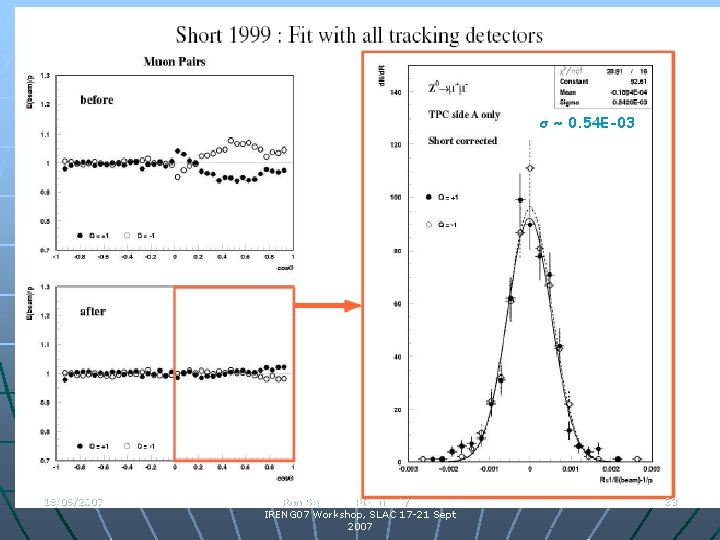
n n n LEP 1/2: 1994 -1996 • Tracking-upgrade program (LEP 1 data reprocessed) n Improved coordinate determination requires better understanding of systematic effects n Combined calculations for field and alignment distortions, reevaluation of B-field map • All methods for distortion corrections now based directly on data • Development of “few”-parameter correction models to cope with drastically reduced calibration samples at LEP 2: 1995 -2000 • New VDET with larger acceptance • Calibrations@Z at beginning of run periods have limited statistics • Frequent beam losses cause charge-up effects and new FC shorts n Superimposed distortions n Short-corrections with Z -> μμ; time-dep. effects tracked with hadrons LEP 1 & 2: Three times over the 10 years a sector was replaced by a spare. 18/09/2007 Ron Settles MPI-Munich/DESY IRENG 07 Workshop, SLAC 17 -21 Sept 2007 26
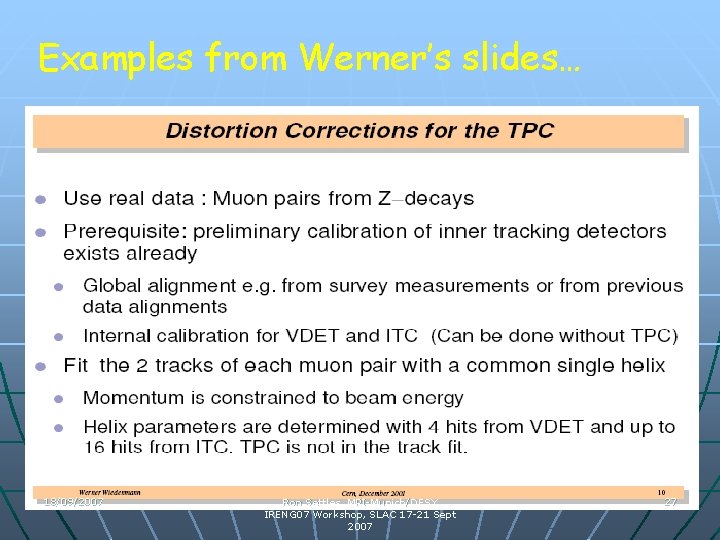
Examples from Werner’s slides… 18/09/2007 Ron Settles MPI-Munich/DESY IRENG 07 Workshop, SLAC 17 -21 Sept 2007 27
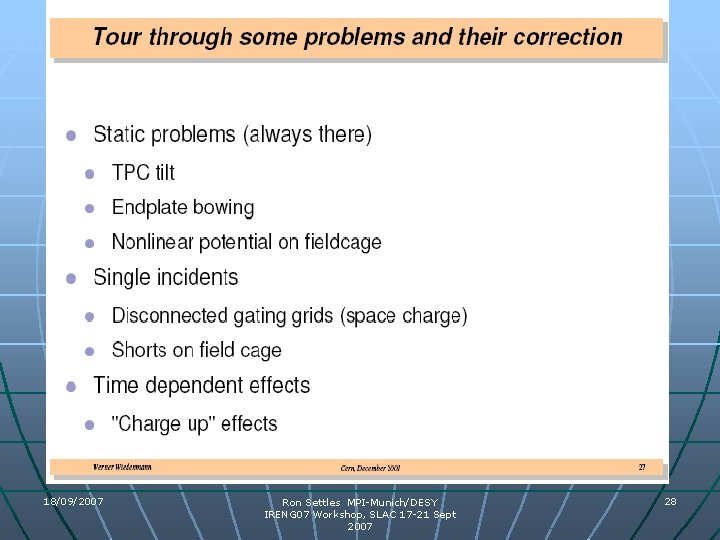
18/09/2007 Ron Settles MPI-Munich/DESY IRENG 07 Workshop, SLAC 17 -21 Sept 2007 28
e. g. , field-cage shorts 18/09/2007 Ron Settles MPI-Munich/DESY IRENG 07 Workshop, SLAC 17 -21 Sept 2007 29
18/09/2007 Ron Settles MPI-Munich/DESY IRENG 07 Workshop, SLAC 17 -21 Sept 2007 30
18/09/2007 Ron Settles MPI-Munich/DESY IRENG 07 Workshop, SLAC 17 -21 Sept 2007 31
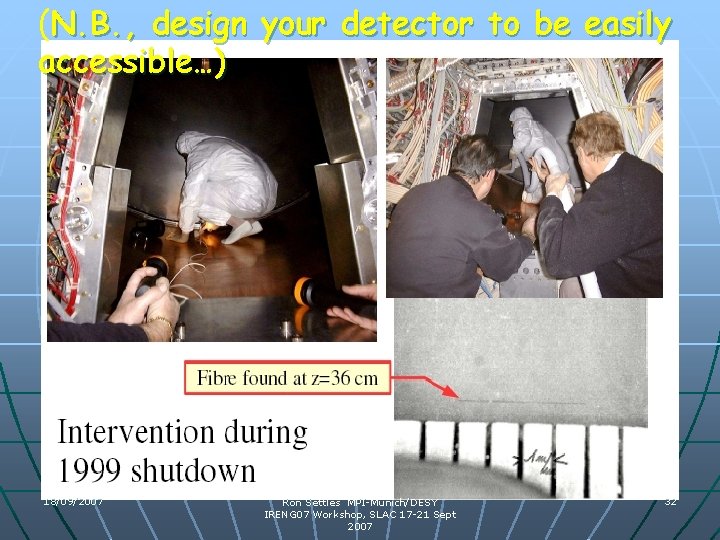
(N. B. , design your detector to be easily accessible…) 18/09/2007 Ron Settles MPI-Munich/DESY IRENG 07 Workshop, SLAC 17 -21 Sept 2007 32
σ ~ 0. 54 E-03 18/09/2007 Ron Settles MPI-Munich/DESY IRENG 07 Workshop, SLAC 17 -21 Sept 2007 33
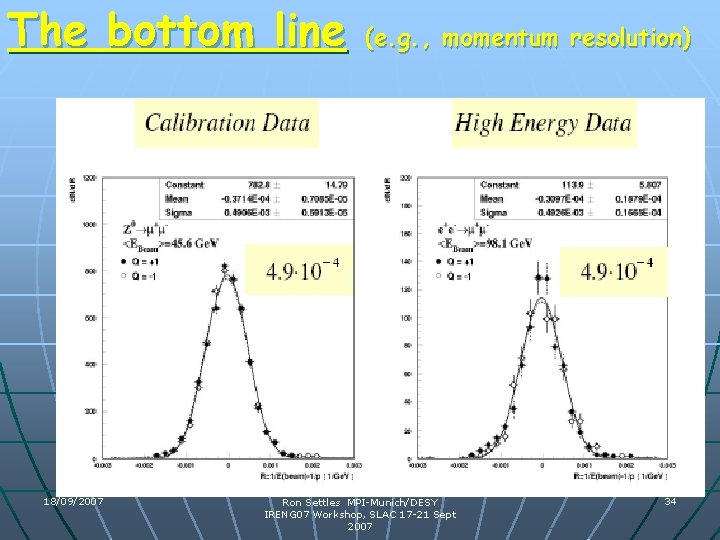
The bottom line 18/09/2007 (e. g. , momentum resolution) Ron Settles MPI-Munich/DESY IRENG 07 Workshop, SLAC 17 -21 Sept 2007 34
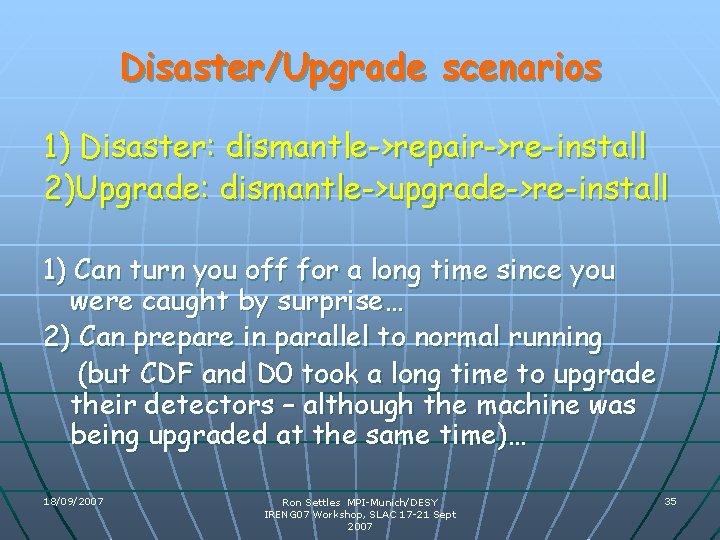
Disaster/Upgrade scenarios 1) Disaster: dismantle->repair->re-install 2)Upgrade: dismantle->upgrade->re-install 1) Can turn you off for a long time since you were caught by surprise… 2) Can prepare in parallel to normal running (but CDF and D 0 took a long time to upgrade their detectors – although the machine was being upgraded at the same time)… 18/09/2007 Ron Settles MPI-Munich/DESY IRENG 07 Workshop, SLAC 17 -21 Sept 2007 35
1. Conclusion -Design your detector/subdetectors to be as accessible as possible so that you can get in and fix them -What else? 18/09/2007 Ron Settles MPI-Munich/DESY IRENG 07 Workshop, SLAC 17 -21 Sept 2007 36