
Discussion of Pictorial Structures Pedro Felzenszwalb Daniel Huttenlocher

Discussion of Pictorial Structures Pedro Felzenszwalb Daniel Huttenlocher Sicily Workshop September, 2006
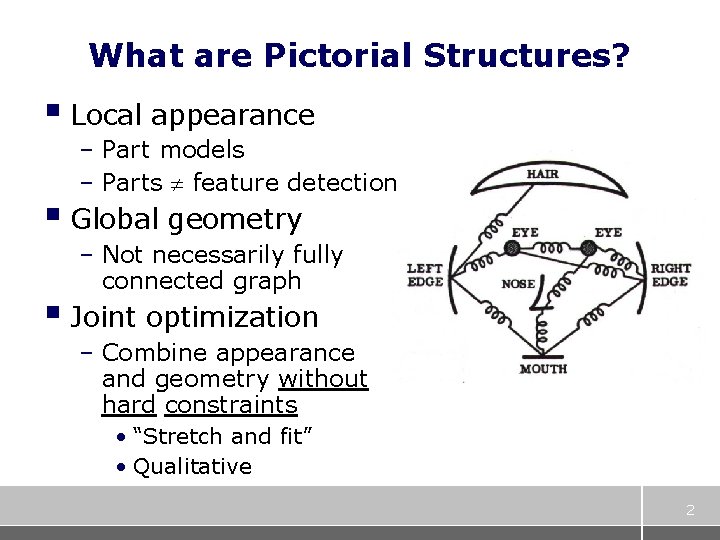
What are Pictorial Structures? § Local appearance – Part models – Parts feature detection § Global geometry – Not necessarily fully connected graph § Joint optimization – Combine appearance and geometry without hard constraints • “Stretch and fit” • Qualitative 2
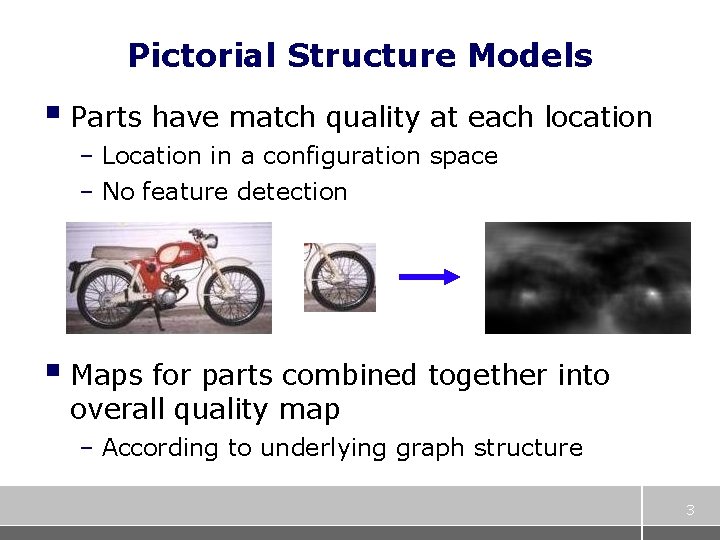
Pictorial Structure Models § Parts have match quality at each location – Location in a configuration space – No feature detection § Maps for parts combined together into overall quality map – According to underlying graph structure 3
A History of Pictorial Structures § Fischler and Elschlager original 1973 paper § Burl, Weber and Perona ECCV 1998 – Probabilistic formulation – Full joint Gaussian spatial model – Computational challenges led to feature-based § Felzenszwalb and Huttenlocher CVPR 2000 – Explicit revisiting of FE 73 for trees, probabilistic – Efficient algorithms using distance transforms § Crandall et al CVPR 2005, ECCV 2006 – Low tree-width graph structures, unsupervised 4

Matching Pictorial Structures § Cost map for each part § Distance transform (soft max) using spatial model § Shift and combine – Localize root then recursively other parts 5

Learning Models § Automatically determine which spatial relationships to represent [FH 03] § Weakly supervised learning [CH 06] – Learn part appearance and geometric relations simultaneously – No labeling of part locations – Use large number of patches, similar to Ullman – Better detection accuracy than strongly supervised Car (rear) star topology 6
Parts as Context § No part detected without using context provided by other parts – Detect overall configuration composed of parts in a spatial arrangement § Allows for weak evidence for a part – Unlike feature detection § Combination of matches can constrain pose § In contrast to scene-level context – More spatial regularity 7
Factored Models § For n parts in fixed arrangement with k templates per part – Exponential number of possibilities, O(kn) § For variable arrangement, another exponential factor § Important both for representation and algorithmic efficiency § Pictorial structures takes particular advantage of this factoring 8
Closely Related Work § Ioffe and Forsyth, Ramanan and Forsyth human body pose – Part detection but very “dense” part locations § Constellation models – Fergus, Perona, Zisserman and others – Hard feature detection in contrast with BWP 98 soft feature matching § Amit’s patch models – No assumption of independent part appearance § Fergus and Zisserman star models 9
What’s Important § No decisions until the end – No feature detection • Quality maps or likelihoods – No hard geometric constraints • Deformation costs or priors § Efficient algorithms – Dynamic programming critical or can’t get away without making intermediate decisions – Not applicable to all problems, need good factorizations of geometry and appearance 10
Some Pros § § Good for categorical object recognition – Qualitative descriptions of appearance – Factoring variability in appearance and geometry Deals well with occlusion – In contrast to hard feature detection Weakly supervised learning algorithms Sampling as way of dealing with models that don’t factor – more Saturday 11
Some Cons/Limitations § Most applicable to 2 D objects defined by relatively small number of parts § Unclear how to extend to large number of transformation parameters per part – Explicit representation grows exponentially § No known way of using to index into model databases 12
Role of Spatial Constraints § For k-fans, spatial information substantially improves detection accuracy – However, limited by relatively small number of parts compared to features in a bag § General question 13
- Slides: 13