
Discussion of CLPC by PCAMAP IE for TDD
Discussion of CLPC by PC-A-MAP IE for TDD and FDD IEEE 802. 16 Presentation Submission Template (Rev. 9) Document Number: IEEE S 802. 16 m-09/2661 Date Submitted: 2009 -11 -15 Source: Rongzhen Yang, Hujun Yin Yang-seok Choi, Apostolos Papathanassiou , Amir Rubin| Intel Corporation E-mail: Rongzhen. Yang@intel. com Wilson Tim Motorola Inc. E-mail: Tim. Wilson@motorola. com Kiran Kuchi Ce. Wi. T E-mail: kkuchi@cewit. org. in Yan-Xiu Zheng ITRI E-mail: zhengyanxiu@itri. org. tw Yih-Shen Chen Media. Tek E-mail: yihshen. chen@mediatek. com Huiying Fang ZTE Corporation E-mail: fang. huiying@zte. com. cn Venue: . RE: Comments on P 802. 16 m/D 2 Purpose: To be discussed and adopted into P 802. 16 m/D 2 by WG LB Notice: This document does not represent the agreed views of the IEEE 802. 16 Working Group or any of its subgroups. It represents only the views of the participants listed in
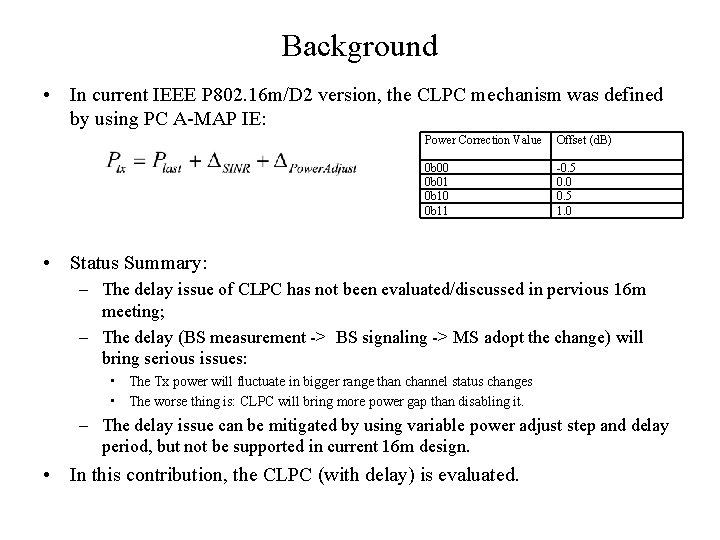
Background • In current IEEE P 802. 16 m/D 2 version, the CLPC mechanism was defined by using PC A-MAP IE: Power Correction Value Offset (d. B) 0 b 00 0 b 01 0 b 10 0 b 11 -0. 5 0. 0 0. 5 1. 0 • Status Summary: – The delay issue of CLPC has not been evaluated/discussed in pervious 16 m meeting; – The delay (BS measurement -> BS signaling -> MS adopt the change) will bring serious issues: • The Tx power will fluctuate in bigger range than channel status changes • The worse thing is: CLPC will bring more power gap than disabling it. – The delay issue can be mitigated by using variable power adjust step and delay period, but not be supported in current 16 m design. • In this contribution, the CLPC (with delay) is evaluated.
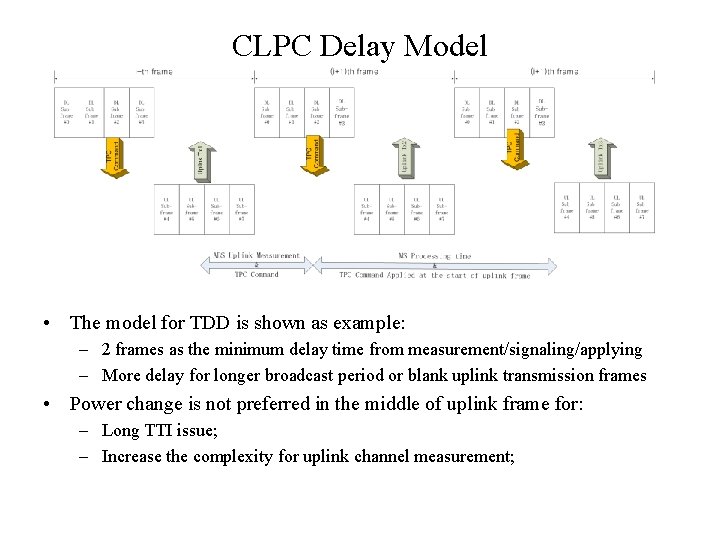
CLPC Delay Model • The model for TDD is shown as example: – 2 frames as the minimum delay time from measurement/signaling/applying – More delay for longer broadcast period or blank uplink transmission frames • Power change is not preferred in the middle of uplink frame for: – Long TTI issue; – Increase the complexity for uplink channel measurement;
CLPC Power Tracking Evaluation • Because CLPC is target to compensate the fast channel fading change: – IMT-Adv UMa 120 km/h is selected for the study – 10 Mhz bandwidth, 1 x 4 antenna configuration • It is assumed that: – CLPC is updated per-frame as its maximum ability. – CLPC try to compensate the received SINR difference at each frame: 1) 2) 3) Measure the uplink current frame received signal PSD TPC commend sent for adjustment base on current frame measurement result The TPC commend will be applied to MS for the pathloss compensation at “Delayed” frame – Power Change Step is fixed at [-0. 5, 0, 0. 5, 1] d. B • Different CLPC delay is evaluated: 1, 2, 3, 4 frames. • The power tracking error CDF is compared with OLPC only model
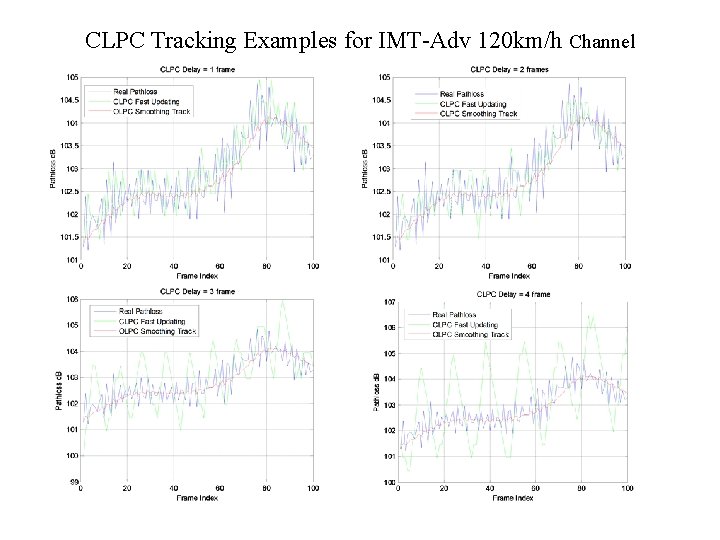
CLPC Tracking Examples for IMT-Adv 120 km/h Channel
Power Tracking Error CDF Comparison • By using the direct compensation method with fixed step, CLPC performance is worse than OLPC only • With variable step size and period, CLPC is still hard to maintain good stability and fast convergence.
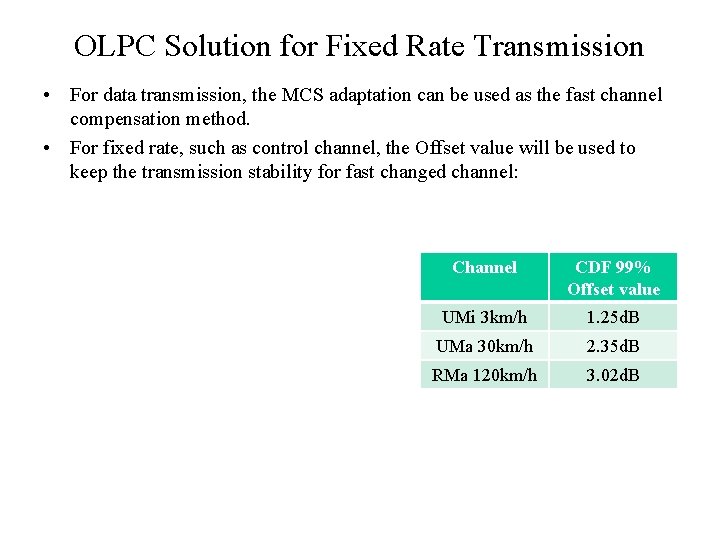
OLPC Solution for Fixed Rate Transmission • For data transmission, the MCS adaptation can be used as the fast channel compensation method. • For fixed rate, such as control channel, the Offset value will be used to keep the transmission stability for fast changed channel: Channel CDF 99% Offset value UMi 3 km/h 1. 25 d. B UMa 30 km/h 2. 35 d. B RMa 120 km/h 3. 02 d. B
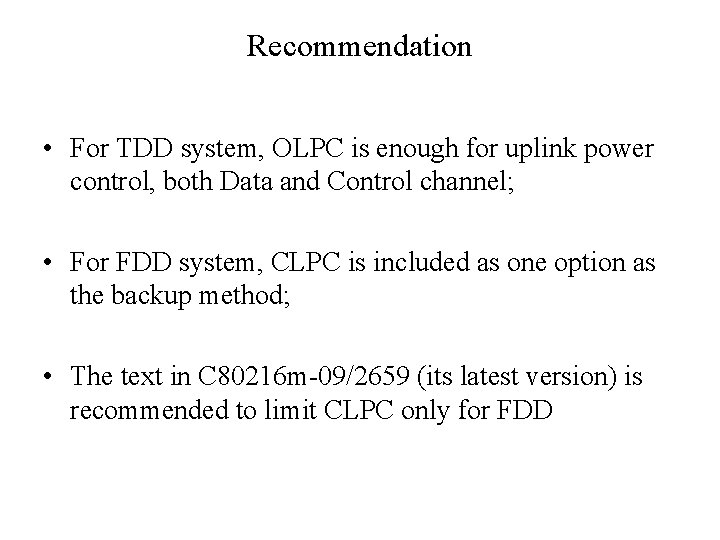
Recommendation • For TDD system, OLPC is enough for uplink power control, both Data and Control channel; • For FDD system, CLPC is included as one option as the backup method; • The text in C 80216 m-09/2659 (its latest version) is recommended to limit CLPC only for FDD
- Slides: 8