
DISCUSSION 4 EECS 183 Hannah Westra Upcoming Deadlines
- Slides: 22
DISCUSSION 4 EECS 183 Hannah Westra
Upcoming Deadlines ◦ Assignment 2 due September 29 th (this Friday) ◦ Project 2 will be due October 7 th (a week from Friday) ◦ Get started early!
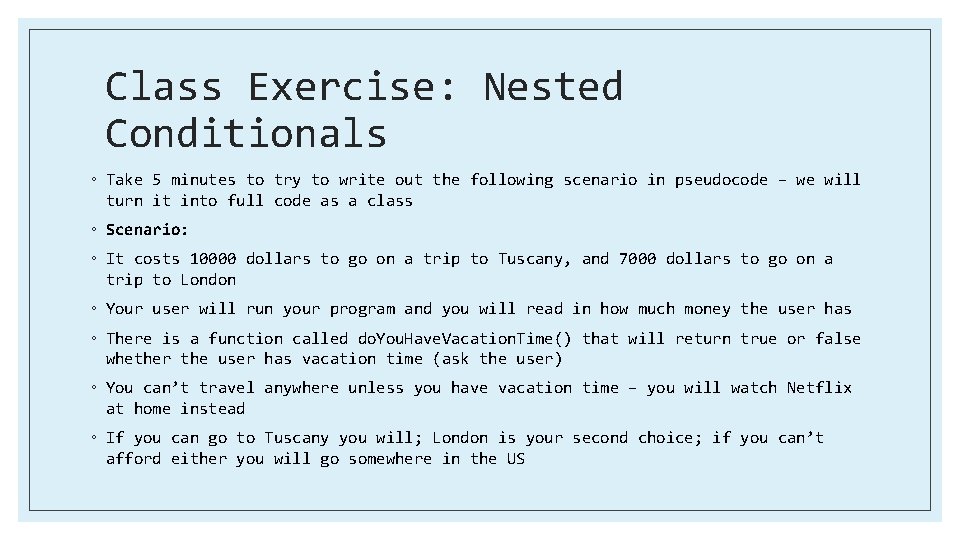
Class Exercise: Nested Conditionals ◦ Take 5 minutes to try to write out the following scenario in pseudocode – we will turn it into full code as a class ◦ Scenario: ◦ It costs 10000 dollars to go on a trip to Tuscany, and 7000 dollars to go on a trip to London ◦ Your user will run your program and you will read in how much money the user has ◦ There is a function called do. You. Have. Vacation. Time() that will return true or false whether the user has vacation time (ask the user) ◦ You can’t travel anywhere unless you have vacation time – you will watch Netflix at home instead ◦ If you can go to Tuscany you will; London is your second choice; if you can’t afford either you will go somewhere in the US
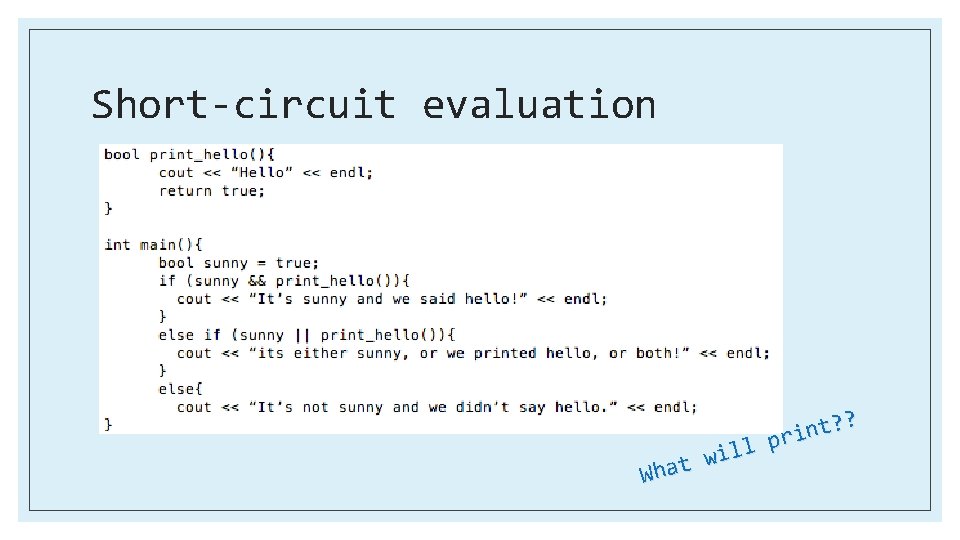
Short-circuit evaluation ? ? t n i pr l l wi t a Wh
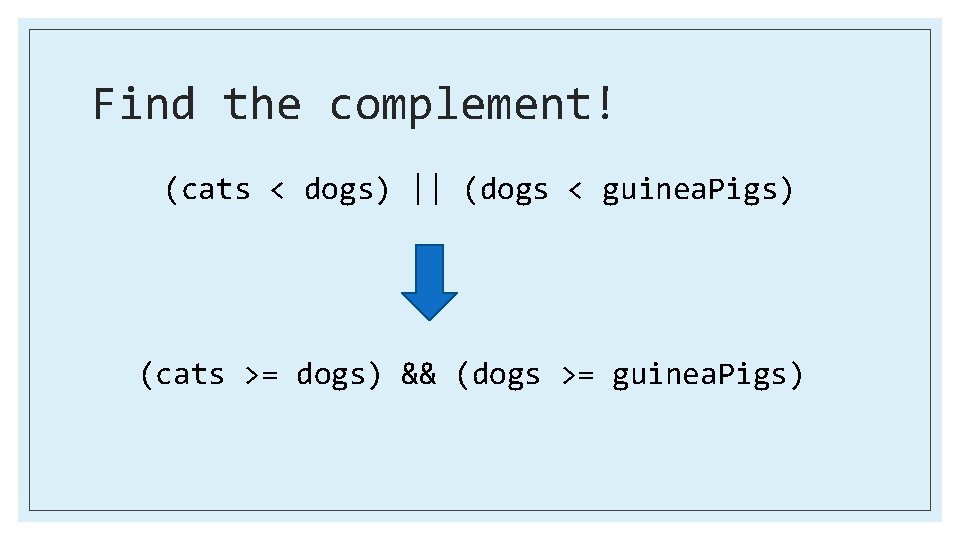
Find the complement! (cats < dogs) || (dogs < guinea. Pigs) (cats >= dogs) && (dogs >= guinea. Pigs)
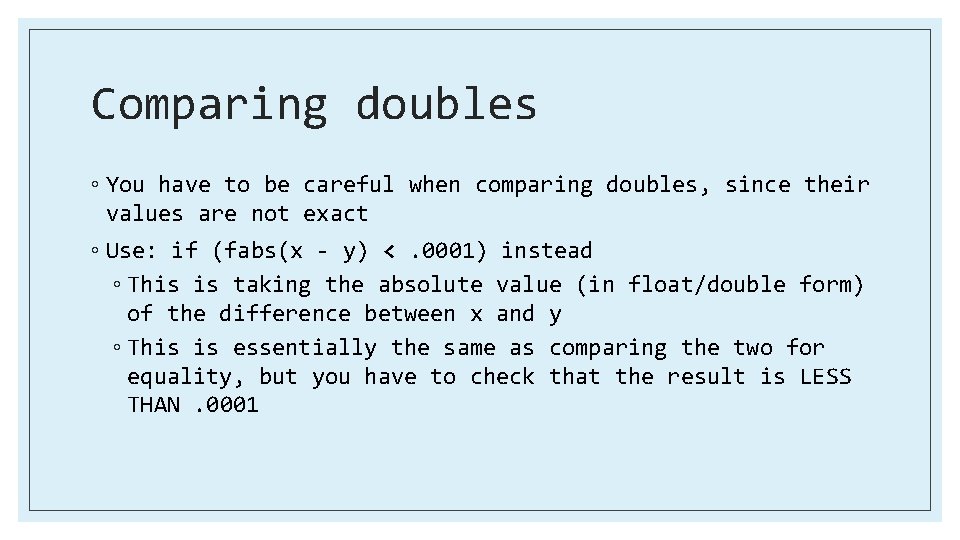
Comparing doubles ◦ You have to be careful when comparing doubles, since their values are not exact ◦ Use: if (fabs(x - y) <. 0001) instead ◦ This is taking the absolute value (in float/double form) of the difference between x and y ◦ This is essentially the same as comparing the two for equality, but you have to check that the result is LESS THAN. 0001
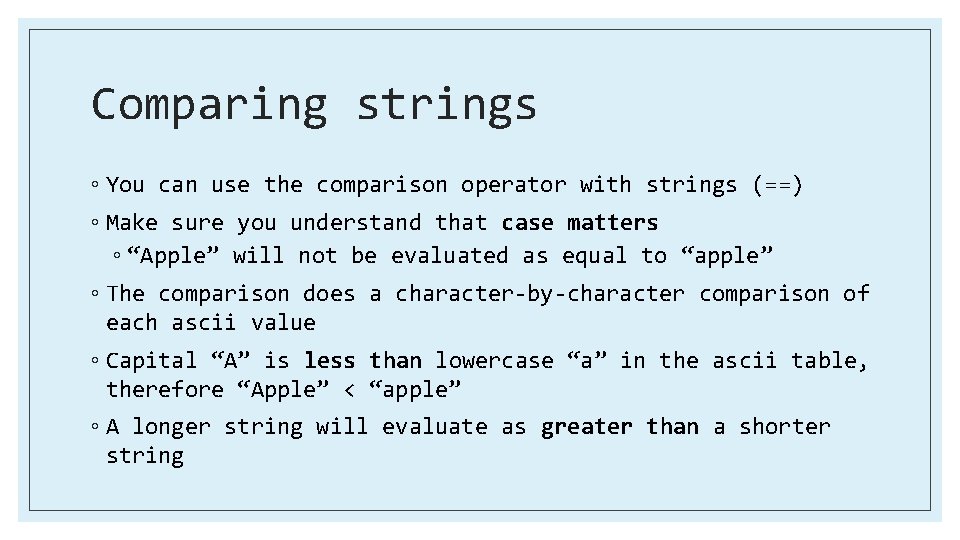
Comparing strings ◦ You can use the comparison operator with strings (==) ◦ Make sure you understand that case matters ◦ “Apple” will not be evaluated as equal to “apple” ◦ The comparison does a character-by-character comparison of each ascii value ◦ Capital “A” is less than lowercase “a” in the ascii table, therefore “Apple” < “apple” ◦ A longer string will evaluate as greater than a shorter string
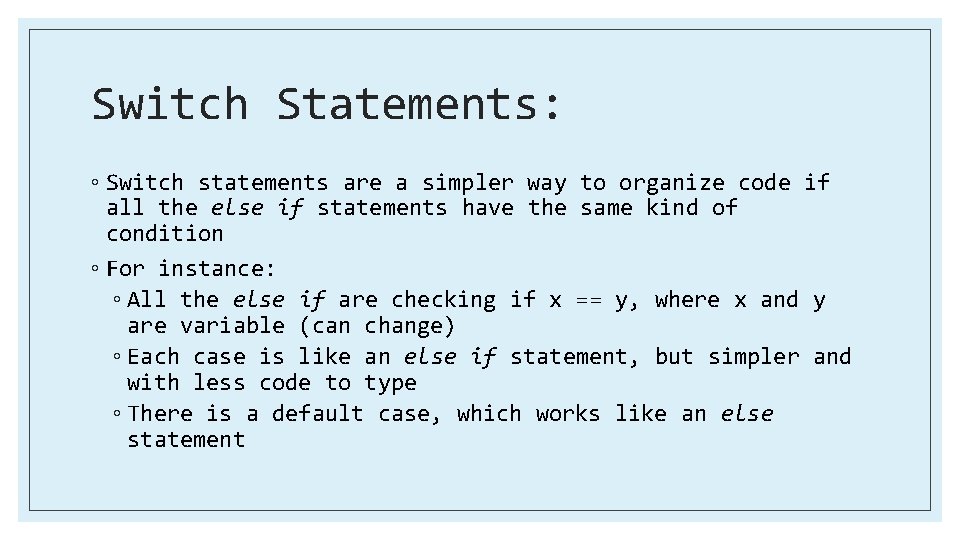
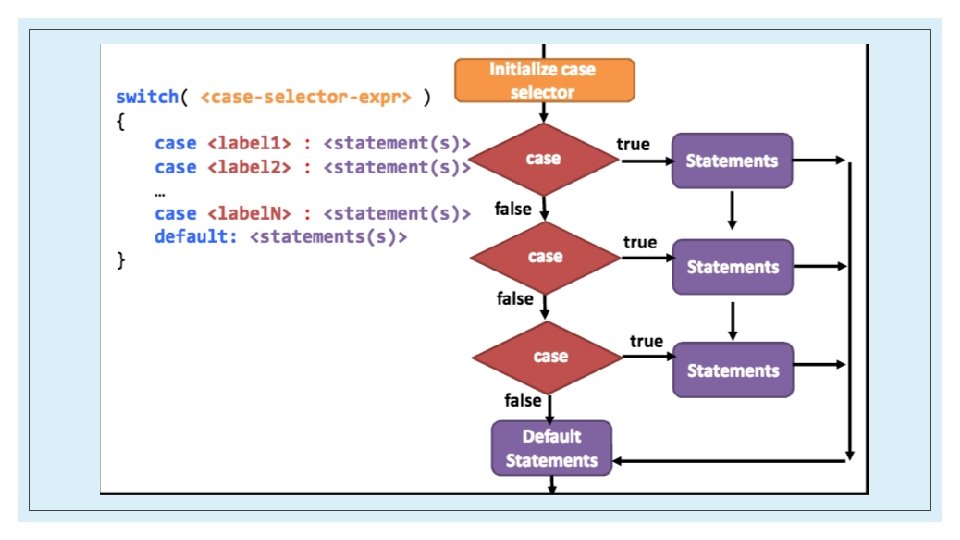
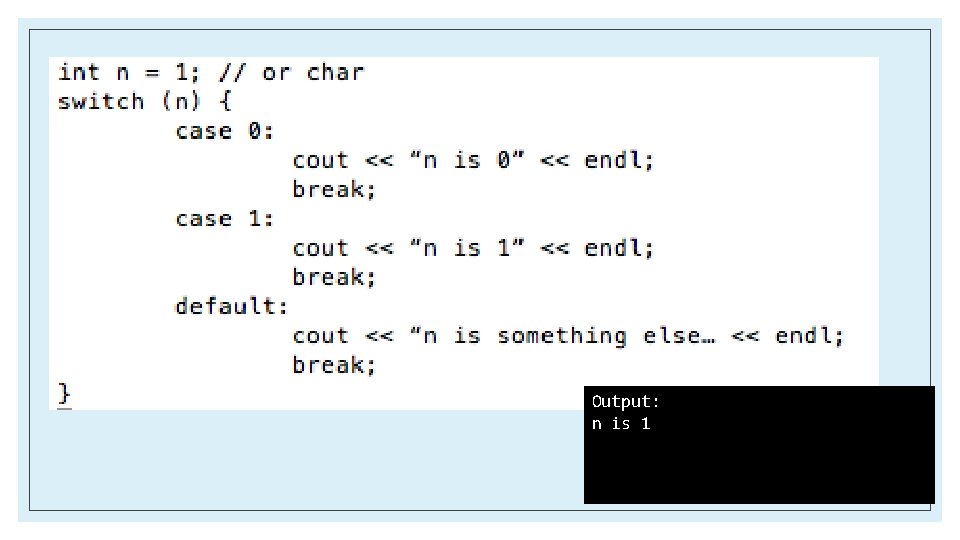
Switch Statements: ◦ Switch statements are a simpler way to organize code if all the else if statements have the same kind of condition ◦ For instance: ◦ All the else if are checking if x == y, where x and y are variable (can change) ◦ Each case is like an else if statement, but simpler and with less code to type ◦ There is a default case, which works like an else statement
Output: n is 1
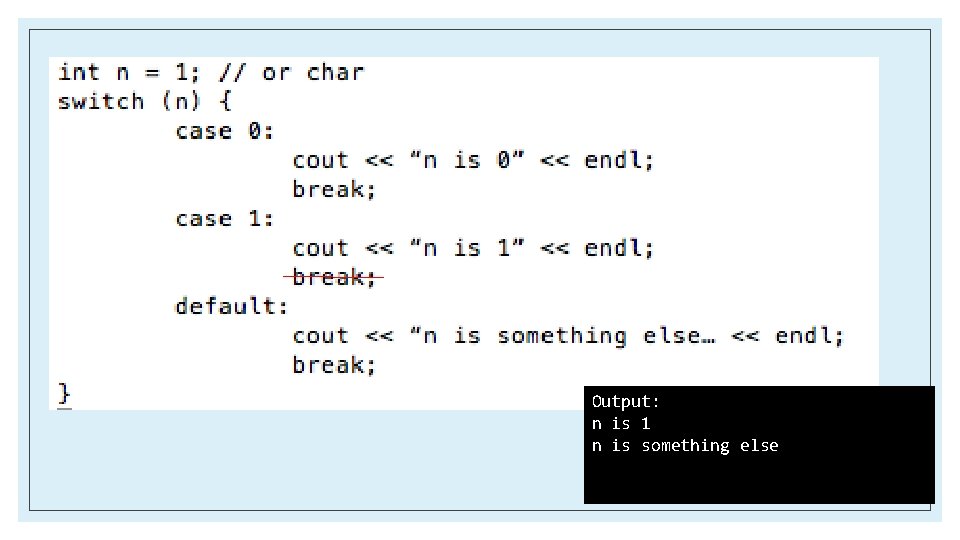
Switches ◦ A switch statement can only have an integer or char value as the condition ◦ If you are comparing strings, a switch statement is not the way to go – use branching instead ◦ The ‘break’ tells the program that the work for that case is done, and the switch statement should be exited ◦ What happens if the break isn’t there? ◦ The program execution will fall through to the next case of the switch statement
Output: n is 1 n is something else
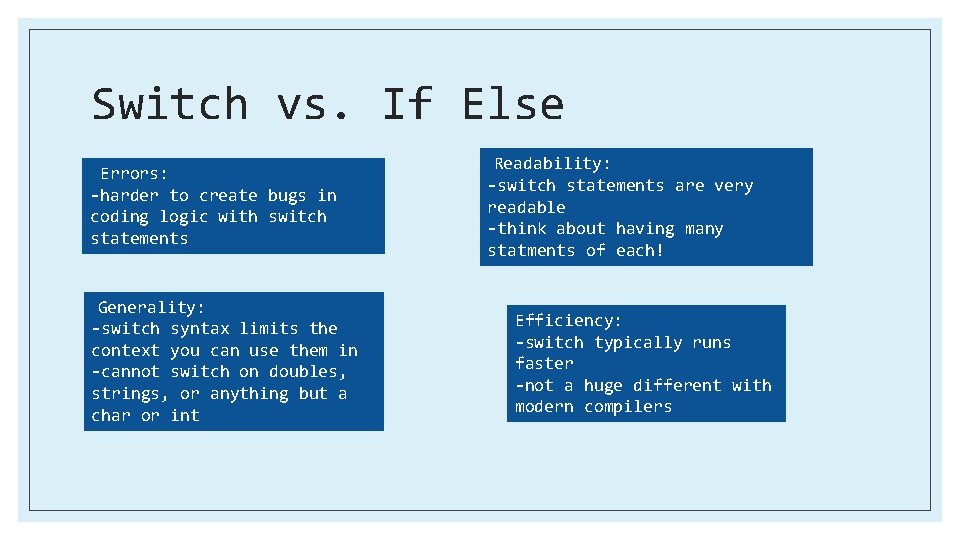
Switch vs. If Else Errors: -harder to create bugs in coding logic with switch statements Generality: -switch syntax limits the context you can use them in -cannot switch on doubles, strings, or anything but a char or int Readability: -switch statements are very readable -think about having many statments of each! Efficiency: -switch typically runs faster -not a huge different with modern compilers
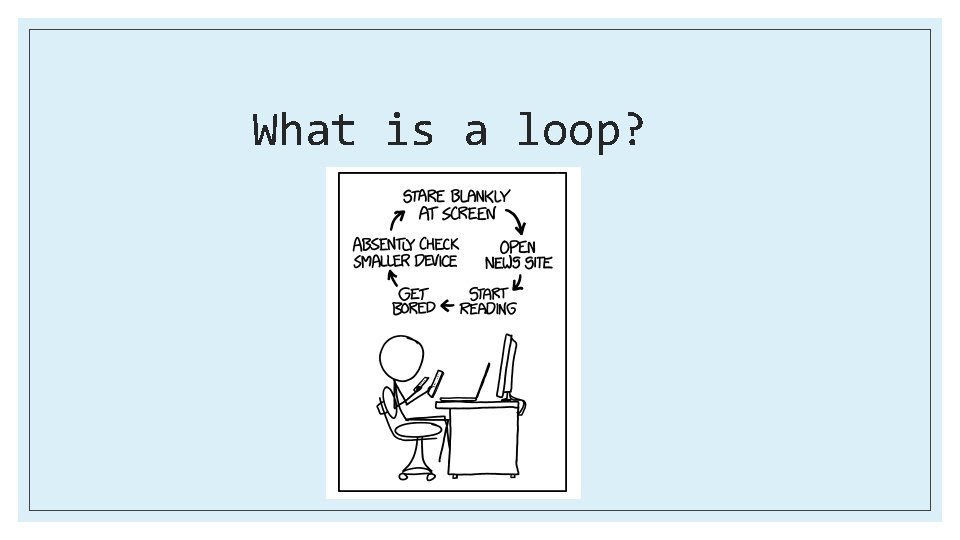
What is a loop?
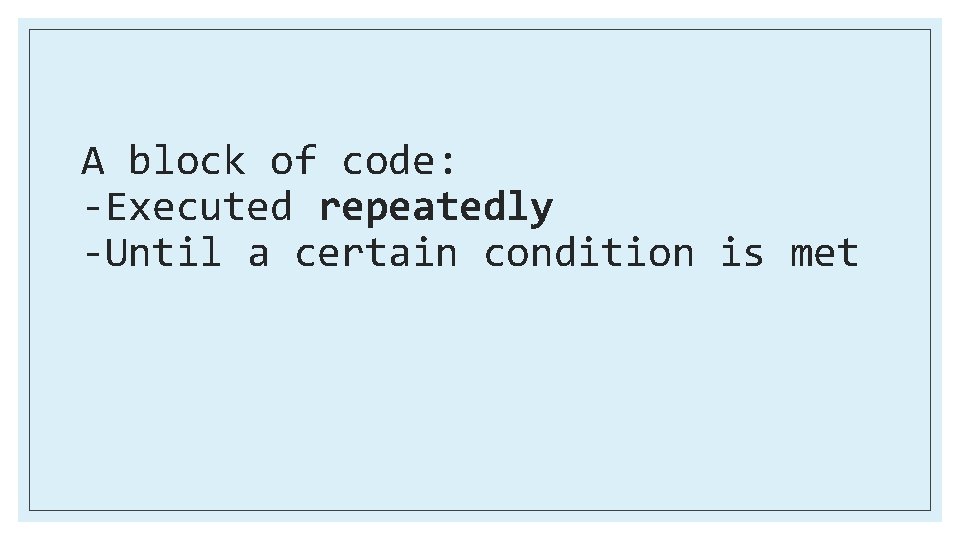
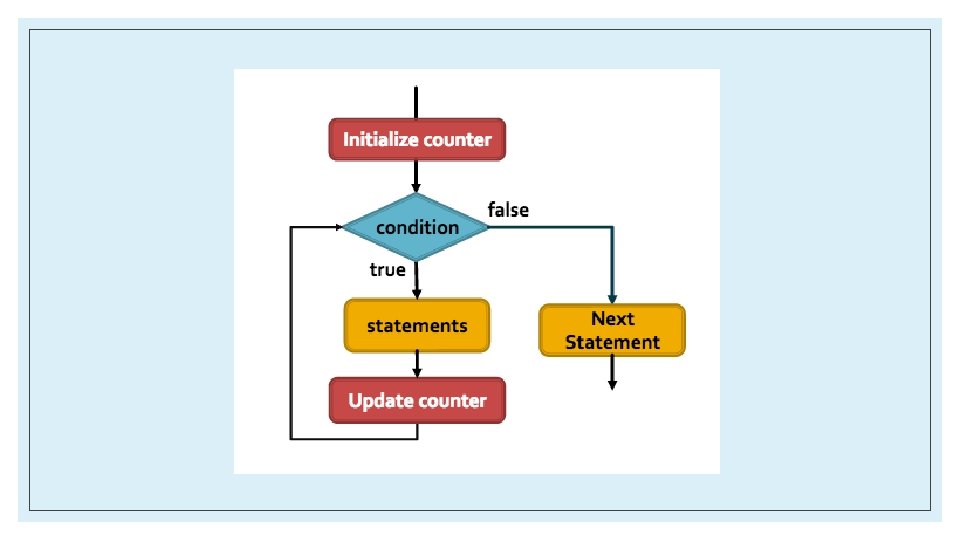
A block of code: -Executed repeatedly -Until a certain condition is met
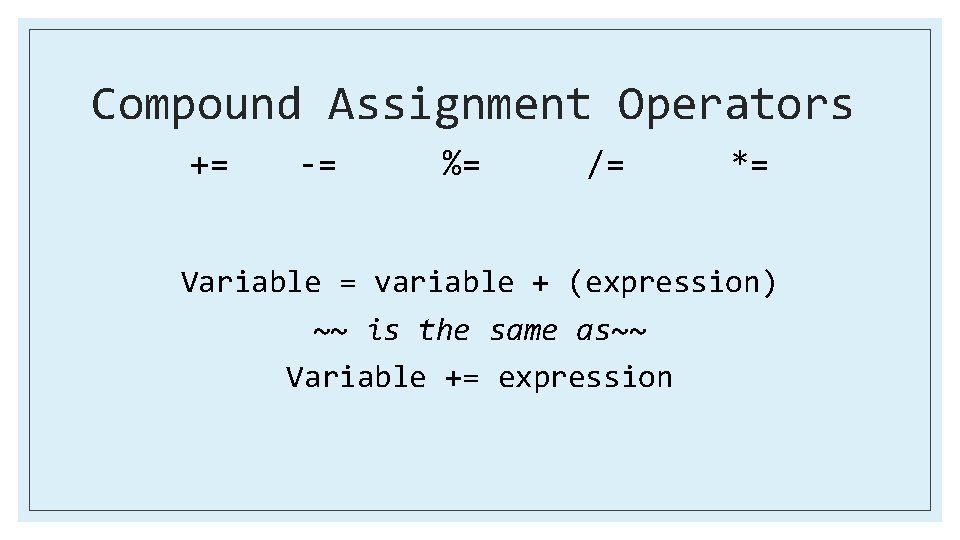
Compound Assignment Operators += -= %= /= *= Variable = variable + (expression) ~~ is the same as~~ Variable += expression
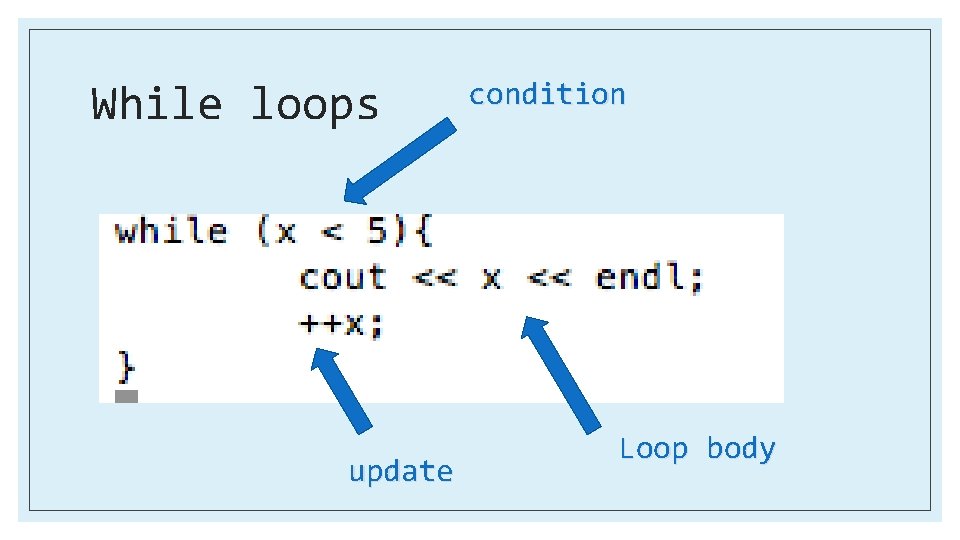
While loops update condition Loop body
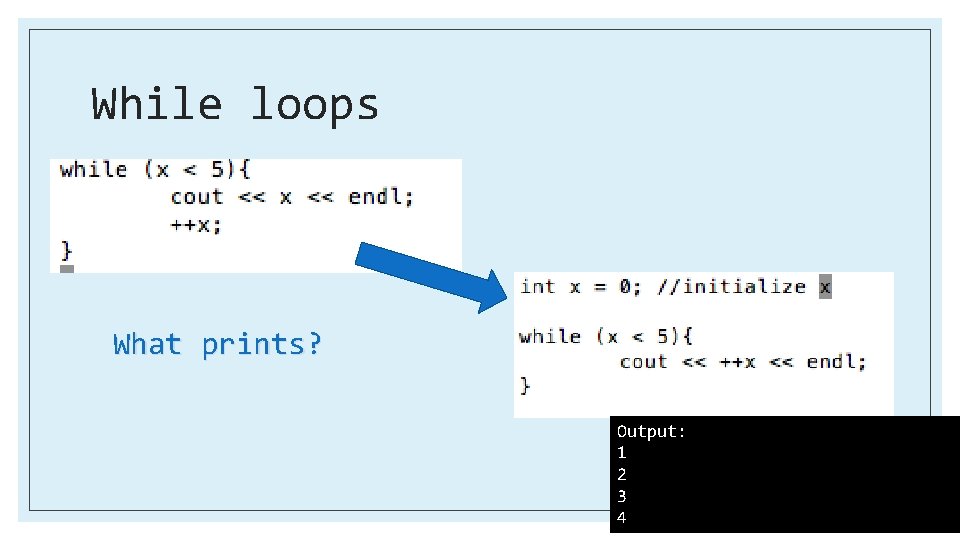
While loops What prints? Output: 1 2 3 4
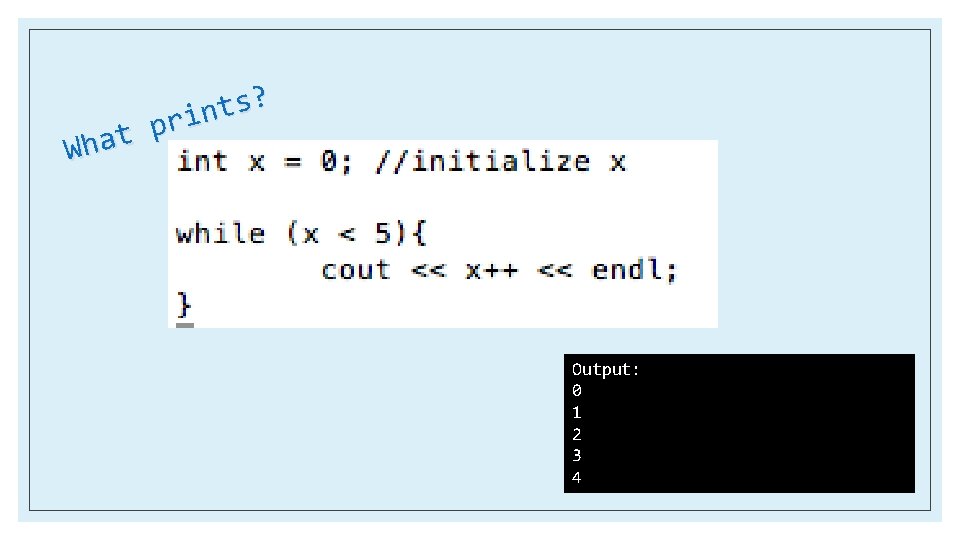
? s t n i r p t a h W Output: 0 1 2 3 4
Questions?
Upcoming Deadlines ◦ Assignment 2 due Jan 29 th (this Friday) ◦ Project 2 will be due October 7 th (a week from Friday) ◦ Get started early!