
Discussion 1 Theory Definition a scientific theory is
- Slides: 15
Discussion 1: Theory
Definition Ø a scientific theory is a set of related assumptions that allows scientists to use logical deductive reasoning to formulate testable hypotheses.
Components of the definition Ø a set of related assumptions Ø logical deductive reasoning Ø testable
Example Ø cognitive dissonance theory Ø cognitive dissonance: uncomfortable feeling or stress caused by holding two contradictory ideas simultaneously. Ø "dissonant" vs. "consonant" Ø theory of cognitive dissonance proposes that people have a fundamental cognitive drive to reduce this dissonance by modifying an existing belief, or rejecting one of the contradictory ideas.
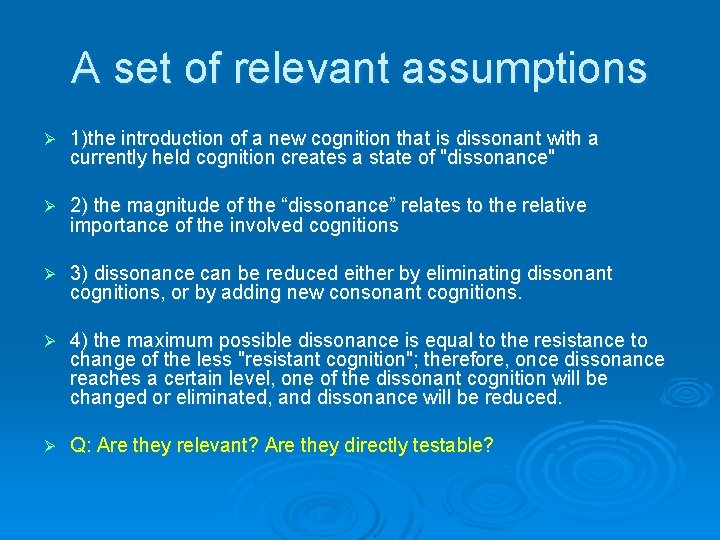
A set of relevant assumptions Ø 1)the introduction of a new cognition that is dissonant with a currently held cognition creates a state of "dissonance" Ø 2) the magnitude of the “dissonance” relates to the relative importance of the involved cognitions Ø 3) dissonance can be reduced either by eliminating dissonant cognitions, or by adding new consonant cognitions. Ø 4) the maximum possible dissonance is equal to the resistance to change of the less "resistant cognition"; therefore, once dissonance reaches a certain level, one of the dissonant cognition will be changed or eliminated, and dissonance will be reduced. Ø Q: Are they relevant? Are they directly testable?
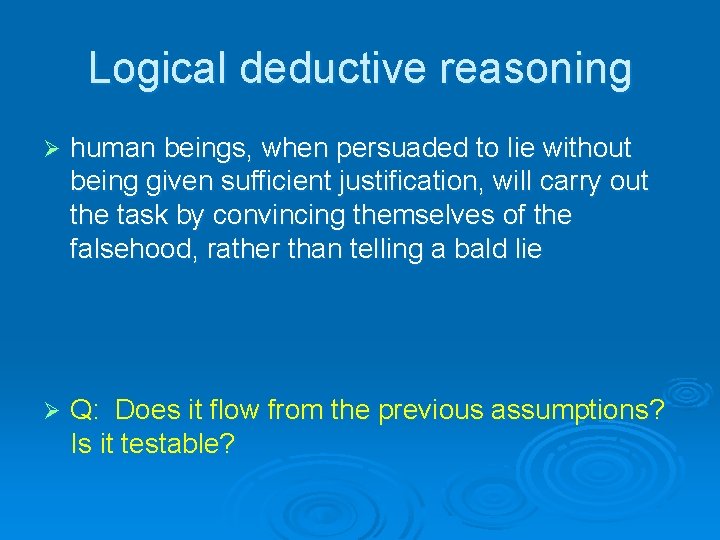
Logical deductive reasoning Ø human beings, when persuaded to lie without being given sufficient justification, will carry out the task by convincing themselves of the falsehood, rather than telling a bald lie Ø Q: Does it flow from the previous assumptions? Is it testable?
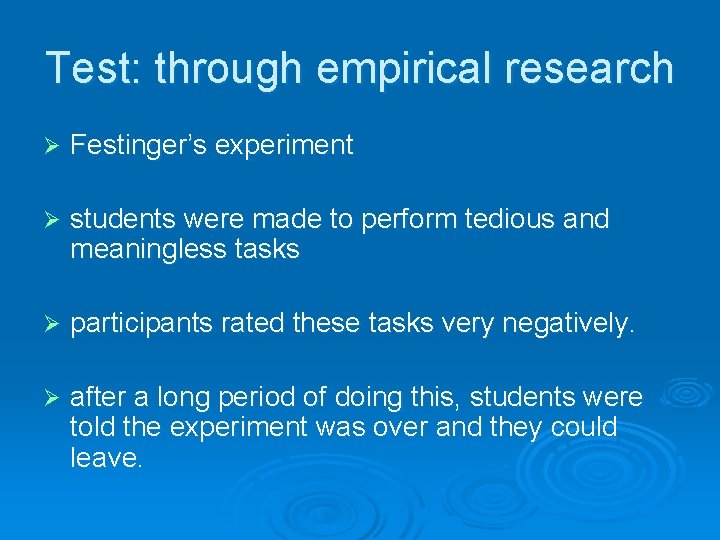
Test: through empirical research Ø Festinger’s experiment Ø students were made to perform tedious and meaningless tasks Ø participants rated these tasks very negatively. Ø after a long period of doing this, students were told the experiment was over and they could leave.
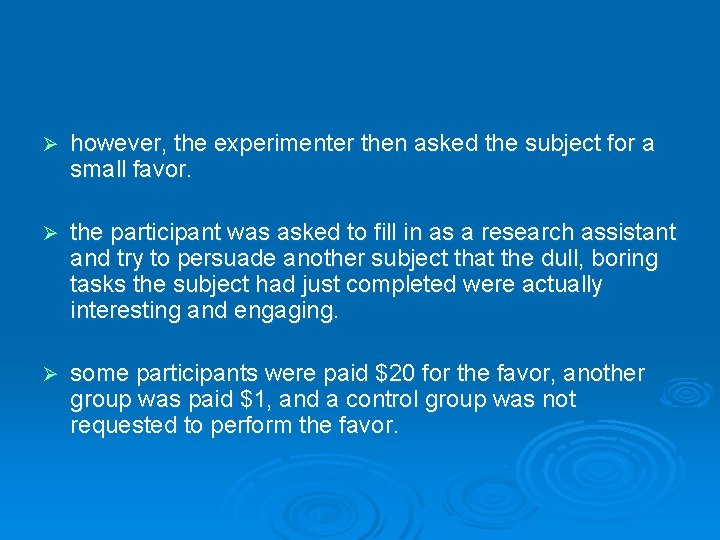
Ø however, the experimenter then asked the subject for a small favor. Ø the participant was asked to fill in as a research assistant and try to persuade another subject that the dull, boring tasks the subject had just completed were actually interesting and engaging. Ø some participants were paid $20 for the favor, another group was paid $1, and a control group was not requested to perform the favor.
Ø when asked to rate the peg-turning tasks later, those in the $1 group rated them more positively than those in the $20 group and control group. Ø Q: Is this explainable by the cognitive dissonance theory? How is the result related to theory?
More than one testable hypotheses Ø other ways of forming the hypotheses Ø people who feel dissonance will seek information that will reduce dissonance and avoid information that will increase dissonance Ø people who are involuntarily exposed to information that increases dissonance are likely to discount that information, either by ignoring it, misinterpreting it, or denying it.
Why different theories? Ø alternate theories exist because the very nature of a theory allows theorist to make speculations from a particular point of view. Ø observations are colored by the individual observer’s frame of reference, so there may be many diverse theories.
What makes a theory useful Ø generates research: generates a number of hypotheses that can be investigated through research. l l Ø descriptive research hypothesis testing organizes data into a meaningful structure, provides an explanation for the results, and help ask further questions. l l Integrate knowledge into an intelligible framework shape as many bits of information as possible into arrangement
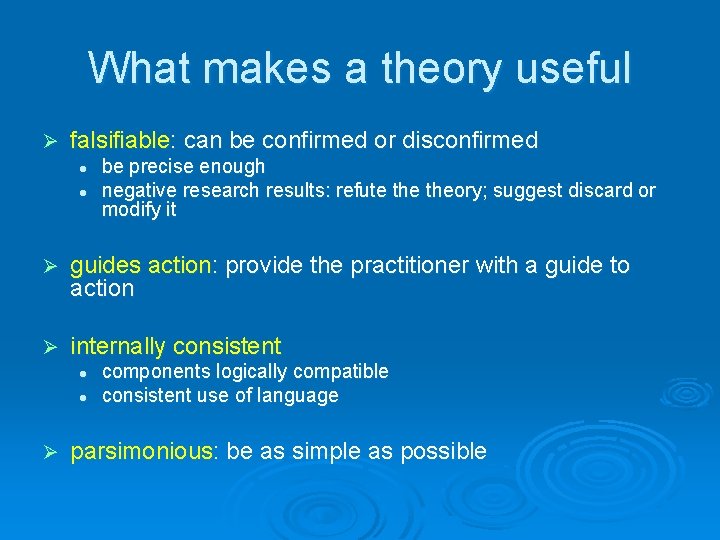
What makes a theory useful Ø falsifiable: can be confirmed or disconfirmed l l be precise enough negative research results: refute theory; suggest discard or modify it Ø guides action: provide the practitioner with a guide to action Ø internally consistent l l Ø components logically compatible consistent use of language parsimonious: be as simple as possible
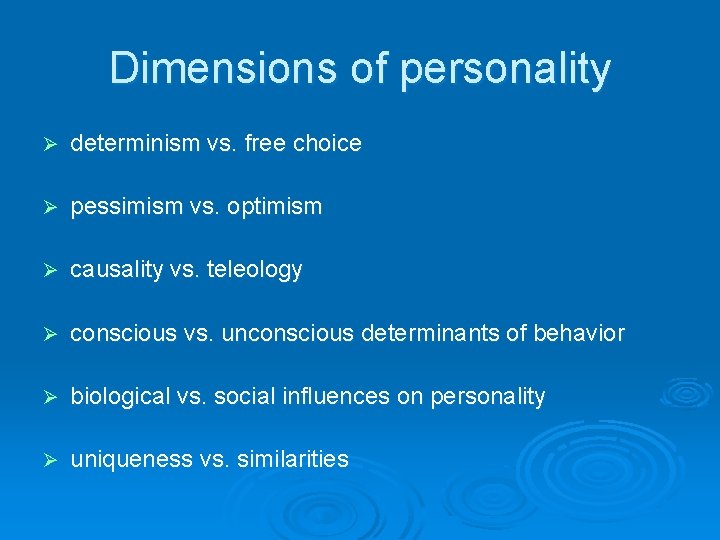
Dimensions of personality Ø determinism vs. free choice Ø pessimism vs. optimism Ø causality vs. teleology Ø conscious vs. unconscious determinants of behavior Ø biological vs. social influences on personality Ø uniqueness vs. similarities
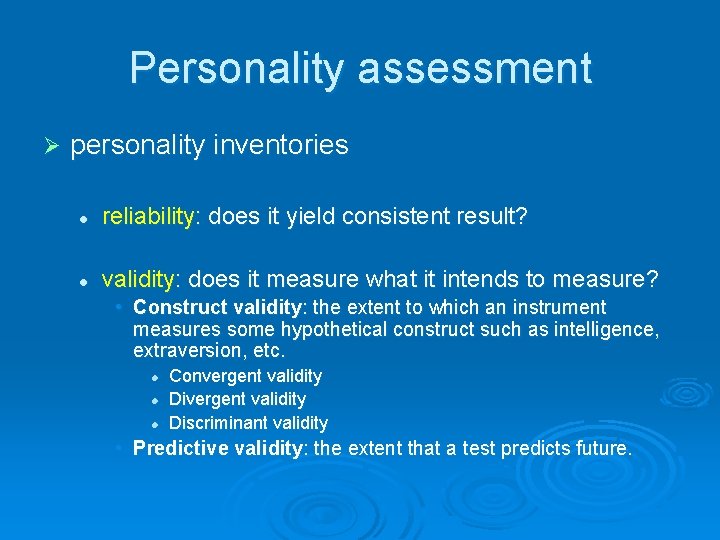
Personality assessment Ø personality inventories l reliability: does it yield consistent result? l validity: does it measure what it intends to measure? • Construct validity: the extent to which an instrument measures some hypothetical construct such as intelligence, extraversion, etc. l l l Convergent validity Discriminant validity • Predictive validity: the extent that a test predicts future.