
Discrimination Methods As Used In Gene Array Analysis
- Slides: 46
Discrimination Methods As Used In Gene Array Analysis
Discrimination Methods n n n Microarray Background Clustering and Classifiers Discrimination Methods: ¡ ¡ n n n Nearest Neighbor Classification Trees Maximum Likelihood Discrimination Fisher Linear Discrimination Aggregating Classifiers Results Conclusions
Microarray Background n n n Nowadays, very little is known about genes functionality Biologists provides experimental information for analyze, in order to find biological function to genes Their tool - Microarray
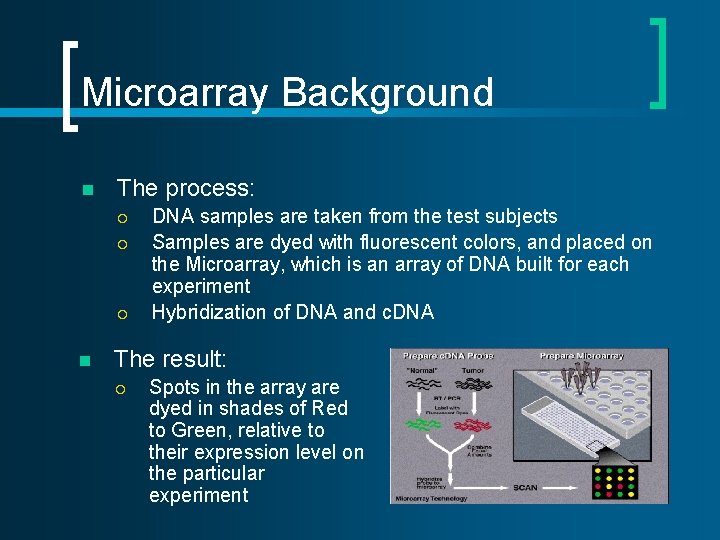
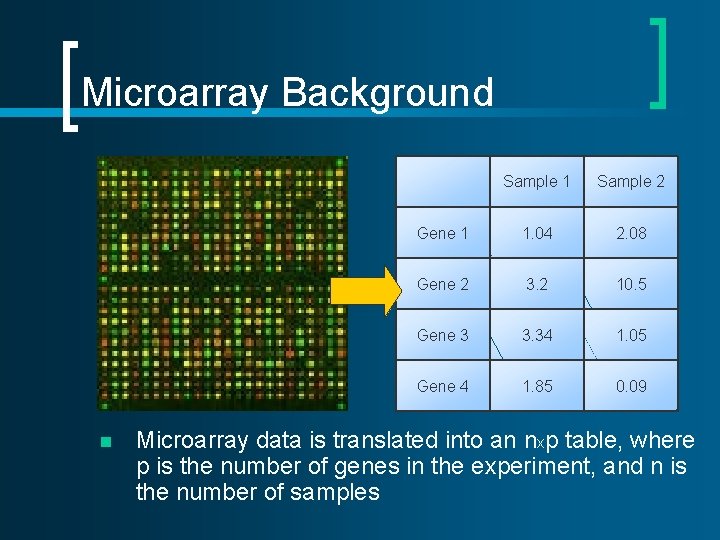
Microarray Background n The process: ¡ ¡ ¡ n DNA samples are taken from the test subjects Samples are dyed with fluorescent colors, and placed on the Microarray, which is an array of DNA built for each experiment Hybridization of DNA and c. DNA The result: ¡ Spots in the array are dyed in shades of Red to Green, relative to their expression level on the particular experiment
Microarray Background n Sample 1 Sample 2 Gene 1 1. 04 2. 08 Gene 2 3. 2 10. 5 Gene 3 3. 34 1. 05 Gene 4 1. 85 0. 09 Microarray data is translated into an nxp table, where p is the number of genes in the experiment, and n is the number of samples
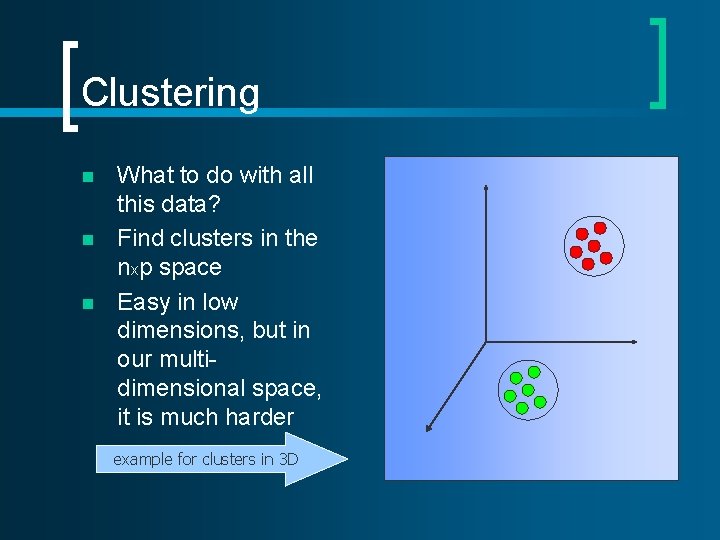
Clustering n n n What to do with all this data? Find clusters in the nxp space Easy in low dimensions, but in our multidimensional space, it is much harder example for clusters in 3 D
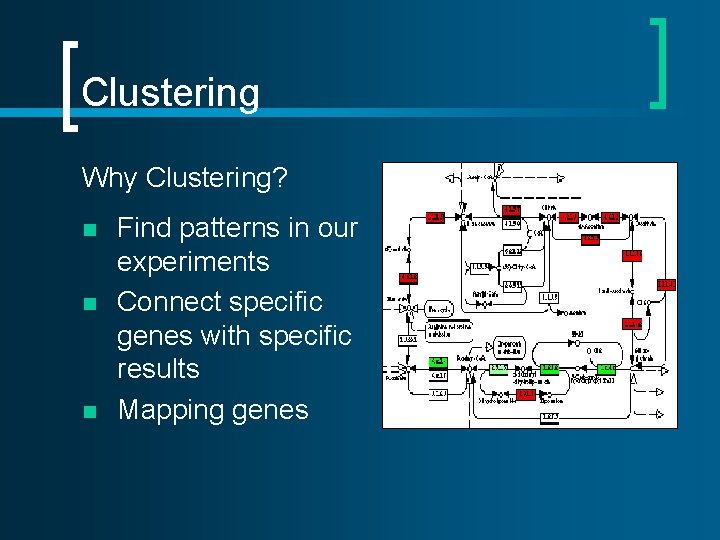
Clustering Why Clustering? n n n Find patterns in our experiments Connect specific genes with specific results Mapping genes
Classifiers n n n The tool – Classifiers Classifier is a function that splits the space into K disjoint sets Two approaches: ¡ Supervised Learning (Discrimination Analysis): n n n ¡ Unsupervised Learning (Cluster Analysis): n n K is known learning set is used to classify new samples used to classify malignancies into known classes K is unknown the data “organizes itself” used for identification of new tumors Feature Selection – another use for classifiers ¡ used for identification of marker genes
Classifiers n n We will discuss only about supervised learning Discrimination methods: ¡ ¡ n Fisher Linear Discrimination Maximum Likelihood Discrimination K Nearest Neighbor Classification Trees Aggregating classifiers
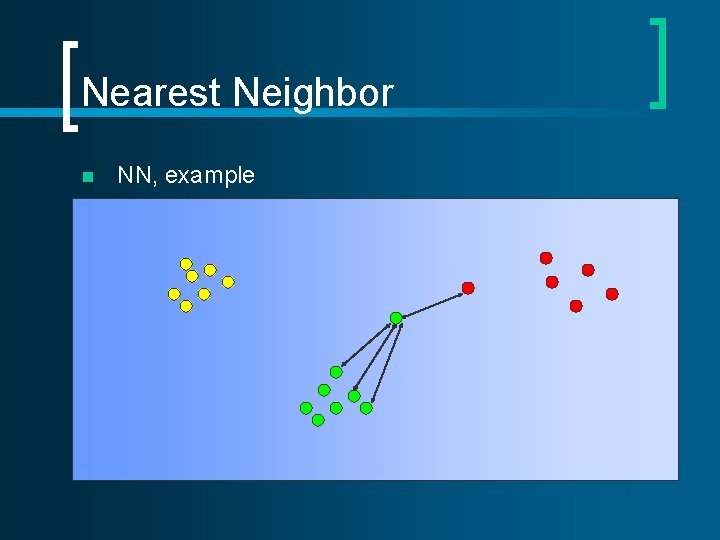
Nearest Neighbor n n We use a predefined learning set, already classified New samples are being classified into the same classes of the learning set Each sample is classified its K nearest neighbors, according to a distance metric (usually Euclidian distance) The classification is made by majority of votes
Nearest Neighbor n NN, example
Nearest Neighbor Cross-Validation: n Method for finding the best K to use n Test each of {1, . . . , T} as K, by running the algorithm T times on a known test set, and choosing the K which gives the best results
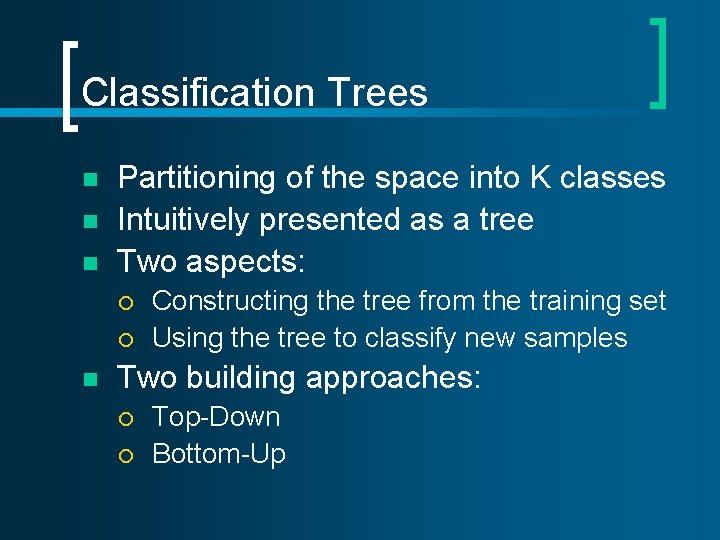
Classification Trees n n n Partitioning of the space into K classes Intuitively presented as a tree Two aspects: ¡ ¡ n Constructing the tree from the training set Using the tree to classify new samples Two building approaches: ¡ ¡ Top-Down Bottom-Up
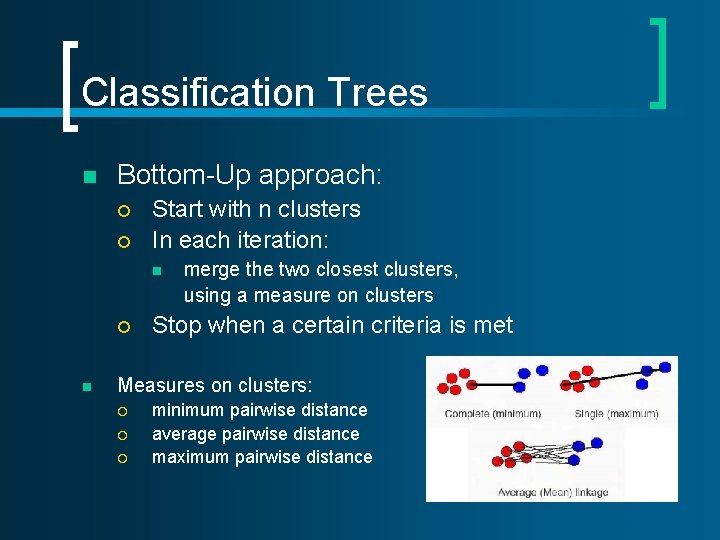
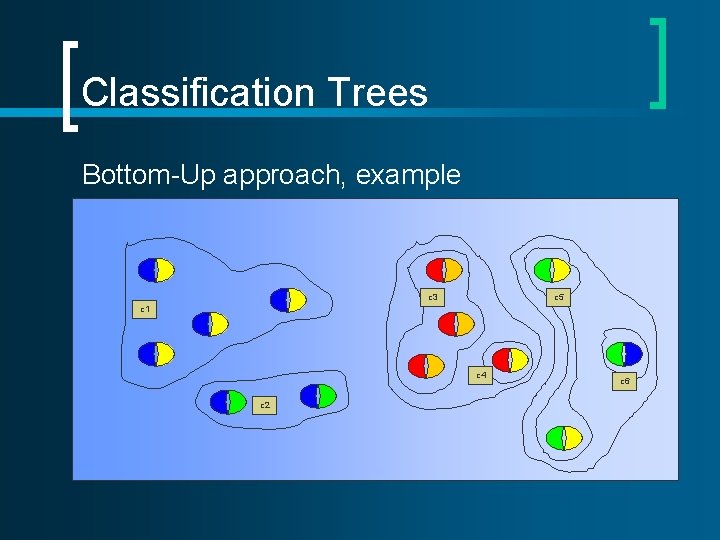
Classification Trees n Bottom-Up approach: ¡ ¡ Start with n clusters In each iteration: n ¡ n merge the two closest clusters, using a measure on clusters Stop when a certain criteria is met Measures on clusters: ¡ ¡ ¡ minimum pairwise distance average pairwise distance maximum pairwise distance
Classification Trees Bottom-Up approach, example c 3 c 5 c 1 c 4 c 2 c 6
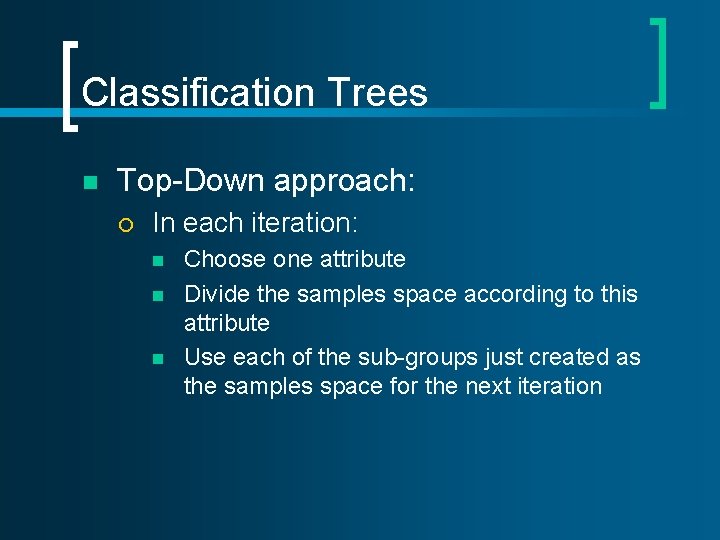
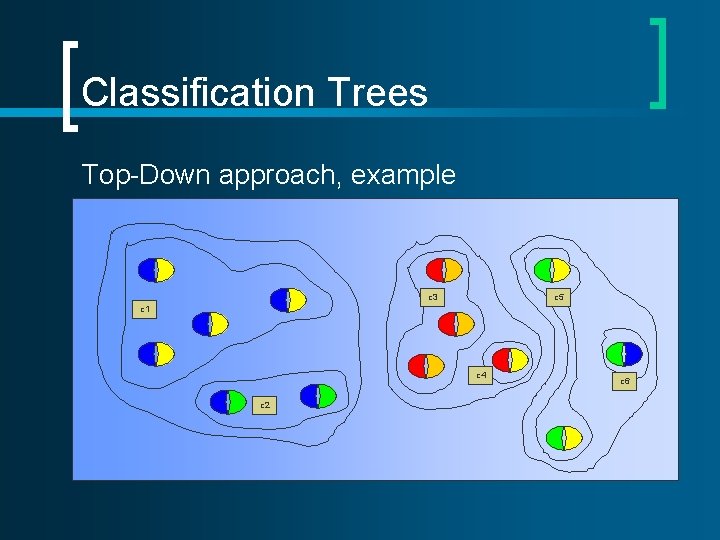
Classification Trees n Top-Down approach: ¡ In each iteration: n n n Choose one attribute Divide the samples space according to this attribute Use each of the sub-groups just created as the samples space for the next iteration
Classification Trees Top-Down approach, example c 3 c 5 c 1 c 4 c 2 c 6
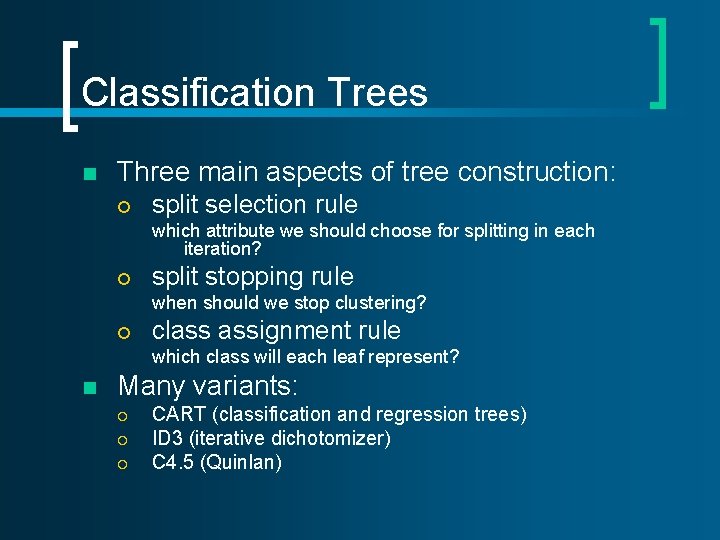
Classification Trees n Three main aspects of tree construction: ¡ split selection rule which attribute we should choose for splitting in each iteration? ¡ split stopping rule when should we stop clustering? ¡ class assignment rule which class will each leaf represent? n Many variants: ¡ ¡ ¡ CART (classification and regression trees) ID 3 (iterative dichotomizer) C 4. 5 (Quinlan)
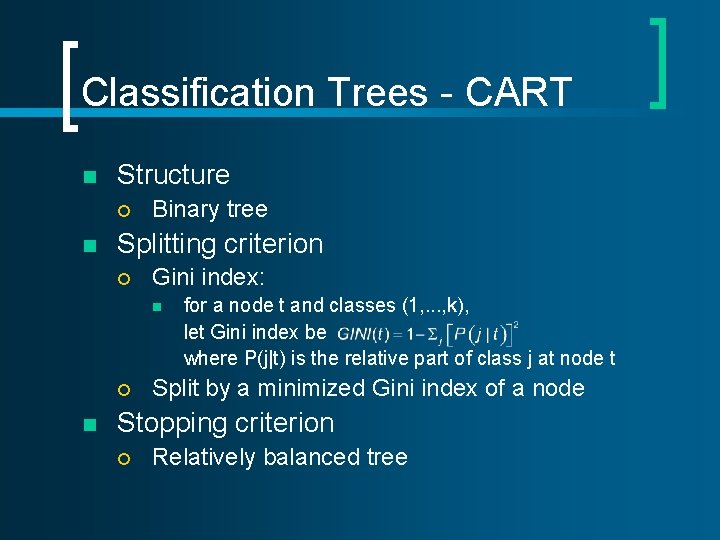
Classification Trees - CART n Structure ¡ n Binary tree Splitting criterion ¡ Gini index: n ¡ n for a node t and classes (1, . . . , k), let Gini index be where P(j|t) is the relative part of class j at node t Split by a minimized Gini index of a node Stopping criterion ¡ Relatively balanced tree
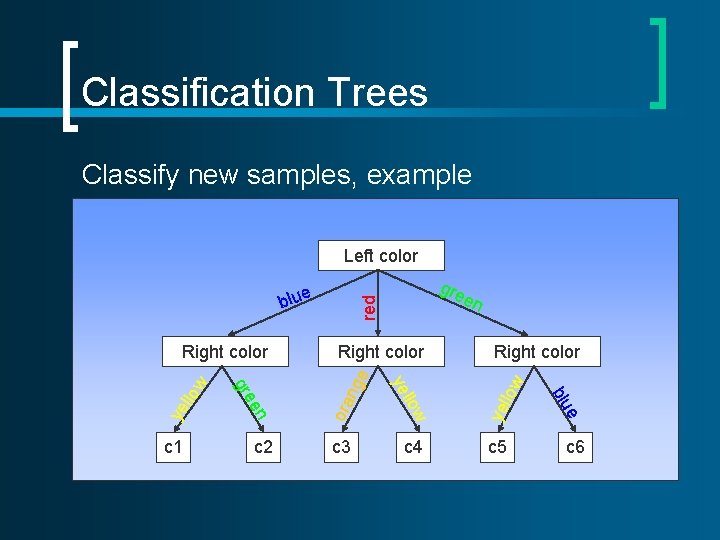
Classification Trees Classify new samples, example Left color llow ye e ng ora c 5 e c 4 blu c 3 Right color ow c 2 ll ye ye ll Right color en c 1 gre ow Right color gre en red blue c 6
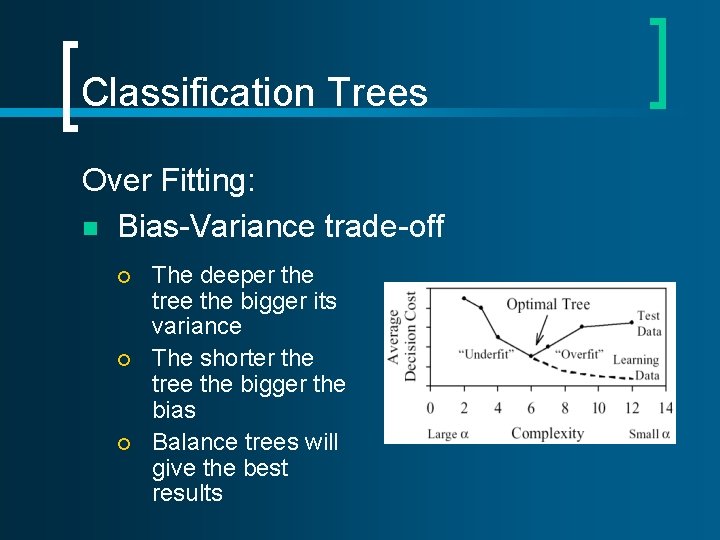
Classification Trees Over Fitting: n Bias-Variance trade-off ¡ ¡ ¡ The deeper the tree the bigger its variance The shorter the tree the bigger the bias Balance trees will give the best results
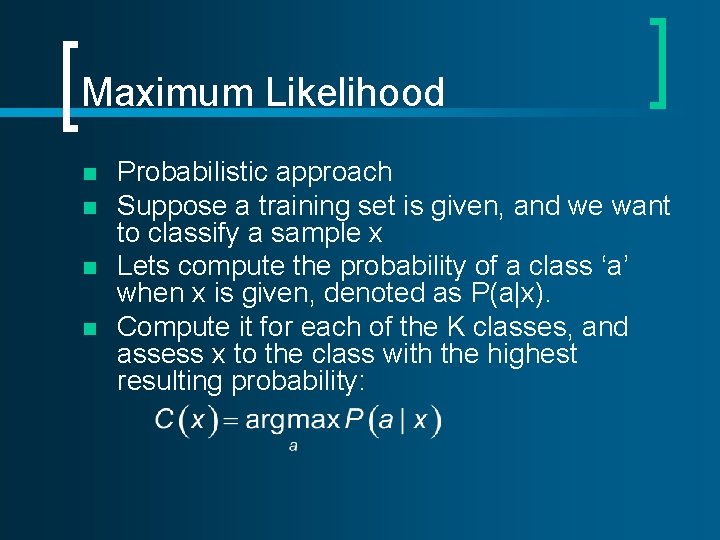
Maximum Likelihood n n Probabilistic approach Suppose a training set is given, and we want to classify a sample x Lets compute the probability of a class ‘a’ when x is given, denoted as P(a|x). Compute it for each of the K classes, and assess x to the class with the highest resulting probability:
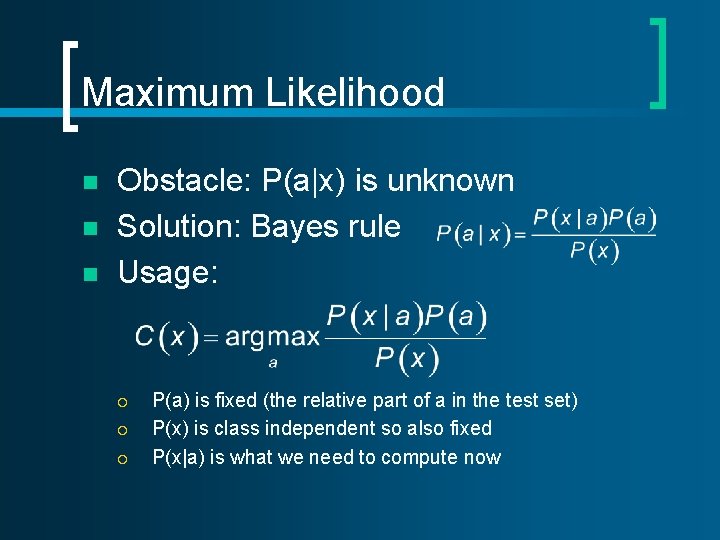
Maximum Likelihood n n n Obstacle: P(a|x) is unknown Solution: Bayes rule Usage: ¡ ¡ ¡ P(a) is fixed (the relative part of a in the test set) P(x) is class independent so also fixed P(x|a) is what we need to compute now
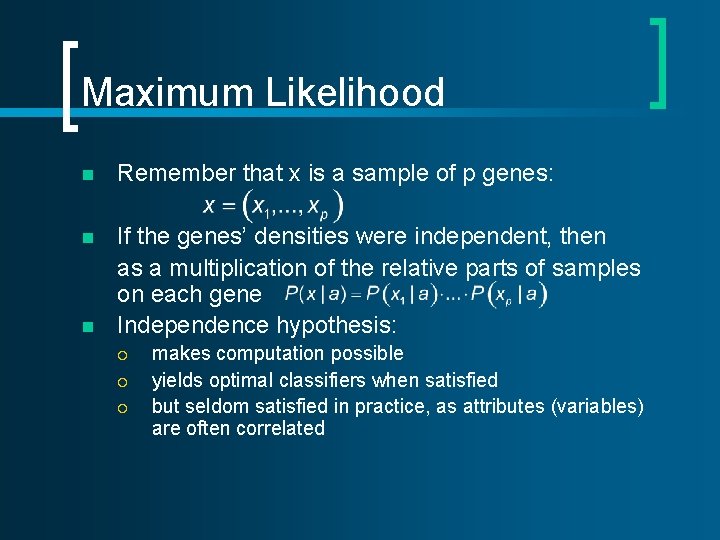
Maximum Likelihood n Remember that x is a sample of p genes: n If the genes’ densities were independent, then as a multiplication of the relative parts of samples on each gene Independence hypothesis: n ¡ ¡ ¡ makes computation possible yields optimal classifiers when satisfied but seldom satisfied in practice, as attributes (variables) are often correlated
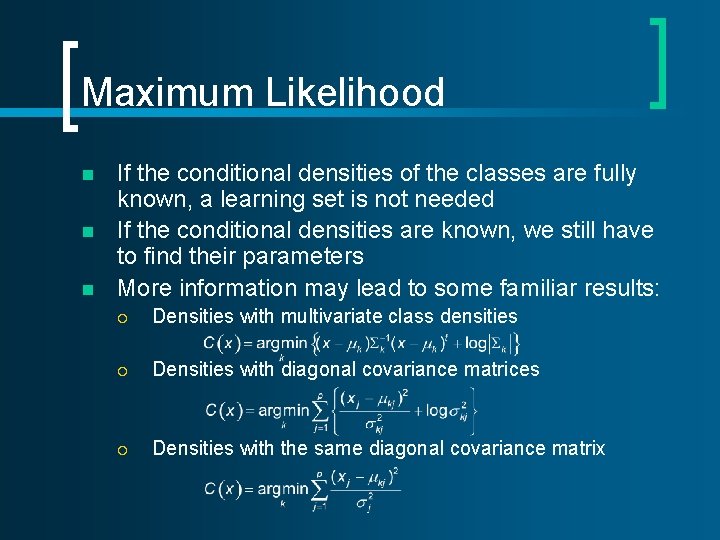
Maximum Likelihood n n n If the conditional densities of the classes are fully known, a learning set is not needed If the conditional densities are known, we still have to find their parameters More information may lead to some familiar results: ¡ Densities with multivariate class densities ¡ Densities with diagonal covariance matrices ¡ Densities with the same diagonal covariance matrix
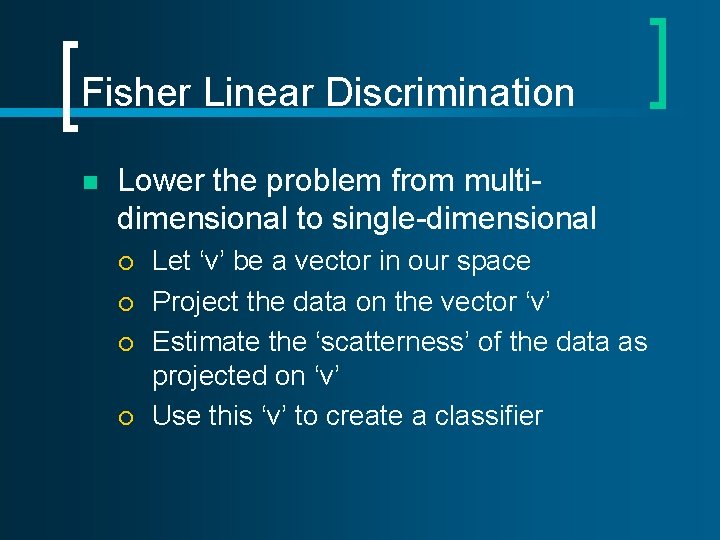
Fisher Linear Discrimination n Lower the problem from multidimensional to single-dimensional ¡ ¡ Let ‘v’ be a vector in our space Project the data on the vector ‘v’ Estimate the ‘scatterness’ of the data as projected on ‘v’ Use this ‘v’ to create a classifier
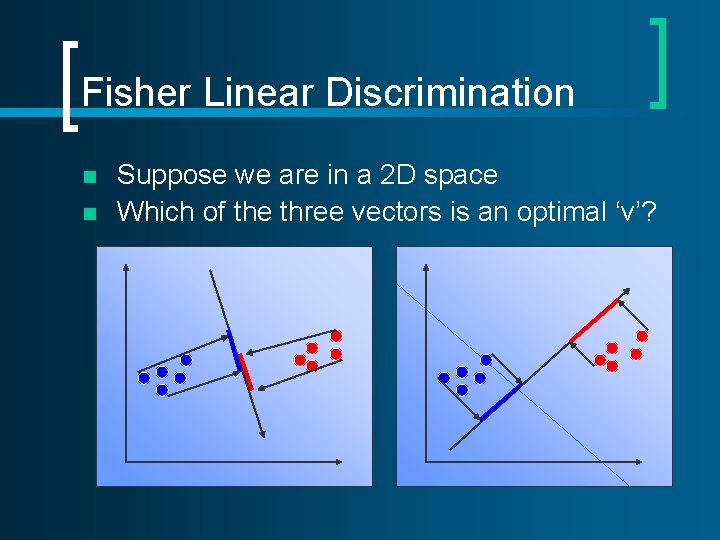
Fisher Linear Discrimination n n Suppose we are in a 2 D space Which of the three vectors is an optimal ‘v’?
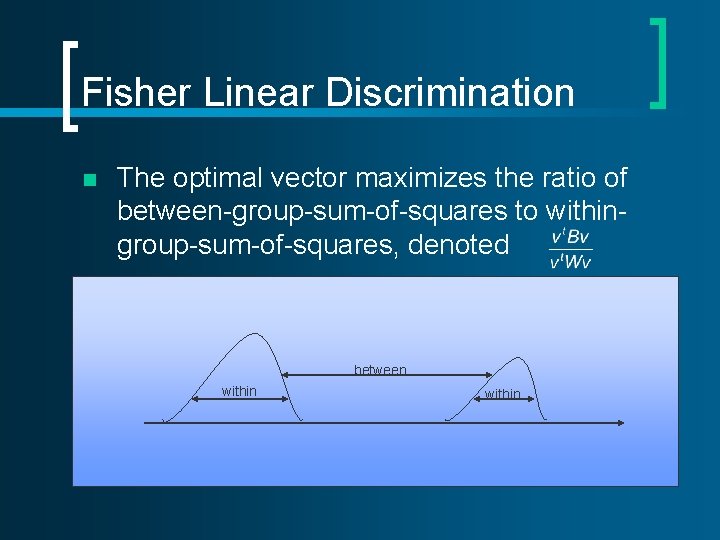
Fisher Linear Discrimination n The optimal vector maximizes the ratio of between-group-sum-of-squares to withingroup-sum-of-squares, denoted between within
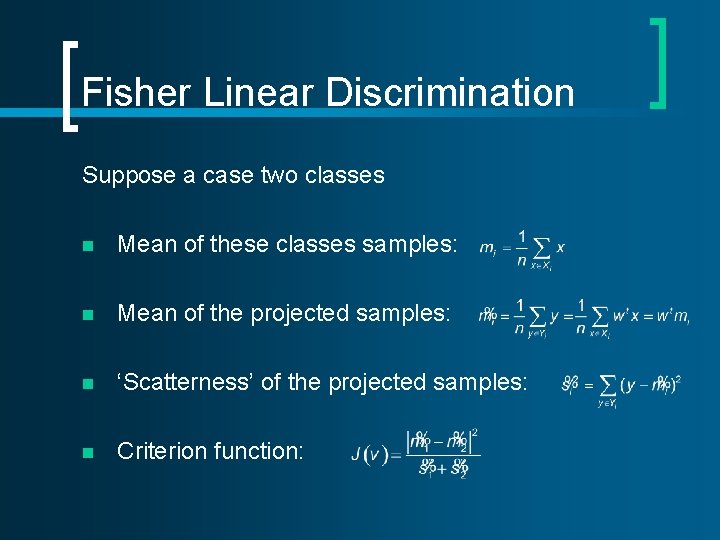
Fisher Linear Discrimination Suppose a case two classes n Mean of these classes samples: n Mean of the projected samples: n ‘Scatterness’ of the projected samples: n Criterion function:
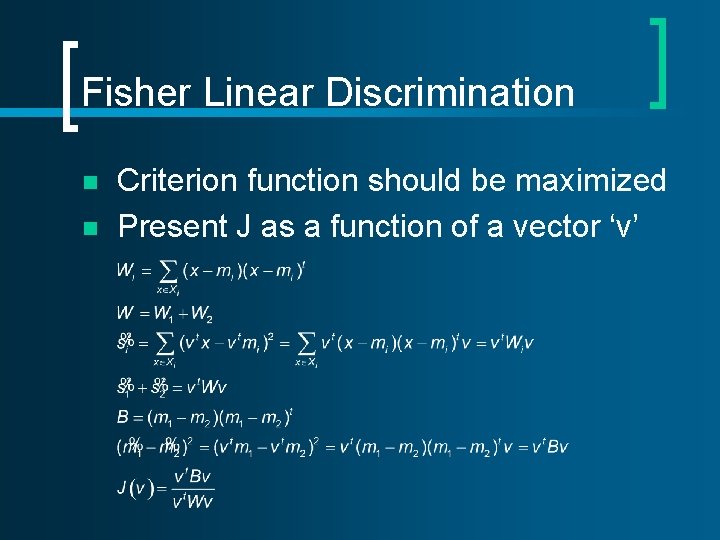
Fisher Linear Discrimination n n Criterion function should be maximized Present J as a function of a vector ‘v’
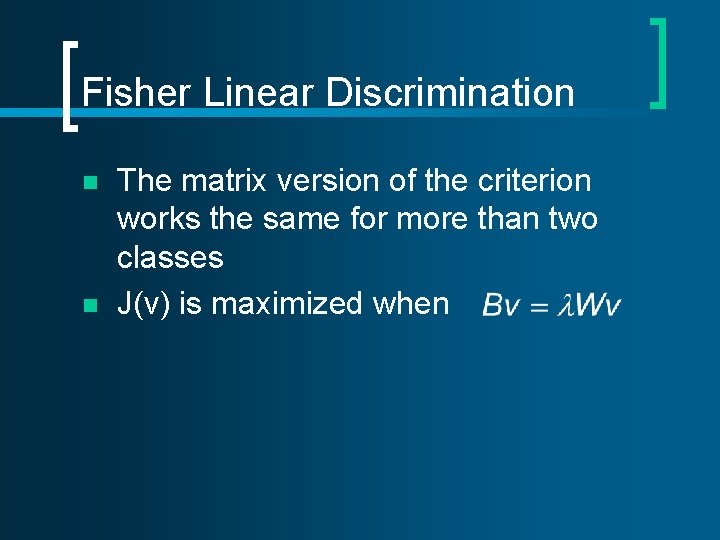
Fisher Linear Discrimination n n The matrix version of the criterion works the same for more than two classes J(v) is maximized when
Fisher Linear Discrimination Classification of a new observation ‘x’: n Let the class of ‘x’ be the class whose mean vector is closest to ‘x’ in terms of the discriminant variables n In other words, the class whose mean vector’s projection on ‘v’ is the closest to the projection of ‘x’ on ‘v’
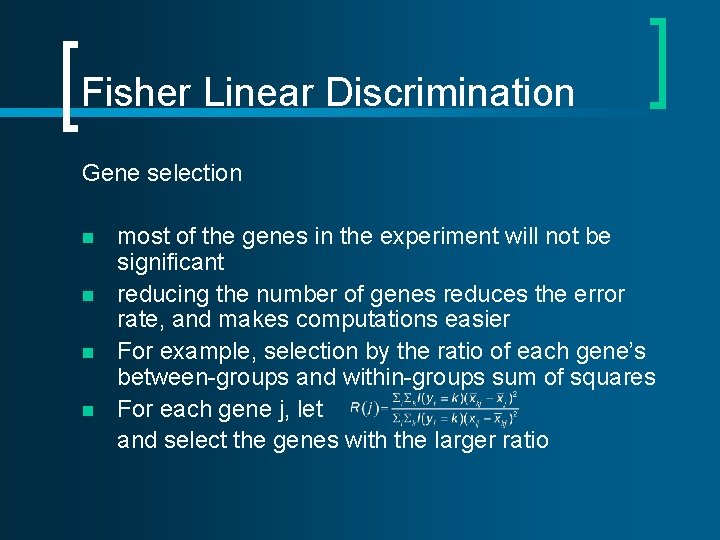
Fisher Linear Discrimination Gene selection n n most of the genes in the experiment will not be significant reducing the number of genes reduces the error rate, and makes computations easier For example, selection by the ratio of each gene’s between-groups and within-groups sum of squares For each gene j, let and select the genes with the larger ratio
Fisher Linear Discrimination Error reduction n n Small number of samples makes the error more significant Noise will affect measurements of small values, and thus the WSS can be too big in some measurements This will make the selecting criterion of a gene bigger than its real importance to the discrimination Solution - Adding a minimal value to the WSS
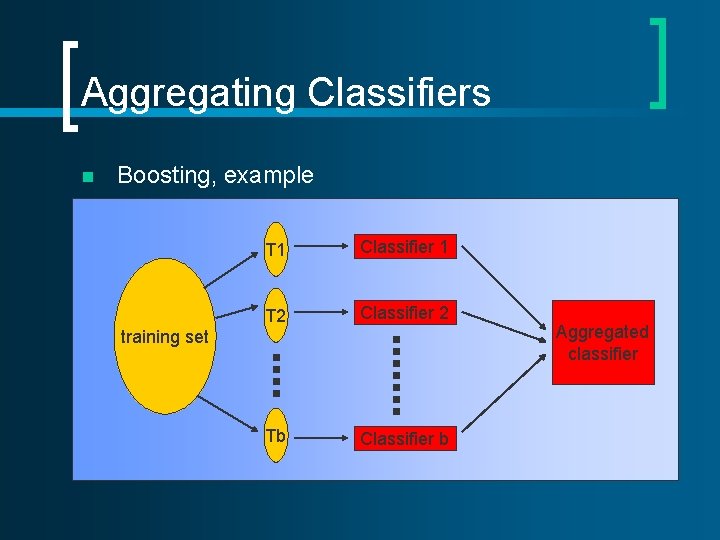
Aggregating Classifiers n n n A concept for enhancing performance of classification procedures A classification procedure uses some prior knowledge (i. e. training set) to get its classifier parameters Lets aggregate these parameters from more training sets into a stronger classifier
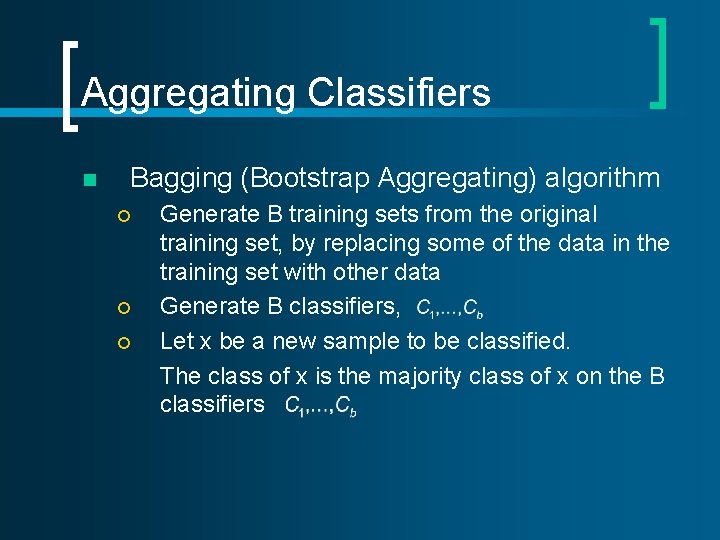
Aggregating Classifiers n Bagging (Bootstrap Aggregating) algorithm ¡ ¡ ¡ Generate B training sets from the original training set, by replacing some of the data in the training set with other data Generate B classifiers, Let x be a new sample to be classified. The class of x is the majority class of x on the B classifiers
Aggregating Classifiers n Boosting, example T 1 Classifier 1 T 2 Classifier 2 Tb Classifier b training set Aggregated classifier
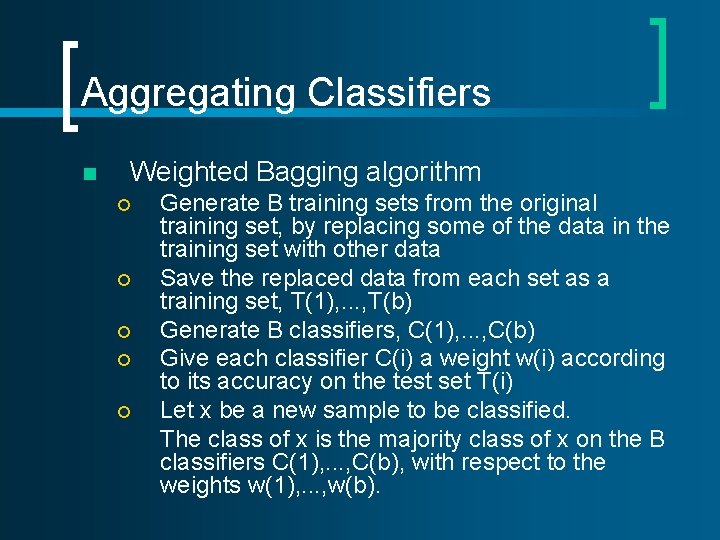
Aggregating Classifiers n Weighted Bagging algorithm ¡ ¡ ¡ Generate B training sets from the original training set, by replacing some of the data in the training set with other data Save the replaced data from each set as a training set, T(1), . . . , T(b) Generate B classifiers, C(1), . . . , C(b) Give each classifier C(i) a weight w(i) according to its accuracy on the test set T(i) Let x be a new sample to be classified. The class of x is the majority class of x on the B classifiers C(1), . . . , C(b), with respect to the weights w(1), . . . , w(b).
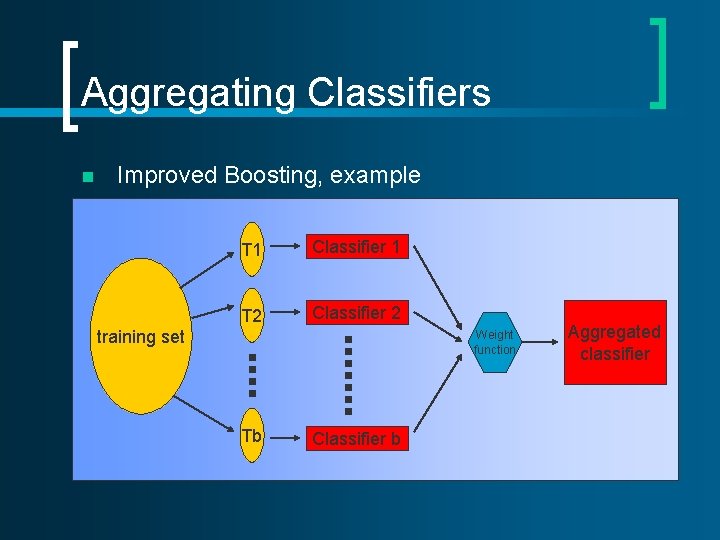
Aggregating Classifiers n Improved Boosting, example T 1 Classifier 1 T 2 Classifier 2 training set Weight function Tb Classifier b Aggregated classifier
Imputation of Missing Data n n n Most of the classifiers need information about each spot in the array in order to work properly Many methods of missing data imputation For example - Nearest Neighbor: ¡ each missing value gets the majority value of its K nearest neighbors
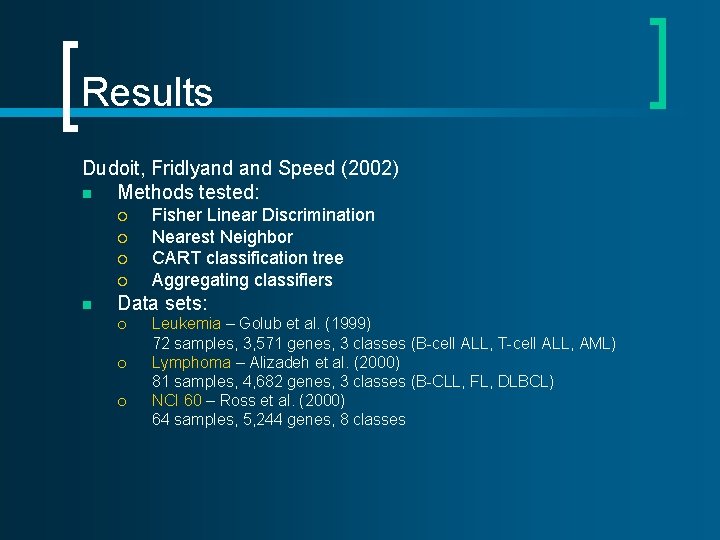
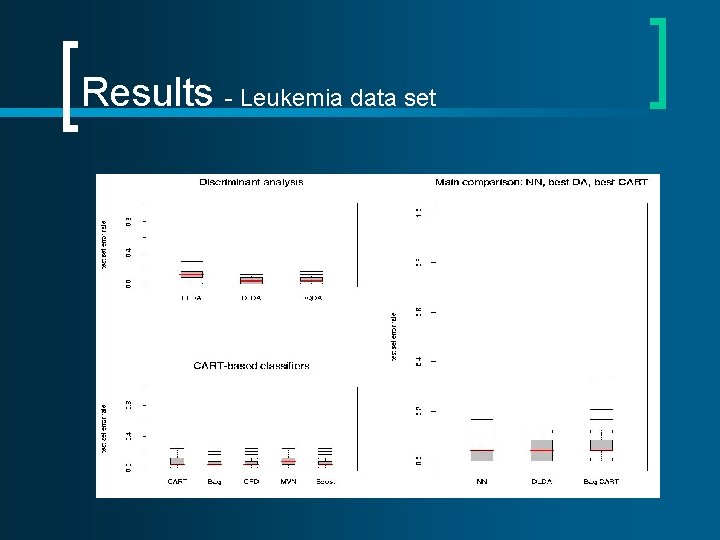
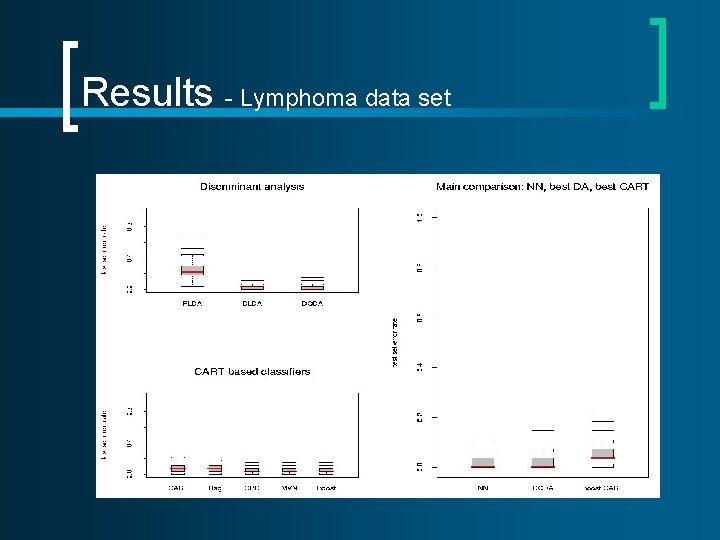
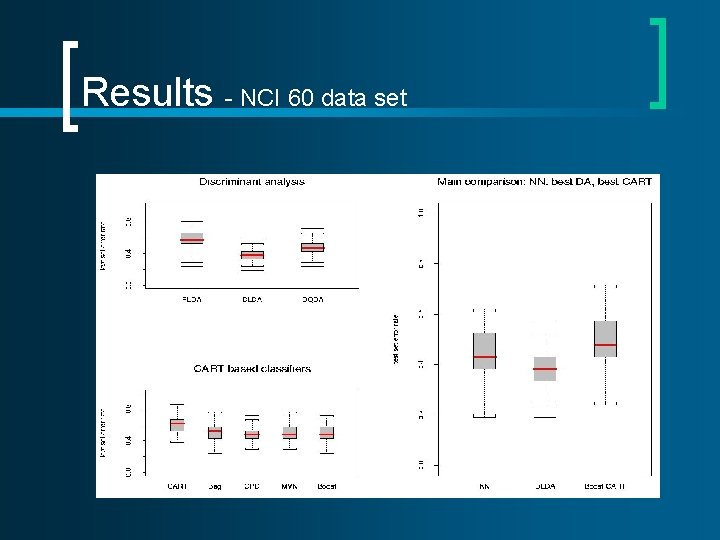
Results Dudoit, Fridlyand Speed (2002) n Methods tested: ¡ ¡ n Fisher Linear Discrimination Nearest Neighbor CART classification tree Aggregating classifiers Data sets: ¡ ¡ ¡ Leukemia – Golub et al. (1999) 72 samples, 3, 571 genes, 3 classes (B-cell ALL, T-cell ALL, AML) Lymphoma – Alizadeh et al. (2000) 81 samples, 4, 682 genes, 3 classes (B-CLL, FL, DLBCL) NCI 60 – Ross et al. (2000) 64 samples, 5, 244 genes, 8 classes
Results - Leukemia data set
Results - Lymphoma data set
Results - NCI 60 data set
Conclusions n “Diagonal” LDA: ignoring correlation between genes improved error rates n Unlike classification trees and nearest neighbors, LDA is unable to take into account gene interactions n Although nearest neighbor is s simple and intuitive classifier, its main limitation is that it give very little insight into mechanisms underlying the class distinctions
Conclusions n Classification trees are capable of handling and revealing interactions between variables n Variable selection: a crude criterion such as BSS/WSS may not identify the genes that discriminate between all the classes and may not reveal interactions between genes n With larger training sets, expect improvement in performance of aggregated classifiers