
Discrimination in the Labour Market Aims and Objectives
Discrimination in the Labour Market
Aims and Objectives Aim: • Understand discrimination in the labour market Objectives: • Define labour market discrimination • Explain the reasons for discrimination • Analyse the effects of discrimination • Evaluate government policy to alleviate discrimination
Starter • How may discrimination occur in the labour market? • Define market failure.
Discrimination • Occurs when a group of workers/potential workers are treated differently to other workers doing the same job, in terms of promotion, pay, working conditions. • Can be positive or negative. • Causes market failure as market fails to allocate resources efficiently.

Who would you employ?
Negative Discrimination • Occurs when similar workers are treated less favourable than others, and are paid lower wages because of race, gender, age or disability. • Why might employers discriminate in the labour market? • Prejudice leads to employers believing that the MRP of these groups is lower than it really is. • E. g. MRP of women is lower than that of men.
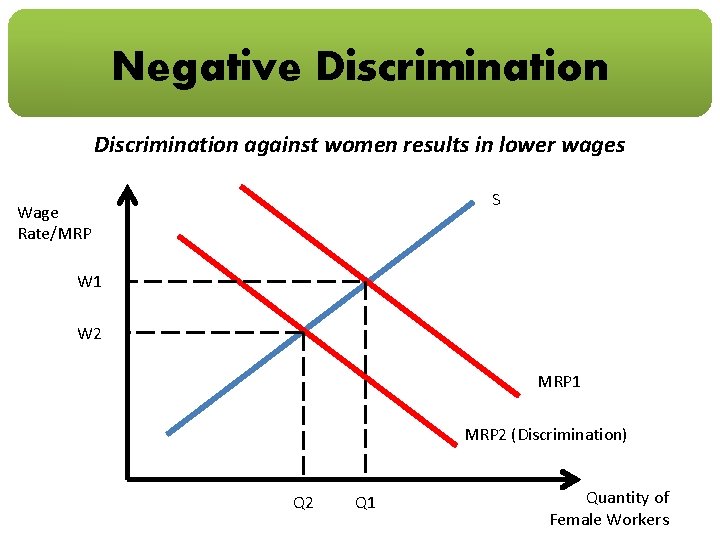
Negative Discrimination against women results in lower wages S Wage Rate/MRP W 1 W 2 MRP 1 MRP 2 (Discrimination) Q 2 Q 1 Quantity of Female Workers
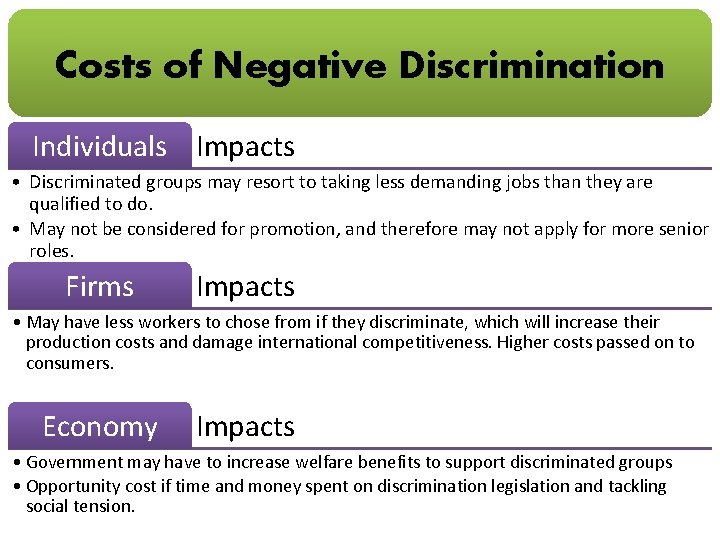
Costs of Negative Discrimination Individuals Impacts • Discriminated groups may resort to taking less demanding jobs than they are qualified to do. • May not be considered for promotion, and therefore may not apply for more senior roles. Firms Impacts • May have less workers to chose from if they discriminate, which will increase their production costs and damage international competitiveness. Higher costs passed on to consumers. Economy Impacts • Government may have to increase welfare benefits to support discriminated groups • Opportunity cost if time and money spent on discrimination legislation and tackling social tension.
Negative Discrimination • Could also affect supply side if workers who are discriminated against look for employment in other markets, with other employers. • Resulting in an increase in the supply of labour to the non discriminating firm, leading to lower wages for the discriminated group.
Positive Discrimination • Firms discriminating in favour of a certain group. • Employers judge the MRP of a particular group to be higher than it actually is. • Some groups will earn higher wages than others of similar ability.
Government & Positive Discrimination • Governments can positively discriminate to offset negative discrimination effects. • Conservatives launched ‘Equal Pay and Flexible Working Act’ to address the male: female pay gap. • Does this work? • http: //news. bbc. co. uk/1/hi/england/8492366. stm • http: //news. bbc. co. uk/1/hi/programmes/politics_sh ow/regions/west_midlands/8313171. stm
- Slides: 11