
Discrimination Definition of discrimination members of a group
Discrimination • Definition of discrimination: members of a group (women, blacks, Muslims, immigrants, etc. ) are treated differentially (less favorably) than members of another group with otherwise identical characteristics in similar circumstances. • Focus: labor market discrimination, i. e. firms choosing to pay some workers less than other workers
Types of discrimination • Taste-based: some employers have a distaste for hiring members of the minority group, and, as a result, may refuse to hire members of this group, or may pay them less than other employees with same productivity. • If the fraction of these employers is large enough, there will be an economy-wide wage differential between majority and minority groups.
Types of discrimination • Taste-based: some employers have a distaste for hiring members of the minority group, and, as a result, may refuse to hire members of this group, or may pay them less than other employees with same productivity. • If the fraction of these employers is large enough, there will be an economy-wide wage differential between majority and minority groups. • However, non-discriminatory firms will earn higher profits than discriminatory firms, and so over time the market should push out discriminatory firms.
Types of discrimination • Statistical discrimination: Employers have imperfect information about quality of workers applying, observing only noisy signals of productivity. • One such signal could be majority/minority status. If members of majority group are, on average, more productive than members of a minority group, employers may decline to hire minority applicants.
How common is discrimination? • Both types of discrimination are illegal in US labor and housing markets. • However, enforcement is challenging; employment decisions are often made on the basis of data points which are not easily observed. • While taste-based discrimination may be transient, statistical discrimination could be selfreinforcing. If a minority group perceives few labor market opportunities, the incentive to invest in education, training, etc. is diminished.
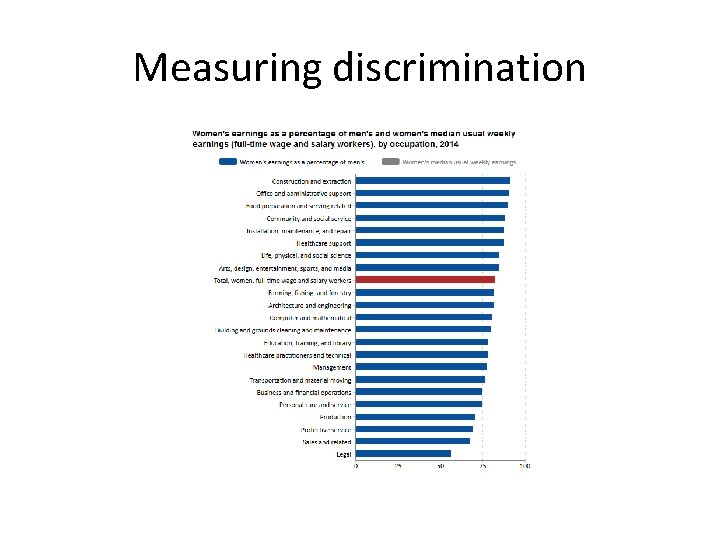
Measuring discrimination • In 2014, women who worked full-time earned a median weekly wage of $719, or 83% of men’s weekly wage of $871. • However, the male-female wage differential varies by field.
Measuring discrimination
Measuring discrimination • Multiple regression studies find only a portion of the male-female wage gap (perhaps 5%) remains after controlling for observable worker and job characteristics. • Men and women make different choices about which field and job to pursue. • To the extent these choices reflect different preferences, a wage gap resulting from different choices isn’t due to discrimination. • However, to the extent these choices are informed by perceived opportunities across field and job, different choices could themselves be caused by discrimination.
Audit studies • Two actors are matched as closely as possible, except for one dimension (usually race or gender). They both apply for the same job. • Example: Neumark, Bank, and Van Nort (1996). Malefemale pairs applied to 65 Philadelphia restaurants. 10/13 job offers at high-end restaurants made to males. 8/10 job offers at low-end restaurants made to women. • Another: When applying to the same job, 5% of blacks with a “criminal record” were called back, versus 14% who didn’t have one. For whites, 17% and 34%.
Field studies • Bertrand Mullainathan (2004) sends fake resumes responding to Chicago and Boston helpwanted ads. Assign white-sounding names (e. g. Emily Walsh) to half, black-sounding names (e. g. Lakisha Washington) to other half. Resumes are otherwise identical. White names receive 50% more interview requests. • When varying quality, whites with high-quality resumes receive 30% more interview requests than whites with low-quality resumes. For blacks, 9% (and statistically insignificant from 0).
- Slides: 10