
DISCRIMINATION AND HARASSMENT TRAINING Presented By Mary Ellen
DISCRIMINATION AND HARASSMENT TRAINING Presented By Mary Ellen Donnelly Putney, Twombly, Hall & Hirson LLP
PURPOSE OF THIS TRAINING ■ To gain an understanding of the different types of discrimination that affects the workplace, including sexual harassment. ■ To learn to recognize inappropriate conduct within the work environment and establish a common understanding of what is and what is not unacceptable behavior in the workplace. ■ To comprehend and fully participate in efforts to maintain a work environment that is free from discrimination and harassment of any kind. ■ To focus attention on the impact of discrimination and sexual harassment in the workplace and the importance of reporting such discrimination and harassment.
PURPOSE OF THIS TRAINING (CON’T) ■ To create a more productive and enjoyable work environment through the elimination of discriminatory and harassing behavior. ■ To explain the procedure on how to report discrimination and sexual harassment at SNCH and other options for reporting workplace discrimination and sexual harassment. ■ To explain disciplinary action for sexual harassment. ■ Any questions? Check with the Human Resources Department.
DISCRIMINATION AND HARASSMENT • Discrimination: when an employer treats an employee differently in the terms and conditions of employment based upon the employee’s membership in a protected category. • Harassment: when an employee is targeted because of a protected category and such harassment interferes with the employee’s job and/or creates a hostile work environment. Harassing conduct can consist of words, signs, jokes, pranks, intimidation, physical actions, or violence that is directed at an employee due to any protected characteristic.
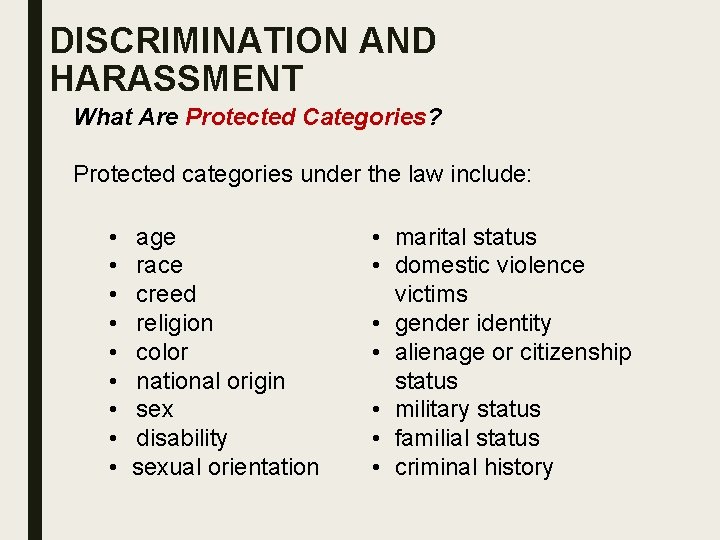
DISCRIMINATION AND HARASSMENT What Are Protected Categories? Protected categories under the law include: • • • age race creed religion color national origin sex disability sexual orientation • marital status • domestic violence victims • gender identity • alienage or citizenship status • military status • familial status • criminal history
RETALIATION It is illegal to fire, demote, harass, or otherwise retaliate against applicants or employees who file a charge of discrimination, complain to the employer about discrimination on the job, or participate in an employment discrimination proceeding such as an investigation or lawsuit.
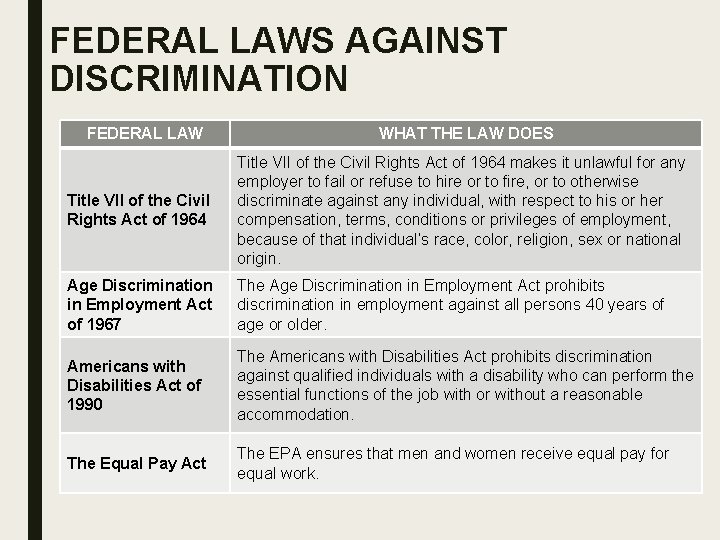
FEDERAL LAWS AGAINST DISCRIMINATION FEDERAL LAW WHAT THE LAW DOES Title VII of the Civil Rights Act of 1964 makes it unlawful for any employer to fail or refuse to hire or to fire, or to otherwise discriminate against any individual, with respect to his or her compensation, terms, conditions or privileges of employment, because of that individual’s race, color, religion, sex or national origin. Age Discrimination in Employment Act of 1967 The Age Discrimination in Employment Act prohibits discrimination in employment against all persons 40 years of age or older. Americans with Disabilities Act of 1990 The Americans with Disabilities Act prohibits discrimination against qualified individuals with a disability who can perform the essential functions of the job with or without a reasonable accommodation. The Equal Pay Act The EPA ensures that men and women receive equal pay for equal work.

STATE LAW AGAINST DISCRIMINATION STATE LAW New York State Human Rights Law WHAT THE LAW DOES The New York State Human Rights Law makes it unlawful for any employer to refuse to hire or employ or to bar or to discharge from employment any individual or to discriminate against any individual in compensation or in terms, conditions or privileges of employment because of the age, creed, race, color, sexual orientation, national origin, marital status, disability, military status, domestic violence victim status, criminal or arrest record, or predisposing genetic characteristics any individual.
SEX DISCRIMINATION ■ Discrimination on the basis of sex is prohibited. ■ Sex is defined as gender, not sexuality or sexual practices. Sex discrimination occurs when employment decisions are made based upon gender stereotypes and patient preferences. ■ Title VII and New York State have expanded the definition of “sex” to include protections for a person’s gender identity and for transgender people. ■ New York State also expanded the term “disability” to include “gender dysphoria, ” a recognized medical condition related to an individual having a gender identity different from the sex assigned at birth. ■ Includes discrimination on the basis of pregnancy.
SEXUAL HARASSMENT Sexual harassment is a form of sex discrimination and is unlawful. Sexual harassment includes harassment on the basis of: ■ ■ ■ Sexual orientation Self-identified or perceived sex Gender expression Gender identity Transgender status
SEXUAL HARASSMENT Unwelcome sexual advances, requests for sexual favors, and other verbal or physical conduct of a sexual nature constitutes sexual harassment when: 1. Submission to such conduct is made either explicitly or implicitly a term or condition of an individual’s employment; 2. Submission to or rejection of such conduct by an individual is used as a basis for employment decisions affecting that individual; or 3. Such conduct has the purpose or effect of unreasonably interfering with an individual’s work performance or creating an intimidating, hostile or offensive working environment.
SEXUAL HARASSMENT Sexual Conduct is Unlawful When it is Unwelcome First and foremost, in order for conduct to rise to the level of harassment under either federal, state or local law, the conduct must be sexual in nature and it must be unwelcome. A sexual advance, request for sexual favors, or sexually verbal conduct must not have been wanted, solicited, invited or encouraged. A truly consensual sexual relationship or sexual conduct which an individual willingly sets in motion or continues is not unwelcome sexual conduct and, therefore, will not constitute sexual harassment. Unwelcome conduct can include: - physical conduct, such as pinching or touching; - verbal conduct, such as sexual jokes or improper sexual questions; or - non-verbal conduct, such as sexual gestures or distributing or posting materials of a sexual nature.
SEXUAL HARASSMENT Sexual conduct is unwelcome when: ■ The employee did not solicit or encourage the conduct ■ The employee considered the conduct to be offensive and undesirable ■ The employee complains immediately about the conduct Submission or acquiescence to sexual conduct does not mean conduct was welcome. ■ Initial toleration does not equal approval ■ Submission to sexual conduct does not automatically indicate that conduct was welcome
SEXUAL HARASSMENT Sexual conduct must be severe and pervasive ■ Conduct must be Severe or Pervasive to the Reasonable Person to Constitute Sexual Harassment – Conduct is considered in the context of the employer and/or industry. – The harassment is defined from the perspective of the objective, gender-neutral, reasonable person. – One joke or comment may not be enough to be sexual harassment. – Courts have found single incident that are severe to be considered sexual harassment.
SEXUAL HARASSMENT ■ Sexual Conduct Must be Objectively Severe or Pervasive – In order to determine whether conduct is objectively severe or pervasive, the following factors may be considered: ■ the frequency of the unwelcome conduct ■ the severity of the conduct ■ whether the conduct is physically threatening or humiliating, or merely an isolated offensive utterance ■ whether the conduct complained of interfered with the employee’s work performance ■ the effect of the conduct on the employee’s psychological well-being. ■ Conduct Must be Subjectively Perceived as Abusive – Not all sexually offensive conduct will constitute illegal sexual harassment. In order to constitute sexual harassment, the employee affected by the
SEXUAL HARASSMENT Quid Pro Quo Sexual Harassment ■ Quid pro quo sexual harassment, meaning “this for that, ” occurs when a supervisor or manager trades or tries to trade job benefits (such as a job, raise, larger office, or better shift) for sexual favors from a subordinate. ■ Usually the most direct and obvious type of sexual harassment. It typically occurs when some job penalty or benefit is given based on the individuals rejection or acceptance of a request for sexual favors. ■ Examples: changes in compensation, job transfers, promotions, work schedules, bonuses, or any other job benefits can be conditioned on a request for sexual favors.
SEXUAL HARASSMENT Quid Pro Quo Sexual Harassment ■ Examples: o Offering or granting better working conditions or opportunities in exchange for a sexual relationship. o Threatening adverse working conditions (like demotions, shift alterations, or work locations). o Denial of opportunities if a sexual relationship is refused. o Using pressure, threats, or physical acts to force a sexual relationship. o Retaliating for refusing to engage in a sexual relationship.
SEXUAL HARASSMENT Hostile Work Environment Sexual Harassment ■ Occurs when a supervisor or co-worker engages in unwelcome and inappropriate sexually based conduct which renders the workplace atmosphere intimidating, hostile or offensive. ■ Usually involves a situation where the workplace is replete with sexual comments, innuendos, jokes, inappropriate touching or other degrading or abusive conduct of a sexual nature that is repeated and continuous over a period of time. ■ Can be created by words, signs, jokes, pranks, intimidations, physical actions or violence, either of a sexual nature or not of a sexual nature, directed at an individual because of that individual’s sex. ■ There does not have to be an actual or threatened job perk or penalty for an individual to demonstrate that he or she was subject to a sexually hostile work environment.
SEXUAL HARASSMENT Hostile Work Environment Sexual Harassment ■ Examples: o Sexual or discriminatory displays or publications anywhere in the workplace, such as displaying pictures, posters, calendars, graffiti, objects, promotional material, reading materials, or other materials that are sexually demeaning or pornographic. – Includes sexual displays on workplace computers or cell phones, and – Sharing such displays while in the workplace o Hostile actions taken against an individual because of that individual’s sex, such as: o Interfering with, destroying or damaging a person’s workstation, tools, or equipment, or otherwise interfering with the individual’s ability to perform the job; o Sabotaging an individual’s work; o Bullying, yelling, name-calling.
SEXUAL HARASSMENT Hostile Work Environment Sexual Harassment • • Additional Examples: Explicit sexual propositions or repeatedly pressuring someone for a date or sex Unwanted and unwelcome touching or other persistent sexual advances Sexual innuendos, stories, jokes or suggestive comments Sexually-oriented kidding/ teasing Practical jokes of a sexuallyorientated nature Sexually-orientated letters, telephone calls, e-mails, or texts Turning work discussions into sexual discussions Bragging about sexual activities • • • Asking personal questions about a co-worker’s social or sex life Commenting on or complimenting physical attributes Using demeaning or inappropriate terms, such as “babe” or “honey” Using crude, offensive or obscene language or gestures Passing around or displaying sexually suggestive or offensive visual materials Hugging, kissing, patting, pinching, brushing against, or stroking a co-worker
WHO CAN BE THE TARGET OF SEXUAL HARASSMENT? ■ May occur between males and females, or between persons of the same sex ■ “Sex” includes sexual orientation, gender identity, and the status of being transgender ■ Sexual harassment that occurs because the victim is transgender is also unlawful. ■ The law protects: o Employees o Unpaid interns o Non-employees who work in the workplace – Independent contractors – Those employed by companies contracting to provide services in the workplace
WHO CAN BE PERPETRATOR OF SEXUAL HARASSMENT? ■ Answer: anyone in the workplace o Coworker of the recipient o Supervisor or manager o Third-party, including: – – – Non-employee Intern Vendor Building security Patient Visitor
WHERE CAN WORKPLACE SEXUAL HARASSMENT OCCUR? ■ Whenever and wherever employees are fulfilling their work responsibilities, including: o In the workplace o At a work-sponsored event o Trainings o Conferences o Office parties ■ Employee interactions during off hours, such as at the hotel while traveling or at events after work may impact the workplace. ■ Locations off site and off-hour activities can be considered extensions of the work environment. ■ Harassing behavior that in any way affects the work environment is rightly the concern of management.
SEX STEREOTYPING ■ Strictly prohibited. ■ Sex stereotyping occurs when conduct or personality traits are considered inappropriate simply because they may not conform to other people’s ideas or perceptions about how individuals of either sex should act or look. ■ Harassing a person because that person does not conform to gender stereotypes as to “appropriate” looks, speech, personality, or lifestyle is sexual harassment. ■ Harassment because someone is performing a job that is usually performed, or was performed in the past, mostly by persons of the opposite sex, is sex
SOCIAL NETWORKING ■ “Social Networking” has created new employment issues in the workplace. Social networking includes Facebook, Twitter, Linked. In, individual blogs or any other online networking site. ■ Employees should be aware that they must not: – Use social networking cites and other media outlets while at work on work time; – Post confidential or proprietary information online; – Disseminate confidential information in violation of the law; – Make disparaging, harassing, or discriminatory comments about their supervisors or co-workers online; – Blog or tweet about issues with the workplace; or – Post inappropriate photographs online.
TEXTING ■ Text messaging can lead to several employment issues, including discrimination, harassment and retaliation claims. ■ More and more situations are arising where employees send inappropriate messages to each other via text, creating a difficult issue to address for employers. ■ Harassment among employees via text messaging has become increasingly prevalent and can be more difficult for employers to address than other methods of harassment.
ZERO TOLERANCE ■ The Hospital has a zero tolerance policy toward harassment. ■ Any harassing behavior will be investigated and the perpetrator or perpetrators will be told to stop. ■ Disciplinary action will be taken, if appropriate. – Up to and including termination of employment. ■ Repeated behavior, especially after counseling, is particularly serious and will be subject to additional disciplinary action.
RETALIATION Retaliation is any action to alter an employee’s terms and conditions of employment because that individual engaged in protected activities. The negative action need not be job-related or occur in the workplace, and may occur after the end of employment, such as an unwarranted negative reference.
RETALIATION: STRICTLY PROHIBITED ■ It is illegal to fire, demote, harass, or otherwise retaliate against applicants or employees who file a charge of discrimination, complain to the employer about discrimination on the job, or participate in an employment discrimination proceeding such as an investigation or lawsuit. ■ An employee who has engaged in “protected activity” is protected by law from being retaliated against because of that “protective activity. ”
RETALIATION: PROTECTED ACTIVITIES “Protected activities” with regard to harassment include: ■ Making a complaint to a supervisor, manager, or another person designated by the Hospital to receive complaints about harassment ■ Making a report of suspected harassment, even if you are not the recipient ■ Filing a formal complaint about harassment ■ Opposing harassment ■ Assisting another employee who is complaining of harassment ■ Providing information during a workplace investigation of harassment, or testifying in connection with a complaint of harassment filed with a government agency or in court
WHAT IS NOT RETALIATION? ■ A negative employment action is not retaliatory merely because it occurs after the employee engages in protected activity. ■ Employees continue to be subject to all job requirements and disciplinary rules after having engaged in such activity. ■ To establish a claim of retaliation, an individual must be able to show that the adverse action was motivated by the protected activity.
SUPERVISORS AND MANAGERS ■ A manager/supervisor cannot be held personally liable under Title VII. ■ However, a manager/supervisor can be held personally liable for discriminatory practices under the New York State Human Rights Law.
SUPERVISORS AND MANAGERS ■ Why Are You Responsible? § Position of authority and must not abuse that authority § Your actions can create liability for the employer without the employer having any opportunity to correct the harassment § You are required to report any harassment that is reported to them or which they observe § You are responsible for any harassment or discrimination that they should have known of with reasonable care and attention to the workplace for which they are responsible § You are expected to model appropriate workplace behavior
SUPERVISORS AND MANAGERS RESPONSIBILITY ■ Mandatory Internal Reporting o Supervisors and managers must internally report any harassment or suspected harassment that they observe or know of, even if no one is objecting to the harassment. o If a supervisor or manager receives a report of harassment, or is otherwise aware of harassment, it must be promptly reported to the employer, without exception. – Even if the supervisor or manager thinks the conduct is trivial – Even if the harassed individual asks that it not be reported ■ Supervisors and managers will be subject to discipline for
WHAT SHOULD I DO IF I AM HARASSED? 1. Report the Harassment cannot be stopped unless Hospital management knows about the problem. The Hospital encourages all employees to internally report harassment, sexual or otherwise to supervisors, managers, and the Human Resources Department. o Behavior does not have to violate the law to violate Hospital policy. o Report any behavior you experience or know about that is inappropriate, as described in this training, without worrying about whether or not if it is unlawful harassment.
WHAT SHOULD I DO IF I AM HARASSED? 2. Complete a Complaint Form. The Hospital’s Human Resources Department will provide complaint forms to report harassment and file complaints. – Complaint Forms should be returned to the Human Resources Office. – Employees may also complain verbally. – Regardless of whethere is a verbal or written complaint, the Hospital will conduct an investigation into the alleged harassing conduct in accordance with its Anti-Harassment Policy.
WHAT SHOULD I DO IF I AM HARASSED? 3. Cooperate with Hospital Management. Individuals who report or experience harassment should cooperate with Hospital management so a full and fair investigation can be conducted any necessary corrective action can be taken. o If you report harassment to a manager or supervisor and receive an inappropriate response, such as “just ignore it, ” you may take your complaint to the Human Resources Offices, or you may use external remedies as outlined in the Hospital’s Anti-Harassment Policy.
WHAT SHOULD I DO IF I WITNESS SEXUAL HARASSMENT ? ■ Anyone who witnesses or becomes aware of potential instances of sexual harassment should report it to a supervisor, manager or the Hospital’s Human Resources Department. ■ It is unlawful for an employer to retaliate against an individual for reporting suspected sexual harassment or assisting in any investigation.
INVESTIGATION OF SEXUAL HARASSMENT ■ The Hospital will investigate all reports of harassment, verbal or written. ■ The Hospital will take appropriate steps to ensure that harassment will not occur in the future. ■ An investigation of harassment: § Will be commenced immediately and completed as soon as possible § Will be confidential to the extent possible § Any employee may be required to cooperate as needed in the investigation.
THE INVESTIGATION PROCESS 1. The Hospital’s Human Resources Department will conduct an immediate review of the allegations and take any interim actions, as appropriate. 2. Relevant documents, emails or phone records will be requested, preserved and obtained. 3. Interviews will be conducted with parties involved and witnesses 4. The investigation will be documented as outlined in the Hospital’s Anti-Harassment Policy. 5. The individual who complained and the individual(s) accused of sexual harassment will be notified of a final determination and that appropriate administrative action has been taken.
DISCIPLINARY ACTION FOR SEXUAL HARASSMENT Anyone who is found to have engaged in sexual harassment or retaliation will be subject to remedial and/or disciplinary action, up to and including termination of employment.
LEGAL PROTECTIONS AND REMEDIES ■ Hospital employees may choose to pursue outside legal remedies through any of the following: o Equal Employment Opportunity Commission (EEOC) o New York State Division of Human Rights (DHR) o Nassau County Commission on Human Rights o Local Police
LEGAL PROTECTIONS AND REMEDIES ■ Equal Employment Opportunity Commission (EEOC) o o o An individual can file a complaint with the EEOC anytime within 300 days from alleged discrimination. An attorney is not needed to file. An EEOC complaint must be filed before filing in federal court. More information: www. eeoc. gov ■ New York State Division of Human Rights (DHR) o o o A complaint alleging a violation of the Human Rights Law may be filed either with DHR or in New York State Supreme Court. Complaints may be filed with DHR any time within 1 year of the alleged discrimination. An attorney is not needed to file. More information: www. dhr. ny. gov.
LEGAL PROTECTIONS AND REMEDIES ■ Nassau County Commission on Human Rights o Employees may file a formal written complaint with the Nassau County Commission on Human Rights. ■ Local Police o Many localities enforce laws protecting individuals from sexual harassment and discrimination. o Employees should contact the county, city or town in which they live to find out if such a law exists. o Harassment may constitute a crime if it involves things like physical touching, coerced physical confinement or coerced sex acts. Employees should also contact the local police department.
SUMMARY § After this training, employees should understand the following: o o o How to recognize harassment as inappropriate workplace behavior Nature of sexual harassment Harassment because of any protected characteristic is prohibited Reasons why workplace harassment is employment discrimination All harassment should be reported Supervisors and managers have a special responsibility to report harassment. § Employees can achieve appropriate workplace behavior, avoid disciplinary action, know their rights and feel secure that they are entitled to and can work in an atmosphere of respect for all people.
SUMMARY § Complaint Form is available through Human Resources. § Review the Hospital’s Anti-Harassment Policy. § For additional information, visit: https: //www. ny. gov/programs/combatingsexual-harassment-workplace
THANK YOU! MARY ELLEN DONNELLY mdonnelly@putneylaw. com (212) 682 -0020
- Slides: 47