
Discretizing the Boundary Conditions of the Gulf of
Discretizing the Boundary Conditions of the Gulf of Mexico Project Rich Affalter Math 1110 February 18, 2001 1
Goals n n To write discretized mathematical expressions for the flow potential, f, along our boundary. To examine the normal and velocity vectors at each node along the boundary. 2
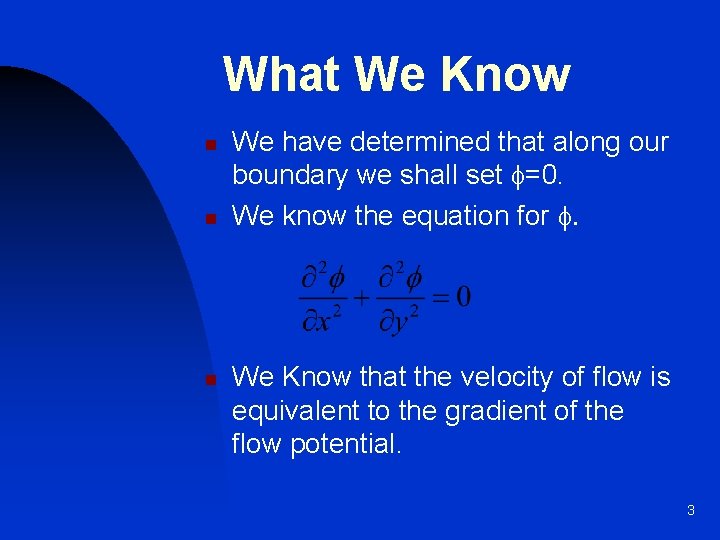
What We Know n n n We have determined that along our boundary we shall set f=0. We know the equation for f. We Know that the velocity of flow is equivalent to the gradient of the flow potential. 3
Three Circumstances of Node Points n Along the boundary of the Gulf of Mexico we encounter three possible circumstances for each node. 1) On Land u 2) On River u 3) On Open Sea u 4
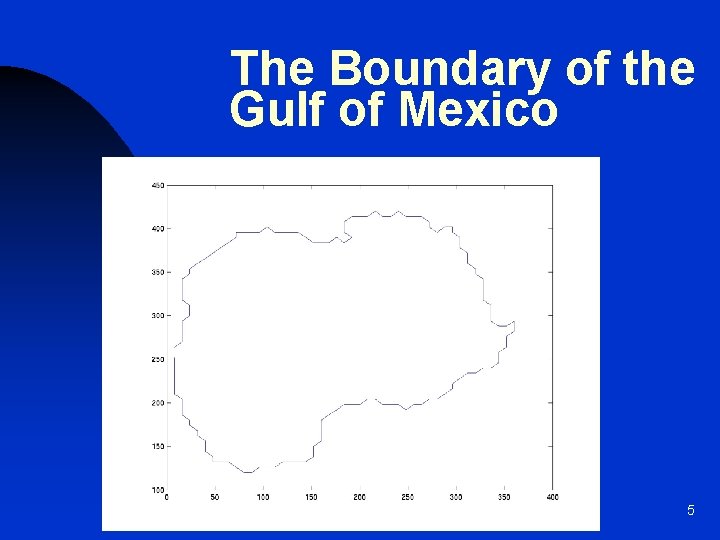
The Boundary of the Gulf of Mexico 5
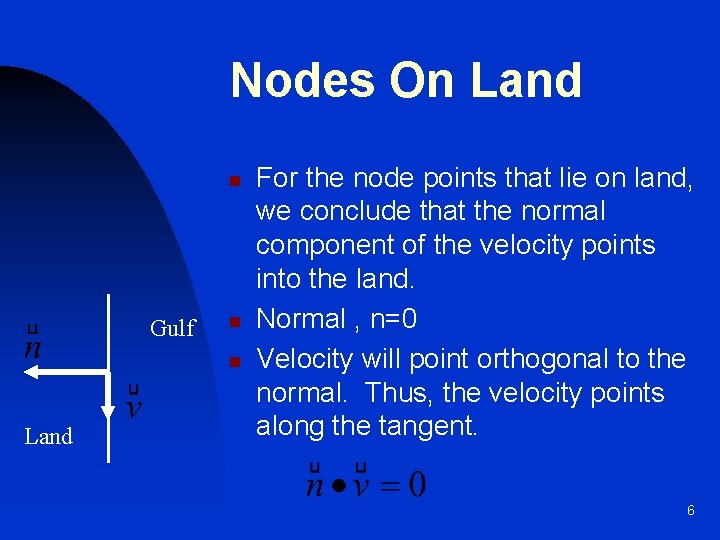
Nodes On Land n Gulf n n Land For the node points that lie on land, we conclude that the normal component of the velocity points into the land. Normal , n=0 Velocity will point orthogonal to the normal. Thus, the velocity points along the tangent. 6
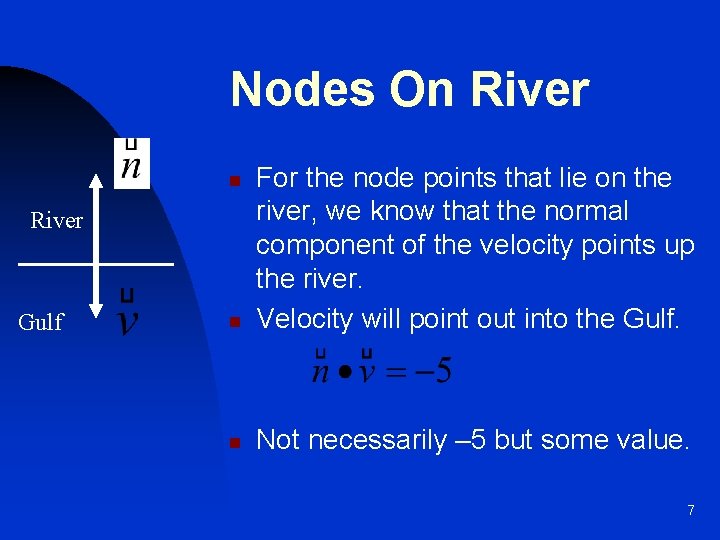
Nodes On River n For the node points that lie on the river, we know that the normal component of the velocity points up the river. Velocity will point out into the Gulf. n Not necessarily – 5 but some value. n River Gulf 7
Nodes on Open Sea n n For any of the node points that lie on the open sea of our boundary, we will assume that flow potential equals zero. f=0. 8
Discretizing this information into equations n We will use this knowledge of the velocity at each node along the boundary to create a solvable system involving functions of flow potential. 9
5 Boundary Point Configurations n There will be five possible boundary point configurations 1) North-South with 2 known points u 2) East-West with 2 known points u 3) North-South with 1 known point u 4) East-West with 1 known point u 5) Points lying along a diagonal u 10
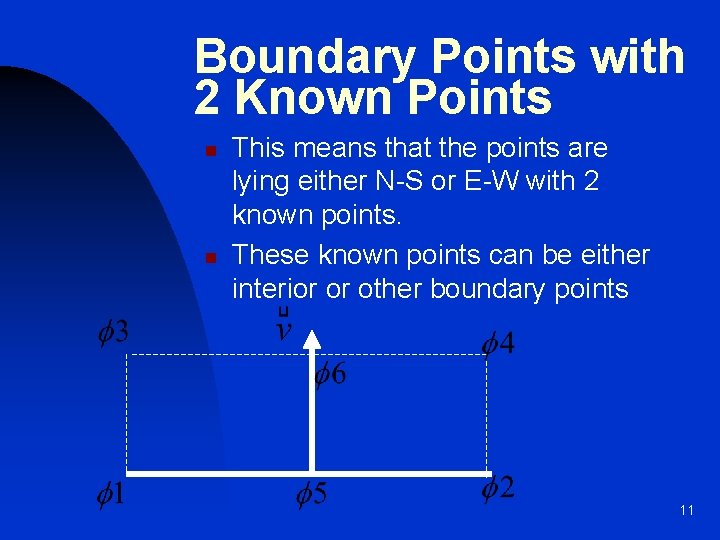
Boundary Points with 2 Known Points n n This means that the points are lying either N-S or E-W with 2 known points. These known points can be either interior or other boundary points 11
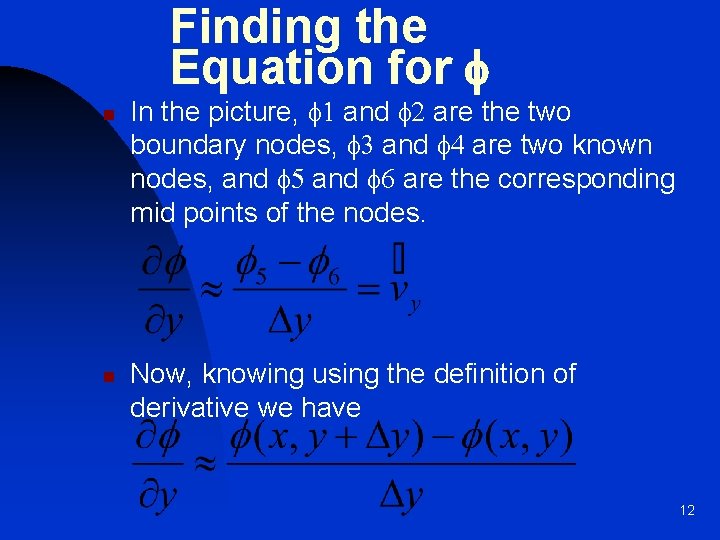
Finding the Equation for f n n In the picture, f 1 and f 2 are the two boundary nodes, f 3 and f 4 are two known nodes, and f 5 and f 6 are the corresponding mid points of the nodes. Now, knowing using the definition of derivative we have 12
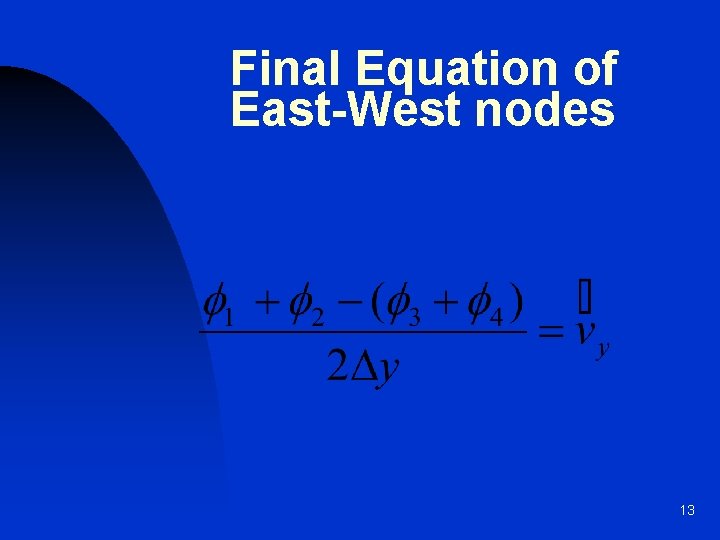
Final Equation of East-West nodes 13
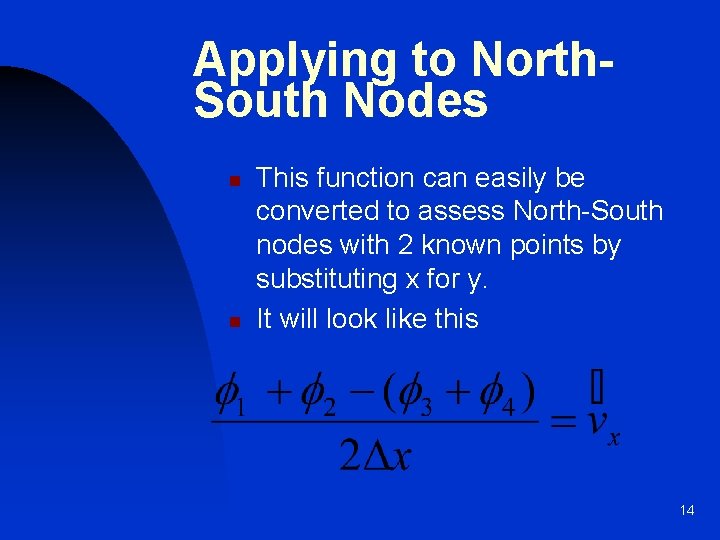
Applying to North. South Nodes n n This function can easily be converted to assess North-South nodes with 2 known points by substituting x for y. It will look like this 14
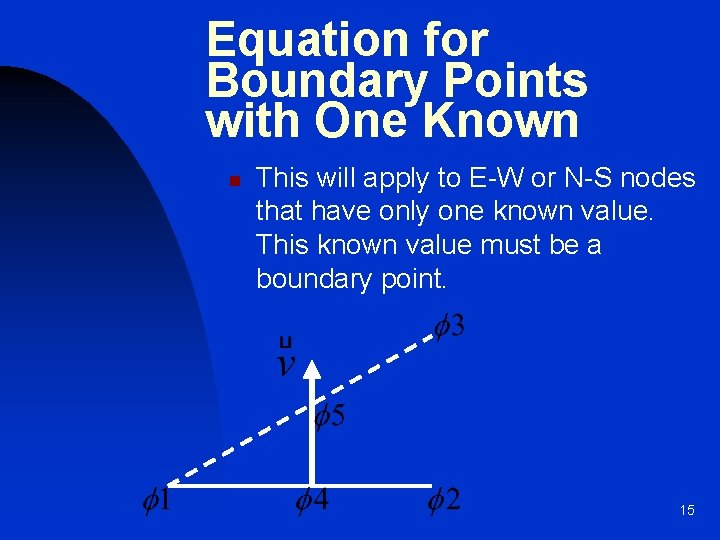
Equation for Boundary Points with One Known n This will apply to E-W or N-S nodes that have only one known value. This known value must be a boundary point. 15
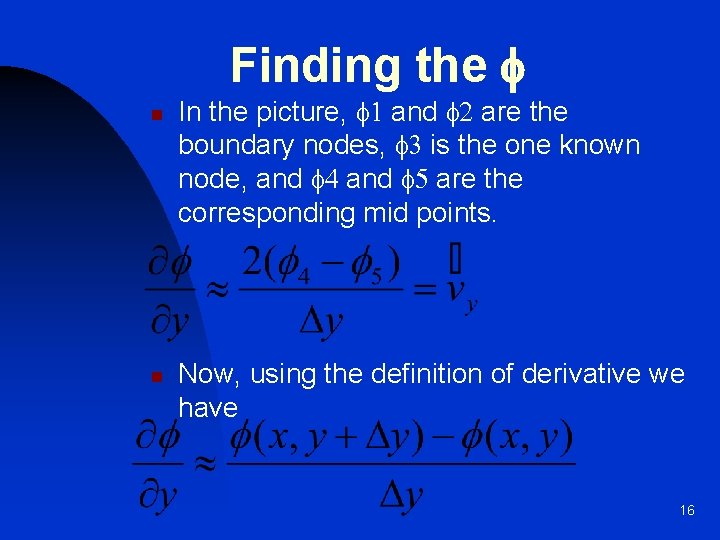
Finding the f n n In the picture, f 1 and f 2 are the boundary nodes, f 3 is the one known node, and f 4 and f 5 are the corresponding mid points. Now, using the definition of derivative we have 16
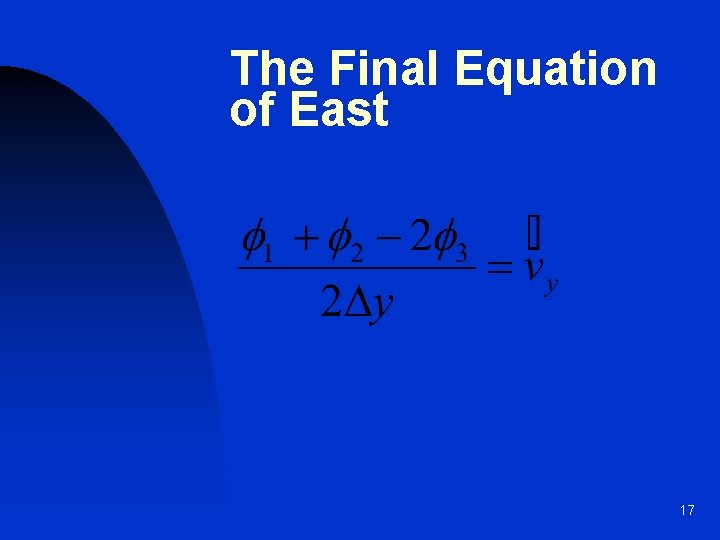
The Final Equation of East 17
Applying this to North-South Nodes n This equation can also easily be applied to N-S nodes by substituting x for y. 18
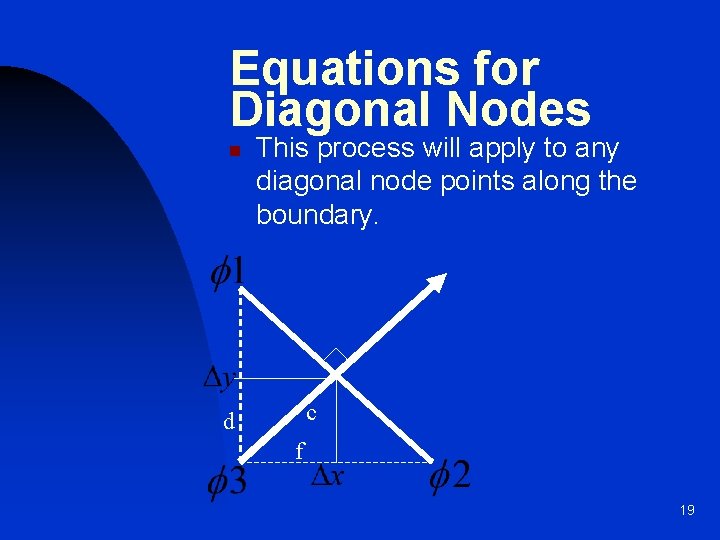
Equations for Diagonal Nodes n This process will apply to any diagonal node points along the boundary. c d f 19
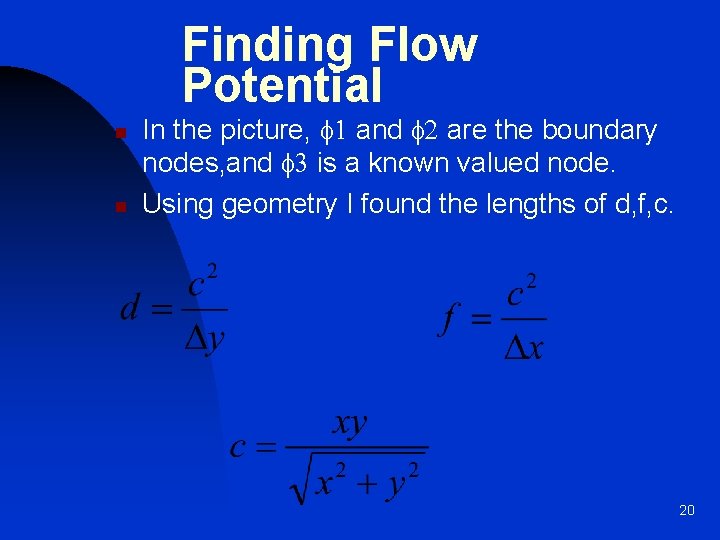
Finding Flow Potential n n In the picture, f 1 and f 2 are the boundary nodes, and f 3 is a known valued node. Using geometry I found the lengths of d, f, c. 20
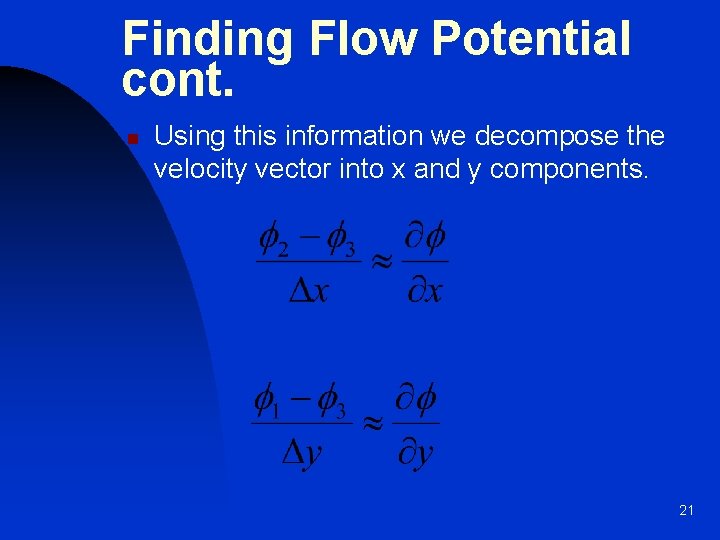
Finding Flow Potential cont. n Using this information we decompose the velocity vector into x and y components. 21
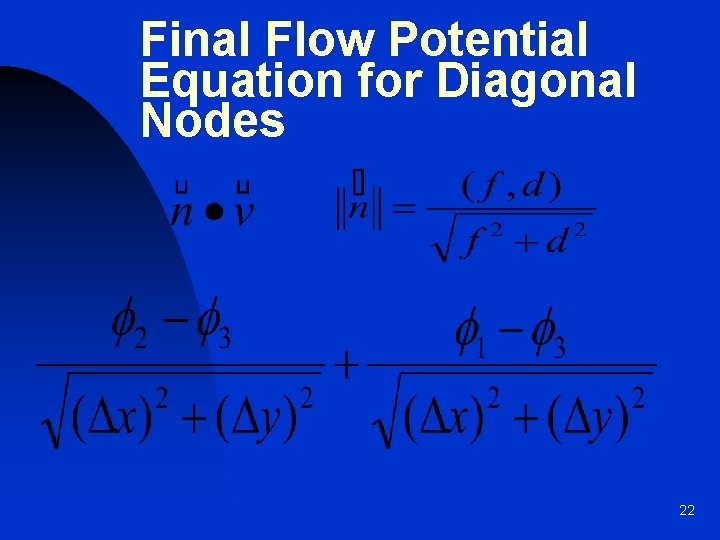
Final Flow Potential Equation for Diagonal Nodes 22
- Slides: 22