
Discrete Trial Teaching A Research Based Method for
Discrete Trial Teaching A Research Based Method for Teaching Students with Autism and Significant Cognitive Disabilities
Discrete Trial Teaching Presented By: Tanya Semerad- Autism/Significant Cognitive Disabilities Specialist Utah State Board of Education Lindsey Baxter- Instructional Coach/Implementation Specialist Utah Professional Development Network
Discrete Trial Teaching (DTT) Agenda 1 - KWL and Rationale for Training 2 - Steps to Prepare for DTT Session 3 - Steps Within DTT Session 4 - Generalization 5 - Questions
Discrete Trial Teaching 1. KWL and Rationale for Training KWL Activity Knowledge: What do you know about DTT? How have you used it? Who do you use it with? What: What would you like to learn? Roadblocks you would like to get past. Learn: What have you learned (at the end of the session)?
Discrete Trial Teaching Why have training about DTT? Research based method for teaching students with severe cognitive disabilities *See references at end of power point
Discrete Trial Teaching 2. Steps to Prepare for DTT Session Before The Session Begins- Considerations and Planning What to teach? Task Analysis (break down into steps) Organize Notebook and Materials Setting the environment Preference Assessment 2
Discrete Trial Teaching Before The Session Begins. Considerations and Planning What to teach? DTT curriculum? Behavioral Intervention for Young Children with Autism, Big Book of ABA Programs, A Complete ABA Curriculum for Individuals on the Autism Spectrum with a Developmental Age of 2 -4 Years, Assert Curriculum, etc. IEP goals
Discrete Trial Teaching Before The Session Begins. Considerations and Planning Talk Analysis of IEP goals or missing skills to be learned Task Analysis – Detailed analysis of a task and how it is accomplished, both mentally and physically. The task is broken into smaller component steps. Task frequency, skill level required, and complexity should all be identified. Task Analysis Activity
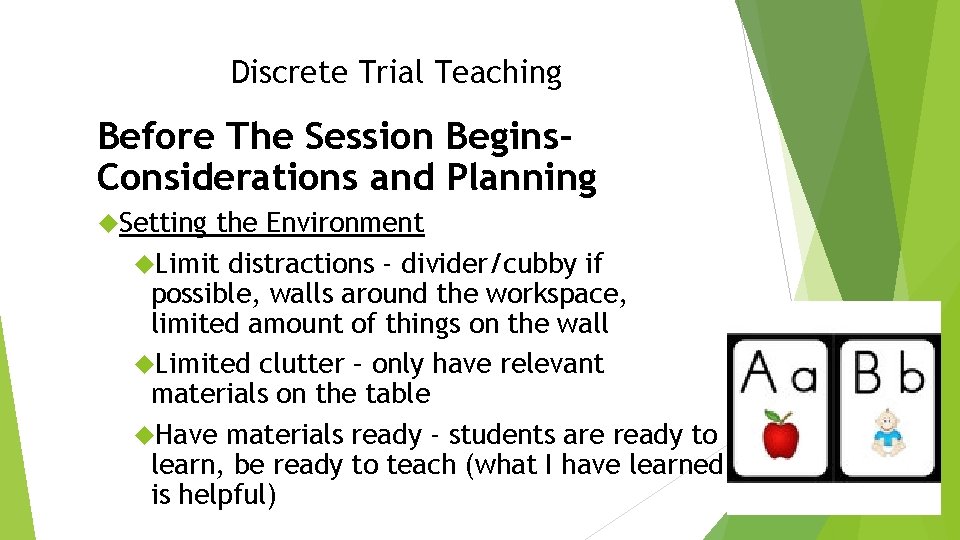
Discrete Trial Teaching Before The Session Begins. Considerations and Planning Setting the Environment Limit distractions - divider/cubby if possible, walls around the workspace, limited amount of things on the wall Limited clutter – only have relevant materials on the table Have materials ready - students are ready to learn, be ready to teach (what I have learned is helpful)
Discrete Trial Teaching Setting the Environment Continued Program materials - shapes, object matching, picture cards, etc. Pencils Data sheet Reinforcing items (edibles and tangibles) Token board, applicable behavioral supports (timers, break cards, first-then)
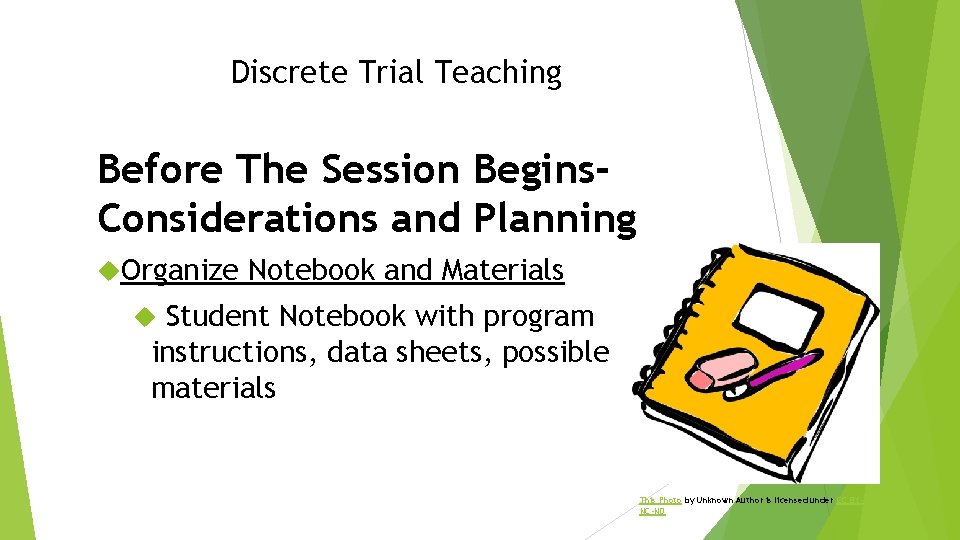
Discrete Trial Teaching Before The Session Begins. Considerations and Planning Organize Notebook and Materials Student Notebook with program instructions, data sheets, possible materials This Photo by Unknown Author is licensed under CC BYNC-ND
Discrete Trial Training Before The Session Begins- Considerations and Planning Preference Assessment A valid and effective way to identify preferred items/activities for use as reinforcement (Tullis, Cannella-Malone, Basbigill, Yeager, Fleming, Payne & Wu, 2011) Many Types and Data Sheets http: //vkc. mc. vanderbilt. edu/ebip/datasheets/
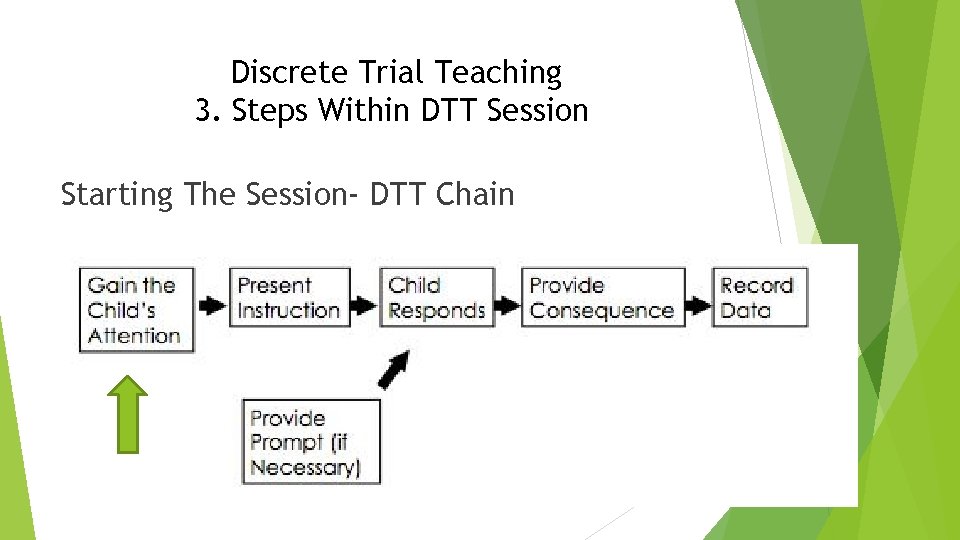
Discrete Trial Teaching 3. Steps Within DTT Session Starting The Session- DTT Chain
Discrete Trial Teaching Activity: Think and Pair Share What strategies do you use to gain a student’s or students’ attention when wanting to give a direction or present work? Individual? Small group/whole group?
Discrete Trial Training 1. Gaining Attention- various considerations Attending/Get Ready Program Saying the Student’s Name Instructional Cue Teaching Student to Attend Without a Cue
Discrete Trial Training 1. Gaining Attention Practices to Increase Success: Visual shield Prompting appropriate body positioning Wait time Material presentation Mastered tasks Present instruction when you have gained attention
Discrete Trial Training Practices to Avoid when Gaining Attention: Repeating Saying the instruction over and over the child’s name- consider Snapping at the child Caution: wait time
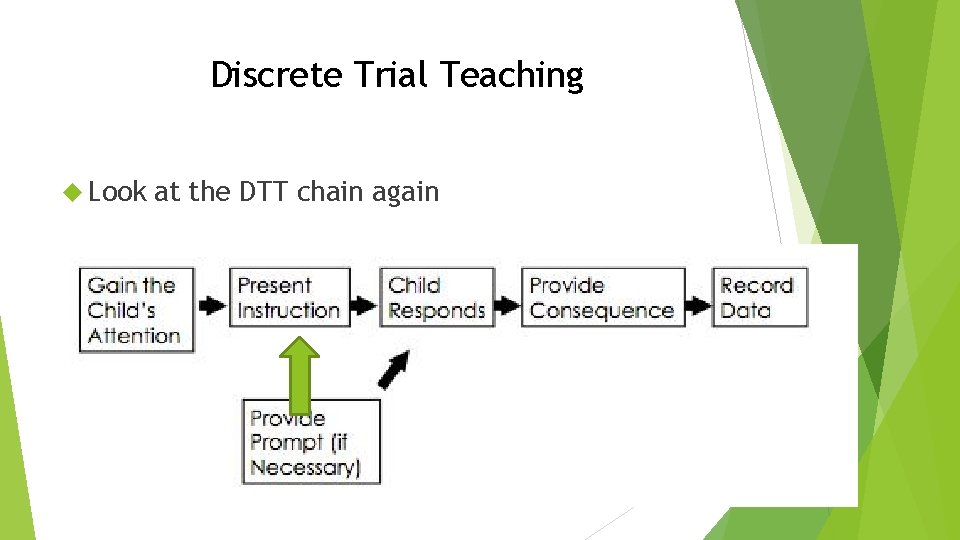
Discrete Trial Teaching Look at the DTT chain again
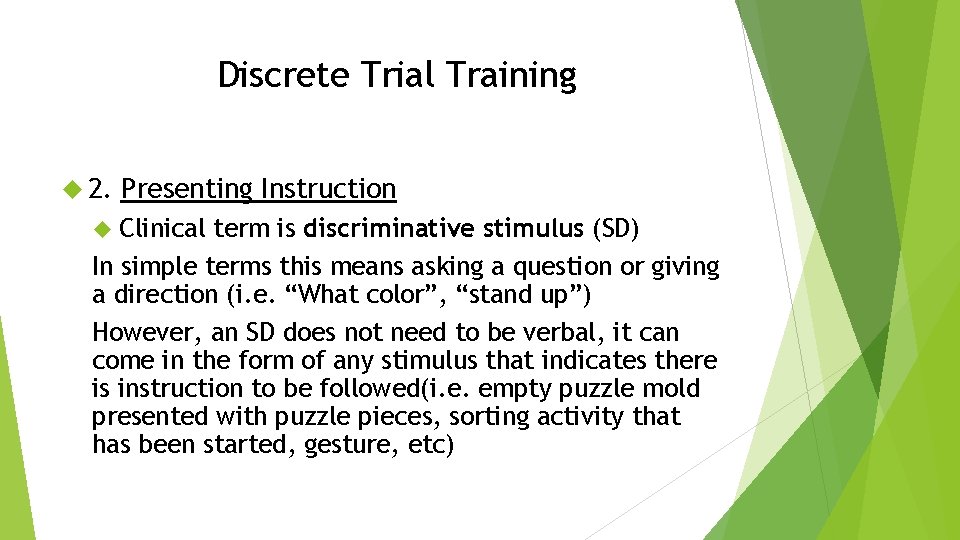
Discrete Trial Training 2. Presenting Instruction Clinical term is discriminative stimulus (SD) In simple terms this means asking a question or giving a direction (i. e. “What color”, “stand up”) However, an SD does not need to be verbal, it can come in the form of any stimulus that indicates there is instruction to be followed(i. e. empty puzzle mold presented with puzzle pieces, sorting activity that has been started, gesture, etc)
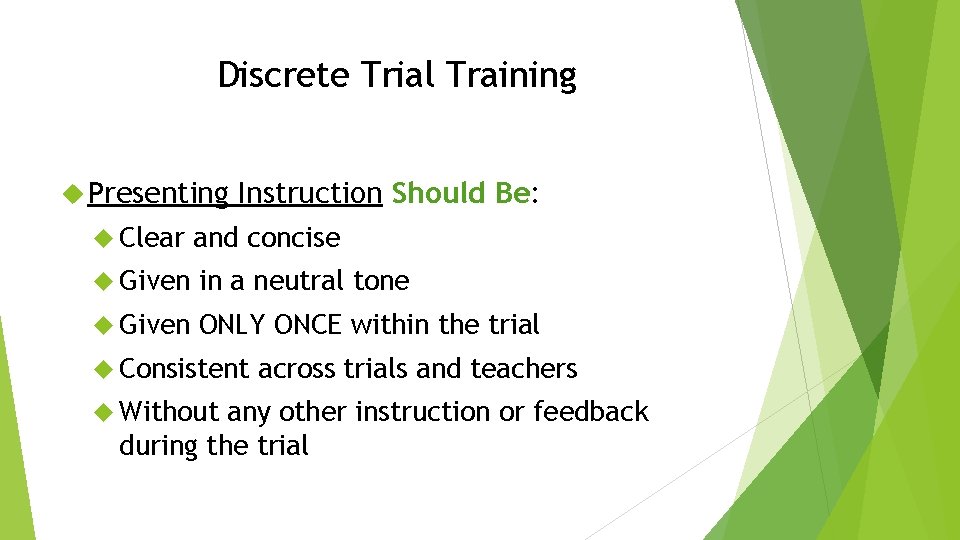
Discrete Trial Training Presenting Instruction Should Be: Clear and concise Given in a neutral tone Given ONLY ONCE within the trial Consistent Without across trials and teachers any other instruction or feedback during the trial
Discrete Trial Training Practices to Avoid when Presenting Instruction: Repeating the instruction over and over Rephrasing High the instruction pitched, enthusiastic voice Correcting within the trial after
Discrete Trial Training Typical Types of Instructional Programming: Imitation (physical and vocal/verbal) often a prerequisite for other programs Receptive knowledge of understanding is demonstrated through action (point to, show me, do, go, match, put, etc. ) Usually a pre-requisite to expressive programs Expressive knowledge of understanding is demonstrated through verbal, sign language, text, pictures, etc. )
Discrete Trial Training Demonstration of presenting instruction Model * * * * do this- imitation say “mama”- imitation touch nose- receptive give me pencil- receptive stand up- receptive what color- expressive how many- expressive What is your name- expressive
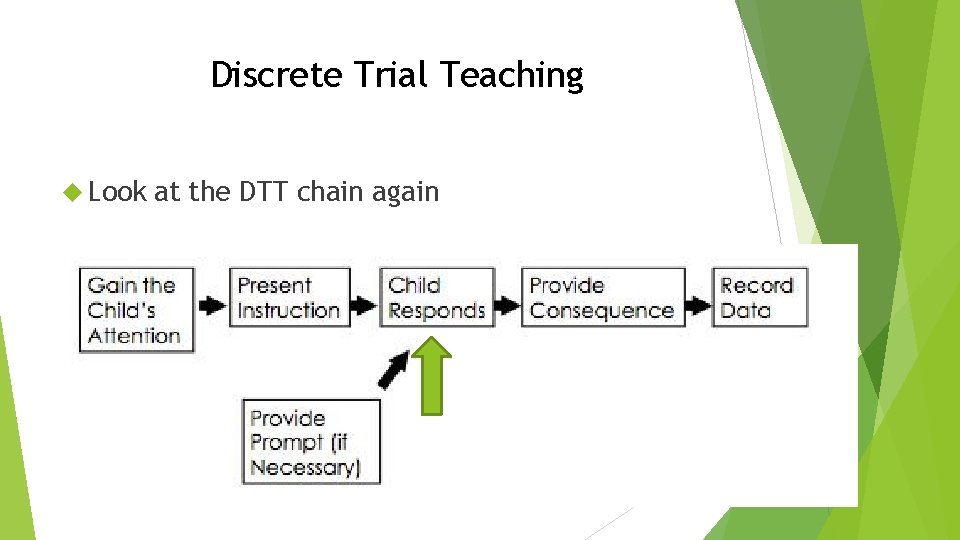
Discrete Trial Teaching Look at the DTT chain again
Discrete Trial Training 3. Student Response: There are 3 Types of Student Response Correct Incorrect- problem behavior or unexpected behavior is considered and incorrect response No Response-this is considered an incorrect response
Discrete Trial Training Things To Be Aware Of During Student Response: Response time (usually 3 -5 seconds) Be cautious of indicating correct response with your facial expression, verbal cues, presentation of materials, etc. NEVER prompt correct response after incorrect response during the SAME trial- Leads to chaining behavior- this will be explained further in prompting slides
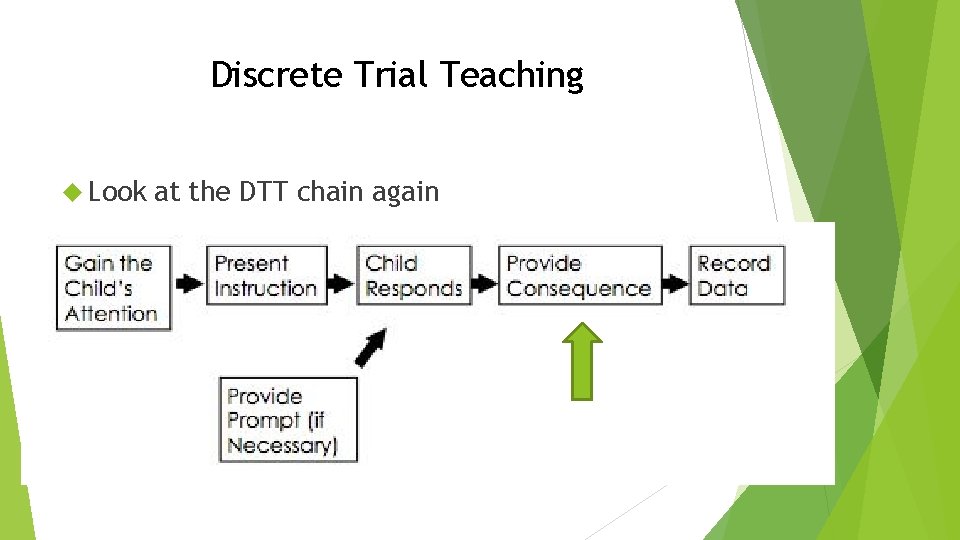
Discrete Trial Teaching Look at the DTT chain again
Discrete Trial Training 4. Providing Consequence Based on Student Response: What to do if they get it INCORRECT * You can say “try again”, “no”, “that’s not ___” (neutral voice), turn away and say nothing. * Take data * End the trial as quickly as possible
Discrete Trial Training Providing Consequence Based on Student Response: What to do if they DO NOT RESPOND treat it as incorrect * You can say “try again”, “no”, “that’s not ___” (neutral voice), turn away and say nothing. * Take data * End the trial
Discrete Trial Training Providing Consequence Based on Student Response: PROBLEM BEHAVIOR? ? ?
Discrete Trial Training How To Respond To Problem Behavior During DTT: Minimize materials present Be ready to block materials Environmentally set up so it is challenging to leave the session Decrease the demand until you see behavior momentum and then go back to harder tasks Keep going with the demand Mentally check if you have been giving reinforcementgive mild praise if you see small successes and build up Consider ending the session early but check with the teacher first and only after they have completed the task successfully
Discrete Trial Training Providing Consequence Based on Student Response: What to do if they get it CORRECT * Praise in excited voice, indicate what they did correctly “you did match yellow!”, give social reinforcement (high five, tickle), sticker/token towards item they are working for, give tangible item (edible, book, toy, etc). * Take data * End the trial
Discrete Trial Training Tips On Delivering Positive Reinforcement: Immediate Enthusiastic Eye Contact Descriptive Vary More motivating reinforcement for independent (un -prompted) correct response
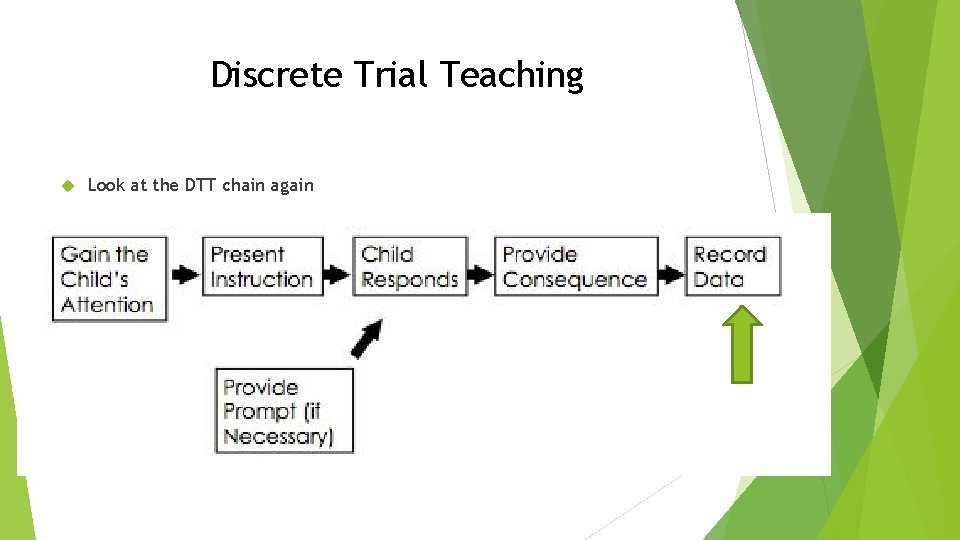
Discrete Trial Teaching Look at the DTT chain again
Discrete Trial Training Why Take Data: To track progress For determining next steps for teaching To document skills and deficits
Discrete Trial Training 5. Recording Data: Always the last step of the trial If delivering a social praise, token, tangible for correct response do that BEFORE recording data!! You can record data when delivering a consequence for incorrect response(“try again”, “no”, turning away, etc. ) Mark the data after every single trial Once you have marked your data you can consider the trial complete You can stop working on a program once there have been at least 5 trials and you are ending with 2 correct unprompted responses (with transfer trial)
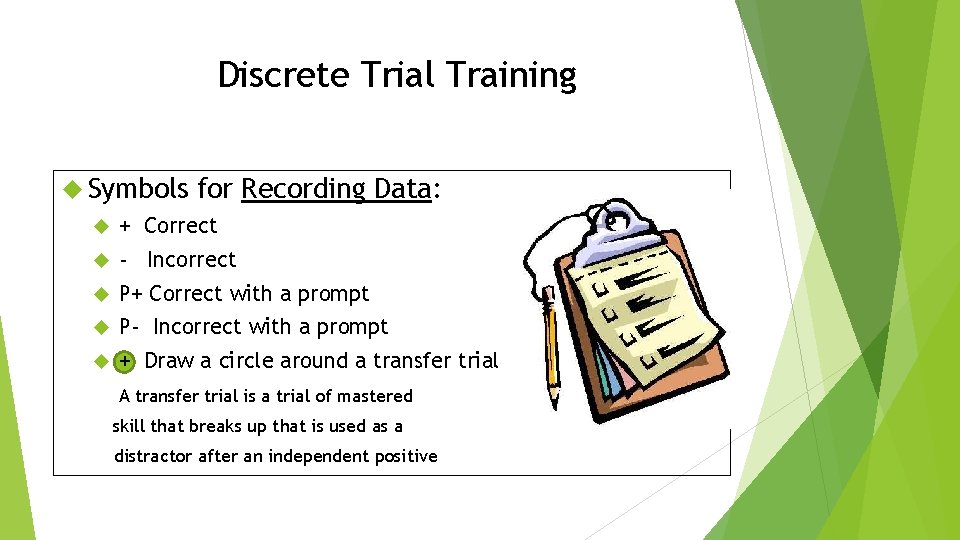
Discrete Trial Training Symbols for Recording Data: + Correct - Incorrect P+ Correct with a prompt P- Incorrect with a prompt + Draw a circle around a transfer trial A transfer trial is a trial of mastered skill that breaks up that is used as a distractor after an independent positive
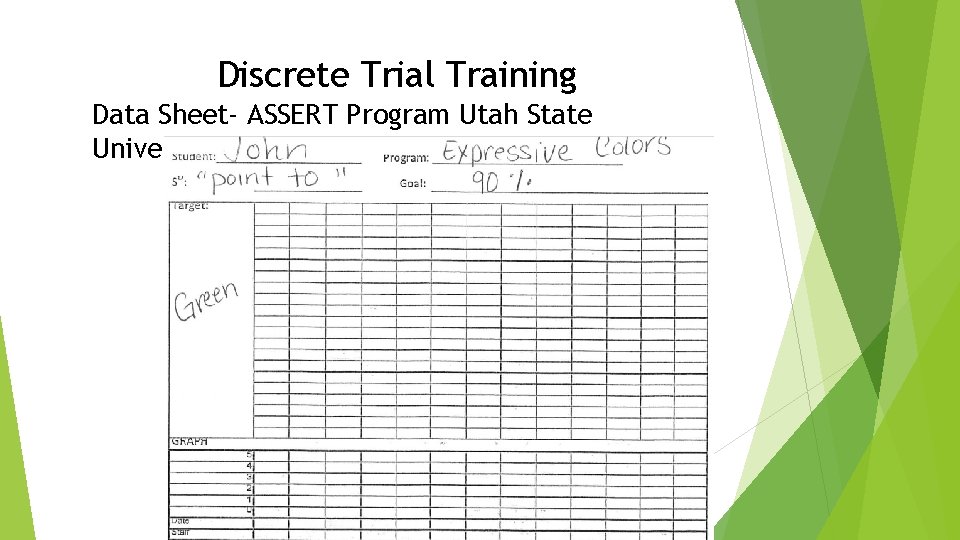
Discrete Trial Training Data Sheet- ASSERT Program Utah State University
Discrete Trial Training Model Taking Data Without Prompts: Model with gaining attention, SD or instruction, student response, consequence and taking data. Introduce ABA focused Data Sheet *ASSERT - record all data - only count the first 5 for graphing (at the bottom) - one data sheet for a program or goal (i. e. receptive colors) Fill out data sheet together Observe and take data
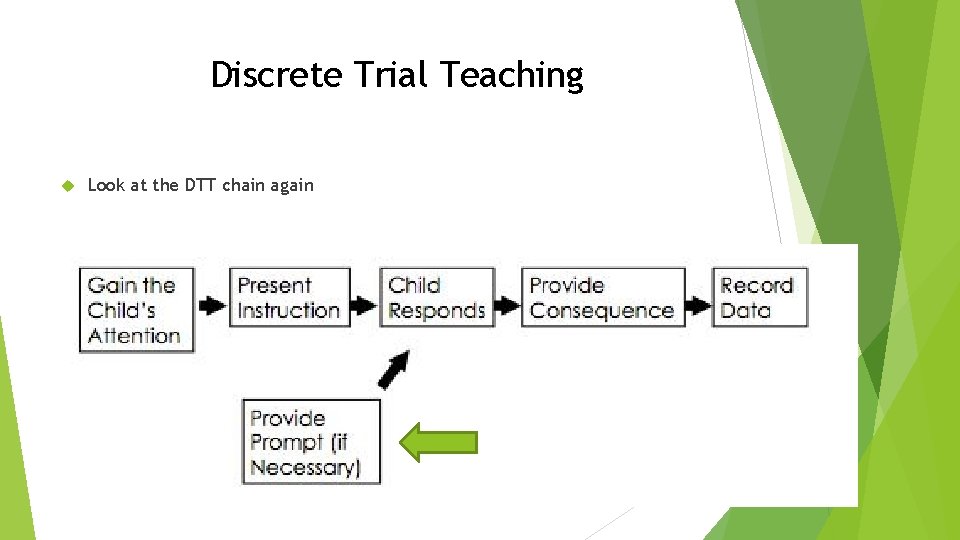
Discrete Trial Teaching Look at the DTT chain again

Discrete Trial Training Prompts During DTT: Prompting will be given on the NEXT trial if there was an incorrect response Use the least intrusive prompt necessary NEVER prompt within the trial when an incorrect response was given Record data as a P+ or a P-
Discrete Trial Training Types of Prompts (Least to Most): Partial gesture Full gesture Partial model Full model Physical prompt at forearm Physical prompt at wrist Full physical prompt * Model examples for “touch pencil”
Discrete Trial Training Prompting During DTT For Expressive programs (student needs to answer verbally): Full verbal prompt Partial verbal prompt Volume prompt
Discrete Trial Training Prompting During DTT: If the response with prompt is P+: reinforce, mark the data, start new trial without prompt(see if they can do it independently) If the response with prompt is P-: provide consequence, mark the data, start new trial with more intrusive prompt
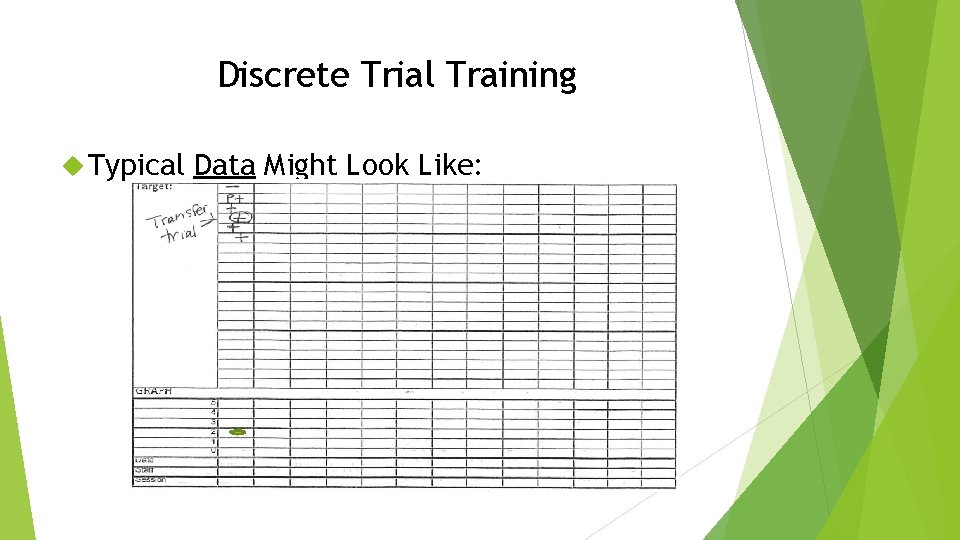
Discrete Trial Training Typical Data Might Look Like:
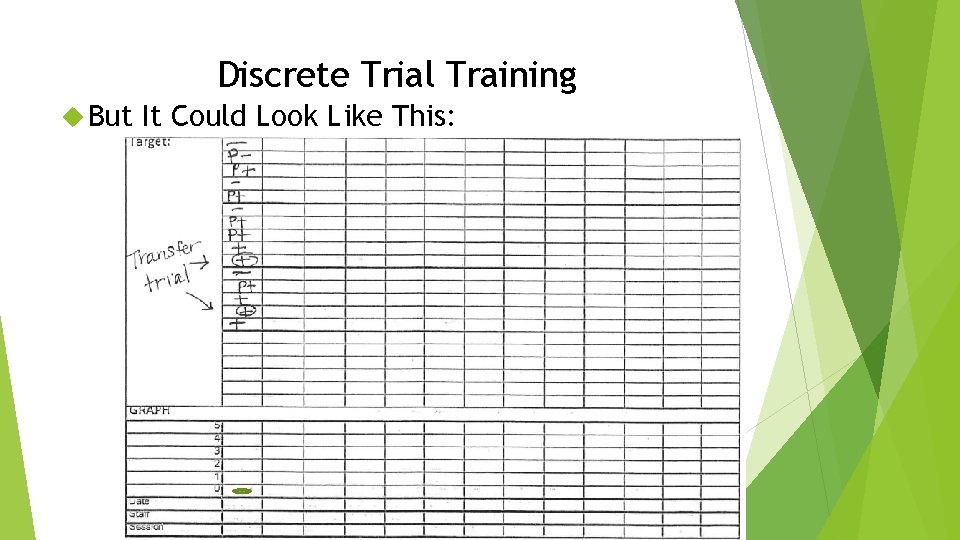
Discrete Trial Training But It Could Look Like This:
Discrete Trial Training Practice Taking Data with Prompts Observe and take data Remember don’t take data on the transfer trial
Discrete Trial Training Back to Prompting- sometimes Errorless Learning is necessary: Probe (determine least intrusive prompt in order to get correct response) Do ALL trials with that prompt Fade the prompt to less intrusive when data shows progress (3 sessions of at least 80%) success Continue until no longer needing prompts and can respond correctly independently
Discrete Trial Training 4. Generalization What Why is Necessary: is generalization? is it necessary?
Discrete Trial Training How to Ensure Generalization: Once skill is mastered teach and reinforce skill * in different settings * with different people * with different materials
Discrete Trial Teaching KWL What is one new thing that you learned today?
Discrete Trial Teaching 5. Questions Review Other Parking Lot Questions
Discrete Trial Teaching Resources Cohen, H. , Amerine-Dickens, M. , & Smith, T. (2006). Early intensive behavioral treatment: Replication of the UCLA model in a community setting. Journal of Developmental and Behavioral Pediatrics, 27(2), 145 -155. Howard, J. S. , Sparkman, C. R. , Cohen, H. G. , Green, G. , & Stanislaw, H. (2005). A comparison of intensive behavior analytic and eclectic treatments for young children with autism. Research in Developmental Disabilities, 26(4), 359 -383. Remington, B. , Hastings, R. P. , Kovshoff, H. , Degli Espinosa, F. , Jahr, E. , Brown T. , et al. (2007). Early intensive behavioral intervention: Outcomes for children with autism and their parents after two years. American Journal on Mental Retardation, 112(6), 418 -438. Smith, T. , Groen, A. , & Wynn, J. W. (2000). Randomized trial of intensive early intervention for children with pervasive developmental disorder. American Journal on Mental Retardation, 105(4), 269 -285. Whalen, C. , & Schreibman, L. (2003). Joint attention training for children with autism using behavior modification procedures. Journal of Child Psychology & Psychiatry, 44(3), 456 -468.
Discrete Trial Teaching Dib, N. , & Sturmey, P. (2007). Reducing student stereotypy by improving teachers' implementation of discrete-trial teaching. Journal of Applied Behavior Analysis, 40(2), 339 -343. Eikeseth, S. , Smith, T. , Jahr, E. , & Eldevik, S. (2002). Intensive behavioral treatment at school for 4 -7 year-old children with autism. Behavior Modification. 26(1), 49 -68. Lovaas, O. I. (1987). Behavioral treatment and normal educational and intellectual functioning in young autistic children. Journal of Consulting and Clinical Psychology. 55, 3 -9. National Professional Development Center on Autism Spectrum Disorders Module: Discrete Trial Training (DTT) Discrete Trial Training: Overview Page 3 of 3 National Professional Development Center on ASD 10/2010 Mc. Eachin, J. J. , Smith, T. , & Lovaas, O. I. (1993). Long-term outcomes for children with autism who received early intensive behavioral treatment. American Journal on Mental Retardation, 97(4), 359 -372.
Discrete Trial Teaching Leaf, R. , & Mc. Eachin J. (1999). A work in progress. New York, NY: Autism Partnership Lovaas, O. I. , & Smith, T. (1989). A comprehensive behavioral theory of autistic children: Paradigm for research and treatment. Journal of Behavior Therapy and Experimental Psychiatry, 20, 17 -29 Matson, J. , Benavidez, D. , Compton, L. S. , Paclawskyj, T. , & Baglio, C. (1996). Behavioral treatment of autistic persons: A review of research from 1980 to the present. Research in Developmental Disabilities, 17(6), 433 -465. Maurice, C. (1993). Let me hear your voice. NY: Knopf. Smith, T. (1999). Outcome of early intervention for children with autism. Clinical Psychology: Science and Practice, 6(1), 33 -49. Taylor, B. A. , & Mc. Donough, K. A. (1996). Selecting teaching programs. In C. Maurice, G. Green, & S. C. Luce (Eds. ). Behavioral intervention for young children with autism: A manual for parents and professionals (pp. 63 -177). Autism, TX: Pro Ed.
- Slides: 55