
Discrete Structures Trees Ch 11 Dr Muhammad Humayoun

- Slides: 50
Discrete Structures Trees (Ch. 11) Dr. Muhammad Humayoun Assistant Professor COMSATS Institute of Computer Science, Lahore. mhumayoun@ciitlahore. edu. pk https: //sites. google. com/a/ciitlahore. edu. pk/dstruct/ Modified slides of Dr. M. Atif 1
First we need some definitions from Graph theory 2
Path • A path is a sequence of edges that begins at a vertex of a graph and travels from vertex to vertex along edges of the graph. • Formal Definition: Let n∈Z+ and G an undirected graph. A path of length n from vertices u to v in G is a sequence of n edges e 1 , . . . , en of G for which there exists a sequence x 0=u, x 1, . . . , xn− 1, xn=v of vertices. 3
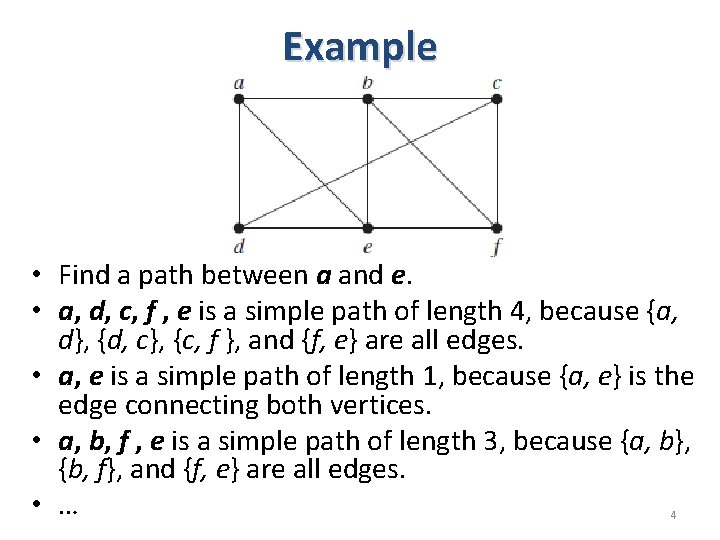
Example • Find a path between a and e. • a, d, c, f , e is a simple path of length 4, because {a, d}, {d, c}, {c, f }, and {f, e} are all edges. • a, e is a simple path of length 1, because {a, e} is the edge connecting both vertices. • a, b, f , e is a simple path of length 3, because {a, b}, {b, f}, and {f, e} are all edges. • … 4
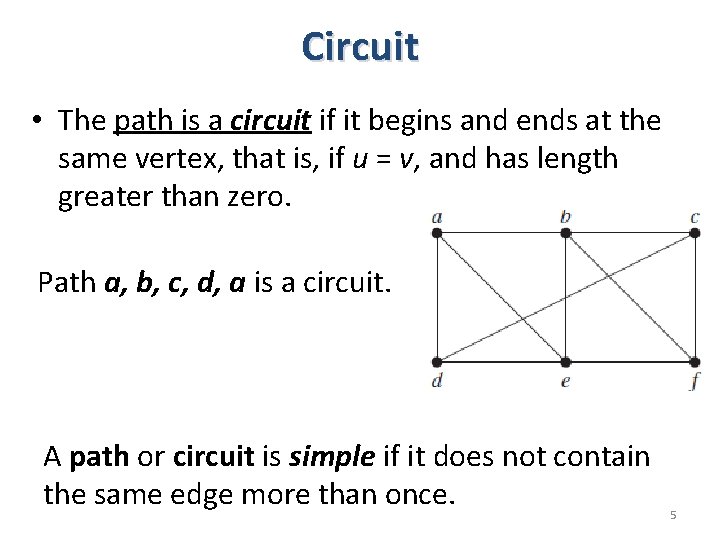
Circuit • The path is a circuit if it begins and ends at the same vertex, that is, if u = v, and has length greater than zero. Path a, b, c, d, a is a circuit. A path or circuit is simple if it does not contain the same edge more than once. 5
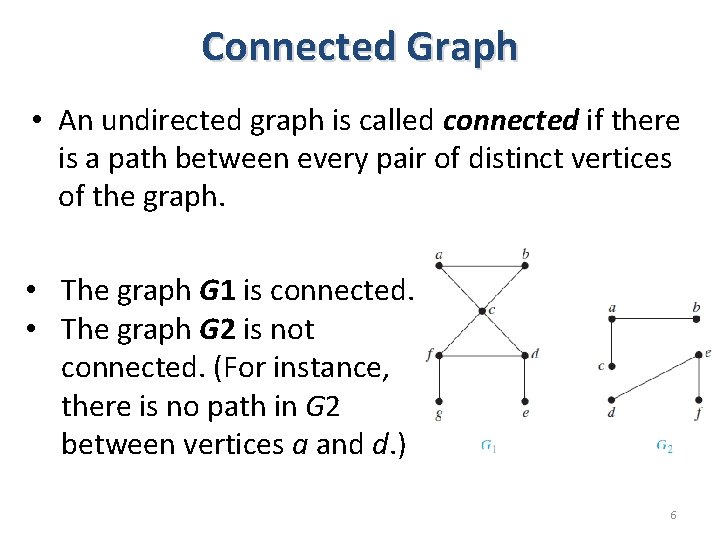
Connected Graph • An undirected graph is called connected if there is a path between every pair of distinct vertices of the graph. • The graph G 1 is connected. • The graph G 2 is not connected. (For instance, there is no path in G 2 between vertices a and d. ) 6
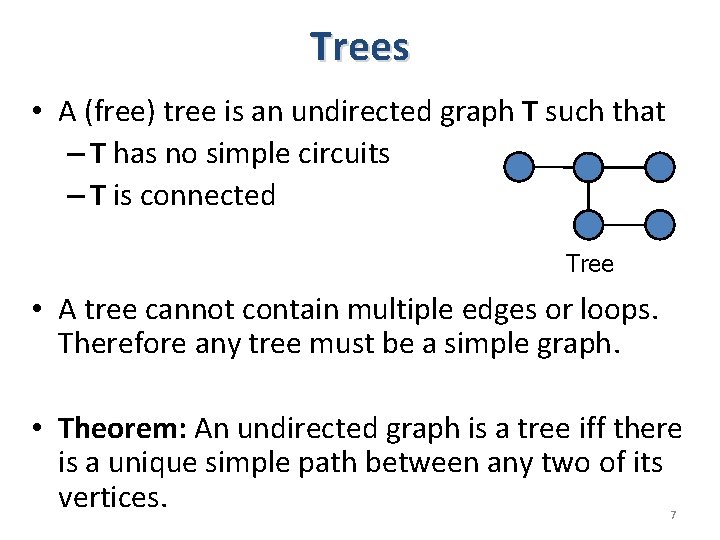
Trees • A (free) tree is an undirected graph T such that – T has no simple circuits – T is connected Tree • A tree cannot contain multiple edges or loops. Therefore any tree must be a simple graph. • Theorem: An undirected graph is a tree iff there is a unique simple path between any two of its vertices. 7
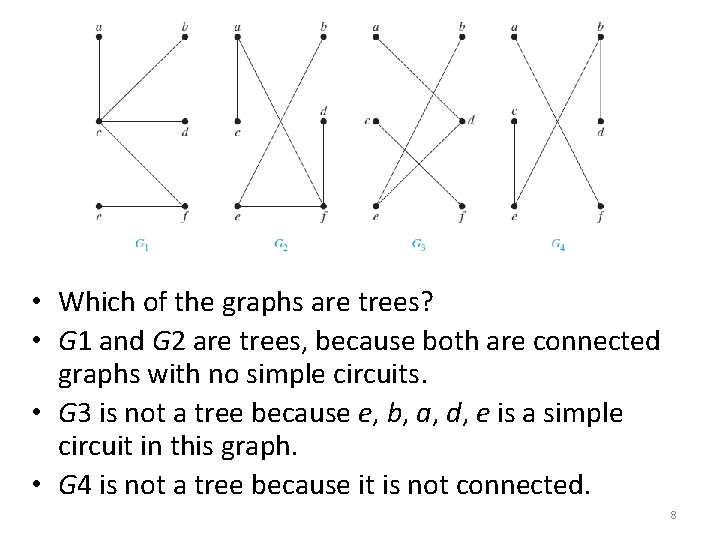
• Which of the graphs are trees? • G 1 and G 2 are trees, because both are connected graphs with no simple circuits. • G 3 is not a tree because e, b, a, d, e is a simple circuit in this graph. • G 4 is not a tree because it is not connected. 8
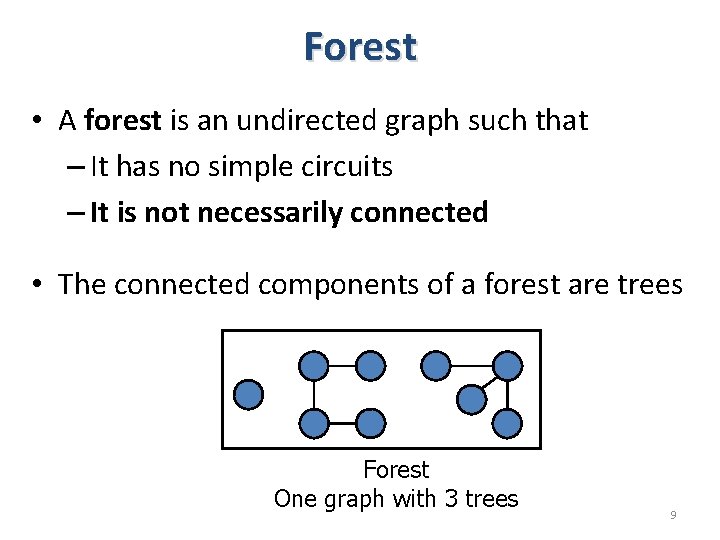
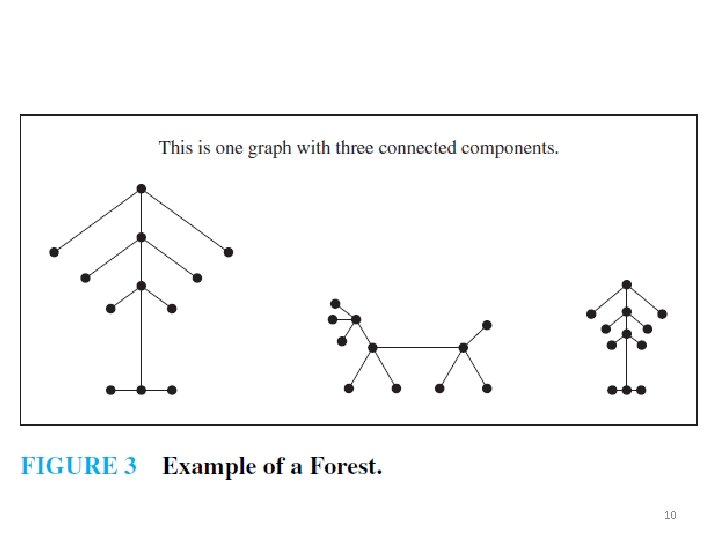
Forest • A forest is an undirected graph such that – It has no simple circuits – It is not necessarily connected • The connected components of a forest are trees Forest One graph with 3 trees 9
10
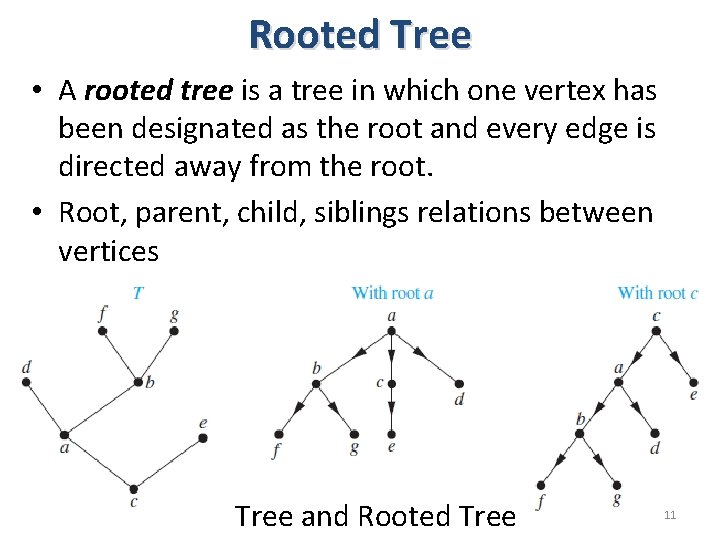
Rooted Tree • A rooted tree is a tree in which one vertex has been designated as the root and every edge is directed away from the root. • Root, parent, child, siblings relations between vertices Tree and Rooted Tree 11
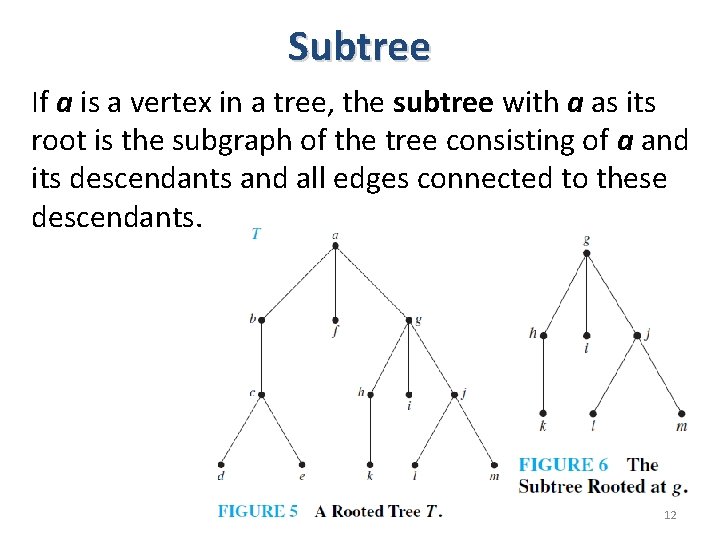
Subtree If a is a vertex in a tree, the subtree with a as its root is the subgraph of the tree consisting of a and its descendants and all edges connected to these descendants. 12
Spanning Tree • A spanning tree of a connected graph is a spanning subgraph that is a tree 13
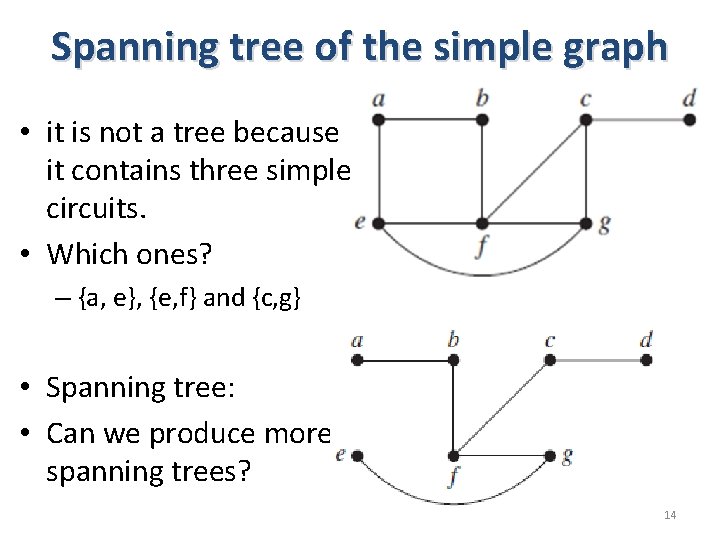
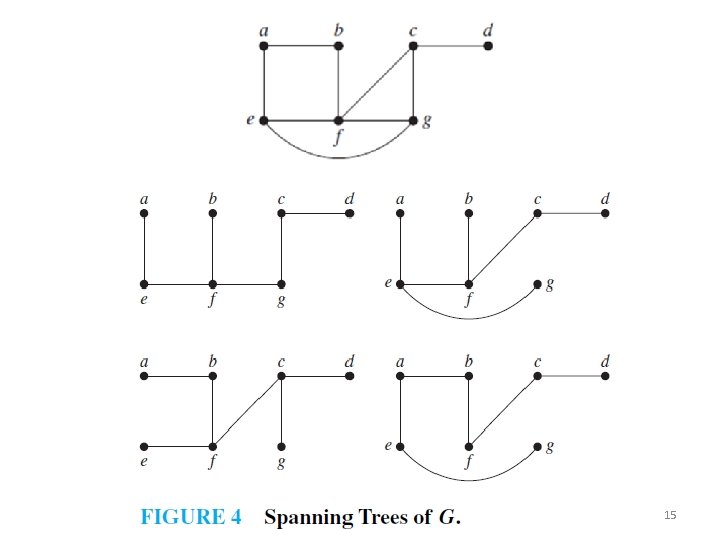
Spanning tree of the simple graph • it is not a tree because it contains three simple circuits. • Which ones? – {a, e}, {e, f} and {c, g} • Spanning tree: • Can we produce more spanning trees? 14
15
Some facts • A simple graph is connected if and only if it has a spanning tree. • A spanning tree is not unique unless the graph is a tree • Spanning trees have applications to the design of communication networks 16
Tree Traversal • Ordered rooted trees are often used to store information. • We need procedures for visiting each vertex of an ordered rooted tree to access data. • We will study some important algorithms for visiting all the vertices of an ordered rooted tree. • Ordered rooted trees can also be used to represent various types of expressions. 17
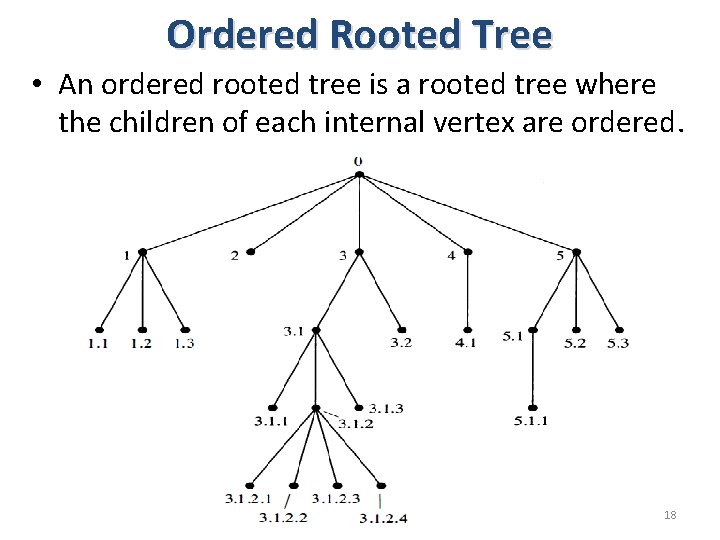
Ordered Rooted Tree • An ordered rooted tree is a rooted tree where the children of each internal vertex are ordered. 18
Traversal Algorithms • Procedures for systematically visiting every vertex of an ordered rooted tree are called traversal algorithms. • Most commonly used algorithms: – Preorder traversal – Inorder traversal – Postorder traversal • All recursively defined. 19
20
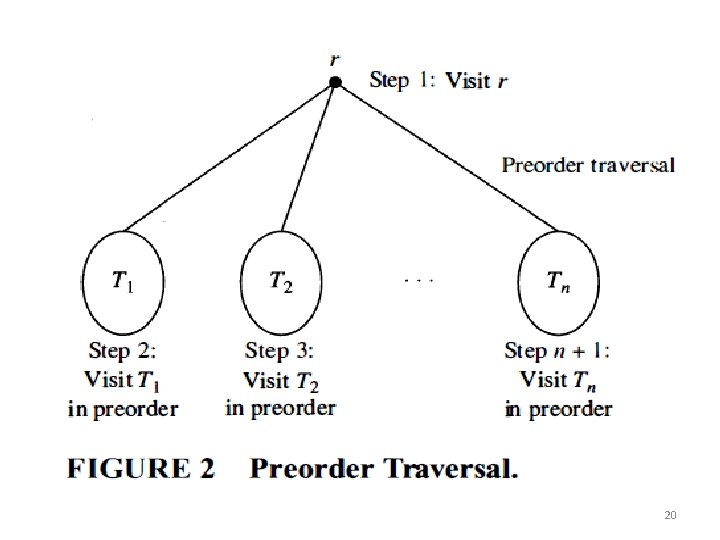
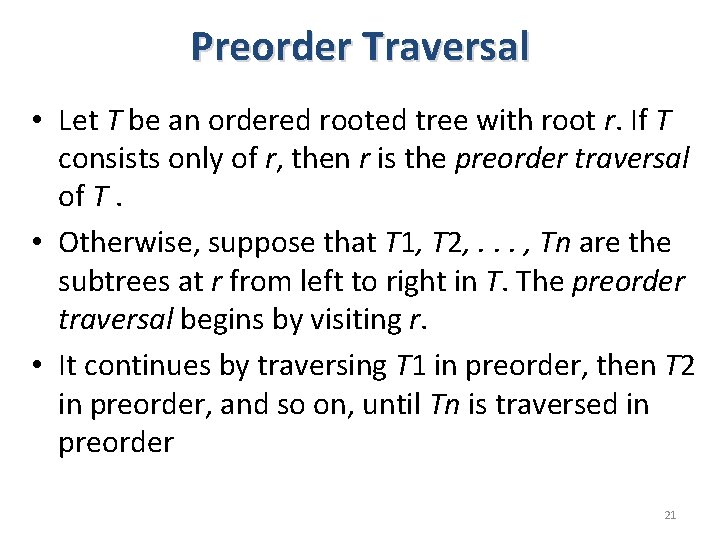
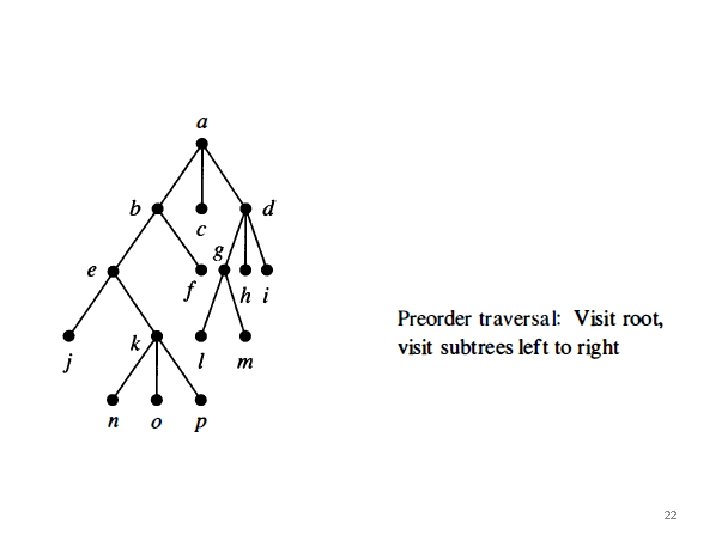
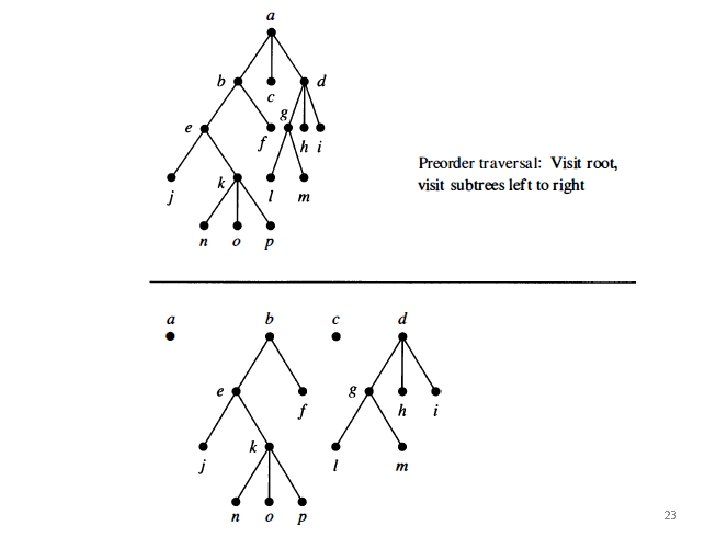
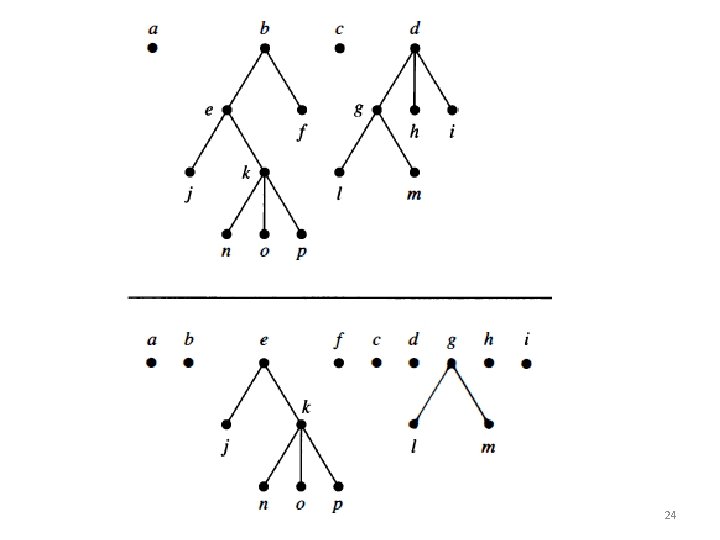
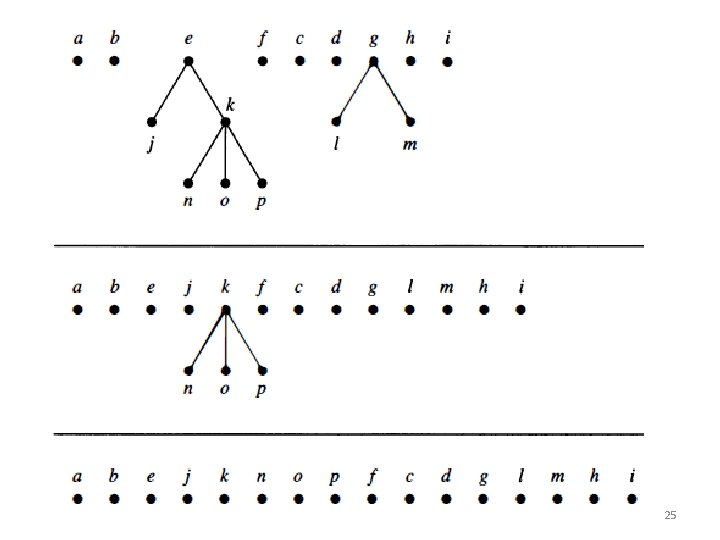
Preorder Traversal • Let T be an ordered rooted tree with root r. If T consists only of r, then r is the preorder traversal of T. • Otherwise, suppose that T 1, T 2, . . . , Tn are the subtrees at r from left to right in T. The preorder traversal begins by visiting r. • It continues by traversing T 1 in preorder, then T 2 in preorder, and so on, until Tn is traversed in preorder 21
22
23
24
25
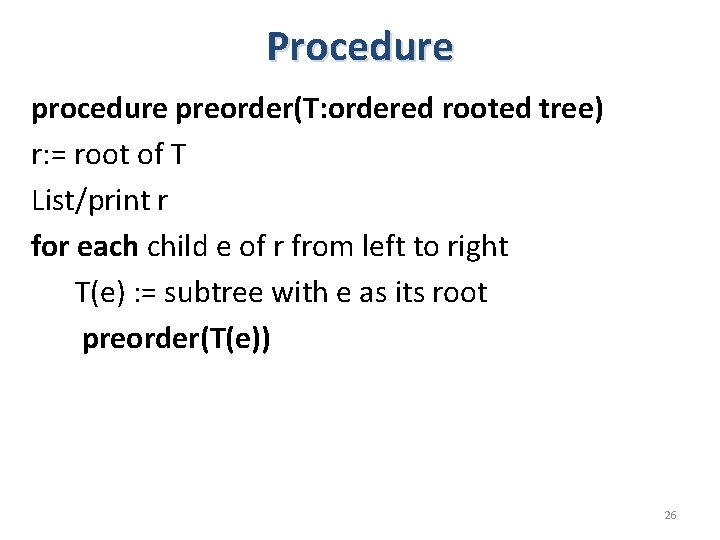
Procedure preorder(T: ordered rooted tree) r: = root of T List/print r for each child e of r from left to right T(e) : = subtree with e as its root preorder(T(e)) 26
Inorder Traversal 27
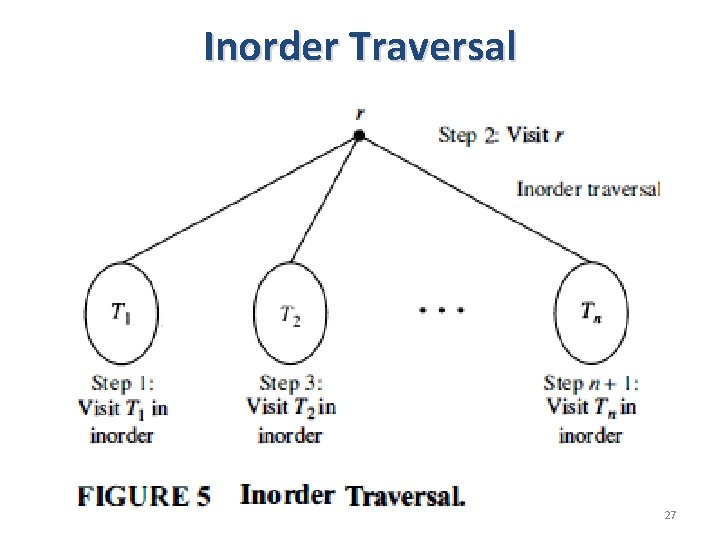
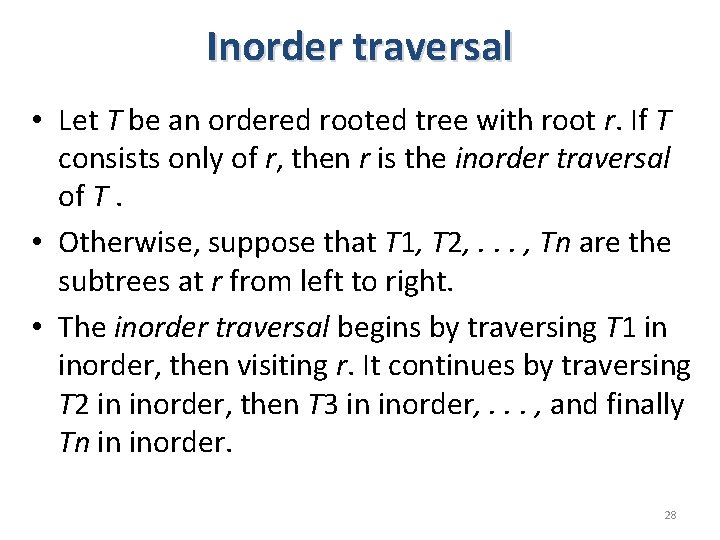
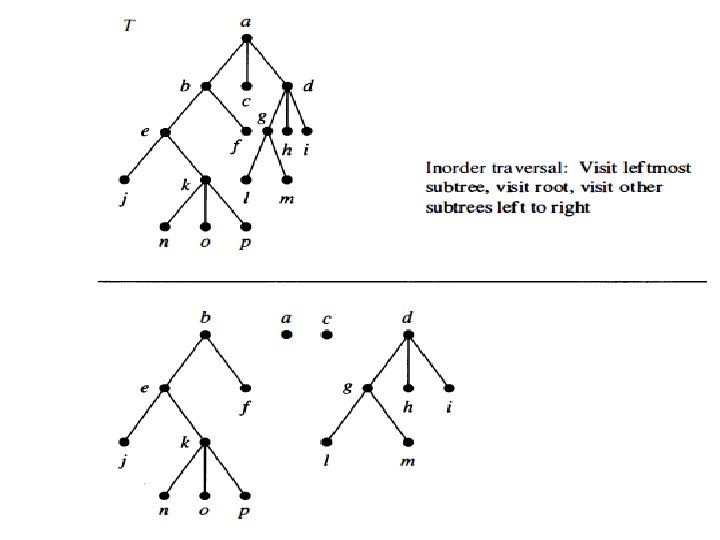
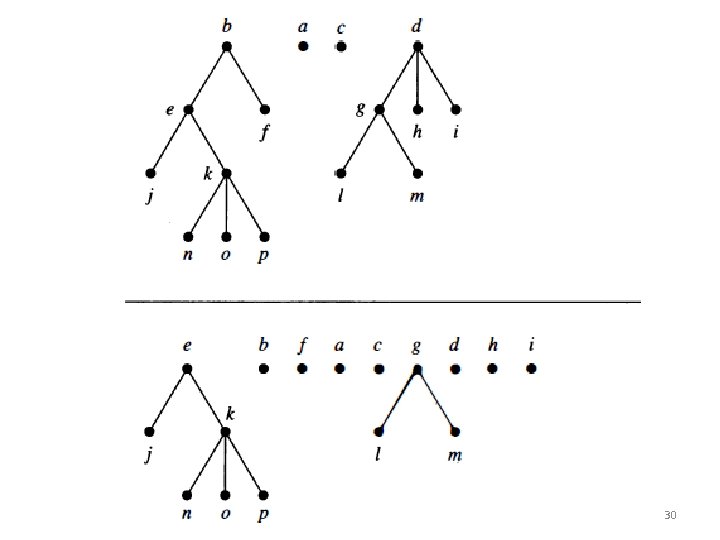
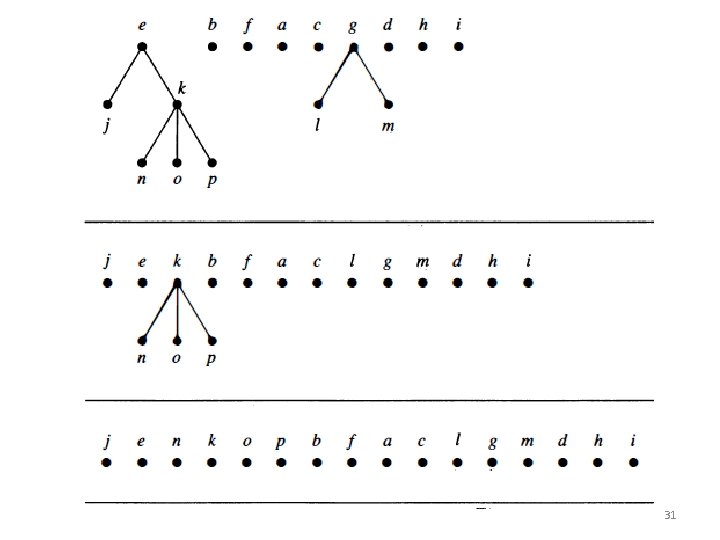
Inorder traversal • Let T be an ordered rooted tree with root r. If T consists only of r, then r is the inorder traversal of T. • Otherwise, suppose that T 1, T 2, . . . , Tn are the subtrees at r from left to right. • The inorder traversal begins by traversing T 1 in inorder, then visiting r. It continues by traversing T 2 in inorder, then T 3 in inorder, . . . , and finally Tn in inorder. 28
29
30
31
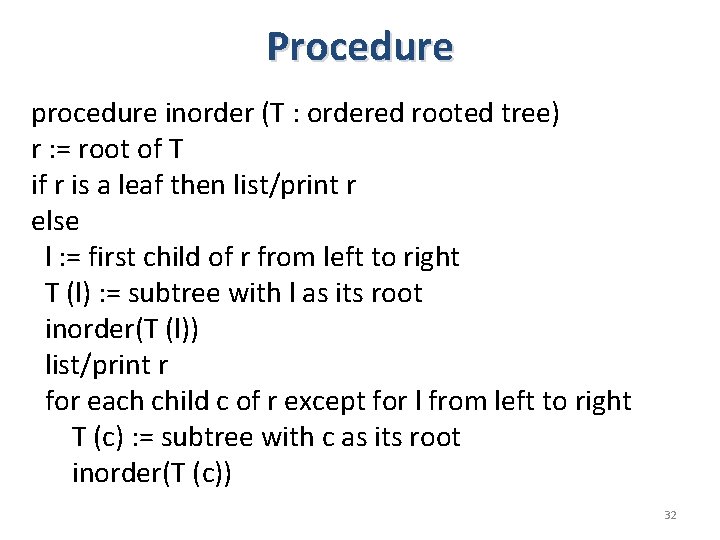
Procedure procedure inorder (T : ordered rooted tree) r : = root of T if r is a leaf then list/print r else l : = first child of r from left to right T (l) : = subtree with l as its root inorder(T (l)) list/print r for each child c of r except for l from left to right T (c) : = subtree with c as its root inorder(T (c)) 32
Postorder Traversal 33
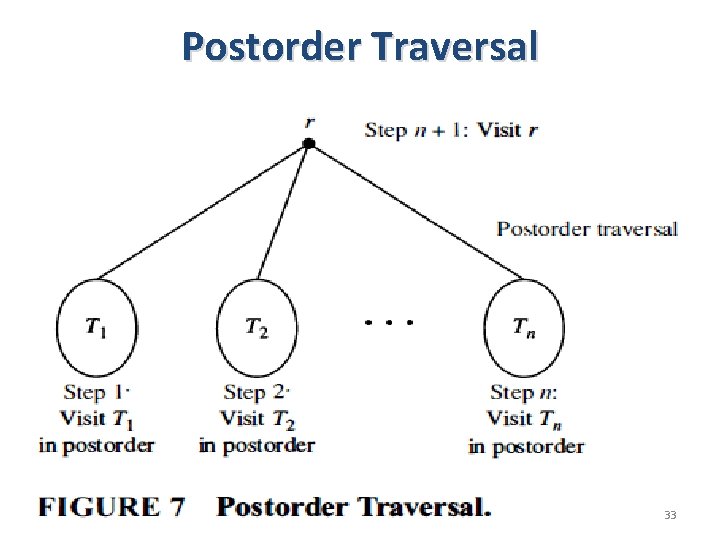
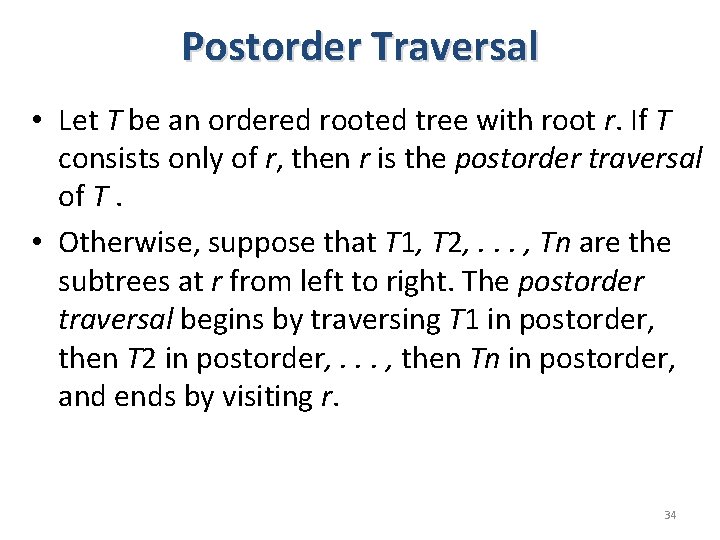
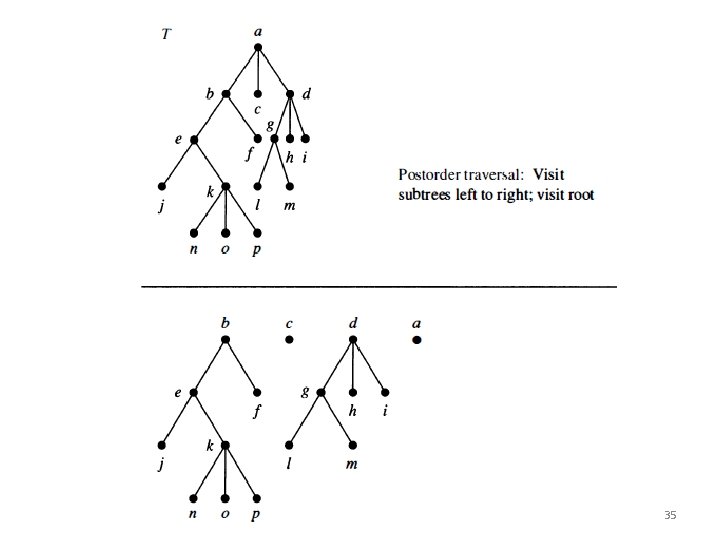
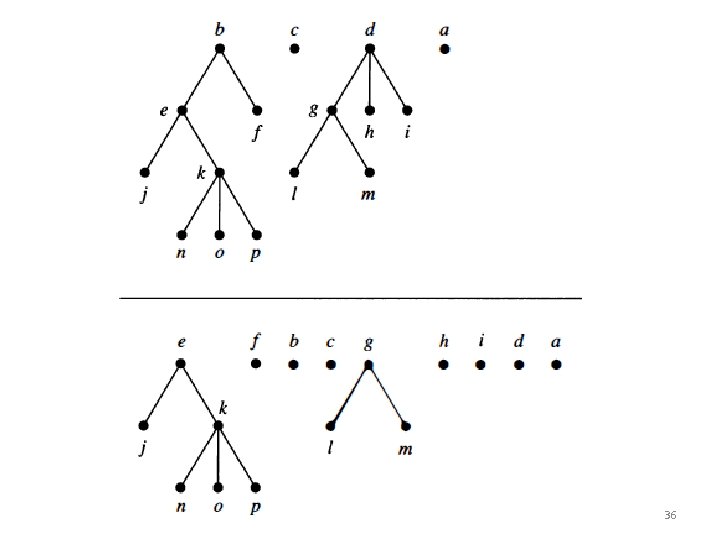
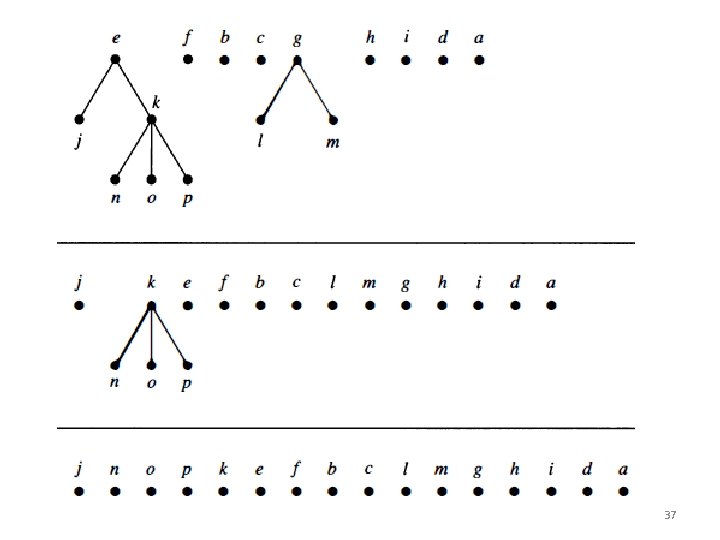
Postorder Traversal • Let T be an ordered rooted tree with root r. If T consists only of r, then r is the postorder traversal of T. • Otherwise, suppose that T 1, T 2, . . . , Tn are the subtrees at r from left to right. The postorder traversal begins by traversing T 1 in postorder, then T 2 in postorder, . . . , then Tn in postorder, and ends by visiting r. 34
35
36
37
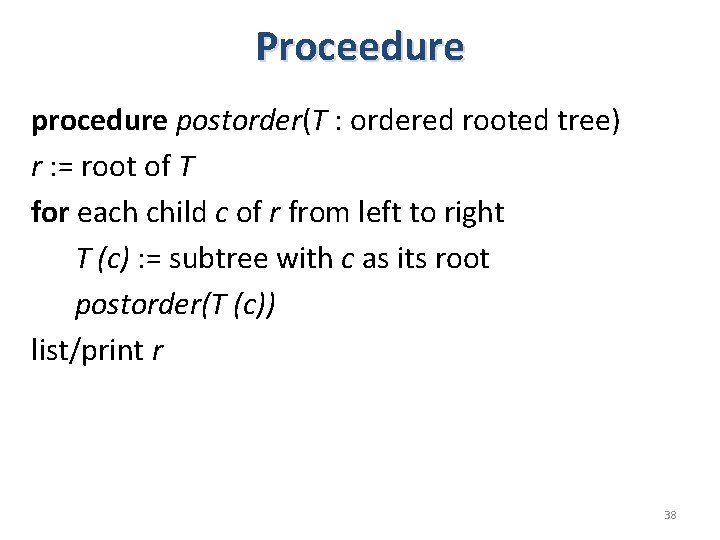
Proceedure procedure postorder(T : ordered rooted tree) r : = root of T for each child c of r from left to right T (c) : = subtree with c as its root postorder(T (c)) list/print r 38
Infix, Prefix, and Postfix Notation • We can represent complicated expressions, such as compound propositions, combinations of sets, and arithmetic expressions using ordered rooted trees. 39
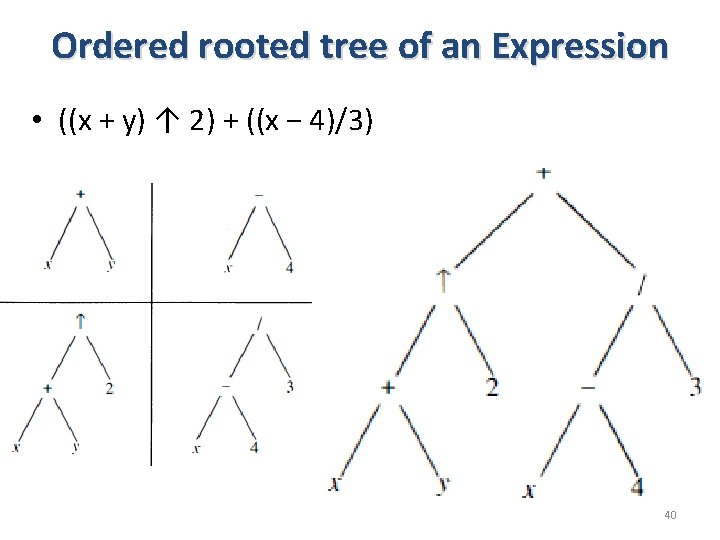
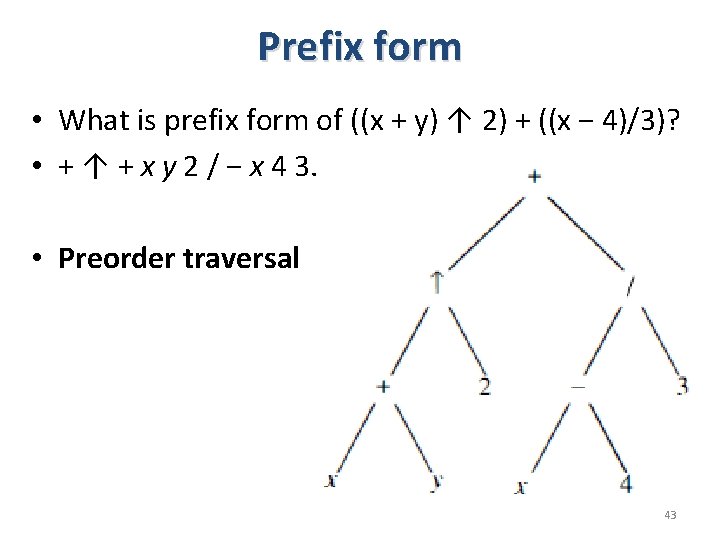
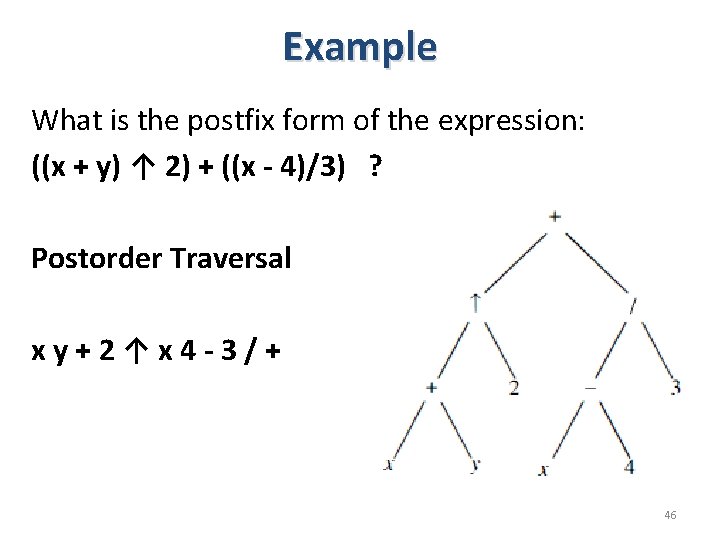
Ordered rooted tree of an Expression • ((x + y) ↑ 2) + ((x − 4)/3) 40
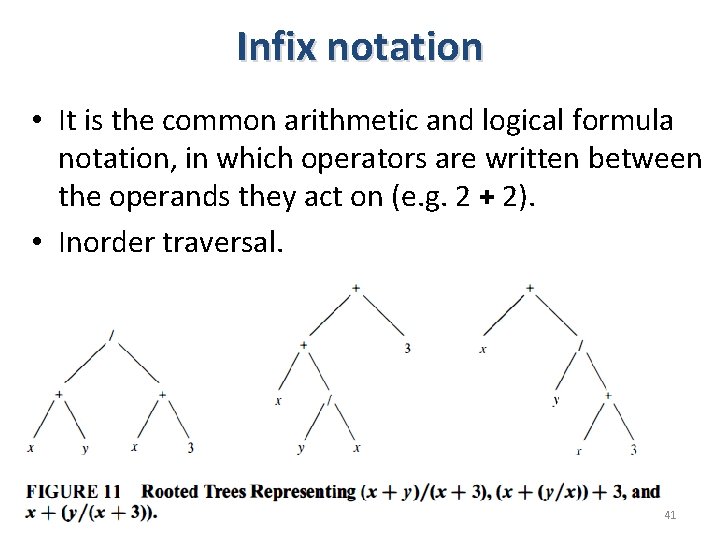
Infix notation • It is the common arithmetic and logical formula notation, in which operators are written between the operands they act on (e. g. 2 + 2). • Inorder traversal. 41
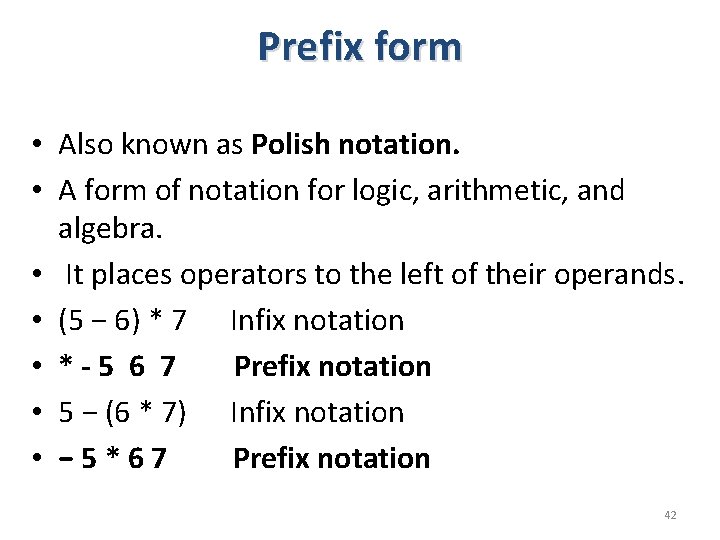
Prefix form • Also known as Polish notation. • A form of notation for logic, arithmetic, and algebra. • It places operators to the left of their operands. • (5 − 6) * 7 Infix notation • *-5 6 7 Prefix notation • 5 − (6 * 7) Infix notation • − 5*67 Prefix notation 42
Prefix form • What is prefix form of ((x + y) ↑ 2) + ((x − 4)/3)? • + ↑ + x y 2 / − x 4 3. • Preorder traversal 43
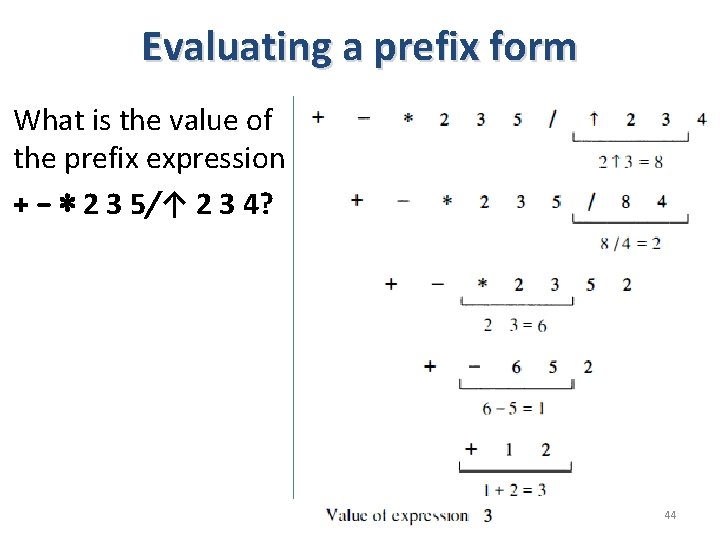
Evaluating a prefix form What is the value of the prefix expression + − ∗ 2 3 5/↑ 2 3 4? 44
Postfix form • Also known as Reverse Polish Notation. • We obtain the postfix form of an expression by traversing its tree in postorder. 45
Example What is the postfix form of the expression: ((x + y) ↑ 2) + ((x - 4)/3) ? Postorder Traversal xy+2↑x 4 -3/+ 46
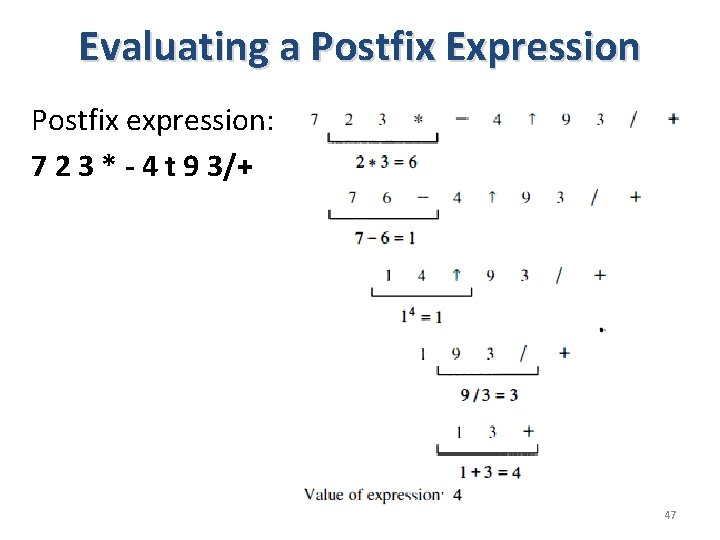
Evaluating a Postfix Expression Postfix expression: 7 2 3 * - 4 t 9 3/+ 47
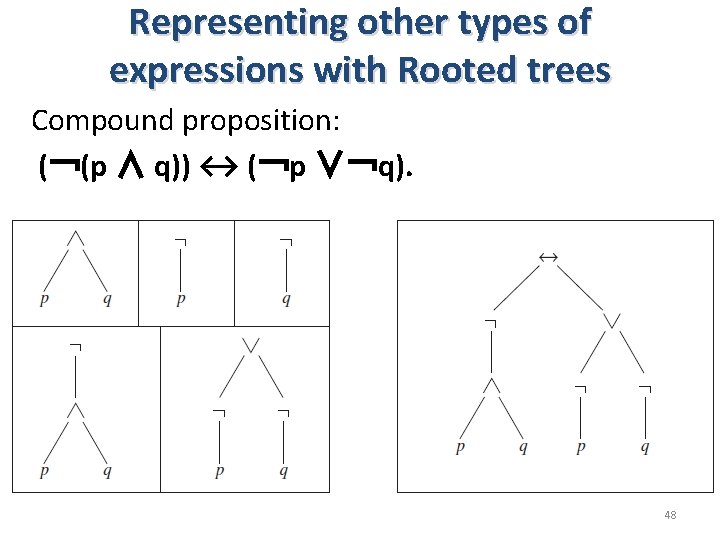
Representing other types of expressions with Rooted trees Compound proposition: (¬(p ∧ q)) ↔ (¬p ∨¬q). 48
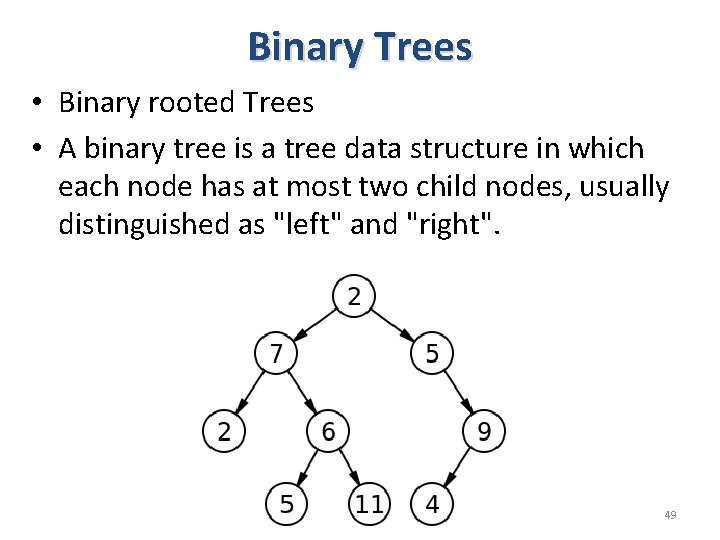
Binary Trees • Binary rooted Trees • A binary tree is a tree data structure in which each node has at most two child nodes, usually distinguished as "left" and "right". 49
END 50