
Discrete Structures CSC 102 Lecture 10 Previous Lectures

- Slides: 25
Discrete Structures (CSC 102) Lecture 10
Previous Lectures Summary • Divisors • Prime Numbers • Fundamental Theorem of Arithmetic • Division Algorithm. • Greatest common divisors. • Least Common Multiple • Relative Prime
Elementary Number Theory II
Today's Lecture • Rational Number • Properties of Rational Numbers • Irrational numbers • Absolute values • Triangular inequality • Floor and Ceiling functions
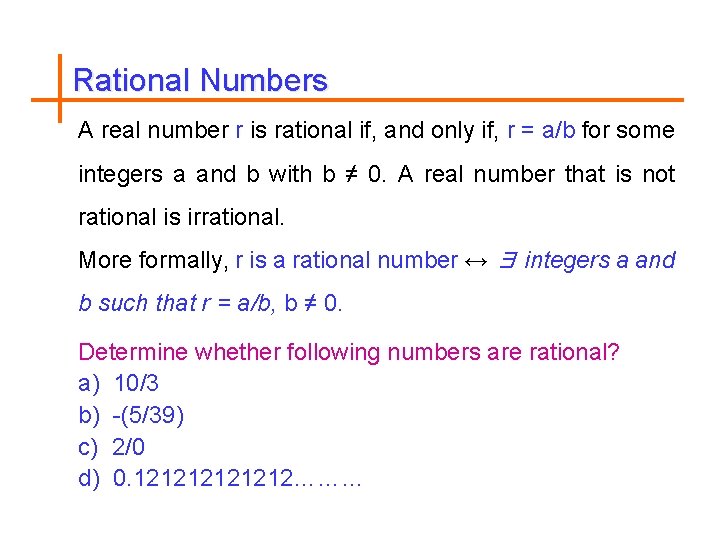
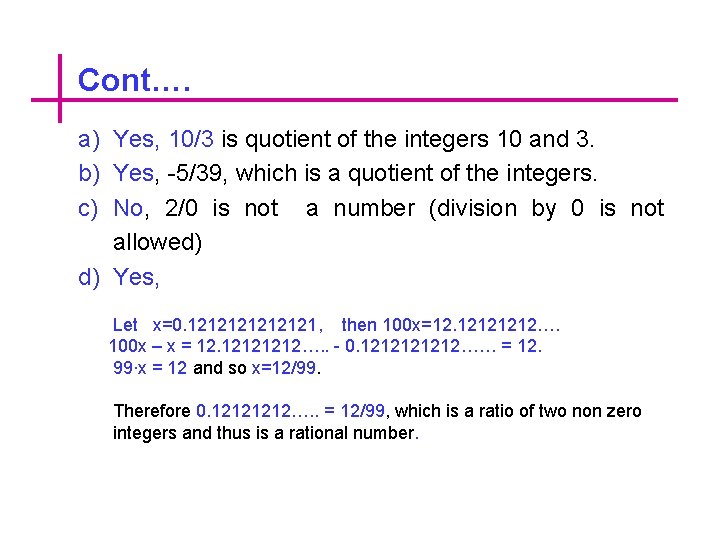
Rational Numbers A real number r is rational if, and only if, r = a/b for some integers a and b with b ≠ 0. A real number that is not rational is irrational. More formally, r is a rational number ↔ ∃ integers a and b such that r = a/b, b ≠ 0. Determine whether following numbers are rational? a) 10/3 b) -(5/39) c) 2/0 d) 0. 121212………
Cont…. a) Yes, 10/3 is quotient of the integers 10 and 3. b) Yes, -5/39, which is a quotient of the integers. c) No, 2/0 is not a number (division by 0 is not allowed) d) Yes, Let x=0. 1212121, then 100 x=12. 1212…. 100 x – x = 12. 1212…. . - 0. 121212…… = 12. 99∙x = 12 and so x=12/99. Therefore 0. 1212…. . = 12/99, which is a ratio of two non zero integers and thus is a rational number.
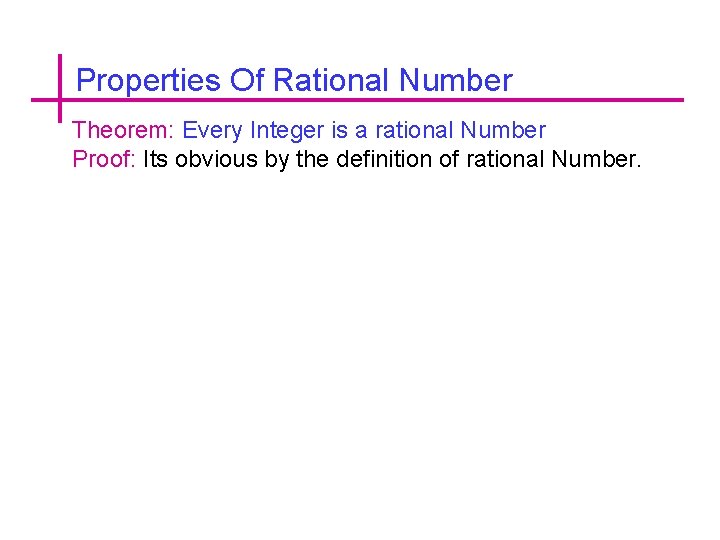
Properties Of Rational Number Theorem: Every Integer is a rational Number Proof: Its obvious by the definition of rational Number.
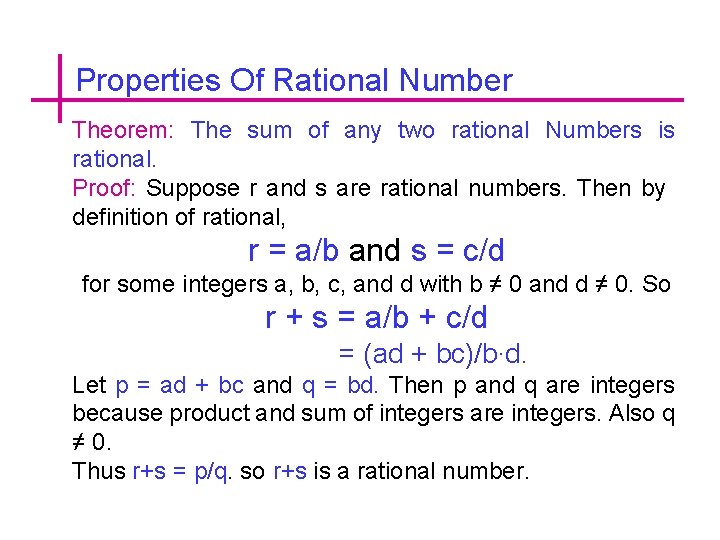
Properties Of Rational Number Theorem: The sum of any two rational Numbers is rational. Proof: Suppose r and s are rational numbers. Then by definition of rational, r = a/b and s = c/d for some integers a, b, c, and d with b ≠ 0 and d ≠ 0. So r + s = a/b + c/d = (ad + bc)/b∙d. Let p = ad + bc and q = bd. Then p and q are integers because product and sum of integers are integers. Also q ≠ 0. Thus r+s = p/q. so r+s is a rational number.
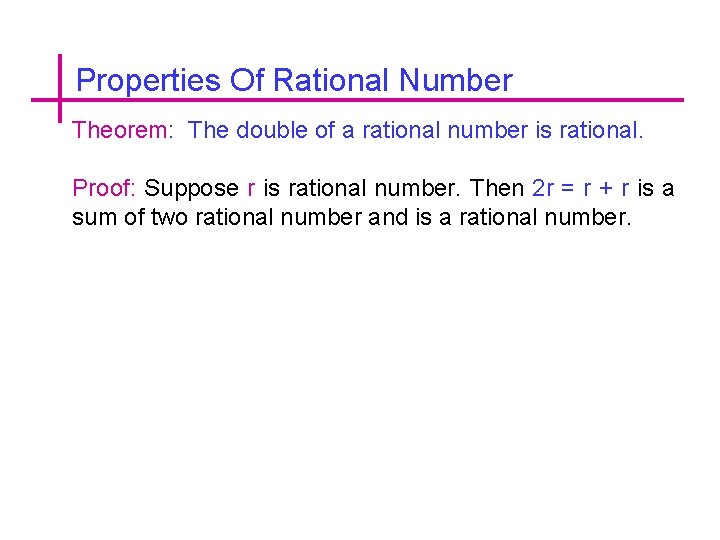
Properties Of Rational Number Theorem: The double of a rational number is rational. Proof: Suppose r is rational number. Then 2 r = r + r is a sum of two rational number and is a rational number.
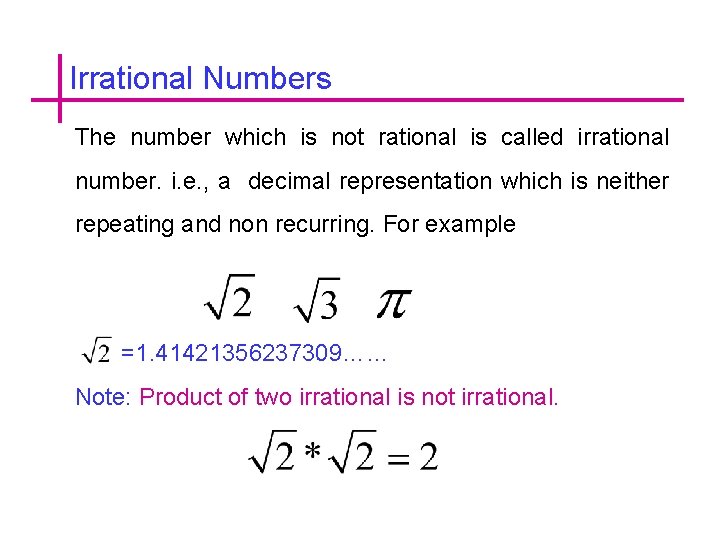
Irrational Numbers The number which is not rational is called irrational number. i. e. , a decimal representation which is neither repeating and non recurring. For example =1. 41421356237309…… Note: Product of two irrational is not irrational.
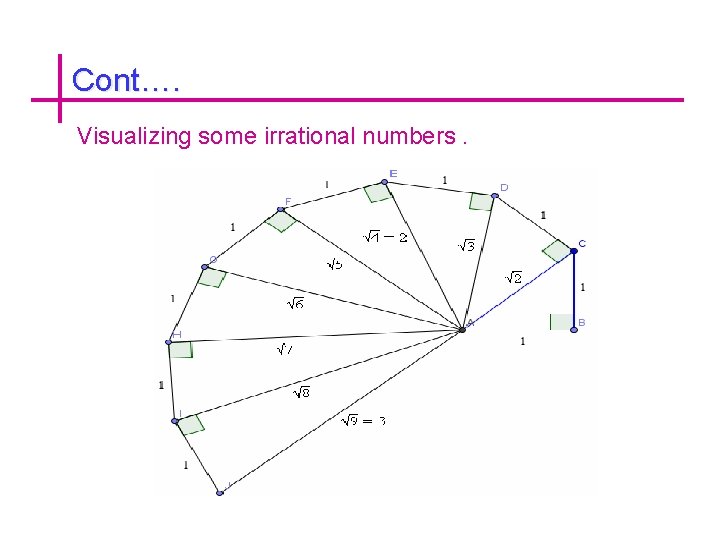
Cont…. Visualizing some irrational numbers.
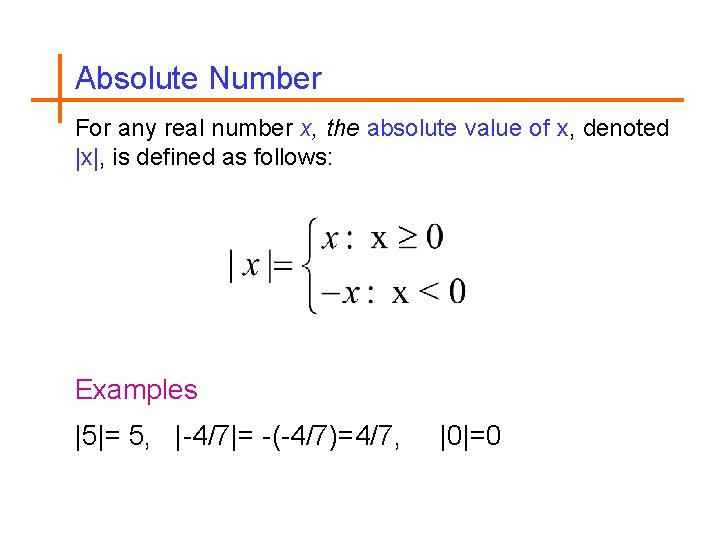
Absolute Number For any real number x, the absolute value of x, denoted |x|, is defined as follows: Examples |5|= 5, |-4/7|= -(-4/7)=4/7, |0|=0
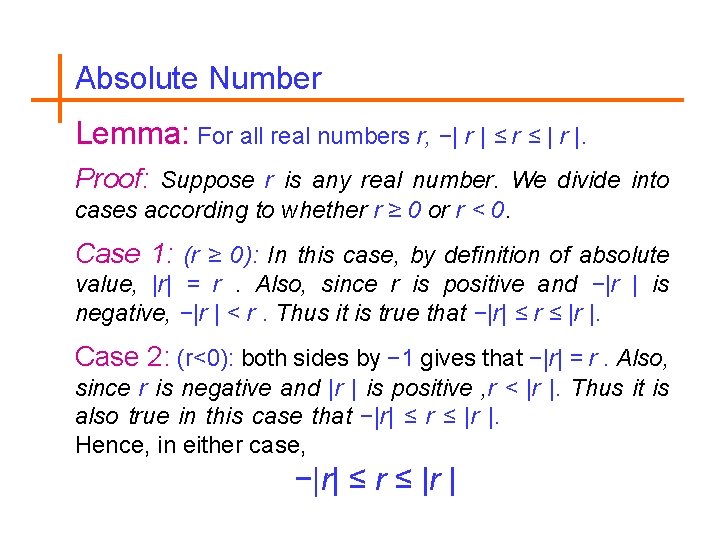
Absolute Number Lemma: For all real numbers r, −| r | ≤ r ≤ | r |. Proof: Suppose r is any real number. We divide into cases according to whether r ≥ 0 or r < 0. Case 1: (r ≥ 0): In this case, by definition of absolute value, |r| = r. Also, since r is positive and −|r | is negative, −|r | < r. Thus it is true that −|r| ≤ r ≤ |r |. Case 2: (r<0): both sides by − 1 gives that −|r| = r. Also, since r is negative and |r | is positive , r < |r |. Thus it is also true in this case that −|r| ≤ r ≤ |r |. Hence, in either case, −|r| ≤ r ≤ |r |
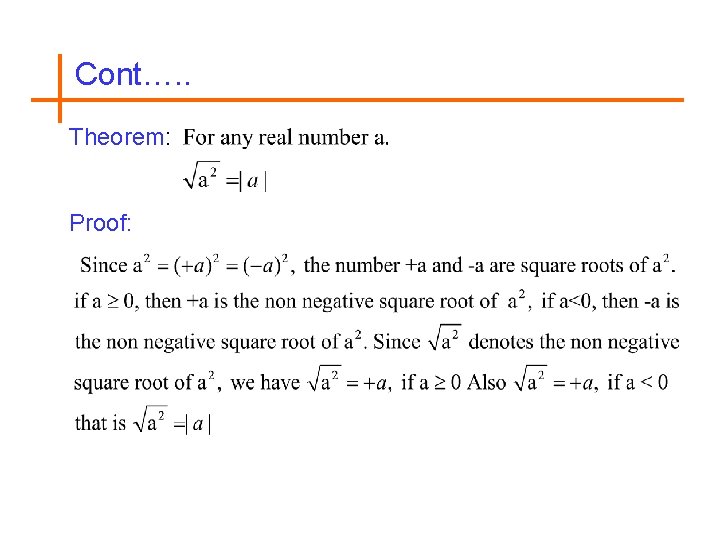
Cont…. . Theorem: Proof:
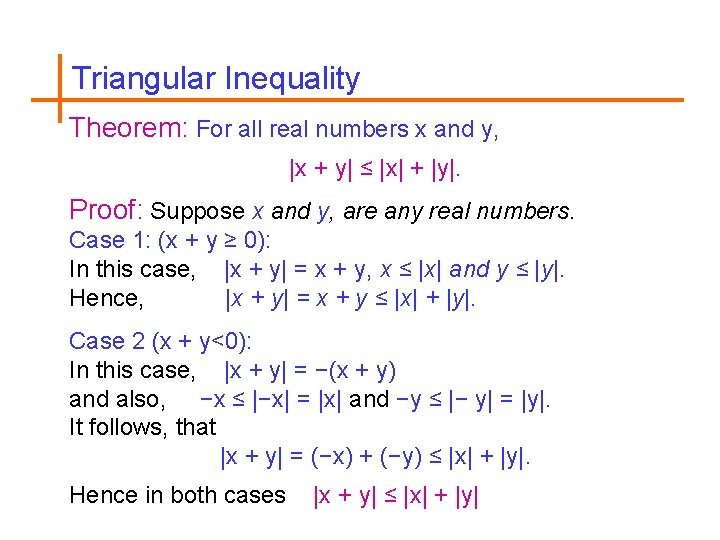
Triangular Inequality Theorem: For all real numbers x and y, |x + y| ≤ |x| + |y|. Proof: Suppose x and y, are any real numbers. Case 1: (x + y ≥ 0): In this case, |x + y| = x + y, x ≤ |x| and y ≤ |y|. Hence, |x + y| = x + y ≤ |x| + |y|. Case 2 (x + y<0): In this case, |x + y| = −(x + y) and also, −x ≤ |−x| = |x| and −y ≤ |− y| = |y|. It follows, that |x + y| = (−x) + (−y) ≤ |x| + |y|. Hence in both cases |x + y| ≤ |x| + |y|
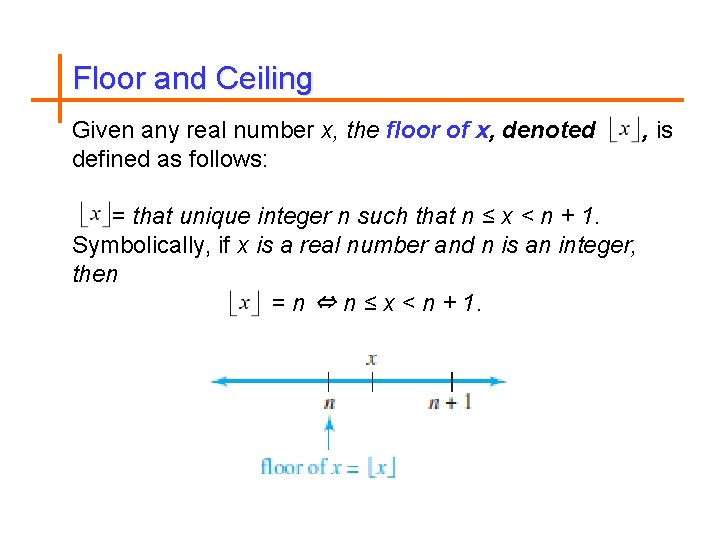
Floor and Ceiling Given any real number x, the floor of x, denoted defined as follows: = that unique integer n such that n ≤ x < n + 1. Symbolically, if x is a real number and n is an integer, then = n ⇔ n ≤ x < n + 1. , is
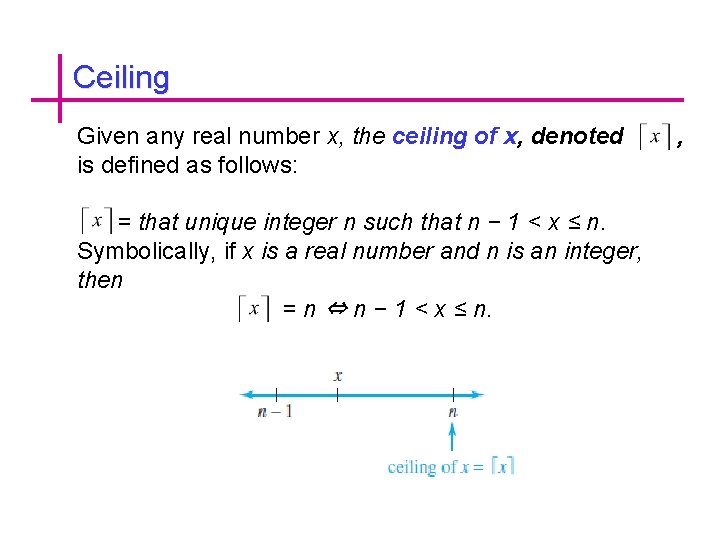
Ceiling Given any real number x, the ceiling of x, denoted is defined as follows: = that unique integer n such that n − 1 < x ≤ n. Symbolically, if x is a real number and n is an integer, then = n ⇔ n − 1 < x ≤ n. ,
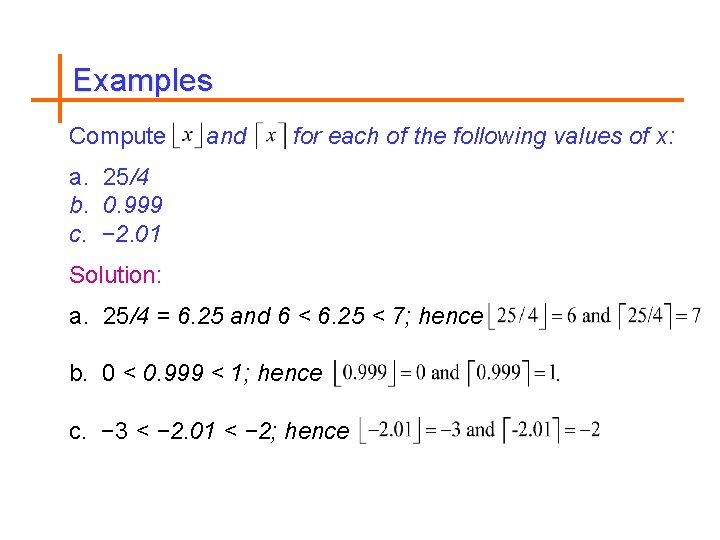
Examples Compute and for each of the following values of x: a. 25/4 b. 0. 999 c. − 2. 01 Solution: a. 25/4 = 6. 25 and 6 < 6. 25 < 7; hence b. 0 < 0. 999 < 1; hence c. − 3 < − 2. 01 < − 2; hence .
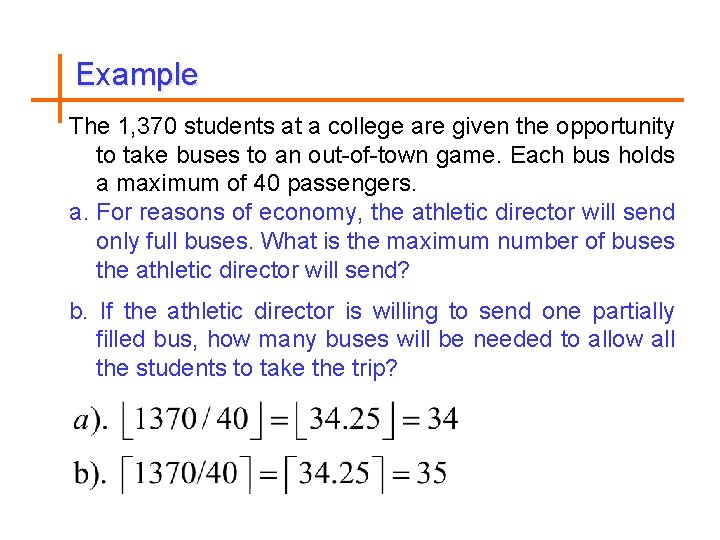
Example The 1, 370 students at a college are given the opportunity to take buses to an out-of-town game. Each bus holds a maximum of 40 passengers. a. For reasons of economy, the athletic director will send only full buses. What is the maximum number of buses the athletic director will send? b. If the athletic director is willing to send one partially filled bus, how many buses will be needed to allow all the students to take the trip?
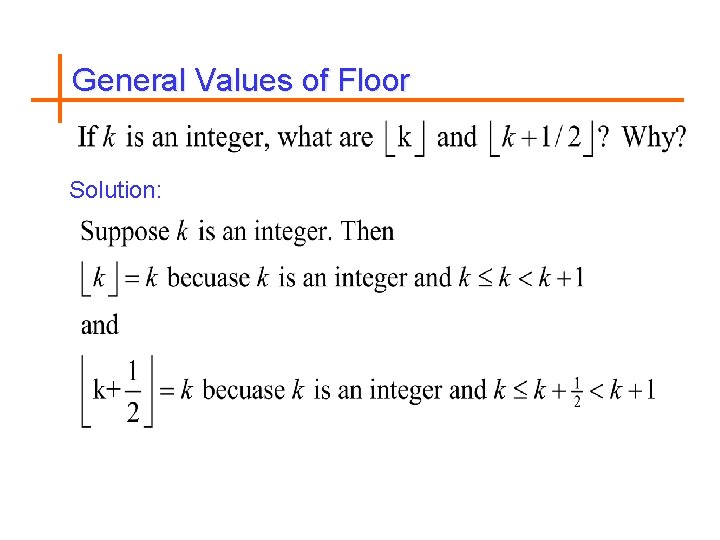
General Values of Floor Solution:
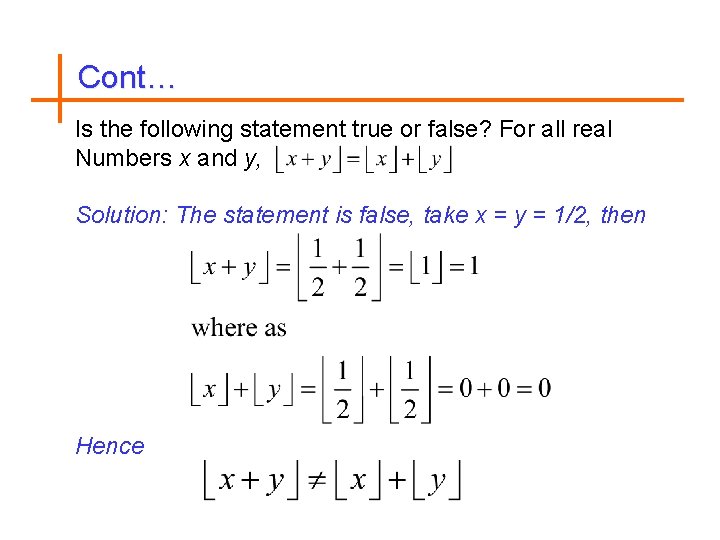
Cont… Is the following statement true or false? For all real Numbers x and y, Solution: The statement is false, take x = y = 1/2, then Hence
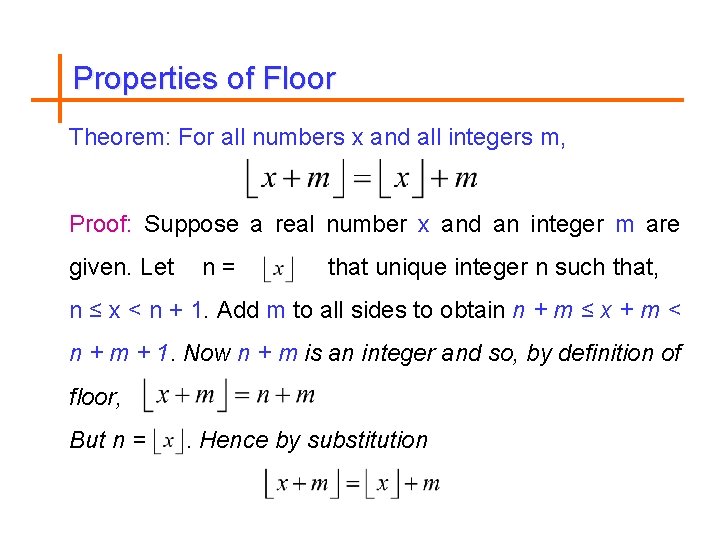
Properties of Floor Theorem: For all numbers x and all integers m, Proof: Suppose a real number x and an integer m are given. Let n= that unique integer n such that, n ≤ x < n + 1. Add m to all sides to obtain n + m ≤ x + m < n + m + 1. Now n + m is an integer and so, by definition of floor, But n = . Hence by substitution
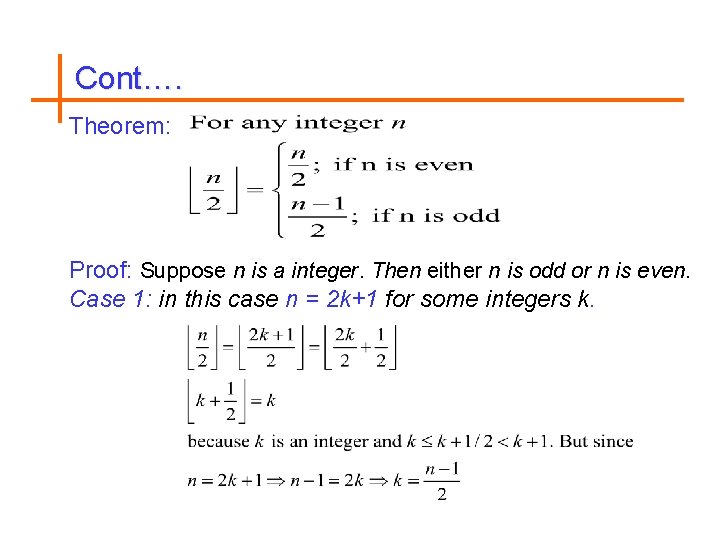
Cont…. Theorem: Proof: Suppose n is a integer. Then either n is odd or n is even. Case 1: in this case n = 2 k+1 for some integers k.
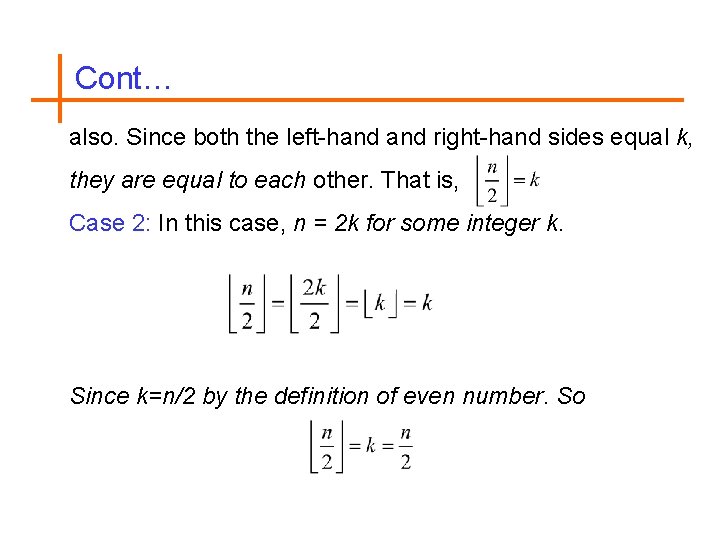
Cont… also. Since both the left-hand right-hand sides equal k, they are equal to each other. That is, Case 2: In this case, n = 2 k for some integer k. Since k=n/2 by the definition of even number. So
Lecture Summary • Rational Number • Properties of Rational Numbers • Irrational numbers • Absolute values • Triangular inequality • Floor and Ceiling