
Discrete Structers IT 103 Chapter 3 Matrices Dr
![Matrix Arithmetic: The sum of two matrix • Definition// Let A = [aij] and](https://slidetodoc.com/presentation_image_h2/a241fee48110e6ee70f25ddf96159aa2/image-4.jpg "Matrix Arithmetic: The sum of two matrix • Definition// Let A = [aij] and")
![Join and Meet of the zero-one matrixes Definition// Let A = [aij] and B](https://slidetodoc.com/presentation_image_h2/a241fee48110e6ee70f25ddf96159aa2/image-12.jpg "Join and Meet of the zero-one matrixes Definition// Let A = [aij] and B")
![Boolean product of the zero-one matrixes • Definition// Let A = [aij] be an](https://slidetodoc.com/presentation_image_h2/a241fee48110e6ee70f25ddf96159aa2/image-14.jpg "Boolean product of the zero-one matrixes • Definition// Let A = [aij] be an")
- Slides: 35
Discrete Structers IT 103 Chapter 3 Matrices Dr Taleb Obaid 1
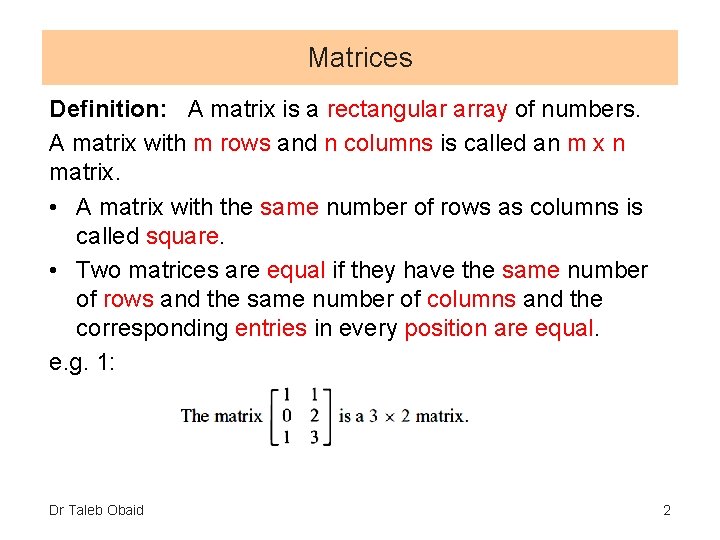
Matrices Definition: A matrix is a rectangular array of numbers. A matrix with m rows and n columns is called an m x n matrix. • A matrix with the same number of rows as columns is called square. • Two matrices are equal if they have the same number of rows and the same number of columns and the corresponding entries in every position are equal. e. g. 1: Dr Taleb Obaid 2
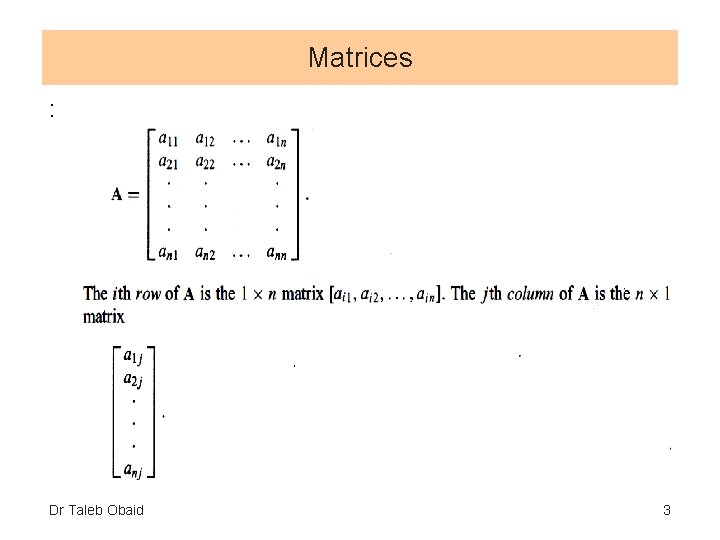
Matrices : Dr Taleb Obaid 3
Matrix Arithmetic: The sum of two matrix • Definition// Let A = [aij] and B = [bij] be m x n matrices. The sum of A and B, denoted by A + B, is the m x n matrix that has aij + bij as its (i, j)th element. In other words, C = A + B = [aij + bij]. e. g. What is the sum of A and B where Aij = B ij = Cij = Aij + Bij = Dr Taleb Obaid 4
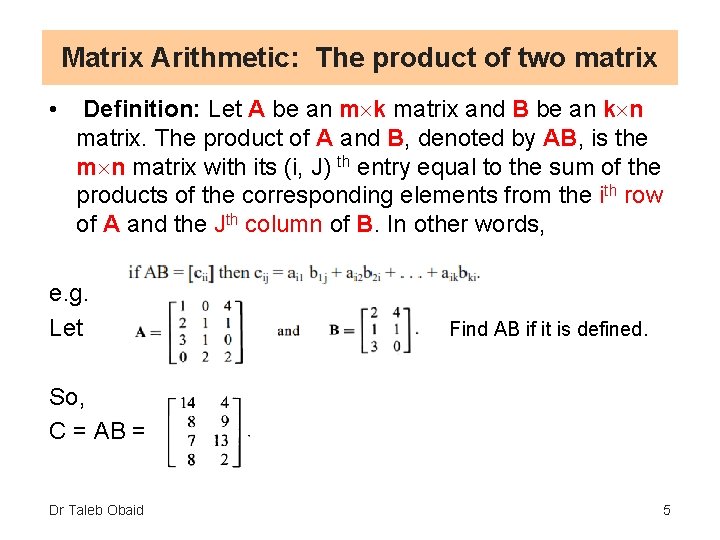
Matrix Arithmetic: The product of two matrix • Definition: Let A be an m k matrix and B be an k n matrix. The product of A and B, denoted by AB, is the m n matrix with its (i, J) th entry equal to the sum of the products of the corresponding elements from the ith row of A and the Jth column of B. In other words, e. g. Let Find AB if it is defined. So, C = AB = Dr Taleb Obaid 5
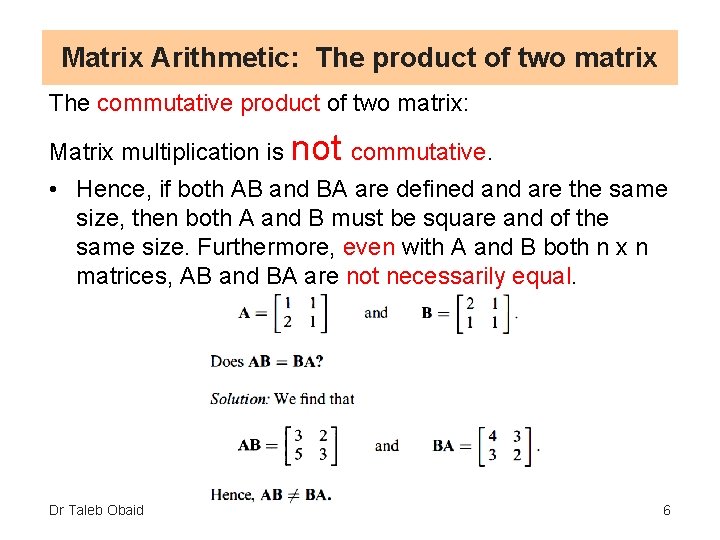
Matrix Arithmetic: The product of two matrix The commutative product of two matrix: Matrix multiplication is not commutative. • Hence, if both AB and BA are defined and are the same size, then both A and B must be square and of the same size. Furthermore, even with A and B both n x n matrices, AB and BA are not necessarily equal. Dr Taleb Obaid 6
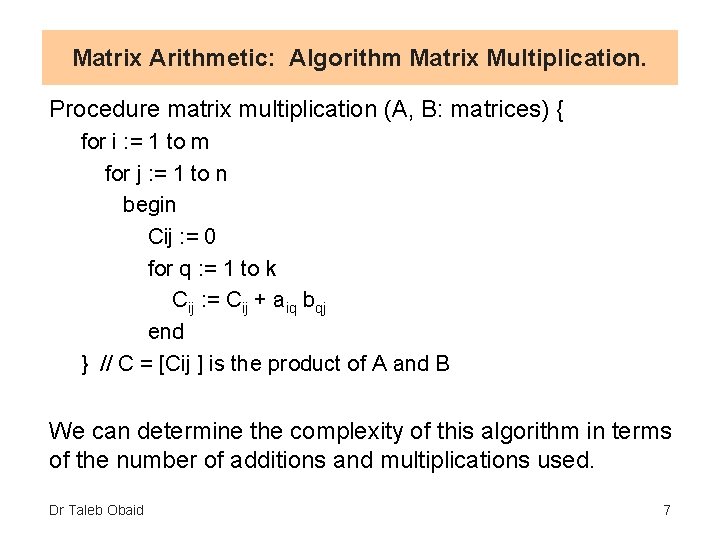
Matrix Arithmetic: Algorithm Matrix Multiplication. Procedure matrix multiplication (A, B: matrices) { for i : = 1 to m for j : = 1 to n begin Cij : = 0 for q : = 1 to k Cij : = Cij + aiq bqj end } // C = [Cij ] is the product of A and B We can determine the complexity of this algorithm in terms of the number of additions and multiplications used. Dr Taleb Obaid 7
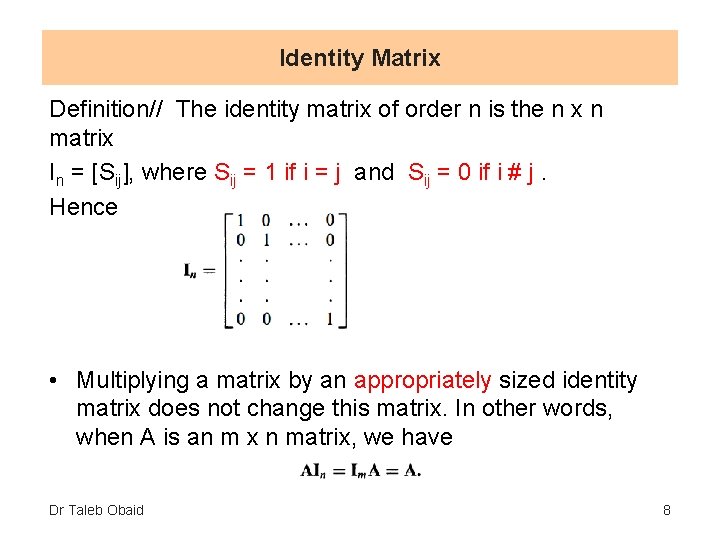
Identity Matrix Definition// The identity matrix of order n is the n x n matrix In = [Sij], where Sij = 1 if i = j and Sij = 0 if i # j. Hence • Multiplying a matrix by an appropriately sized identity matrix does not change this matrix. In other words, when A is an m x n matrix, we have Dr Taleb Obaid 8
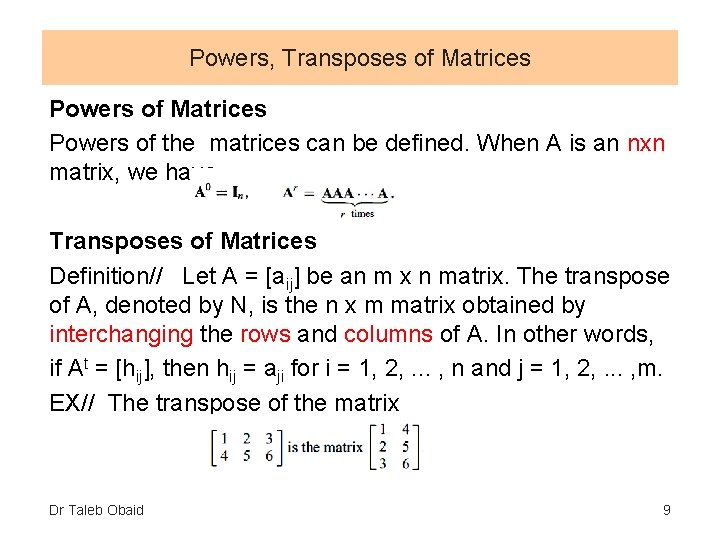
Powers, Transposes of Matrices Powers of the matrices can be defined. When A is an nxn matrix, we have Transposes of Matrices Definition// Let A = [aij] be an m x n matrix. The transpose of A, denoted by N, is the n x m matrix obtained by interchanging the rows and columns of A. In other words, if At = [hij], then hij = aji for i = 1, 2, . . . , n and j = 1, 2, . . . , m. EX// The transpose of the matrix Dr Taleb Obaid 9
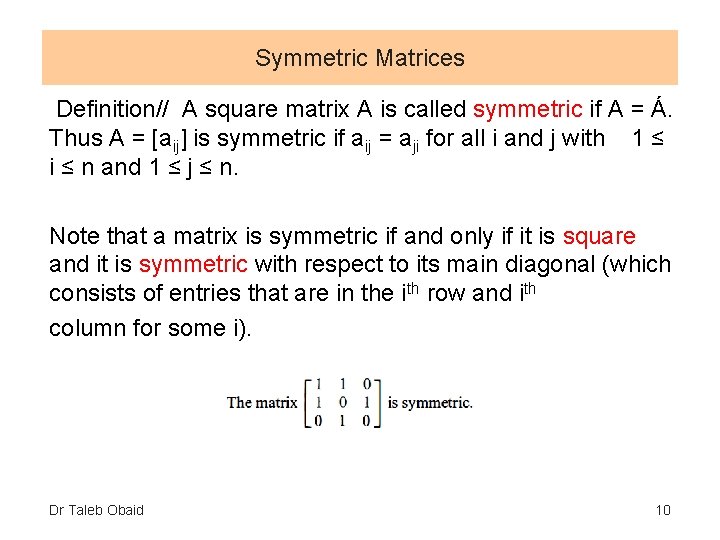
Symmetric Matrices Definition// A square matrix A is called symmetric if A = Á. Thus A = [aij] is symmetric if aij = aji for all i and j with 1 ≤ i ≤ n and 1 ≤ j ≤ n. Note that a matrix is symmetric if and only if it is square and it is symmetric with respect to its main diagonal (which consists of entries that are in the ith row and ith column for some i). Dr Taleb Obaid 10
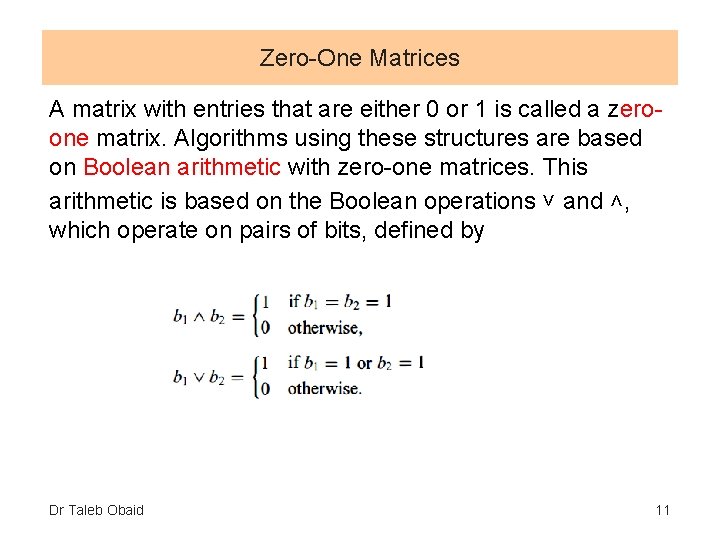
Zero-One Matrices A matrix with entries that are either 0 or 1 is called a zeroone matrix. Algorithms using these structures are based on Boolean arithmetic with zero-one matrices. This arithmetic is based on the Boolean operations ˅ and ˄, which operate on pairs of bits, defined by Dr Taleb Obaid 11
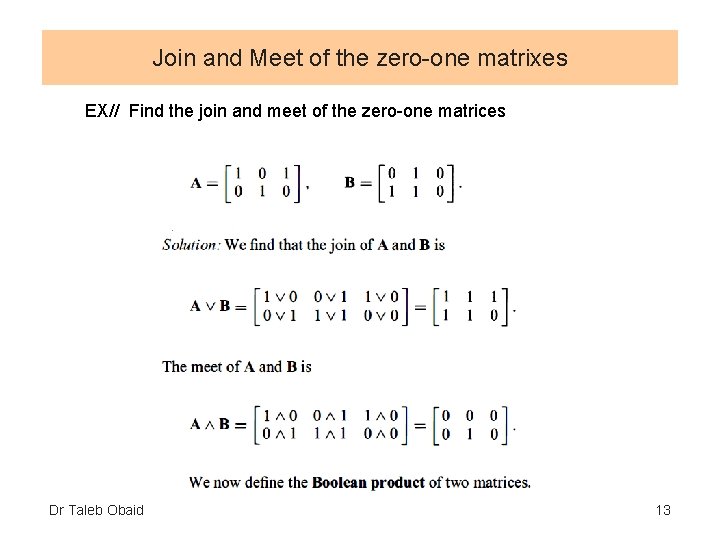
Join and Meet of the zero-one matrixes Definition// Let A = [aij] and B = [bij] be m x n zero-one matrices. Then the join of A and B is the zero-one matrix with (i, j)th entry aij ˅ bij. The join of A and B is denoted by A ˄ B. The meet of A and B is the zero-one matrix with (i, j)th entry aij ˄ bij. The meet of A and B is denoted by A ˄ B. Dr Taleb Obaid 12
Join and Meet of the zero-one matrixes EX// Find the join and meet of the zero-one matrices Dr Taleb Obaid 13
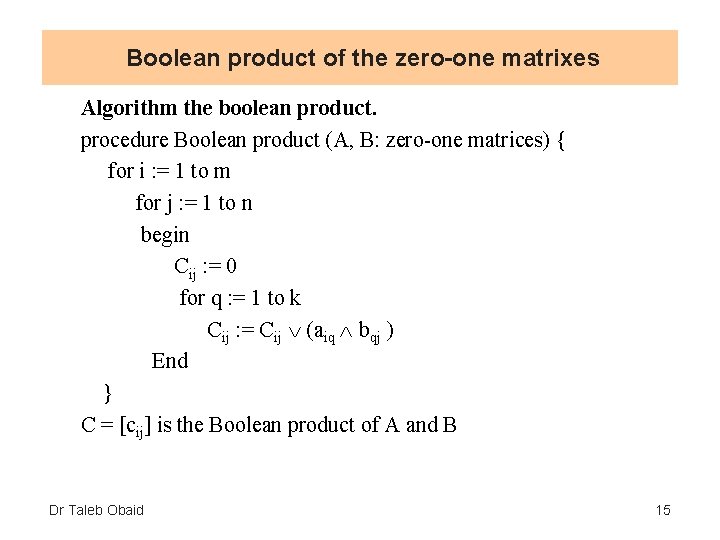
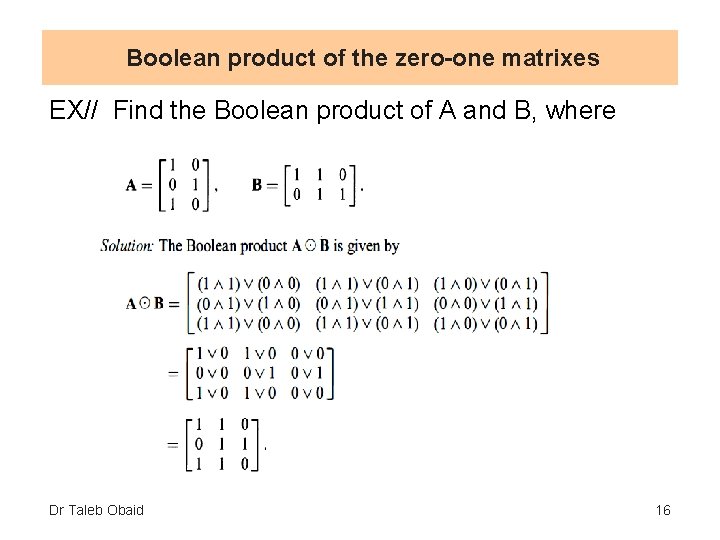
Boolean product of the zero-one matrixes • Definition// Let A = [aij] be an m x k zero-one matrix and B = [bij] be an k x n zero-one matrix. Then the Boolean product of A and B, denoted by Ao. B, is the mxn matrix with (i, j)th entry Cij where Cij = (ail b 1 j) (ai 2 b 2 j) . . . (aik bkj). • Note that the Boolean product of A and B is obtained in an analogous way to the ordinary product of these matrices, but with addition replaced with the operation and with multiplication replaced with the operation . We give an example of the Boolean products of matrices. Dr Taleb Obaid 14
Boolean product of the zero-one matrixes Algorithm the boolean product. procedure Boolean product (A, B: zero-one matrices) { for i : = 1 to m for j : = 1 to n begin Cij : = 0 for q : = 1 to k Cij : = Cij (aiq bqj ) End } C = [cij] is the Boolean product of A and B Dr Taleb Obaid 15
Boolean product of the zero-one matrixes EX// Find the Boolean product of A and B, where Dr Taleb Obaid 16
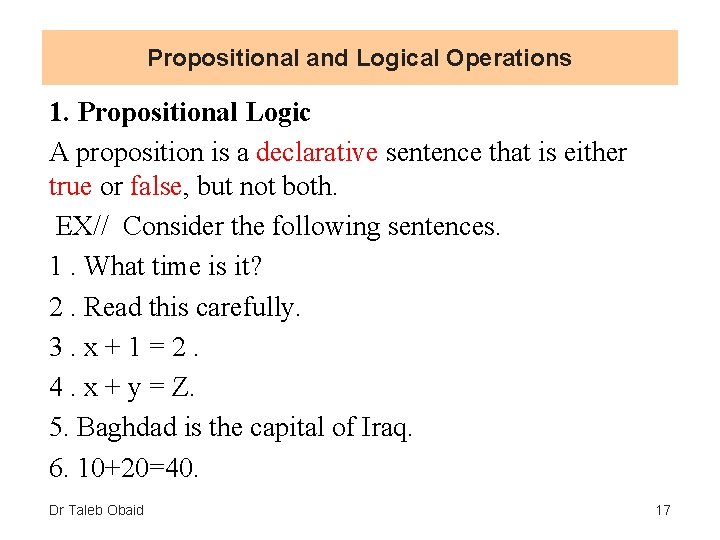
Propositional and Logical Operations 1. Propositional Logic A proposition is a declarative sentence that is either true or false, but not both. EX// Consider the following sentences. 1. What time is it? 2. Read this carefully. 3. x+1=2. 4. x + y = Z. 5. Baghdad is the capital of Iraq. 6. 10+20=40. Dr Taleb Obaid 17
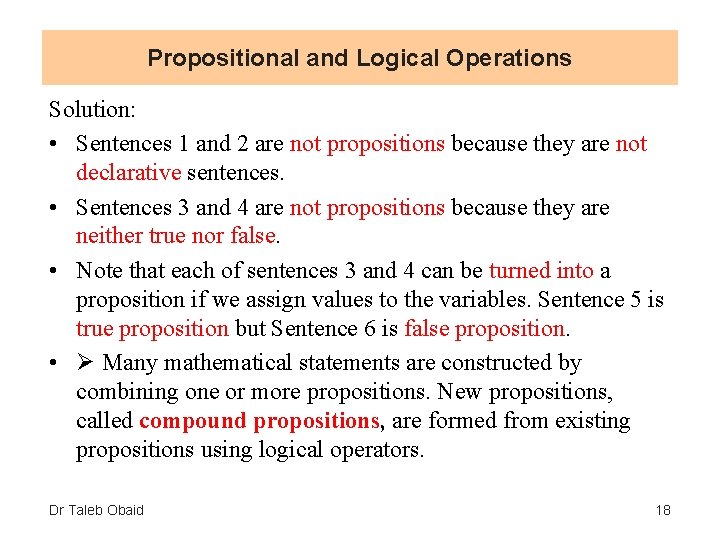
Propositional and Logical Operations Solution: • Sentences 1 and 2 are not propositions because they are not declarative sentences. • Sentences 3 and 4 are not propositions because they are neither true nor false. • Note that each of sentences 3 and 4 can be turned into a proposition if we assign values to the variables. Sentence 5 is true proposition but Sentence 6 is false proposition. • Many mathematical statements are constructed by combining one or more propositions. New propositions, called compound propositions, are formed from existing propositions using logical operators. Dr Taleb Obaid 18
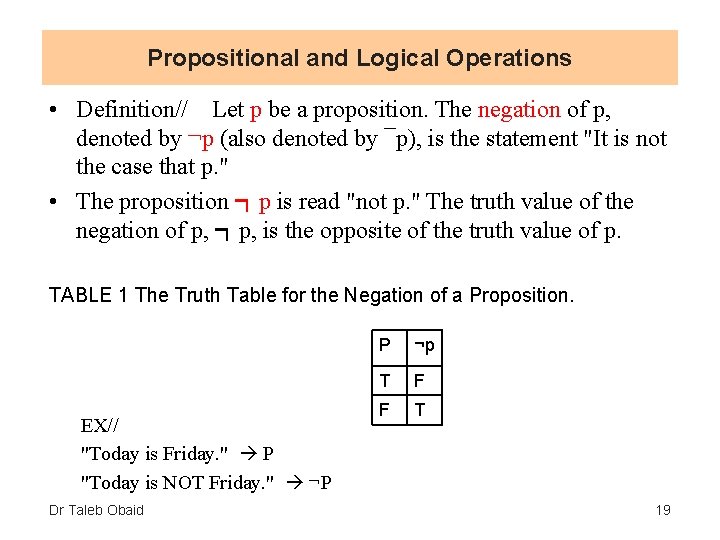
Propositional and Logical Operations • Definition// Let p be a proposition. The negation of p, denoted by ¬p (also denoted by ¯p), is the statement "It is not the case that p. " • The proposition ┑p is read "not p. " The truth value of the negation of p, ┑p, is the opposite of the truth value of p. TABLE 1 The Truth Table for the Negation of a Proposition. EX// "Today is Friday. " P "Today is NOT Friday. " ¬P Dr Taleb Obaid P ¬p T F F T 19
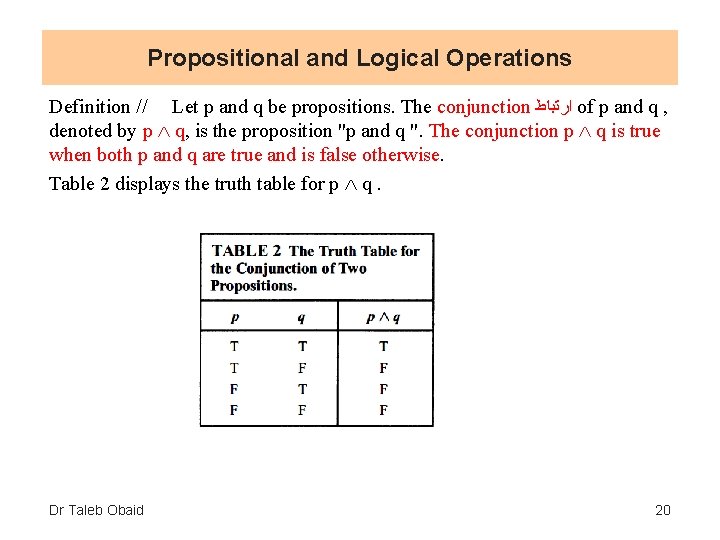
Propositional and Logical Operations Definition // Let p and q be propositions. The conjunction ﺍﺭﺗﺒﺎﻁ of p and q , denoted by p q, is the proposition "p and q ". The conjunction p q is true when both p and q are true and is false otherwise. Table 2 displays the truth table for p q. Dr Taleb Obaid 20
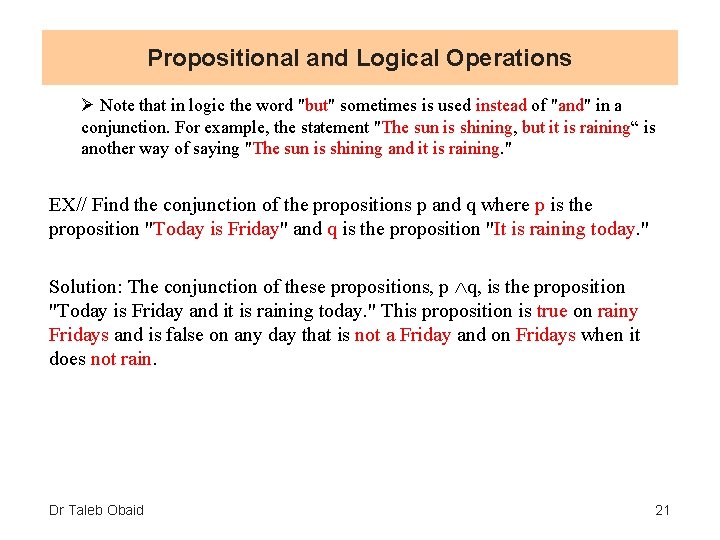
Propositional and Logical Operations Note that in logic the word "but" sometimes is used instead of "and" in a conjunction. For example, the statement "The sun is shining, but it is raining“ is another way of saying "The sun is shining and it is raining. " EX// Find the conjunction of the propositions p and q where p is the proposition "Today is Friday" and q is the proposition "It is raining today. " Solution: The conjunction of these propositions, p q, is the proposition "Today is Friday and it is raining today. " This proposition is true on rainy Fridays and is false on any day that is not a Friday and on Fridays when it does not rain. Dr Taleb Obaid 21
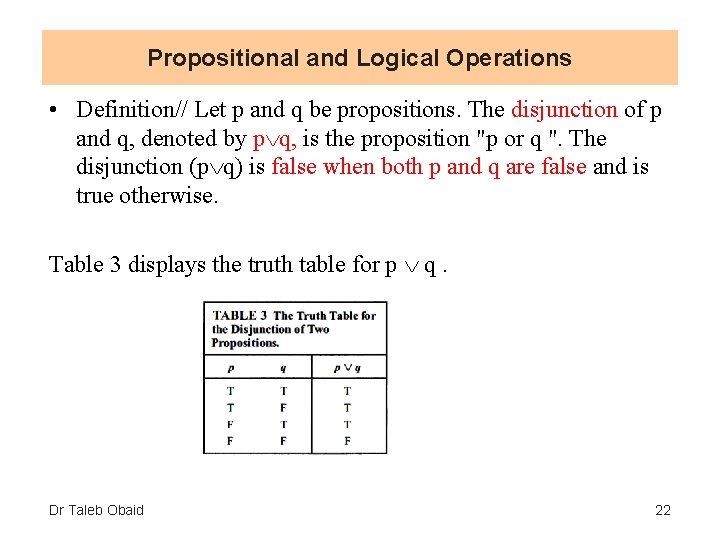
Propositional and Logical Operations • Definition// Let p and q be propositions. The disjunction of p and q, denoted by p q, is the proposition "p or q ". The disjunction (p q) is false when both p and q are false and is true otherwise. Table 3 displays the truth table for p q. Dr Taleb Obaid 22
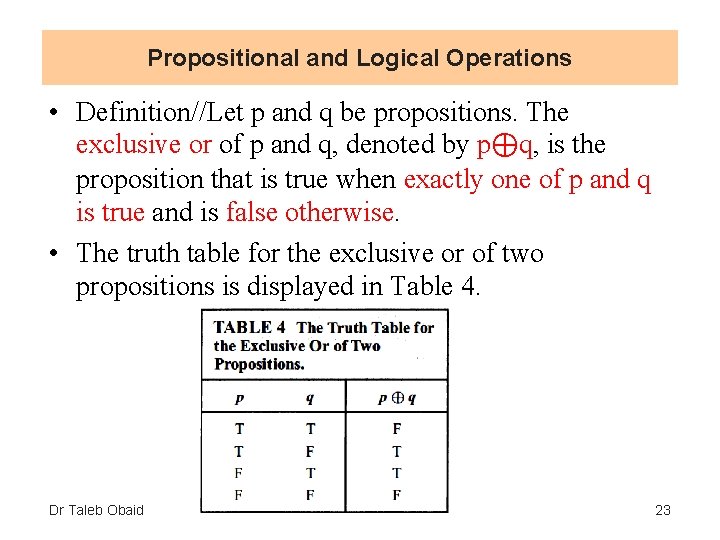
Propositional and Logical Operations • Definition//Let p and q be propositions. The exclusive or of p and q, denoted by p⊕q, is the proposition that is true when exactly one of p and q is true and is false otherwise. • The truth table for the exclusive or of two propositions is displayed in Table 4. Dr Taleb Obaid 23
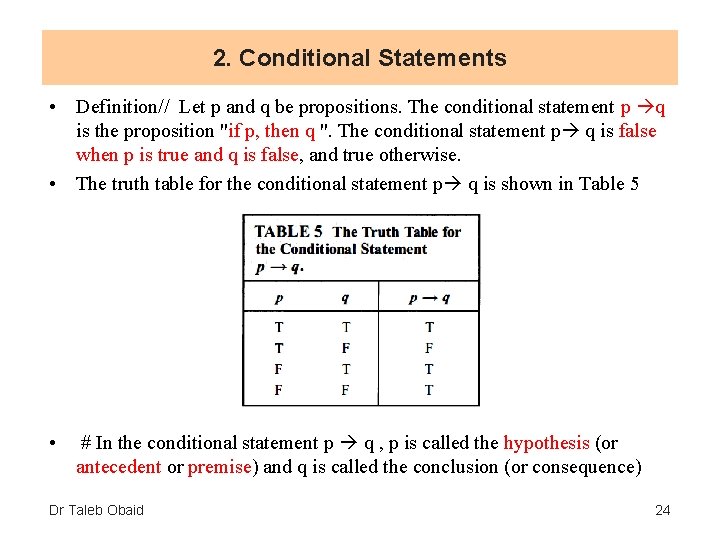
2. Conditional Statements • Definition// Let p and q be propositions. The conditional statement p q is the proposition "if p, then q ". The conditional statement p q is false when p is true and q is false, and true otherwise. • The truth table for the conditional statement p q is shown in Table 5 • # In the conditional statement p q , p is called the hypothesis (or antecedent or premise) and q is called the conclusion (or consequence) Dr Taleb Obaid 24
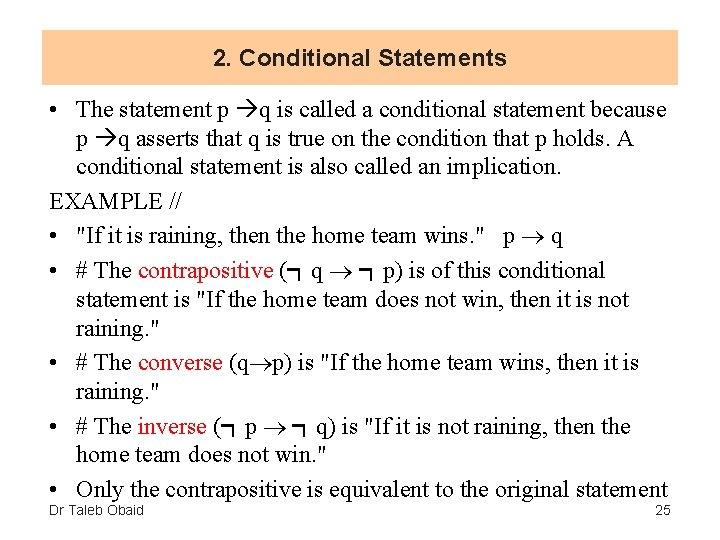
2. Conditional Statements • The statement p q is called a conditional statement because p q asserts that q is true on the condition that p holds. A conditional statement is also called an implication. EXAMPLE // • "If it is raining, then the home team wins. " p q • # The contrapositive (┑q ┑p) is of this conditional statement is "If the home team does not win, then it is not raining. " • # The converse (q p) is "If the home team wins, then it is raining. " • # The inverse (┑p ┑q) is "If it is not raining, then the home team does not win. " • Only the contrapositive is equivalent to the original statement Dr Taleb Obaid 25
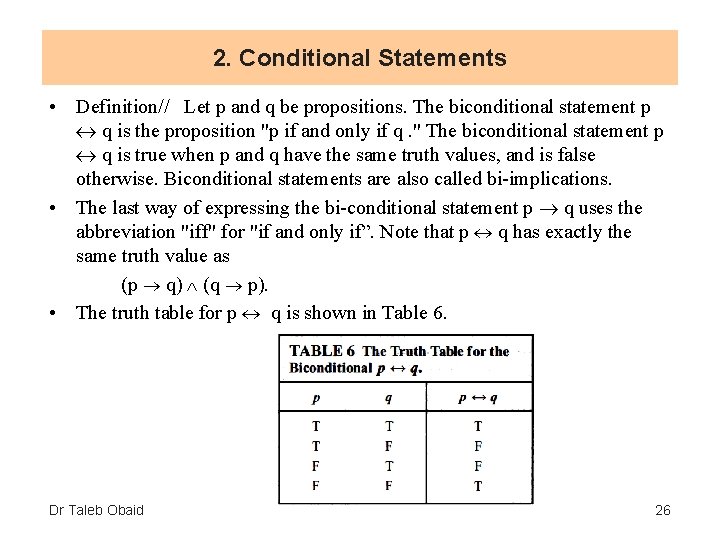
2. Conditional Statements • Definition// Let p and q be propositions. The biconditional statement p q is the proposition "p if and only if q. " The biconditional statement p q is true when p and q have the same truth values, and is false otherwise. Biconditional statements are also called bi-implications. • The last way of expressing the bi-conditional statement p q uses the abbreviation "iff" for "if and only if”. Note that p q has exactly the same truth value as (p q) (q p). • The truth table for p q is shown in Table 6. Dr Taleb Obaid 26
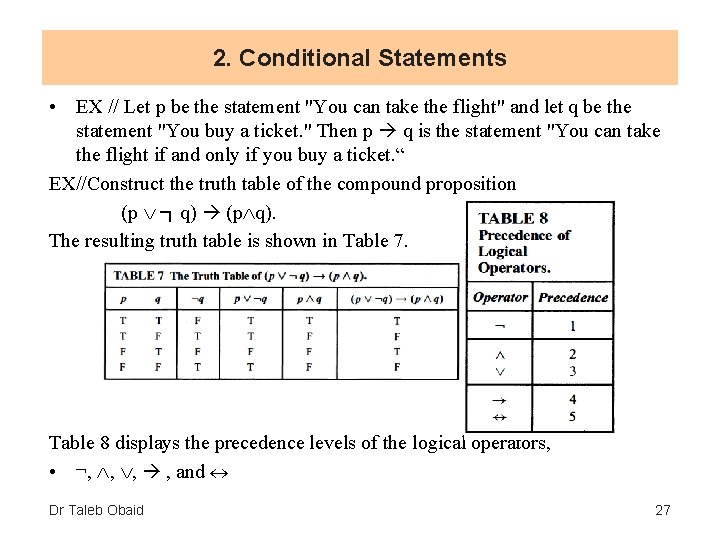
2. Conditional Statements • EX // Let p be the statement "You can take the flight" and let q be the statement "You buy a ticket. " Then p q is the statement "You can take the flight if and only if you buy a ticket. “ EX//Construct the truth table of the compound proposition (p ┑q) (p q). The resulting truth table is shown in Table 7. Table 8 displays the precedence levels of the logical operators, • ¬, , and Dr Taleb Obaid 27
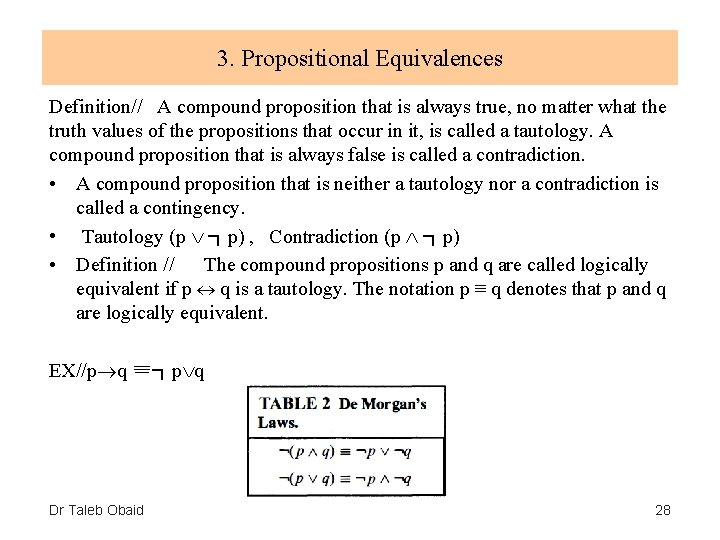
3. Propositional Equivalences Definition// A compound proposition that is always true, no matter what the truth values of the propositions that occur in it, is called a tautology. A compound proposition that is always false is called a contradiction. • A compound proposition that is neither a tautology nor a contradiction is called a contingency. • Tautology (p ┑p) , Contradiction (p ┑p) • Definition // The compound propositions p and q are called logically equivalent if p q is a tautology. The notation p ≡ q denotes that p and q are logically equivalent. EX//p q ≡┑p q Dr Taleb Obaid 28
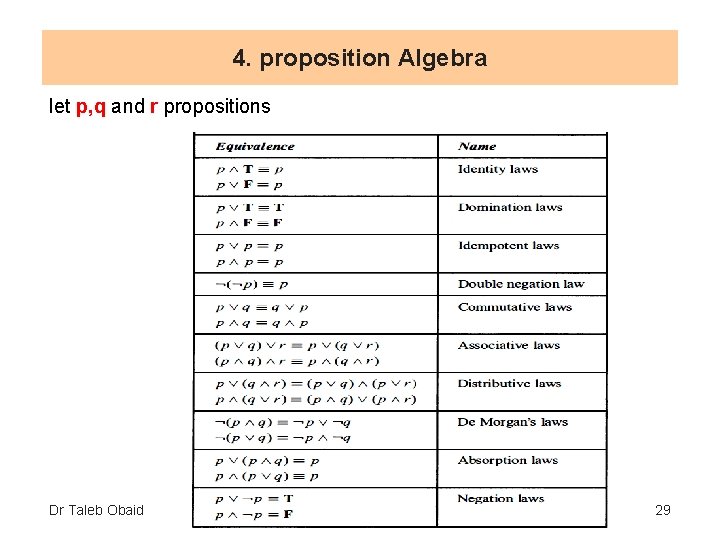
4. proposition Algebra let p, q and r propositions Dr Taleb Obaid 29
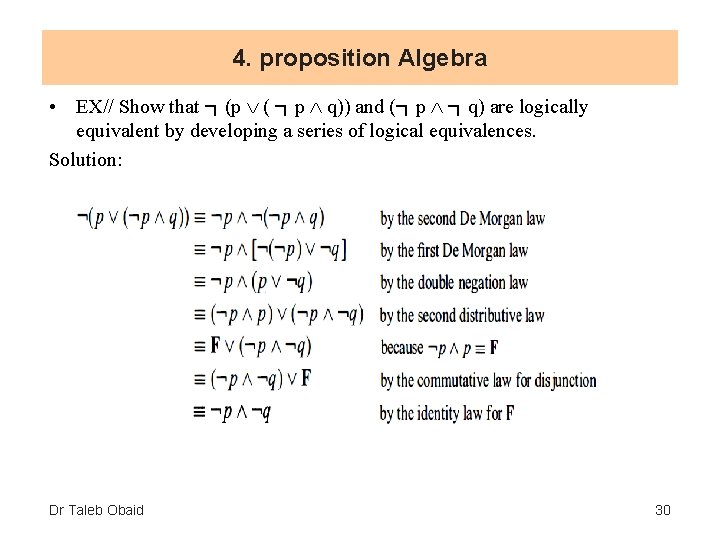
4. proposition Algebra • EX// Show that ┑(p ( ┑p q)) and (┑p ┑q) are logically equivalent by developing a series of logical equivalences. Solution: Dr Taleb Obaid 30
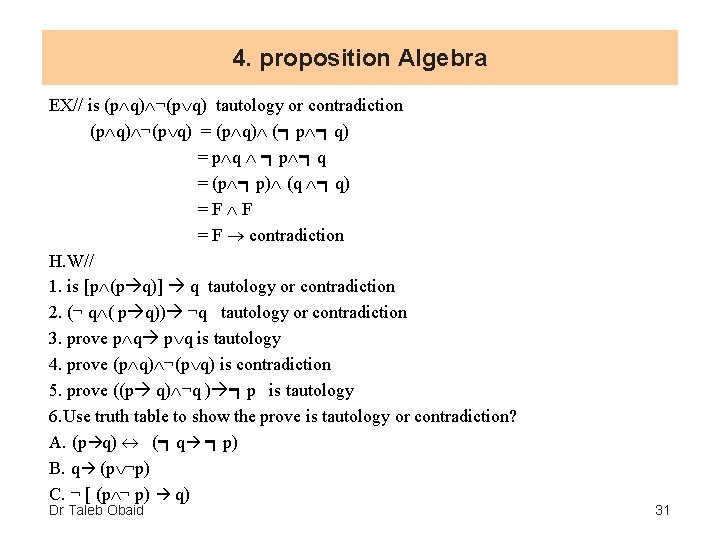
4. proposition Algebra EX// is (p q) ¬(p q) tautology or contradiction (p q) ¬(p q) = (p q) (┑p ┑q) = p q ┑p ┑q = (p ┑p) (q ┑q) =F F = F contradiction H. W// 1. is [p (p q)] q tautology or contradiction 2. (¬ q ( p q)) ¬q tautology or contradiction 3. prove p q is tautology 4. prove (p q) ¬(p q) is contradiction 5. prove ((p q) ¬q ) ┑p is tautology 6. Use truth table to show the prove is tautology or contradiction? A. (p q) (┑q ┑p) B. q (p ¬p) C. ¬ [ (p ¬ p) q) Dr Taleb Obaid 31
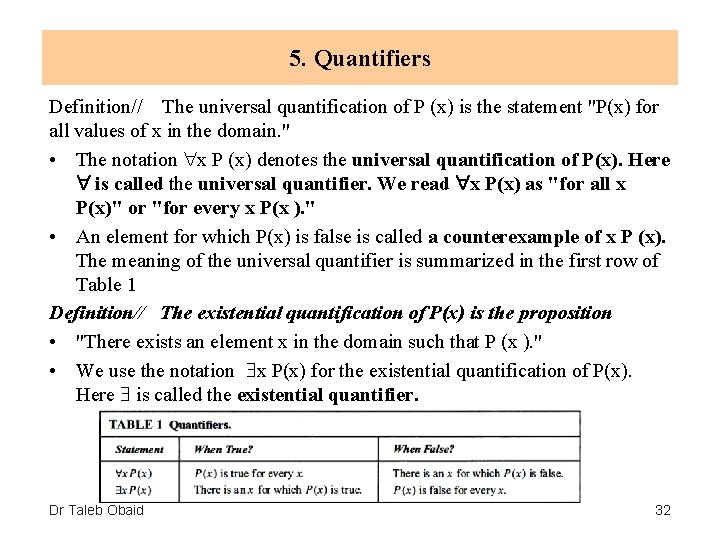
5. Quantifiers Definition// The universal quantification of P (x) is the statement "P(x) for all values of x in the domain. " • The notation x P (x) denotes the universal quantification of P(x). Here is called the universal quantifier. We read x P(x) as "for all x P(x)" or "for every x P(x ). " • An element for which P(x) is false is called a counterexample of x P (x). The meaning of the universal quantifier is summarized in the first row of Table 1 Definition// The existential quantification of P(x) is the proposition • "There exists an element x in the domain such that P (x ). " • We use the notation x P(x) for the existential quantification of P(x). Here is called the existential quantifier. Dr Taleb Obaid 32
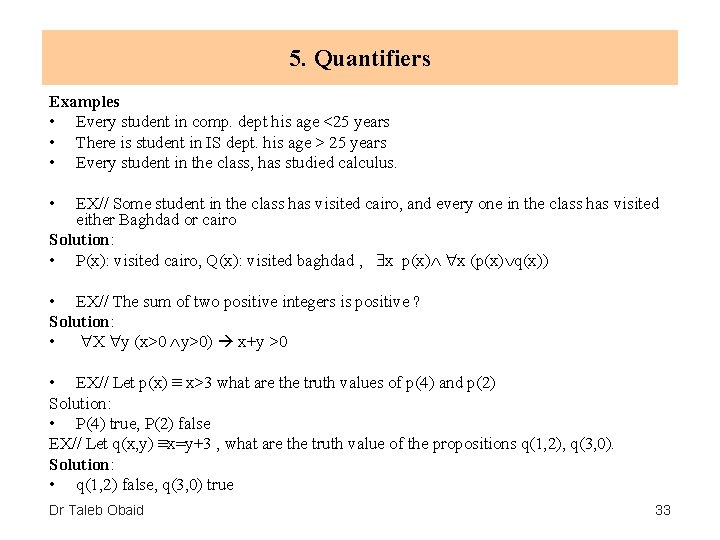
5. Quantifiers Examples • Every student in comp. dept his age <25 years • There is student in IS dept. his age > 25 years • Every student in the class, has studied calculus. • EX// Some student in the class has visited cairo, and every one in the class has visited either Baghdad or cairo Solution: • P(x): visited cairo, Q(x): visited baghdad , x p(x) x (p(x) q(x)) • EX// The sum of two positive integers is positive ? Solution: • X y (x>0 y>0) x+y >0 • EX// Let p(x) ≡ x>3 what are the truth values of p(4) and p(2) Solution: • P(4) true, P(2) false EX// Let q(x, y) ≡x=y+3 , what are the truth value of the propositions q(1, 2), q(3, 0). Solution: • q(1, 2) false, q(3, 0) true Dr Taleb Obaid 33
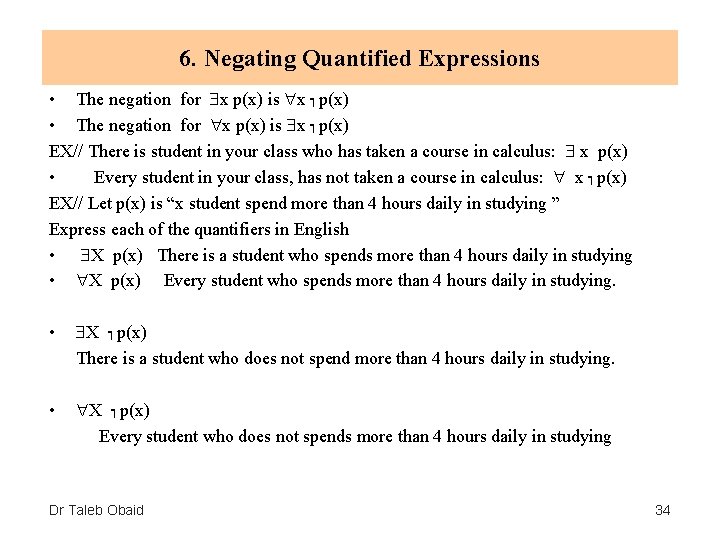
6. Negating Quantified Expressions • The negation for x p(x) is x ┑p(x) EX// There is student in your class who has taken a course in calculus: x p(x) • Every student in your class, has not taken a course in calculus: x ┑p(x) EX// Let p(x) is “x student spend more than 4 hours daily in studying ” Express each of the quantifiers in English • X p(x) There is a student who spends more than 4 hours daily in studying • X p(x) Every student who spends more than 4 hours daily in studying. • X ┑p(x) There is a student who does not spend more than 4 hours daily in studying. • X ┑p(x) Every student who does not spends more than 4 hours daily in studying Dr Taleb Obaid 34
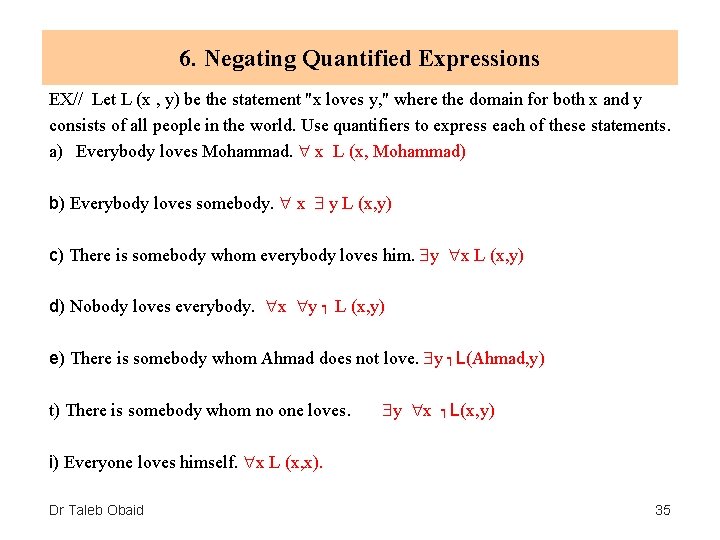
6. Negating Quantified Expressions EX// Let L (x , y) be the statement "x loves y, " where the domain for both x and y consists of all people in the world. Use quantifiers to express each of these statements. a) Everybody loves Mohammad. x L (x, Mohammad) b) Everybody loves somebody. x y L (x, y) c) There is somebody whom everybody loves him. y x L (x, y) d) Nobody loves everybody. x y ┑ L (x, y) e) There is somebody whom Ahmad does not love. y ┑L(Ahmad, y) t) There is somebody whom no one loves. y x ┑L(x, y) i) Everyone loves himself. x L (x, x). Dr Taleb Obaid 35