
Discrete Random Variables Joint PMFs Conditioning and Independence
Discrete Random Variables: Joint PMFs, Conditioning and Independence Berlin Chen Department of Computer Science & Information Engineering National Taiwan Normal University Reference: - D. P. Bertsekas, J. N. Tsitsiklis, Introduction to Probability , Sections 2. 5 -2. 7
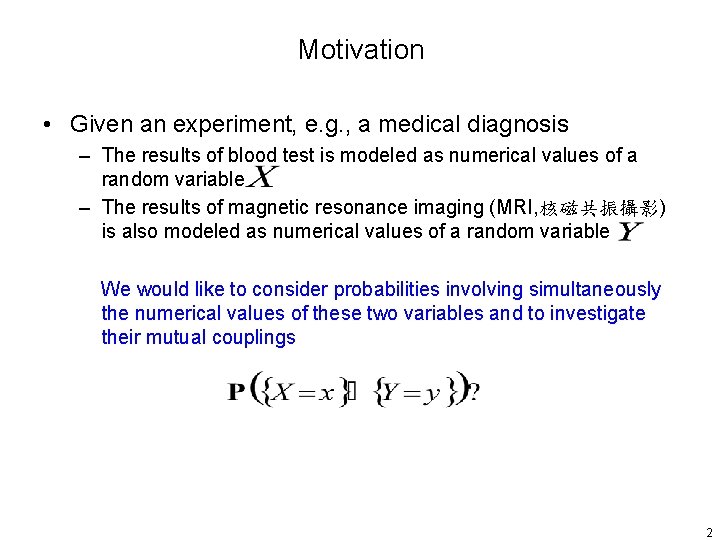
Motivation • Given an experiment, e. g. , a medical diagnosis – The results of blood test is modeled as numerical values of a random variable – The results of magnetic resonance imaging (MRI, 核磁共振攝影) is also modeled as numerical values of a random variable We would like to consider probabilities involving simultaneously the numerical values of these two variables and to investigate their mutual couplings 2
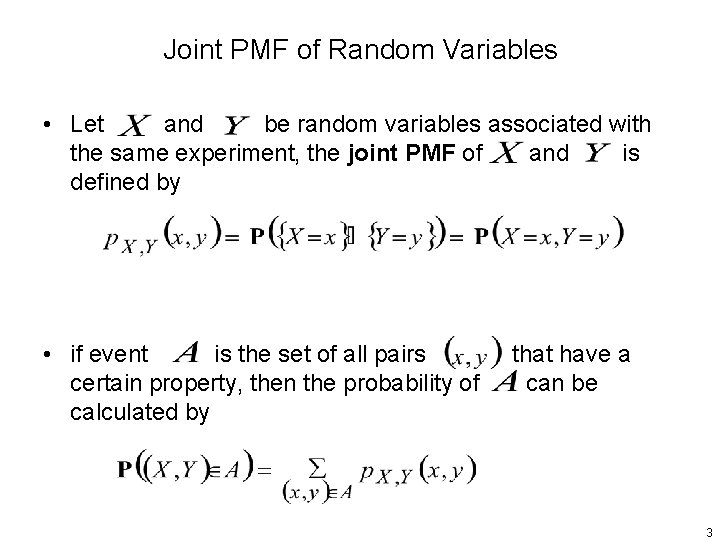
Joint PMF of Random Variables • Let and be random variables associated with the same experiment, the joint PMF of and is defined by • if event is the set of all pairs certain property, then the probability of calculated by that have a can be 3
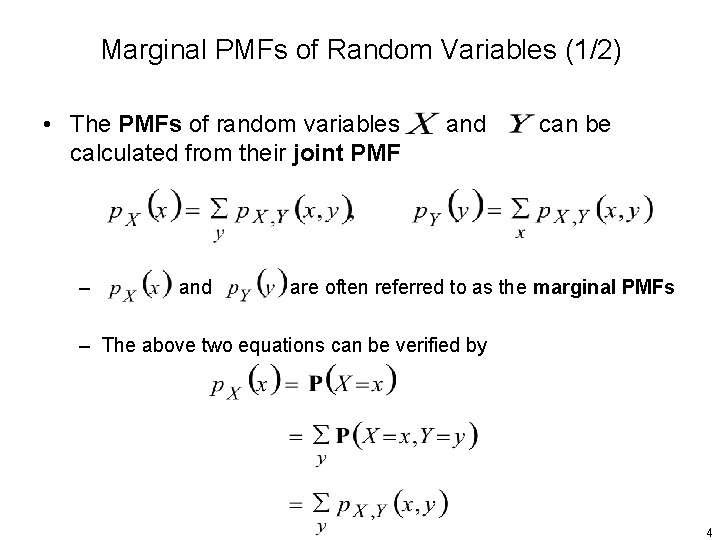
Marginal PMFs of Random Variables (1/2) • The PMFs of random variables calculated from their joint PMF – and can be are often referred to as the marginal PMFs – The above two equations can be verified by 4
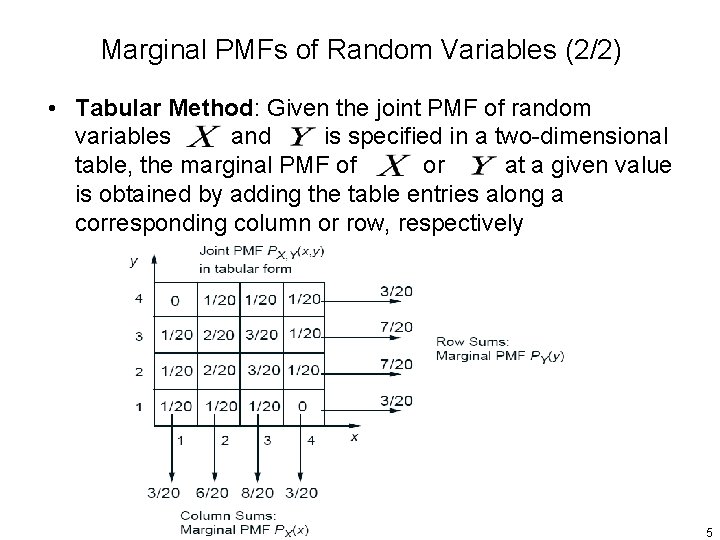
Marginal PMFs of Random Variables (2/2) • Tabular Method: Given the joint PMF of random variables and is specified in a two-dimensional table, the marginal PMF of or at a given value is obtained by adding the table entries along a corresponding column or row, respectively 5
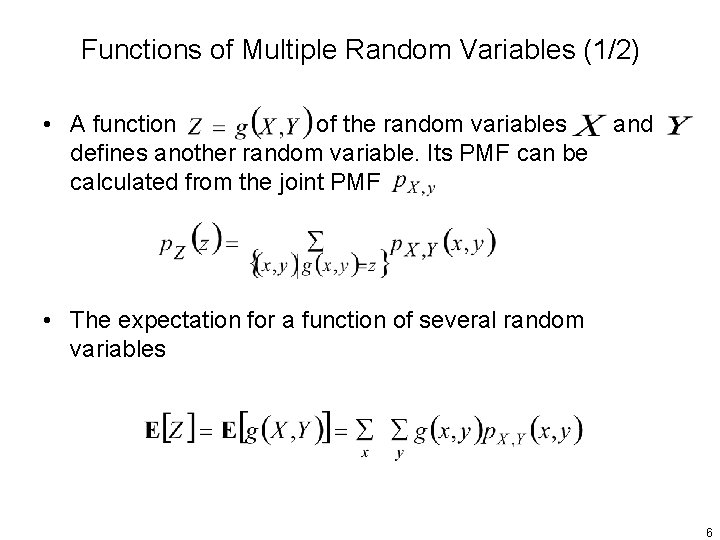
Functions of Multiple Random Variables (1/2) • A function of the random variables defines another random variable. Its PMF can be calculated from the joint PMF and • The expectation for a function of several random variables 6
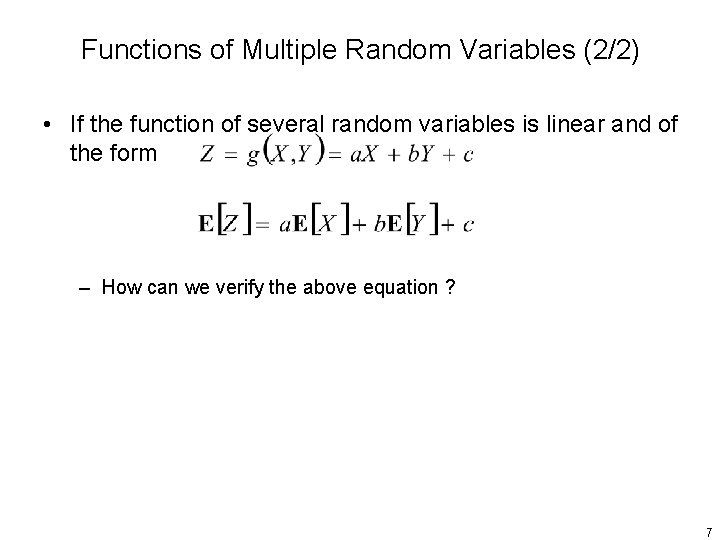
Functions of Multiple Random Variables (2/2) • If the function of several random variables is linear and of the form – How can we verify the above equation ? 7
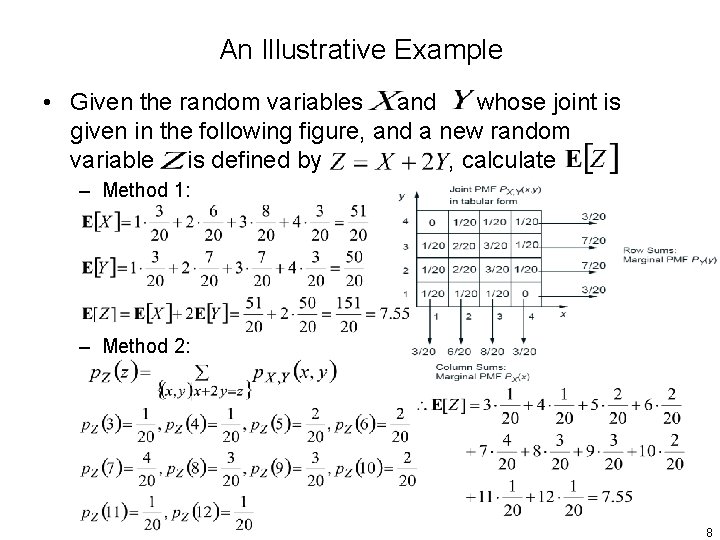
An Illustrative Example • Given the random variables and whose joint is given in the following figure, and a new random variable is defined by , calculate – Method 1: – Method 2: 8
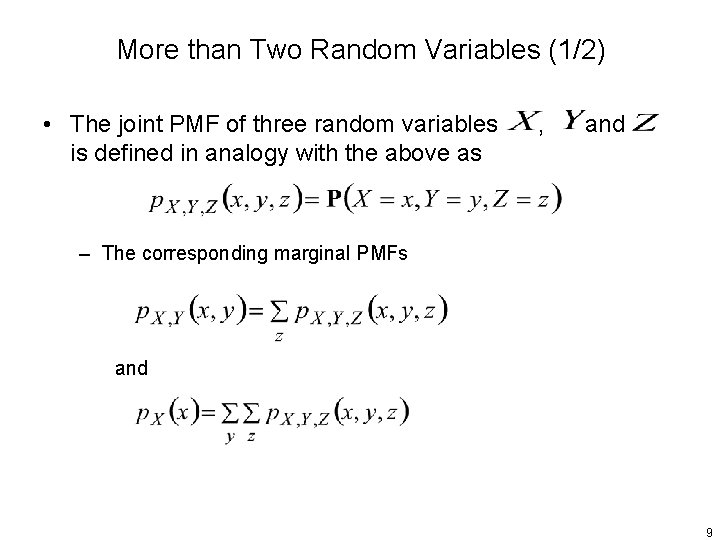
More than Two Random Variables (1/2) • The joint PMF of three random variables is defined in analogy with the above as , and – The corresponding marginal PMFs and 9
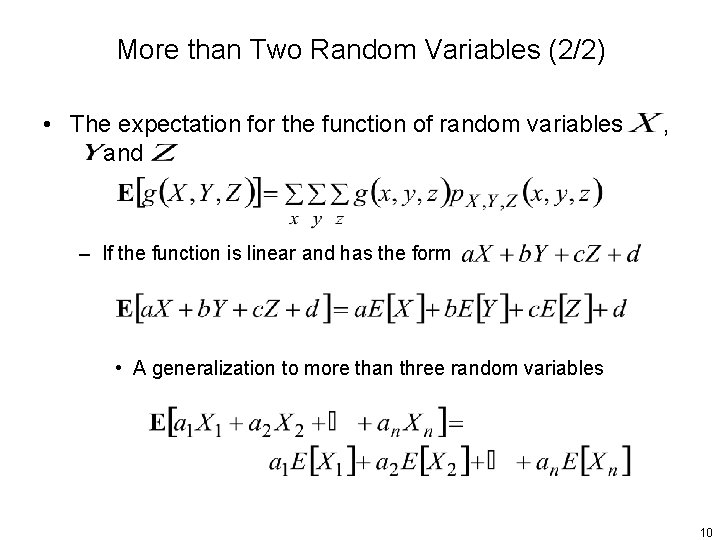
More than Two Random Variables (2/2) • The expectation for the function of random variables and , – If the function is linear and has the form • A generalization to more than three random variables 10
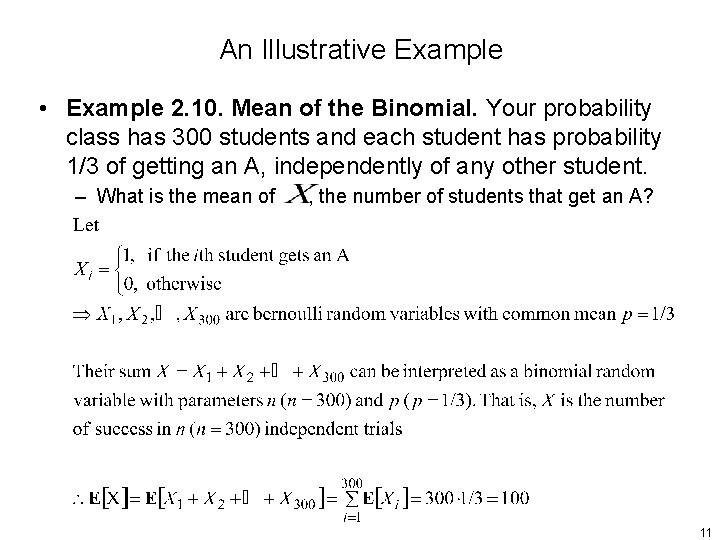
An Illustrative Example • Example 2. 10. Mean of the Binomial. Your probability class has 300 students and each student has probability 1/3 of getting an A, independently of any other student. – What is the mean of , the number of students that get an A? 11
Conditioning • Recall that conditional probability provides us with a way to reason about the outcome of an experiment, based on partial information • In the same spirit, we can define conditional PMFs, given the occurrence of a certain event or given the value of another random variable 12
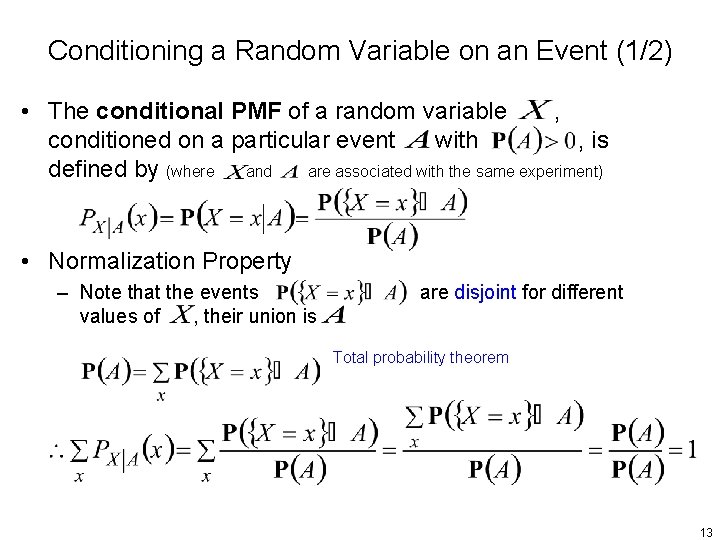
Conditioning a Random Variable on an Event (1/2) • The conditional PMF of a random variable , conditioned on a particular event with , is defined by (where and are associated with the same experiment) • Normalization Property – Note that the events values of , their union is are disjoint for different Total probability theorem 13
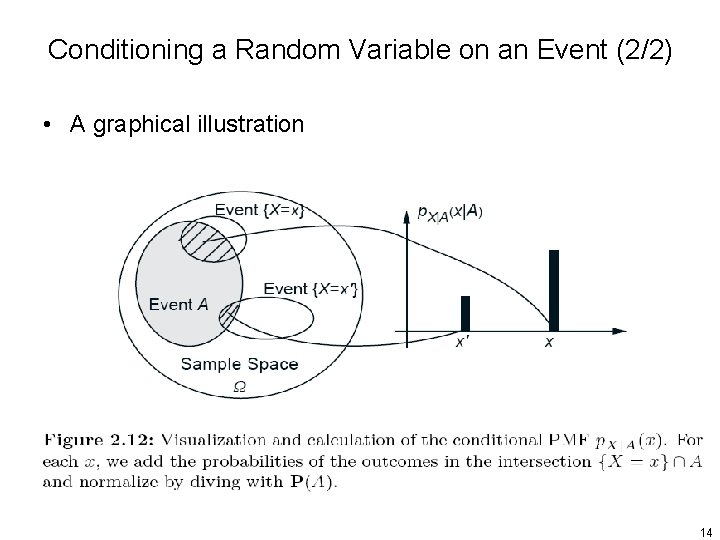
Conditioning a Random Variable on an Event (2/2) • A graphical illustration 14
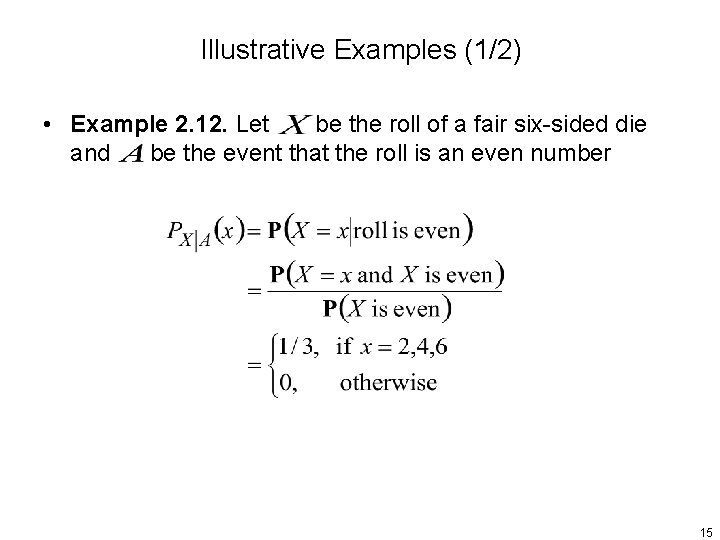
Illustrative Examples (1/2) • Example 2. 12. Let be the roll of a fair six-sided die and be the event that the roll is an even number 15
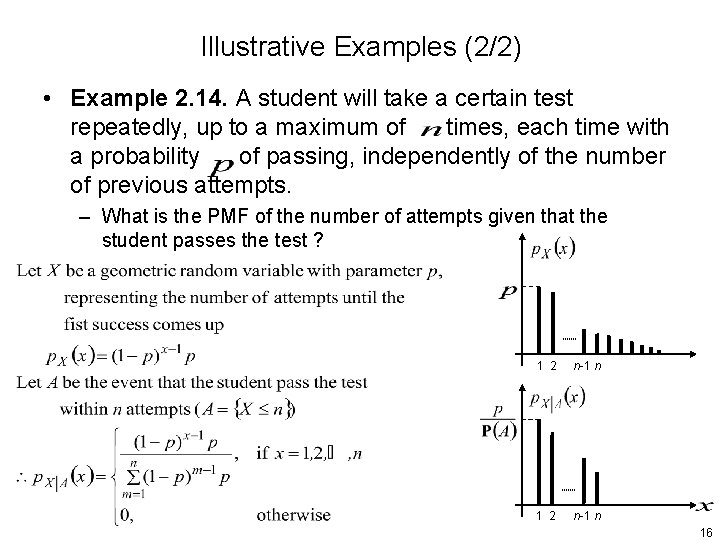
Illustrative Examples (2/2) • Example 2. 14. A student will take a certain test repeatedly, up to a maximum of times, each time with a probability of passing, independently of the number of previous attempts. – What is the PMF of the number of attempts given that the student passes the test ? 1 2 n-1 n 16
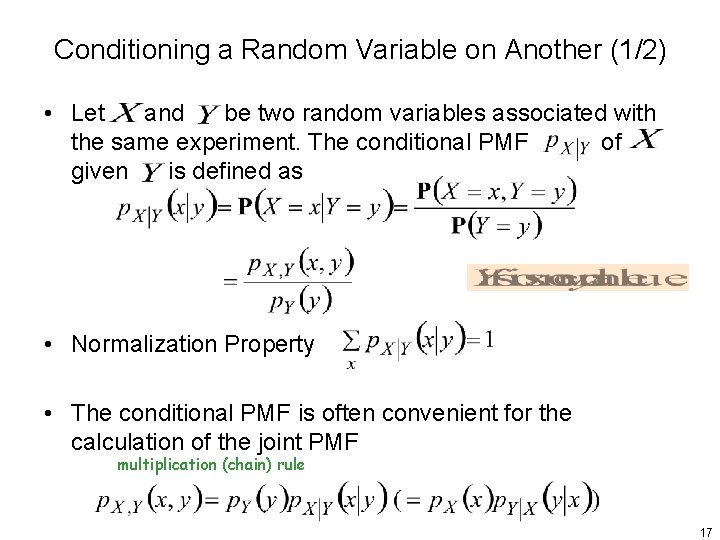
Conditioning a Random Variable on Another (1/2) • Let and be two random variables associated with the same experiment. The conditional PMF of given is defined as • Normalization Property • The conditional PMF is often convenient for the calculation of the joint PMF multiplication (chain) rule 17
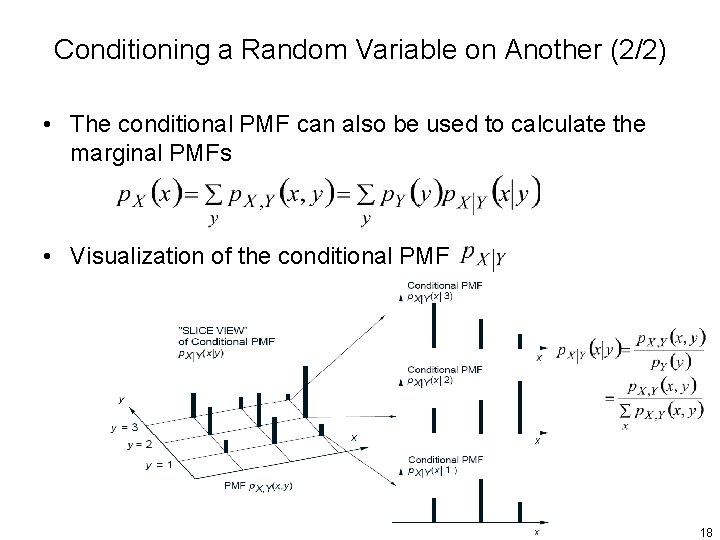
Conditioning a Random Variable on Another (2/2) • The conditional PMF can also be used to calculate the marginal PMFs • Visualization of the conditional PMF 18
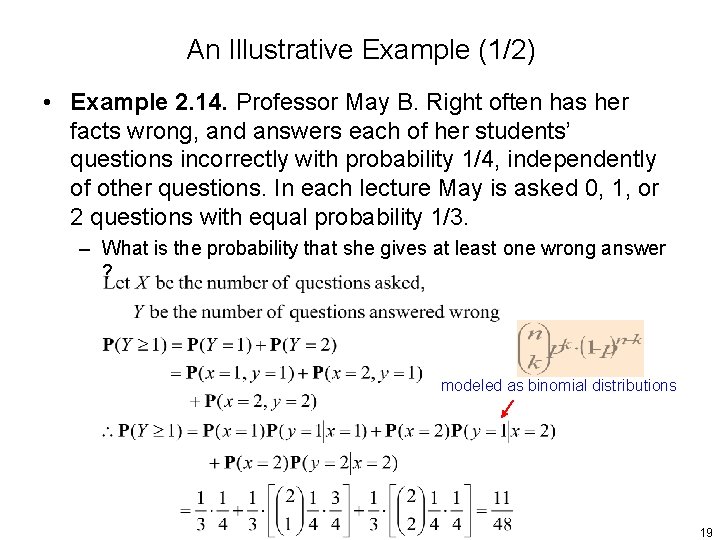
An Illustrative Example (1/2) • Example 2. 14. Professor May B. Right often has her facts wrong, and answers each of her students’ questions incorrectly with probability 1/4, independently of other questions. In each lecture May is asked 0, 1, or 2 questions with equal probability 1/3. – What is the probability that she gives at least one wrong answer ? modeled as binomial distributions 19
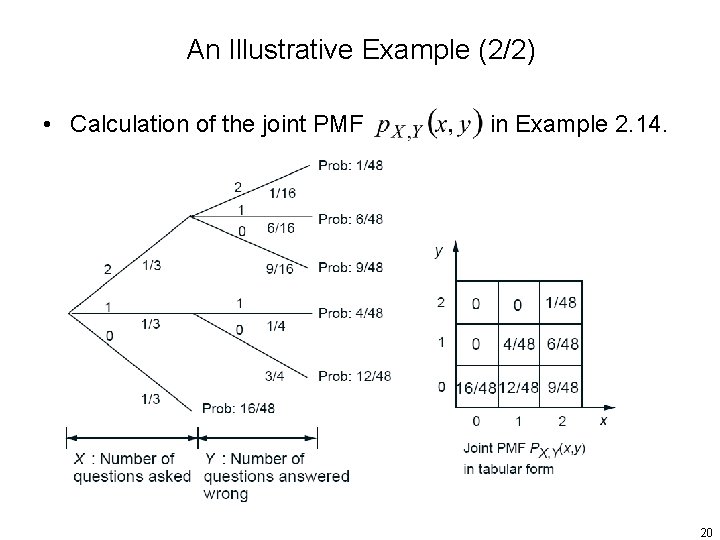
An Illustrative Example (2/2) • Calculation of the joint PMF in Example 2. 14. 20
Conditional Expectation • Recall that a conditional PMF can be thought of as an ordinary PMF over a new universe determined by the conditioning event • In the same spirit, a conditional expectation is the same as an ordinary expectation, except that it refers to the new universe, and all probabilities and PMFs are replaced by their conditional counterparts 21
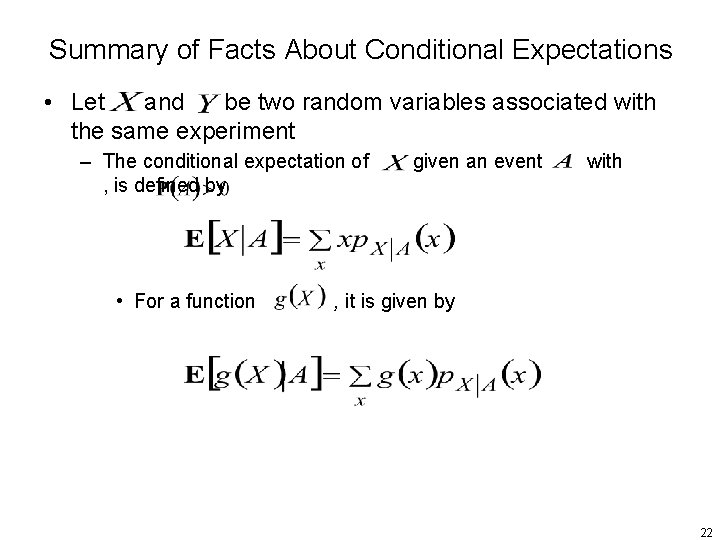
Summary of Facts About Conditional Expectations • Let and be two random variables associated with the same experiment – The conditional expectation of , is defined by • For a function given an event with , it is given by 22
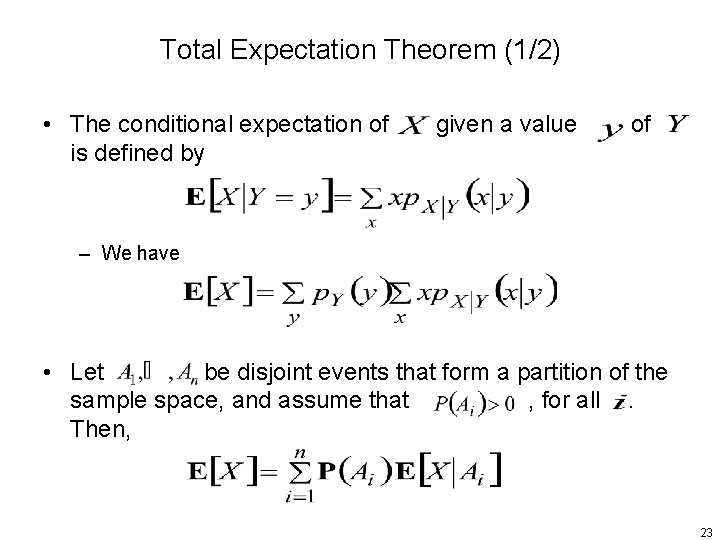
Total Expectation Theorem (1/2) • The conditional expectation of is defined by given a value of – We have • Let be disjoint events that form a partition of the sample space, and assume that , for all. Then, 23
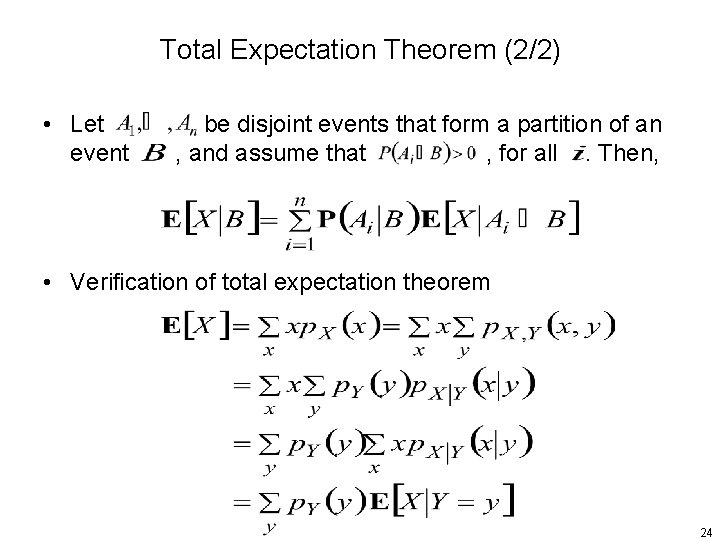
Total Expectation Theorem (2/2) • Let event be disjoint events that form a partition of an , and assume that , for all. Then, • Verification of total expectation theorem 24
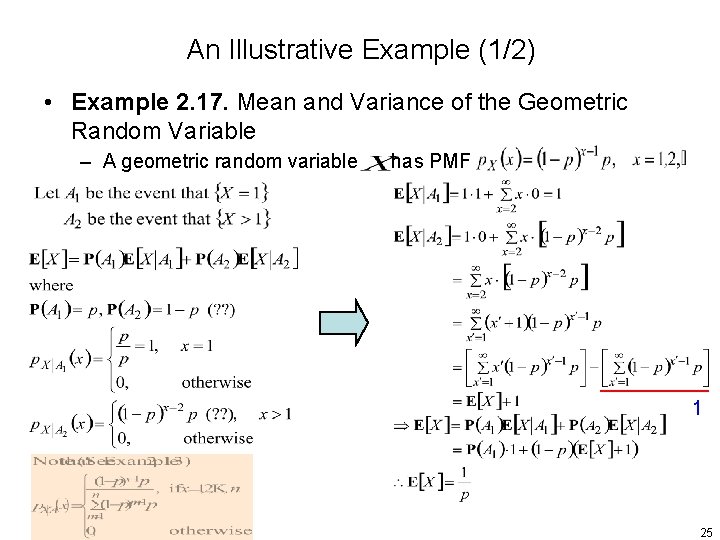
An Illustrative Example (1/2) • Example 2. 17. Mean and Variance of the Geometric Random Variable – A geometric random variable has PMF 1 25
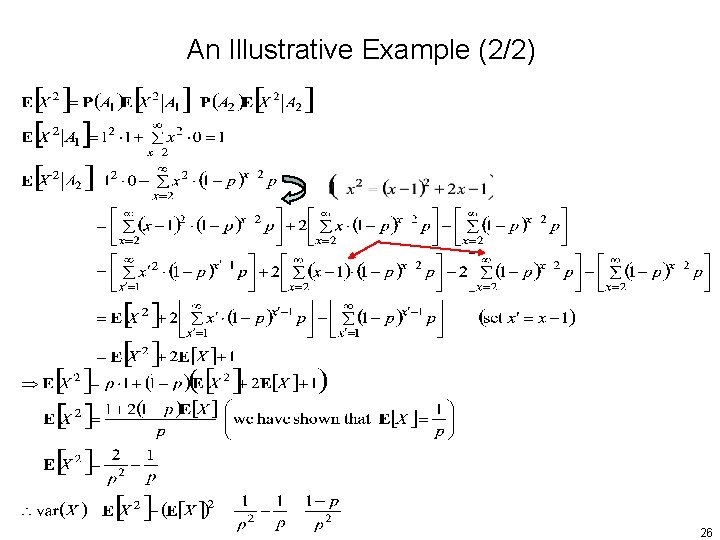
An Illustrative Example (2/2) 26
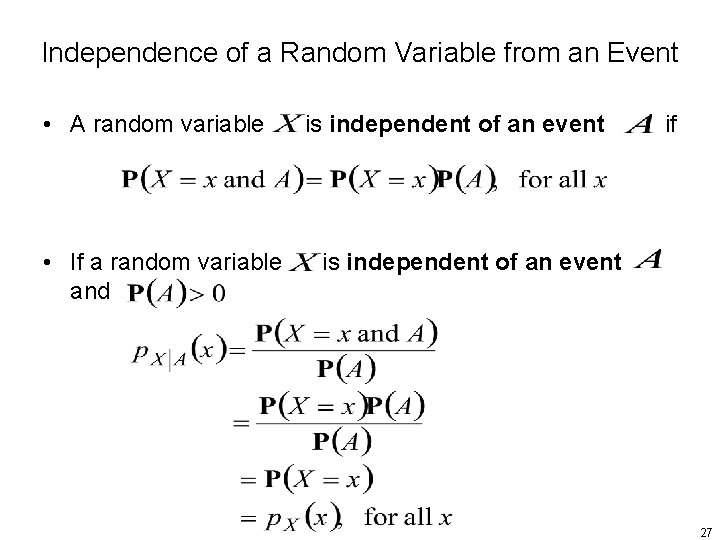
Independence of a Random Variable from an Event • A random variable • If a random variable and is independent of an event if is independent of an event 27
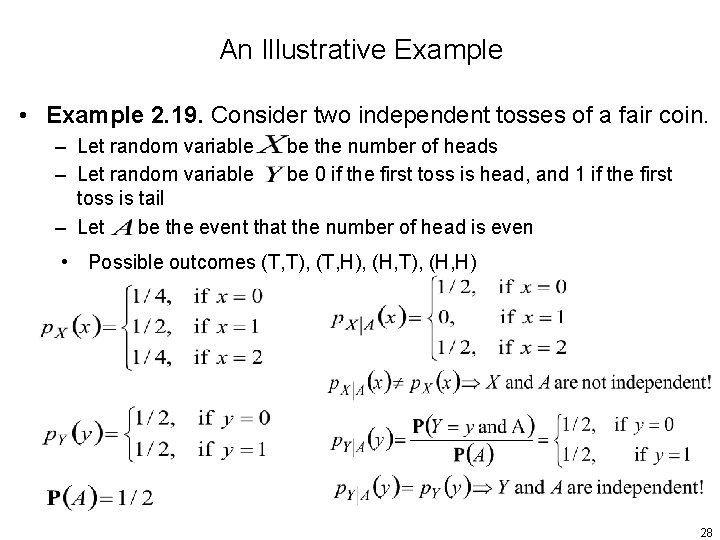
An Illustrative Example • Example 2. 19. Consider two independent tosses of a fair coin. – Let random variable be the number of heads – Let random variable be 0 if the first toss is head, and 1 if the first toss is tail – Let be the event that the number of head is even • Possible outcomes (T, T), (T, H), (H, T), (H, H) 28
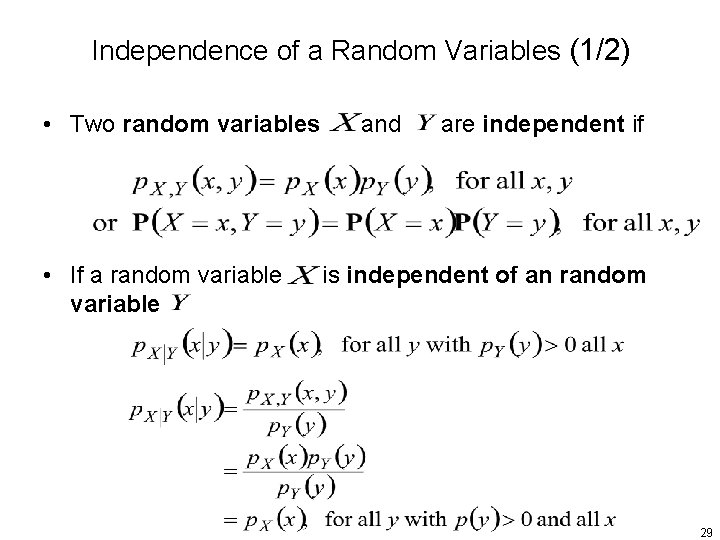
Independence of a Random Variables (1/2) • Two random variables • If a random variable and are independent if is independent of an random 29
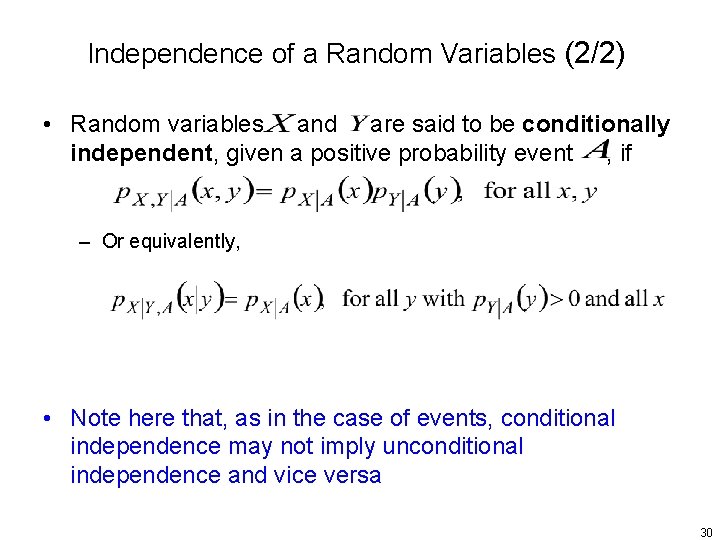
Independence of a Random Variables (2/2) • Random variables and are said to be conditionally independent, given a positive probability event , if – Or equivalently, • Note here that, as in the case of events, conditional independence may not imply unconditional independence and vice versa 30
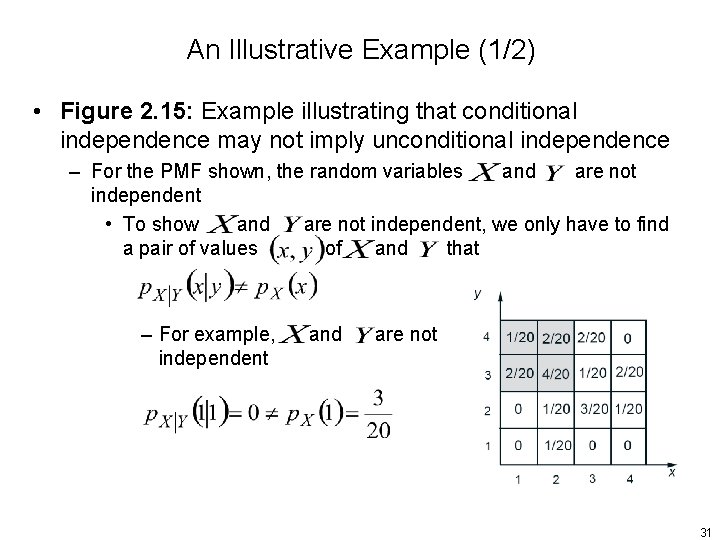
An Illustrative Example (1/2) • Figure 2. 15: Example illustrating that conditional independence may not imply unconditional independence – For the PMF shown, the random variables and are not independent • To show and are not independent, we only have to find a pair of values of and that – For example, independent and are not 31
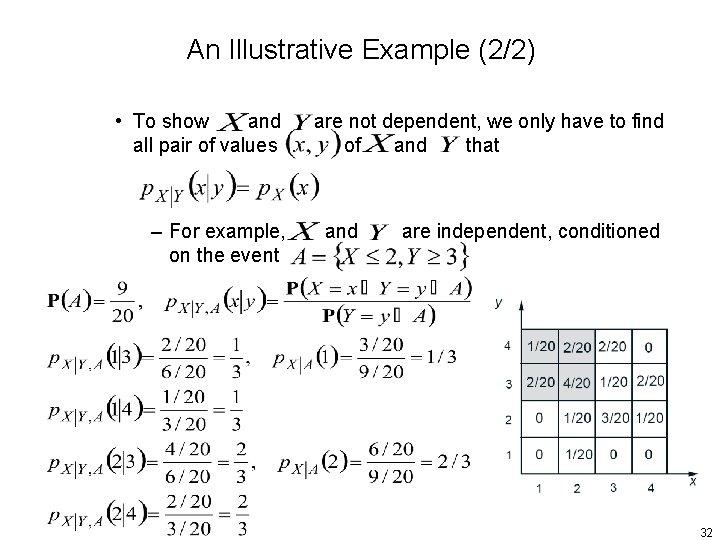
An Illustrative Example (2/2) • To show and all pair of values – For example, on the event are not dependent, we only have to find of and that and are independent, conditioned 32
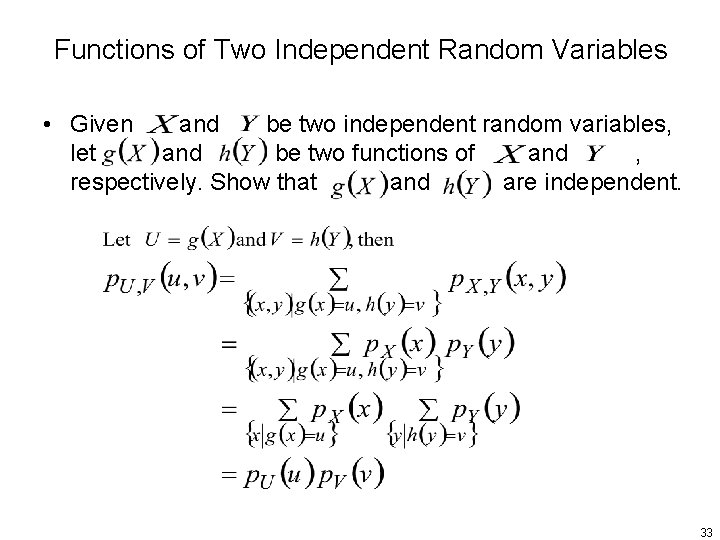
Functions of Two Independent Random Variables • Given and be two independent random variables, let and be two functions of and , respectively. Show that and are independent. 33
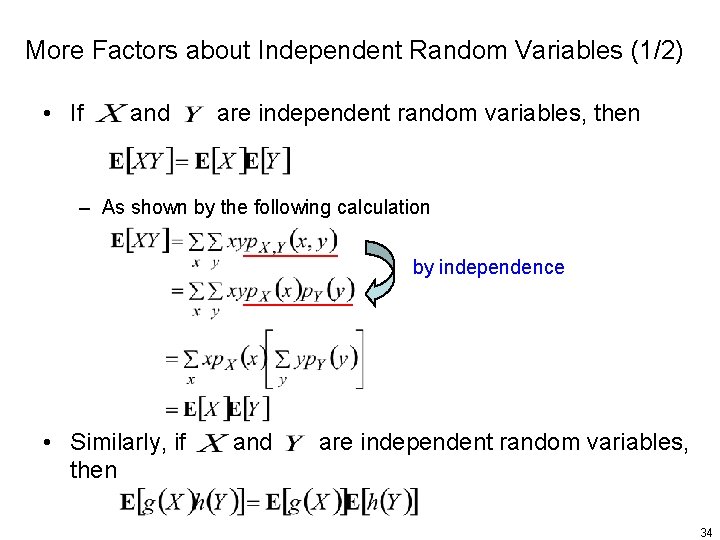
More Factors about Independent Random Variables (1/2) • If and are independent random variables, then – As shown by the following calculation by independence • Similarly, if then and are independent random variables, 34
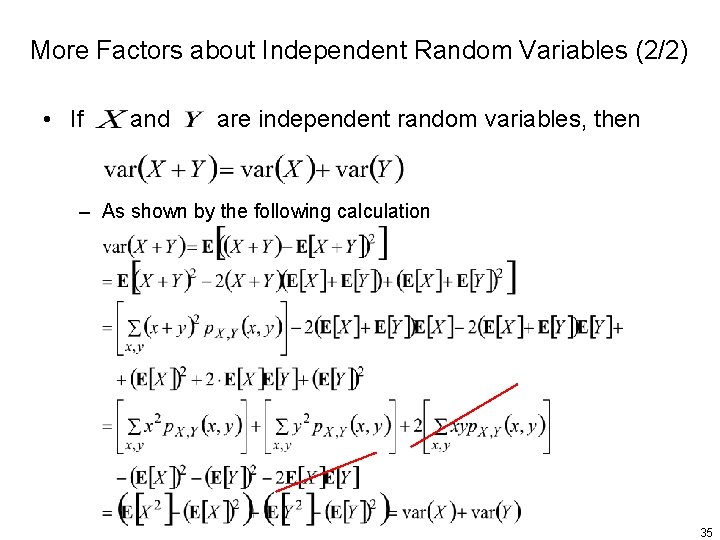
More Factors about Independent Random Variables (2/2) • If and are independent random variables, then – As shown by the following calculation 35
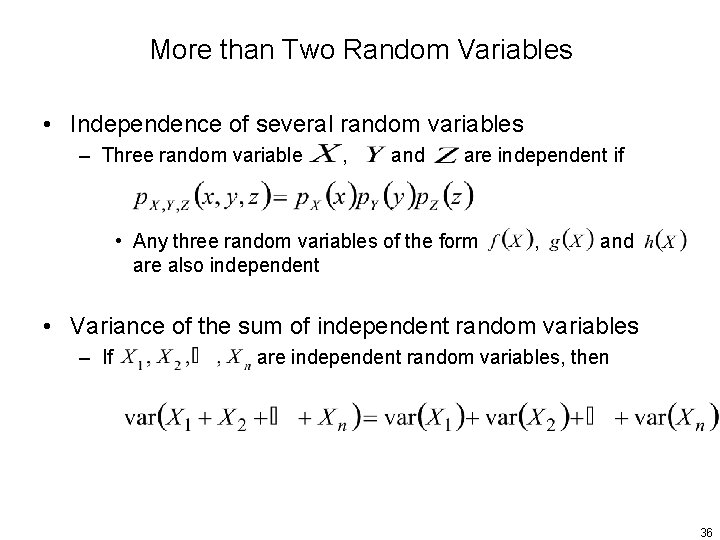
More than Two Random Variables • Independence of several random variables – Three random variable , and are independent if • Any three random variables of the form are also independent , and • Variance of the sum of independent random variables – If are independent random variables, then 36
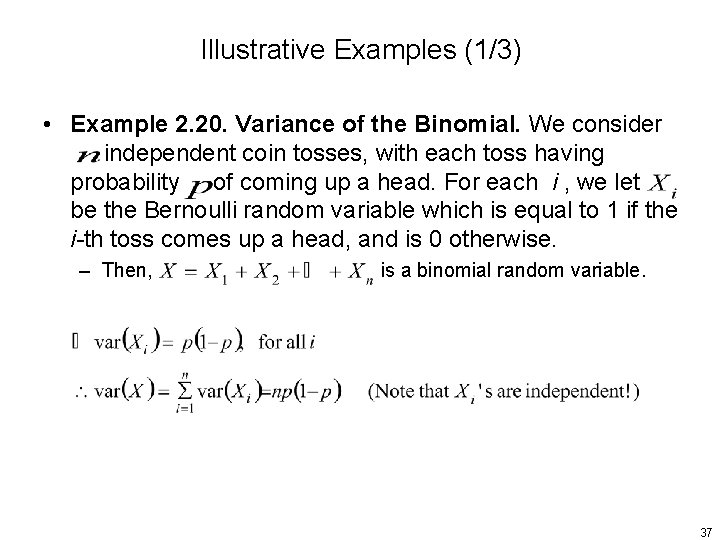
Illustrative Examples (1/3) • Example 2. 20. Variance of the Binomial. We consider independent coin tosses, with each toss having probability of coming up a head. For each i , we let be the Bernoulli random variable which is equal to 1 if the i-th toss comes up a head, and is 0 otherwise. – Then, is a binomial random variable. 37
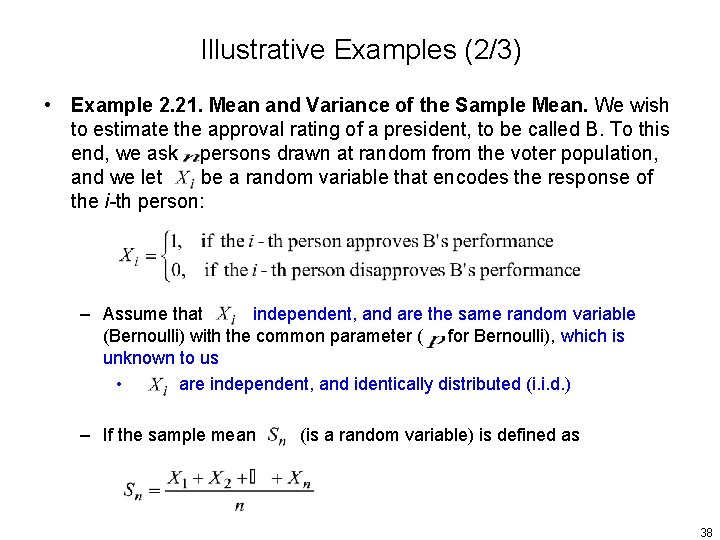
Illustrative Examples (2/3) • Example 2. 21. Mean and Variance of the Sample Mean. We wish to estimate the approval rating of a president, to be called B. To this end, we ask persons drawn at random from the voter population, and we let be a random variable that encodes the response of the i-th person: – Assume that independent, and are the same random variable (Bernoulli) with the common parameter ( for Bernoulli), which is unknown to us • are independent, and identically distributed (i. i. d. ) – If the sample mean (is a random variable) is defined as 38
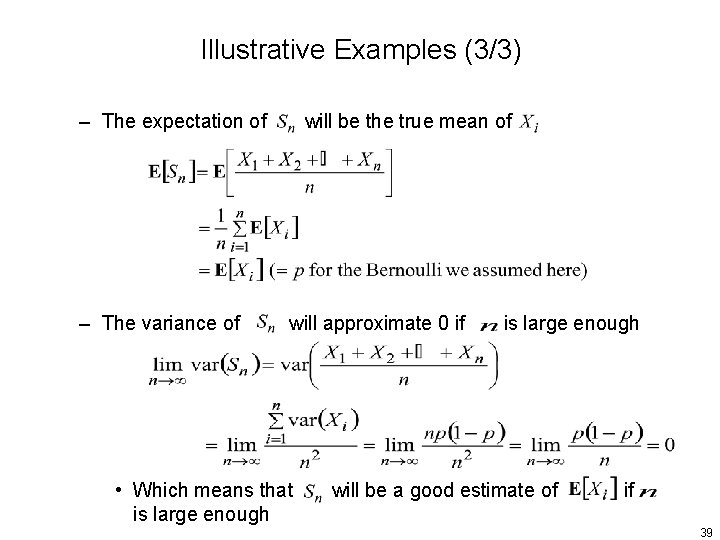
Illustrative Examples (3/3) – The expectation of – The variance of will be the true mean of will approximate 0 if • Which means that is large enough will be a good estimate of if 39
Recitation • SECTION 2. 5 Joint PMFs of Multiple Random Variables – Problems 27, 28, 30 • SECTION 2. 6 Conditioning – Problems 33, 34, 35, 37 • SECTION 2. 6 Independence – Problems 42, 43, 45, 46 40
- Slides: 40