
Discrete Mathematics for Computer Science COMPSCI 230 Lecture


![Defn: Modular equivalence of integers a and b a b [mod n] (a mod](https://slidetodoc.com/presentation_image_h2/15b98c3e0b998f9987774377652fa990/image-15.jpg "Defn: Modular equivalence of integers a and b a b [mod n] (a mod")
![31 81 [mod 2] 31 2 81](https://slidetodoc.com/presentation_image_h2/15b98c3e0b998f9987774377652fa990/image-16.jpg "31 81 [mod 2] 31 2 81")



- Slides: 92
Discrete Mathematics for Computer Science COMPSCI 230 Lecture 16 Duke University Modular Arithmetic and the RSA Cryptosystem p-1 p 1
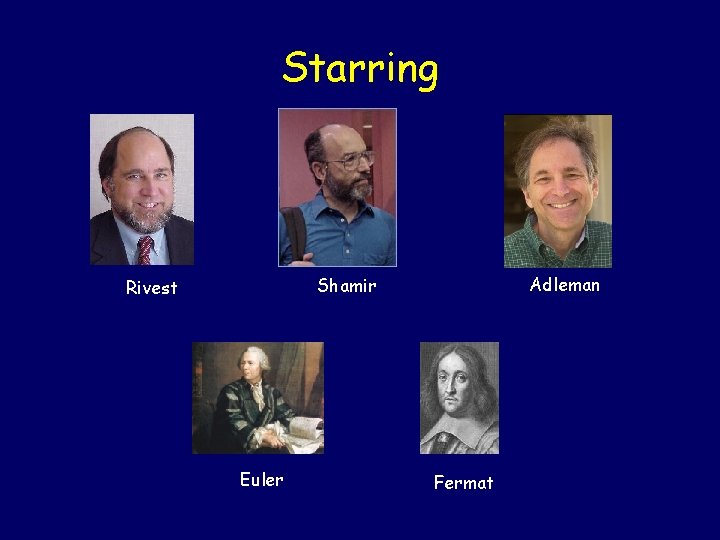
Starring Adleman Shamir Rivest Euler Fermat
The RSA Cryptosystem Rivest, Shamir, and Adelman (1978) RSA is one of the most used cryptographic protocols on the net. Your browser uses it to establish a secure session with a site.
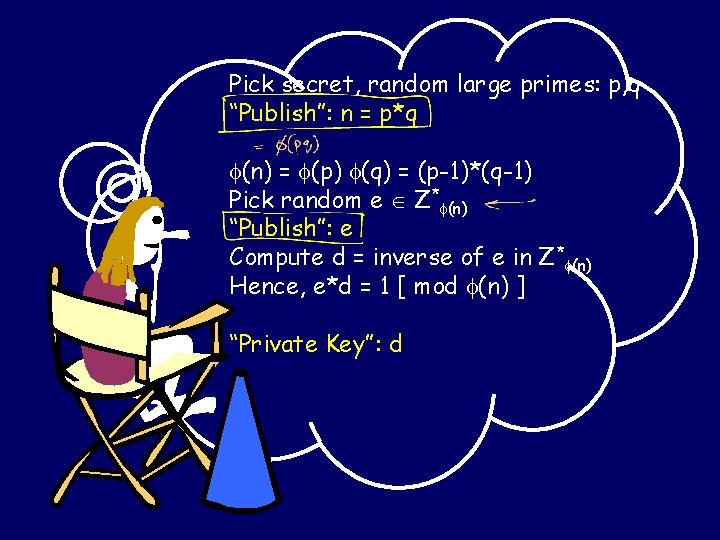
Pick secret, random large primes: p, q “Publish”: n = p*q (n) = (p) (q)Mumbo = (p-1)*(q-1) jumbo… * Pick random e Z (n) “Publish”: e Compute d = inverse of e in Z* (n) Mumbo jumbo… Hence, e*d =More 1 [ mod (n) ] “Private Key”: d
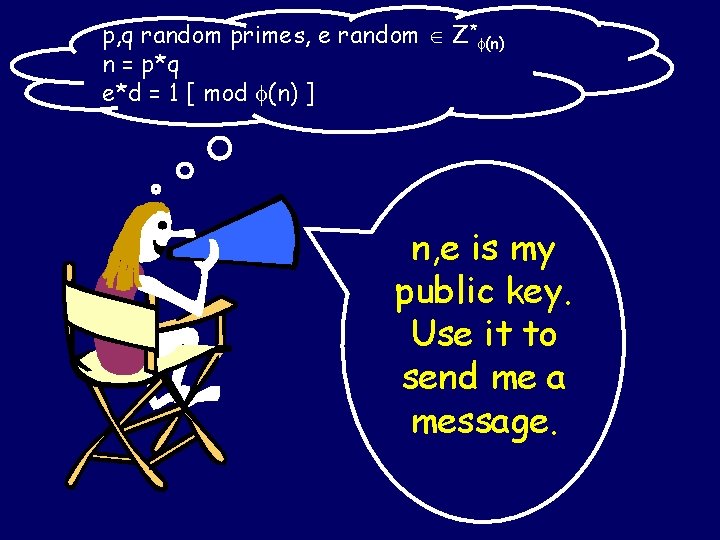
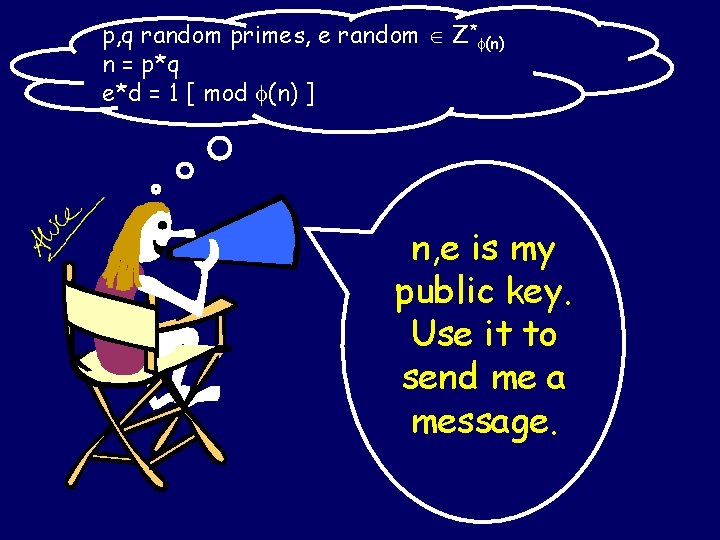
p, q random primes, e random Z* (n) n = p*q e*d = 1 [ mod (n) ] n, e is my public key. Use it to send me a message.
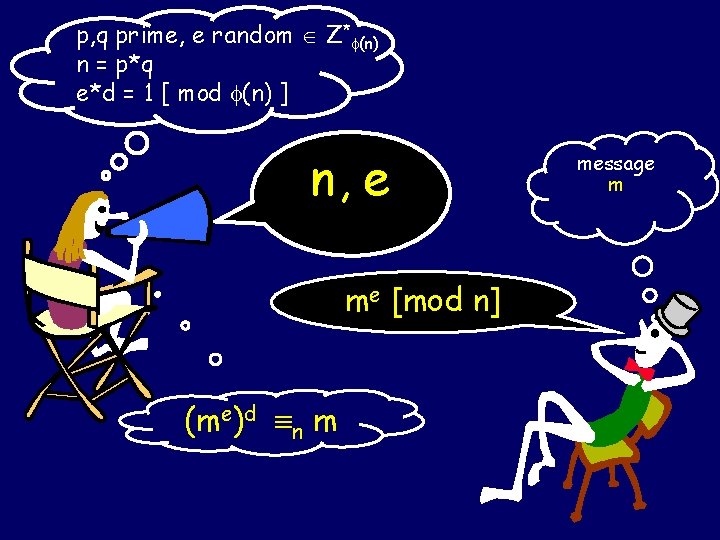
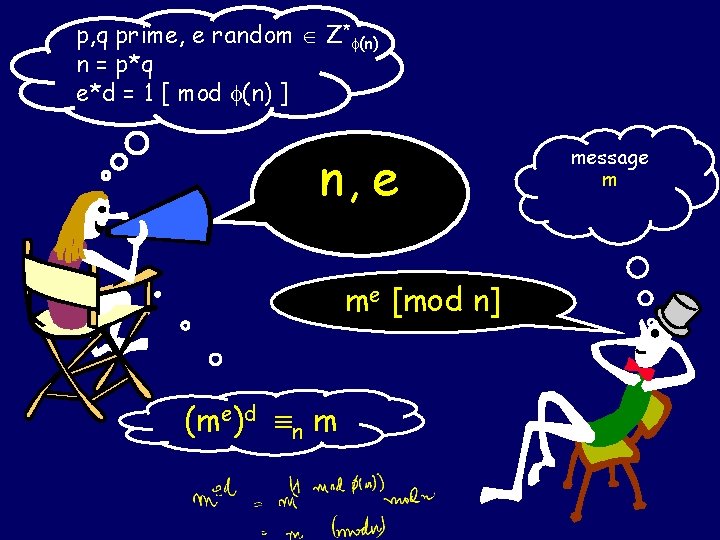
p, q prime, e random Z* (n) n = p*q e*d = 1 [ mod (n) ] n, e me [mod n] (me)d n m message m
But how does it all work? What is φ(n)? What is Zφ(n)*? … Why do all the steps work? To understand this, we need a little number theory. . .
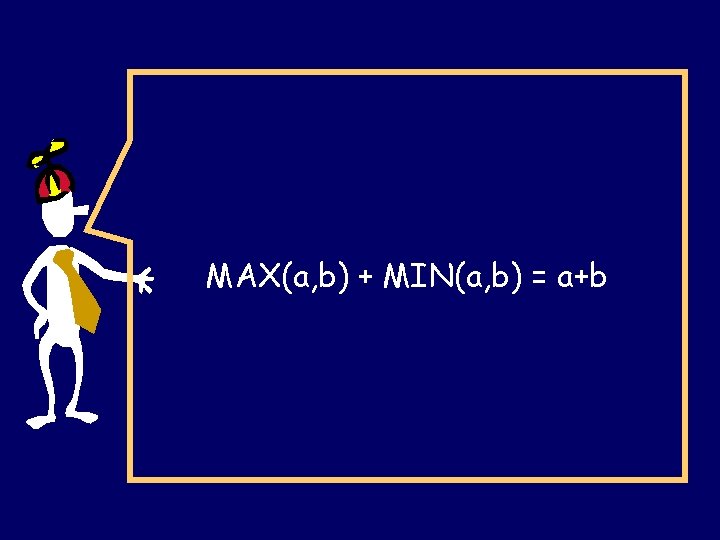
MAX(a, b) + MIN(a, b) = a+b
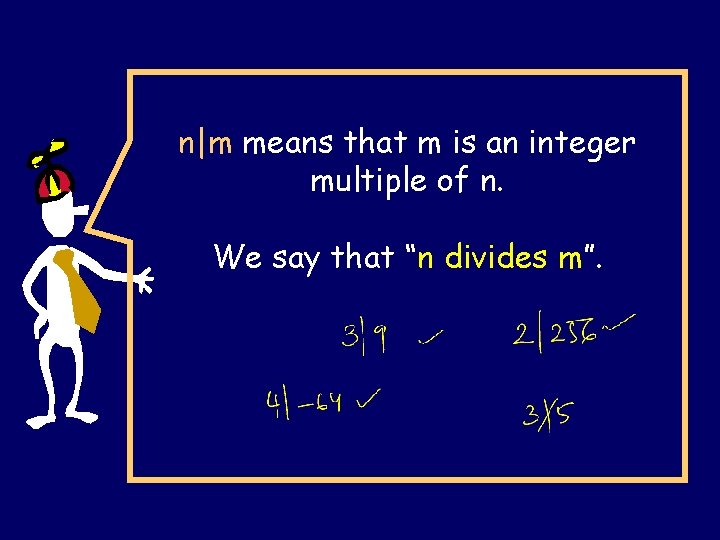
n|m means that m is an integer multiple of n. We say that “n divides m”.
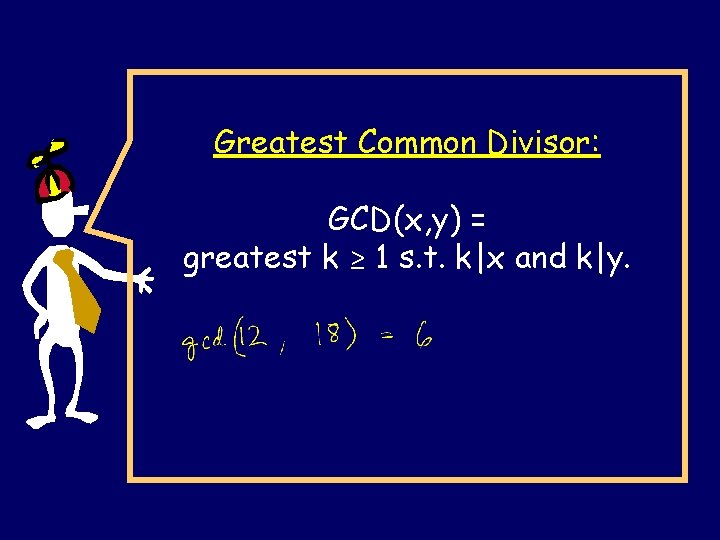
Greatest Common Divisor: GCD(x, y) = greatest k ≥ 1 s. t. k|x and k|y.
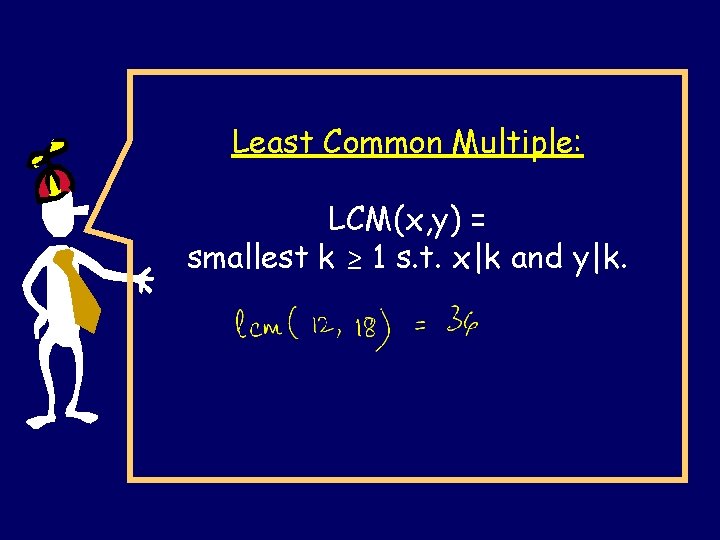
Least Common Multiple: LCM(x, y) = smallest k ≥ 1 s. t. x|k and y|k.
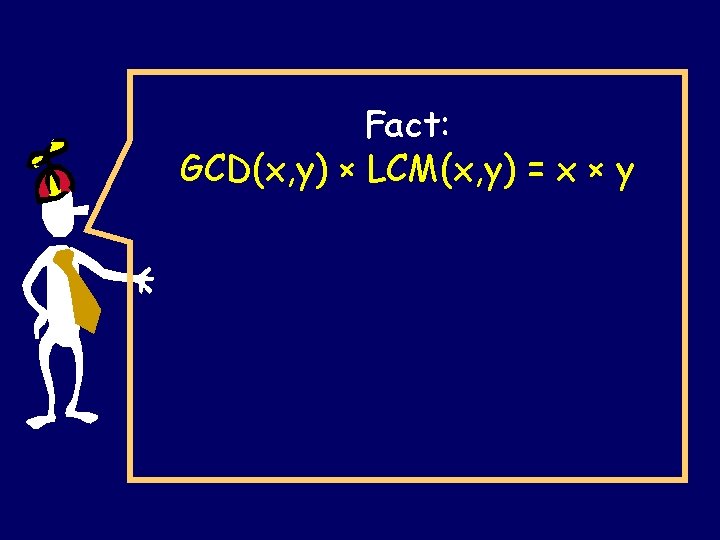
Fact: GCD(x, y) × LCM(x, y) = x × y
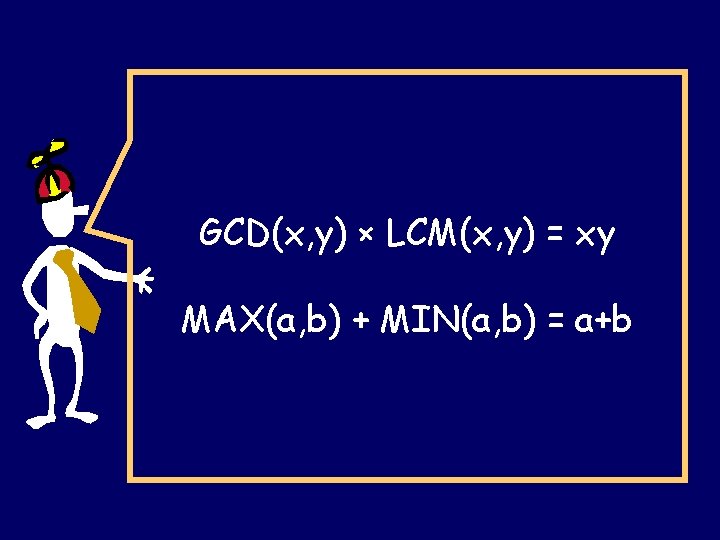
GCD(x, y) × LCM(x, y) = xy MAX(a, b) + MIN(a, b) = a+b
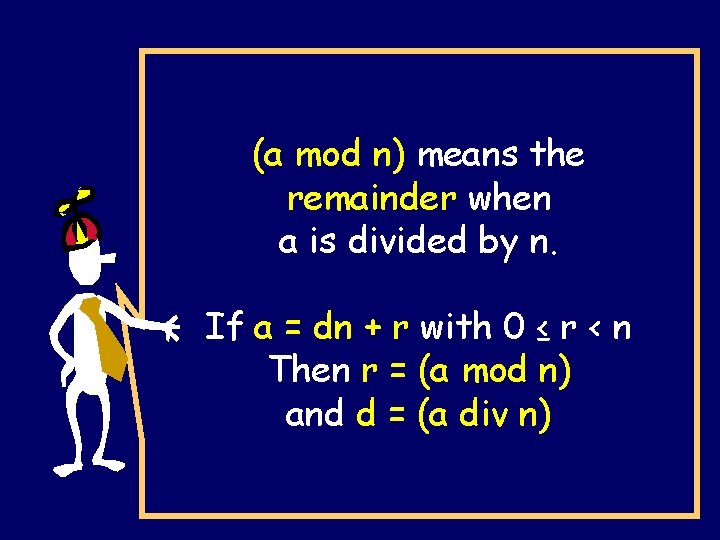
(a mod n) means the remainder when a is divided by n. If a = dn + r with 0 ≤ r < n Then r = (a mod n) and d = (a div n)
Defn: Modular equivalence of integers a and b a b [mod n] (a mod n) = (b mod n) n|(a-b) Written as a n b, and spoken “a and b are equivalent modulo n”
31 81 [mod 2] 31 2 81
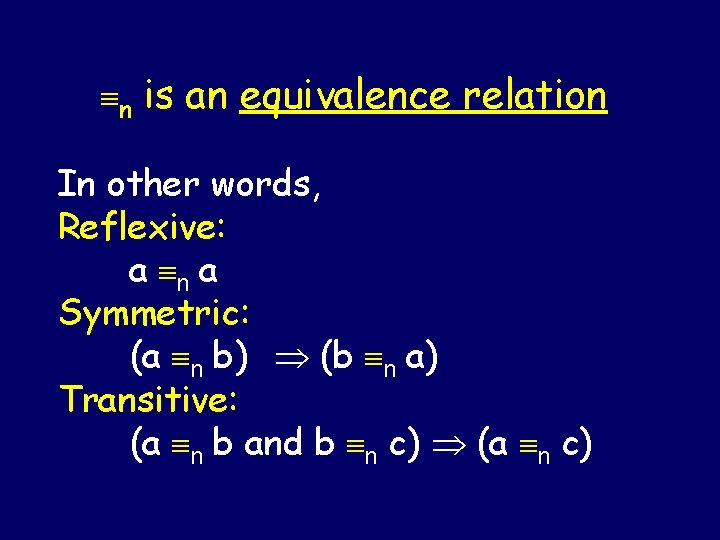
n is an equivalence relation In other words, Reflexive: a n a Symmetric: (a n b) (b n a) Transitive: (a n b and b n c) (a n c)
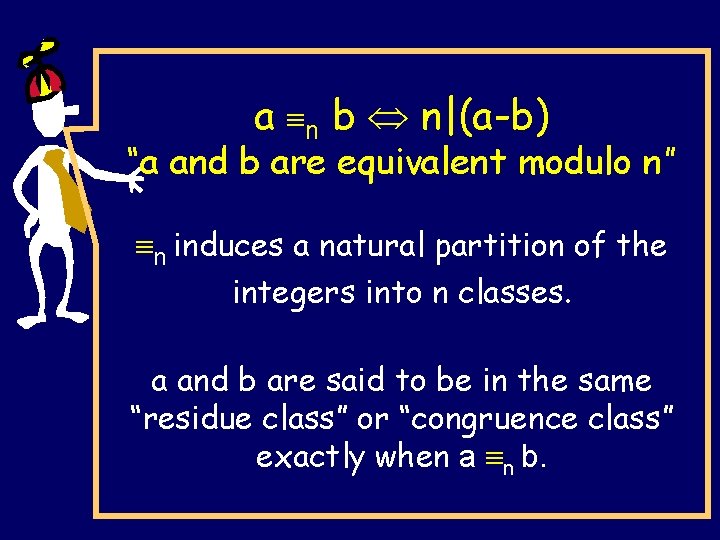
a n b n|(a-b) “a and b are equivalent modulo n” n induces a natural partition of the integers into n classes. a and b are said to be in the same “residue class” or “congruence class” exactly when a n b.
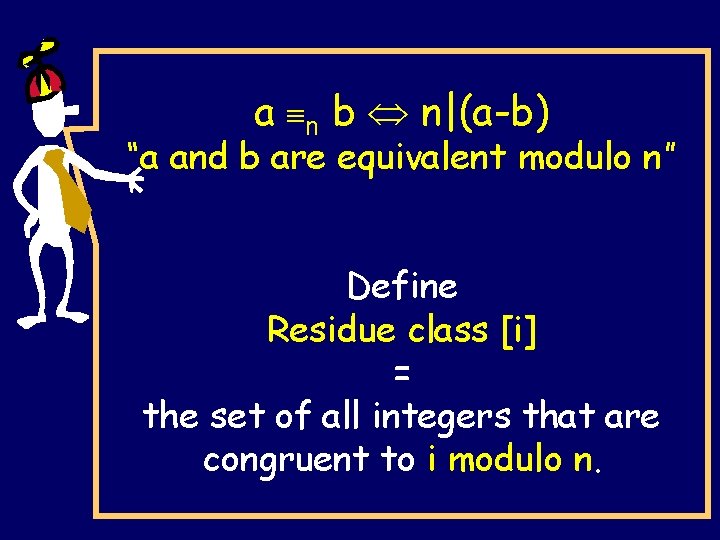
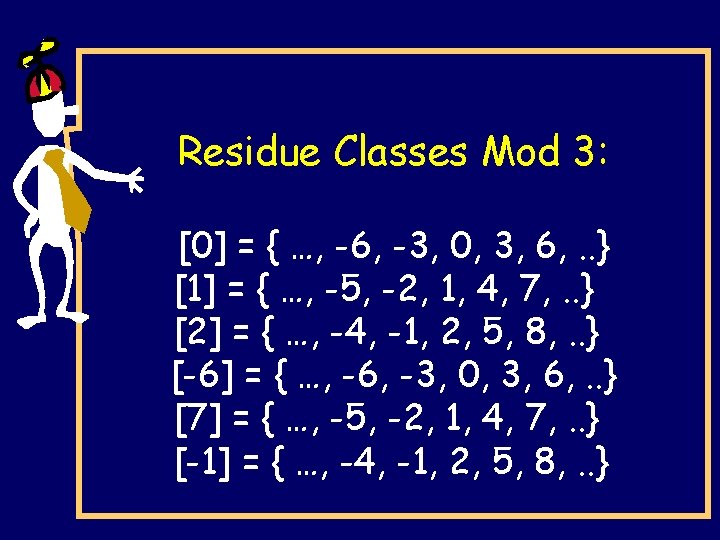
a n b n|(a-b) “a and b are equivalent modulo n” Define Residue class [i] = the set of all integers that are congruent to i modulo n.
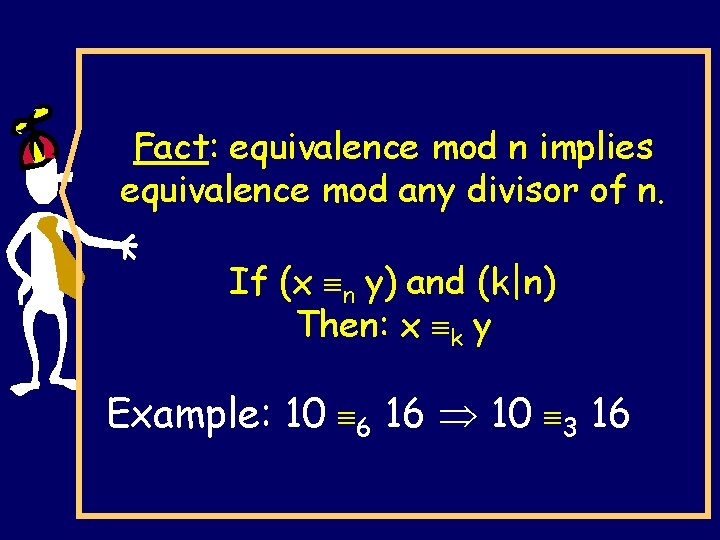
Fact: equivalence mod n implies equivalence mod any divisor of n. If (x n y) and (k|n) Then: x k y Example: 10 6 16 10 3 16
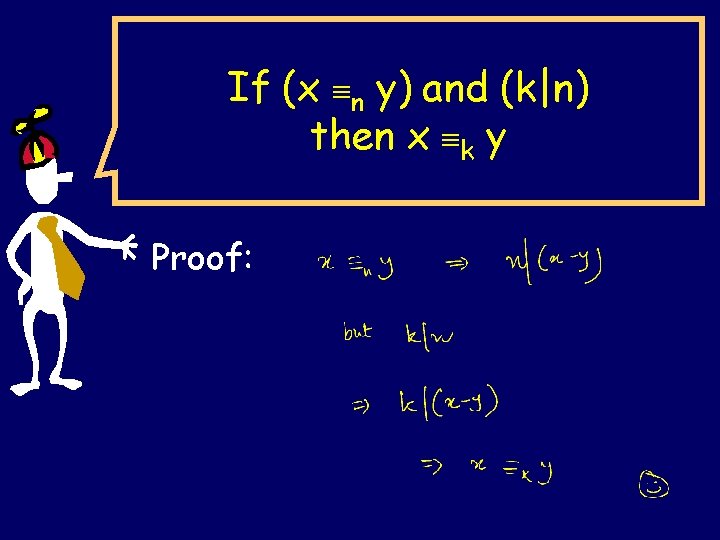
If (x n y) and (k|n) then x k y Proof:
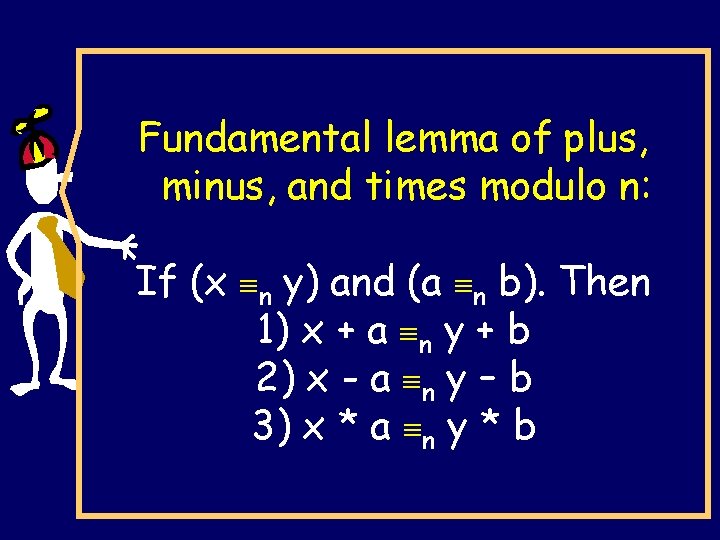
Fundamental lemma of plus, minus, and times modulo n: If (x y) and (a n b). Then 1) x + a n y + b 2) x - a n y – b 3) x * a n y * b n
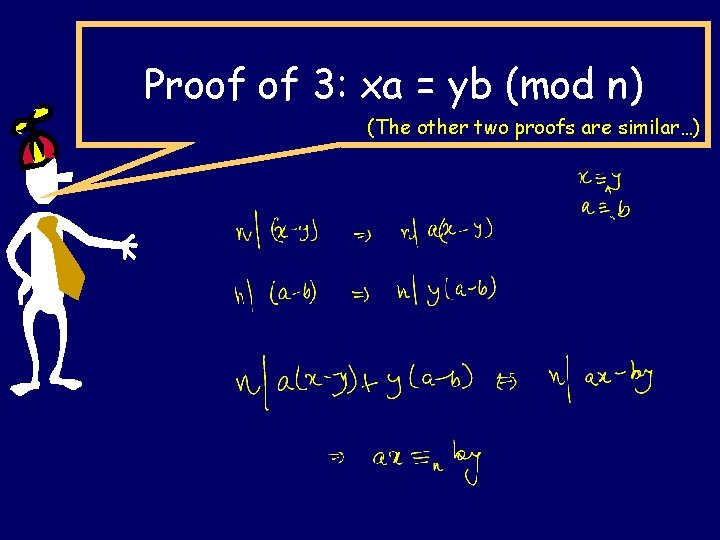
Proof of 3: xa = yb (mod n) (The other two proofs are similar…)
Fundamental lemma of plus minus, and times modulo n: When doing plus, minus, and times modulo n, I can at any time in the calculation replace a number with a number in the same residue class modulo n
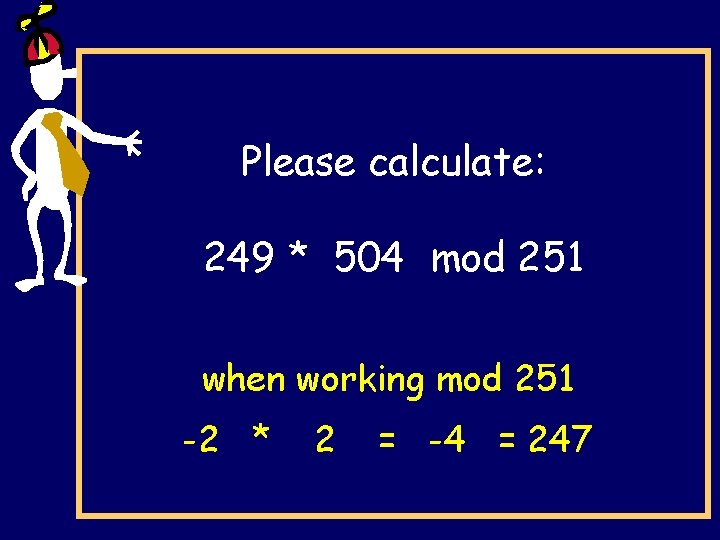
Please calculate: 249 * 504 mod 251 when working mod 251 -2 * 2 = -4 = 247
A Unique Representation System Modulo n: We pick exactly one representative from each residue class. We do all our calculations using these representatives.
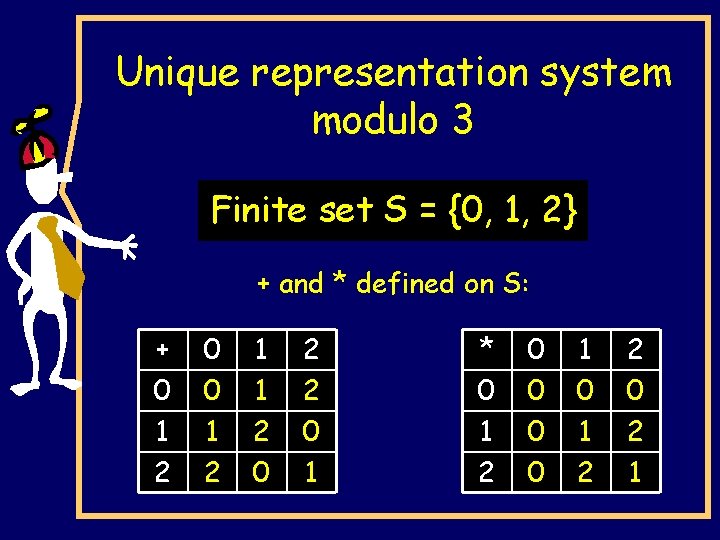
Unique representation system modulo 3 Finite set S = {0, 1, 2} + and * defined on S: + 0 1 2 0 0 1 2 1 1 2 0 2 2 0 1 * 0 1 2 0 0 1 0 1 2 2 0 2 1
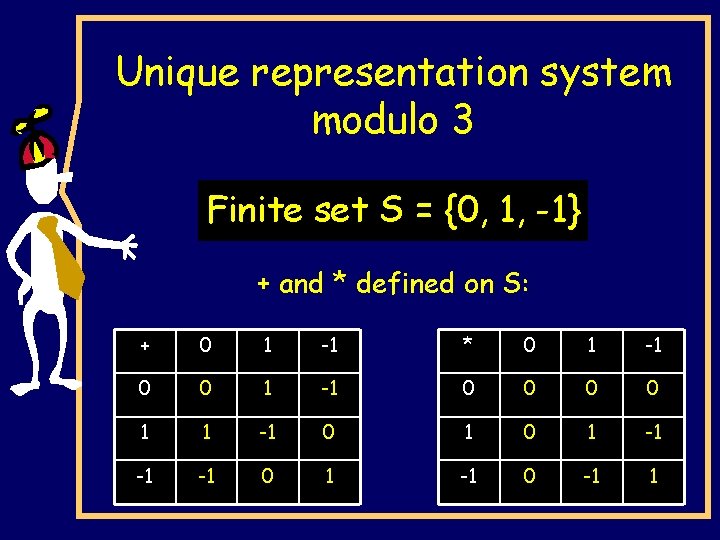
Unique representation system modulo 3 Finite set S = {0, 1, -1} + and * defined on S: + 0 1 -1 * 0 1 -1 0 0 0 0 1 1 -1 0 1 -1 -1 -1 0 -1 1
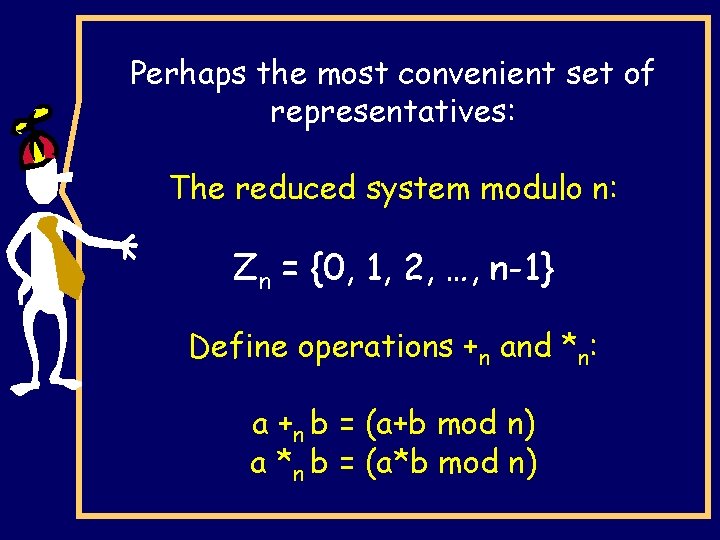
Perhaps the most convenient set of representatives: The reduced system modulo n: Zn = {0, 1, 2, …, n-1} Define operations +n and *n: a +n b = (a+b mod n) a *n b = (a*b mod n)
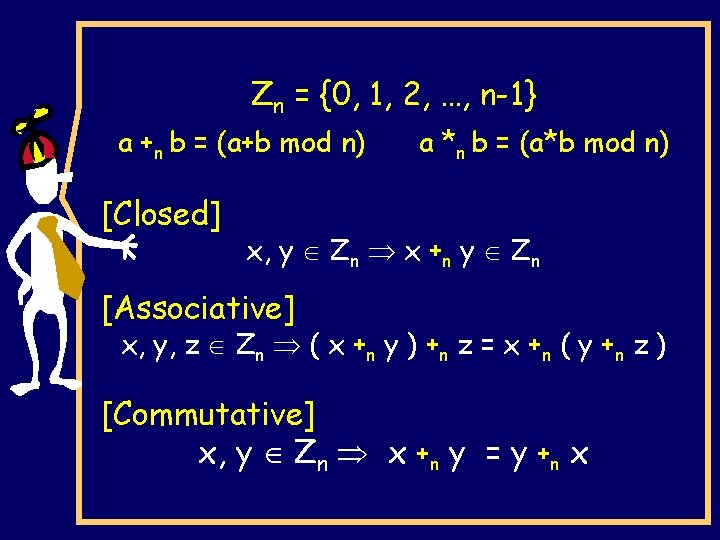
Zn = {0, 1, 2, …, n-1} a +n b = (a+b mod n) [Closed] a *n b = (a*b mod n) x, y Zn x +n y Zn [Associative] x, y, z Zn ( x +n y ) +n z = x +n ( y +n z ) [Commutative] x, y Zn x +n y = y +n x
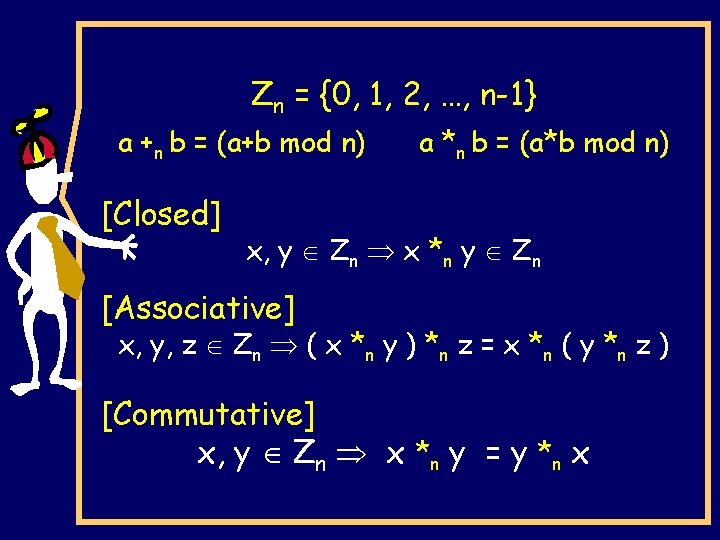
Zn = {0, 1, 2, …, n-1} a +n b = (a+b mod n) [Closed] a *n b = (a*b mod n) x, y Zn x *n y Zn [Associative] x, y, z Zn ( x *n y ) *n z = x *n ( y *n z ) [Commutative] x, y Zn x *n y = y *n x
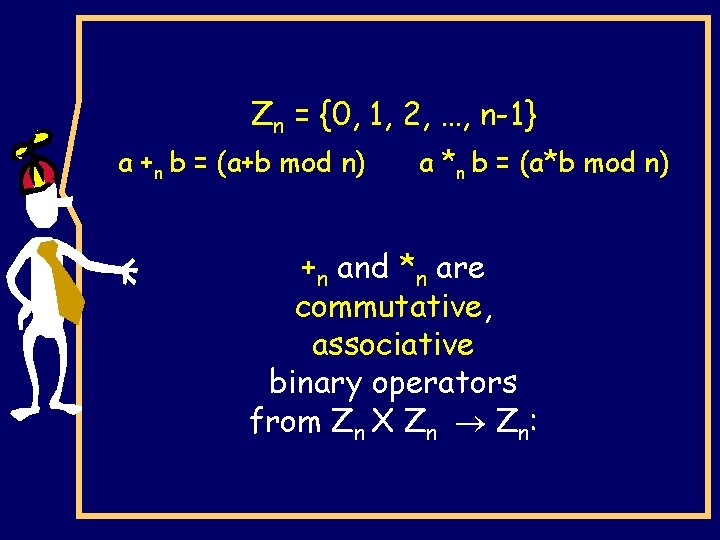
Zn = {0, 1, 2, …, n-1} a +n b = (a+b mod n) a *n b = (a*b mod n) +n and *n are commutative, associative binary operators from Zn X Zn Zn:
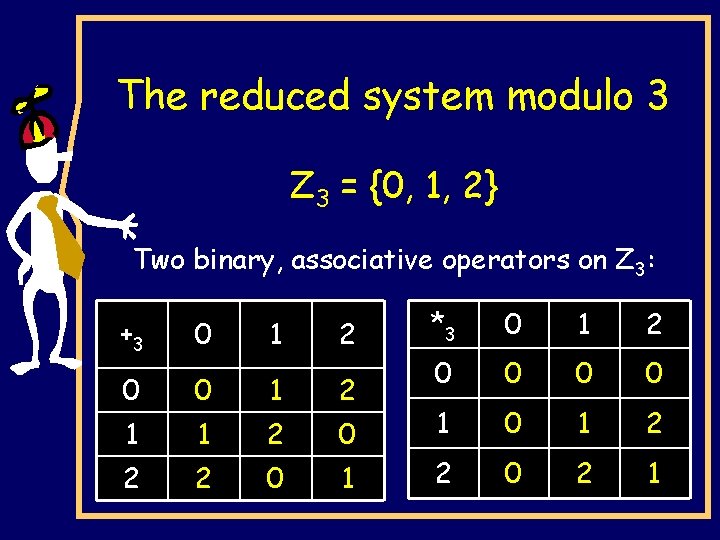
The reduced system modulo 3 Z 3 = {0, 1, 2} Two binary, associative operators on Z 3: 1 *3 0 1 2 0 0 0 1 2 1 2 0 2 1 +3 0 2 0 0 1 2 1 1 2 2 2 0
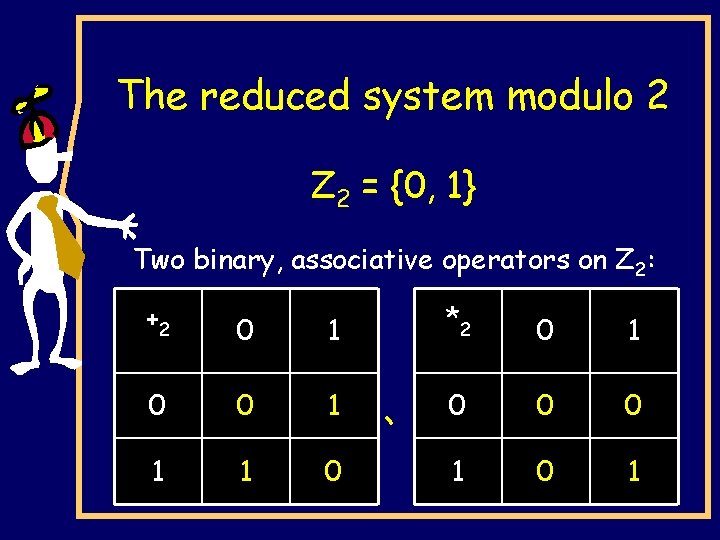
The reduced system modulo 2 Z 2 = {0, 1} Two binary, associative operators on Z 2: +2 0 1 *2 0 1 0 0 0 1 1 0 1 `
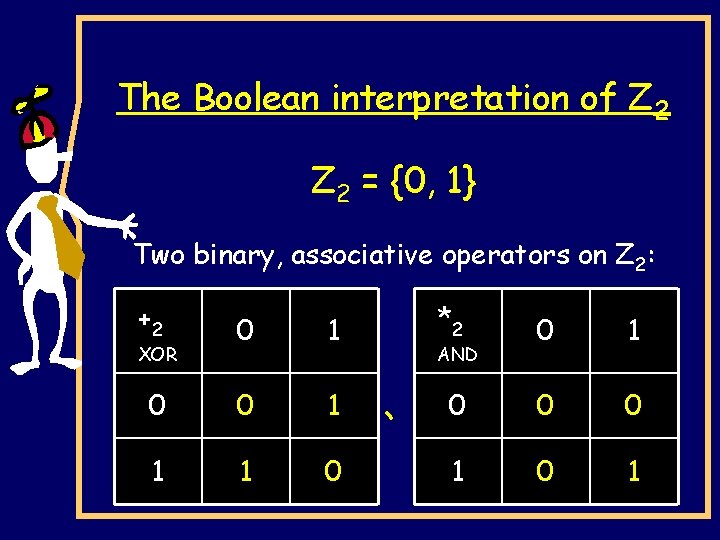
The Boolean interpretation of Z 2 = {0, 1} Two binary, associative operators on Z 2: +2 0 1 *2 0 1 0 0 0 1 1 0 1 XOR AND `
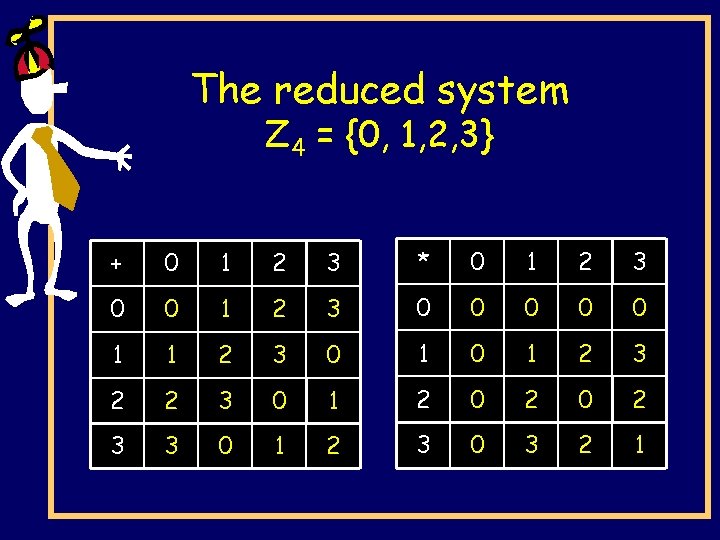
The reduced system Z 4 = {0, 1, 2, 3} + 0 1 2 3 * 0 1 2 3 0 0 0 1 1 2 3 0 1 2 3 2 2 3 0 1 2 0 2 3 3 0 1 2 3 0 3 2 1
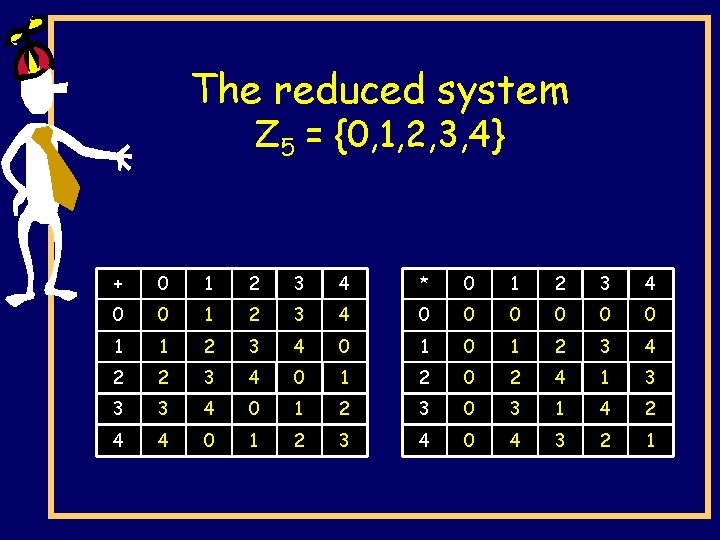
The reduced system Z 5 = {0, 1, 2, 3, 4} + 0 1 2 3 4 * 0 1 2 3 4 0 0 0 0 1 1 2 3 4 0 1 2 3 4 2 2 3 4 0 1 2 0 2 4 1 3 3 3 4 0 1 2 3 0 3 1 4 2 4 4 0 1 2 3 4 0 4 3 2 1
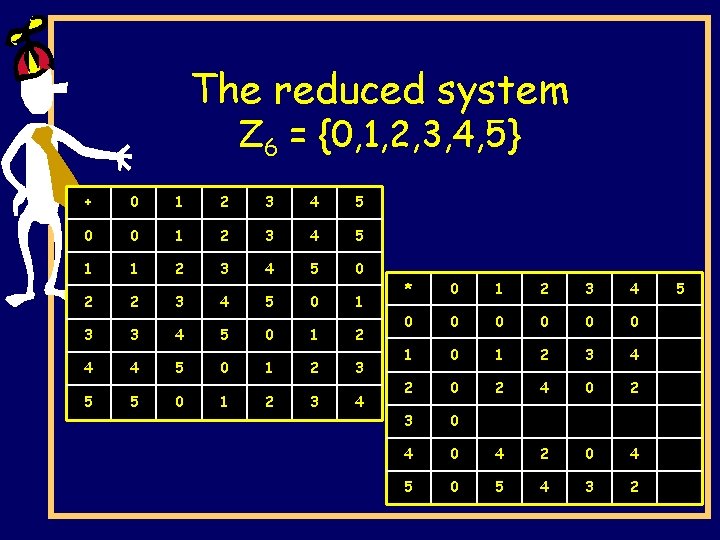
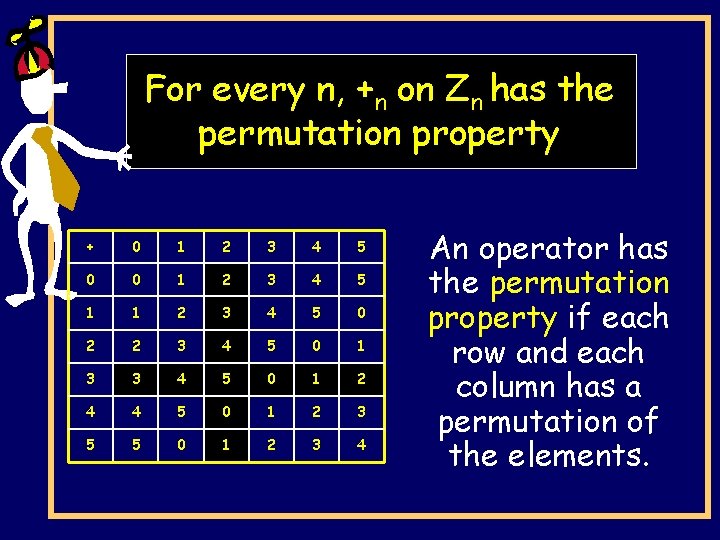
The reduced system Z 6 = {0, 1, 2, 3, 4, 5} + 0 1 2 3 4 5 0 0 1 2 3 4 5 1 1 2 3 4 5 0 2 2 3 4 5 0 1 3 3 4 5 0 1 2 4 4 5 0 1 2 3 5 5 0 1 2 3 4 * 0 1 2 3 4 0 0 0 1 0 1 2 3 4 2 0 2 4 0 2 3 0 4 2 0 4 5 0 5 4 3 2 5
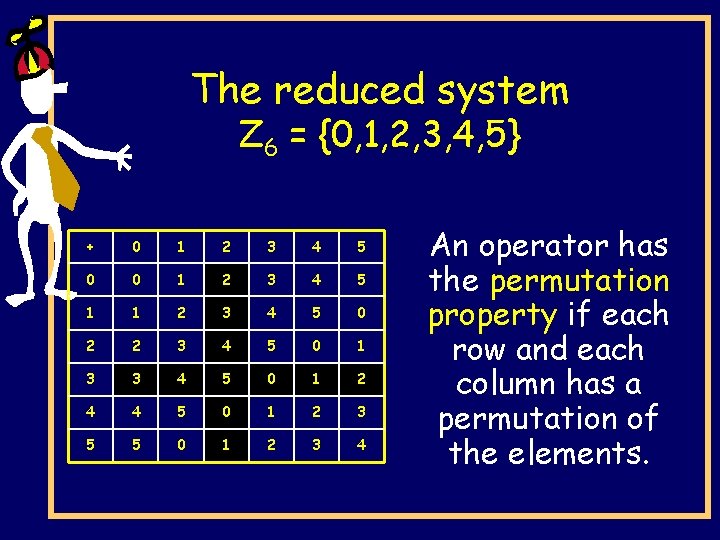
The reduced system Z 6 = {0, 1, 2, 3, 4, 5} + 0 1 2 3 4 5 0 0 1 2 3 4 5 1 1 2 3 4 5 0 2 2 3 4 5 0 1 3 3 4 5 0 1 2 4 4 5 0 1 2 3 5 5 0 1 2 3 4 An operator has the permutation property if each row and each column has a permutation of the elements.
For every n, +n on Zn has the permutation property + 0 1 2 3 4 5 0 0 1 2 3 4 5 1 1 2 3 4 5 0 2 2 3 4 5 0 1 3 3 4 5 0 1 2 4 4 5 0 1 2 3 5 5 0 1 2 3 4 An operator has the permutation property if each row and each column has a permutation of the elements.
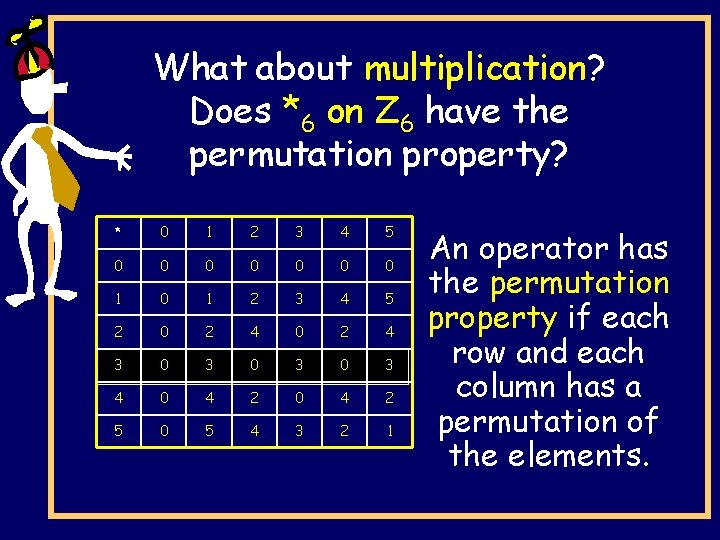
What about multiplication? Does *6 on Z 6 have the permutation property? * 0 1 2 3 4 5 0 0 0 0 1 2 3 4 5 2 0 2 4 3 0 3 0 3 4 0 4 2 5 0 5 4 3 2 1 An operator has the permutation property if each row and each column has a permutation of the elements.
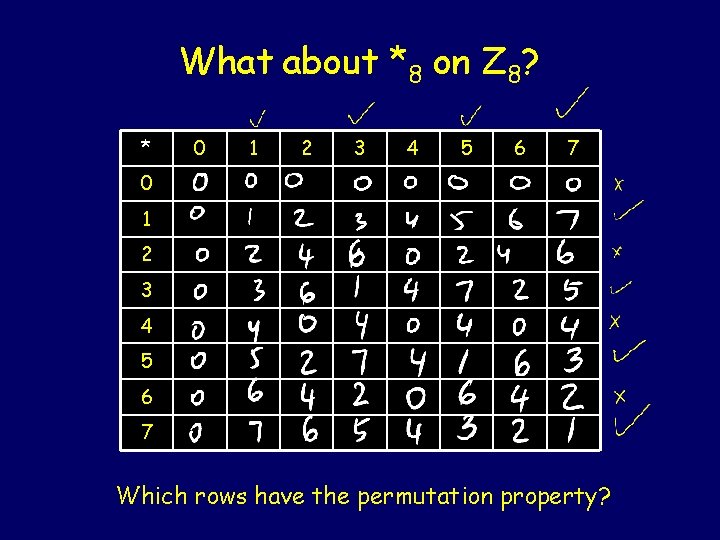
What about *8 on Z 8? * 0 1 2 3 4 5 6 7 Which rows have the permutation property?
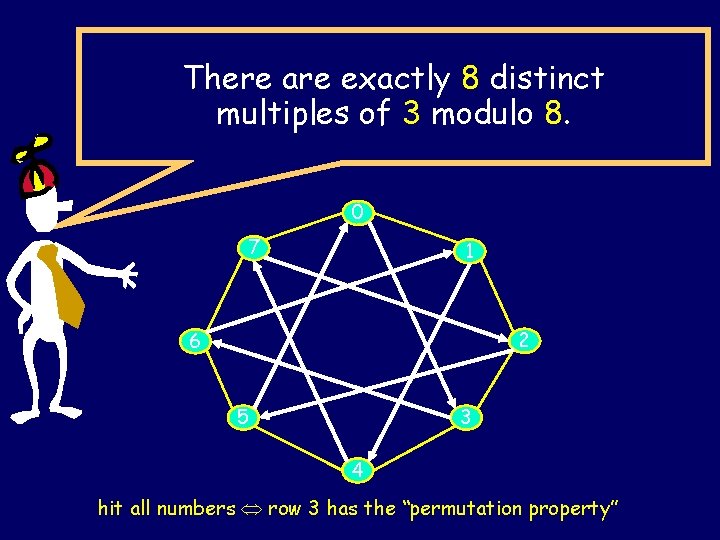
There are exactly 8 distinct multiples of 3 modulo 8. 0 7 1 2 6 5 3 4 hit all numbers row 3 has the “permutation property”
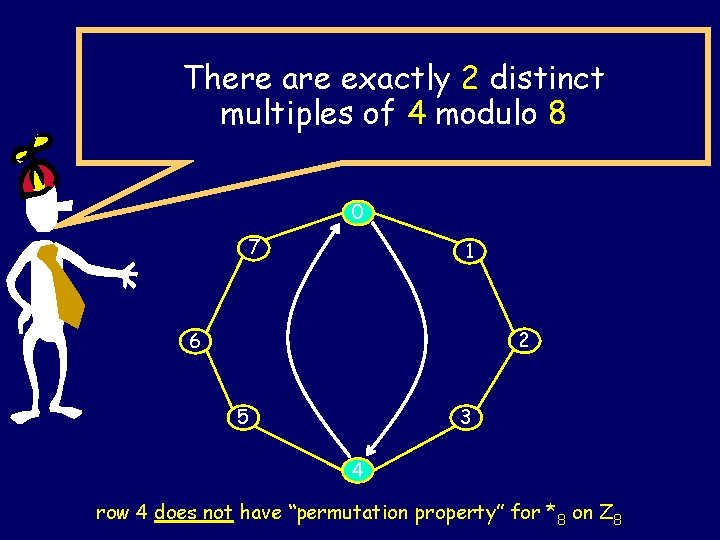
There are exactly 2 distinct multiples of 4 modulo 8 0 7 1 2 6 5 3 4 row 4 does not have “permutation property” for *8 on Z 8
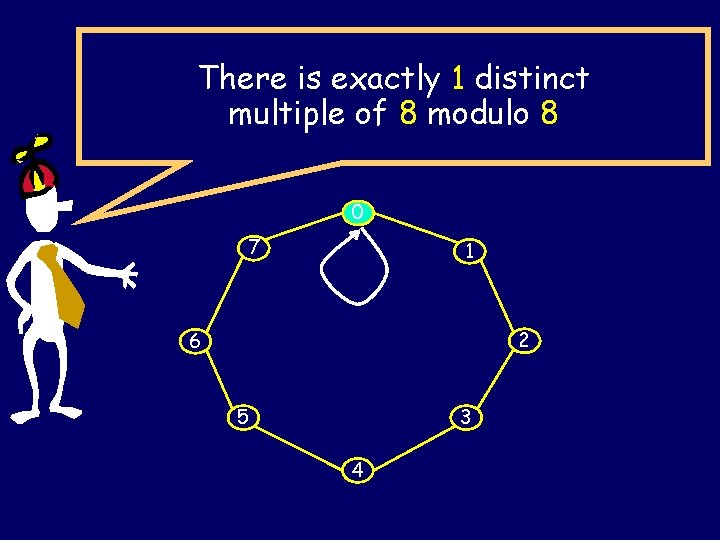
There is exactly 1 distinct multiple of 8 modulo 8 0 7 1 2 6 5 3 4
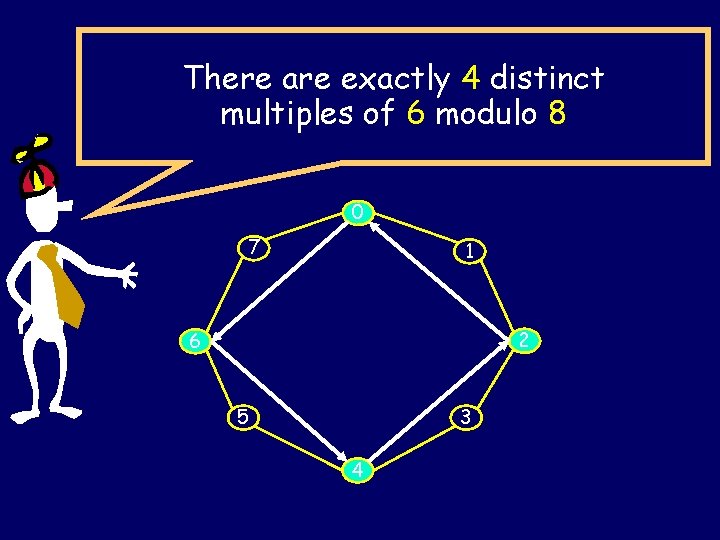
There are exactly 4 distinct multiples of 6 modulo 8 0 7 1 2 6 5 3 4
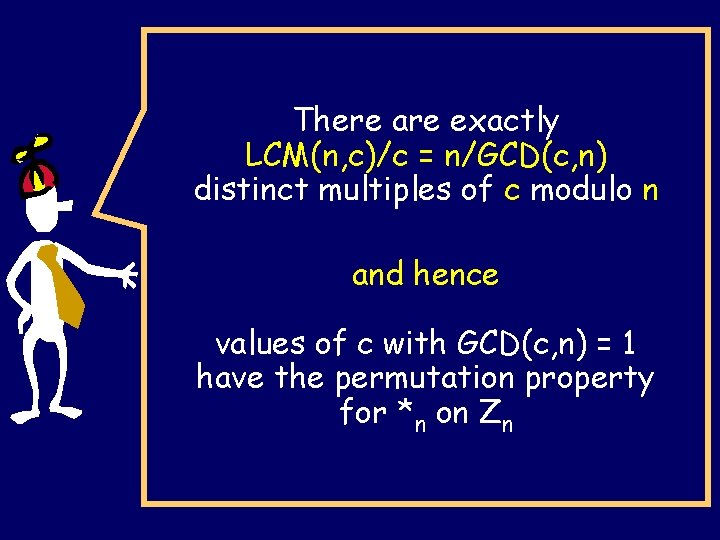
There are exactly LCM(n, c)/c = n/GCD(c, n) distinct multiples of c modulo n and hence values of c with GCD(c, n) = 1 have the permutation property for *n on Zn
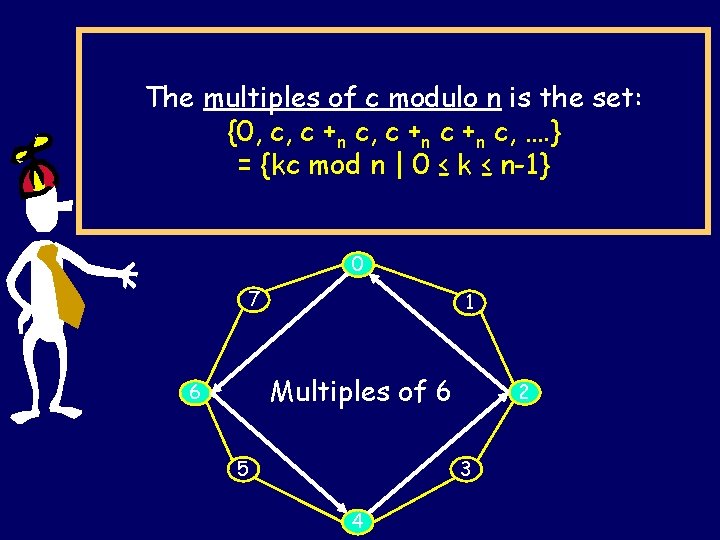
The multiples of c modulo n is the set: {0, c, c +n c, …. } = {kc mod n | 0 ≤ k ≤ n-1} 0 7 1 Multiples of 6 6 5 2 3 4
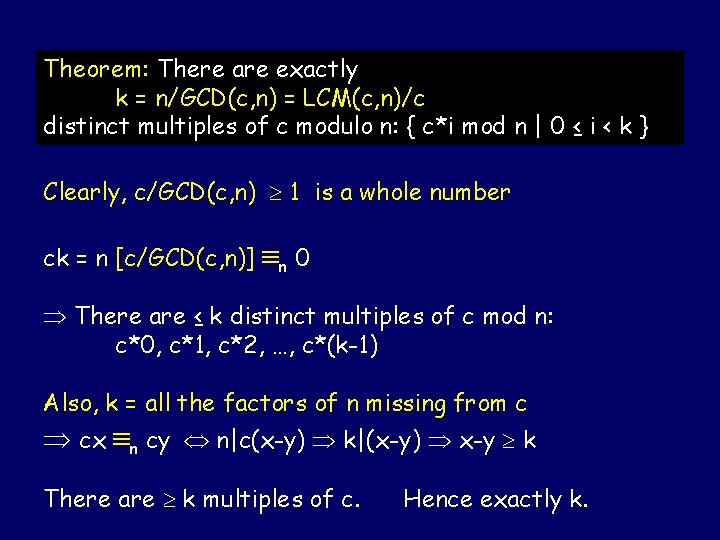
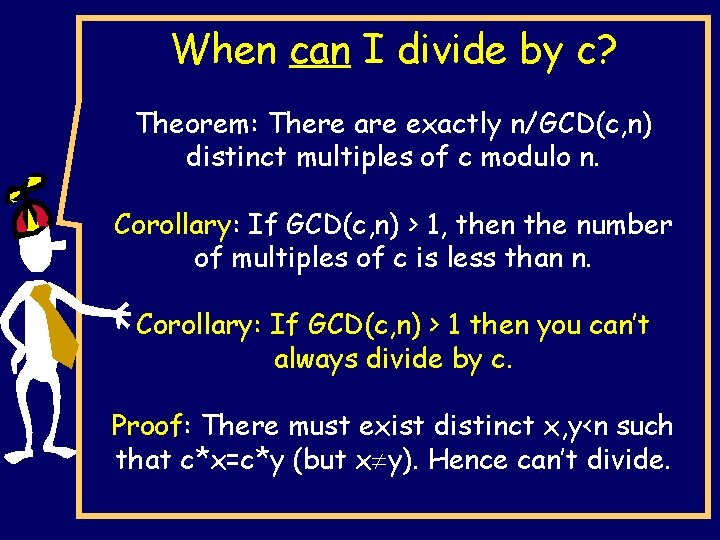
Theorem: There are exactly k = n/GCD(c, n) = LCM(c, n)/c distinct multiples of c modulo n: { c*i mod n | 0 ≤ i < k } Clearly, c/GCD(c, n) 1 is a whole number ck = n [c/GCD(c, n)] n 0 There are ≤ k distinct multiples of c mod n: c*0, c*1, c*2, …, c*(k-1) Also, k = all the factors of n missing from c cx n cy n|c(x-y) k|(x-y) x-y k There are k multiples of c. Hence exactly k.
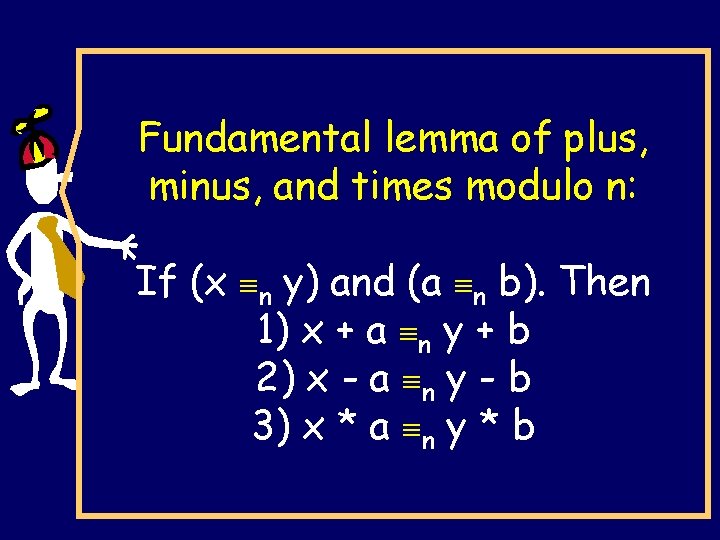
Fundamental lemma of plus, minus, and times modulo n: If (x y) and (a n b). Then 1) x + a n y + b 2) x - a n y - b 3) x * a n y * b n
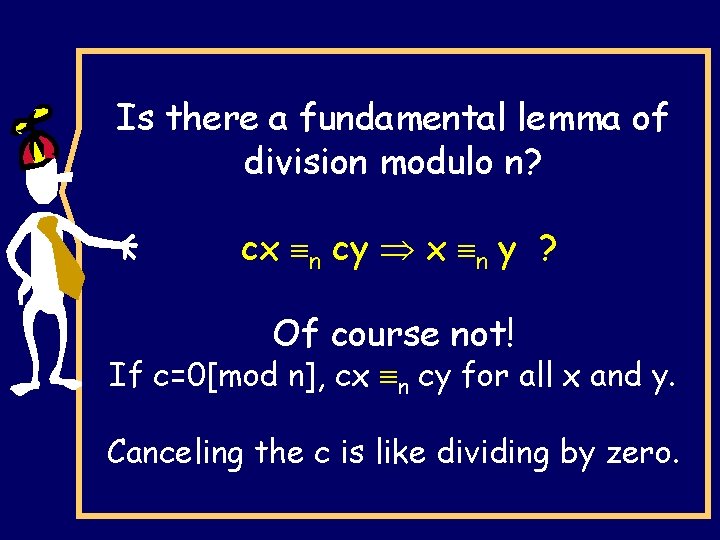
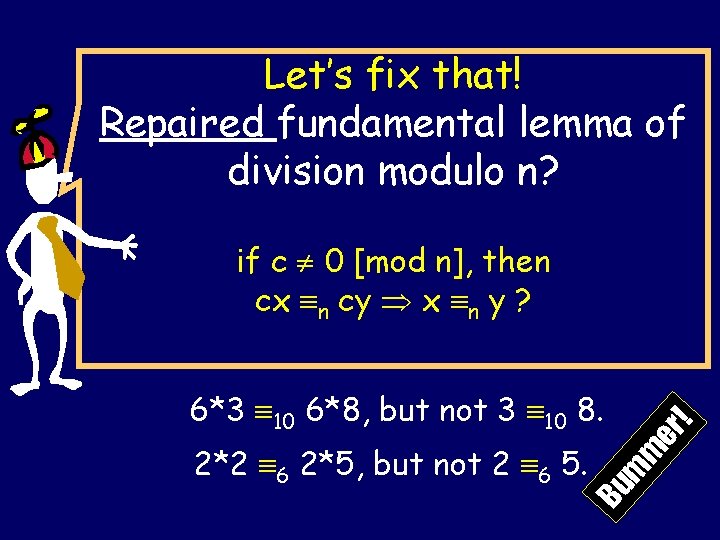
Is there a fundamental lemma of division modulo n? cx n cy x n y ? Of course not! If c=0[mod n], cx n cy for all x and y. Canceling the c is like dividing by zero.
Let’s fix that! Repaired fundamental lemma of division modulo n? if c 0 [mod n], then cx n cy x n y ? er m m Bu 2*2 6 2*5, but not 2 6 5. ! 6*3 10 6*8, but not 3 10 8.
When can I divide by c? Theorem: There are exactly n/GCD(c, n) distinct multiples of c modulo n. Corollary: If GCD(c, n) > 1, then the number of multiples of c is less than n. Corollary: If GCD(c, n) > 1 then you can’t always divide by c. Proof: There must exist distinct x, y<n such that c*x=c*y (but x y). Hence can’t divide.
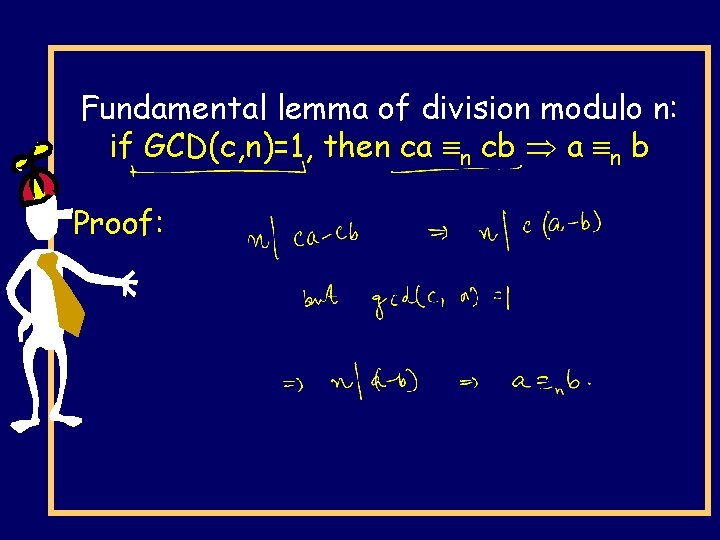
Fundamental lemma of division modulo n: if GCD(c, n)=1, then ca n cb a n b Proof:
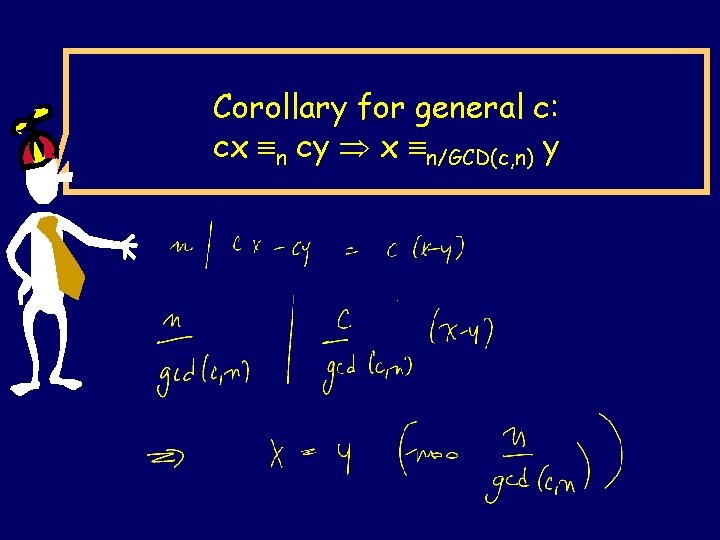
Corollary for general c: cx n cy x n/GCD(c, n) y
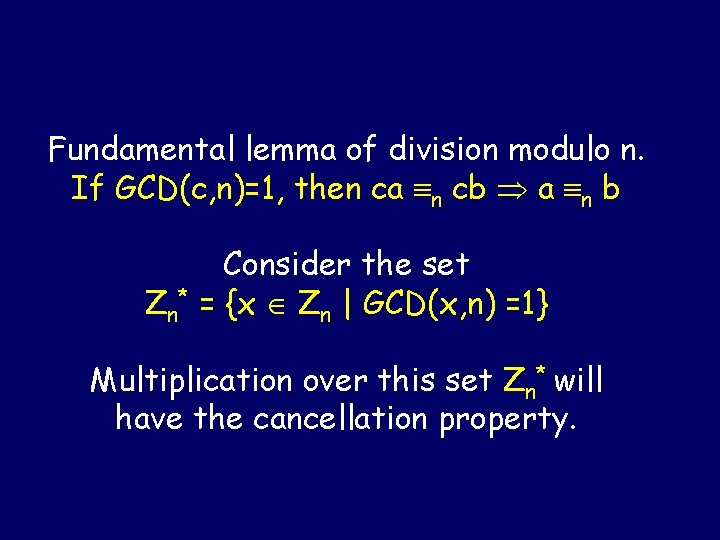
Fundamental lemma of division modulo n. If GCD(c, n)=1, then ca n cb a n b Consider the set Zn* = {x Zn | GCD(x, n) =1} Multiplication over this set Zn* will have the cancellation property.
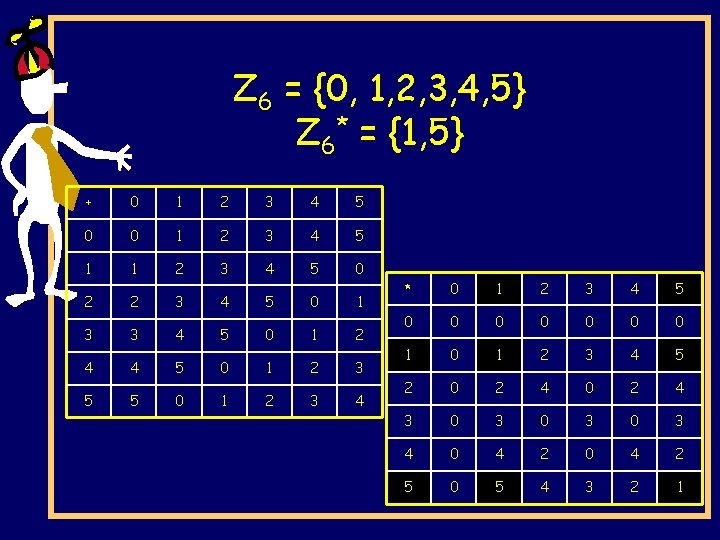
Z 6 = {0, 1, 2, 3, 4, 5} Z 6* = {1, 5} + 0 1 2 3 4 5 0 0 1 2 3 4 5 1 1 2 3 4 5 0 2 2 3 4 5 0 1 3 3 4 5 0 1 2 4 4 5 0 1 2 3 5 5 0 1 2 3 4 * 0 1 2 3 4 5 0 0 0 0 1 2 3 4 5 2 0 2 4 3 0 3 0 3 4 0 4 2 5 0 5 4 3 2 1
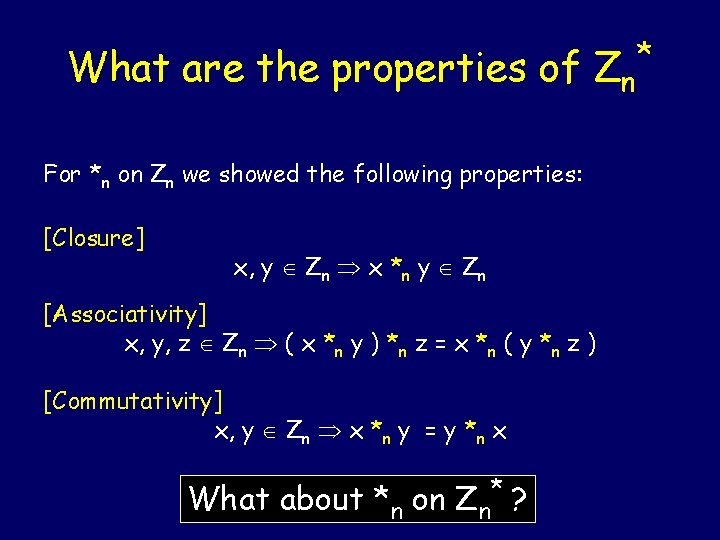
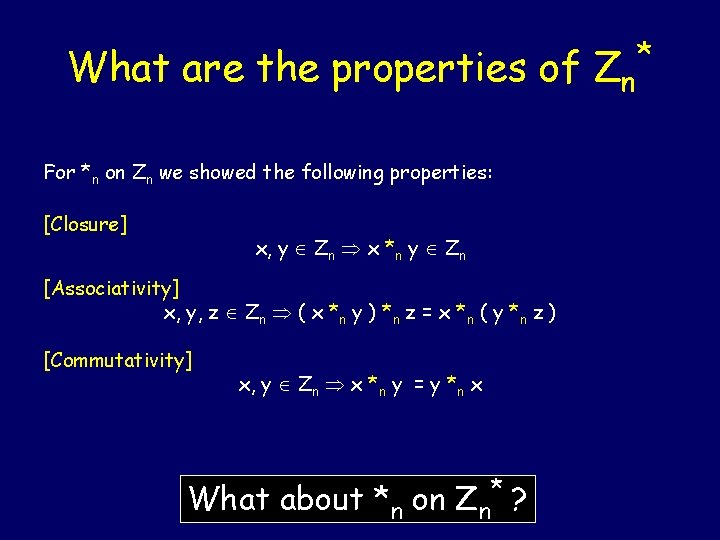
What are the properties of Zn For *n on Zn we showed the following properties: [Closure] x, y Zn x *n y Zn [Associativity] x, y, z Zn ( x *n y ) *n z = x *n ( y *n z ) [Commutativity] x, y Zn x *n y = y *n x What about *n on Zn* ? *
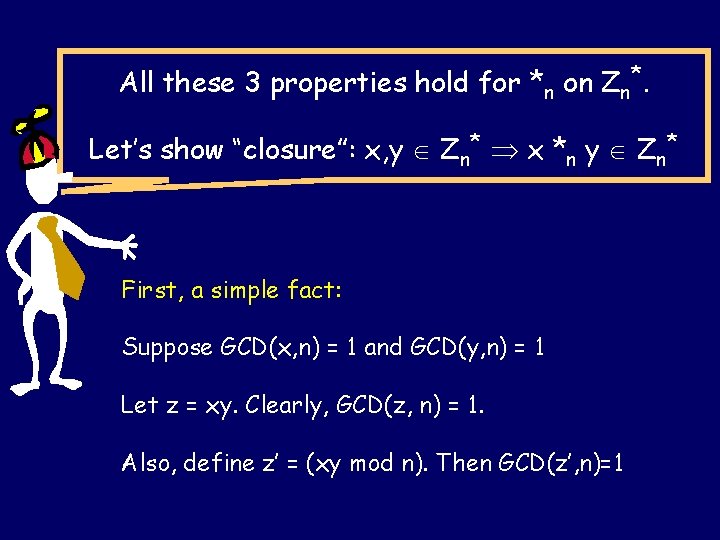
All these 3 properties hold for *n on Zn*. Let’s show “closure”: x, y Zn* x *n y Zn* First, a simple fact: Suppose GCD(x, n) = 1 and GCD(y, n) = 1 Let z = xy. Clearly, GCD(z, n) = 1. Also, define z’ = (xy mod n). Then GCD(z’, n)=1
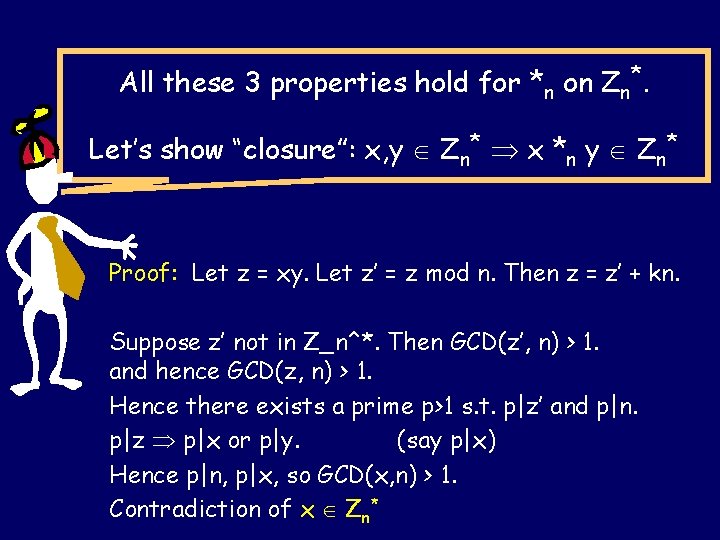
All these 3 properties hold for *n on Zn*. Let’s show “closure”: x, y Zn* x *n y Zn* Proof: Let z = xy. Let z’ = z mod n. Then z = z’ + kn. Suppose z’ not in Z_n^*. Then GCD(z’, n) > 1. and hence GCD(z, n) > 1. Hence there exists a prime p>1 s. t. p|z’ and p|n. p|z p|x or p|y. (say p|x) Hence p|n, p|x, so GCD(x, n) > 1. Contradiction of x Zn*
What are the properties of Zn For *n on Zn we showed the following properties: [Closure] x, y Zn x *n y Zn [Associativity] x, y, z Zn ( x *n y ) *n z = x *n ( y *n z ) [Commutativity] x, y Zn x *n y = y *n x What about *n on Zn* ? *
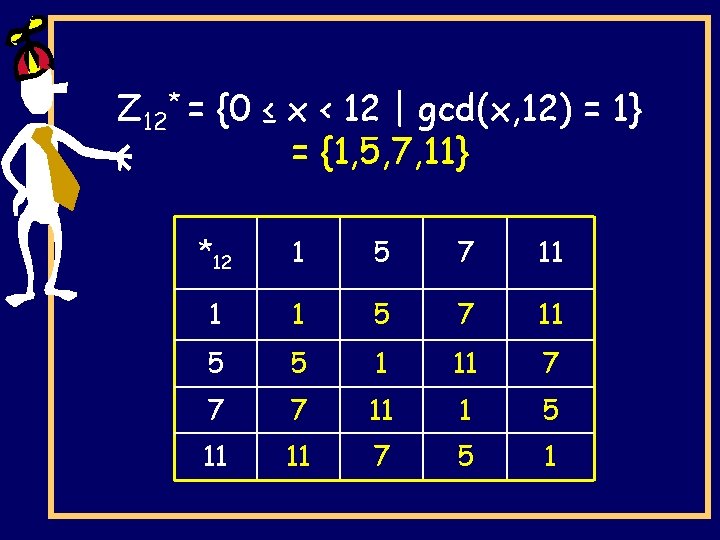
Z 12* = {0 ≤ x < 12 | gcd(x, 12) = 1} = {1, 5, 7, 11} *12 1 5 7 11 1 1 5 7 11 5 5 1 11 7 7 7 11 1 5 11 11 7 5 1
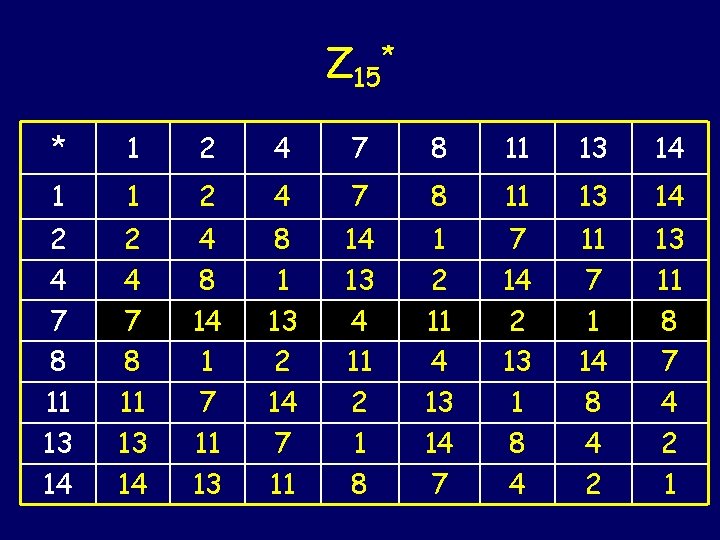
Z 15* * 1 2 4 7 8 11 13 14 1 1 2 4 7 8 11 13 14 4 8 14 1 7 11 13 8 1 13 2 14 7 11 14 13 4 11 2 1 8 1 2 11 4 13 14 7 7 14 2 13 1 8 4 11 7 1 14 8 4 2 13 11 8 7 4 2 1
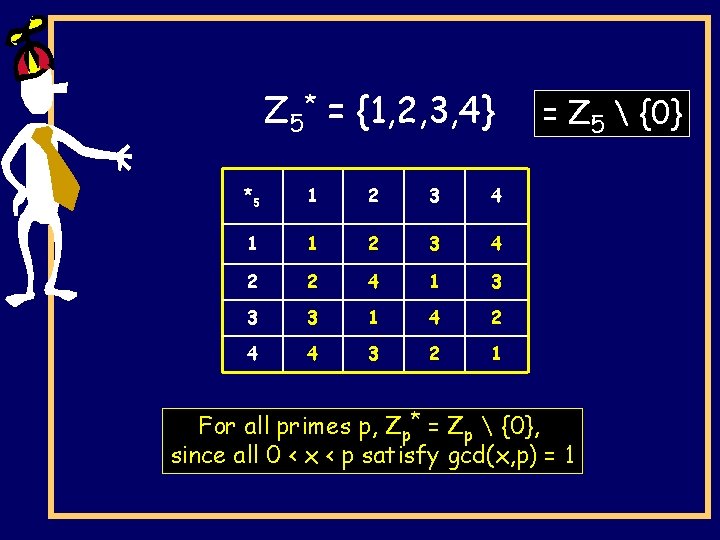
Z 5* = {1, 2, 3, 4} *5 1 2 3 4 1 1 2 3 4 2 2 4 1 3 3 3 1 4 2 4 4 3 2 1 = Z 5 {0} For all primes p, Zp* = Zp {0}, since all 0 < x < p satisfy gcd(x, p) = 1
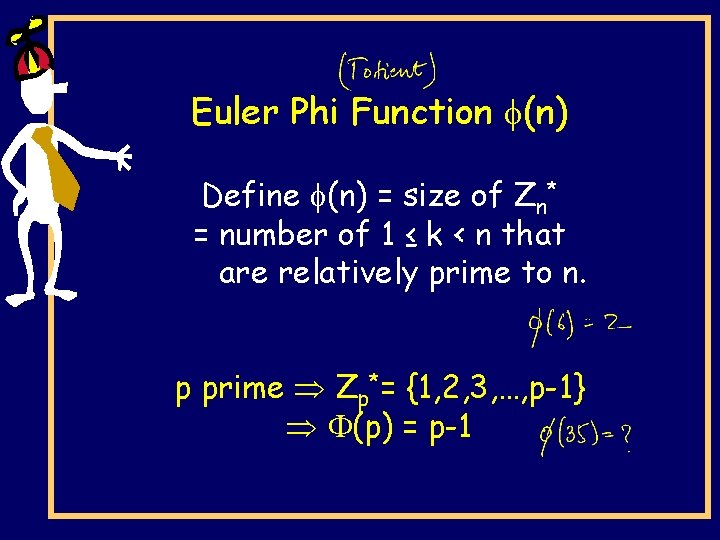
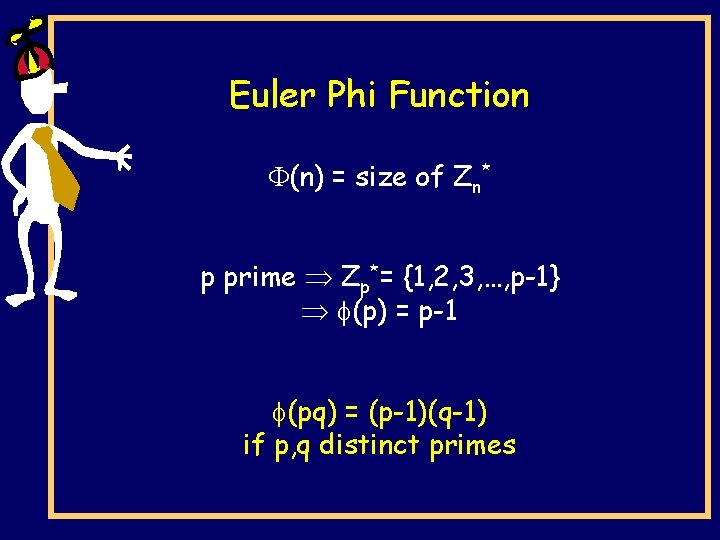
Euler Phi Function (n) Define (n) = size of Zn* = number of 1 ≤ k < n that are relatively prime to n. p prime Zp*= {1, 2, 3, …, p-1} (p) = p-1
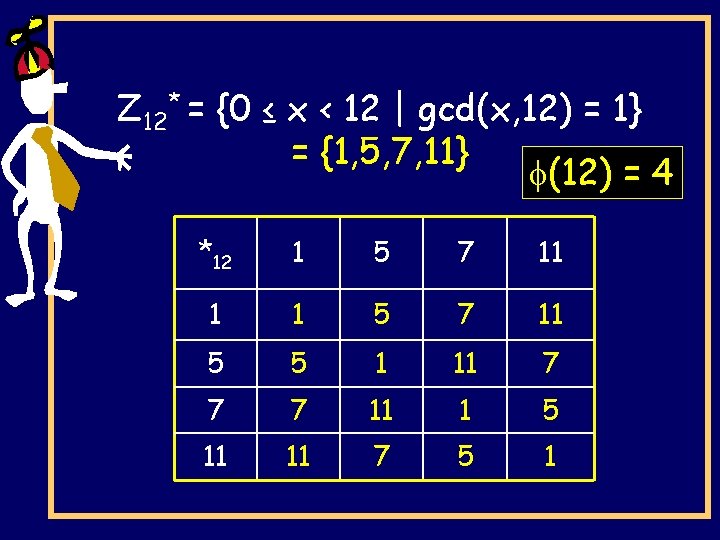
Z 12* = {0 ≤ x < 12 | gcd(x, 12) = 1} = {1, 5, 7, 11} (12) = 4 *12 1 5 7 11 1 1 5 7 11 5 5 1 11 7 7 7 11 1 5 11 11 7 5 1
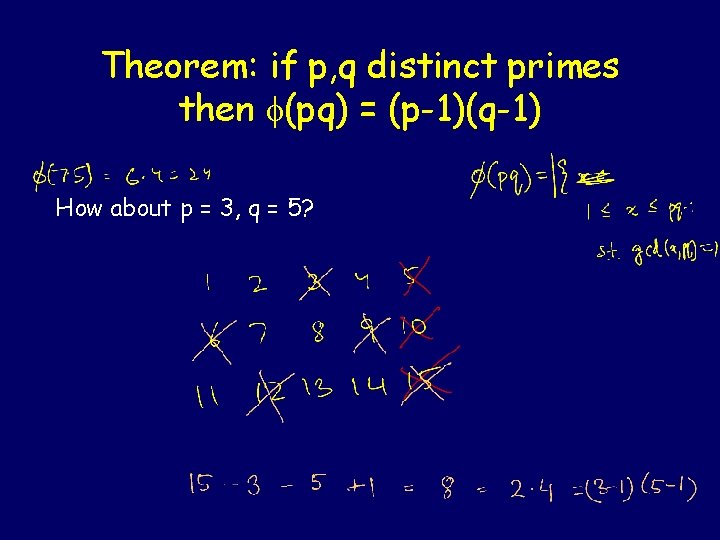
Theorem: if p, q distinct primes then (pq) = (p-1)(q-1) How about p = 3, q = 5?
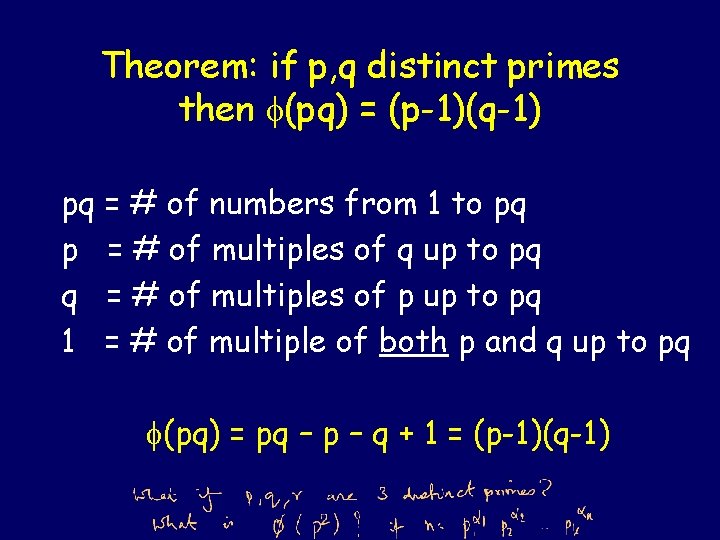
Theorem: if p, q distinct primes then (pq) = (p-1)(q-1) pq = # of numbers from 1 to pq p = # of multiples of q up to pq q = # of multiples of p up to pq 1 = # of multiple of both p and q up to pq (pq) = pq – p – q + 1 = (p-1)(q-1)
Additive and Multiplicative Inverses
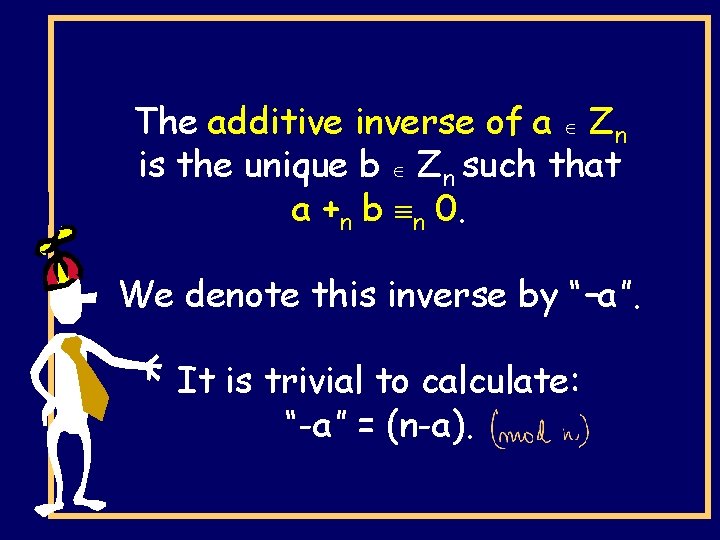
The additive inverse of a Zn is the unique b Zn such that a +n b n 0. We denote this inverse by “–a”. It is trivial to calculate: “-a” = (n-a).
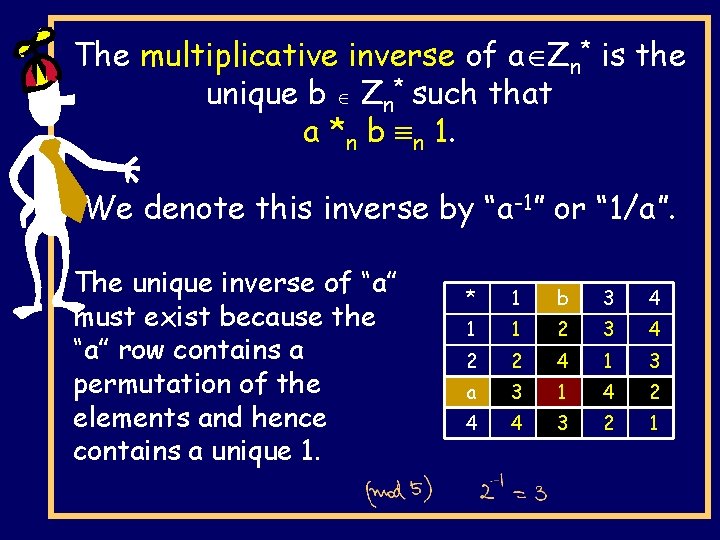
The multiplicative inverse of a Zn* is the unique b Zn* such that a *n b n 1. We denote this inverse by “a-1” or “ 1/a”. The unique inverse of “a” must exist because the “a” row contains a permutation of the elements and hence contains a unique 1. * 1 b 3 4 1 1 2 3 4 2 2 4 1 3 a 3 1 4 2 4 4 3 2 1
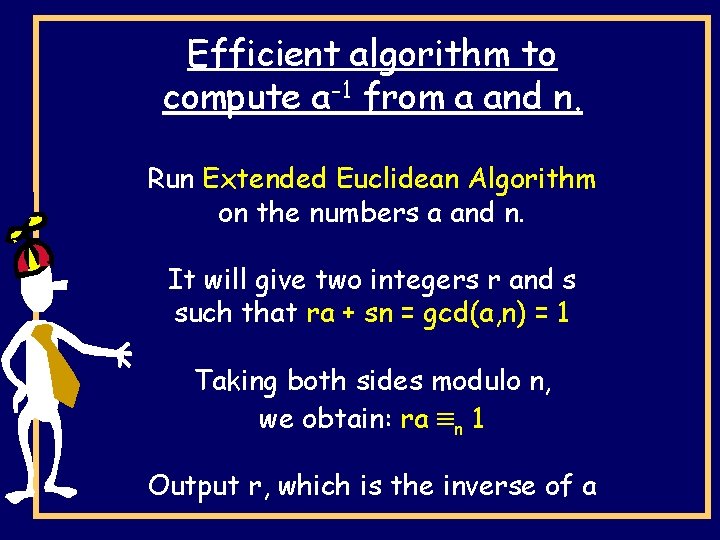
Efficient algorithm to compute a-1 from a and n. Run Extended Euclidean Algorithm on the numbers a and n. It will give two integers r and s such that ra + sn = gcd(a, n) = 1 Taking both sides modulo n, we obtain: ra n 1 Output r, which is the inverse of a
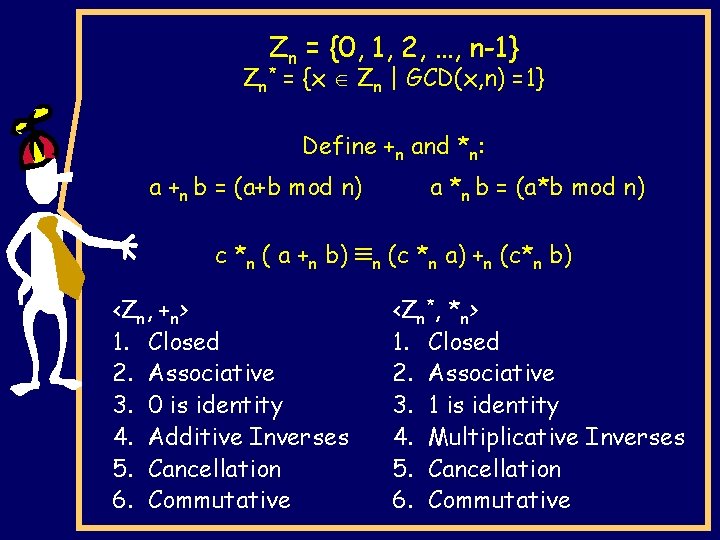
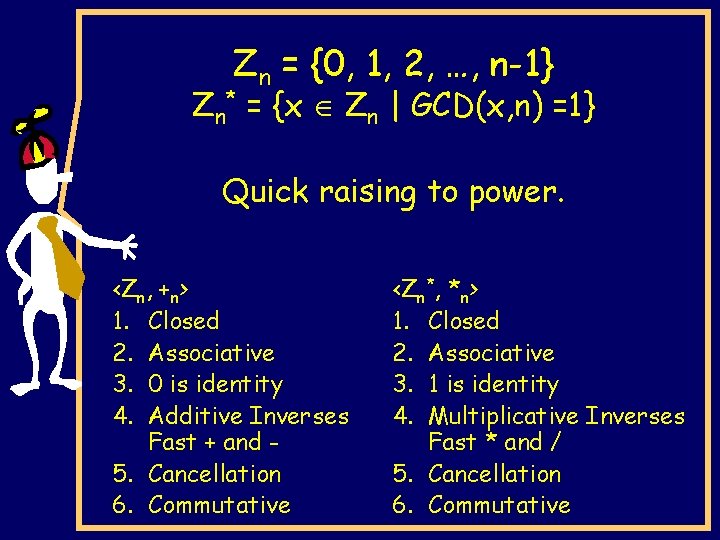
Zn = {0, 1, 2, …, n-1} Zn* = {x Zn | GCD(x, n) =1} Define +n and *n: a +n b = (a+b mod n) c *n ( a +n b) <Zn, +n> 1. Closed 2. Associative 3. 0 is identity 4. Additive Inverses 5. Cancellation 6. Commutative a *n b = (a*b mod n) n (c *n a) +n (c*n b) <Zn*, *n> 1. Closed 2. Associative 3. 1 is identity 4. Multiplicative Inverses 5. Cancellation 6. Commutative
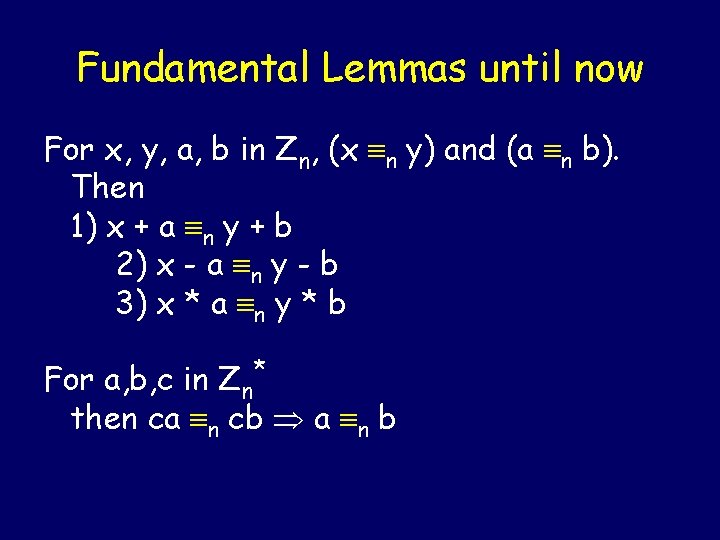
Fundamental Lemmas until now For x, y, a, b in Zn, (x n y) and (a n b). Then 1) x + a n y + b 2) x - a n y - b 3) x * a n y * b For a, b, c in Zn* then ca n cb a n b
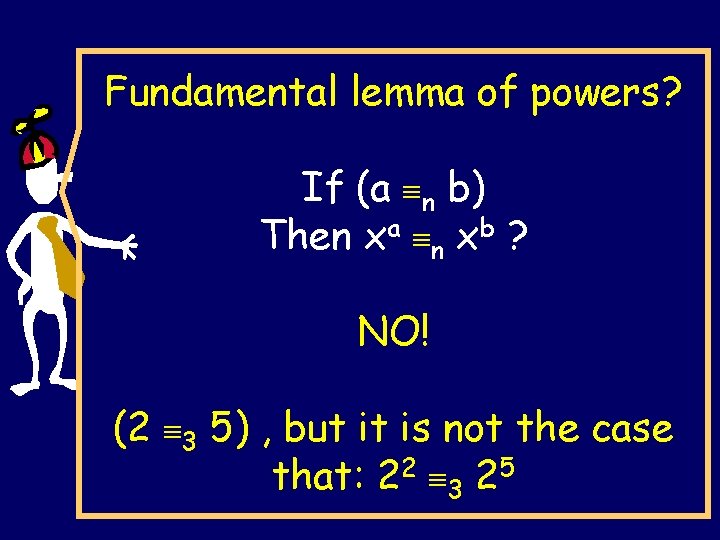
Fundamental lemma of powers? If (a n b) Then xa n xb ? NO! (2 3 5) , but it is not the case that: 22 3 25
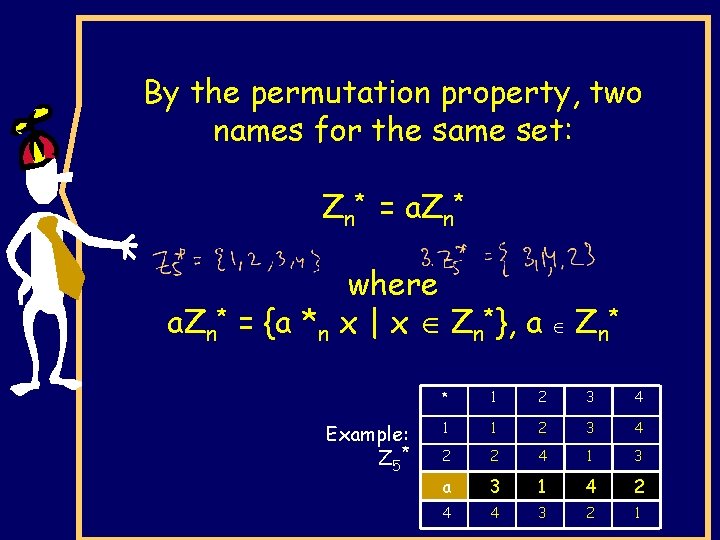
By the permutation property, two names for the same set: Zn* = a. Zn* where a. Zn* = {a *n x | x Zn*}, a Example: Z 5* Z n* * 1 2 3 4 1 1 2 3 4 2 2 4 1 3 a 3 1 4 2 4 4 3 2 1
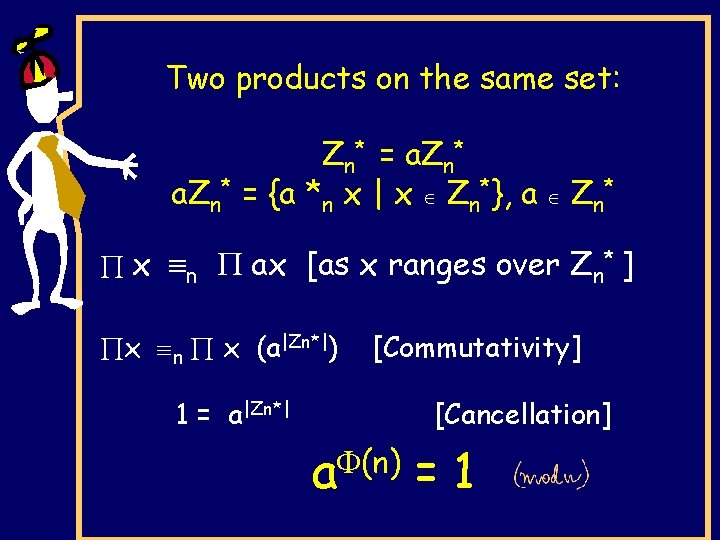
Two products on the same set: Zn* = a. Zn* = {a *n x | x Zn*}, a Z n* x n ax [as x ranges over Zn* ] x n x (a|Zn*|) 1 = a|Zn*| [Commutativity] [Cancellation] a (n) = 1
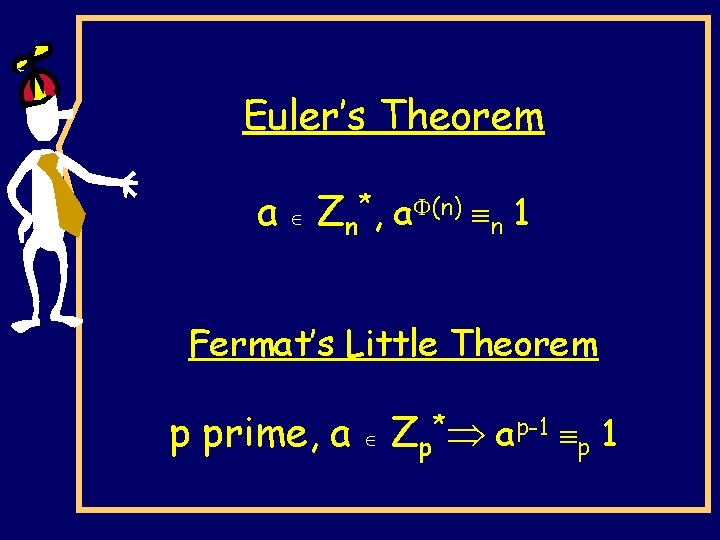
Euler’s Theorem a Zn*, a (n) n 1 Fermat’s Little Theorem p prime, a Zp* ap-1 p 1
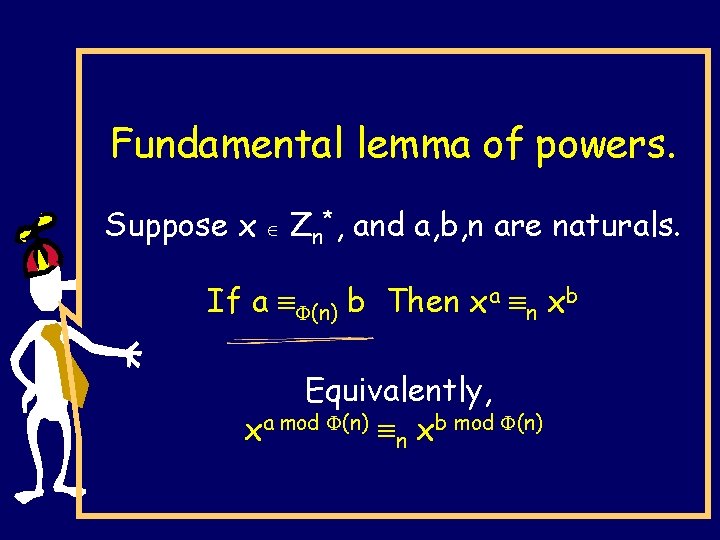
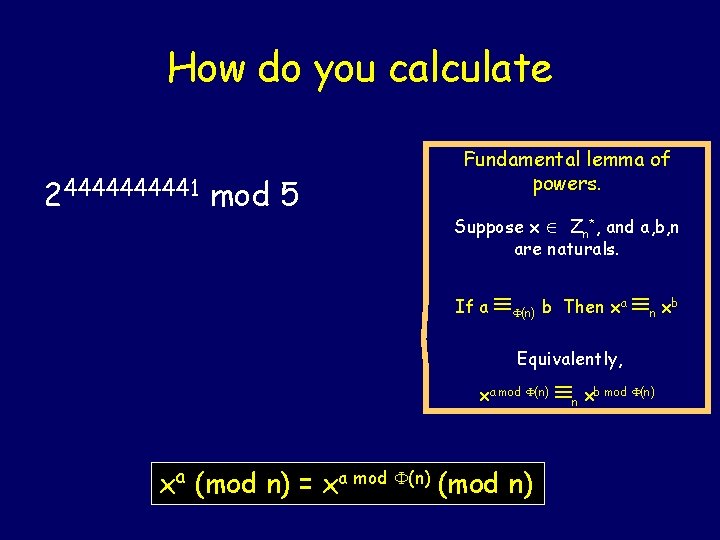
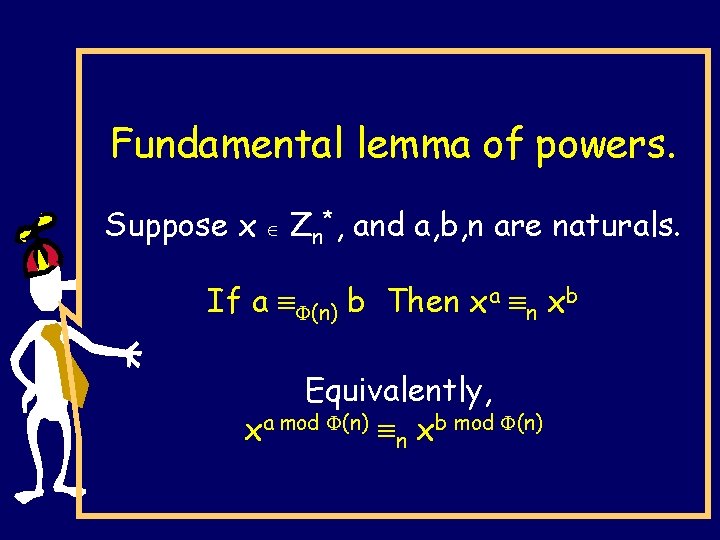
Fundamental lemma of powers. Suppose x Zn*, and a, b, n are naturals. If a (n) b Then xa n xb Equivalently, xa mod (n) n xb mod (n)
How do you calculate 2444441 mod 5 Fundamental lemma of powers. Suppose x Zn*, and a, b, n are naturals. If a (n) b Then xa n Equivalently, xa mod (n) xa (mod n) = xa mod (n) (mod n) n xb mod (n) xb
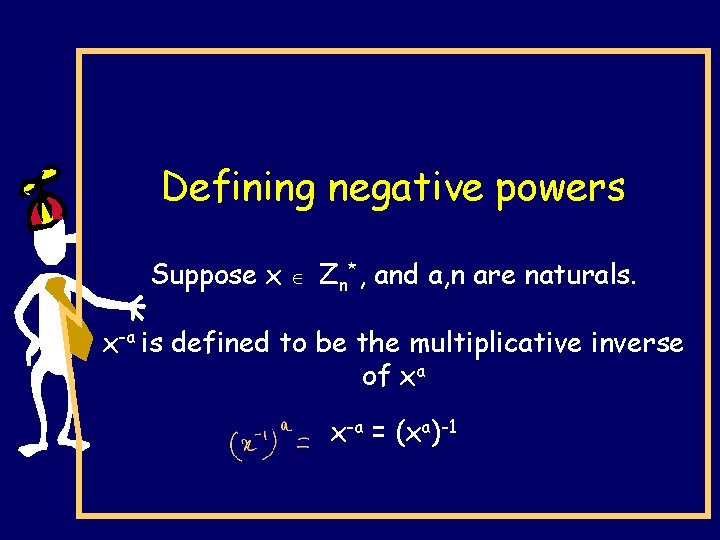
Defining negative powers Suppose x Zn*, and a, n are naturals. x-a is defined to be the multiplicative inverse of xa x-a = (xa)-1
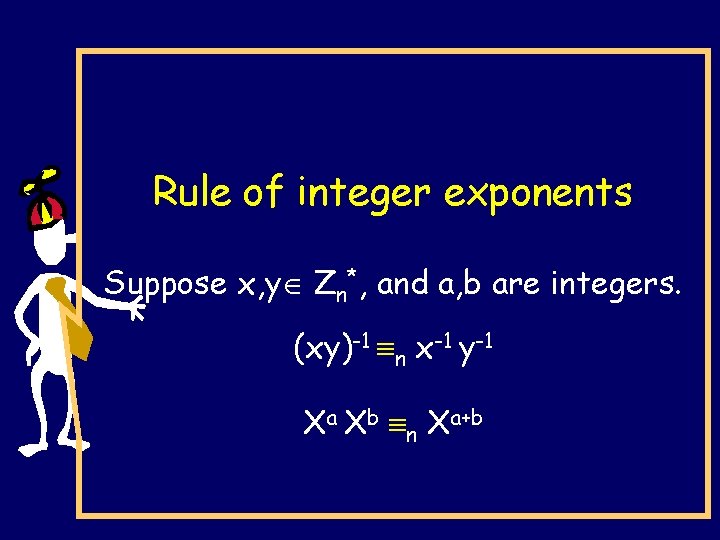
Rule of integer exponents Suppose x, y Zn*, and a, b are integers. (xy)-1 n x-1 y-1 Xa Xb n Xa+b
Zn = {0, 1, 2, …, n-1} Zn* = {x Zn | GCD(x, n) =1} Quick raising to power. <Zn, +n> 1. Closed 2. Associative 3. 0 is identity 4. Additive Inverses Fast + and 5. Cancellation 6. Commutative <Zn*, *n> 1. Closed 2. Associative 3. 1 is identity 4. Multiplicative Inverses Fast * and / 5. Cancellation 6. Commutative
Fundamental lemma of powers. Suppose x Zn*, and a, b, n are naturals. If a (n) b Then xa n xb Equivalently, xa mod (n) n xb mod (n)
Euler Phi Function (n) = size of Zn* p prime Zp*= {1, 2, 3, …, p-1} (p) = p-1 (pq) = (p-1)(q-1) if p, q distinct primes
The RSA Cryptosystem Rivest, Shamir, and Adelman (1978) RSA is one of the most used cryptographic protocols on the net. Your browser uses it to establish a secure session with a site.
Back to our dramatis personae Adleman Shamir Rivest Euler Fermat
The RSA Cryptosystem Rivest, Shamir, and Adelman (1978) RSA is one of the most used cryptographic protocols on the net. Your browser uses it to establish a secure session with a site.
Pick secret, random large primes: p, q “Publish”: n = p*q (n) = (p) (q) = (p-1)*(q-1) Pick random e Z* (n) “Publish”: e Compute d = inverse of e in Z* (n) Hence, e*d = 1 [ mod (n) ] “Private Key”: d
p, q random primes, e random Z* (n) n = p*q e*d = 1 [ mod (n) ] n, e is my public key. Use it to send me a message.
p, q prime, e random Z* (n) n = p*q e*d = 1 [ mod (n) ] n, e me [mod n] (me)d n m message m