
Discrete Mathematics Chapter 8 Relations Lingling Huang Outline




- Slides: 63
Discrete Mathematics Chapter 8 Relations 大葉大學 資訊 程系 黃鈴玲(Lingling Huang)
Outline 8. 1 Relations and their properties n 8. 3 Representing Relations n 8. 4 Closures of Relations n 8. 5 Equivalence Relations n 8. 6 Partial Orderings n Ch 8 -2
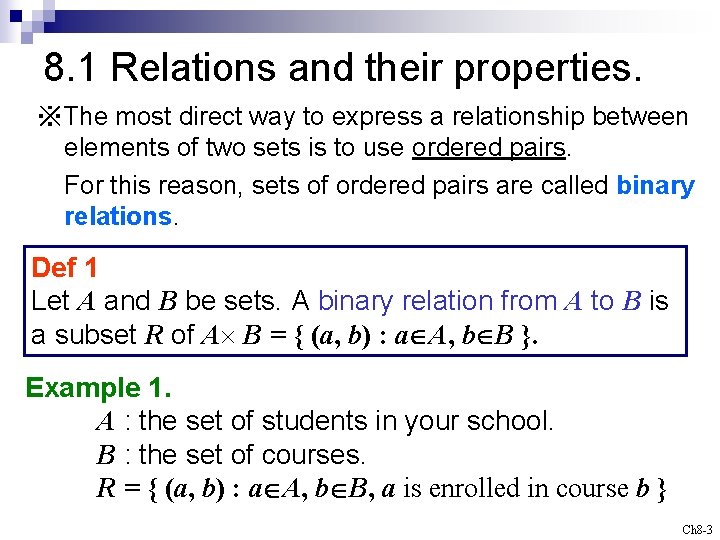
8. 1 Relations and their properties. ※The most direct way to express a relationship between elements of two sets is to use ordered pairs. For this reason, sets of ordered pairs are called binary relations. Def 1 Let A and B be sets. A binary relation from A to B is a subset R of A B = { (a, b) : a A, b B }. Example 1. A : the set of students in your school. B : the set of courses. R = { (a, b) : a A, b B, a is enrolled in course b } Ch 8 -3
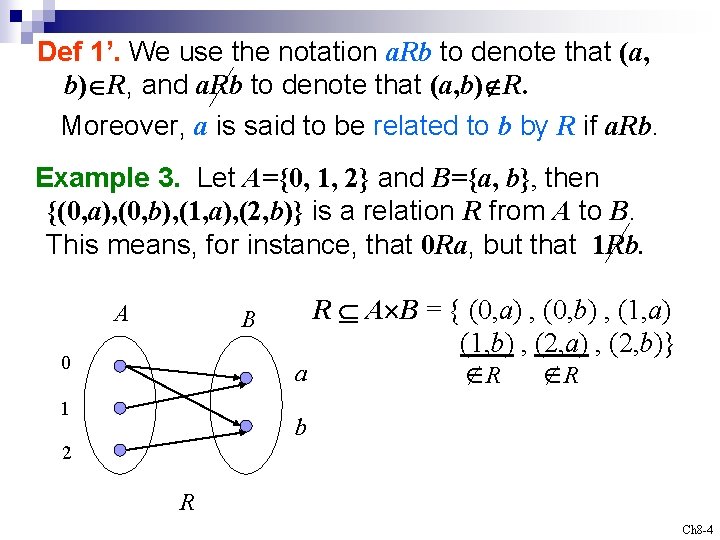
Def 1’. We use the notation a. Rb to denote that (a, b) R, and a. Rb to denote that (a, b) R. Moreover, a is said to be related to b by R if a. Rb. Example 3. Let A={0, 1, 2} and B={a, b}, then {(0, a), (0, b), (1, a), (2, b)} is a relation R from A to B. This means, for instance, that 0 Ra, but that 1 Rb. A R A B = { (0, a) , (0, b) , (1, a) (1, b) , (2, a) , (2, b)} B 0 a 1 R R b 2 R Ch 8 -4
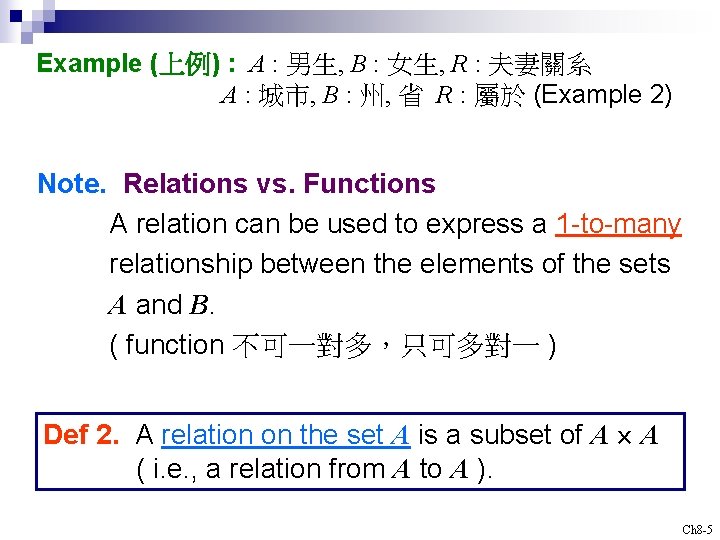
Example (上例) : A : 男生, B : 女生, R : 夫妻關系 A : 城市, B : 州, 省 R : 屬於 (Example 2) Note. Relations vs. Functions A relation can be used to express a 1 -to-many relationship between the elements of the sets A and B. ( function 不可一對多,只可多對一 ) Def 2. A relation on the set A is a subset of A A ( i. e. , a relation from A to A ). Ch 8 -5
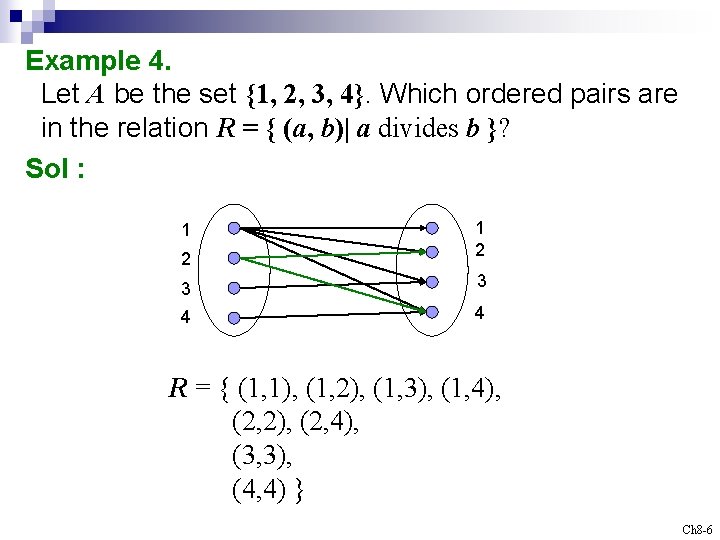
Example 4. Let A be the set {1, 2, 3, 4}. Which ordered pairs are in the relation R = { (a, b)| a divides b }? Sol : 2 1 2 3 3 4 4 1 R = { (1, 1), (1, 2), (1, 3), (1, 4), (2, 2), (2, 4), (3, 3), (4, 4) } Ch 8 -6
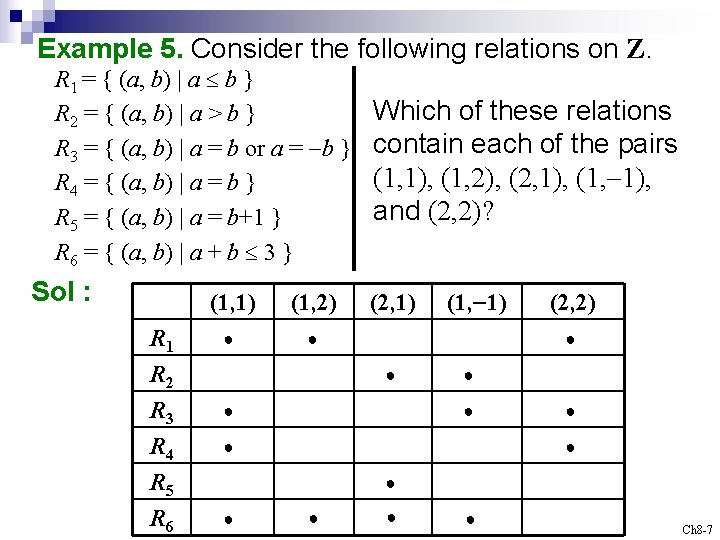
Example 5. Consider the following relations on Z. R 1 = { (a, b) | a b } R 2 = { (a, b) | a > b } R 3 = { (a, b) | a = b or a = -b } R 4 = { (a, b) | a = b } R 5 = { (a, b) | a = b+1 } R 6 = { (a, b) | a + b 3 } Sol : (1, 1) (1, 2) R 1 R 2 R 3 ● ● R 4 R 5 R 6 ● Which of these relations contain each of the pairs (1, 1), (1, 2), (2, 1), (1, -1), and (2, 2)? (2, 1) (1, -1) (2, 2) ● ● ● Ch 8 -7
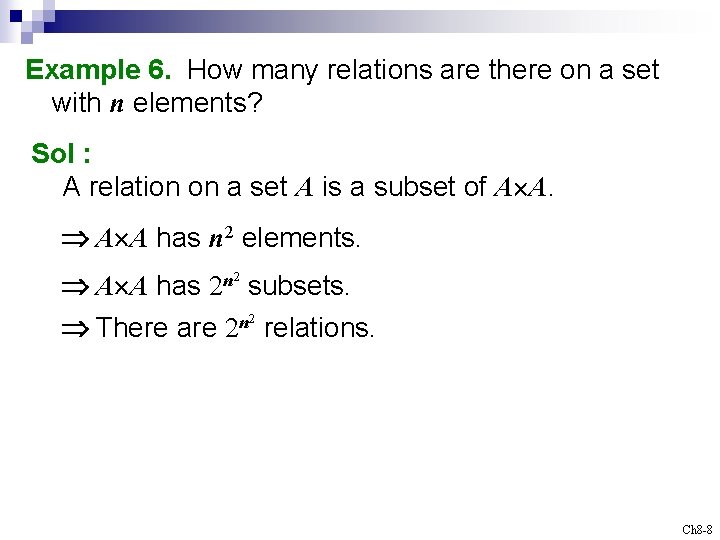
Example 6. How many relations are there on a set with n elements? Sol : A relation on a set A is a subset of A A has n 2 elements. A A has 2 n 2 subsets. 2 n There are 2 relations. Ch 8 -8
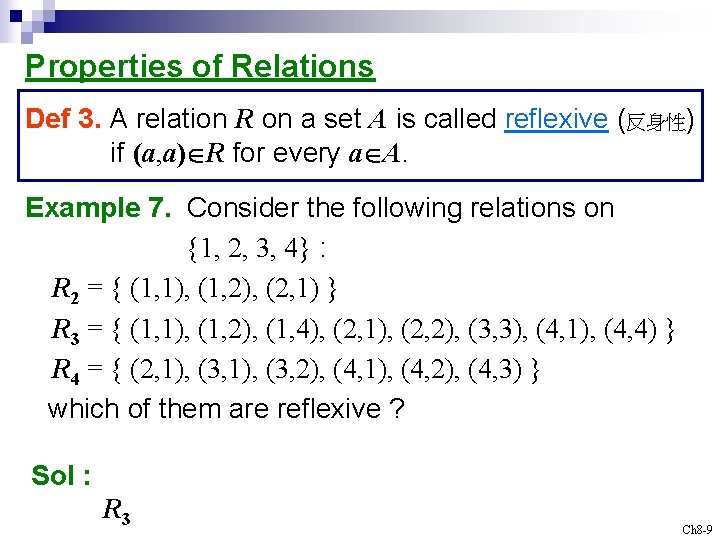
Properties of Relations Def 3. A relation R on a set A is called reflexive (反身性) if (a, a) R for every a A. Example 7. Consider the following relations on {1, 2, 3, 4} : R 2 = { (1, 1), (1, 2), (2, 1) } R 3 = { (1, 1), (1, 2), (1, 4), (2, 1), (2, 2), (3, 3), (4, 1), (4, 4) } R 4 = { (2, 1), (3, 2), (4, 1), (4, 2), (4, 3) } which of them are reflexive ? Sol : R 3 Ch 8 -9
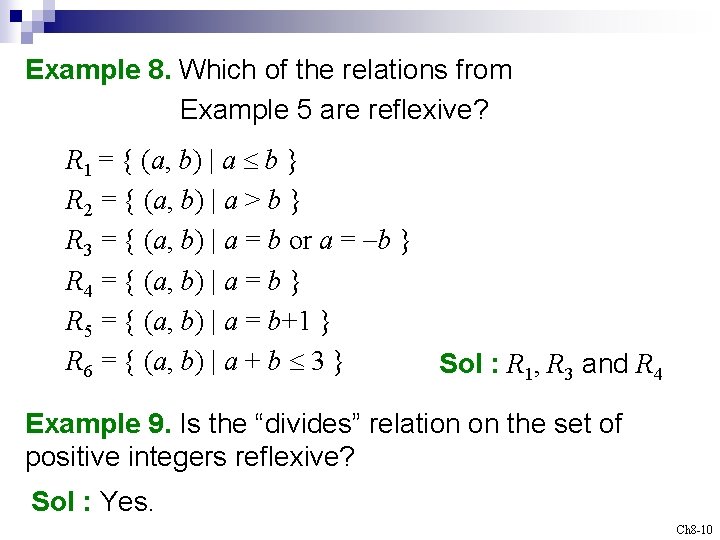
Example 8. Which of the relations from Example 5 are reflexive? R 1 = { (a, b) | a b } R 2 = { (a, b) | a > b } R 3 = { (a, b) | a = b or a = -b } R 4 = { (a, b) | a = b } R 5 = { (a, b) | a = b+1 } R 6 = { (a, b) | a + b 3 } Sol : R 1, R 3 and R 4 Example 9. Is the “divides” relation on the set of positive integers reflexive? Sol : Yes. Ch 8 -10
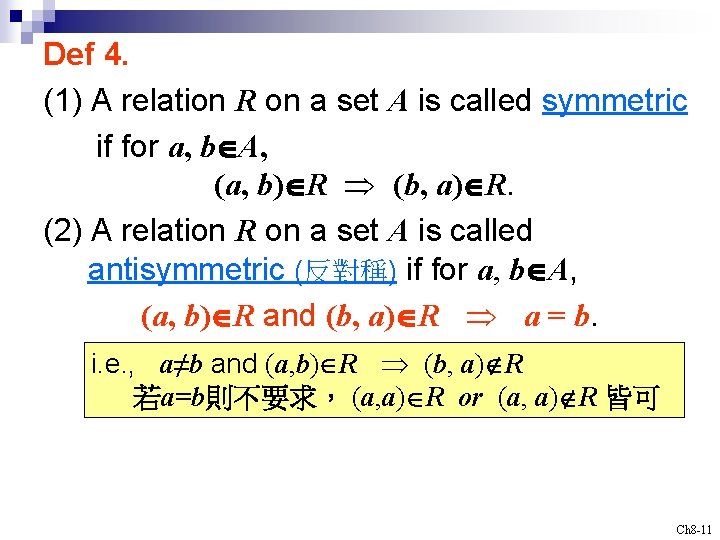
Def 4. (1) A relation R on a set A is called symmetric if for a, b A, (a, b) R (b, a) R. (2) A relation R on a set A is called antisymmetric (反對稱) if for a, b A, (a, b) R and (b, a) R a = b. i. e. , a≠b and (a, b) R (b, a) R 若a=b則不要求, (a, a) R or (a, a) R 皆可 Ch 8 -11
Example 10. Which of the relations from Example 7 are symmetric or antisymmetric ? R 2 = { (1, 1), (1, 2), (2, 1) } R 3 = { (1, 1), (1, 2), (1, 4), (2, 1), (2, 2), (3, 3), (4, 1), (4, 4) } R 4 = { (2, 1), (3, 2), (4, 1), (4, 2), (4, 3) } Sol : R 2, R 3 are symmetric R 4 are antisymmetric. Example 11. Is the “divides” relation on the set of positive integers symmetric? Is it antisymmetric? Sol : It is not symmetric since 1|2 but 2 | 1. It is antisymmetric since a|b and b|a implies a=b. Ch 8 -12
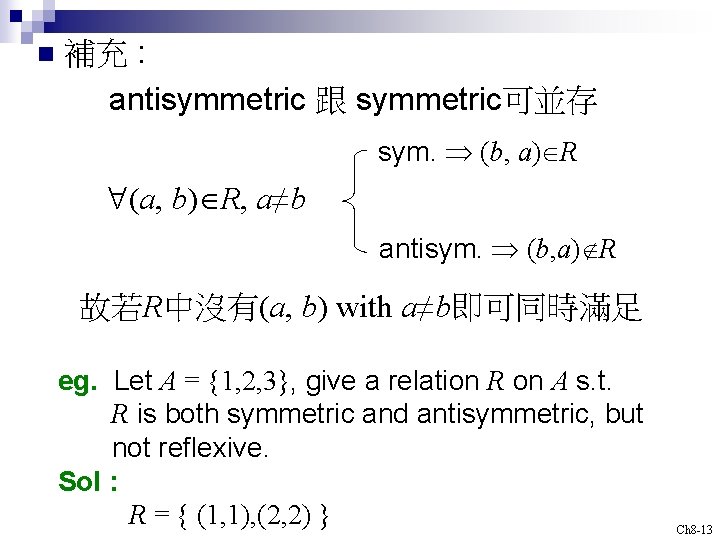
n 補充 : antisymmetric 跟 symmetric可並存 sym. (b, a) R (a, b) R, a≠b antisym. (b, a) R 故若R中沒有(a, b) with a≠b即可同時滿足 eg. Let A = {1, 2, 3}, give a relation R on A s. t. R is both symmetric and antisymmetric, but not reflexive. Sol : R = { (1, 1), (2, 2) } Ch 8 -13
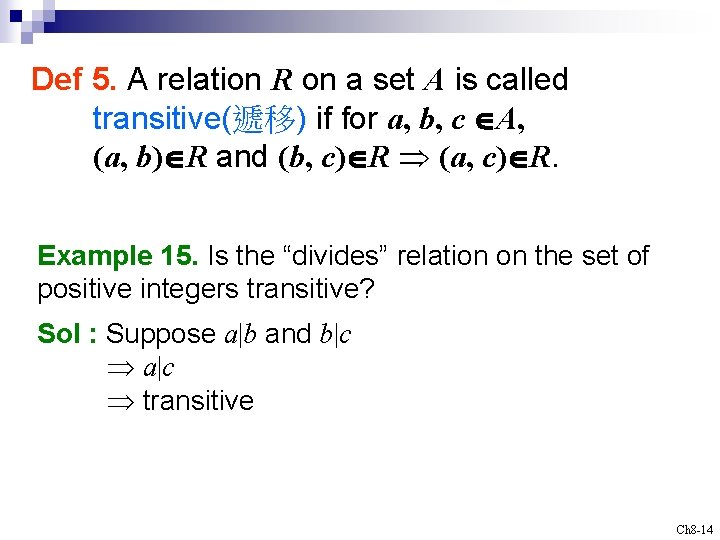
Def 5. A relation R on a set A is called transitive(遞移) if for a, b, c A, (a, b) R and (b, c) R (a, c) R. Example 15. Is the “divides” relation on the set of positive integers transitive? Sol : Suppose a|b and b|c a|c transitive Ch 8 -14
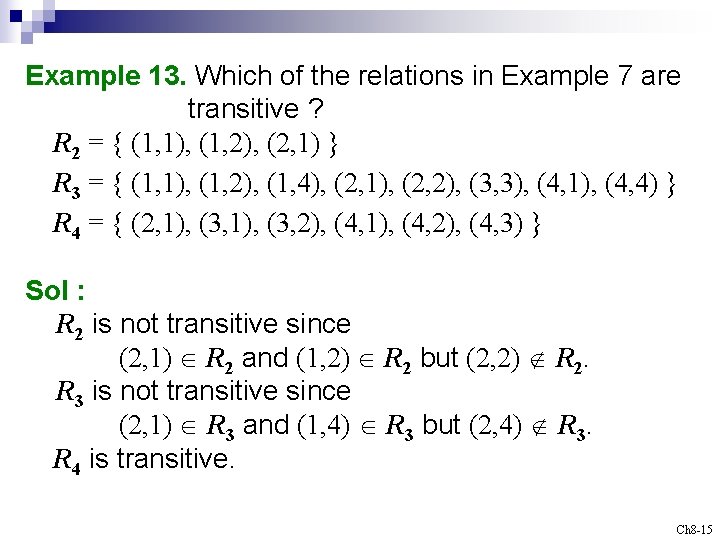
Example 13. Which of the relations in Example 7 are transitive ? R 2 = { (1, 1), (1, 2), (2, 1) } R 3 = { (1, 1), (1, 2), (1, 4), (2, 1), (2, 2), (3, 3), (4, 1), (4, 4) } R 4 = { (2, 1), (3, 2), (4, 1), (4, 2), (4, 3) } Sol : R 2 is not transitive since (2, 1) R 2 and (1, 2) R 2 but (2, 2) R 2. R 3 is not transitive since (2, 1) R 3 and (1, 4) R 3 but (2, 4) R 3. R 4 is transitive. Ch 8 -15
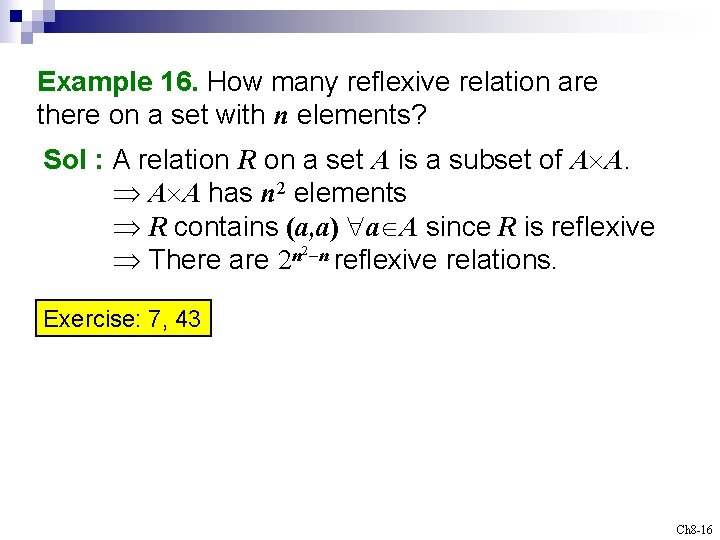
Example 16. How many reflexive relation are there on a set with n elements? Sol : A relation R on a set A is a subset of A A has n 2 elements R contains (a, a) a A since R is reflexive 2 -n n There are 2 reflexive relations. Exercise: 7, 43 Ch 8 -16
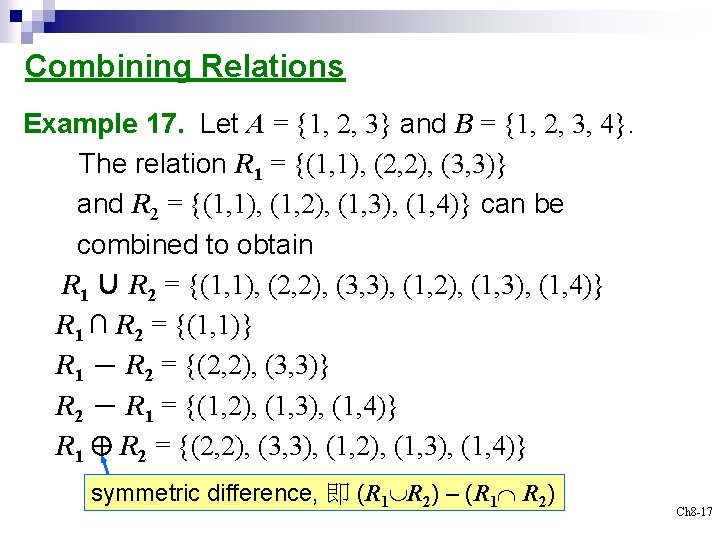
Combining Relations Example 17. Let A = {1, 2, 3} and B = {1, 2, 3, 4}. The relation R 1 = {(1, 1), (2, 2), (3, 3)} and R 2 = {(1, 1), (1, 2), (1, 3), (1, 4)} can be combined to obtain R 1 ∪ R 2 = {(1, 1), (2, 2), (3, 3), (1, 2), (1, 3), (1, 4)} R 1 ∩ R 2 = {(1, 1)} R 1 - R 2 = {(2, 2), (3, 3)} R 2 - R 1 = {(1, 2), (1, 3), (1, 4)} R 1 R 2 = {(2, 2), (3, 3), (1, 2), (1, 3), (1, 4)} symmetric difference, 即 (R 1 R 2) – (R 1 R 2) Ch 8 -17
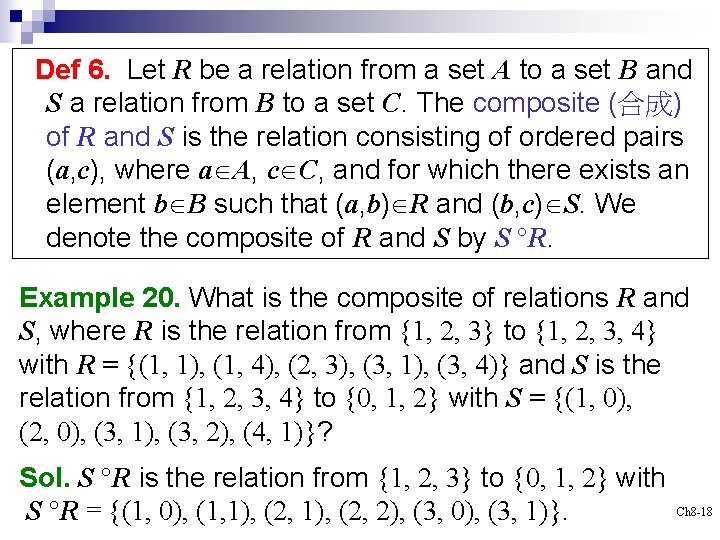
Def 6. Let R be a relation from a set A to a set B and S a relation from B to a set C. The composite (合成) of R and S is the relation consisting of ordered pairs (a, c), where a A, c C, and for which there exists an element b B such that (a, b) R and (b, c) S. We denote the composite of R and S by S R. Example 20. What is the composite of relations R and S, where R is the relation from {1, 2, 3} to {1, 2, 3, 4} with R = {(1, 1), (1, 4), (2, 3), (3, 1), (3, 4)} and S is the relation from {1, 2, 3, 4} to {0, 1, 2} with S = {(1, 0), (2, 0), (3, 1), (3, 2), (4, 1)}? Sol. S R is the relation from {1, 2, 3} to {0, 1, 2} with S R = {(1, 0), (1, 1), (2, 2), (3, 0), (3, 1)}. Ch 8 -18
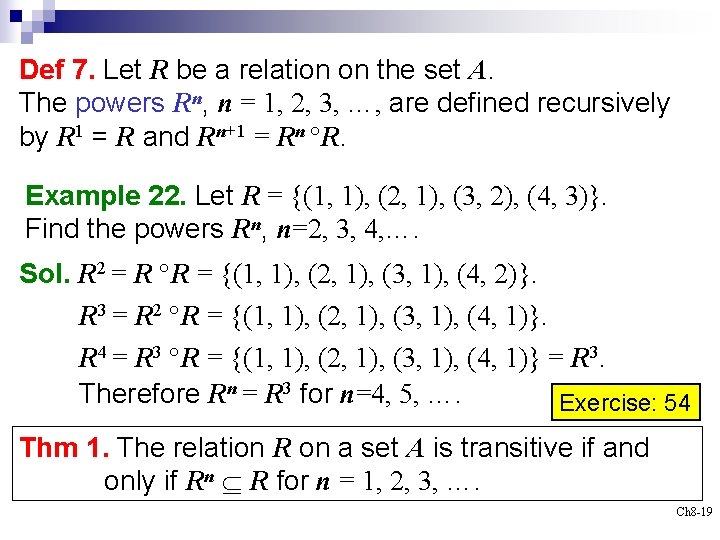
Def 7. Let R be a relation on the set A. The powers Rn, n = 1, 2, 3, …, are defined recursively by R 1 = R and Rn+1 = Rn R. Example 22. Let R = {(1, 1), (2, 1), (3, 2), (4, 3)}. Find the powers Rn, n=2, 3, 4, …. Sol. R 2 = R R = {(1, 1), (2, 1), (3, 1), (4, 2)}. R 3 = R 2 R = {(1, 1), (2, 1), (3, 1), (4, 1)}. R 4 = R 3 R = {(1, 1), (2, 1), (3, 1), (4, 1)} = R 3. Therefore Rn = R 3 for n=4, 5, …. Exercise: 54 Thm 1. The relation R on a set A is transitive if and only if Rn R for n = 1, 2, 3, …. Ch 8 -19
8. 3 Representing Relations using Matrices Suppose that R is a relation from A={a 1, a 2, …, am} to B = {b 1, b 2, …, bn }. The relation R can be represented by the matrix MR = [mij], where mij = 1, if (ai, bj) R 0, if (ai, bj) R Ch 8 -20
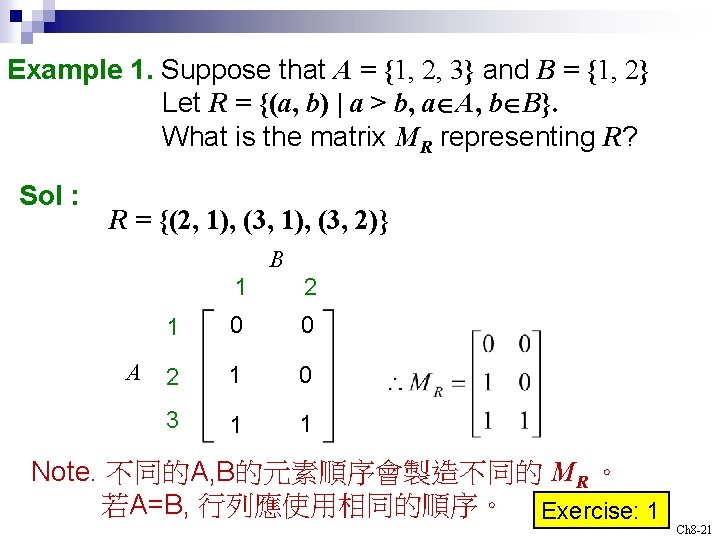
Example 1. Suppose that A = {1, 2, 3} and B = {1, 2} Let R = {(a, b) | a > b, a A, b B}. What is the matrix MR representing R? Sol : R = {(2, 1), (3, 2)} B 1 2 1 0 0 A 2 1 0 3 1 1 Note. 不同的A, B的元素順序會製造不同的 MR 。 若A=B, 行列應使用相同的順序。 Exercise: 1 Ch 8 -21
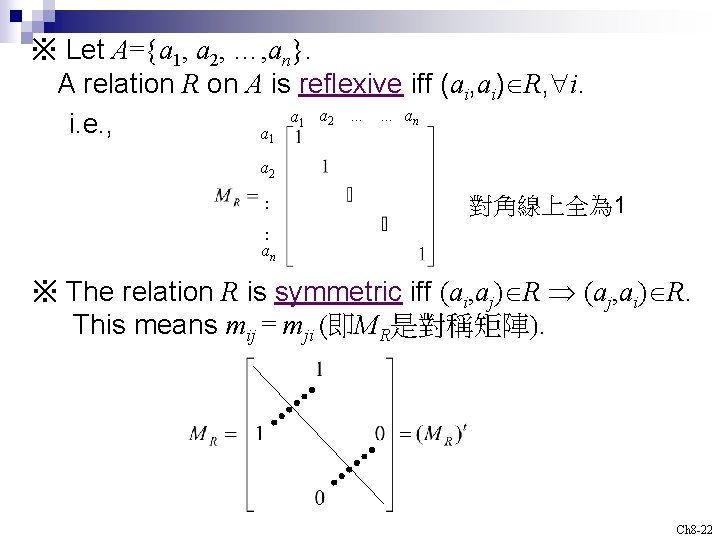
※ Let A={a 1, a 2, …, an}. A relation R on A is reflexive iff (ai, ai) R, i. a 1 a 2 … … an i. e. , a 1 a 2 : 對角線上全為 1 : an ※ The relation R is symmetric iff (ai, aj) R (aj, ai) R. This means mij = mji (即MR是對稱矩陣). Ch 8 -22
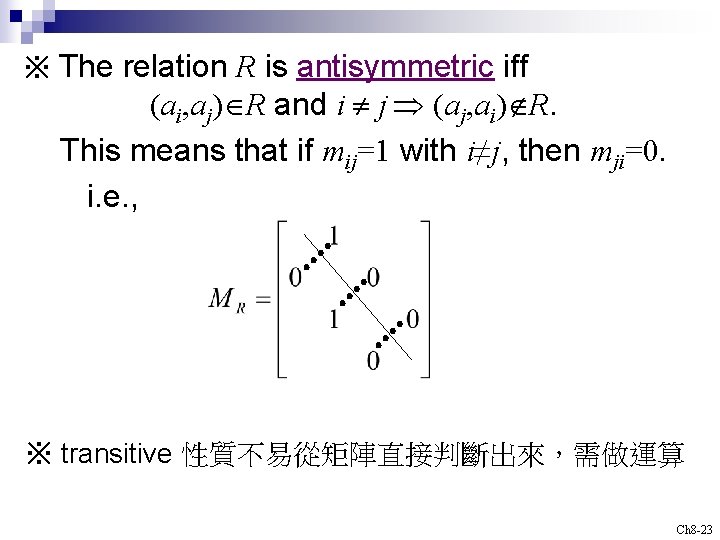
※ The relation R is antisymmetric iff (ai, aj) R and i j (aj, ai) R. This means that if mij=1 with i≠j, then mji=0. i. e. , ※ transitive 性質不易從矩陣直接判斷出來,需做運算 Ch 8 -23
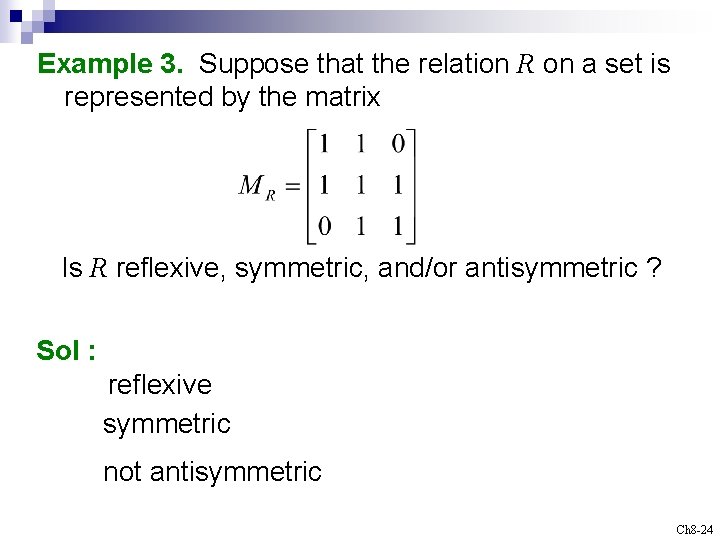
Example 3. Suppose that the relation R on a set is represented by the matrix Is R reflexive, symmetric, and/or antisymmetric ? Sol : reflexive symmetric not antisymmetric Ch 8 -24
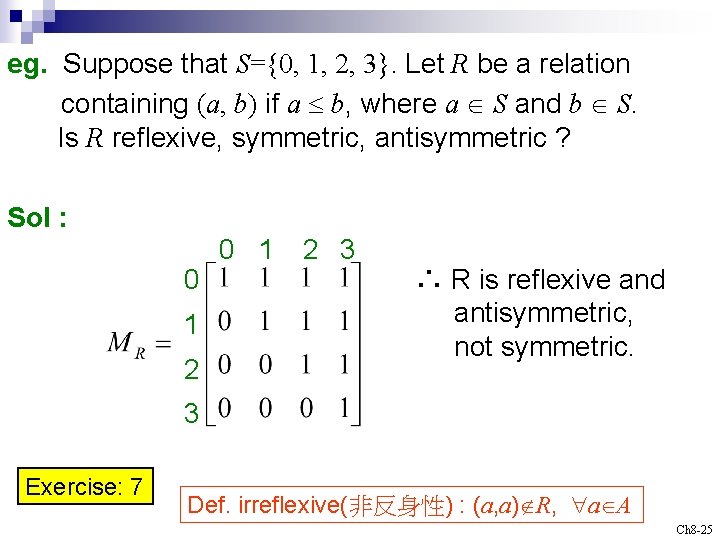
eg. Suppose that S={0, 1, 2, 3}. Let R be a relation containing (a, b) if a b, where a S and b S. Is R reflexive, symmetric, antisymmetric ? Sol : 0 1 2 3 ∴ R is reflexive and antisymmetric, not symmetric. 3 Exercise: 7 Def. irreflexive(非反身性) : (a, a) R, a A Ch 8 -25
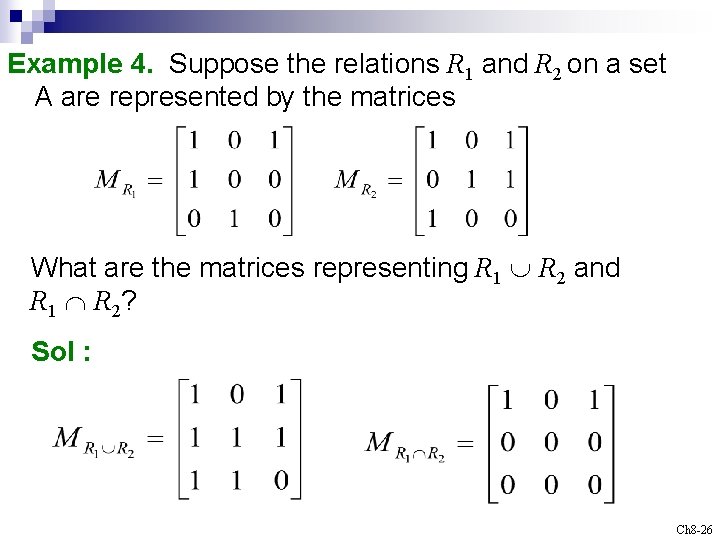
Example 4. Suppose the relations R 1 and R 2 on a set A are represented by the matrices What are the matrices representing R 1 R 2 and R 1 R 2? Sol : Ch 8 -26
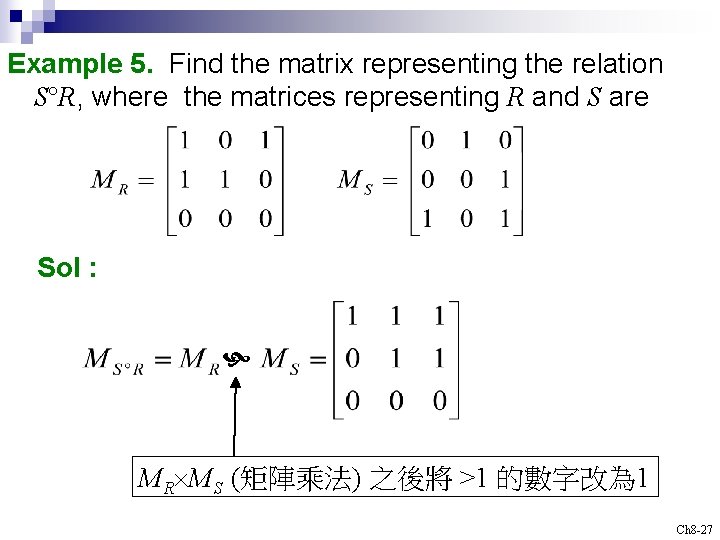
Example 5. Find the matrix representing the relation S R, where the matrices representing R and S are Sol : MR MS (矩陣乘法) 之後將 >1 的數字改為 1 Ch 8 -27
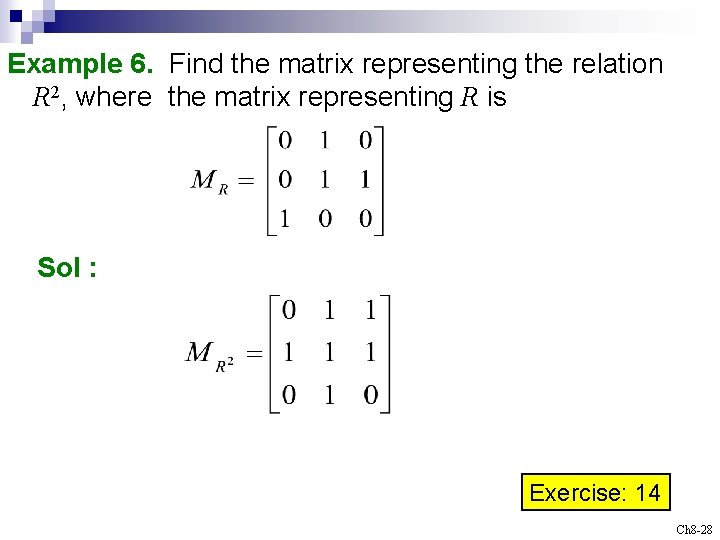
Example 6. Find the matrix representing the relation R 2, where the matrix representing R is Sol : Exercise: 14 Ch 8 -28
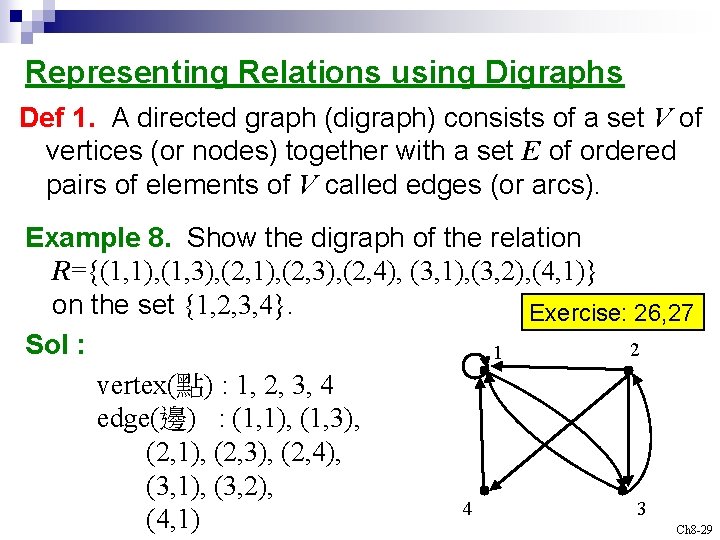
Representing Relations using Digraphs Def 1. A directed graph (digraph) consists of a set V of vertices (or nodes) together with a set E of ordered pairs of elements of V called edges (or arcs). Example 8. Show the digraph of the relation R={(1, 1), (1, 3), (2, 1), (2, 3), (2, 4), (3, 1), (3, 2), (4, 1)} on the set {1, 2, 3, 4}. Exercise: 26, 27 Sol : 2 1 vertex(點) : 1, 2, 3, 4 edge(邊) : (1, 1), (1, 3), (2, 1), (2, 3), (2, 4), (3, 1), (3, 2), 4 3 (4, 1) Ch 8 -29
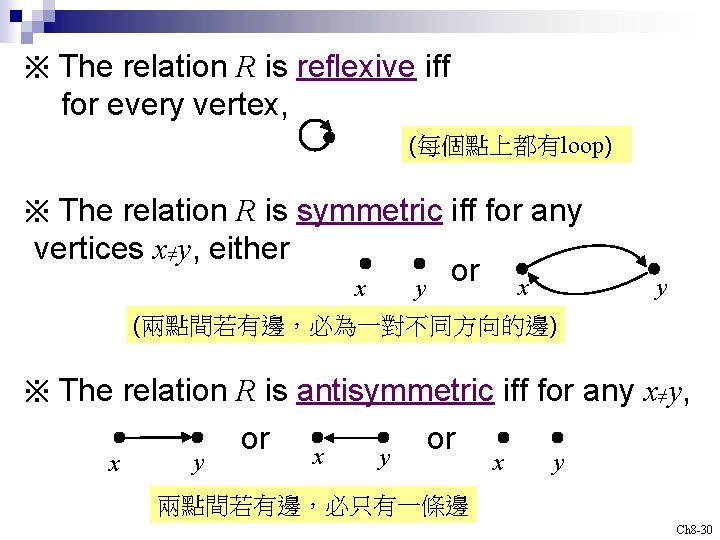
※ The relation R is reflexive iff for every vertex, (每個點上都有loop) ※ The relation R is symmetric iff for any vertices x≠y, either x y or x y (兩點間若有邊,必為一對不同方向的邊) ※ The relation R is antisymmetric iff for any x≠y, x y or x y 兩點間若有邊,必只有一條邊 Ch 8 -30
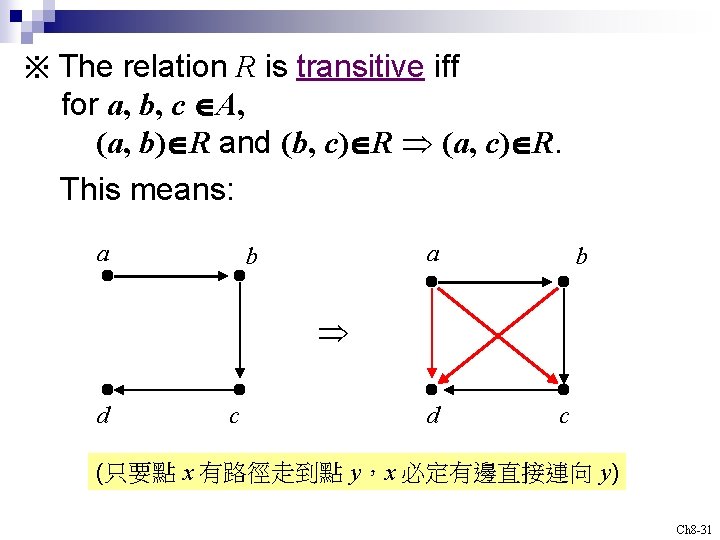
※ The relation R is transitive iff for a, b, c A, (a, b) R and (b, c) R (a, c) R. This means: a a b b d c (只要點 x 有路徑走到點 y,x 必定有邊直接連向 y) Ch 8 -31
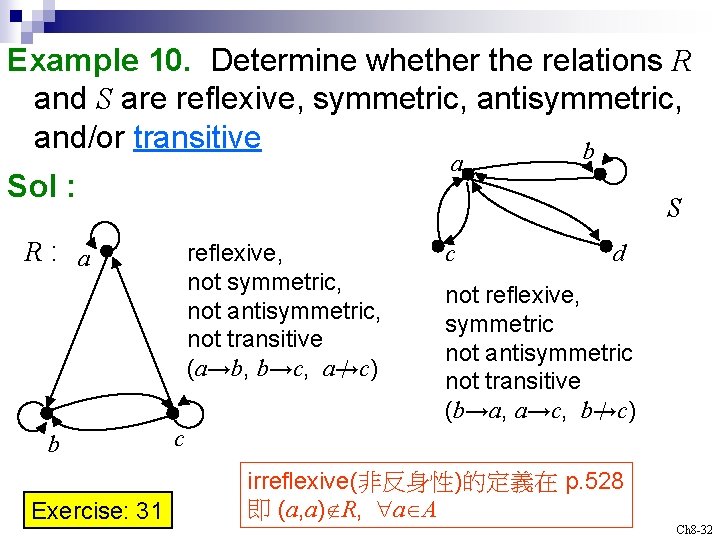
Example 10. Determine whether the relations R and S are reflexive, symmetric, antisymmetric, and/or transitive b a Sol : S R: a b Exercise: 31 reflexive, not symmetric, not antisymmetric, not transitive (a→b, b→c, a→c) c d not reflexive, symmetric not antisymmetric not transitive (b→a, a→c, b→c) c irreflexive(非反身性)的定義在 p. 528 即 (a, a) R, a A Ch 8 -32
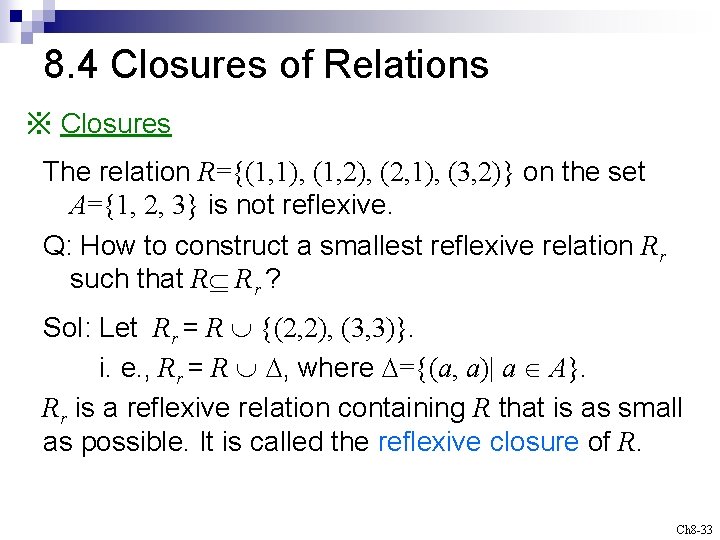
8. 4 Closures of Relations ※ Closures The relation R={(1, 1), (1, 2), (2, 1), (3, 2)} on the set A={1, 2, 3} is not reflexive. Q: How to construct a smallest reflexive relation Rr such that R Rr ? Sol: Let Rr = R {(2, 2), (3, 3)}. i. e. , Rr = R D, where D={(a, a)| a A}. Rr is a reflexive relation containing R that is as small as possible. It is called the reflexive closure of R. Ch 8 -33
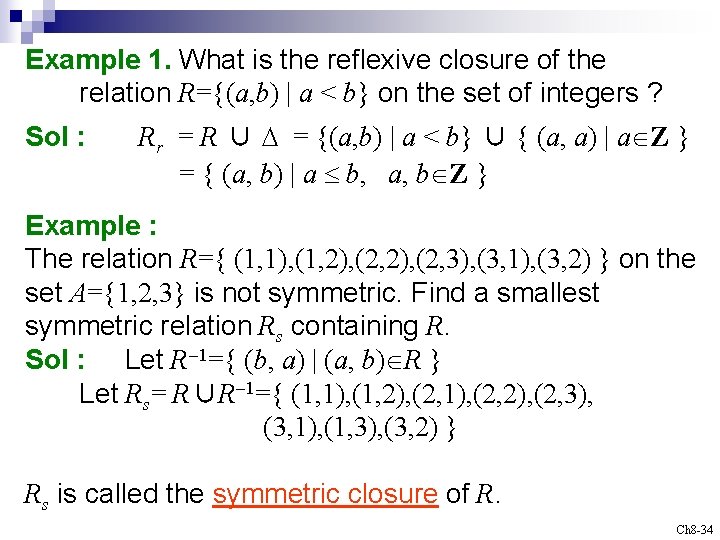
Example 1. What is the reflexive closure of the relation R={(a, b) | a < b} on the set of integers ? Sol : Rr = R ∪ D = {(a, b) | a < b} ∪ { (a, a) | a Z } = { (a, b) | a b, a, b Z } Example : The relation R={ (1, 1), (1, 2), (2, 3), (3, 1), (3, 2) } on the set A={1, 2, 3} is not symmetric. Find a smallest symmetric relation Rs containing R. Sol : Let R-1={ (b, a) | (a, b) R } Let Rs= R∪R-1={ (1, 1), (1, 2), (2, 1), (2, 2), (2, 3), (3, 1), (1, 3), (3, 2) } Rs is called the symmetric closure of R. Ch 8 -34
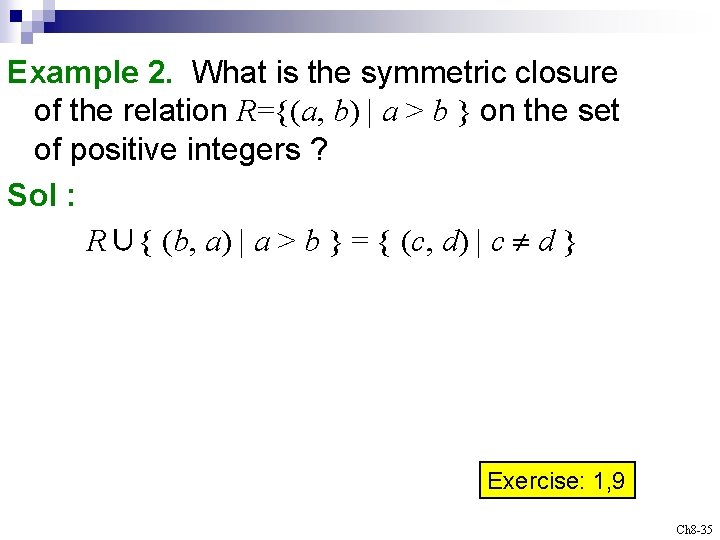
Example 2. What is the symmetric closure of the relation R={(a, b) | a > b } on the set of positive integers ? Sol : R∪{ (b, a) | a > b } = { (c, d) | c d } Exercise: 1, 9 Ch 8 -35
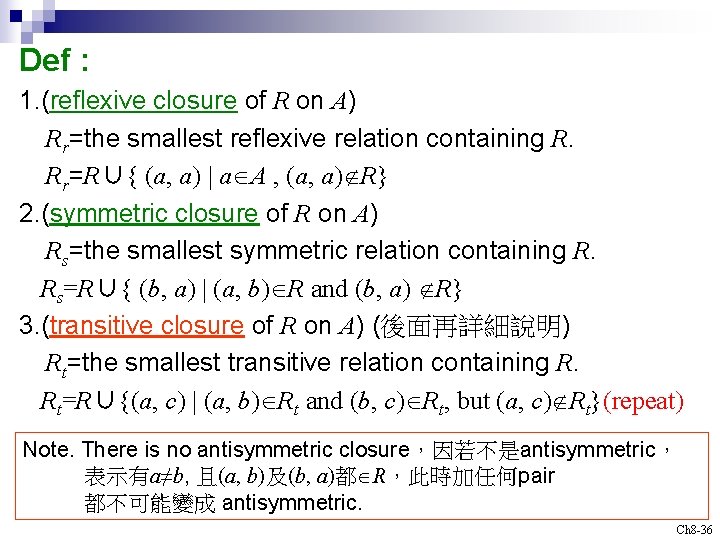
Def : 1. (reflexive closure of R on A) Rr=the smallest reflexive relation containing R. Rr=R∪{ (a, a) | a A , (a, a) R} 2. (symmetric closure of R on A) Rs=the smallest symmetric relation containing R. Rs=R∪{ (b, a) | (a, b) R and (b, a) R} 3. (transitive closure of R on A) (後面再詳細說明) Rt=the smallest transitive relation containing R. Rt=R∪{(a, c) | (a, b) Rt and (b, c) Rt, but (a, c) Rt}(repeat) Note. There is no antisymmetric closure,因若不是antisymmetric, 表示有a≠b, 且(a, b)及(b, a)都 R,此時加任何pair 都不可能變成 antisymmetric. Ch 8 -36
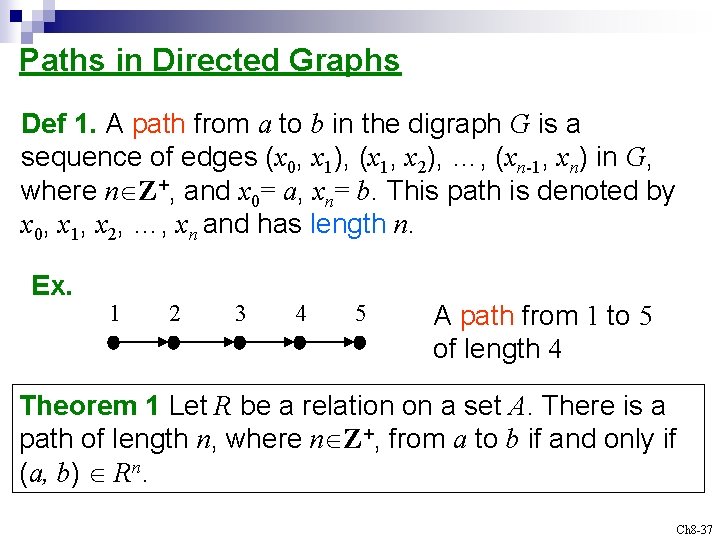
Paths in Directed Graphs Def 1. A path from a to b in the digraph G is a sequence of edges (x 0, x 1), (x 1, x 2), …, (xn-1, xn) in G, where n Z+, and x 0= a, xn= b. This path is denoted by x 0, x 1, x 2, …, xn and has length n. Ex. 1 2 3 4 5 A path from 1 to 5 of length 4 Theorem 1 Let R be a relation on a set A. There is a path of length n, where n Z+, from a to b if and only if (a, b) Rn. Ch 8 -37
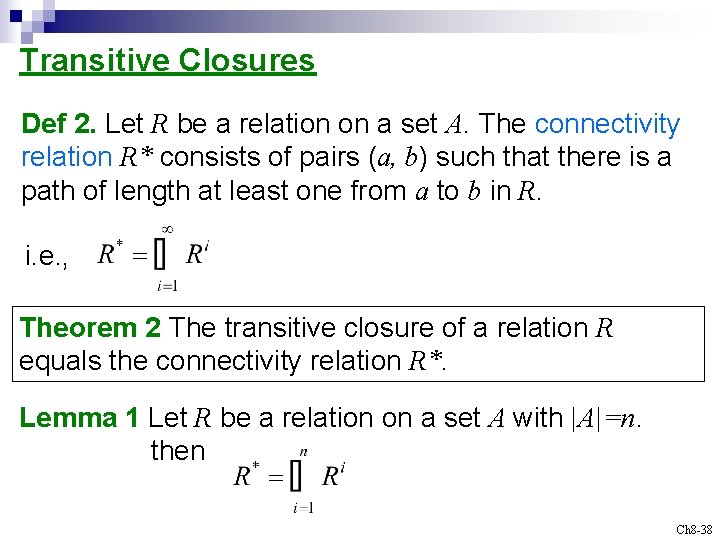
Transitive Closures Def 2. Let R be a relation on a set A. The connectivity relation R* consists of pairs (a, b) such that there is a path of length at least one from a to b in R. i. e. , Theorem 2 The transitive closure of a relation R equals the connectivity relation R*. Lemma 1 Let R be a relation on a set A with |A|=n. then Ch 8 -38
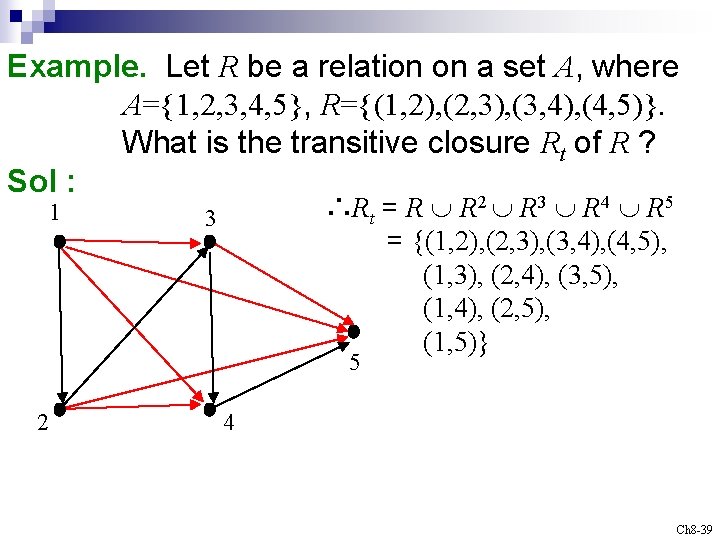
Example. Let R be a relation on a set A, where A={1, 2, 3, 4, 5}, R={(1, 2), (2, 3), (3, 4), (4, 5)}. What is the transitive closure Rt of R ? Sol : 1 ∴Rt = R R 2 R 3 R 4 R 5 = {(1, 2), (2, 3), (3, 4), (4, 5), (1, 3), (2, 4), (3, 5), (1, 4), (2, 5), (1, 5)} 3 5 2 4 Ch 8 -39
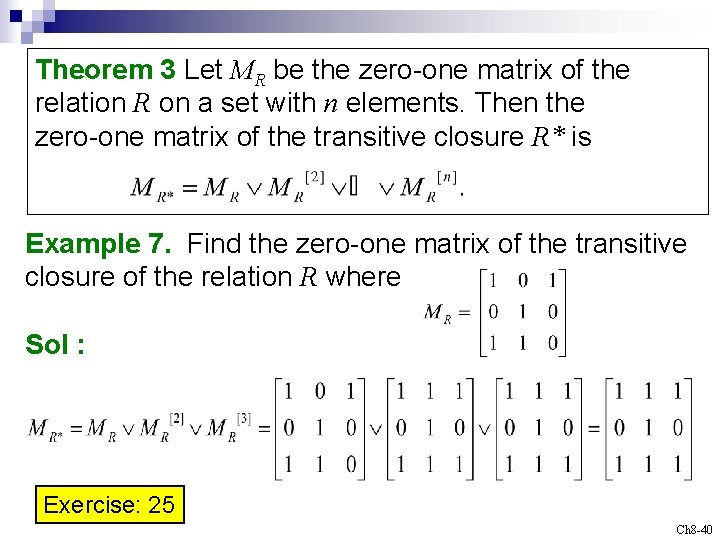
Theorem 3 Let MR be the zero-one matrix of the relation R on a set with n elements. Then the zero-one matrix of the transitive closure R* is Example 7. Find the zero-one matrix of the transitive closure of the relation R where Sol : Exercise: 25 Ch 8 -40
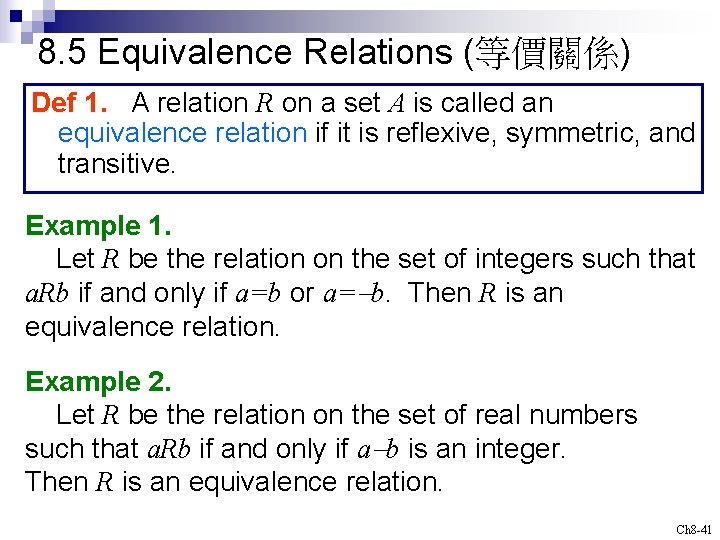
8. 5 Equivalence Relations (等價關係) Def 1. A relation R on a set A is called an equivalence relation if it is reflexive, symmetric, and transitive. Example 1. Let R be the relation on the set of integers such that a. Rb if and only if a=b or a=-b. Then R is an equivalence relation. Example 2. Let R be the relation on the set of real numbers such that a. Rb if and only if a-b is an integer. Then R is an equivalence relation. Ch 8 -41
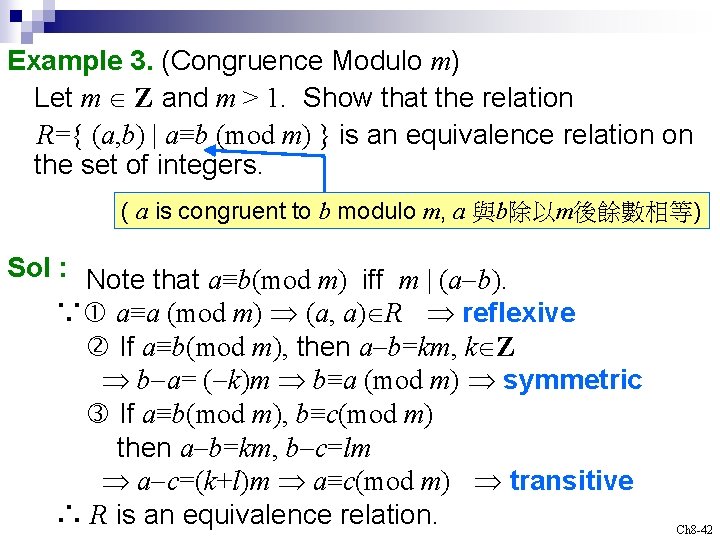
Example 3. (Congruence Modulo m) Let m Z and m > 1. Show that the relation R={ (a, b) | a≡b (mod m) } is an equivalence relation on the set of integers. ( a is congruent to b modulo m, a 與b除以m後餘數相等) Sol : Note that a≡b(mod m) iff m | (a-b). ∵ a≡a (mod m) (a, a) R reflexive If a≡b(mod m), then a-b=km, k Z b-a= (-k)m b≡a (mod m) symmetric If a≡b(mod m), b≡c(mod m) then a-b=km, b-c=lm a-c=(k+l)m a≡c(mod m) transitive ∴ R is an equivalence relation. Ch 8 -42
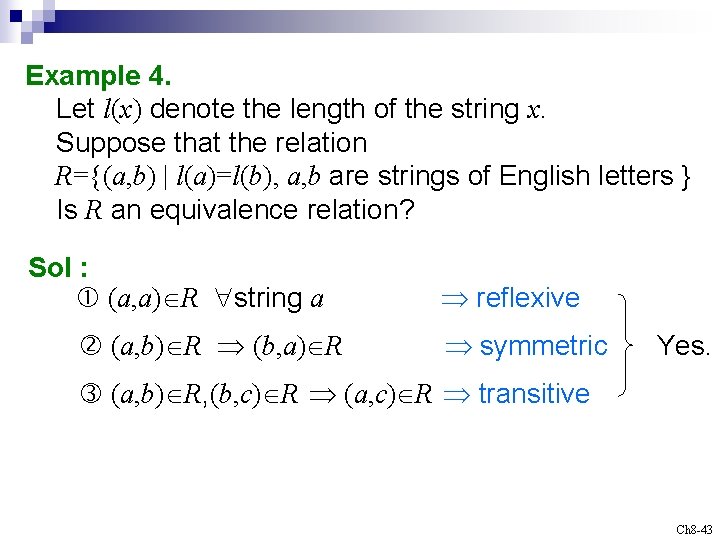
Example 4. Let l(x) denote the length of the string x. Suppose that the relation R={(a, b) | l(a)=l(b), a, b are strings of English letters } Is R an equivalence relation? Sol : (a, a) R string a (a, b) R (b, a) R reflexive symmetric Yes. (a, b) R, (b, c) R (a, c) R transitive Ch 8 -43
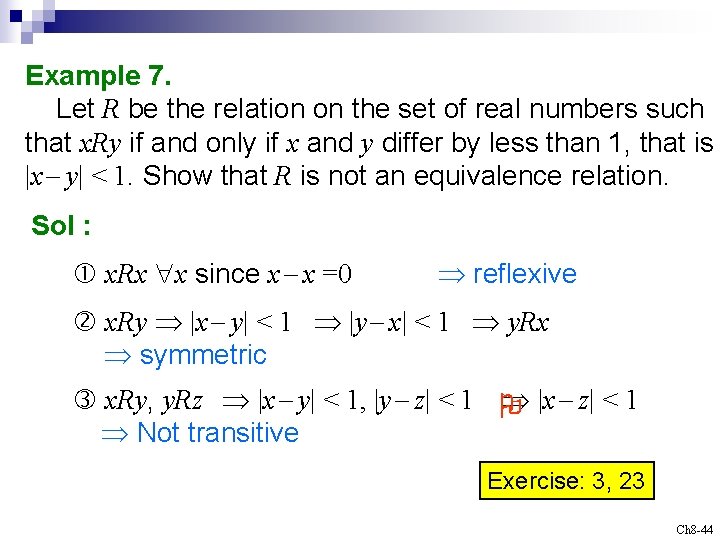
Example 7. Let R be the relation on the set of real numbers such that x. Ry if and only if x and y differ by less than 1, that is |x- y| < 1. Show that R is not an equivalence relation. Sol : x. Rx x since x- x =0 reflexive x. Ry |x- y| < 1 |y- x| < 1 y. Rx symmetric x. Ry, y. Rz |x- y| < 1, |y- z| < 1 |x- z| < 1 Not transitive Exercise: 3, 23 Ch 8 -44
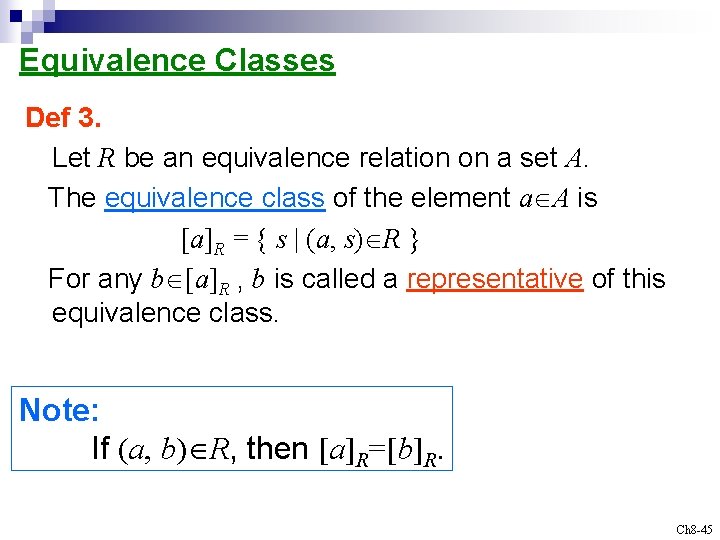
Equivalence Classes Def 3. Let R be an equivalence relation on a set A. The equivalence class of the element a A is [a]R = { s | (a, s) R } For any b [a]R , b is called a representative of this equivalence class. Note: If (a, b) R, then [a]R=[b]R. Ch 8 -45
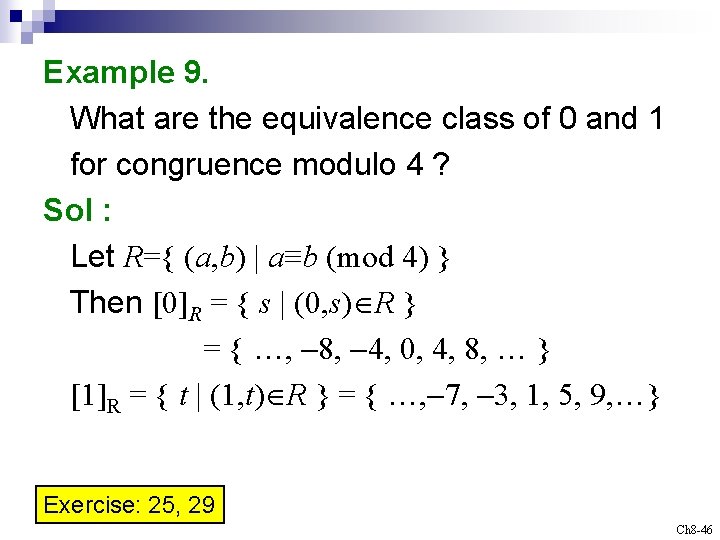
Example 9. What are the equivalence class of 0 and 1 for congruence modulo 4 ? Sol : Let R={ (a, b) | a≡b (mod 4) } Then [0]R = { s | (0, s) R } = { …, -8, -4, 0, 4, 8, … } [1]R = { t | (1, t) R } = { …, -7, -3, 1, 5, 9, …} Exercise: 25, 29 Ch 8 -46
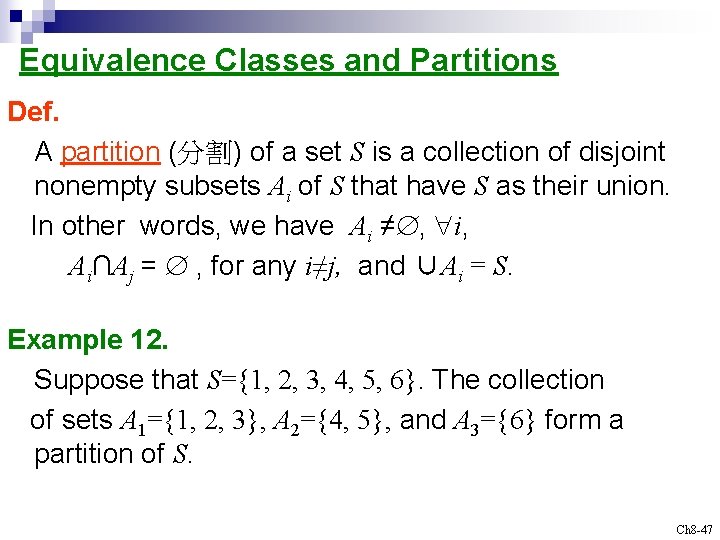
Equivalence Classes and Partitions Def. A partition (分割) of a set S is a collection of disjoint nonempty subsets Ai of S that have S as their union. In other words, we have Ai ≠ , i, Ai∩Aj = , for any i≠j, and ∪Ai = S. Example 12. Suppose that S={1, 2, 3, 4, 5, 6}. The collection of sets A 1={1, 2, 3}, A 2={4, 5}, and A 3={6} form a partition of S. Ch 8 -47
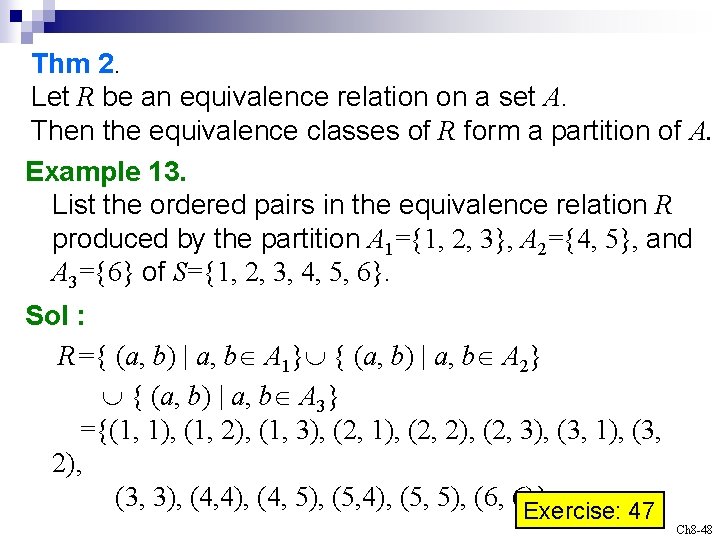
Thm 2. Let R be an equivalence relation on a set A. Then the equivalence classes of R form a partition of A. Example 13. List the ordered pairs in the equivalence relation R produced by the partition A 1={1, 2, 3}, A 2={4, 5}, and A 3={6} of S={1, 2, 3, 4, 5, 6}. Sol : R={ (a, b) | a, b A 1} { (a, b) | a, b A 2} { (a, b) | a, b A 3} ={(1, 1), (1, 2), (1, 3), (2, 1), (2, 2), (2, 3), (3, 1), (3, 2), (3, 3), (4, 4), (4, 5), (5, 4), (5, 5), (6, 6)} Exercise: 47 Ch 8 -48
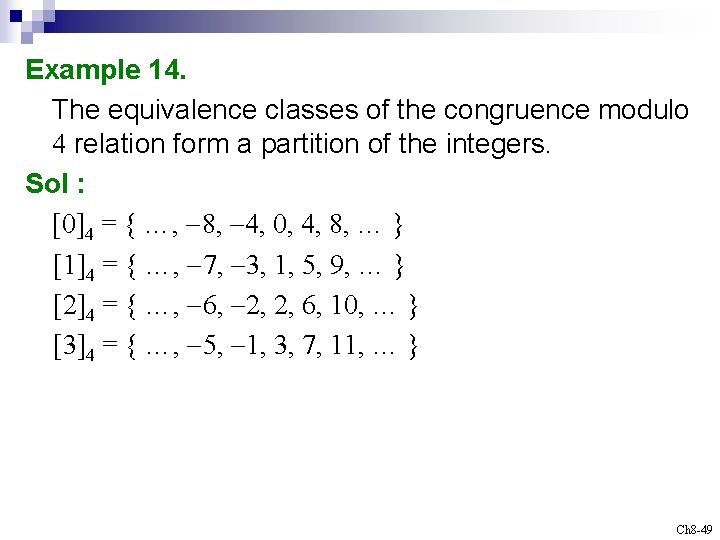
Example 14. The equivalence classes of the congruence modulo 4 relation form a partition of the integers. Sol : [0]4 = { …, -8, -4, 0, 4, 8, … } [1]4 = { …, -7, -3, 1, 5, 9, … } [2]4 = { …, -6, -2, 2, 6, 10, … } [3]4 = { …, -5, -1, 3, 7, 11, … } Ch 8 -49
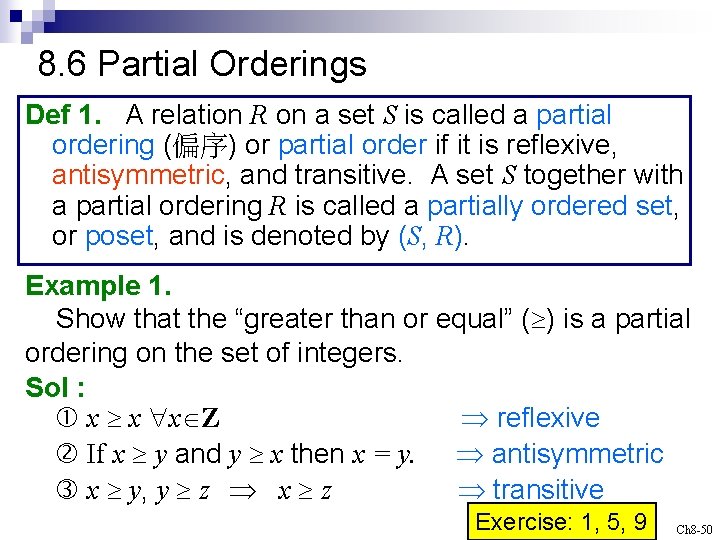
8. 6 Partial Orderings Def 1. A relation R on a set S is called a partial ordering (偏序) or partial order if it is reflexive, antisymmetric, and transitive. A set S together with a partial ordering R is called a partially ordered set, or poset, and is denoted by (S, R). Example 1. Show that the “greater than or equal” ( ) is a partial ordering on the set of integers. Sol : x x x Z reflexive If x y and y x then x = y. antisymmetric x y, y z x z transitive Exercise: 1, 5, 9 Ch 8 -50
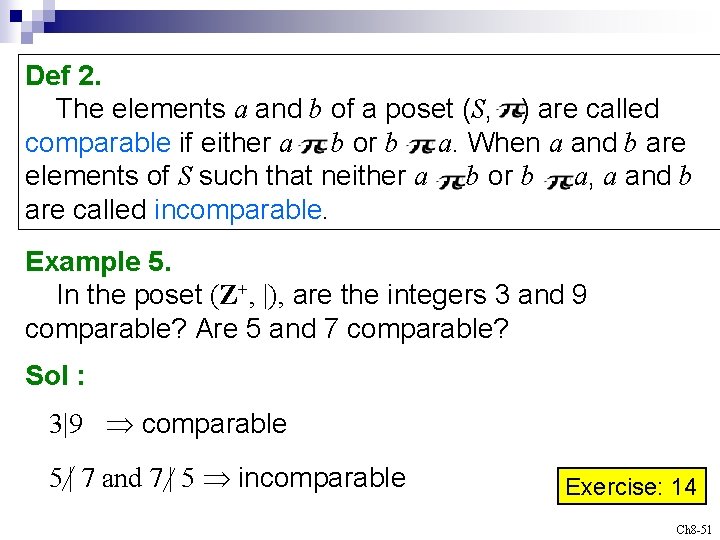
Def 2. The elements a and b of a poset (S, ) are called comparable if either a b or b a. When a and b are elements of S such that neither a b or b a, a and b are called incomparable. Example 5. In the poset (Z+, |), are the integers 3 and 9 comparable? Are 5 and 7 comparable? Sol : 3|9 comparable 5 | 7 and 7 | 5 incomparable Exercise: 14 Ch 8 -51
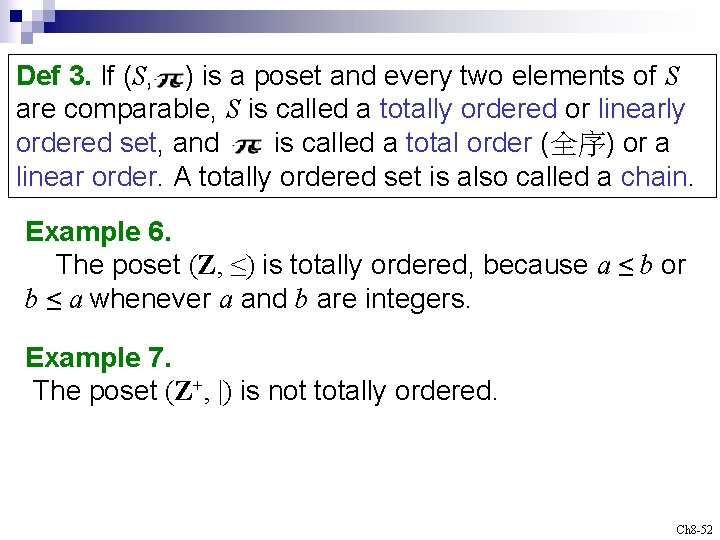
Def 3. If (S, ) is a poset and every two elements of S are comparable, S is called a totally ordered or linearly ordered set, and is called a total order (全序) or a linear order. A totally ordered set is also called a chain. Example 6. The poset (Z, ≤) is totally ordered, because a ≤ b or b ≤ a whenever a and b are integers. Example 7. The poset (Z+, |) is not totally ordered. Ch 8 -52
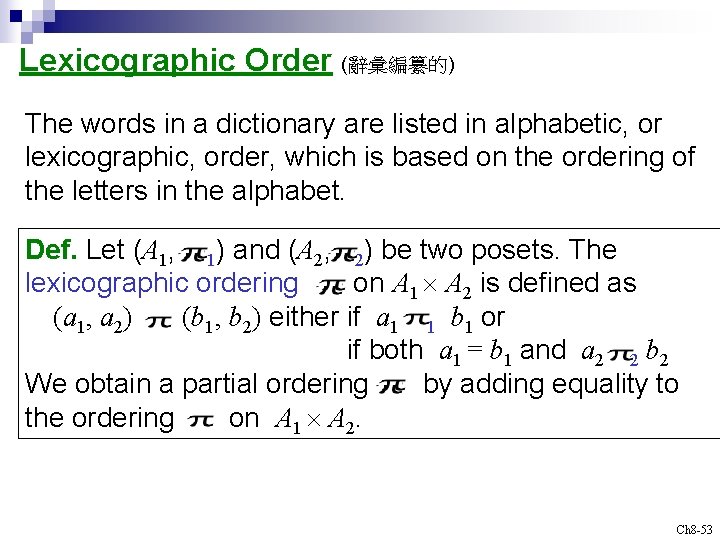
Lexicographic Order (辭彙編纂的) The words in a dictionary are listed in alphabetic, or lexicographic, order, which is based on the ordering of the letters in the alphabet. Def. Let (A 1, 1) and (A 2, 2) be two posets. The lexicographic ordering on A 1 A 2 is defined as (a 1, a 2) (b 1, b 2) either if a 1 1 b 1 or if both a 1 = b 1 and a 2 2 b 2 We obtain a partial ordering by adding equality to the ordering on A 1 A 2. Ch 8 -53
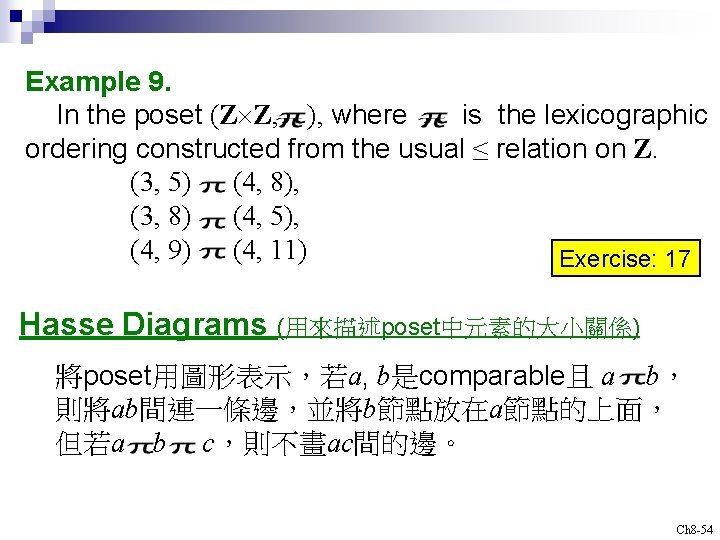
Example 9. In the poset (Z Z, ), where is the lexicographic ordering constructed from the usual ≤ relation on Z. (3, 5) (4, 8), (3, 8) (4, 5), (4, 9) (4, 11) Exercise: 17 Hasse Diagrams (用來描述poset中元素的大小關係) 將poset用圖形表示,若a, b是comparable且 a b, 則將ab間連一條邊,並將b節點放在a節點的上面, 但若a b c,則不畫ac間的邊。 Ch 8 -54
Example 12. Draw the Hasse diagram representing the partial ordering {(a, b) | a divides b} on {1, 2, 3, 4, 6, 8, 12}. Sol : 8 12 4 6 2 3 1 Ch 8 -55
Example 13. Draw the Hasse diagram for the partial ordering {(A, B) | A B} on the power set P(S) where S={a, b, c}. Sol : {a, b, c} {a} {a, b} {c} {b, c} {b} Exercise: 23 Ch 8 -56
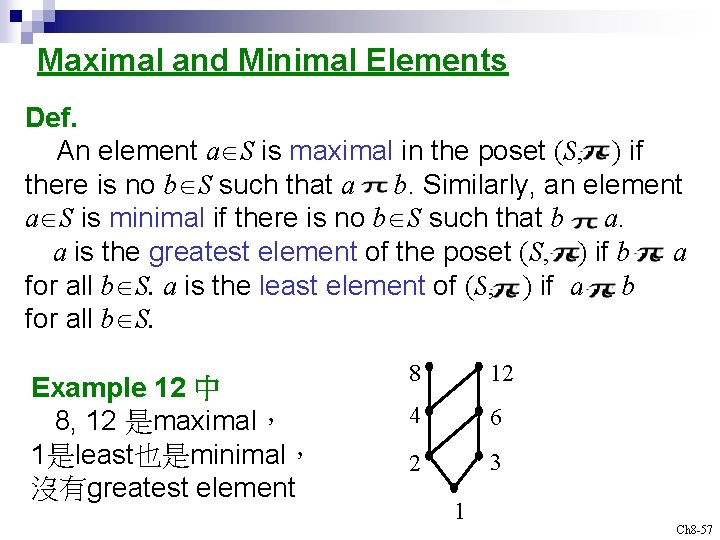
Maximal and Minimal Elements Def. An element a S is maximal in the poset (S, ) if there is no b S such that a b. Similarly, an element a S is minimal if there is no b S such that b a. a is the greatest element of the poset (S, ) if b a for all b S. a is the least element of (S, ) if a b for all b S. Example 12 中 8, 12 是maximal, 1是least也是minimal, 沒有greatest element 8 12 4 6 2 3 1 Ch 8 -57
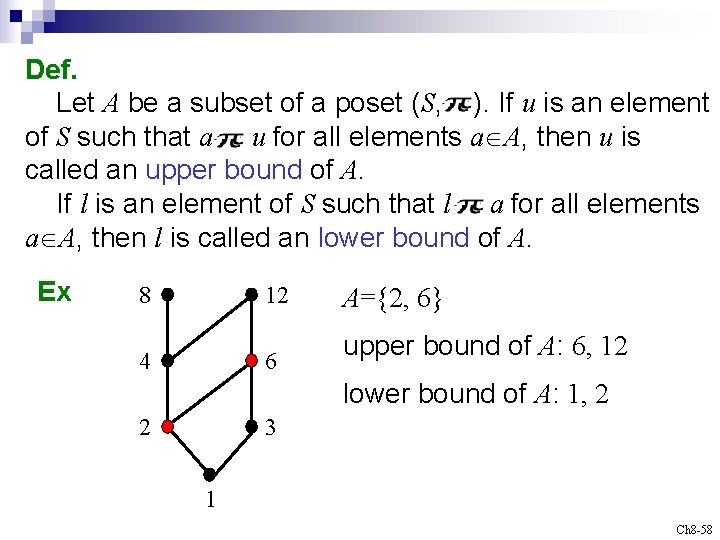
Def. Let A be a subset of a poset (S, ). If u is an element of S such that a u for all elements a A, then u is called an upper bound of A. If l is an element of S such that l a for all elements a A, then l is called an lower bound of A. Ex 8 12 4 6 A={2, 6} upper bound of A: 6, 12 lower bound of A: 1, 2 2 3 1 Ch 8 -58
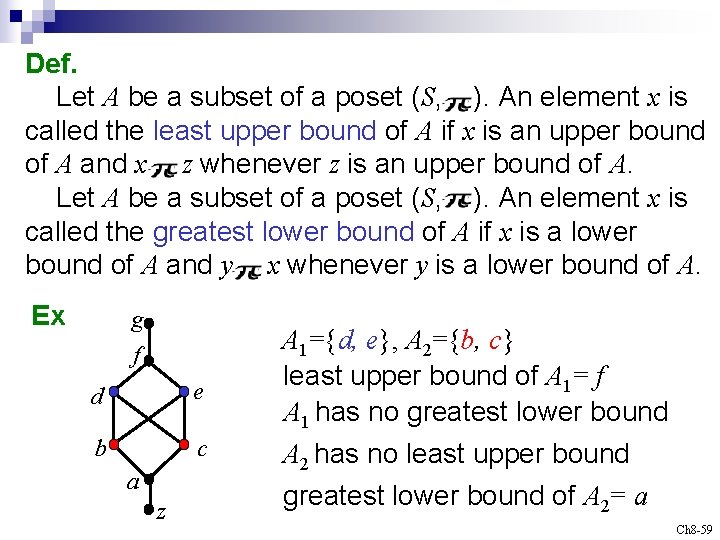
Def. Let A be a subset of a poset (S, ). An element x is called the least upper bound of A if x is an upper bound of A and x z whenever z is an upper bound of A. Let A be a subset of a poset (S, ). An element x is called the greatest lower bound of A if x is a lower bound of A and y x whenever y is a lower bound of A. Ex g f d e b c a z A 1={d, e}, A 2={b, c} least upper bound of A 1= f A 1 has no greatest lower bound A 2 has no least upper bound greatest lower bound of A 2= a Ch 8 -59
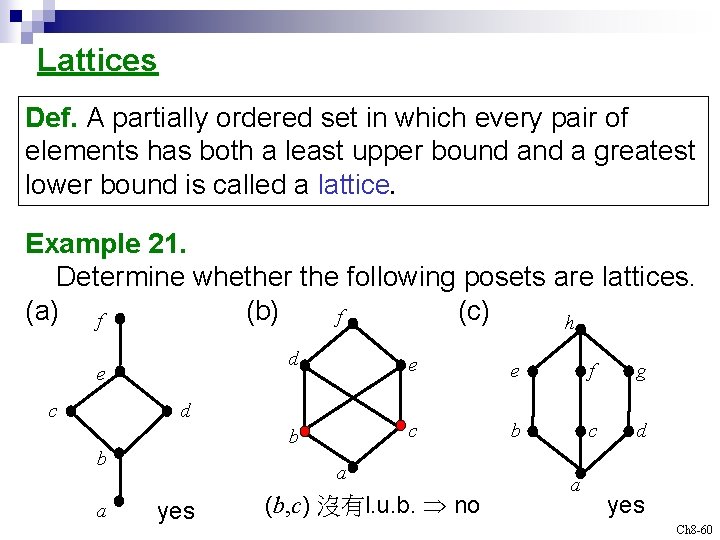
Lattices Def. A partially ordered set in which every pair of elements has both a least upper bound a greatest lower bound is called a lattice. Example 21. Determine whether the following posets are lattices. (a) f (b) (c) f h e c d e e f g b c d d b a a yes (b, c) 沒有l. u. b. no a yes Ch 8 -60
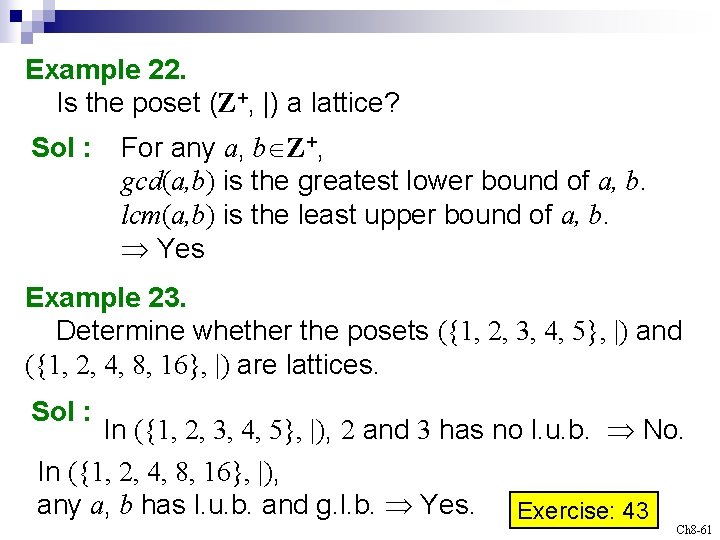
Example 22. Is the poset (Z+, |) a lattice? Sol : For any a, b Z+, gcd(a, b) is the greatest lower bound of a, b. lcm(a, b) is the least upper bound of a, b. Yes Example 23. Determine whether the posets ({1, 2, 3, 4, 5}, |) and ({1, 2, 4, 8, 16}, |) are lattices. Sol : In ({1, 2, 3, 4, 5}, |), 2 and 3 has no l. u. b. No. In ({1, 2, 4, 8, 16}, |), any a, b has l. u. b. and g. l. b. Yes. Exercise: 43 Ch 8 -61
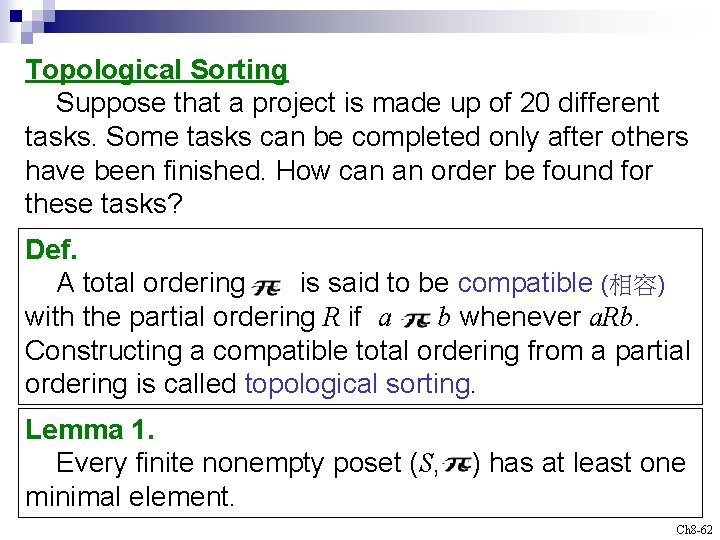
Topological Sorting Suppose that a project is made up of 20 different tasks. Some tasks can be completed only after others have been finished. How can an order be found for these tasks? Def. A total ordering is said to be compatible (相容) with the partial ordering R if a b whenever a. Rb. Constructing a compatible total ordering from a partial ordering is called topological sorting. Lemma 1. Every finite nonempty poset (S, minimal element. ) has at least one Ch 8 -62
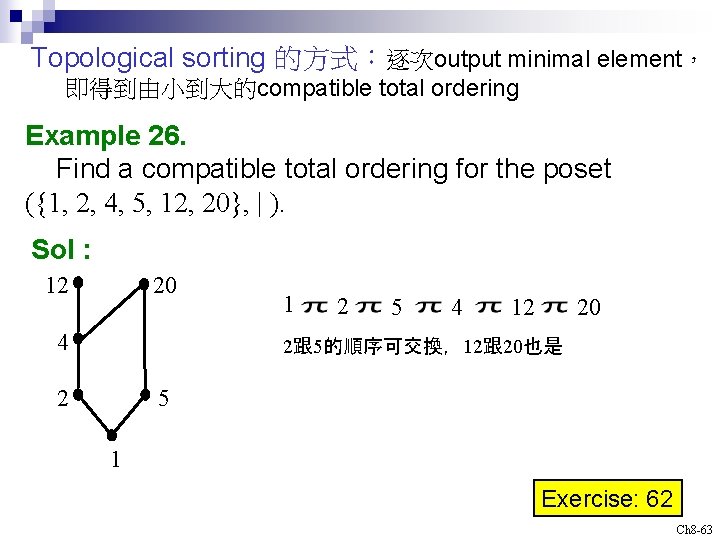
Topological sorting 的方式:逐次output minimal element, 即得到由小到大的compatible total ordering Example 26. Find a compatible total ordering for the poset ({1, 2, 4, 5, 12, 20}, | ). Sol : 20 12 4 1 2 5 4 12 20 2跟 5的順序可交換,12跟 20也是 5 2 1 Exercise: 62 Ch 8 -63