
Discrete Math Lecture 11 Last Week Strict Partial








- Slides: 45
מתמטיקה בדידה Discrete Math Lecture 11
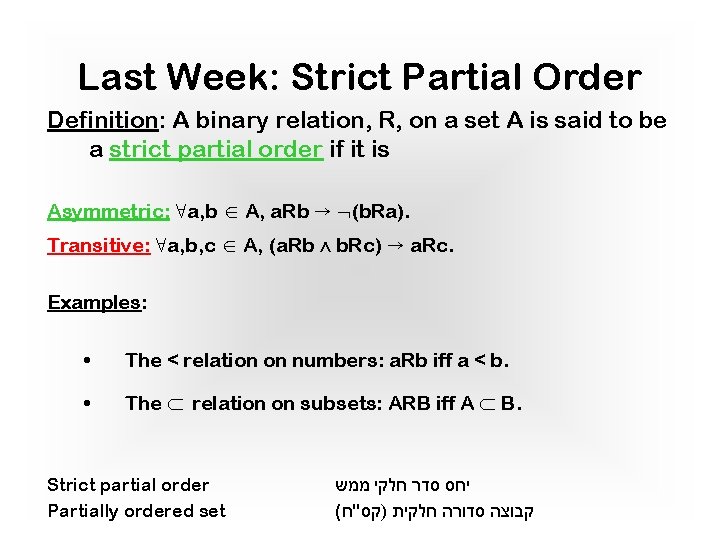
Last Week: Strict Partial Order Definition: A binary relation, R, on a set A is said to be a strict partial order if it is Asymmetric: ∀a, b A, a. Rb → (b. Ra). Transitive: ∀a, b, c A, (a. Rb ∧ b. Rc) → a. Rc. Examples: • The < relation on numbers: a. Rb iff a < b. • The relation on subsets: ARB iff A B. Strict partial order Partially ordered set יחס סדר חלקי ממש ( קבוצה סדורה חלקית )קס"ח
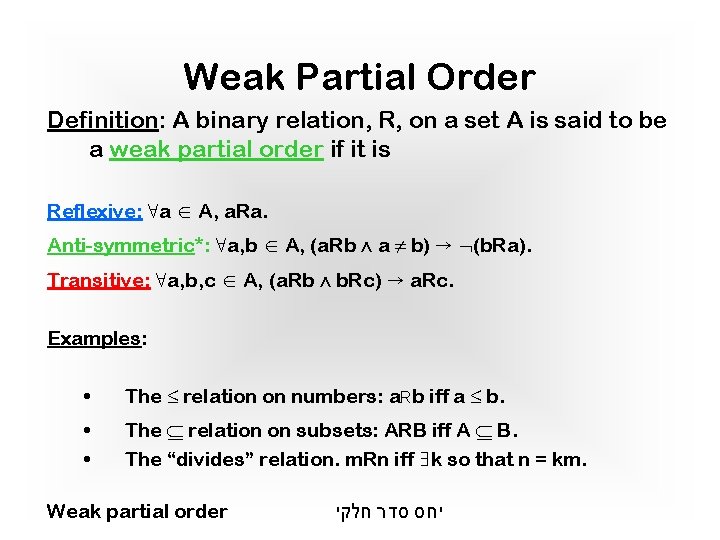
Weak Partial Order Definition: A binary relation, R, on a set A is said to be a weak partial order if it is Reflexive: ∀a A, a. Ra. Anti-symmetric*: ∀a, b A, (a. Rb ∧ a ≠ b) → (b. Ra). Transitive: ∀a, b, c A, (a. Rb ∧ b. Rc) → a. Rc. Examples: • The ≤ relation on numbers: a. Rb iff a ≤ b. • • The relation on subsets: ARB iff A B. The “divides” relation. m. Rn iff ∃k so that n = km. Weak partial order יחס סדר חלקי
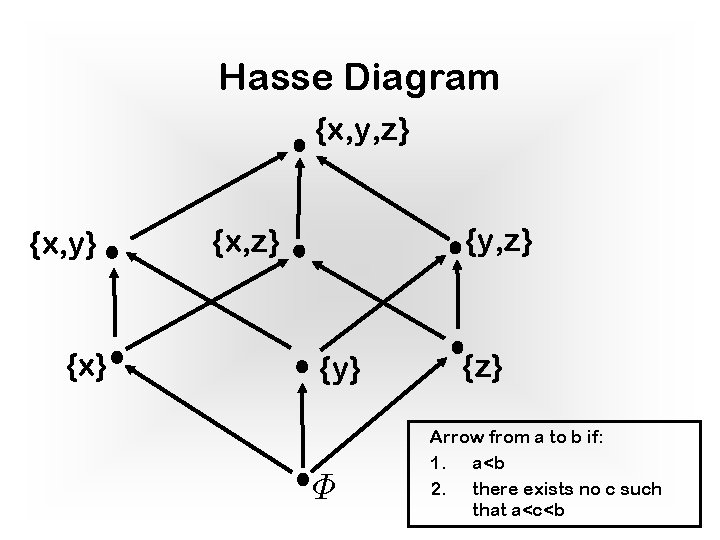
Hasse Diagram {x, y, z} {x, y} {x} {y, z} {x, z} {y} © {z} Arrow from a to b if: 1. a<b 2. there exists no c such that a<c<b
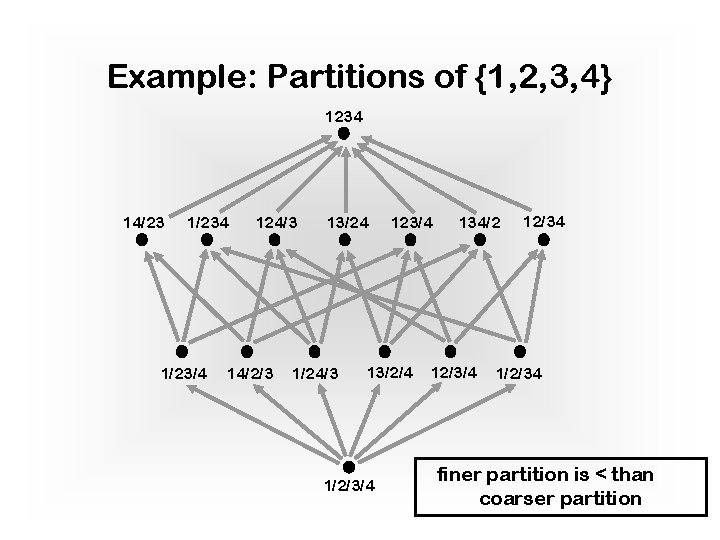
Example: Partitions of {1, 2, 3, 4} 1234 14/23 1/234 1/23/4 124/3 14/2/3 13/24 1/24/3 123/4 13/2/4 1/2/3/4 134/2 12/3/4 12/34 1/2/34 finer partition is < than coarser partition
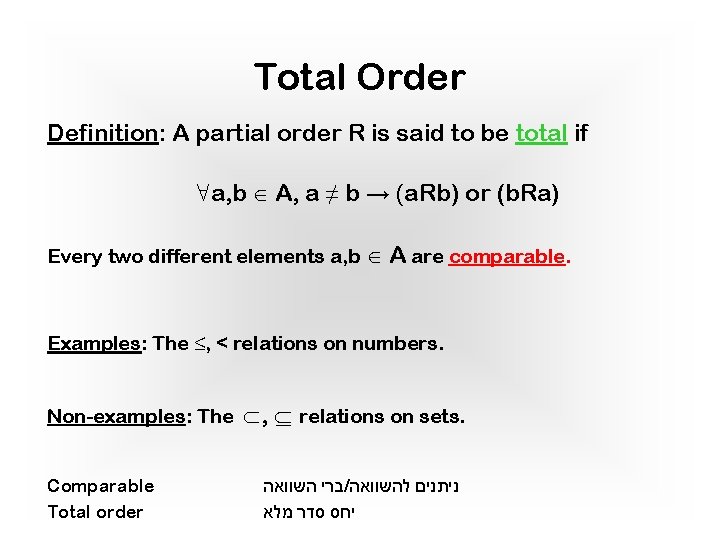
Total Order Definition: A partial order R is said to be total if ∀a, b A, a ≠ b → (a. Rb) or (b. Ra) Every two different elements a, b A are comparable. Examples: The ≤, < relations on numbers. Non-examples: The Comparable Total order , relations on sets. ברי השוואה / ניתנים להשוואה יחס סדר מלא
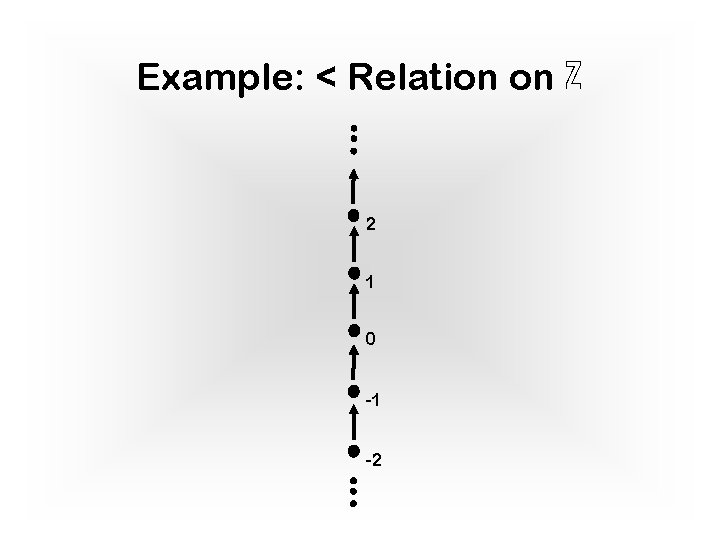
Example: < Relation on ℤ 2 1 0 -1 -2
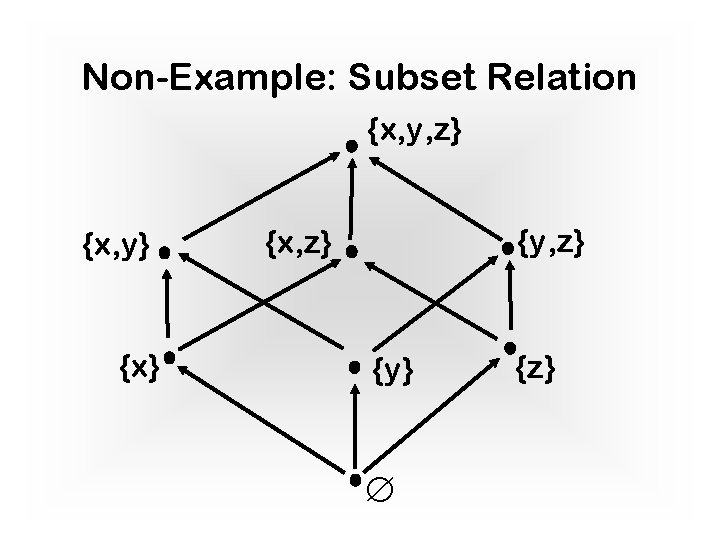
Non-Example: Subset Relation {x, y, z} {x, y} {x} {y, z} {x, z} {y} {z}
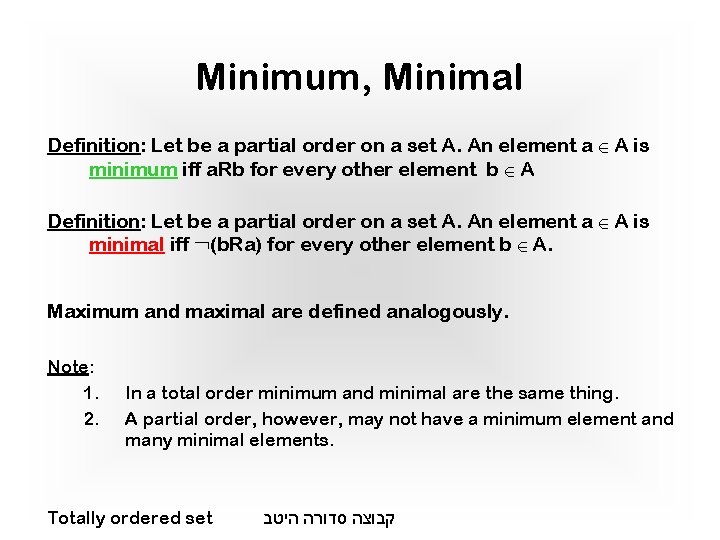
Minimum, Minimal Definition: Let be a partial order on a set A. An element a 2 A is minimum iff a. Rb for every other element b 2 A Definition: Let be a partial order on a set A. An element a 2 A is minimal iff : (b. Ra) for every other element b 2 A. Maximum and maximal are defined analogously. Note: 1. 2. In a total order minimum and minimal are the same thing. A partial order, however, may not have a minimum element and many minimal elements. Totally ordered set קבוצה סדורה היטב
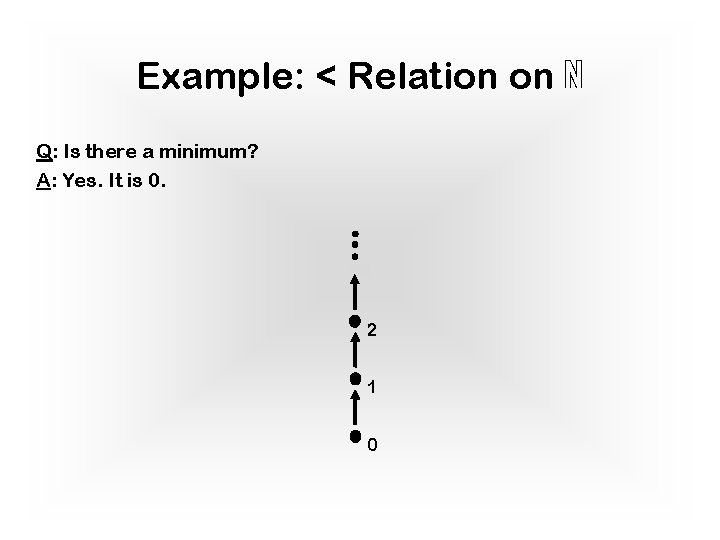
Example: < Relation on ℕ Q: Is there a minimum? A: Yes. It is 0. 2 1 0
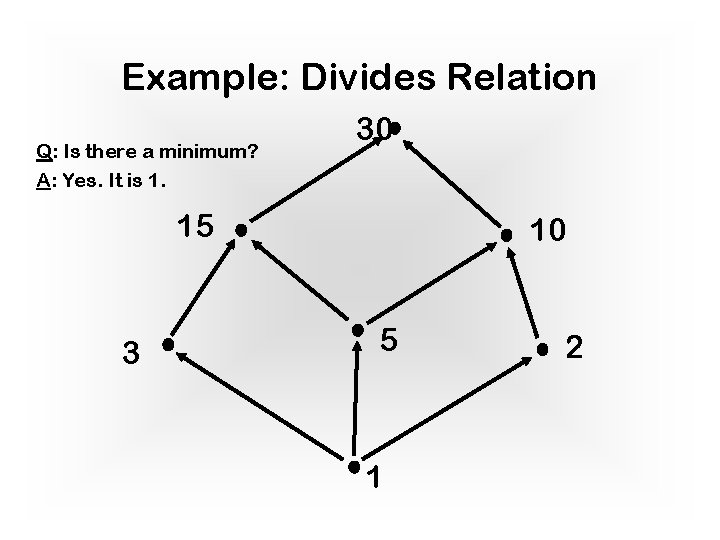
Example: Divides Relation Q: Is there a minimum? A: Yes. It is 1. 30 15 3 10 5 1 2
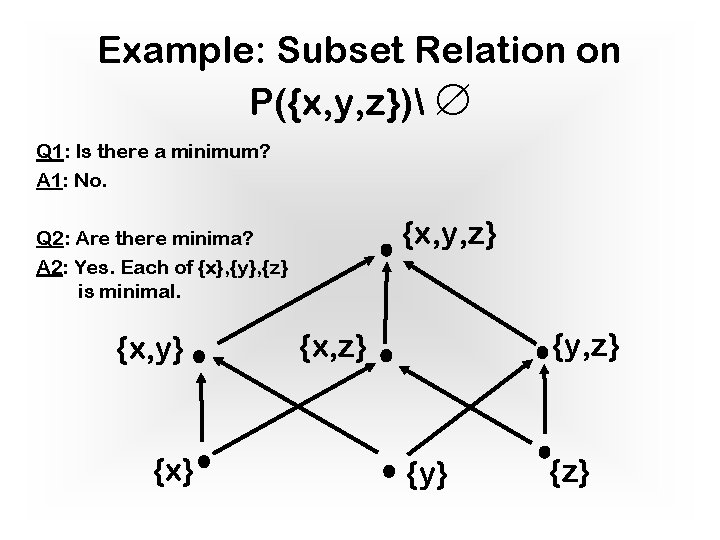
Example: Subset Relation on P({x, y, z}) Q 1: Is there a minimum? A 1: No. {x, y, z} Q 2: Are there minima? A 2: Yes. Each of {x}, {y}, {z} is minimal. {x, y} {x} {y, z} {x, z} {y} {z}
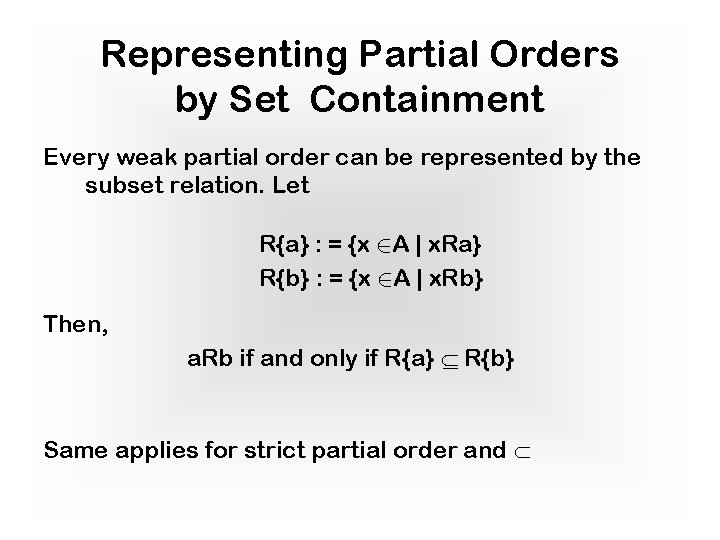
Representing Partial Orders by Set Containment Every weak partial order can be represented by the subset relation. Let Then, R{a} : = {x 2 A | x. Ra} R{b} : = {x 2 A | x. Rb} a. Rb if and only if R{a} R{b} Same applies for strict partial order and
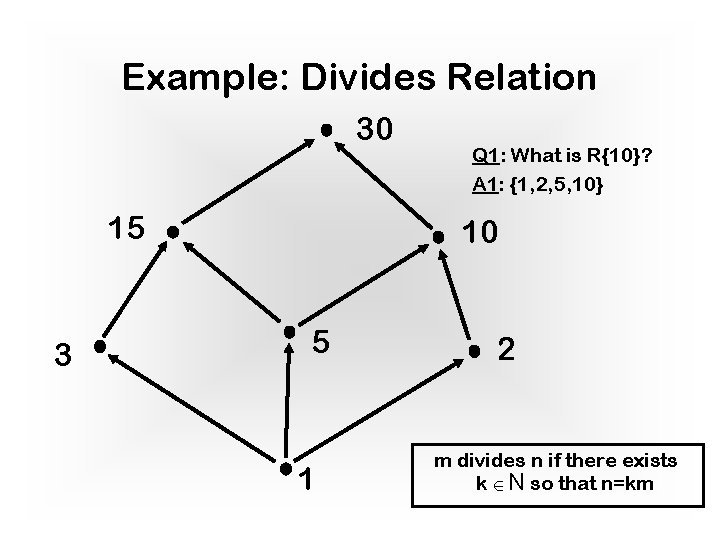
Example: Divides Relation 30 15 3 Q 1: What is R{10}? A 1: {1, 2, 5, 10} 10 5 1 2 m divides n if there exists k 2 N so that n=km
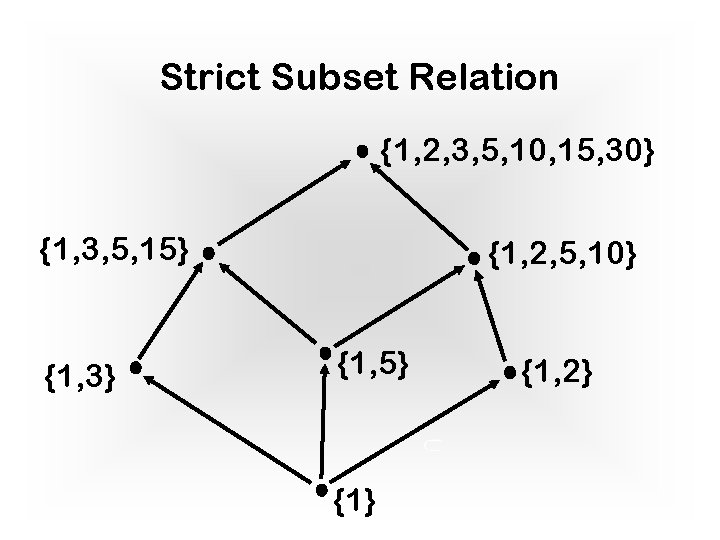
Strict Subset Relation {1, 2, 3, 5, 10, 15, 30} {1, 3, 5, 15} {1, 3} {1, 2, 5, 10} {1, 5} {1, 2}
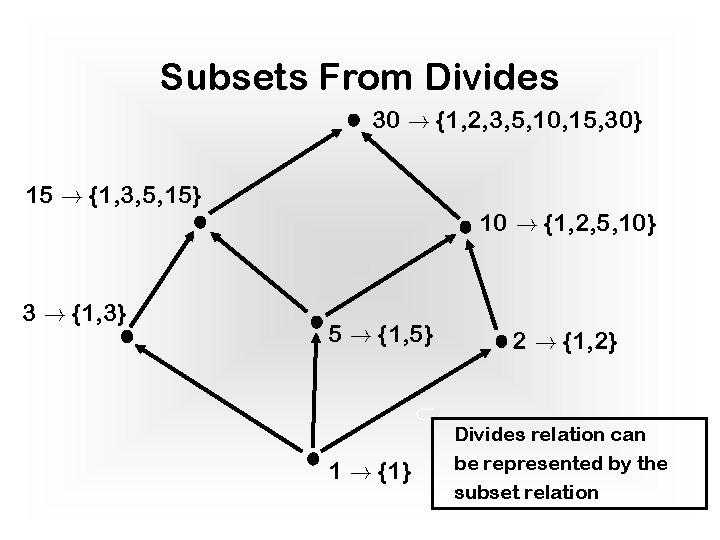
Subsets From Divides 30 ! {1, 2, 3, 5, 10, 15, 30} 15 ! {1, 3, 5, 15} 3 ! {1, 3} 10 ! {1, 2, 5, 10} 5 ! {1, 5} 1 ! {1} 2 ! {1, 2} Divides relation can be represented by the subset relation
An Application: Scheduling Problems 1. Transitive Closure 2. Topological sorting 3. Chains/antichains
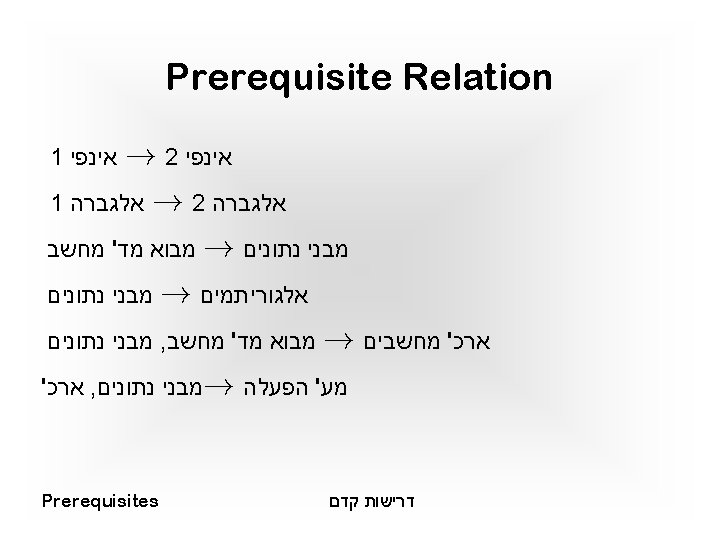
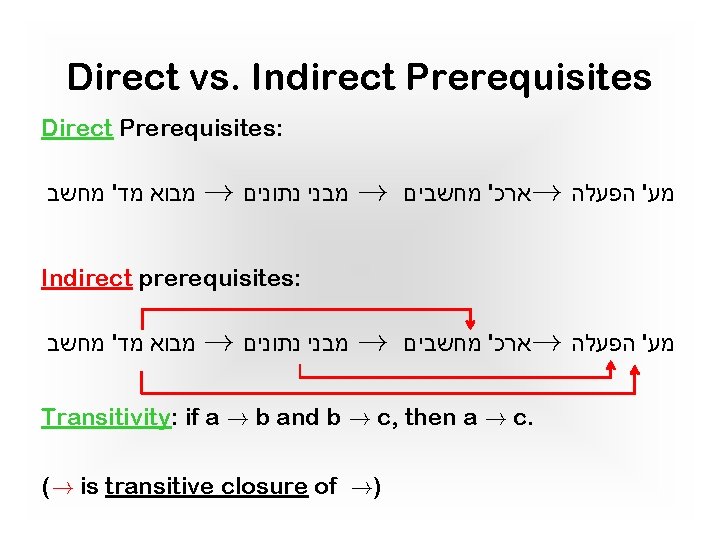
Direct vs. Indirect Prerequisites Direct Prerequisites: מבני נתונים ! מבוא מד' מחשב ! מע' הפעלה !ארכ' מחשבים Indirect prerequisites: מבני נתונים ! מבוא מד' מחשב Transitivity: if a ! b and b ! c, then a ! c. (! is transitive closure of !)
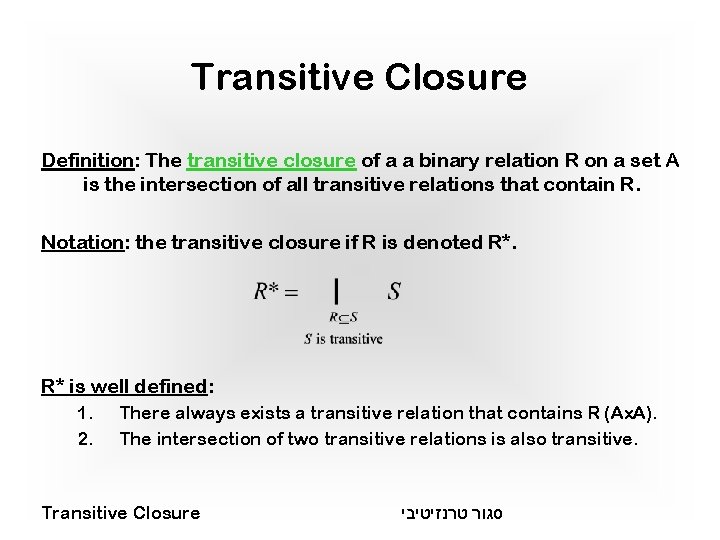
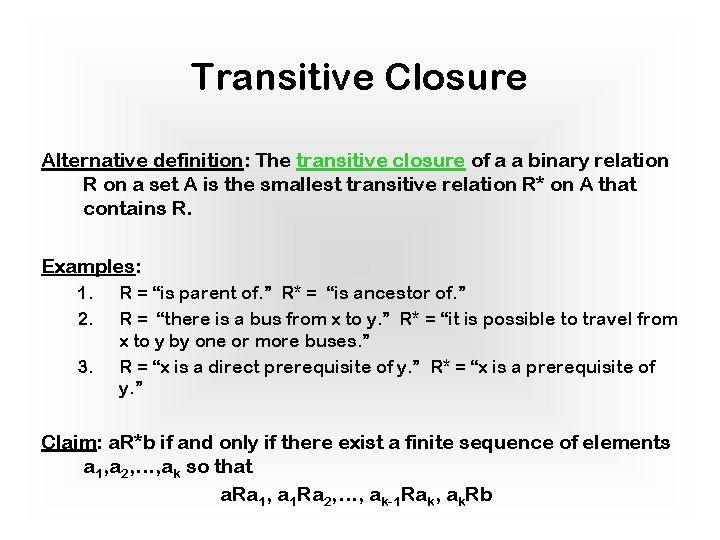
Transitive Closure Definition: The transitive closure of a a binary relation R on a set A is the intersection of all transitive relations that contain R. Notation: the transitive closure if R is denoted R*. R* is well defined: 1. 2. There always exists a transitive relation that contains R (Ax. A). The intersection of two transitive relations is also transitive. Transitive Closure סגור טרנזיטיבי
Transitive Closure Alternative definition: The transitive closure of a a binary relation R on a set A is the smallest transitive relation R* on A that contains R. Examples: 1. 2. 3. R = “is parent of. ” R* = “is ancestor of. ” R = “there is a bus from x to y. ” R* = “it is possible to travel from x to y by one or more buses. ” R = “x is a direct prerequisite of y. ” R* = “x is a prerequisite of y. ” Claim: a. R*b if and only if there exist a finite sequence of elements a 1, a 2, …, ak so that a. Ra 1, a 1 Ra 2, …, ak-1 Rak, ak. Rb
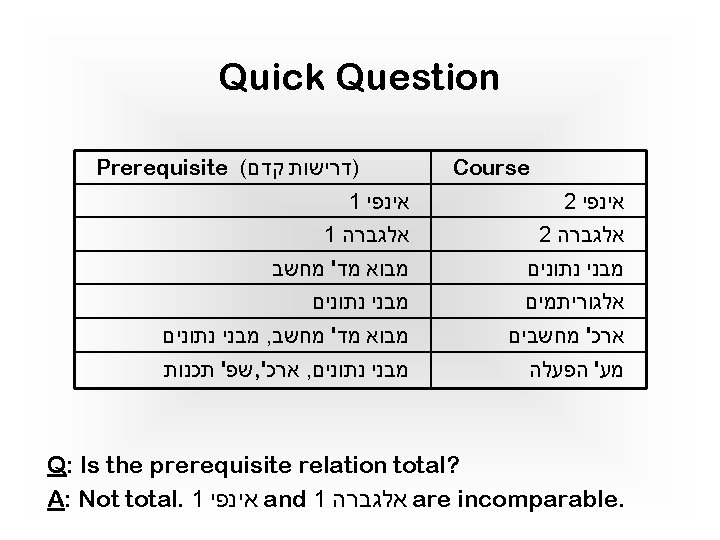
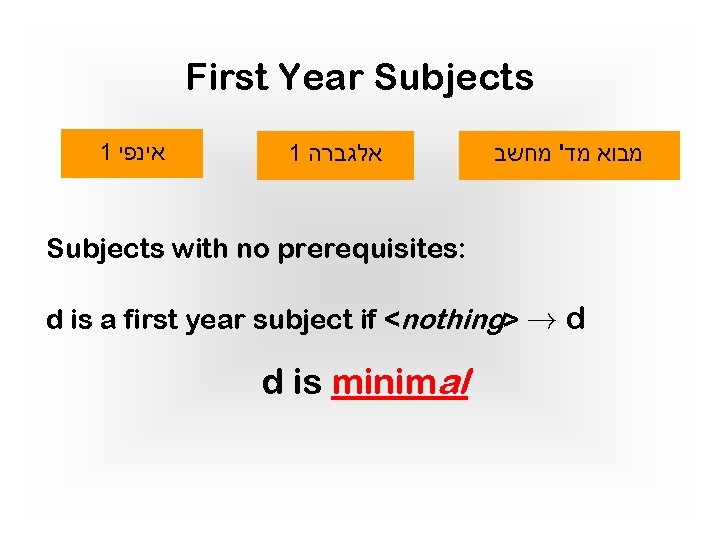
First Year Subjects 1 אינפי 1 אלגברה מבוא מד' מחשב Subjects with no prerequisites: d is a first year subject if <nothing> ! d d is minimal
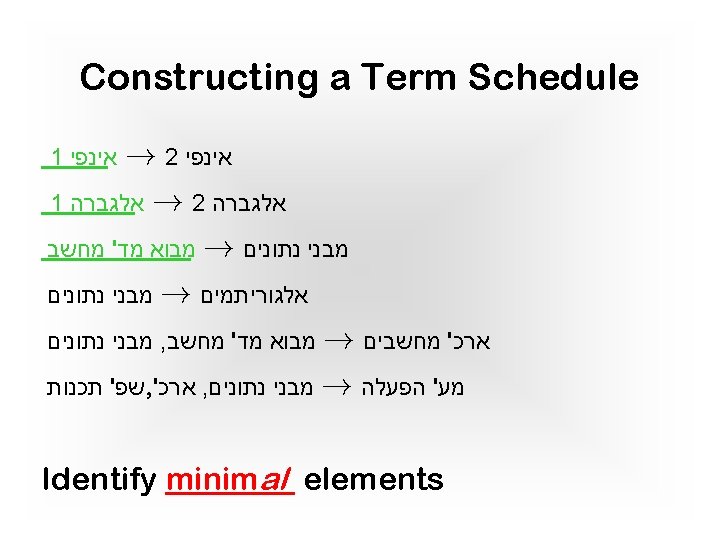
Constructing a Term Schedule II 1 אינפי 1 אלגברה מבוא מד' מחשב Start schedule with minimal elements
Constructing a Term Schedule V 2 אינפי 2 אלגברה מבני נתונים 1 אינפי 1 אלגברה מבוא מד' מחשב Schedule them next, and so on…
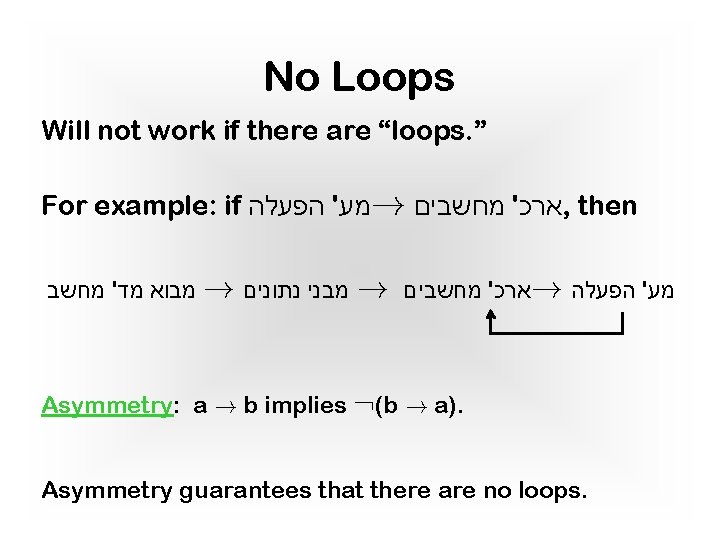
No Loops Will not work if there are “loops. ” For example: if ארכ' מחשבים !מע' הפעלה , then מבני נתונים ! מבוא מד' מחשב ! מע' הפעלה !ארכ' מחשבים Asymmetry: a ! b implies : (b ! a). Asymmetry guarantees that there are no loops.
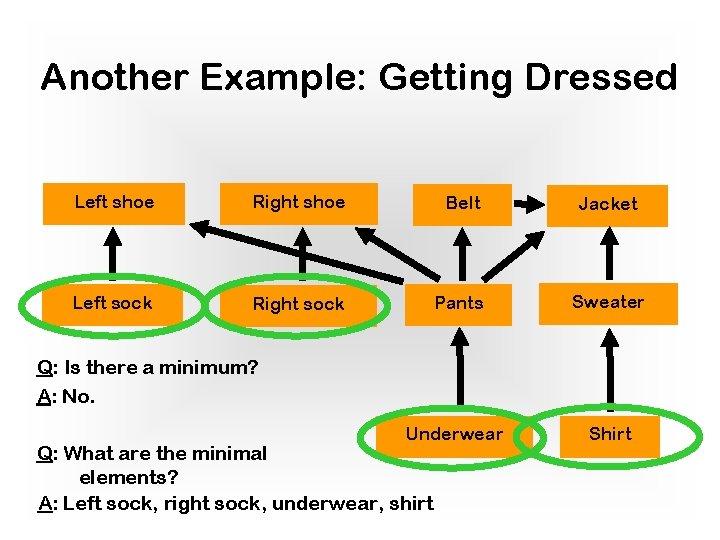
Another Example: Getting Dressed Left shoe Right shoe Belt Jacket Left sock Right sock Pants Sweater Underwear Shirt Q: Is there a minimum? A: No. Q: What are the minimal elements? A: Left sock, right sock, underwear, shirt
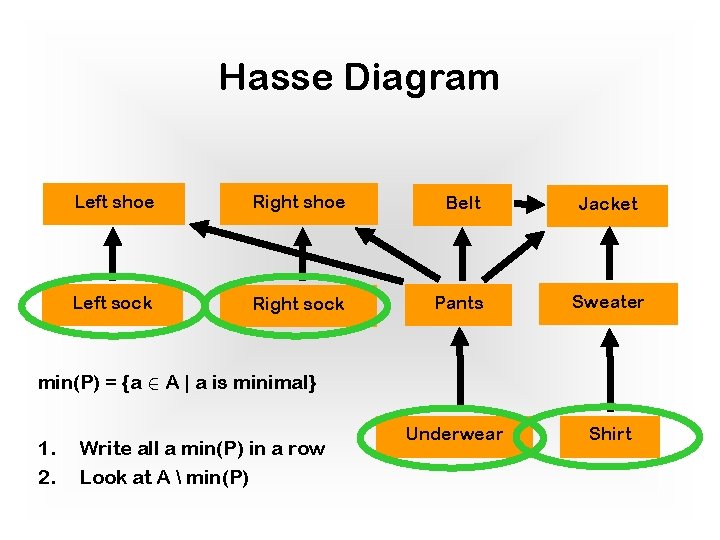
Hasse Diagram Left shoe Right shoe Belt Jacket Left sock Right sock Pants Sweater Underwear Shirt min(P) = {a 2 A | a is minimal} 1. 2. Write all a min(P) in a row Look at A min(P)
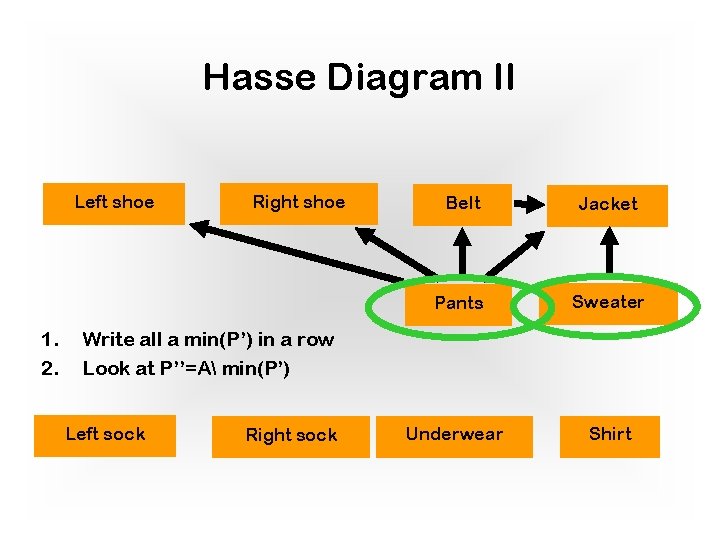
Hasse Diagram II Left shoe 1. 2. Right shoe Belt Jacket Pants Sweater Underwear Shirt Write all a min(P’) in a row Look at P’’=A min(P’) Left sock Right sock
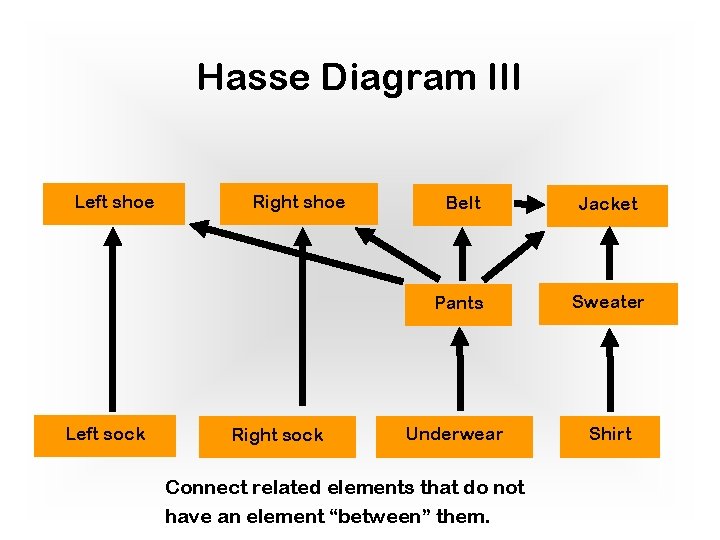
Hasse Diagram III Left shoe Left sock Right shoe Right sock Belt Jacket Pants Sweater Underwear Shirt Connect related elements that do not have an element “between” them.
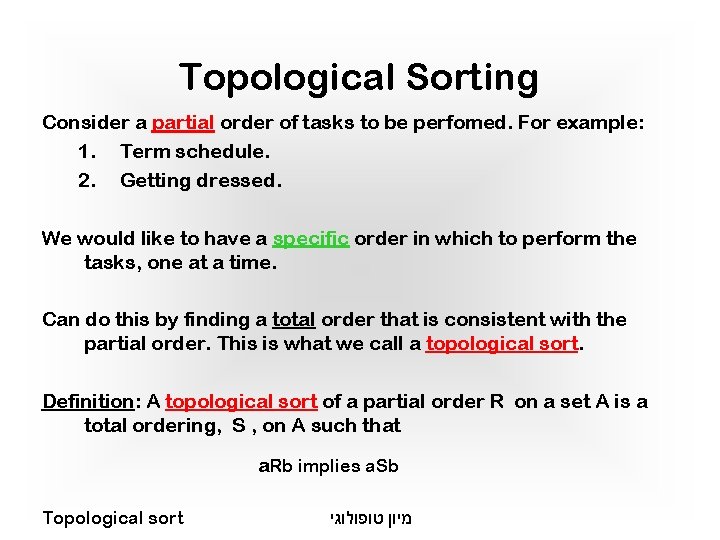
Topological Sorting Consider a partial order of tasks to be perfomed. For example: 1. Term schedule. 2. Getting dressed. We would like to have a specific order in which to perform the tasks, one at a time. Can do this by finding a total order that is consistent with the partial order. This is what we call a topological sort. Definition: A topological sort of a partial order R on a set A is a total ordering, S , on A such that a. Rb implies a. Sb Topological sort מיון טופולוגי
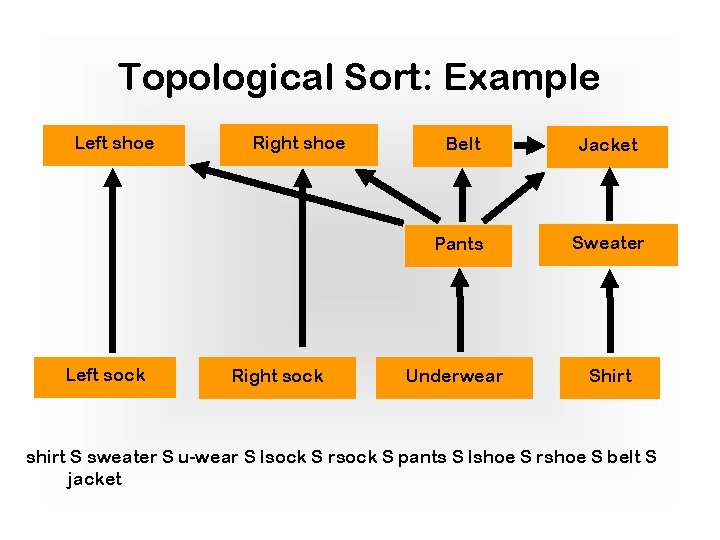
Topological Sort: Example Left shoe Left sock Right shoe Right sock Belt Jacket Pants Sweater Underwear Shirt shirt S sweater S u-wear S lsock S rsock S pants S lshoe S rshoe S belt S jacket
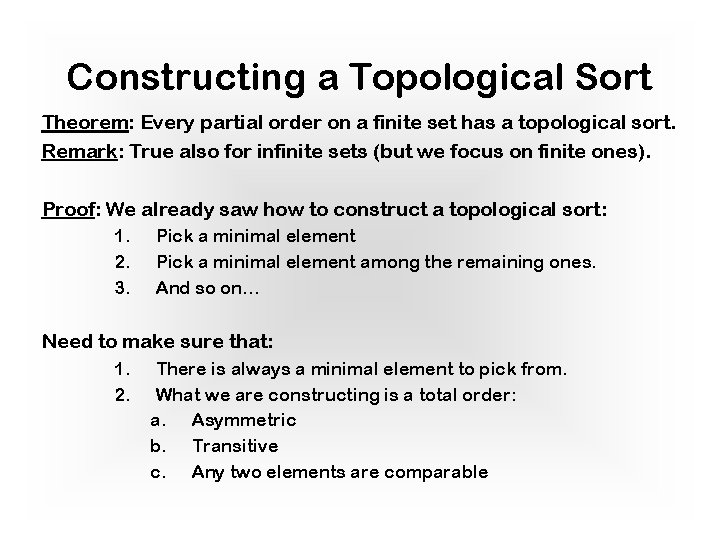
Constructing a Topological Sort Theorem: Every partial order on a finite set has a topological sort. Remark: True also for infinite sets (but we focus on finite ones). Proof: We already saw how to construct a topological sort: 1. 2. 3. Pick a minimal element among the remaining ones. And so on… Need to make sure that: 1. 2. There is always a minimal element to pick from. What we are constructing is a total order: a. Asymmetric b. Transitive c. Any two elements are comparable
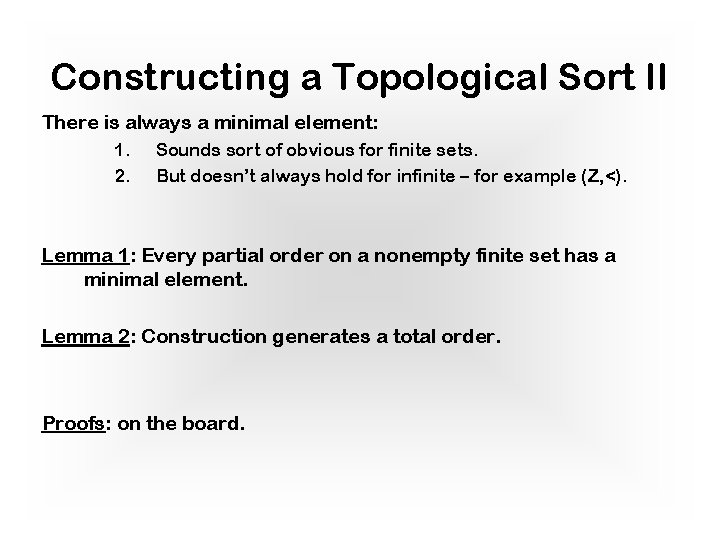
Constructing a Topological Sort II There is always a minimal element: 1. 2. Sounds sort of obvious for finite sets. But doesn’t always hold for infinite – for example (Z, <). Lemma 1: Every partial order on a nonempty finite set has a minimal element. Lemma 2: Construction generates a total order. Proofs: on the board.
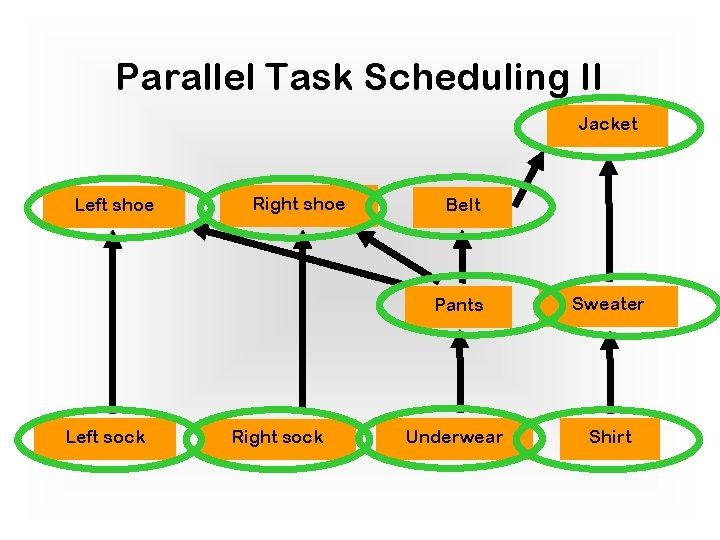
Parallel Task Scheduling Topological sorting - tasks are executed sequentially. What if we can execute more than one task at a time? For example, suppose we have a parallel machine. Want to minimize the total time to complete the tasks. Sequentially In parallel סדרתית במקביל
Parallel Task Scheduling II Jacket Left shoe Left sock Right shoe Right sock Belt Pants Sweater Underwear Shirt
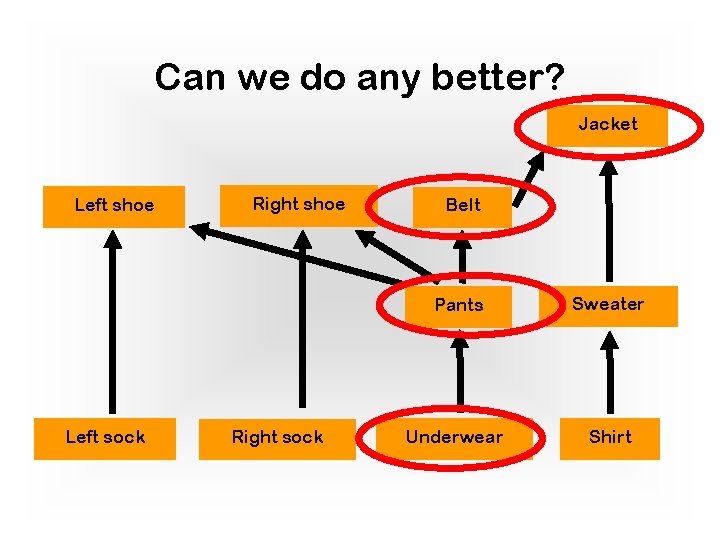
Can we do any better? Jacket Left shoe Left sock Right shoe Right sock Belt Pants Sweater Underwear Shirt
Chain Definition: A chain in a partial order is a set of elements such that any two elements in the set are comparable Terminology: A largest chain is also known as a critical path. min parallel time ≥ max chain size Can also show that min parallel time ≤ max chain size Corollary: min parallel time = max chain size. Chain שרשרת
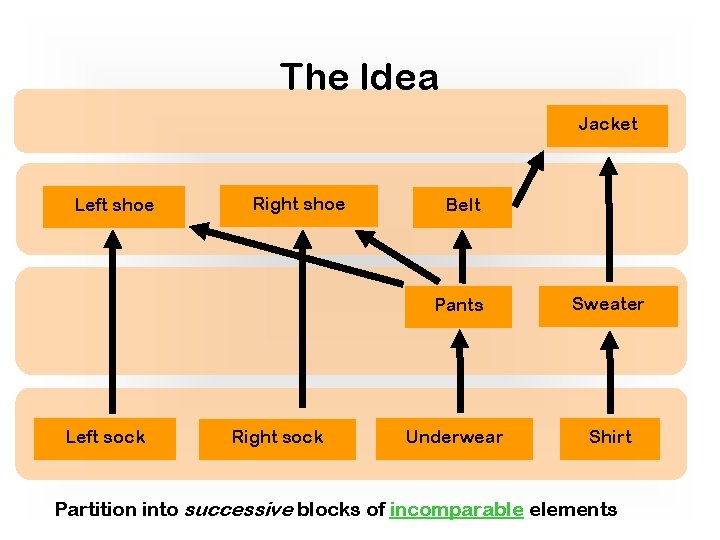
The Idea Jacket Left shoe Left sock Right shoe Right sock Belt Pants Sweater Underwear Shirt Partition into successive blocks of incomparable elements
Antichain Definition: An antichain in a partial order is a set of elements such that any two elements in the set are incomparable Corresponds to a “block. ” If the largest chain is of size t, then the domain can be partitioned into t antichains. Dilworth’s Lemma: For all t > 0, every poset with n elements must have either: 1. A chain of size > t, OR 2. An antichain of size ≥ n/t. Antichain שרשרת - אנטי
Dilworth’s Lemma: Example Dilworth’s Lemma: For all t > 0, every poset with n elements must have either: 1. A chain of size > t, OR 2. An antichain of size ≥ n/t. In the “getting dressed” poset, set n = 10 1. For t = 3, there is a chain of size 4. 2. For t = 4, there is no chain of size 5, there is an antichain of size 4 ≥ 10/4. but