
Discrete Math II Graph Theory Howon Kim 2019
- Slides: 57
Discrete Math II - Graph Theory - Howon Kim 2019. 11.
Agenda n n n 11. 1 Definitions 11. 2 Subgraphs, Complements, & Graph Isomorphism 11. 3 Vertex Degree: Euler Trails & Circuits n 11. 4 Planar Graphs n Next… 2
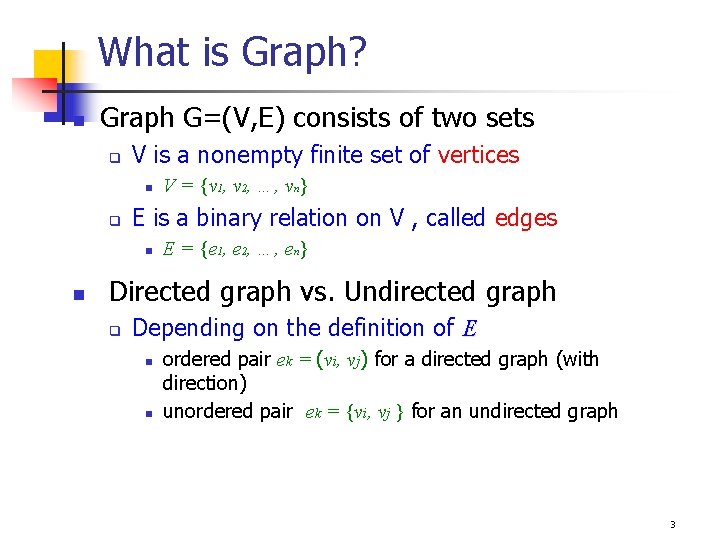
What is Graph? n Graph G=(V, E) consists of two sets V is a nonempty finite set of vertices n E is a binary relation on V , called edges n n V = {v 1, v 2, …, vn} E = {e 1, e 2, …, en} Directed graph vs. Undirected graph Depending on the definition of E n n ordered pair ek = (vi, vj) for a directed graph (with direction) unordered pair ek = {vi, vj } for an undirected graph 3
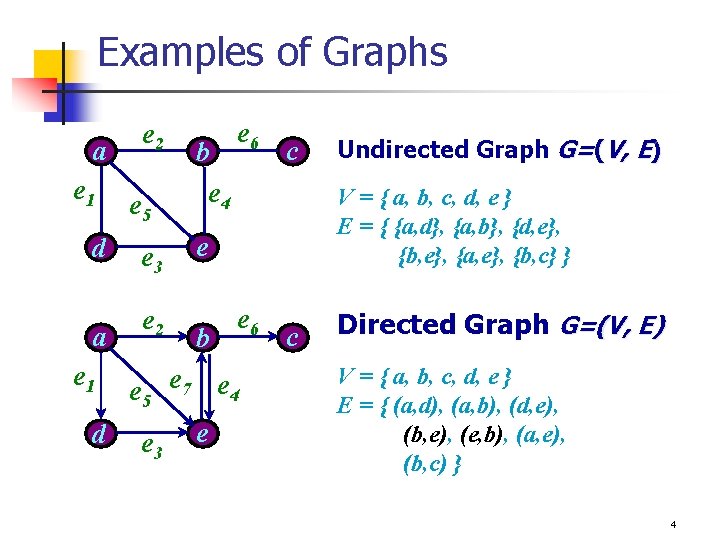
Examples of Graphs a e 1 e 2 e 5 d e 3 a e 2 e 1 b e 4 e 6 e b Undirected Graph G=(V, E) V = { a, b, c, d, e } E = { {a, d}, {a, b}, {d, e}, {b, e}, {a, e}, {b, c} } e 6 e 5 e 7 e 4 e d e 3 c c Directed Graph G=(V, E) V = { a, b, c, d, e } E = { (a, d), (a, b), (d, e), (b, e), (e, b), (a, e), (b, c) } 4
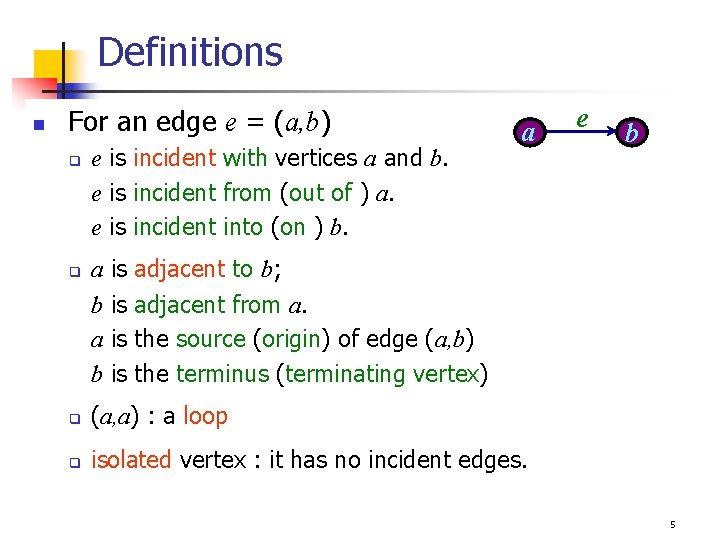
Definitions n For an edge e = (a, b) e is incident with vertices a and b. e is incident from (out of ) a. e is incident into (on ) b. a e b a is adjacent to b; b is adjacent from a. a is the source (origin) of edge (a, b) b is the terminus (terminating vertex) (a, a) : a loop isolated vertex : it has no incident edges. 5
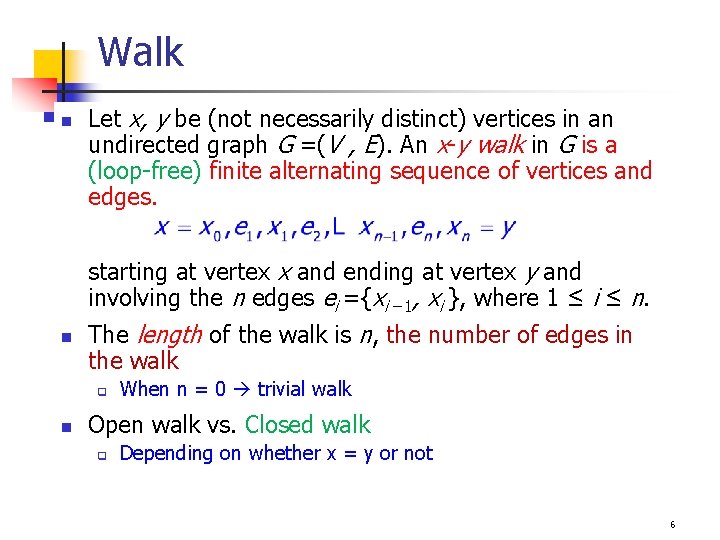
Walk n Let x, y be (not necessarily distinct) vertices in an undirected graph G =(V , E). An x-y walk in G is a (loop-free) finite alternating sequence of vertices and edges. starting at vertex x and ending at vertex y and involving the n edges ei ={xi − 1, xi }, where 1 ≤ i ≤ n. n The length of the walk is n, the number of edges in the walk n When n = 0 trivial walk Open walk vs. Closed walk Depending on whether x = y or not 6
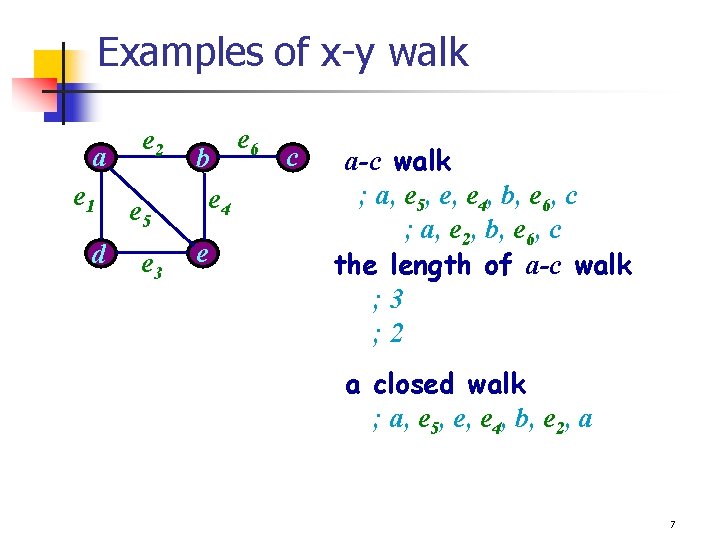
Examples of x-y walk a e 1 d e 2 e 5 e 3 b e 4 e e 6 c a-c walk ; a, e 5, e, e 4, b, e 6, c ; a, e 2, b, e 6, c the length of a-c walk ; 3 ; 2 a closed walk ; a, e 5, e, e 4, b, e 2, a 7
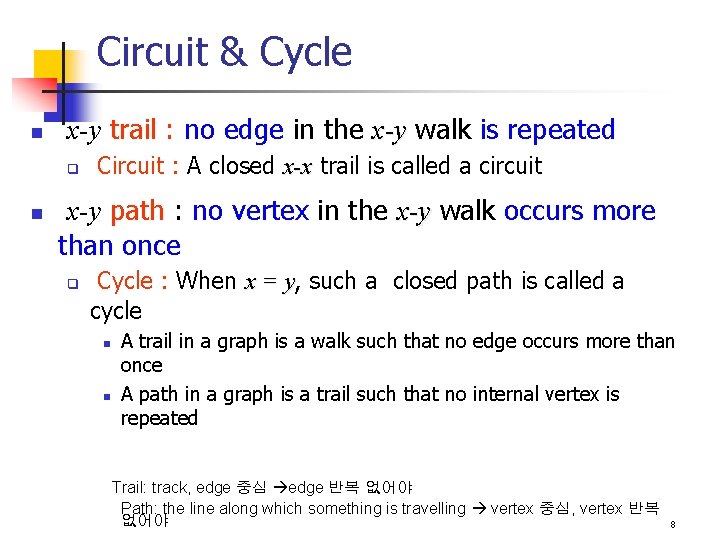
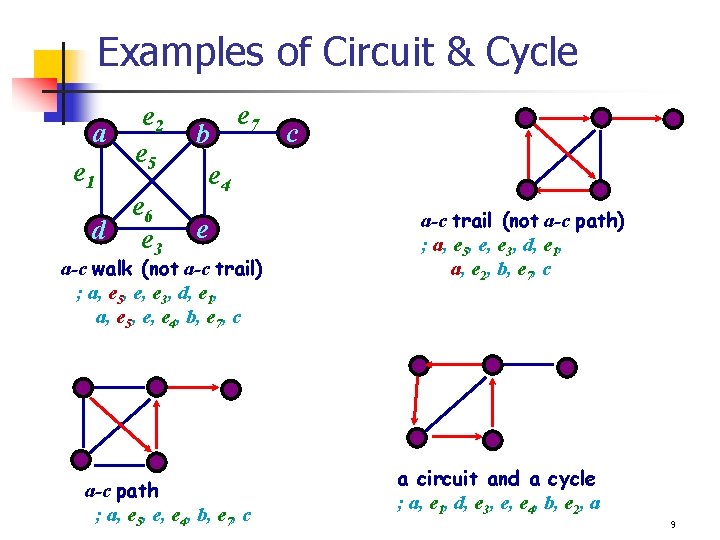
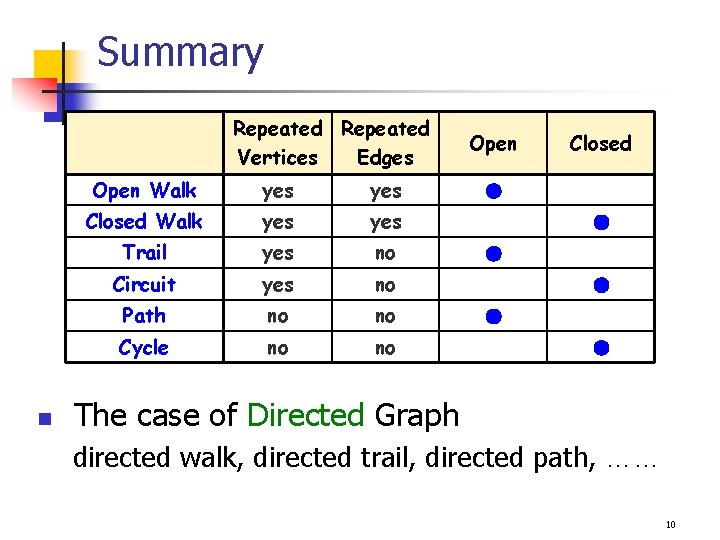
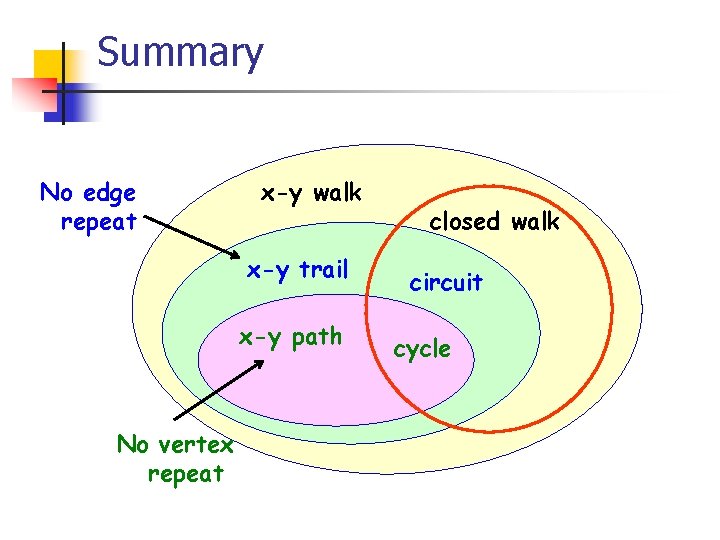
Circuit & Cycle n x-y trail : no edge in the x-y walk is repeated n Circuit : A closed x-x trail is called a circuit x-y path : no vertex in the x-y walk occurs more than once Cycle : When x = y, y such a closed path is called a cycle n n A trail in a graph is a walk such that no edge occurs more than once A path in a graph is a trail such that no internal vertex is repeated Trail: track, edge 중심 edge 반복 없어야 Path: the line along which something is travelling vertex 중심, vertex 반복 없어야 8
Examples of Circuit & Cycle e 2 a e 5 e 1 e 6 d e 3 b e 4 e 7 e a-c walk (not a-c trail) ; a, e 5, e, e 3, d, e 1, a, e 5, e, e 4, b, e 7, c a-c path ; a, e 5, e, e 4, b, e 7, c c a-c trail (not a-c path) ; a, e 5, e, e 3, d, e 1, a, e 2, b, e 7, c a circuit and a cycle ; a, e 1, d, e 3, e, e 4, b, e 2, a 9
Summary Repeated Vertices Edges n Open Walk yes Closed Walk yes Trail yes no Circuit yes no Path no no Cycle no no Open Closed ● ● ● The case of Directed Graph directed walk, directed trail, directed path, …… 10
Summary No edge repeat x-y walk x-y trail x-y path No vertex repeat closed walk circuit cycle
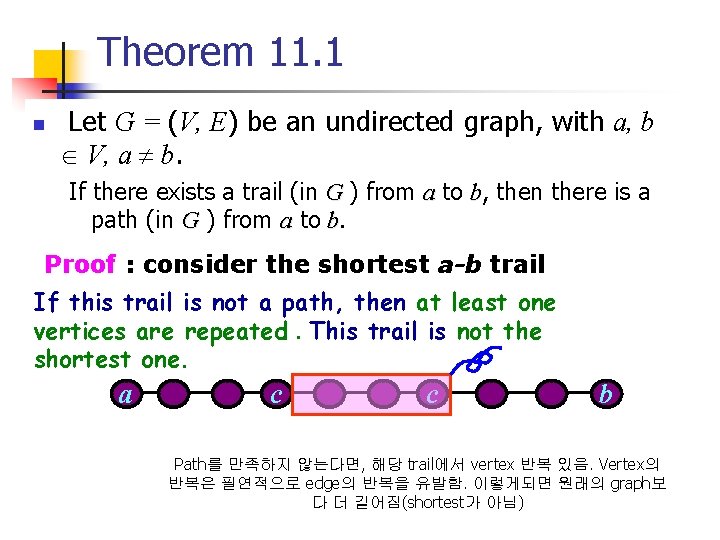
Theorem 11. 1 n Let G = (V, E) be an undirected graph, with a, b V, a b. If there exists a trail (in G ) from a to b, b then there is a path (in G ) from a to b. b Proof : consider the shortest a-b trail If this trail is not a path, then at least one vertices are repeated. This trail is not the shortest one. a c c b Path를 만족하지 않는다면, 해당 trail에서 vertex 반복 있음. Vertex의 반복은 필연적으로 edge의 반복을 유발함. 이렇게되면 원래의 graph보 다 더 길어짐(shortest가 아님)
Some other terminologies n Connected n Disconnected n Component n Multigraph 2020/11/6 13
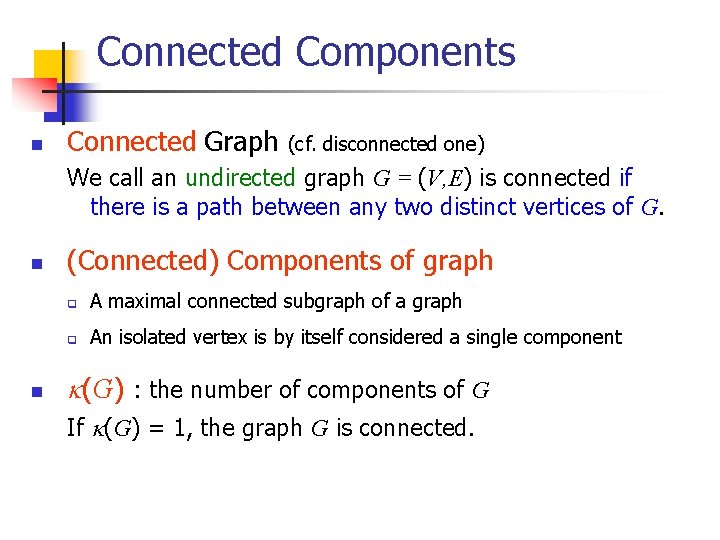
Connected Components n Connected Graph (cf. disconnected one) We call an undirected graph G = (V, E) is connected if there is a path between any two distinct vertices of G. n n (Connected) Components of graph A maximal connected subgraph of a graph An isolated vertex is by itself considered a single component (G) : the number of components of G If (G) = 1, the graph G is connected.
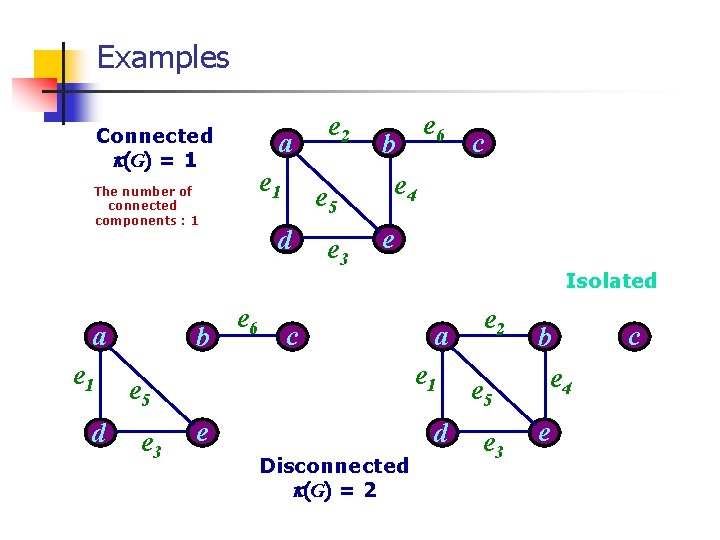
Examples Connected (G) = 1 a e 1 The number of connected components : 1 a e 1 d b e 5 d e 6 e 2 e 3 b e 4 c e c Isolated a e 1 e 5 e 3 e 6 e d Disconnected (G) = 2 e 5 e 3 b e 4 e c
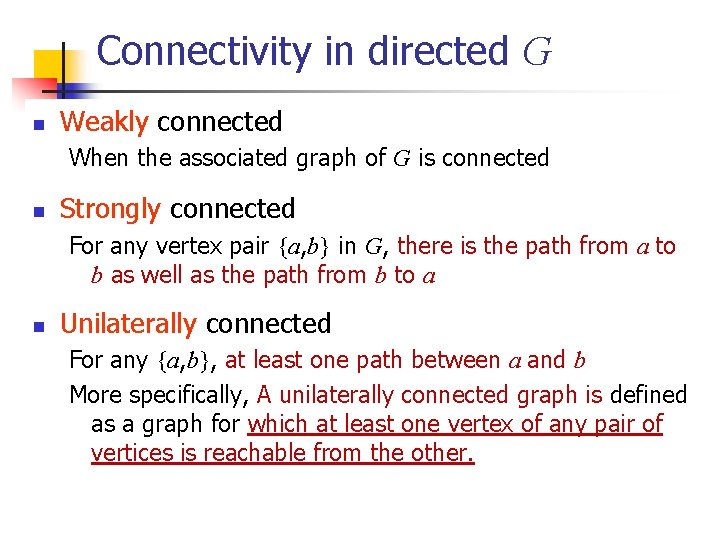
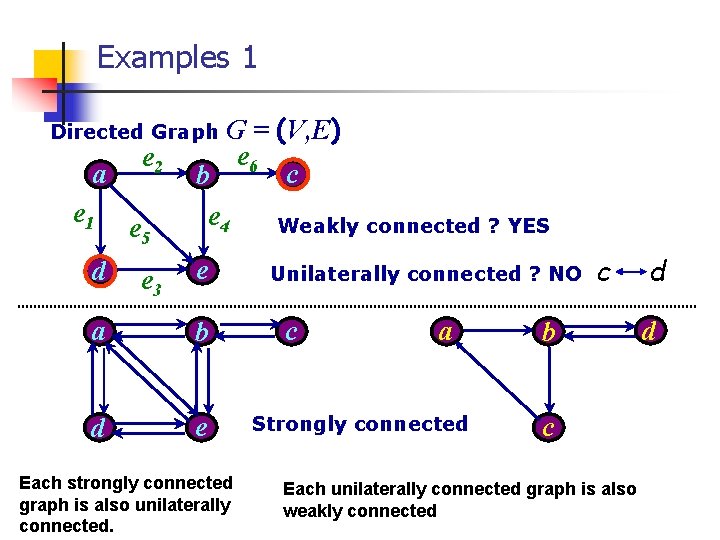
Connectivity in directed G n Weakly connected When the associated graph of G is connected n Strongly connected For any vertex pair {a, b} in G, there is the path from a to b as well as the path from b to a n Unilaterally connected For any {a, b}, at least one path between a and b More specifically, A unilaterally connected graph is defined as a graph for which at least one vertex of any pair of vertices is reachable from the other.
Examples 1 G = (V, E) e 6 c b e 4 Weakly connected ? YES Directed Graph a e 1 d e 2 e 5 e 3 e a b d e Each strongly connected graph is also unilaterally connected. Unilaterally connected ? NO c a Strongly connected c b c Each unilaterally connected graph is also weakly connected d d
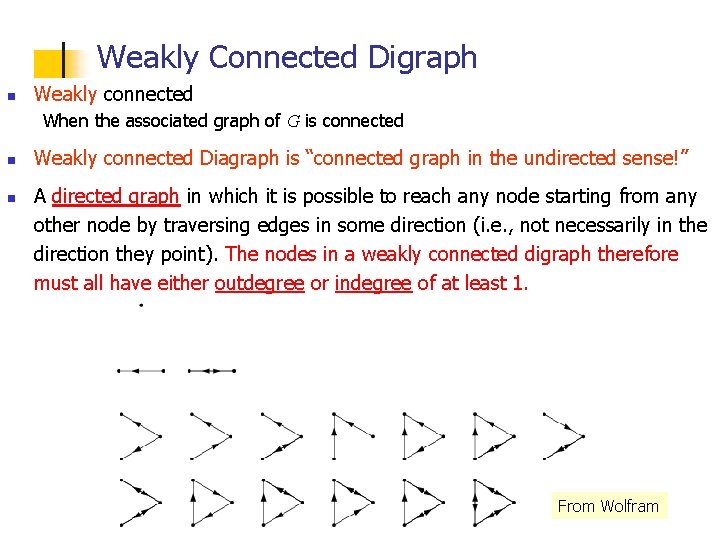
Weakly Connected Digraph n Weakly connected When the associated graph of G is connected n n Weakly connected Diagraph is “connected graph in the undirected sense!” A directed graph in which it is possible to reach any node starting from any other node by traversing edges in some direction (i. e. , not necessarily in the direction they point). The nodes in a weakly connected digraph therefore must all have either outdegree or indegree of at least 1. From Wolfram
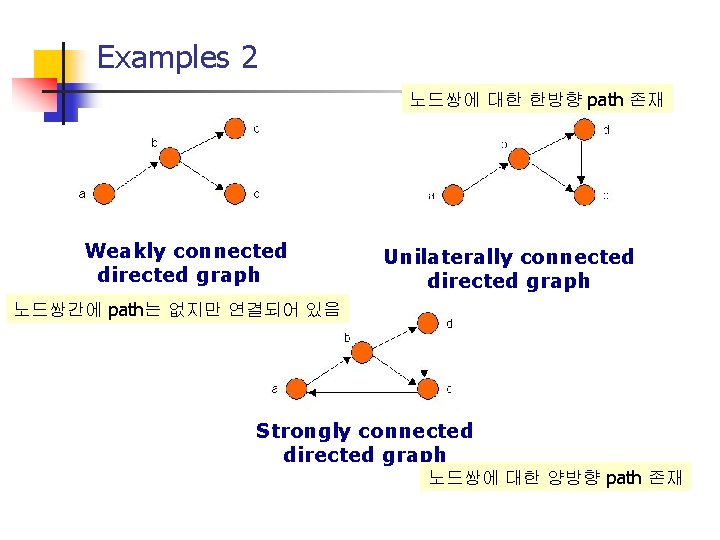
Examples 2 노드쌍에 대한 한방향 path 존재 Weakly connected directed graph Unilaterally connected directed graph 노드쌍간에 path는 없지만 연결되어 있음 Strongly connected directed graph 노드쌍에 대한 양방향 path 존재
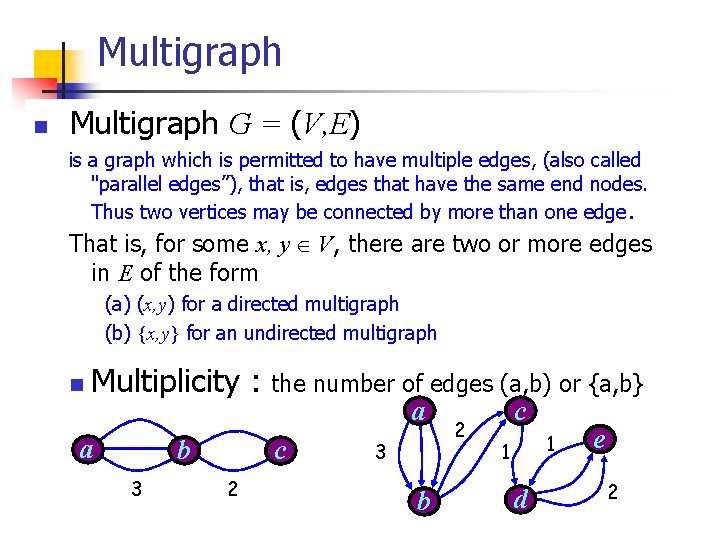
Multigraph n Multigraph G = (V, E) is a graph which is permitted to have multiple edges, (also called "parallel edges”), that is, edges that have the same end nodes. Thus two vertices may be connected by more than one edge. That is, for some x, y V, there are two or more edges in E of the form (a) (x, y) for a directed multigraph (b) {x, y} for an undirected multigraph n Multiplicity : a b 3 the number of edges (a, b) or {a, b} a c 2 3 b 2 c 1 1 d e 2
Agenda n n n 11. 1 Definitions 11. 2 Subgraphs, Complements, & Graph Isomorphism 11. 3 Vertex Degree: Euler Trails & Circuits n 11. 4 Planar Graphs n Next… 21
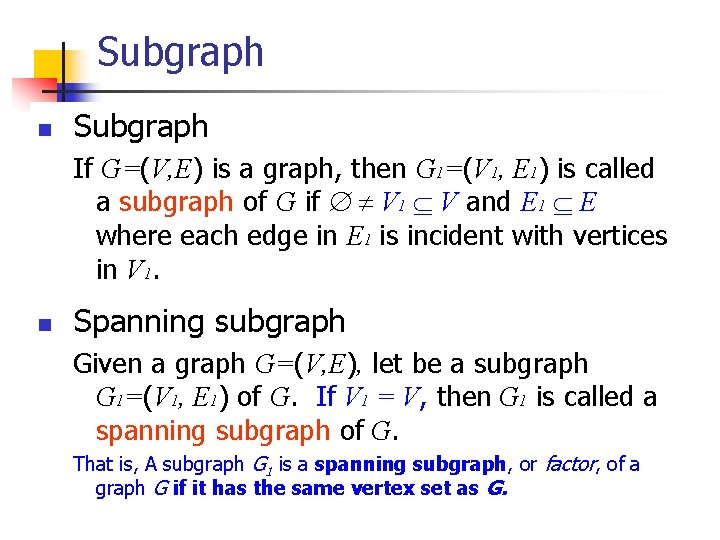
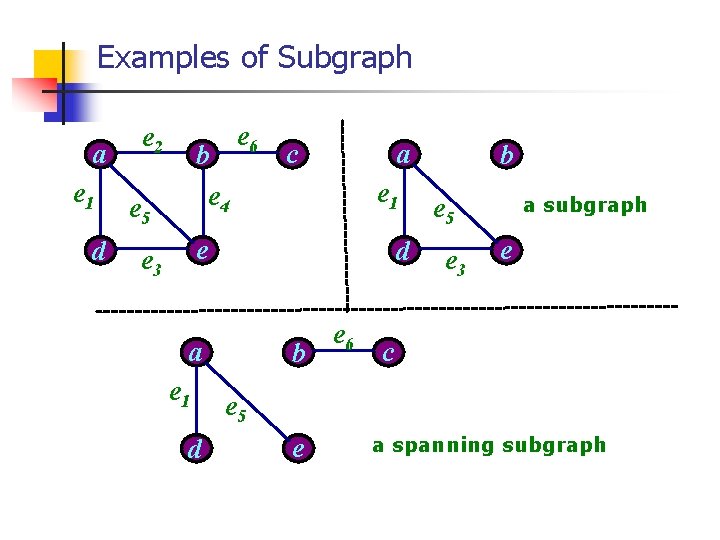
Subgraph n Subgraph If G=(V, E) is a graph, then G 1=(V 1, E 1) is called a subgraph of G if V 1 V and E 1 E where each edge in E 1 is incident with vertices in V 1. n Spanning subgraph Given a graph G=(V, E), let be a subgraph G 1=(V 1, E 1) of G. If V 1 = V, then G 1 is called a spanning subgraph of G. That is, A subgraph G 1 is a spanning subgraph, or factor, of a graph G if it has the same vertex set as G.
Examples of Subgraph a e 1 d e 2 b e 4 e 5 e 6 c a e 1 e e 3 d a e 1 d b e 6 b e 5 e 3 a subgraph e c e 5 e a spanning subgraph
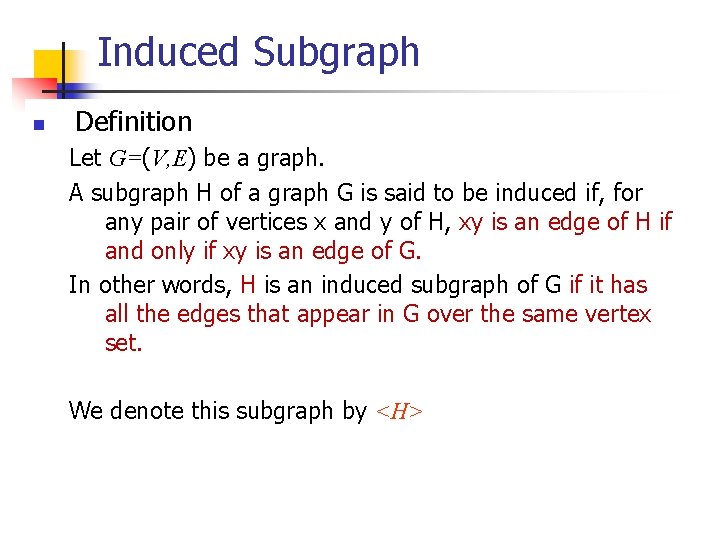
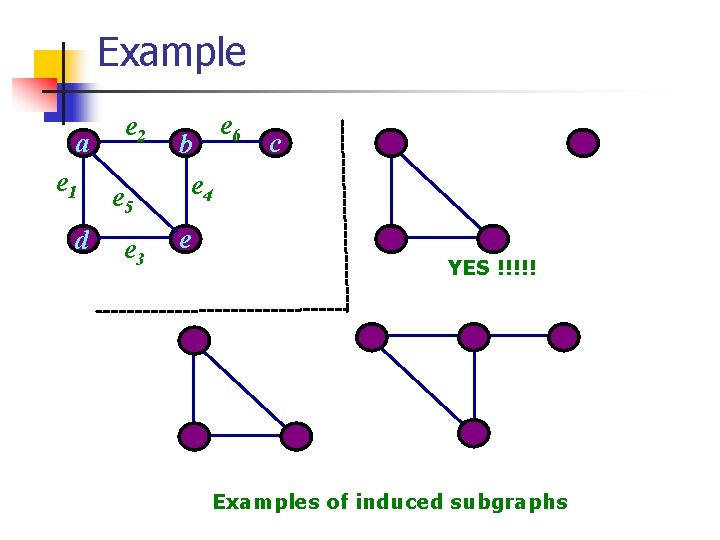
Induced Subgraph n Definition Let G=(V, E) be a graph. A subgraph H of a graph G is said to be induced if, for any pair of vertices x and y of H, xy is an edge of H if and only if xy is an edge of G. In other words, H is an induced subgraph of G if it has all the edges that appear in G over the same vertex set. We denote this subgraph by <H>
Example a e 1 d e 2 e 5 e 3 b e 4 e 6 c e YES !!!!! Examples of induced subgraphs
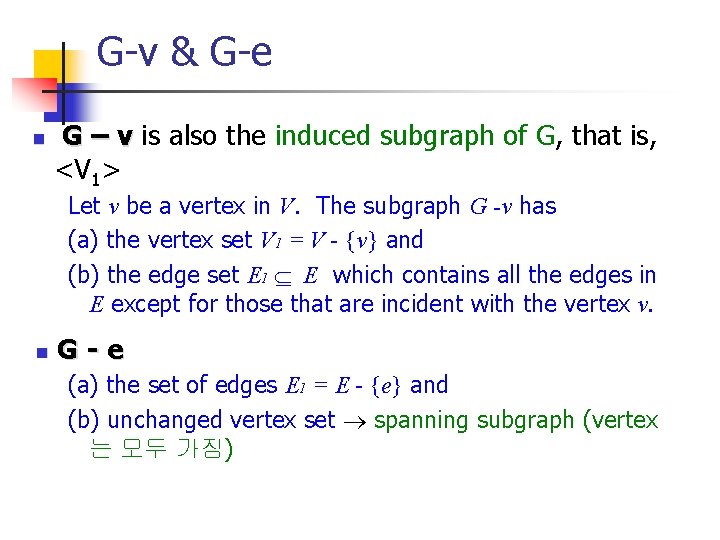
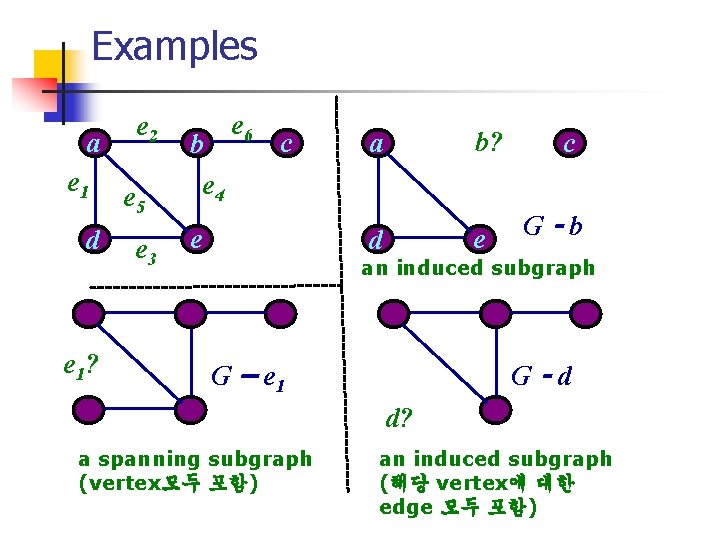
G-v & G-e n G – v is also the induced subgraph of G, that is, <V 1> Let v be a vertex in V. The subgraph G -v has (a) the vertex set V 1 = V - {v} and (b) the edge set E 1 E which contains all the edges in E except for those that are incident with the vertex v. n G-e (a) the set of edges E 1 = E - {e} and (b) unchanged vertex set spanning subgraph (vertex 는 모두 가짐)
Examples a e 1 d e 1? e 2 e 5 e 3 b e 4 e 6 c e a b? d e c G-b an induced subgraph G – e 1 G-d d? a spanning subgraph (vertex모두 포함) an induced subgraph (해당 vertex에 대한 edge 모두 포함)
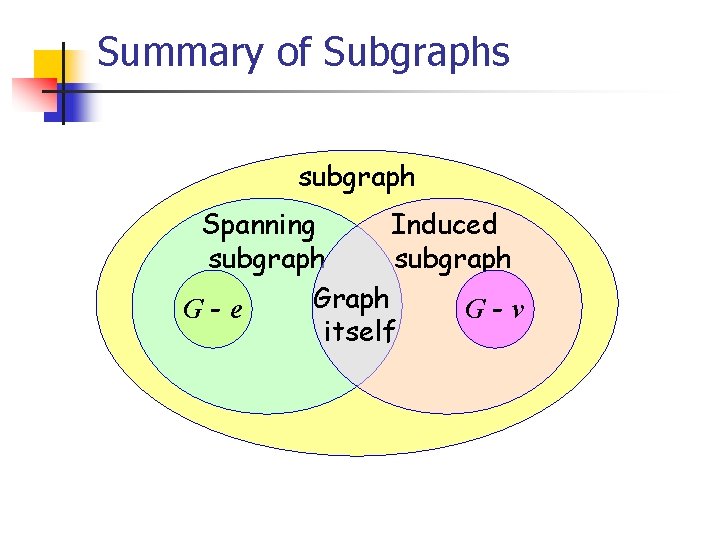
Summary of Subgraphs subgraph Spanning Induced subgraph Graph G-e G-v itself
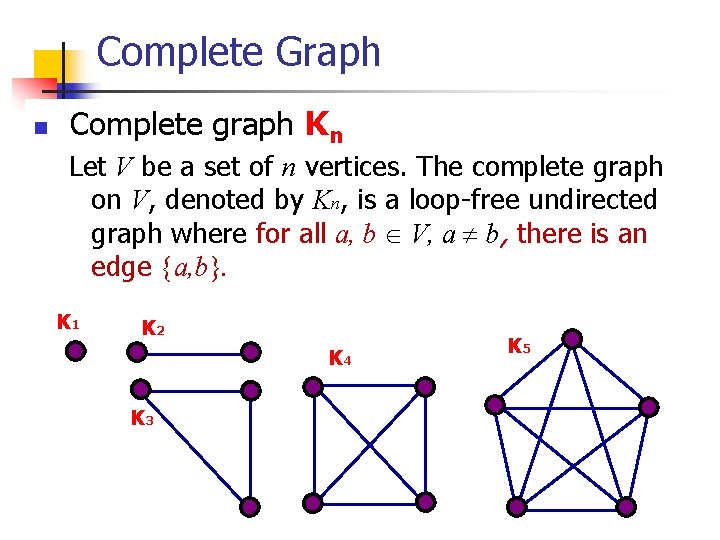
Complete Graph n Complete graph Kn Let V be a set of n vertices. The complete graph on V, denoted by Kn, is a loop-free undirected graph where for all a, b V, a b, there is an edge {a, b}. K 1 K 2 K 4 K 3 K 5
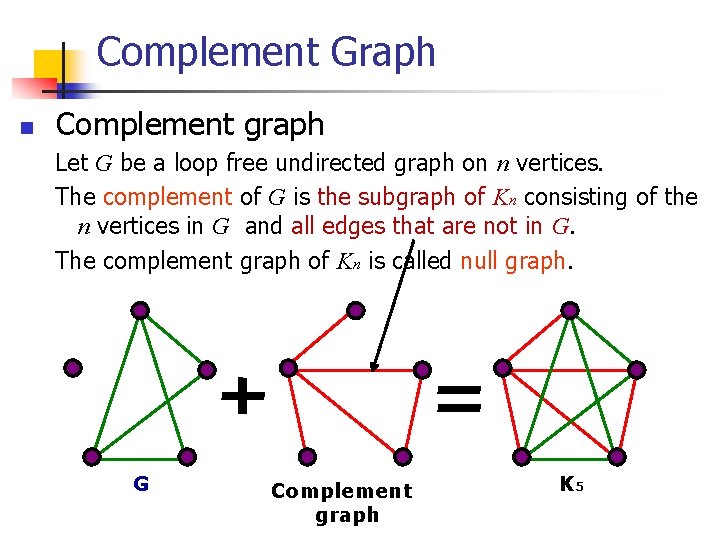
Complement Graph n Complement graph Let G be a loop free undirected graph on n vertices. The complement of G is the subgraph of Kn consisting of the n vertices in G and all edges that are not in G. The complement graph of Kn is called null graph. G Complement graph K 5
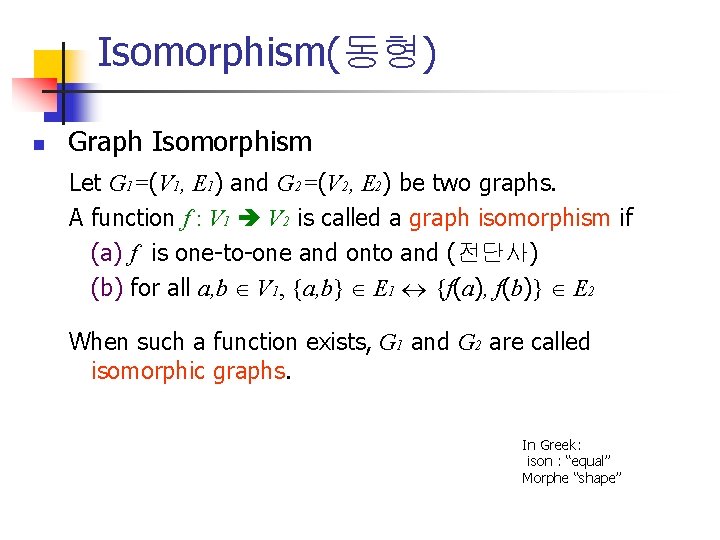
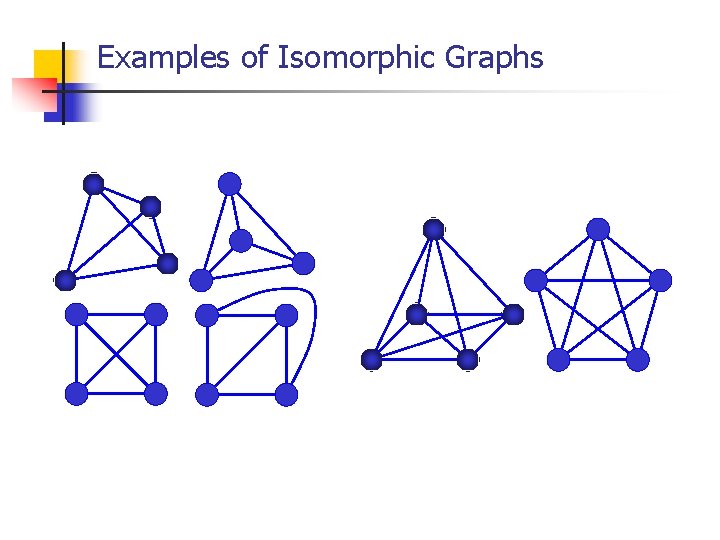
Isomorphism(동형) n Graph Isomorphism Let G 1=(V 1, E 1) and G 2=(V 2, E 2) be two graphs. A function f : V 1 V 2 is called a graph isomorphism if (a) f is one-to-one and onto and (전단사) (b) for all a, b V 1, {a, b} E 1 {f(a), f(b)} E 2 When such a function exists, G 1 and G 2 are called isomorphic graphs. In Greek: ison : “equal” Morphe “shape”
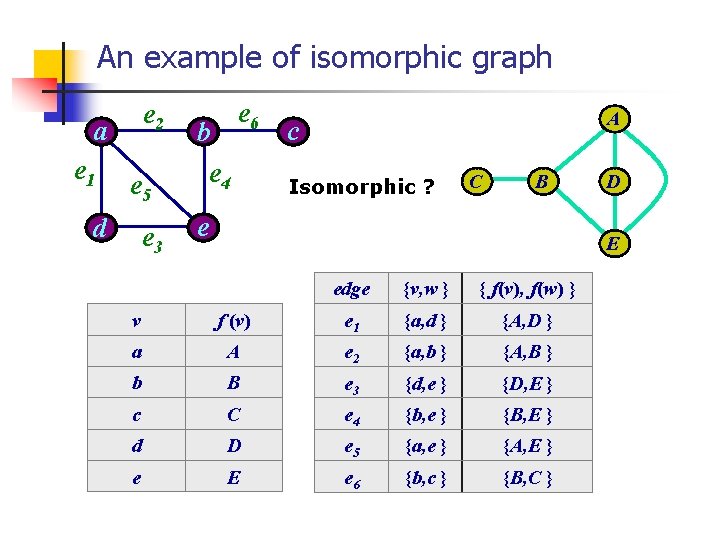
An example of isomorphic graph e 2 a e 1 e 5 d e 3 b e 4 e 6 A c Isomorphic ? C B e D E edge {v, w } { f(v), f(w) } v f (v) e 1 {a, d } {A, D } a A e 2 {a, b } {A, B } b B e 3 {d, e } {D, E } c C e 4 {b, e } {B, E } d D e 5 {a, e } {A, E } e E e 6 {b, c } {B, C }
Examples of Isomorphic Graphs
Agenda n n 11. 1 Definitions 11. 2 Subgraphs, Complements, & Graph Isomorphism n 11. 3 Vertex Degree: Euler Trails & Circuits n 11. 4 Planar Graphs n Next… 34
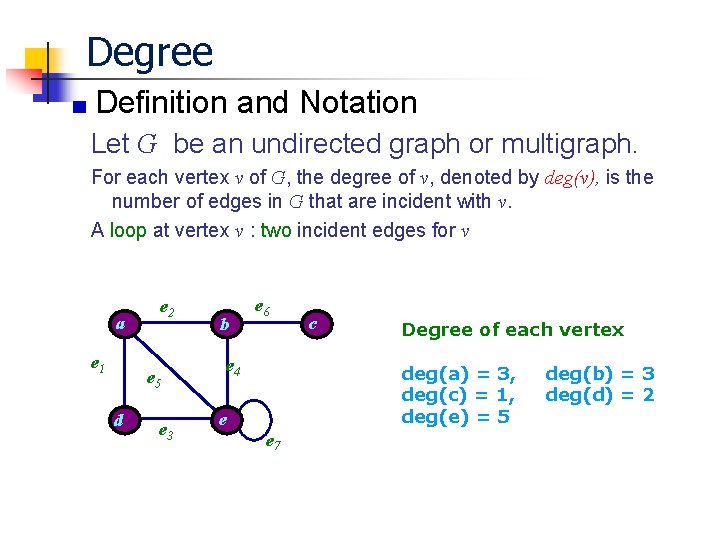
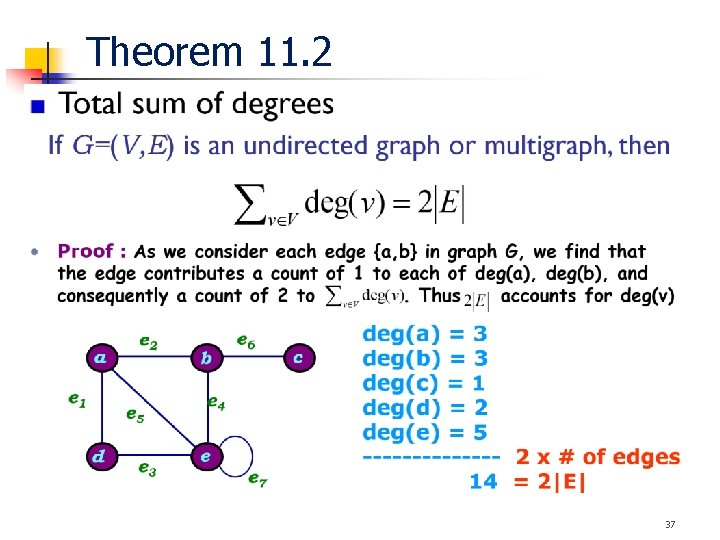
Degree Definition and Notation Let G be an undirected graph or multigraph. For each vertex v of G, the degree of v, denoted by deg(v), is the number of edges in G that are incident with v. A loop at vertex v : two incident edges for v a e 1 e 2 e 5 d e 3 b e 6 e 4 c Degree of each vertex deg(a) = 3, deg(c) = 1, deg(e) = 5 e e 7 deg(b) = 3 deg(d) = 2
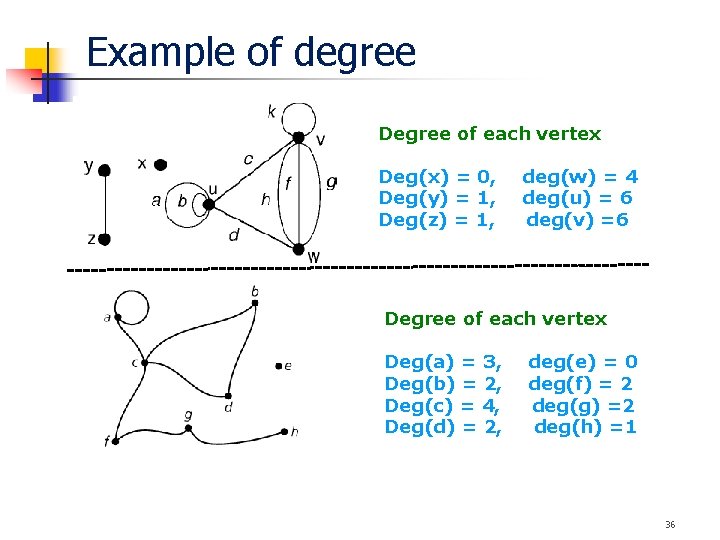
Example of degree Degree of each vertex Deg(x) = 0, Deg(y) = 1, Deg(z) = 1, deg(w) = 4 deg(u) = 6 deg(v) =6 Degree of each vertex Deg(a) = 3, Deg(b) = 2, Deg(c) = 4, Deg(d) = 2, deg(e) = 0 deg(f) = 2 deg(g) =2 deg(h) =1 36
Theorem 11. 2 37
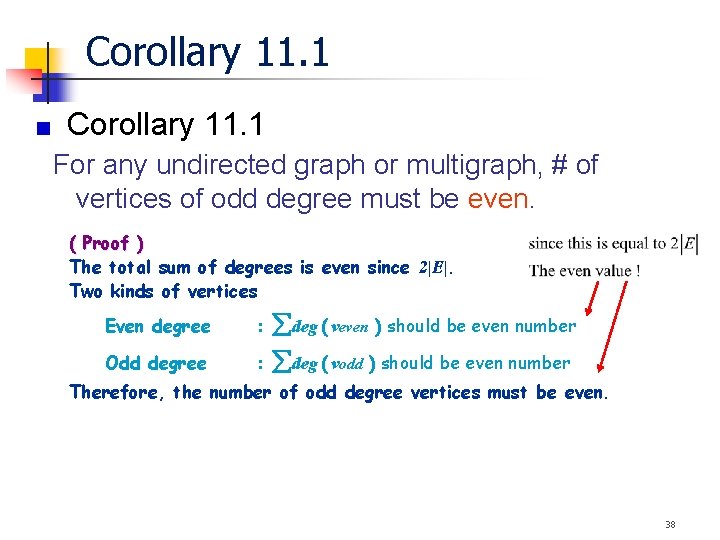
Corollary 11. 1 For any undirected graph or multigraph, # of vertices of odd degree must be even. ( Proof ) The total sum of degrees is even since 2|E|. Two kinds of vertices Even degree Odd degree deg ( veven ) should be even number : deg ( vodd ) should be even number : Therefore, the number of odd degree vertices must be even. 38
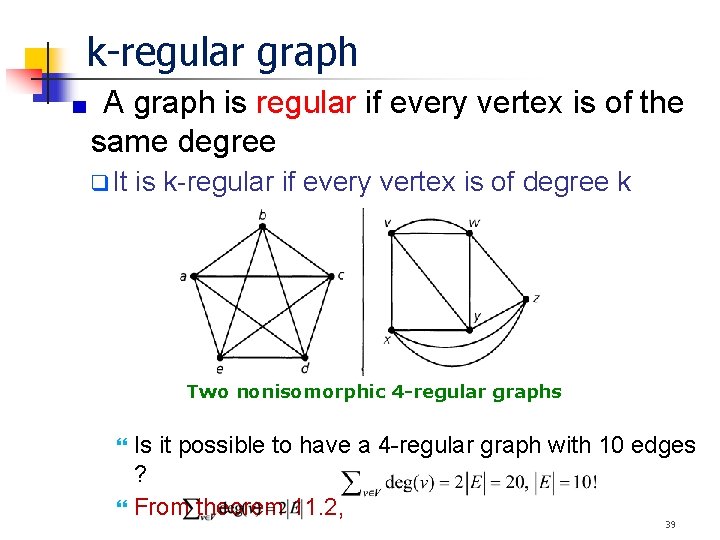
k-regular graph A graph is regular if every vertex is of the same degree It is k-regular if every vertex is of degree k Two nonisomorphic 4 -regular graphs Is it possible to have a 4 -regular graph with 10 edges ? From theorem 11. 2, 39
Example of k-regular graph(for computer arch) The interconnection network of the parallel computer In order to build a parallel computer, one needs to have multiple CPUs. Also, each CPUs need to communicate with one another To model the communication b/w the CPUs we use a loop-free connected undirected graph where each processor is assigned a vertex When two CPUs(processors), say p 1, p 2, are able to communicate directly with one another via the edge {p 1, p 2} We can model with a graph. How can we decide on a graph to speed up the processing time ? The complete graph would be idea. But expensive. 40
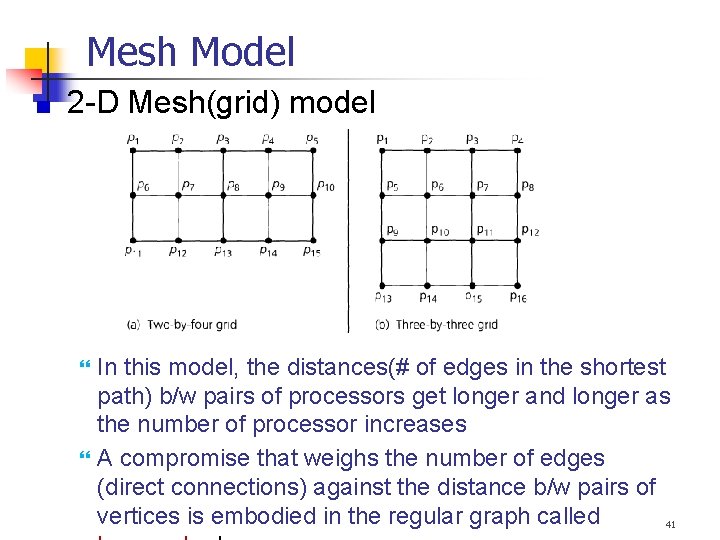
Mesh Model 2 -D Mesh(grid) model In this model, the distances(# of edges in the shortest path) b/w pairs of processors get longer and longer as the number of processor increases A compromise that weighs the number of edges (direct connections) against the distance b/w pairs of vertices is embodied in the regular graph called 41
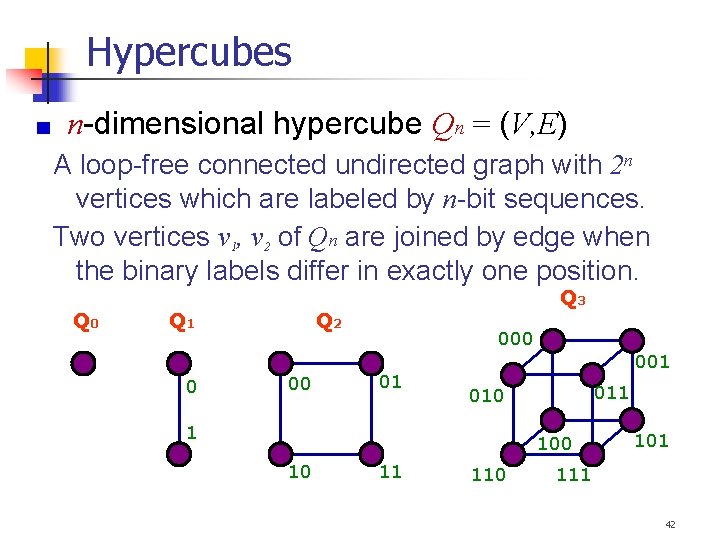
Hypercubes n-dimensional hypercube Qn = (V, E) A loop-free connected undirected graph with 2 n vertices which are labeled by n-bit sequences. Two vertices v 1, v 2 of Qn are joined by edge when the binary labels differ in exactly one position. Q 0 Q 1 0 Q 3 Q 2 00 01 001 010 1 100 10 11 110 101 111 42
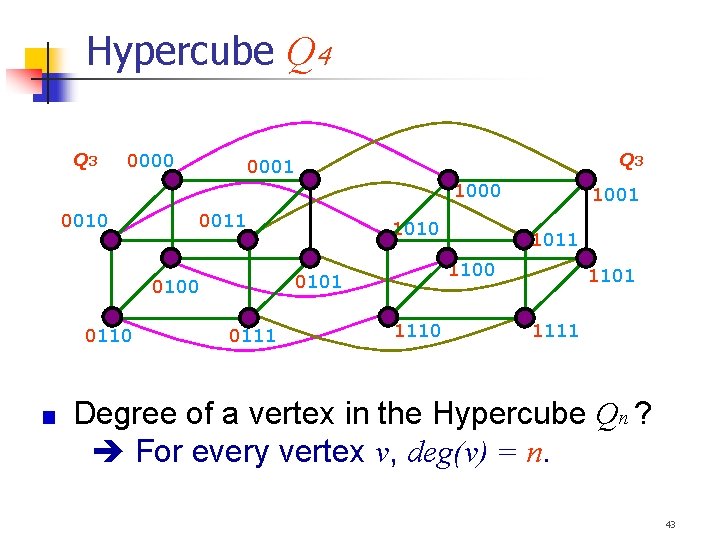
Hypercube Q 4 Q 3 0000 Q 3 0001 1000 0011 0111 1011 1100 0101 0100 0110 1001 1110 1101 1111 Degree of a vertex in the Hypercube Qn ? For every vertex v, deg(v) = n. 43
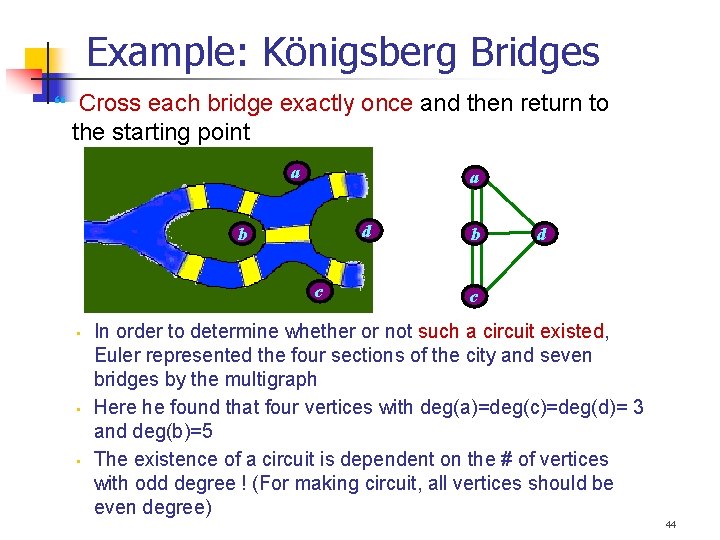
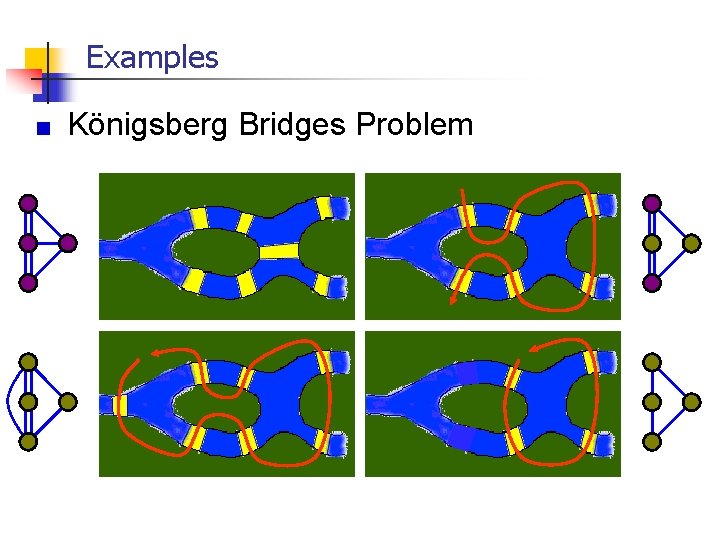
Example: Königsberg Bridges Cross each bridge exactly once and then return to the starting point a a d b c • • • b d c In order to determine whether or not such a circuit existed, Euler represented the four sections of the city and seven bridges by the multigraph Here he found that four vertices with deg(a)=deg(c)=deg(d)= 3 and deg(b)=5 The existence of a circuit is dependent on the # of vertices with odd degree ! (For making circuit, all vertices should be even degree) 44
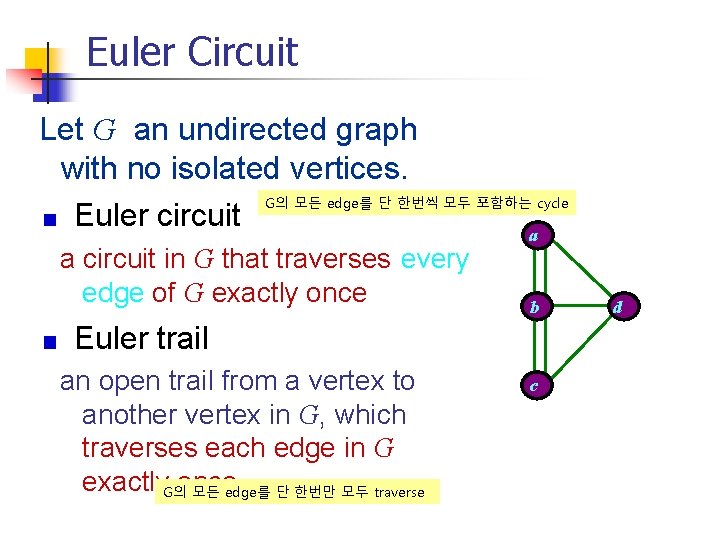
Euler Circuit Let G an undirected graph with no isolated vertices. G의 모든 edge를 단 한번씩 모두 포함하는 cycle Euler circuit a a circuit in G that traverses every edge of G exactly once b Euler trail an open trail from a vertex to another vertex in G, which traverses each edge in G exactly. G의once 모든 edge를 단 한번만 모두 traverse c d
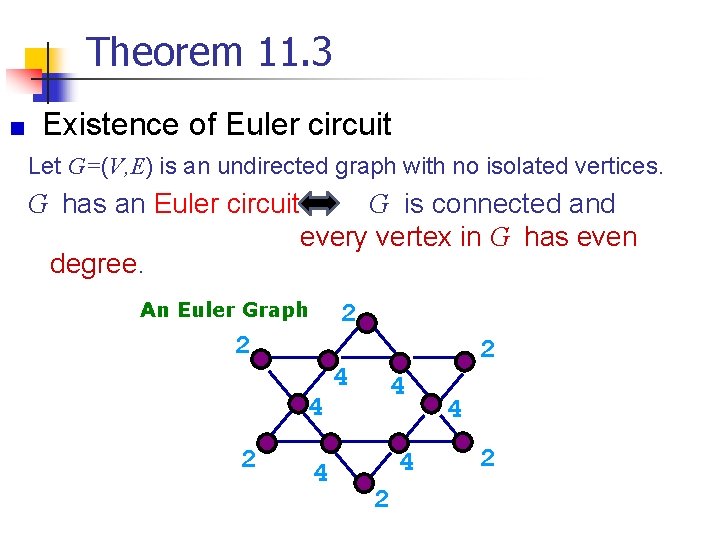
Theorem 11. 3 Existence of Euler circuit Let G=(V, E) is an undirected graph with no isolated vertices. G has an Euler circuit degree. G is connected and every vertex in G has even An Euler Graph 2 2 4 4 2 4 2
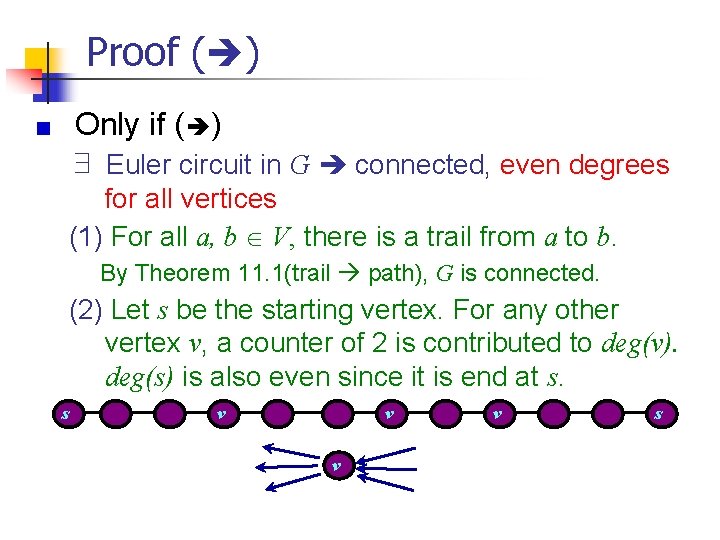
Proof ( ) Only if ( ) ∃ Euler circuit in G connected, even degrees for all vertices (1) For all a, b V, there is a trail from a to b. By Theorem 11. 1(trail path), G is connected. (2) Let s be the starting vertex. For any other vertex v, a counter of 2 is contributed to deg(v). deg(s) is also even since it is end at s. s v v s
Proof ( ) if ( ) ∃ Euler circuit in G connected, even degrees for all vertices
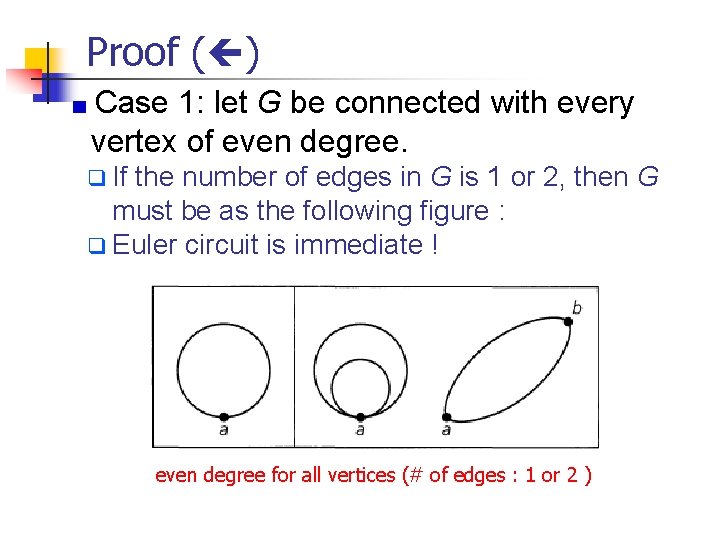
Proof ( ) Case 1: let G be connected with every vertex of even degree. If the number of edges in G is 1 or 2, then G must be as the following figure : Euler circuit is immediate ! even degree for all vertices (# of edges : 1 or 2 )
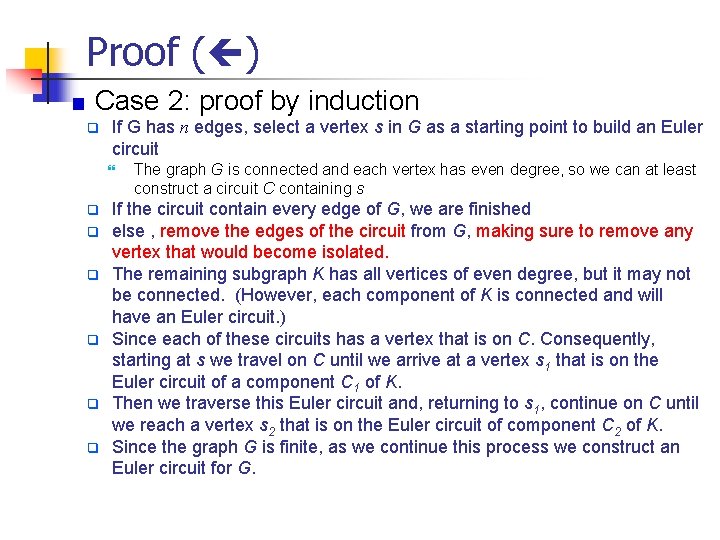
Proof ( ) Case 2: proof by induction If G has n edges, select a vertex s in G as a starting point to build an Euler circuit The graph G is connected and each vertex has even degree, so we can at least construct a circuit C containing s If the circuit contain every edge of G, we are finished else , remove the edges of the circuit from G, making sure to remove any vertex that would become isolated. The remaining subgraph K has all vertices of even degree, but it may not be connected. (However, each component of K is connected and will have an Euler circuit. ) Since each of these circuits has a vertex that is on C. Consequently, starting at s we travel on C until we arrive at a vertex s 1 that is on the Euler circuit of a component C 1 of K. Then we traverse this Euler circuit and, returning to s 1, continue on C until we reach a vertex s 2 that is on the Euler circuit of component C 2 of K. Since the graph G is finite, as we continue this process we construct an Euler circuit for G.
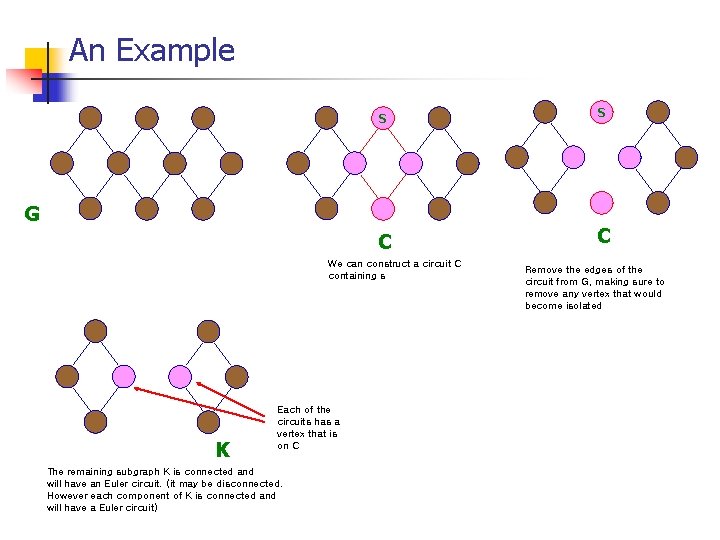
An Example S S C C G We can construct a circuit C containing s K Each of the circuits has a vertex that is on C The remaining subgraph K is connected and will have an Euler circuit. (it may be disconnected. However each component of K is connected and will have a Euler circuit) Remove the edges of the circuit from G, making sure to remove any vertex that would become isolated
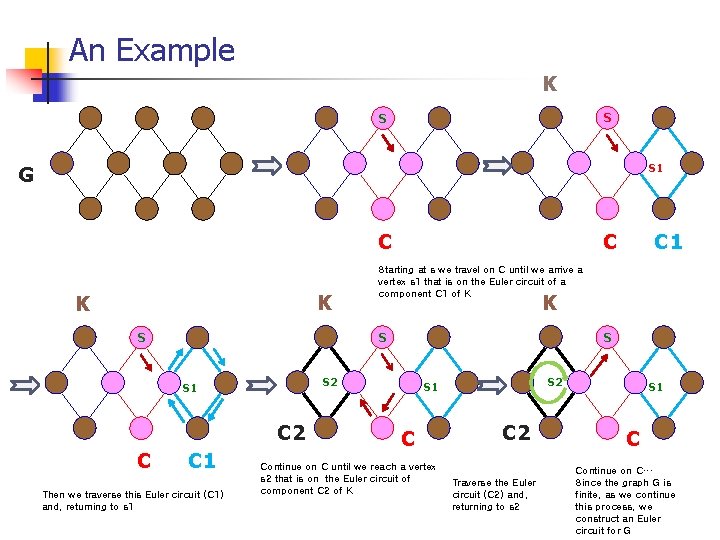
An Example K S S S 1 G K K K C 2 C 1 Then we traverse this Euler circuit (C 1) and, returning to s 1 S S 2 S 1 C Starting at s we travel on C until we arrive a vertex s 1 that is on the Euler circuit of a component C 1 of K S S C 1 C C S 2 S 1 C Continue on C until we reach a vertex s 2 that is on the Euler circuit of component C 2 of K C 2 Traverse the Euler circuit (C 2) and, returning to s 2 S 1 C Continue on C… Since the graph G is finite, as we continue this process, we construct an Euler circuit for G
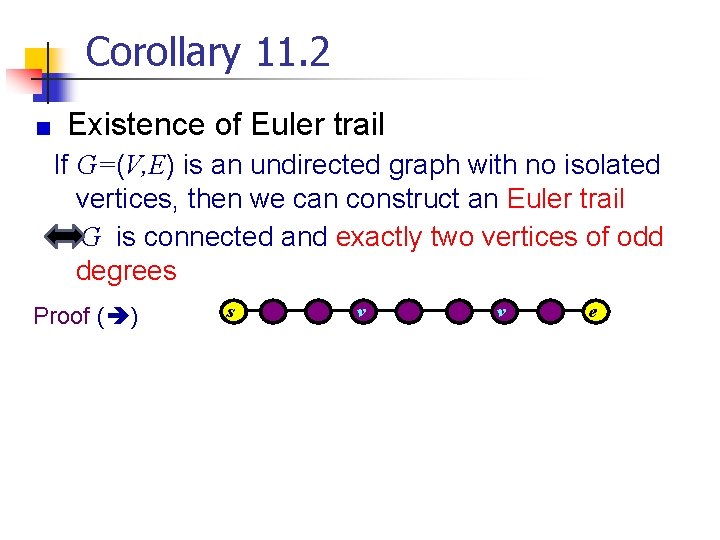
Corollary 11. 2 Existence of Euler trail If G=(V, E) is an undirected graph with no isolated vertices, then we can construct an Euler trail G is connected and exactly two vertices of odd degrees Proof ( ) s v v e
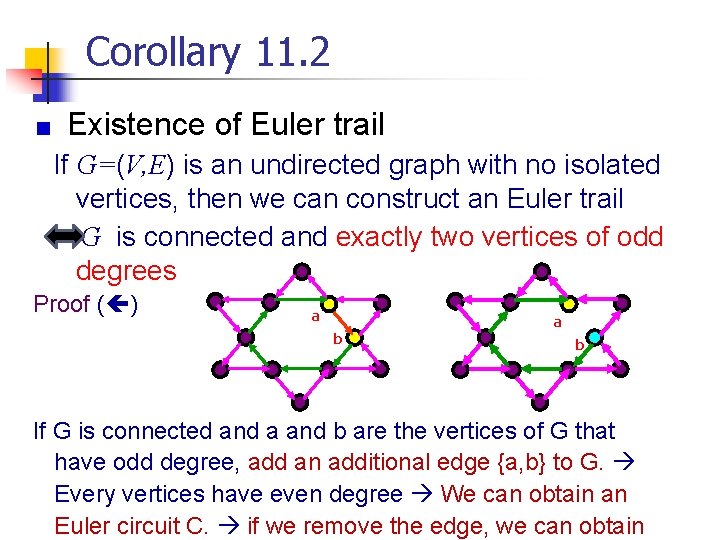
Corollary 11. 2 Existence of Euler trail If G=(V, E) is an undirected graph with no isolated vertices, then we can construct an Euler trail G is connected and exactly two vertices of odd degrees Proof ( ) a b If G is connected and a and b are the vertices of G that have odd degree, add an additional edge {a, b} to G. Every vertices have even degree We can obtain an Euler circuit C. if we remove the edge, we can obtain
Examples Königsberg Bridges Problem
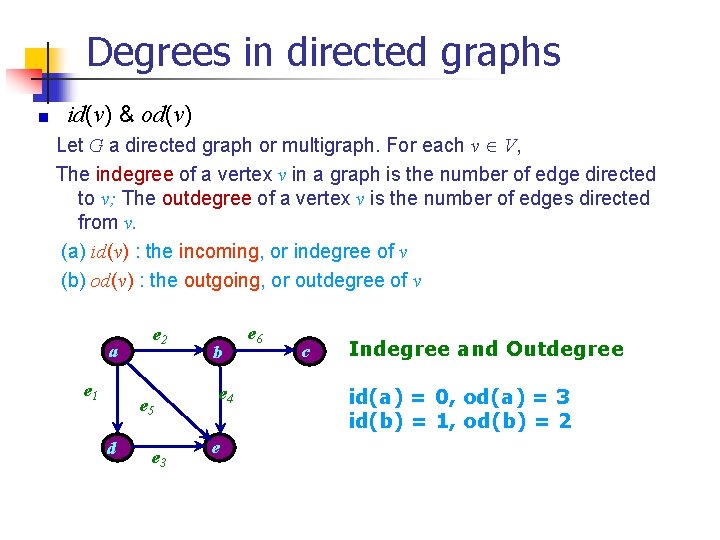
Degrees in directed graphs id(v) & od(v) Let G a directed graph or multigraph. For each v V, The indegree of a vertex v in a graph is the number of edge directed to v; The outdegree of a vertex v is the number of edges directed from v. (a) id(v) : the incoming, or indegree of v (b) od(v) : the outgoing, or outdegree of v a e 1 e 2 e 5 d e 3 b e 4 e e 6 c Indegree and Outdegree id(a) = 0, od(a) = 3 id(b) = 1, od(b) = 2
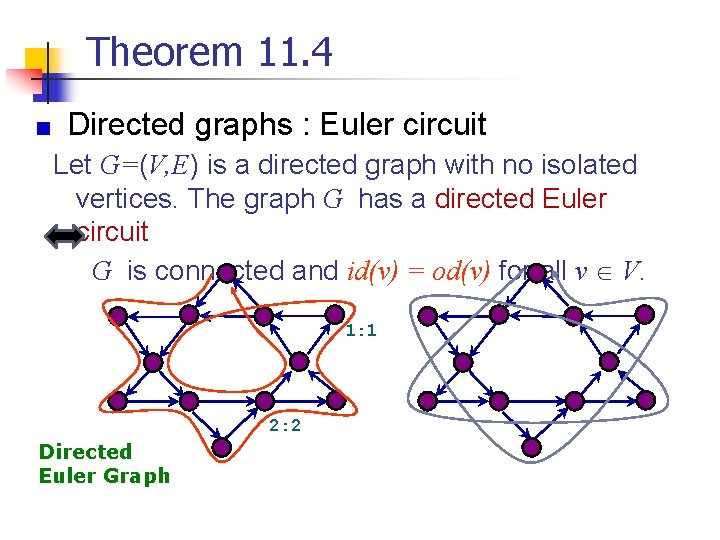
Theorem 11. 4 Directed graphs : Euler circuit Let G=(V, E) is a directed graph with no isolated vertices. The graph G has a directed Euler circuit G is connected and id(v) = od(v) for all v V. 1: 1 2: 2 Directed Euler Graph