
Discrete Math Example 1 of Modeling With Recurrence
- Slides: 5
Discrete Math: Example 1 of Modeling With Recurrence Relations
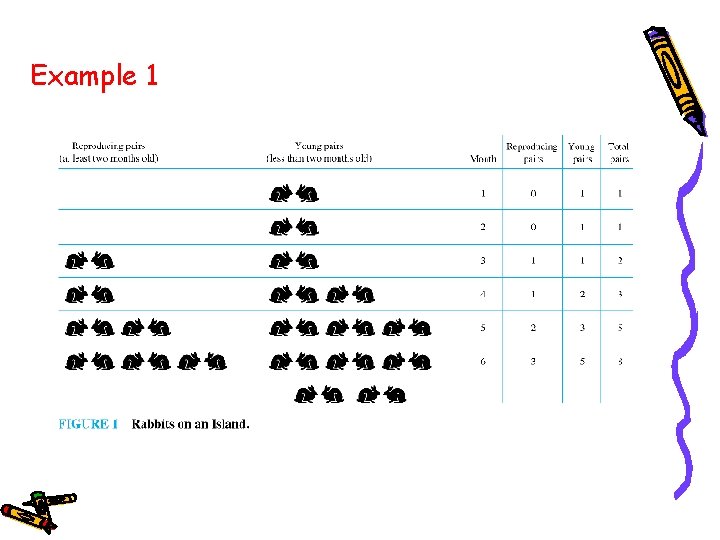
Example 1 Consider this problem, which was originally posed by Leonardo Pisano, also known as Fibonacci, in the thirteenth century in his book Liber abaci. A young pair of rabbits (one of each sex) is placed on an island. A pair of rabbits does not breed until they are 2 months old. After they are 2 months old, each pair of rabbits produces another pair each month, as shown in Figure 1. Find a recurrence relation for the number of pairs of rabbits on the island after n months, assuming that no rabbits ever die.
Example 1
Solution Denote by fn the number of pairs of rabbits after n months. We will show that fn, n = 1, 2, 3, . . . , are the terms of the Fibonacci sequence. The rabbit population can be modeled using a recurrence relation. At the end of the first month, the number of pairs of rabbits on the island is f 1 = 1. Because this pair does not breed during the second month, f 2 = 1 also. To find the number of pairs after n months, add the number on the island the previous month, fn− 1, and the number of newborn pairs, which equals fn− 2, because each newborn pair comes from a pair at least 2 months old. Consequently, the sequence {fn} satisfies the recurrence relation fn = fn− 1 + fn− 2 for n ≥ 3 together with the initial conditions f 1 = 1 and f 2 = 1. Because this recurrence relation and the initial conditions uniquely determine this sequence, the number of pairs of rabbits on the island after n months is given by the nth Fibonacci number.
References Discrete Mathematics and Its Applications, Mc. Graw-Hill; 7 th edition (June 26, 2006). Kenneth Rosen Discrete Mathematics An Open Introduction, 2 nd edition. Oscar Levin A Short Course in Discrete Mathematics, 01 Dec 2004, Edward Bender & S. Gill Williamson