
Discrete Logarithms DLs Fix a prime p Let
- Slides: 15
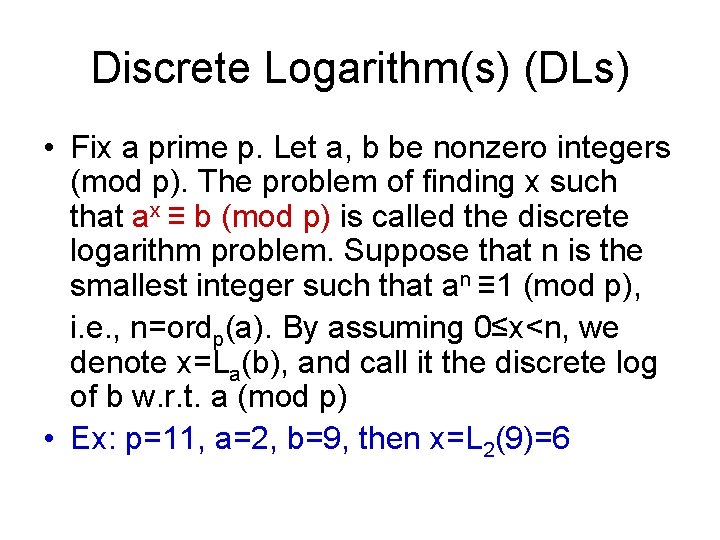
Discrete Logarithm(s) (DLs) • Fix a prime p. Let a, b be nonzero integers (mod p). The problem of finding x such that ax ≡ b (mod p) is called the discrete logarithm problem. Suppose that n is the smallest integer such that an ≡ 1 (mod p), i. e. , n=ordp(a). By assuming 0≤x<n, we denote x=La(b), and call it the discrete log of b w. r. t. a (mod p) • Ex: p=11, a=2, b=9, then x=L 2(9)=6
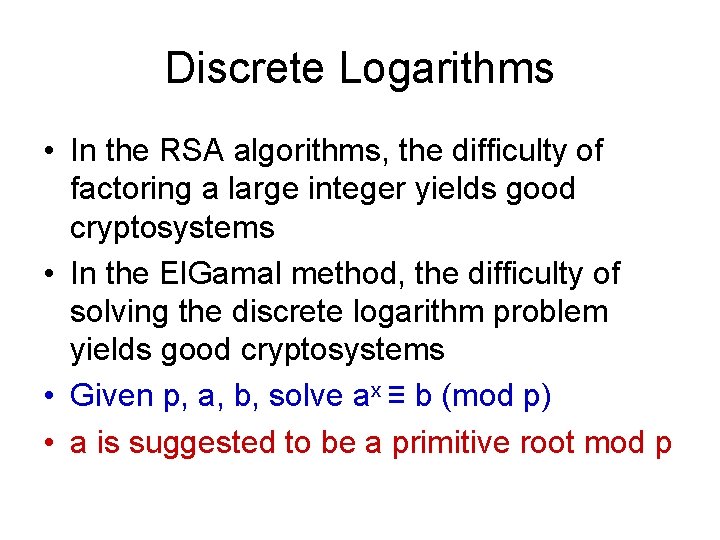
Discrete Logarithms • In the RSA algorithms, the difficulty of factoring a large integer yields good cryptosystems • In the El. Gamal method, the difficulty of solving the discrete logarithm problem yields good cryptosystems • Given p, a, b, solve ax ≡ b (mod p) • a is suggested to be a primitive root mod p
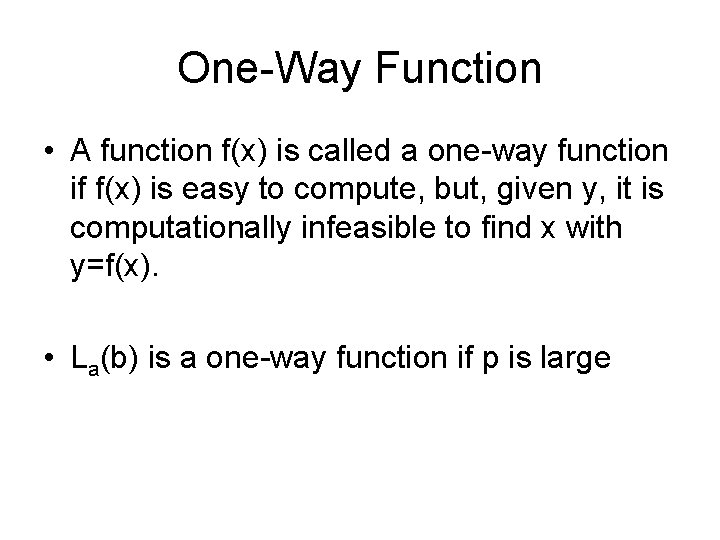
One-Way Function • A function f(x) is called a one-way function if f(x) is easy to compute, but, given y, it is computationally infeasible to find x with y=f(x). • La(b) is a one-way function if p is large
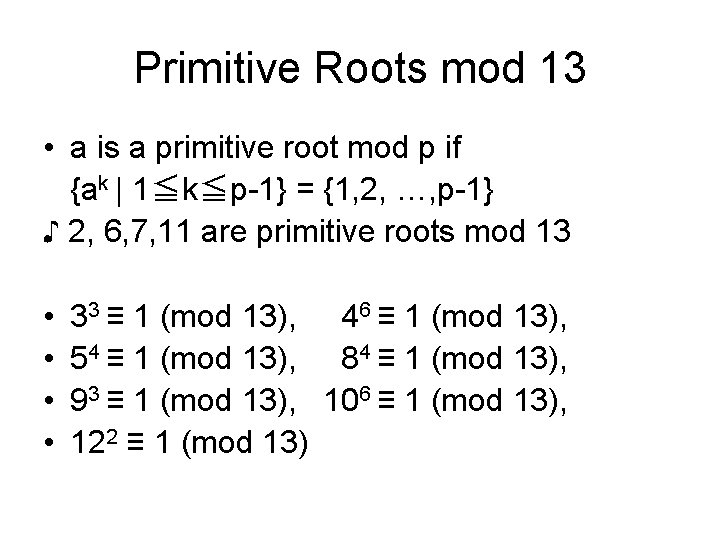
Primitive Roots mod 13 • a is a primitive root mod p if {ak | 1≦k≦p-1} = {1, 2, …, p-1} ♪ 2, 6, 7, 11 are primitive roots mod 13 • • 33 ≡ 1 (mod 13), 46 ≡ 1 (mod 13), 54 ≡ 1 (mod 13), 84 ≡ 1 (mod 13), 93 ≡ 1 (mod 13), 106 ≡ 1 (mod 13), 122 ≡ 1 (mod 13)
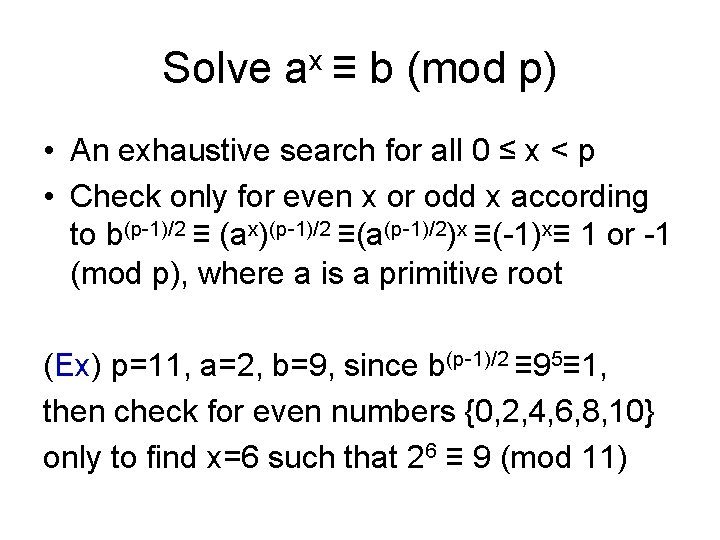
Solve ax ≡ b (mod p) • An exhaustive search for all 0 ≤ x < p • Check only for even x or odd x according to b(p-1)/2 ≡ (ax)(p-1)/2 ≡(a(p-1)/2)x ≡(-1)x≡ 1 or -1 (mod p), where a is a primitive root (Ex) p=11, a=2, b=9, since b(p-1)/2 ≡ 95≡ 1, then check for even numbers {0, 2, 4, 6, 8, 10} only to find x=6 such that 26 ≡ 9 (mod 11)
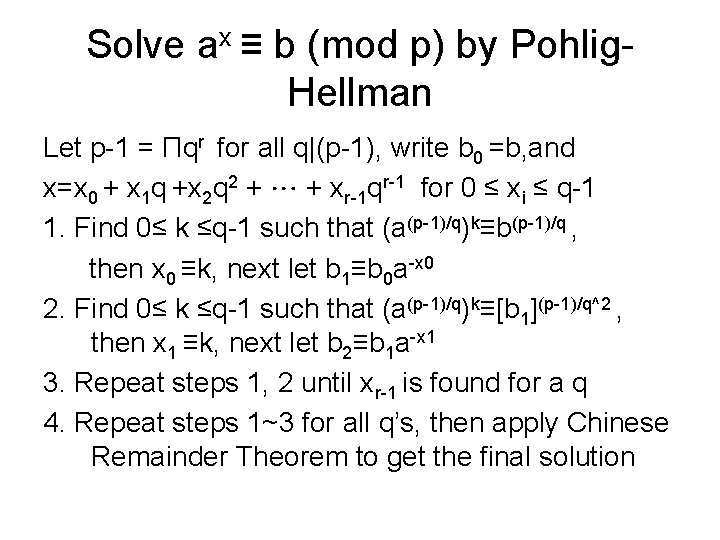
Solve ax ≡ b (mod p) by Pohlig. Hellman Let p-1 = Πqr for all q|(p-1), write b 0 =b, and x=x 0 + x 1 q +x 2 q 2 + … + xr-1 qr-1 for 0 ≤ xi ≤ q-1 1. Find 0≤ k ≤q-1 such that (a(p-1)/q)k≡b(p-1)/q , then x 0 ≡k, next let b 1≡b 0 a-x 0 2. Find 0≤ k ≤q-1 such that (a(p-1)/q)k≡[b 1](p-1)/q^2 , then x 1 ≡k, next let b 2≡b 1 a-x 1 3. Repeat steps 1, 2 until xr-1 is found for a q 4. Repeat steps 1~3 for all q’s, then apply Chinese Remainder Theorem to get the final solution
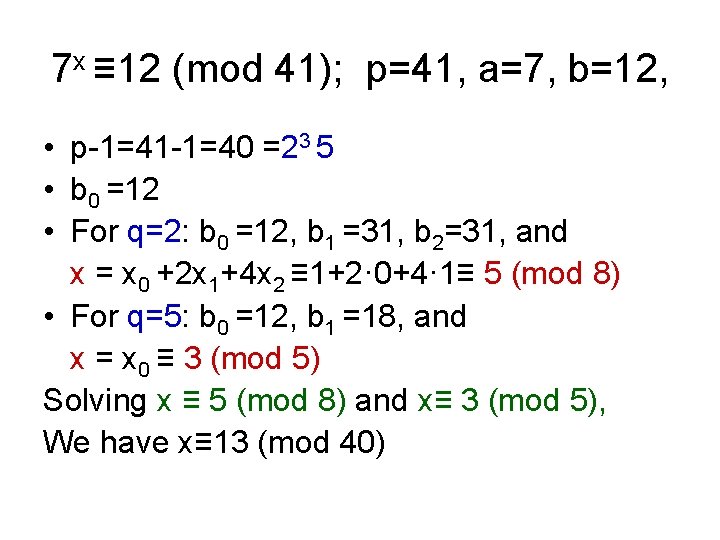
7 x ≡ 12 (mod 41); p=41, a=7, b=12, • p-1=41 -1=40 =23 5 • b 0 =12 • For q=2: b 0 =12, b 1 =31, b 2=31, and x = x 0 +2 x 1+4 x 2 ≡ 1+2· 0+4· 1≡ 5 (mod 8) • For q=5: b 0 =12, b 1 =18, and x = x 0 ≡ 3 (mod 5) Solving x ≡ 5 (mod 8) and x≡ 3 (mod 5), We have x≡ 13 (mod 40)
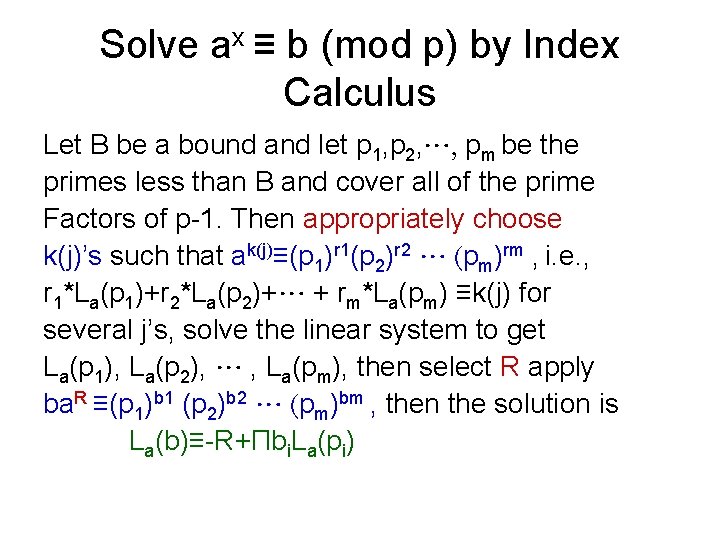
Solve ax ≡ b (mod p) by Index Calculus Let B be a bound and let p 1, p 2, …, pm be the primes less than B and cover all of the prime Factors of p-1. Then appropriately choose k(j)’s such that ak(j)≡(p 1)r 1(p 2)r 2 … (pm)rm , i. e. , r 1*La(p 1)+r 2*La(p 2)+… + rm*La(pm) ≡k(j) for several j’s, solve the linear system to get La(p 1), La(p 2), … , La(pm), then select R apply ba. R ≡(p 1)b 1 (p 2)b 2 … (pm)bm , then the solution is La(b)≡-R+Πbi. La(pi)
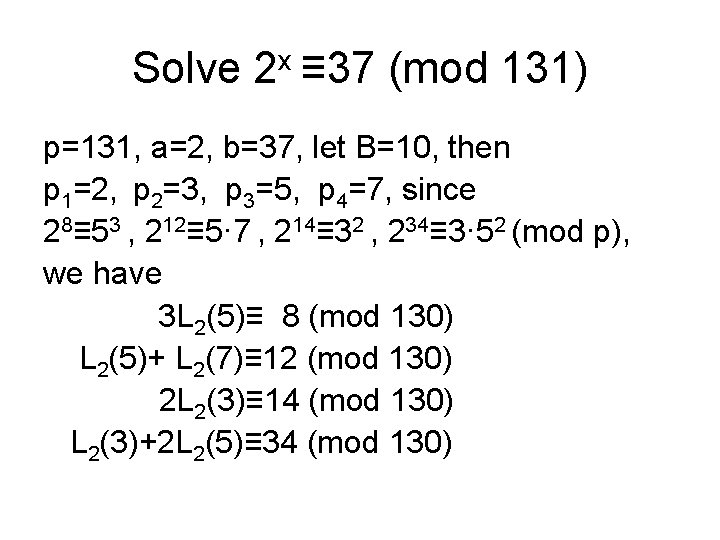
Solve 2 x ≡ 37 (mod 131) p=131, a=2, b=37, let B=10, then p 1=2, p 2=3, p 3=5, p 4=7, since 28≡ 53 , 212≡ 5· 7 , 214≡ 32 , 234≡ 3· 52 (mod p), we have 3 L 2(5)≡ 8 (mod 130) L 2(5)+ L 2(7)≡ 12 (mod 130) 2 L 2(3)≡ 14 (mod 130) L 2(3)+2 L 2(5)≡ 34 (mod 130)
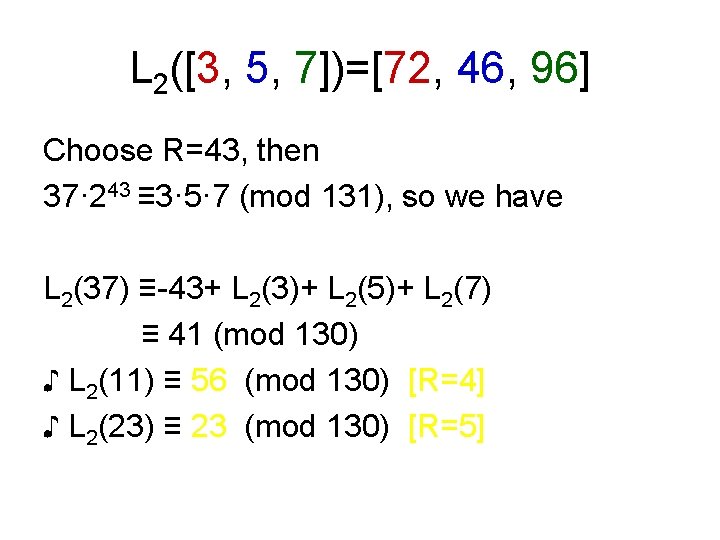
L 2([3, 5, 7])=[72, 46, 96] Choose R=43, then 37· 243 ≡ 3· 5· 7 (mod 131), so we have L 2(37) ≡-43+ L 2(3)+ L 2(5)+ L 2(7) ≡ 41 (mod 130) ♪ L 2(11) ≡ 56 (mod 130) [R=4] ♪ L 2(23) ≡ 23 (mod 130) [R=5]
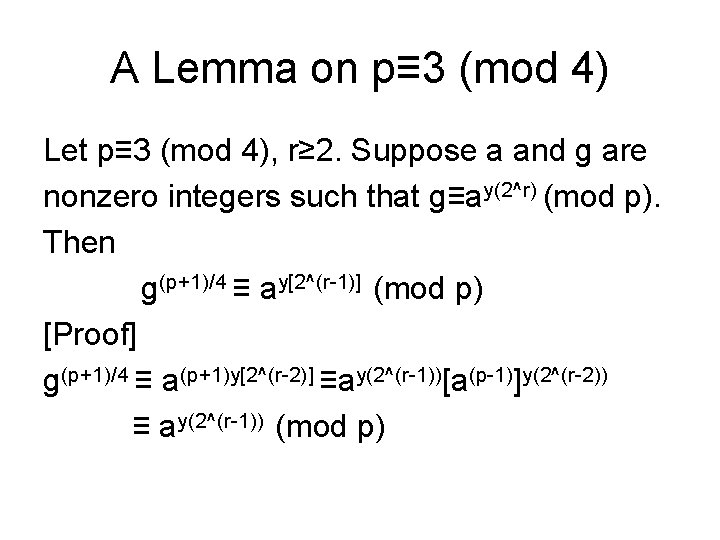
A Lemma on p≡ 3 (mod 4) Let p≡ 3 (mod 4), r≥ 2. Suppose a and g are nonzero integers such that g≡ay(2^r) (mod p). Then g(p+1)/4 ≡ ay[2^(r-1)] (mod p) [Proof] g(p+1)/4 ≡ a(p+1)y[2^(r-2)] ≡ay(2^(r-1))[a(p-1)]y(2^(r-2)) ≡ ay(2^(r-1)) (mod p)
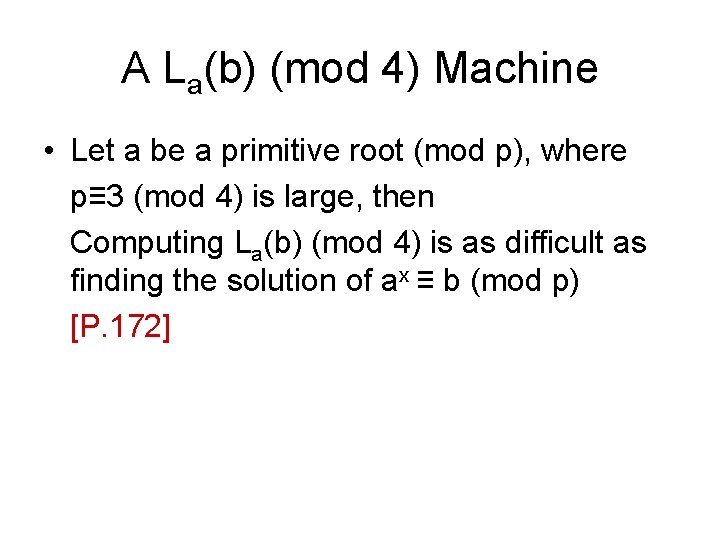
A La(b) (mod 4) Machine • Let a be a primitive root (mod p), where p≡ 3 (mod 4) is large, then Computing La(b) (mod 4) is as difficult as finding the solution of ax ≡ b (mod p) [P. 172]
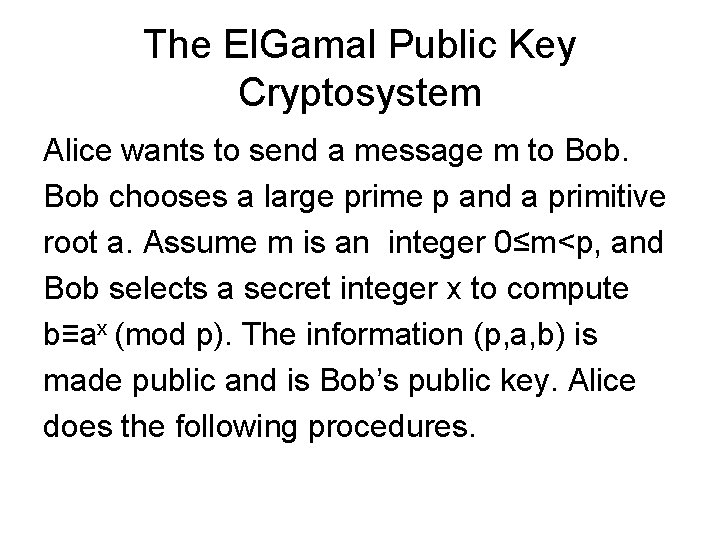
The El. Gamal Public Key Cryptosystem Alice wants to send a message m to Bob chooses a large prime p and a primitive root a. Assume m is an integer 0≤m<p, and Bob selects a secret integer x to compute b≡ax (mod p). The information (p, a, b) is made public and is Bob’s public key. Alice does the following procedures.
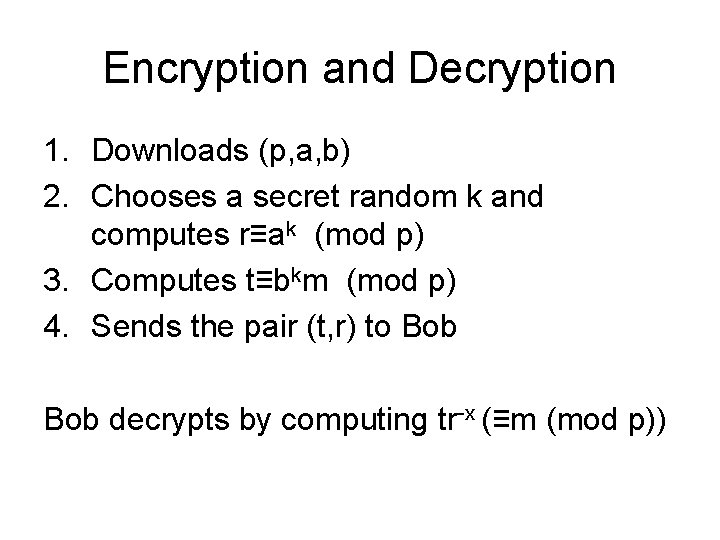
Encryption and Decryption 1. Downloads (p, a, b) 2. Chooses a secret random k and computes r≡ak (mod p) 3. Computes t≡bkm (mod p) 4. Sends the pair (t, r) to Bob decrypts by computing tr-x (≡m (mod p))
Exercises on Pages 175 and 176