
Discrete Linear Canonical Transforms An Operator Theory Approach
![Applications Signal processing [3] Computational and applied mathematics [5], [6], including fast and efficient](https://slidetodoc.com/presentation_image_h/1ee7dfd04563b3b69ee134fdced36d6e/image-6.jpg "Applications Signal processing [3] Computational and applied mathematics [5], [6], including fast and efficient")

- Slides: 31
Discrete Linear Canonical Transforms An Operator Theory Approach Aykut Koç and Haldun M. Ozaktas 30/06/2018 1
Outline Fractional Fourier Transform (FRT) Linear Canonical Transforms (LCTs) Previous Definitions Hyperdifferential Operator Theory Based DLCT The Iwasawa Decomposition The Hyperdifferential Forms The Operator Theory based DLCT Properties of Discrete Transform Results & Conclusions 2
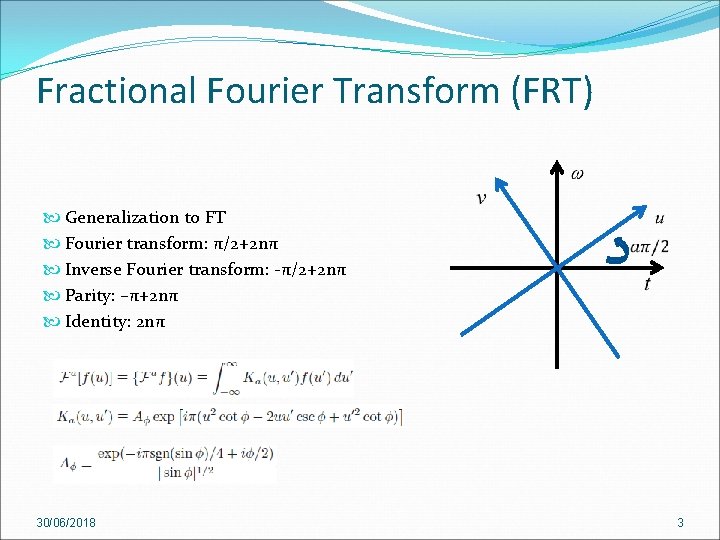
Fractional Fourier Transform (FRT) Generalization to FT Fourier transform: π/2+2 nπ Inverse Fourier transform: -π/2+2 nπ Parity: –π+2 nπ Identity: 2 nπ 30/06/2018 3
Canonical Transform Change of variables from one set of canonical coordinates to another What is the canonical coordinates? Set of coordinates that can describe a physical system at any given point in time Locates the system within phase space For quantum mechanics: position and momentum Thermodynamics: entropy-temperature, pressure-volume 30/06/2018 4
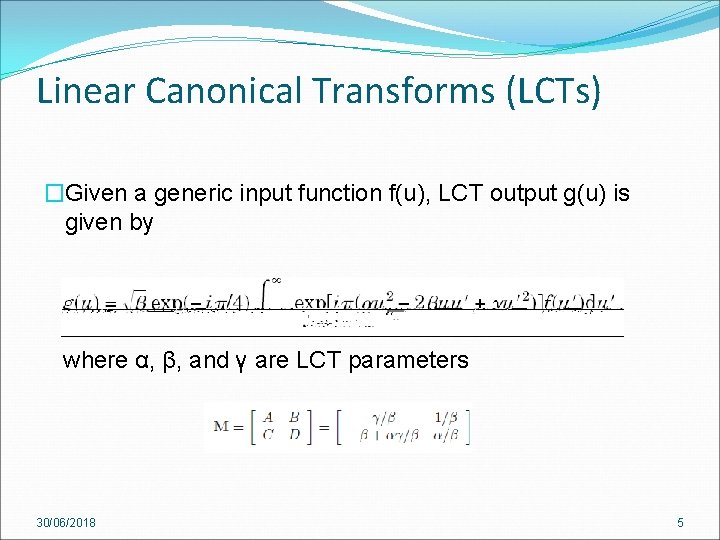
Linear Canonical Transforms (LCTs) �Given a generic input function f(u), LCT output g(u) is given by where α, β, and γ are LCT parameters 30/06/2018 5
Applications Signal processing [3] Computational and applied mathematics [5], [6], including fast and efficient optimal filtering [7] radar signal processing [8], [9] speech processing [10] image representation [11] image encryption and watermarking [12], [13], [14] LCTs have also been extensively studied for their applications in optics [2], [15], [16], [17], [18], [19], [20], electromagnetics, and classical and quantum mechanics [3], [1], [22]. 30/06/2018 6
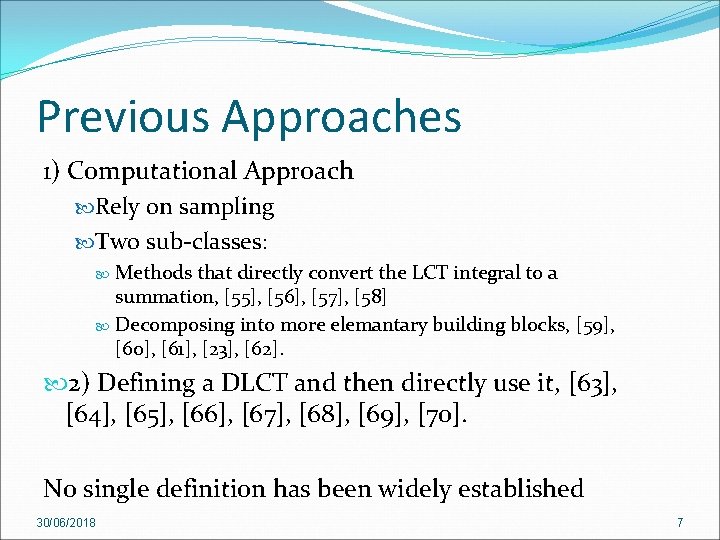
Previous Approaches 1) Computational Approach Rely on sampling Two sub-classes: Methods that directly convert the LCT integral to a summation, [55], [56], [57], [58] Decomposing into more elemantary building blocks, [59], [60], [61], [23], [62]. 2) Defining a DLCT and then directly use it, [63], [64], [65], [66], [67], [68], [69], [70]. No single definition has been widely established 30/06/2018 7
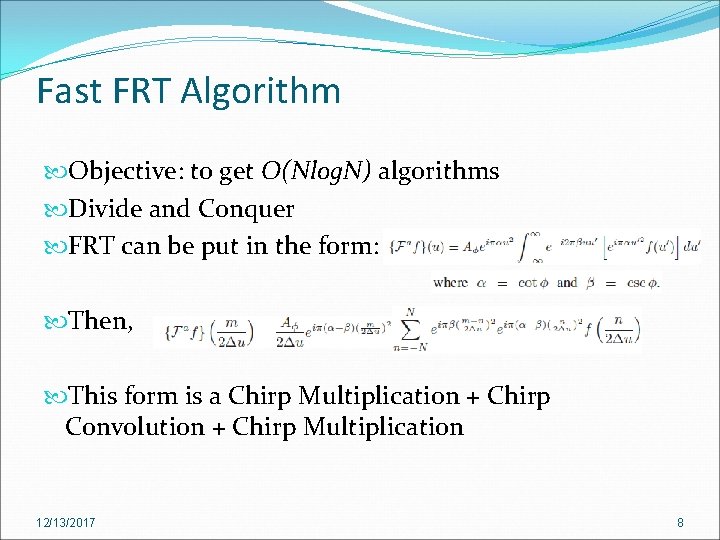
Fast FRT Algorithm Objective: to get O(Nlog. N) algorithms Divide and Conquer FRT can be put in the form: Then, This form is a Chirp Multiplication + Chirp Convolution + Chirp Multiplication 12/13/2017 8
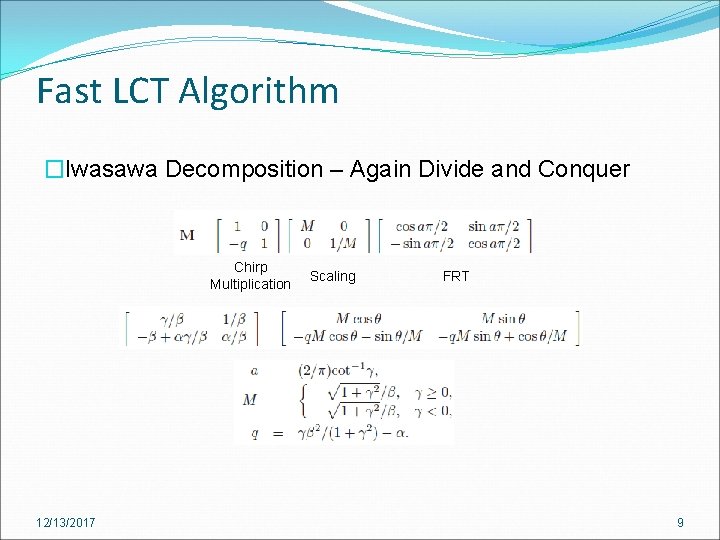
Fast LCT Algorithm �Iwasawa Decomposition – Again Divide and Conquer Chirp Multiplication 12/13/2017 Scaling FRT 9
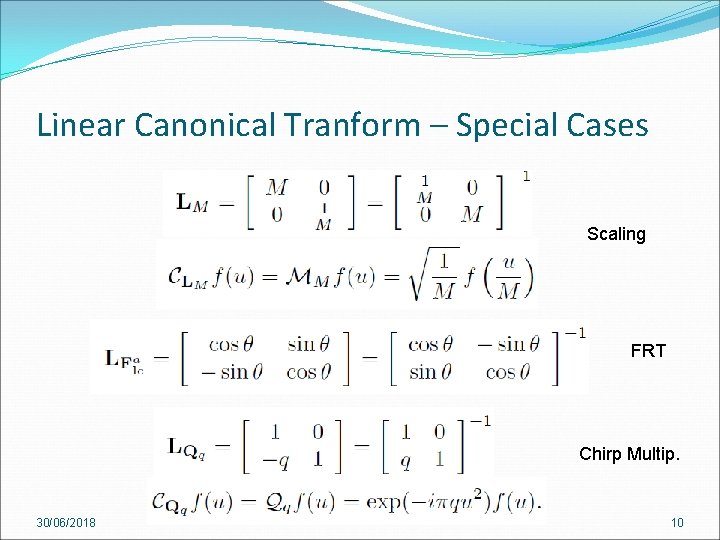
Linear Canonical Tranform – Special Cases Scaling FRT Chirp Multip. 30/06/2018 10
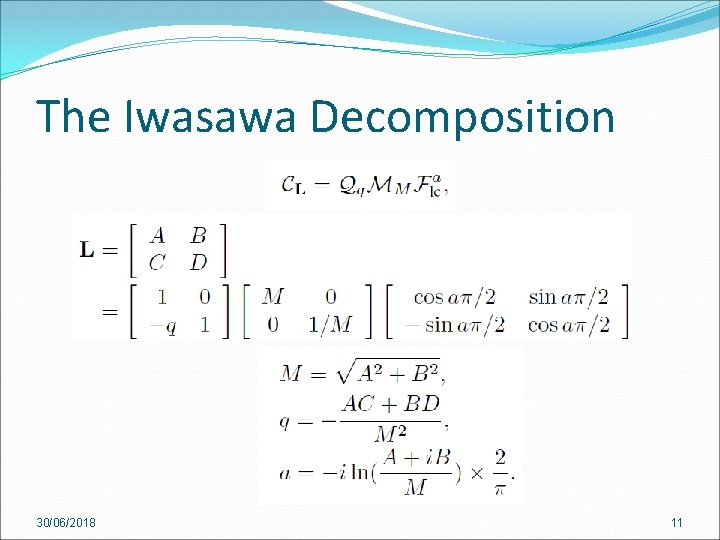
The Iwasawa Decomposition 30/06/2018 11
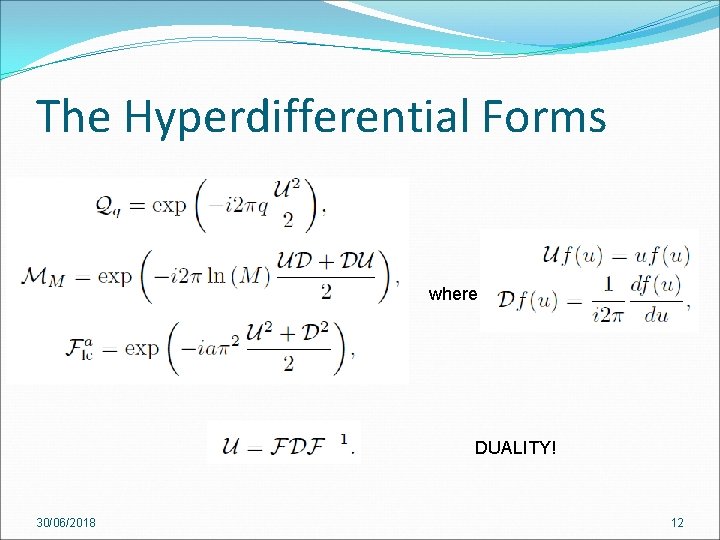
The Hyperdifferential Forms where DUALITY! 30/06/2018 12
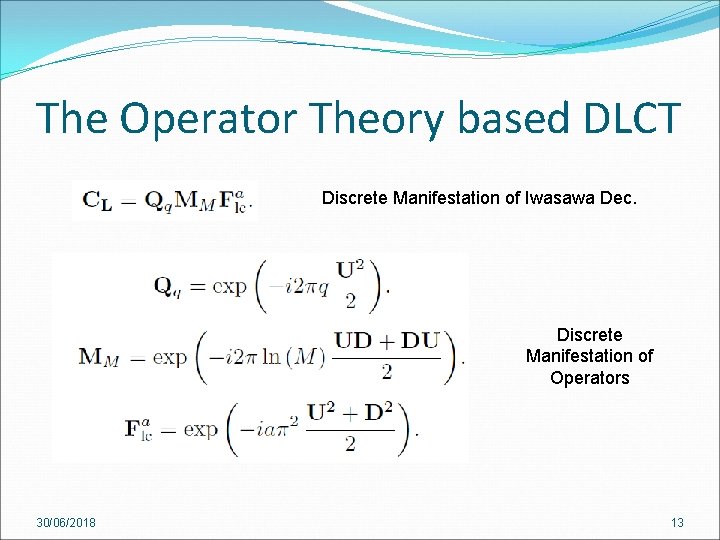
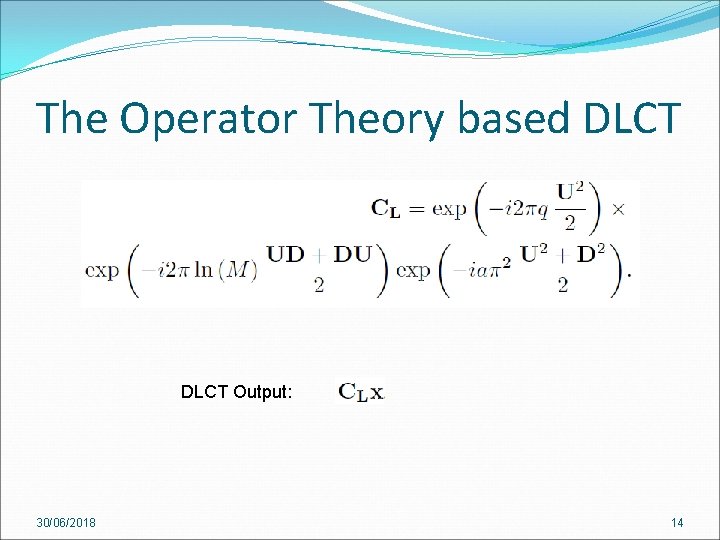
The Operator Theory based DLCT Discrete Manifestation of Iwasawa Dec. Discrete Manifestation of Operators 30/06/2018 13
The Operator Theory based DLCT Output: 30/06/2018 14
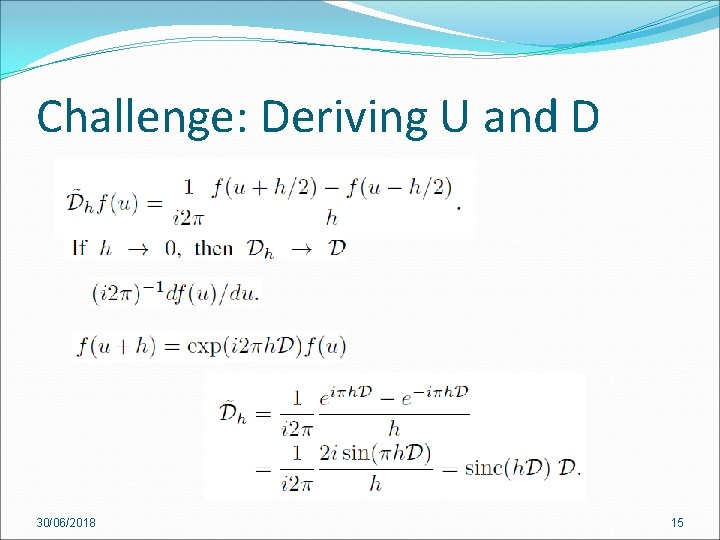
Challenge: Deriving U and D 30/06/2018 15
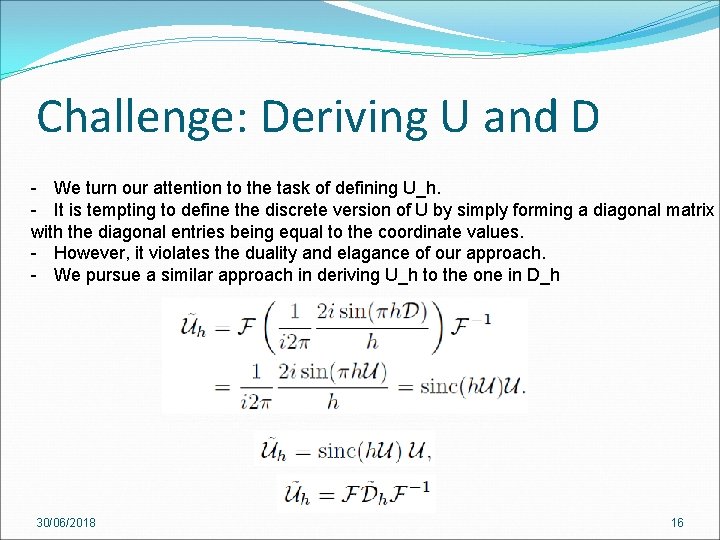
Challenge: Deriving U and D - We turn our attention to the task of defining U_h. - It is tempting to define the discrete version of U by simply forming a diagonal matrix with the diagonal entries being equal to the coordinate values. - However, it violates the duality and elagance of our approach. - We pursue a similar approach in deriving U_h to the one in D_h 30/06/2018 16
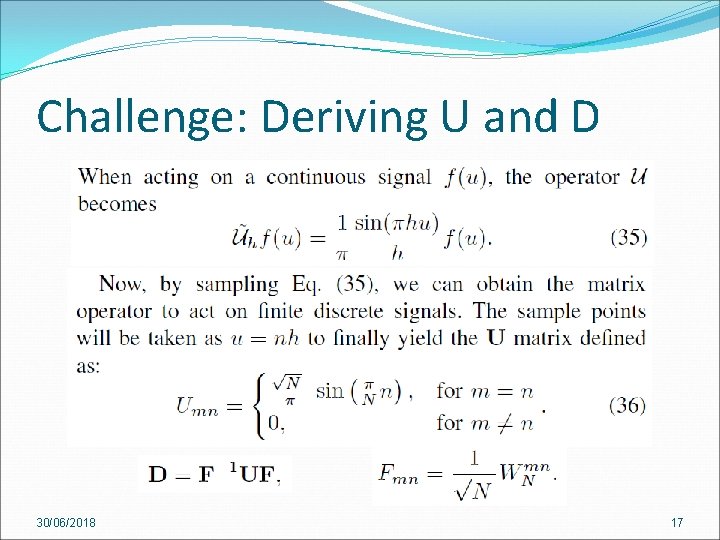
Challenge: Deriving U and D 30/06/2018 17
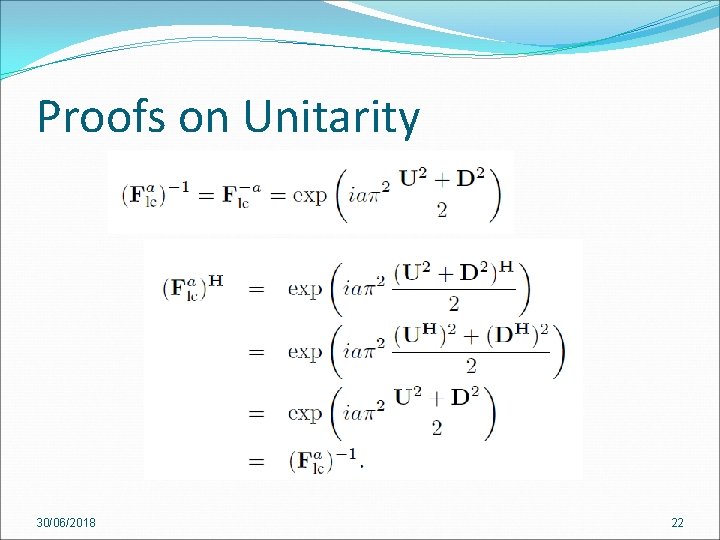
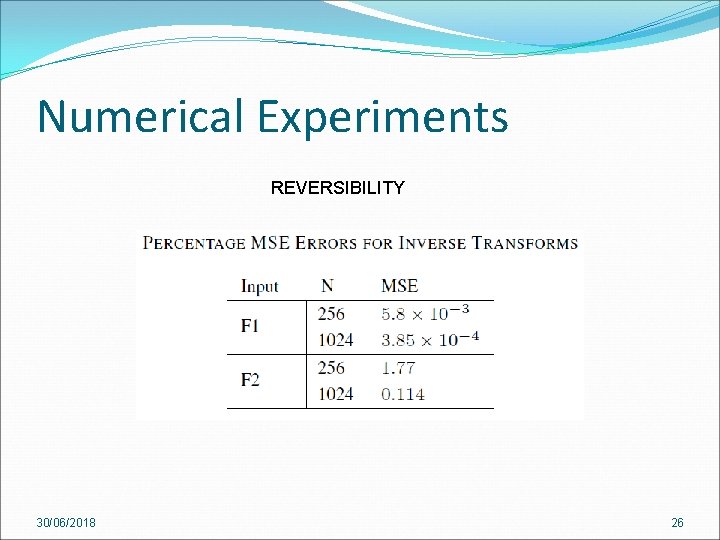
Properties of a Discrete Transform Unitarity Preservation of Group Structure Concatenation Property Reversibility (Special case of above) Satisfactory approximation of continuous transform However, a theorem from Group Theory states: ‘It is theoretically impossible to discretize all LCTs with a finite number of samples such that they are both unitary and they preserve the group structure. ’ - K. B. Wolf, Linear Canonical Transforms: Theory and Applications. New York, NY: Springer New York, 2016, ch. Development of Linear Canonical Transforms: A Historical Sketch, pp. 3– 28. - A. W. Knapp, Representation theory of semisimple groups: An overview based on examples. Princeton University Press, 2001. 30/06/2018 18
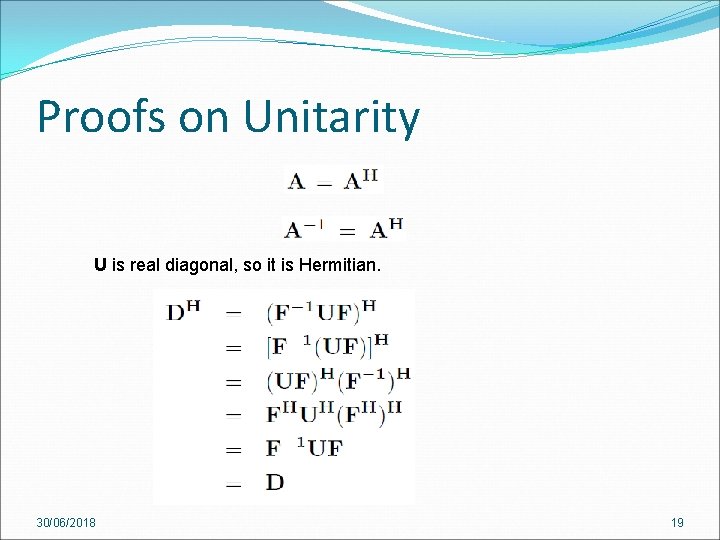
Proofs on Unitarity U is real diagonal, so it is Hermitian. 30/06/2018 19
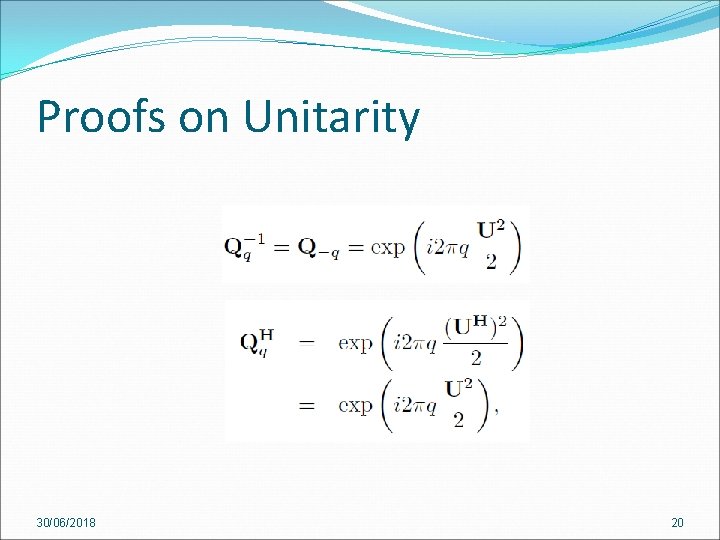
Proofs on Unitarity 30/06/2018 20
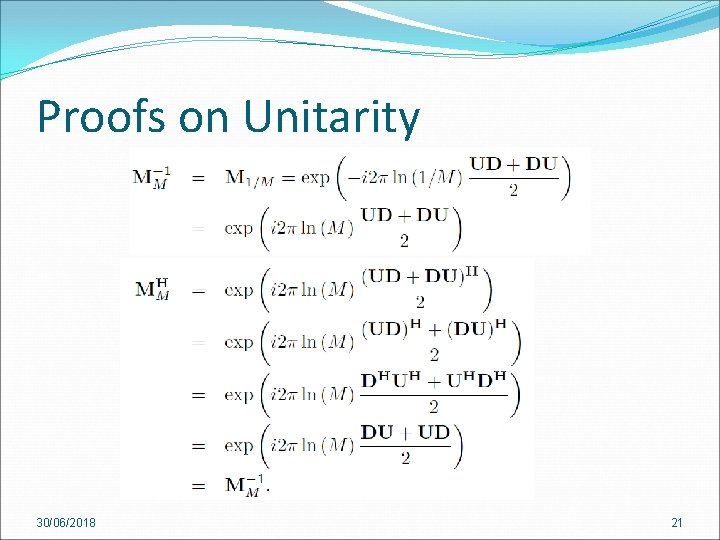
Proofs on Unitarity 30/06/2018 21
Proofs on Unitarity 30/06/2018 22
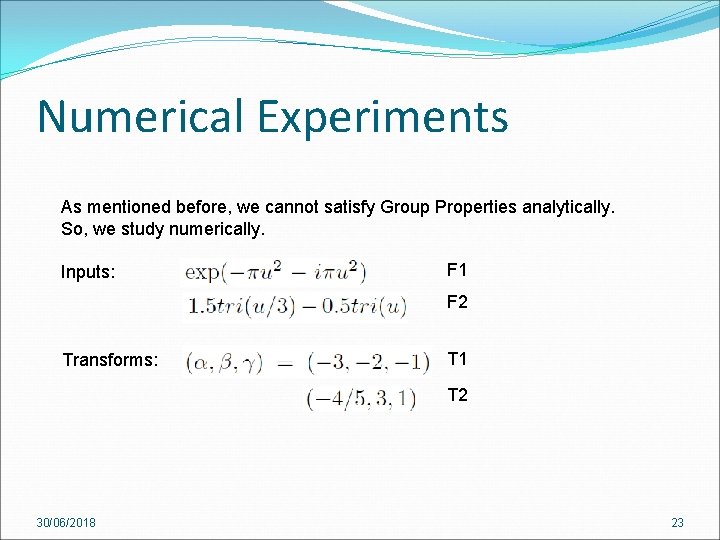
Numerical Experiments As mentioned before, we cannot satisfy Group Properties analytically. So, we study numerically. Inputs: F 1 F 2 Transforms: T 1 T 2 30/06/2018 23
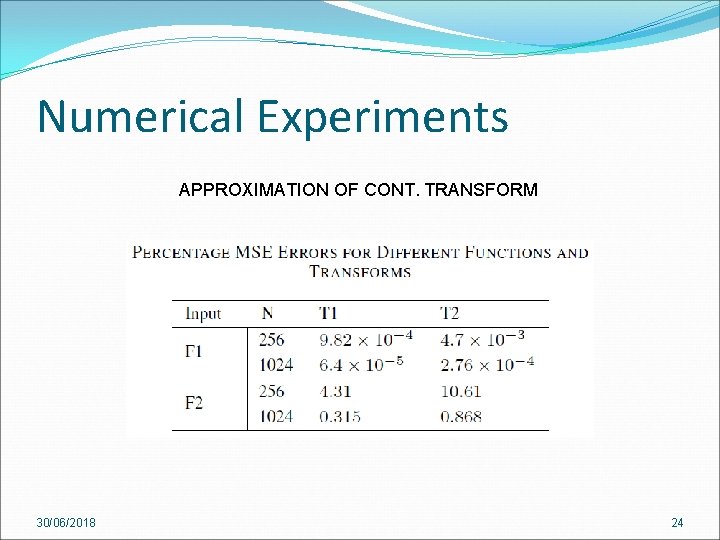
Numerical Experiments APPROXIMATION OF CONT. TRANSFORM 30/06/2018 24
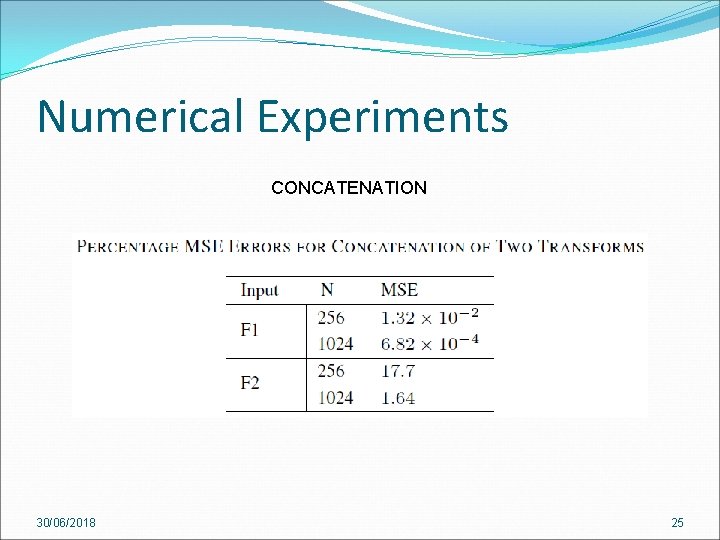
Numerical Experiments CONCATENATION 30/06/2018 25
Numerical Experiments REVERSIBILITY 30/06/2018 26
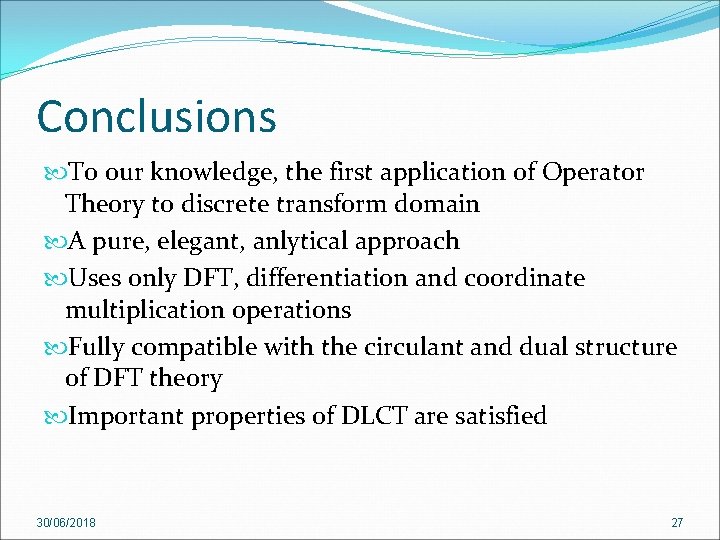
Conclusions To our knowledge, the first application of Operator Theory to discrete transform domain A pure, elegant, anlytical approach Uses only DFT, differentiation and coordinate multiplication operations Fully compatible with the circulant and dual structure of DFT theory Important properties of DLCT are satisfied 30/06/2018 27
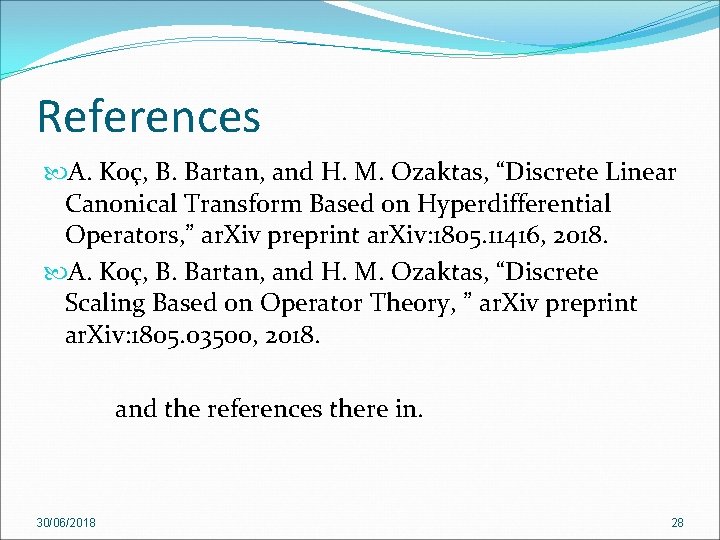
References A. Koç, B. Bartan, and H. M. Ozaktas, “Discrete Linear Canonical Transform Based on Hyperdifferential Operators, ” ar. Xiv preprint ar. Xiv: 1805. 11416, 2018. A. Koç, B. Bartan, and H. M. Ozaktas, “Discrete Scaling Based on Operator Theory, ” ar. Xiv preprint ar. Xiv: 1805. 03500, 2018. and the references there in. 30/06/2018 28
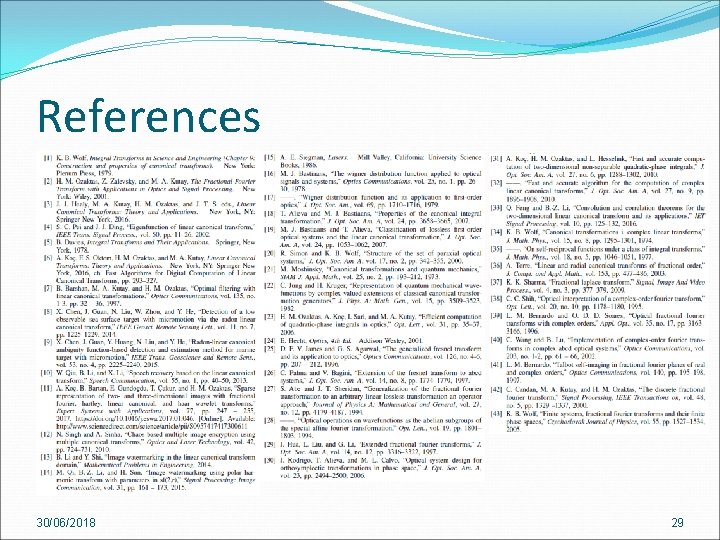
References 30/06/2018 29
References 30/06/2018 30
THANK YOU 12/13/2017 31