
Discrete Element Modelling of Detachment Folding Stuart Hardy












- Slides: 36
Discrete Element Modelling of Detachment Folding Stuart Hardy ICREA (Institució Catalana de Recerca i Estudis Avançats) Barcelona, Catalunya and GGAC, Departament de Geodinàmica i Geofísica Facultat de Geologia, Universitat de Barcelona
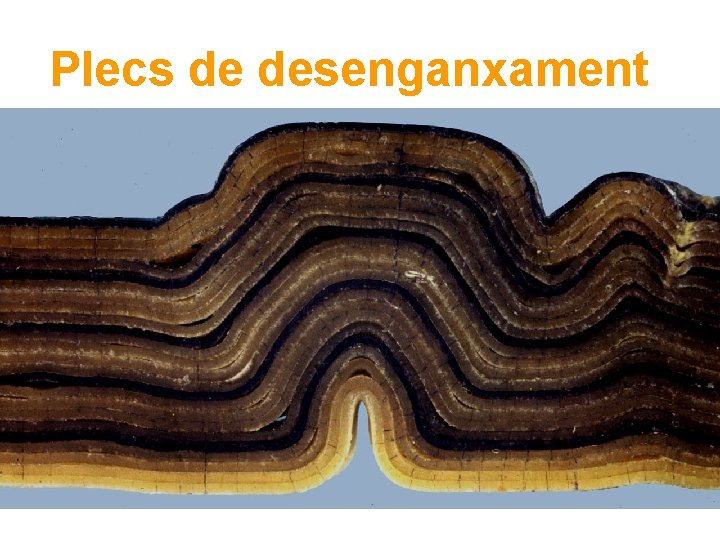
Plecs de desenganxament
What Am I Talking About? • • Detachment Folds (2 D) Their Development Cover Rheology (“the Sandwich”) Deformation Mechanisms/Processes Recognition Comparison with Kinematic Models Comparison with Natural Examples
Why Am I Talking About Detachment Folds? • Important Component of Fold and Thrust Belts • Great Deal of Recent Interest • Plethora of Kinematic Models • Basin Analysis • Active Tectonics • Oil and Gas Potential
Natural Examples of Detachment Folds
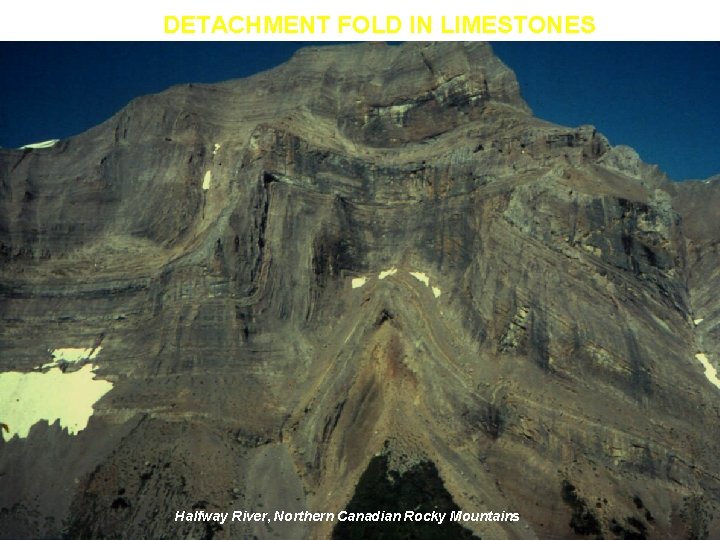
DETACHMENT FOLD IN LIMESTONES Halfway River, Northern Canadian Rocky Mountains
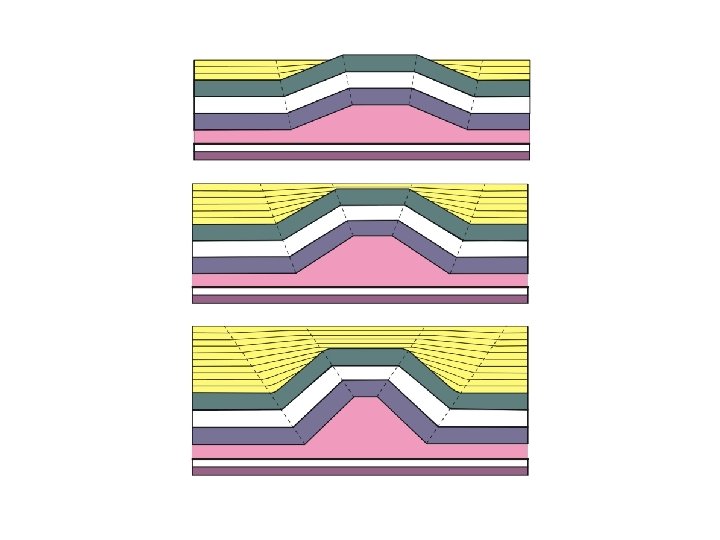
Fold Growth… the debate between… • Limb Rotation • Limb Lengthening …. make specific predictions regarding fold growth
Detachment Fold Models • Plethora of models • e. g. Poblet and Mc. Clay, 1996; Mitra, 2003; Wallace and Homza, 2004 • based on kinematic constraints such as conservation of line-length, bed-thickness and cross-sectional area
Kinematic Models… • One key drawback of current kinematic models is that they describe the manner in which the cover deforms a priori, not allowing investigation of the control of mechanical stratigraphy within the overlying cover on the styles and kinematics of detachment folding, and the conditions under which detachment folding occurs.
• In addition, these models are, by their design, simplifications of nature and, as a result, much of the complexity of detachment fold growth in space and time is lost. Thus, local structures accommodating space problems are not modelled and ad-hoc balancing solutions are devised involving migrating detachment levels and/or distributed strain.
How? Modelling Approach…. • • • Different approach to previous studies Not Finite-Element Or Block Viscous Or Kinematic, Finite-Difference But rather I will use a Discrete Element Technique…. .
Why Use a Discrete Element Approach? • We would like to simulate faulting and folding in the cover • Don’t want to impose rates/locations of faulting or folding • Heterogeneous mechanical properties • Arbitrary boundary conditions (Cons: Model Run Times, Interpreting Results, Scaling, Model Testing and Verification)
Discrete Lattice • Random Lattice (4 Ball Sizes) • Simple elastic-brittle interaction between elements under the influence of gravity • Scaled to 250 m unit length, 2. 5 g/cm 3 density
Model formulation At each discrete time step, particles are advanced to their new positions within the model by integrating their equations of motion using Newtonian physics and a velocity-Verlat based scheme
Illustrative example Strong Cover Layer Weak Decollment Layer
Initial and Boundary Conditions • • Simple Velocity Discontinuity 8906 Elements, 4 Radii (0. 5, 0. 4, 0. 3, 0. 2 LU) Mechanically-Layered Stratigraphy Weak Basal Unit
Experiment 1 Four thick strong units in cover Separated by 3 thinner weak units Bst (Strong) = 0. 05 R Bst (Weak) = 0. 005 R Total Displacement = 15 units, shown at 3 unit intervals
Experiment 1
Animation of fold evolution and bond breakage
Experiment 2 Five thick strong units in cover Separated by four thinner weak units Bst (Strong) = 0. 05 R Bst (Weak) = 0. 005 R Total Displacement = 15 units, shown at 3 unit intervals
Experiment 2
Model Animation and Bond Breakage
Experiment 3 Six thin strong units in cover Separated by 5 thin weak units Bst (Strong) = 0. 05 R Bst (Weak) = 0. 005 R Total Displacement = 15 units, shown at 3 unit intervals
Experiment 3
Model Animation and Bond Breakage
Experiments 4&5 Identical to Experiment 2 Except that relative strengths of weak and strong layers is varied: in Experiment 4 weak layers are 3 x stronger in Experiment 5 6 x stronger -> homogeneous cover Total Displacement = 15 units, shown at 3 unit intervals
Expt 2 Expt 4 Expt 5
Uplift Analysis - Crest of Expt. 2 Fold initiation
Key Observations • Novel Modelling Technique Applied to Detachment Folding
• Folds and faults form “naturally” in the cover and at a variety of scales • Replicate many key features of detachment folds: Parallel outer layers, dominance of folding over faulting, deformation concentrated in weak layers
Key Observations • Folds grow by a combination of limb-lengthening and limb-rotation • Increase in amplitude is correlated with increased shortening and limb dip, but there is little wavelength variation • Model folds quite different from kinematic models • Rheology of the cover sequence a key factor
Acknowledgements Josep Anton Muñoz Eduard Roca ICREA CESCA (Centre de Supercomputació de Catalunya) Geomod 3 D Project Geomodels Programme