
Discrete and Continuous Randonm Variables Group Activity Solution
Discrete and Continuous Randonm Variables; Group Activity Solution ECE 313 Probability with Engineering Applications Lecture 9 Professor Ravi K. Iyer Department of Electrical and Computer Engineering University of Illinois Iyer - Lecture 7 ECE 313 - Fall 2016
Today’s Topics • Group Activity – Solution included in the lecture slides see online • Random Variables – – Examples Discrete Continuous, Probability mass Function (pmf); Cumulative Distribution Function (CDF), Probability Density Function (pdf), – Start on example Distributions • Announcements: – Homework 3 due Wednesday, February 22 nd in class. – Homework 4, out Wed Feb 22 nd due following Wednesday in class Iyer - Lecture 7 ECE 313 - Fall 2016

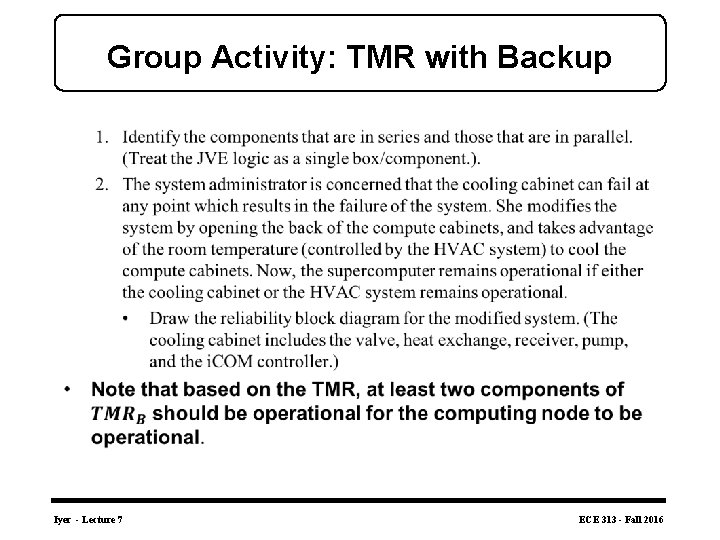
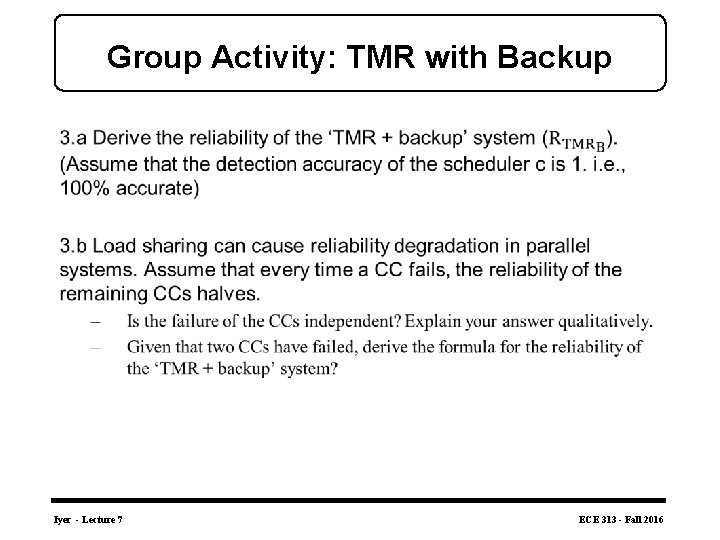
Group Activity: Super computing node with cooling TMR with a Twist • Imagine a node of a new supercomputer with its cooling system set up as in the figure below – similar to what we looked at iearlier n class. The computing nodes are in three cabinets with a backup node in a separate cabinet, ready to switch in, in the event that any one single cabinet fails. The three ‘primary’ cabinets run in a triple modular redundant (TMR) mode with an additional backup (TMR + backup). The job scheduler’s functionality includes: – General scheduling – The ability to vote of the outputs of the three cabinets – Upon detecting a failure, switching out the failed cabinet and switching in the backup cabinet • • • In addition to keeping a set of compute cabinet operational, it is critical to keep the cooling system functional. The valve, pump and the controller plays a critical role in the cooling system. Iyer - Lecture 7 ECE 313 - Fall 2016
Group Activity: TMR with Backup • Iyer - Lecture 7 ECE 313 - Fall 2016
Group Activity: TMR with Backup • Iyer - Lecture 7 ECE 313 - Fall 2016
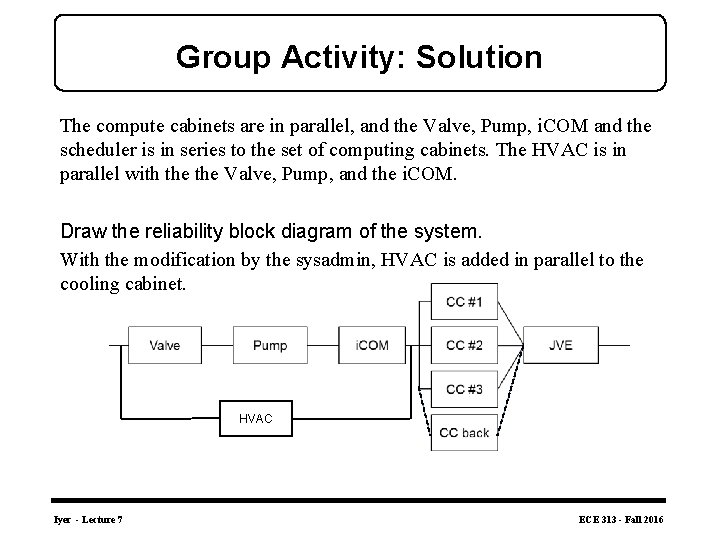
Group Activity: Solution The compute cabinets are in parallel, and the Valve, Pump, i. COM and the scheduler is in series to the set of computing cabinets. The HVAC is in parallel with the Valve, Pump, and the i. COM. Draw the reliability block diagram of the system. With the modification by the sysadmin, HVAC is added in parallel to the cooling cabinet. HVAC Iyer - Lecture 7 ECE 313 - Fall 2016
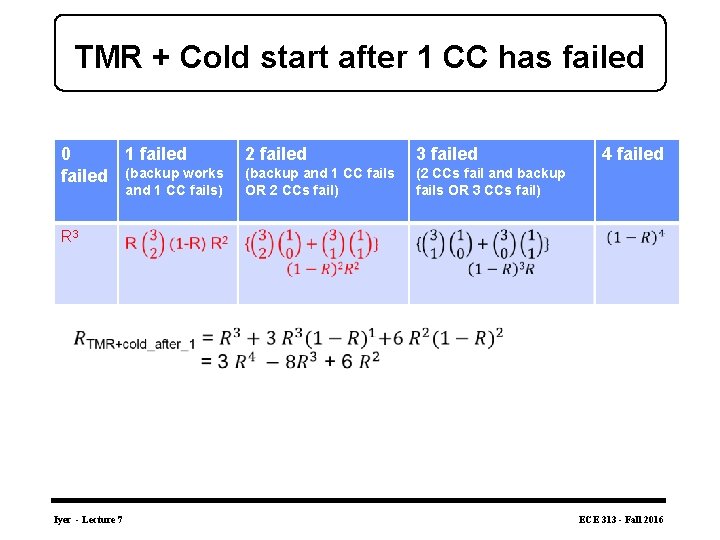
TMR + Cold start after 1 CC has failed 0 1 failed (backup works and 1 CC fails) 2 failed 3 failed (backup and 1 CC fails OR 2 CCs fail) (2 CCs fail and backup fails OR 3 CCs fail) 4 failed R 3 Iyer - Lecture 7 ECE 313 - Fall 2016
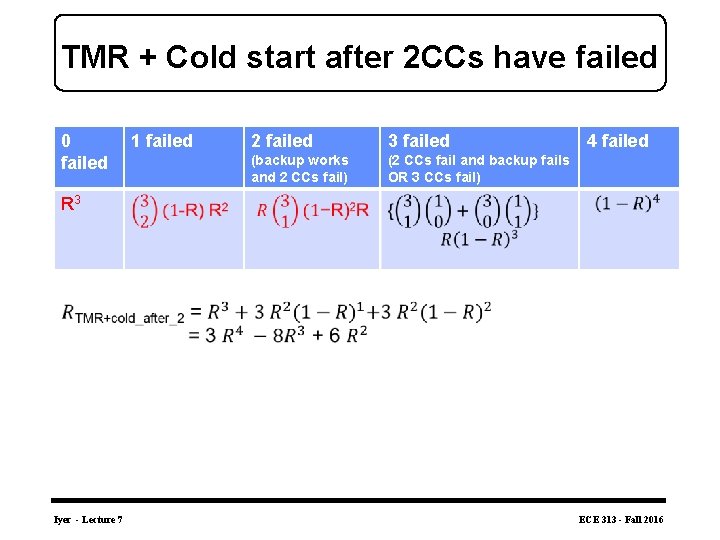
TMR + Cold start after 2 CCs have failed 0 failed 1 failed 2 failed 3 failed (backup works and 2 CCs fail) (2 CCs fail and backup fails OR 3 CCs fail) 4 failed R 3 Iyer - Lecture 7 ECE 313 - Fall 2016
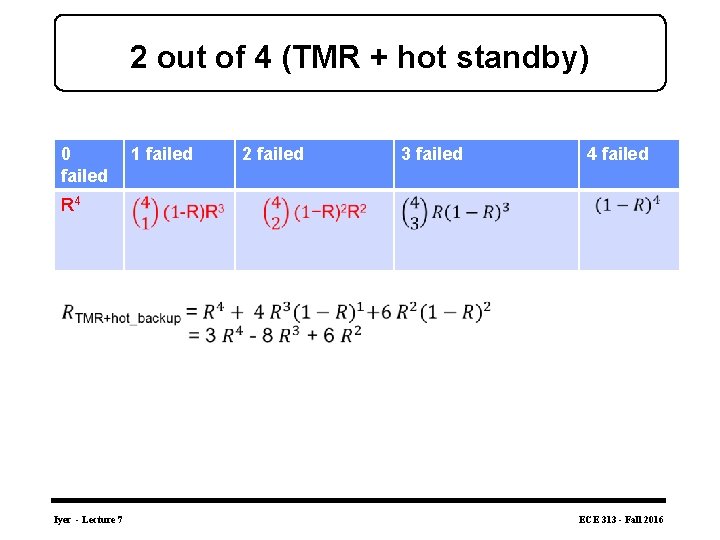
2 out of 4 (TMR + hot standby) 0 failed 1 failed 2 failed 3 failed 4 failed R 4 Iyer - Lecture 7 ECE 313 - Fall 2016
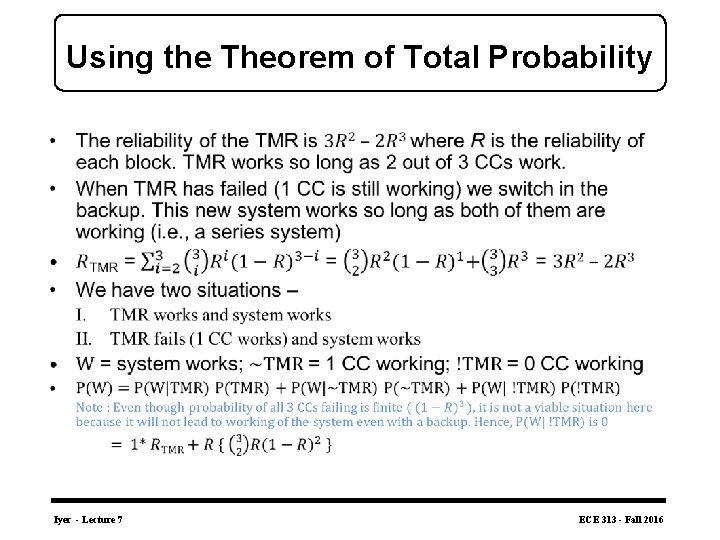
Using the Theorem of Total Probability • Iyer - Lecture 7 ECE 313 - Fall 2016
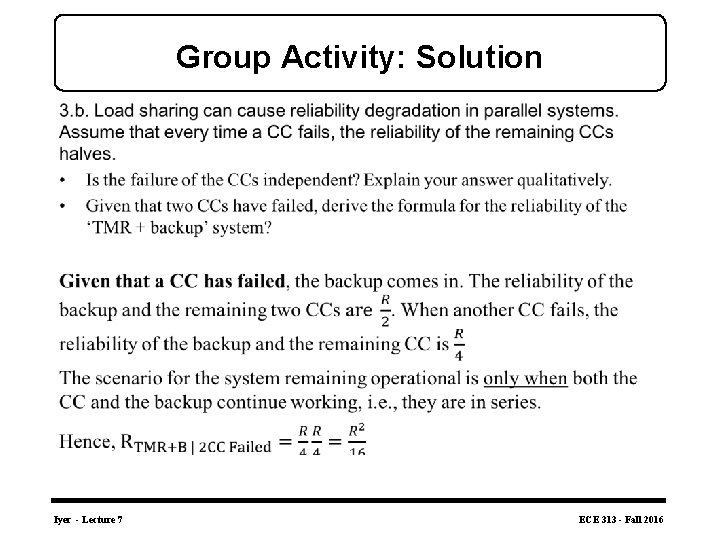
Group Activity: Solution • Iyer - Lecture 7 ECE 313 - Fall 2016
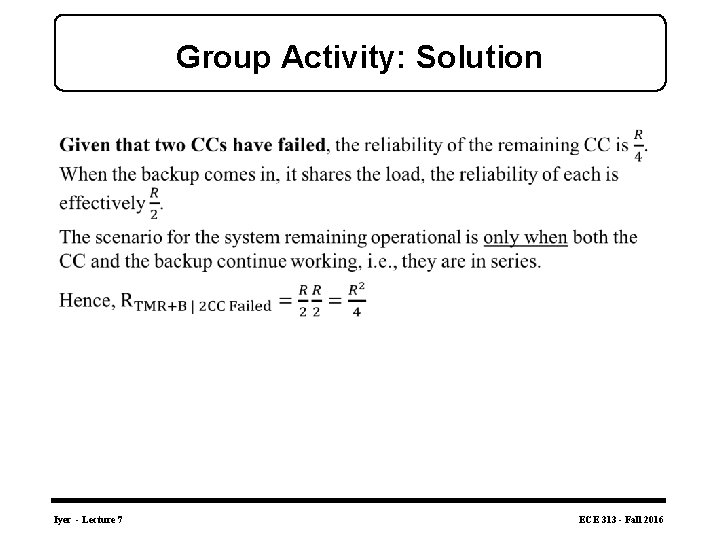
Group Activity: Solution • Iyer - Lecture 7 ECE 313 - Fall 2016

Random Variable • Definition: Random Variable A random variable X on a sample space S is a function X: S ® that assigns a real number X(s) to each sample point s Î S. Example: Consider a random experiment defined by a sequence of three Bernoulli trials. The sample space S consists of eight triples (where 1 and 0 respectively denote success and a failure on the nth trail). The probability of successes , p, is equal 0. 5. Sample points 111 110 101 100 011 010 001 000 Iyer - Lecture 7 P(s) 0. 125 0. 125 X(s) 3 2 2 1 1 0 Note that two or more sample points might give the same value for X (i. e. , X may not be a one-to-one function. ), but that two different numbers in the range cannot be assigned to the sample point (i. e. , X is well defined function). ECE 313 - Fall 2016
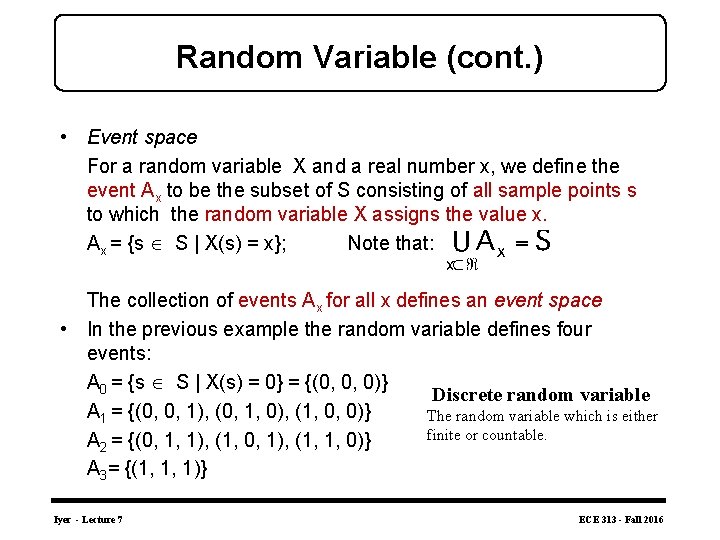
Random Variable (cont. ) • Event space For a random variable X and a real number x, we define the event Ax to be the subset of S consisting of all sample points s to which the random variable X assigns the value x. Ax = {s Î S | X(s) = x}; Note that: The collection of events Ax for all x defines an event space • In the previous example the random variable defines four events: A 0 = {s Î S | X(s) = 0} = {(0, 0, 0)} Discrete random variable A 1 = {(0, 0, 1), (0, 1, 0), (1, 0, 0)} The random variable which is either finite or countable. A 2 = {(0, 1, 1), (1, 0, 1), (1, 1, 0)} A 3= {(1, 1, 1)} Iyer - Lecture 7 ECE 313 - Fall 2016
Discrete/Continuous Random Variables • The discrete random variables are either a finite or a countable number of possible values. • Random variables that take on a continuum of possible values are known as continuous random variables. • Example: A random variable denoting the lifetime of a car, when the car’s lifetime is assumed to take on any value in some interval (a, b) is continuous. Iyer - Lecture 7 ECE 313 - Fall 2016
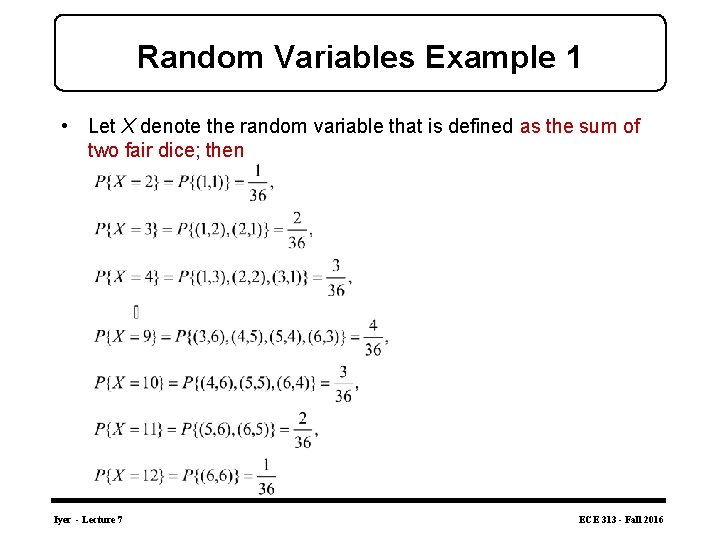
Random Variables Example 1 • Let X denote the random variable that is defined as the sum of two fair dice; then Iyer - Lecture 7 ECE 313 - Fall 2016
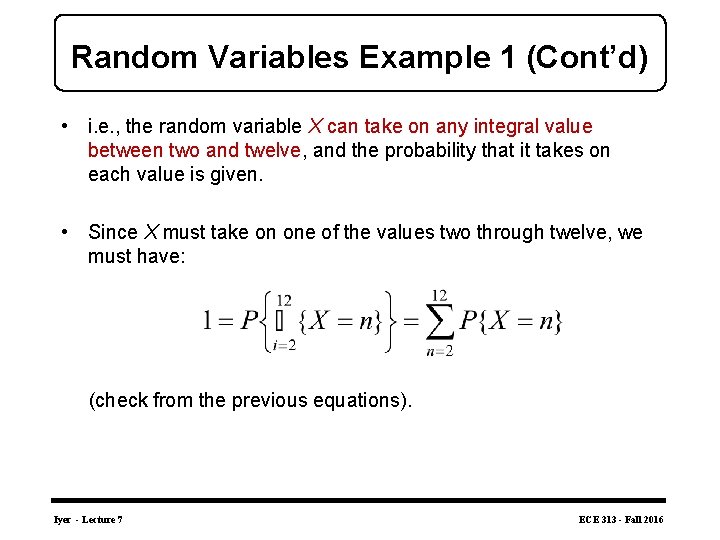
Random Variables Example 1 (Cont’d) • i. e. , the random variable X can take on any integral value between two and twelve, and the probability that it takes on each value is given. • Since X must take on one of the values two through twelve, we must have: (check from the previous equations). Iyer - Lecture 7 ECE 313 - Fall 2016
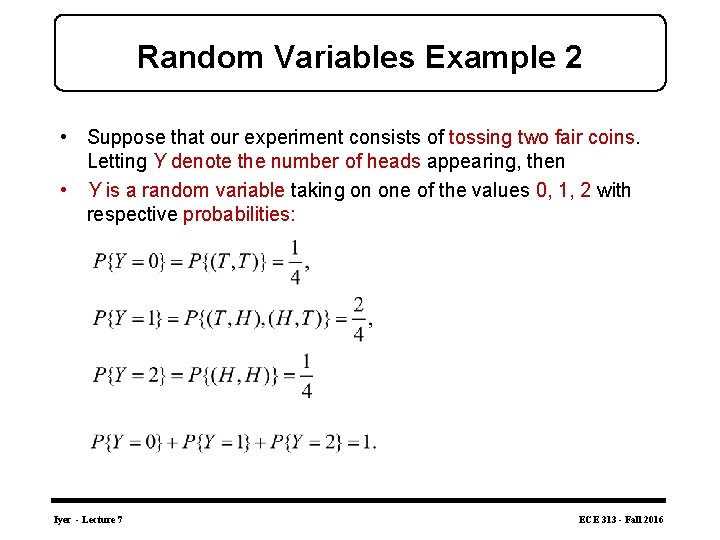
Random Variables Example 2 • Suppose that our experiment consists of tossing two fair coins. Letting Y denote the number of heads appearing, then • Y is a random variable taking on one of the values 0, 1, 2 with respective probabilities: Iyer - Lecture 7 ECE 313 - Fall 2016
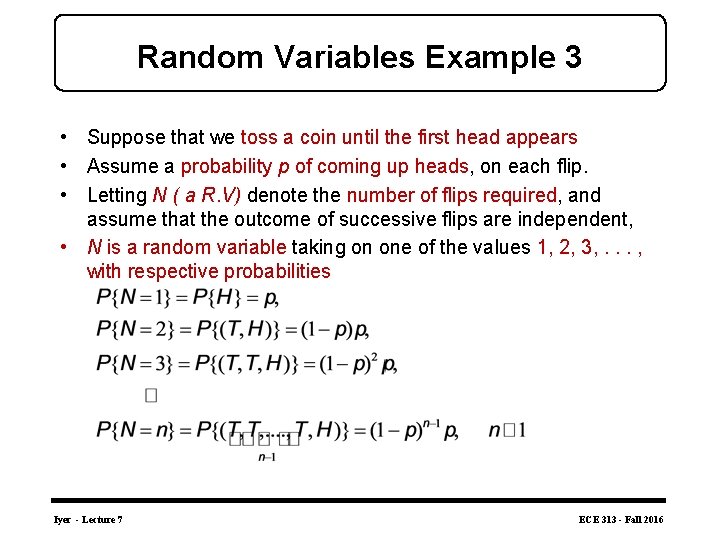
Random Variables Example 3 • Suppose that we toss a coin until the first head appears • Assume a probability p of coming up heads, on each flip. • Letting N ( a R. V) denote the number of flips required, and assume that the outcome of successive flips are independent, • N is a random variable taking on one of the values 1, 2, 3, . . . , with respective probabilities Iyer - Lecture 7 ECE 313 - Fall 2016
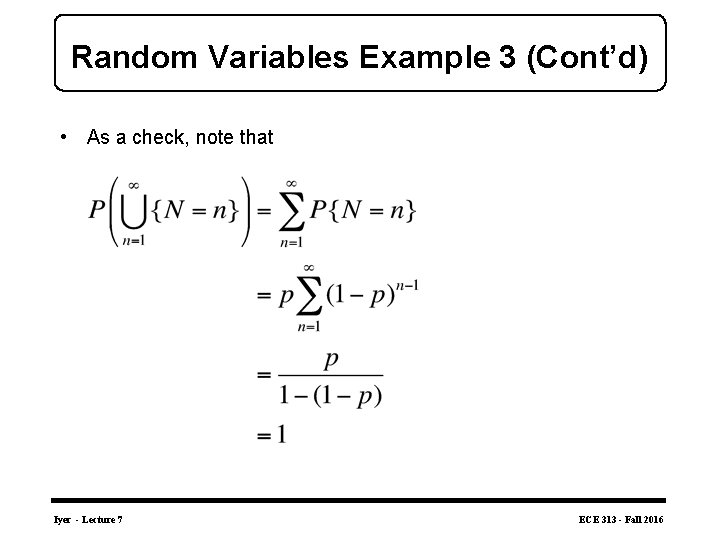
Random Variables Example 3 (Cont’d) • As a check, note that Iyer - Lecture 7 ECE 313 - Fall 2016
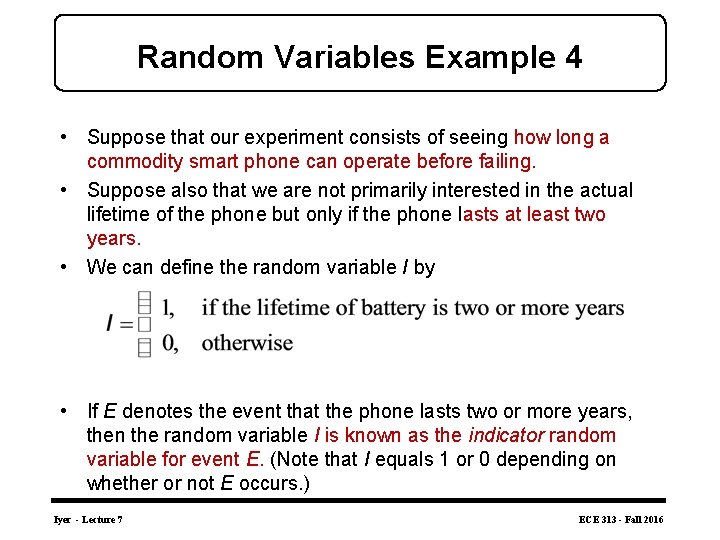
Random Variables Example 4 • Suppose that our experiment consists of seeing how long a commodity smart phone can operate before failing. • Suppose also that we are not primarily interested in the actual lifetime of the phone but only if the phone lasts at least two years. • We can define the random variable I by • If E denotes the event that the phone lasts two or more years, then the random variable I is known as the indicator random variable for event E. (Note that I equals 1 or 0 depending on whether or not E occurs. ) Iyer - Lecture 7 ECE 313 - Fall 2016
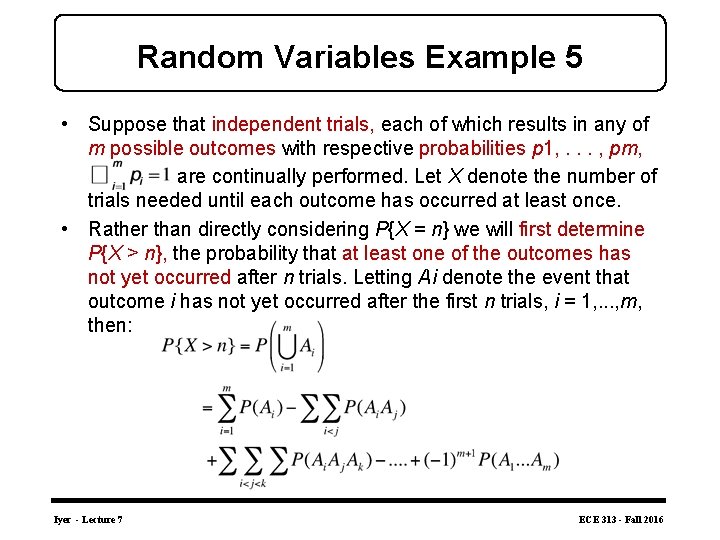
Random Variables Example 5 • Suppose that independent trials, each of which results in any of m possible outcomes with respective probabilities p 1, . . . , pm, are continually performed. Let X denote the number of trials needed until each outcome has occurred at least once. • Rather than directly considering P{X = n} we will first determine P{X > n}, the probability that at least one of the outcomes has not yet occurred after n trials. Letting Ai denote the event that outcome i has not yet occurred after the first n trials, i = 1, . . . , m, then: Iyer - Lecture 7 ECE 313 - Fall 2016
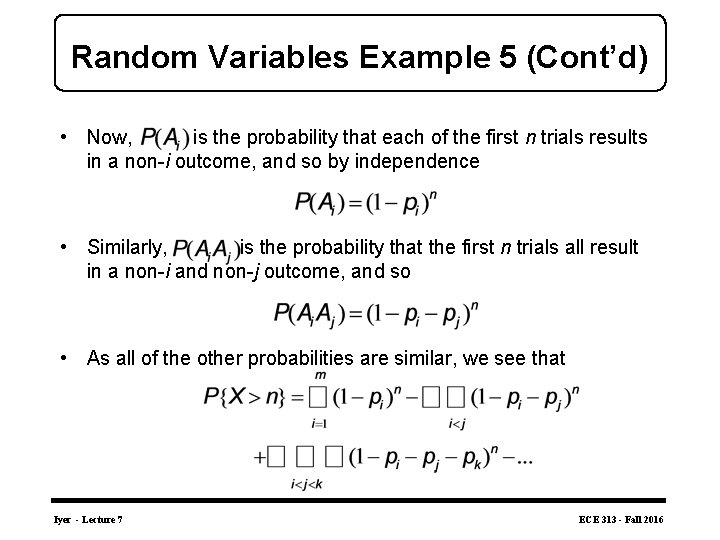
Random Variables Example 5 (Cont’d) • Now, is the probability that each of the first n trials results in a non-i outcome, and so by independence • Similarly, is the probability that the first n trials all result in a non-i and non-j outcome, and so • As all of the other probabilities are similar, we see that Iyer - Lecture 7 ECE 313 - Fall 2016
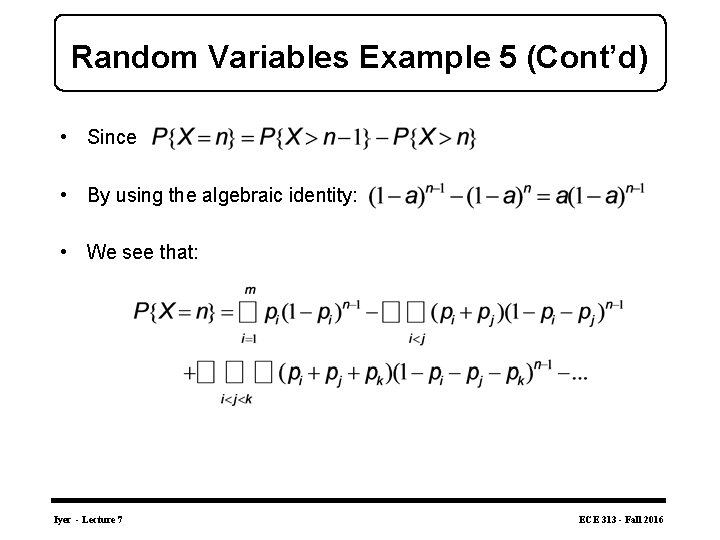
Random Variables Example 5 (Cont’d) • Since • By using the algebraic identity: • We see that: Iyer - Lecture 7 ECE 313 - Fall 2016
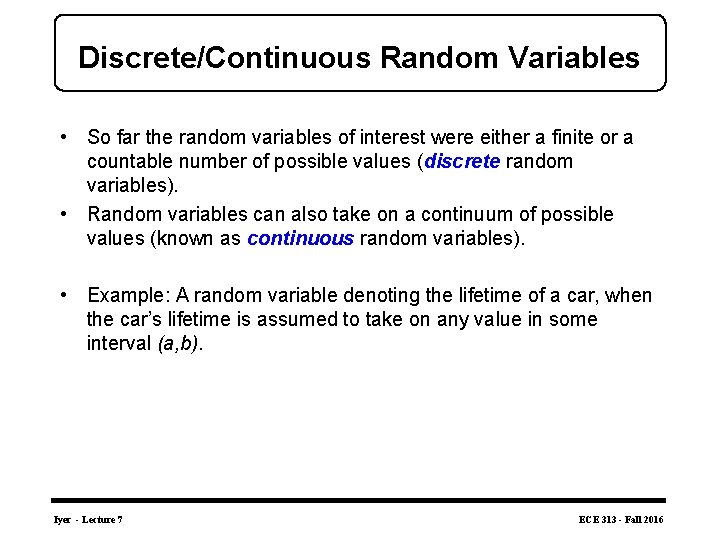
Discrete/Continuous Random Variables • So far the random variables of interest were either a finite or a countable number of possible values (discrete random variables). • Random variables can also take on a continuum of possible values (known as continuous random variables). • Example: A random variable denoting the lifetime of a car, when the car’s lifetime is assumed to take on any value in some interval (a, b). Iyer - Lecture 7 ECE 313 - Fall 2016
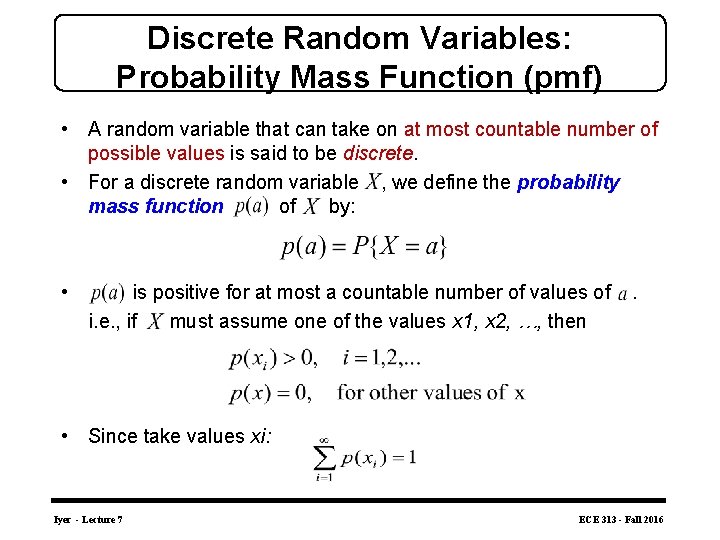
Discrete Random Variables: Probability Mass Function (pmf) • A random variable that can take on at most countable number of possible values is said to be discrete. • For a discrete random variable , we define the probability mass function of by: • is positive for at most a countable number of values of i. e. , if must assume one of the values x 1, x 2, …, then . • Since take values xi: Iyer - Lecture 7 ECE 313 - Fall 2016
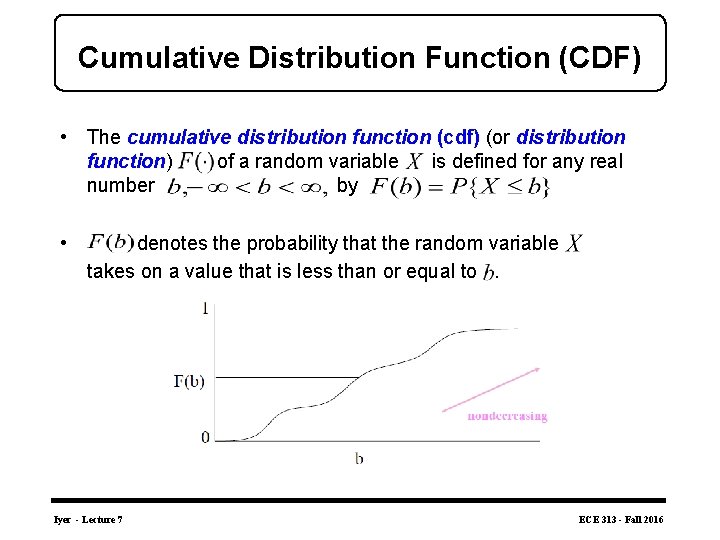
Cumulative Distribution Function (CDF) • The cumulative distribution function (cdf) (or distribution function) of a random variable is defined for any real number by • denotes the probability that the random variable takes on a value that is less than or equal to. Iyer - Lecture 7 ECE 313 - Fall 2016
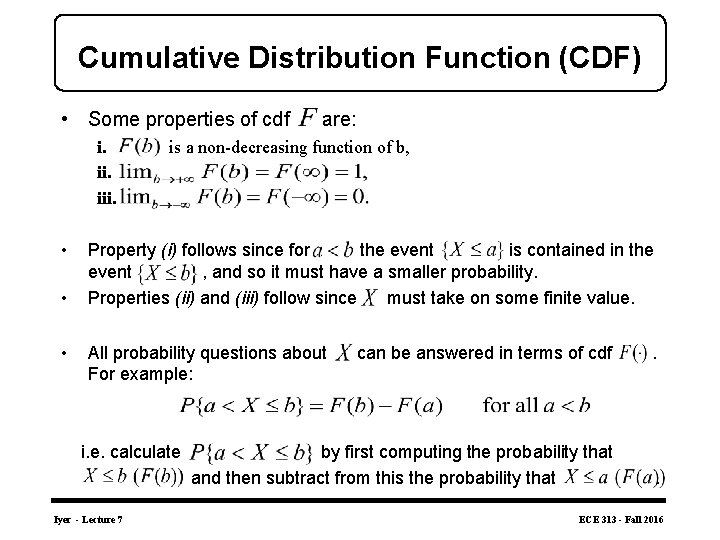
Cumulative Distribution Function (CDF) • Some properties of cdf i. iii. • • • are: is a non-decreasing function of b, Property (i) follows since for the event is contained in the event , and so it must have a smaller probability. Properties (ii) and (iii) follow since must take on some finite value. All probability questions about For example: i. e. calculate Iyer - Lecture 7 can be answered in terms of cdf . by first computing the probability that and then subtract from this the probability that . ECE 313 - Fall 2016
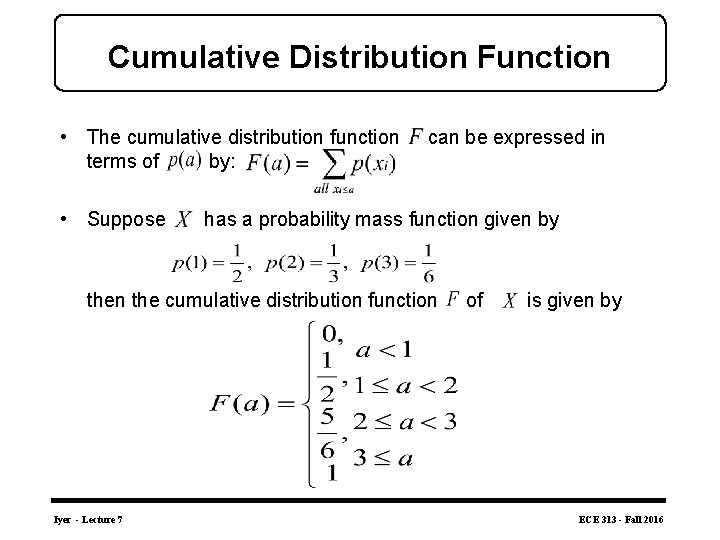
Cumulative Distribution Function • The cumulative distribution function terms of by: • Suppose can be expressed in has a probability mass function given by then the cumulative distribution function Iyer - Lecture 7 of is given by ECE 313 - Fall 2016
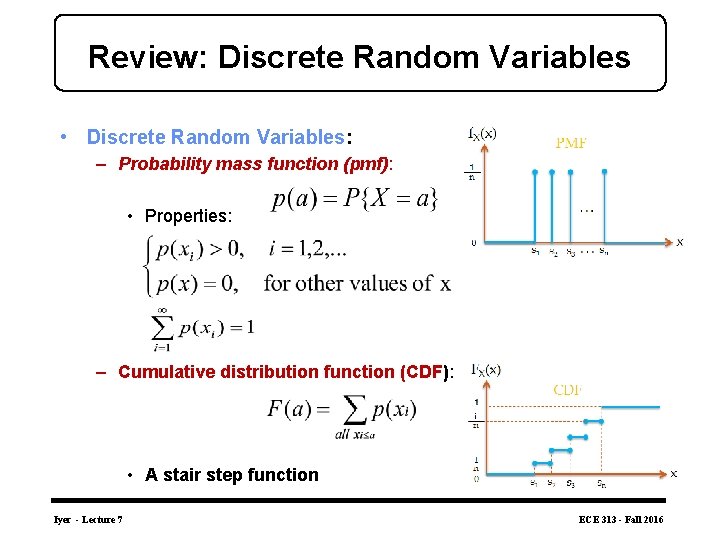
Review: Discrete Random Variables • Discrete Random Variables: – Probability mass function (pmf): • Properties: – Cumulative distribution function (CDF): • A stair step function Iyer - Lecture 7 ECE 313 - Fall 2016
Discrete/Continuous Random Variables • Random variables can also take on a continuum of possible values (known as continuous random variables). • Example: A random variable denoting the lifetime of a car, when the car’s lifetime is assumed to take on any value in some interval (a, b). Iyer - Lecture 7 ECE 313 - Fall 2016
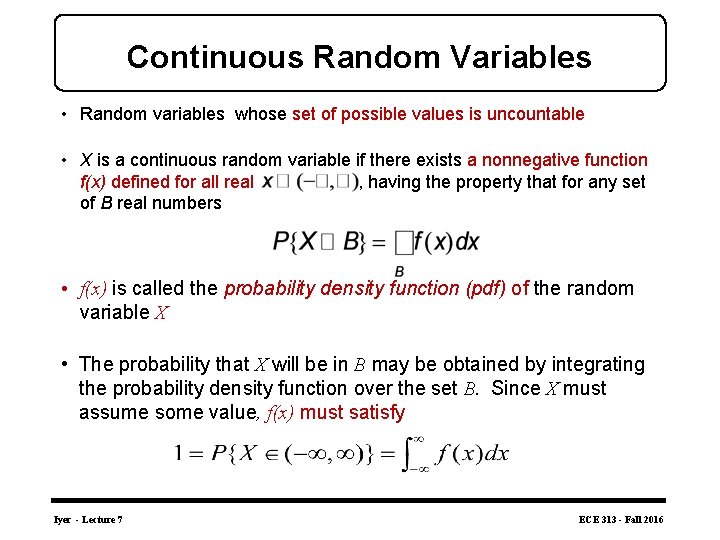
Continuous Random Variables • Random variables whose set of possible values is uncountable • X is a continuous random variable if there exists a nonnegative function f(x) defined for all real , having the property that for any set of B real numbers • f(x) is called the probability density function (pdf) of the random variable X • The probability that X will be in B may be obtained by integrating the probability density function over the set B. Since X must assume some value, f(x) must satisfy Iyer - Lecture 7 ECE 313 - Fall 2016
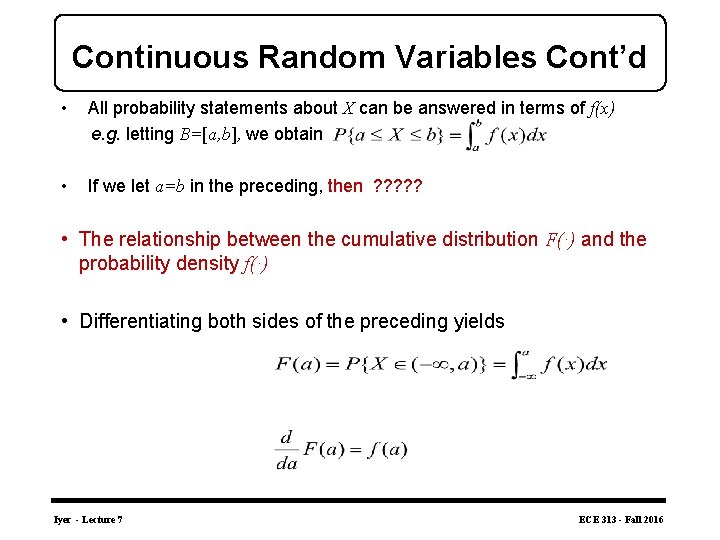
Continuous Random Variables Cont’d • All probability statements about X can be answered in terms of f(x) e. g. letting B=[a, b], we obtain • If we let a=b in the preceding, then ? ? ? • The relationship between the cumulative distribution F(∙) and the probability density f(∙) • Differentiating both sides of the preceding yields Iyer - Lecture 7 ECE 313 - Fall 2016
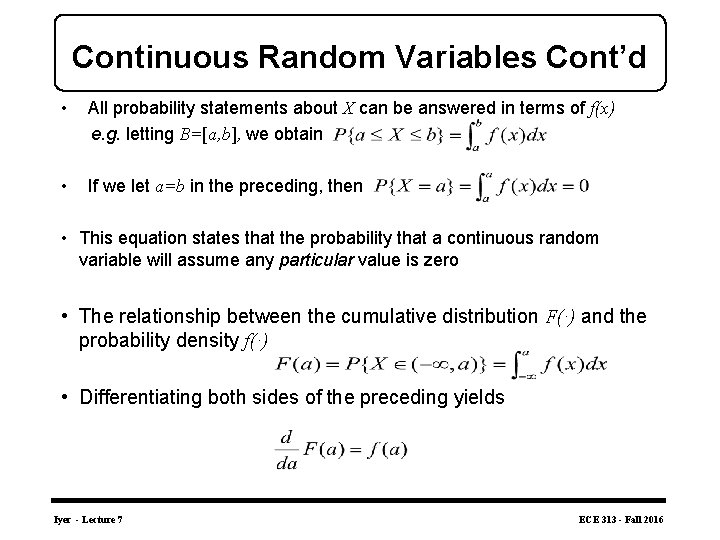
Continuous Random Variables Cont’d • All probability statements about X can be answered in terms of f(x) e. g. letting B=[a, b], we obtain • If we let a=b in the preceding, then • This equation states that the probability that a continuous random variable will assume any particular value is zero • The relationship between the cumulative distribution F(∙) and the probability density f(∙) • Differentiating both sides of the preceding yields Iyer - Lecture 7 ECE 313 - Fall 2016
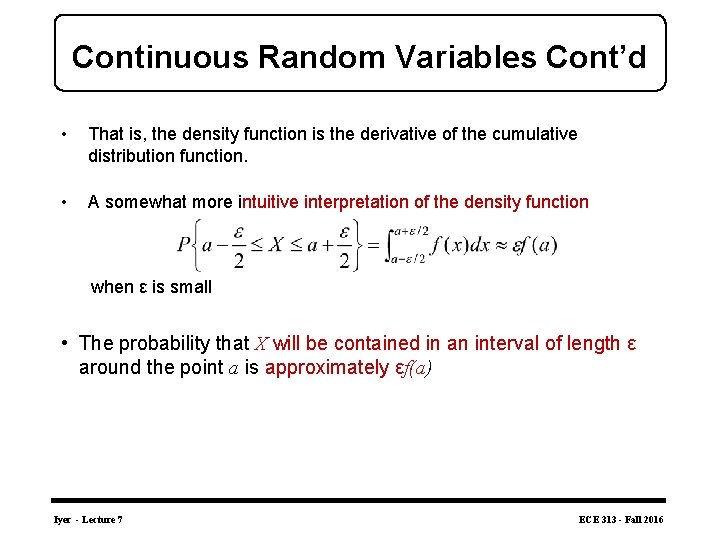
Continuous Random Variables Cont’d • That is, the density function is the derivative of the cumulative distribution function. • A somewhat more intuitive interpretation of the density function when ε is small • The probability that X will be contained in an interval of length ε around the point a is approximately εf(a) Iyer - Lecture 7 ECE 313 - Fall 2016
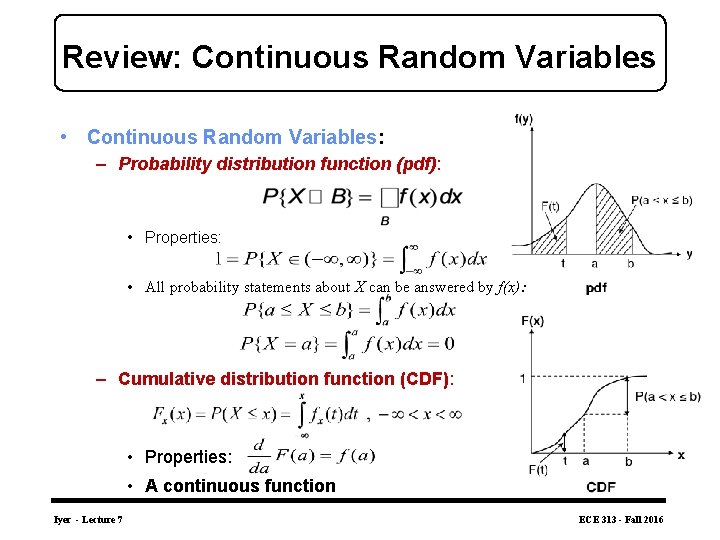
Review: Continuous Random Variables • Continuous Random Variables: – Probability distribution function (pdf): • Properties: • All probability statements about X can be answered by f(x): – Cumulative distribution function (CDF): • Properties: • A continuous function Iyer - Lecture 7 ECE 313 - Fall 2016
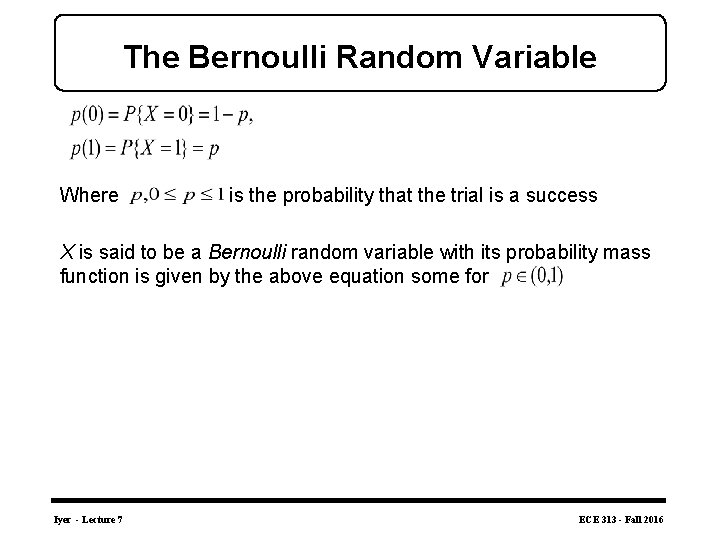
The Bernoulli Random Variable Where is the probability that the trial is a success X is said to be a Bernoulli random variable with its probability mass function is given by the above equation some for Iyer - Lecture 7 ECE 313 - Fall 2016
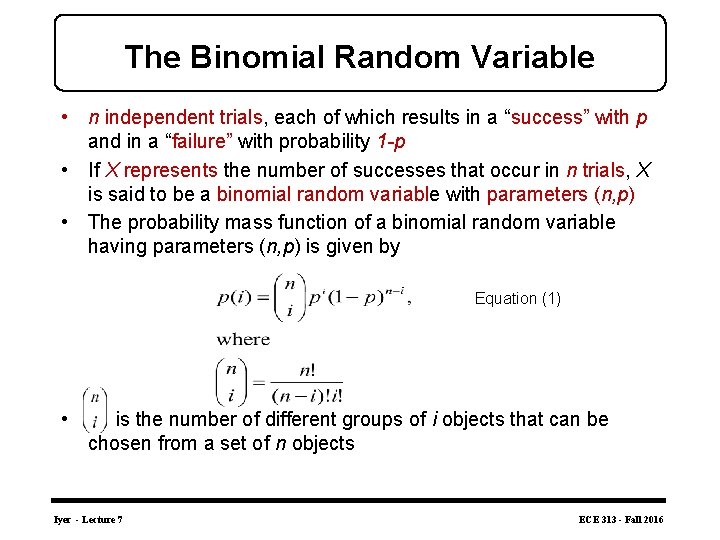
The Binomial Random Variable • n independent trials, each of which results in a “success” with p and in a “failure” with probability 1 -p • If X represents the number of successes that occur in n trials, X is said to be a binomial random variable with parameters (n, p) • The probability mass function of a binomial random variable having parameters (n, p) is given by Equation (1) • is the number of different groups of i objects that can be chosen from a set of n objects Iyer - Lecture 7 ECE 313 - Fall 2016
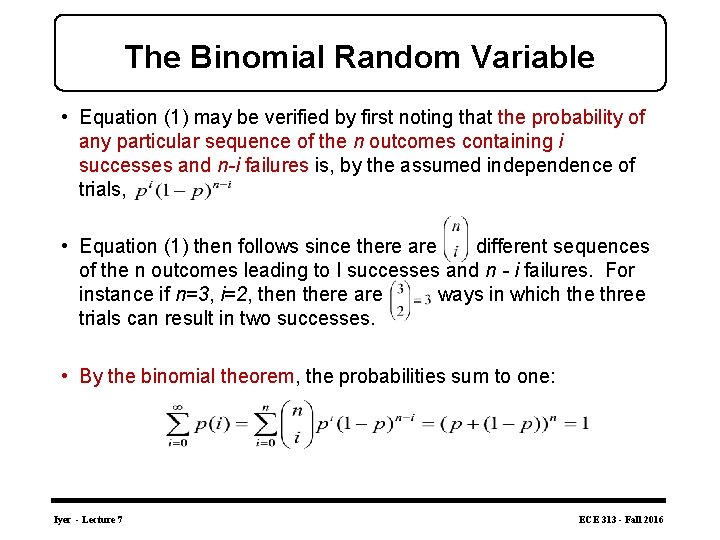
The Binomial Random Variable • Equation (1) may be verified by first noting that the probability of any particular sequence of the n outcomes containing i successes and n-i failures is, by the assumed independence of trials, • Equation (1) then follows since there are different sequences of the n outcomes leading to I successes and n - i failures. For instance if n=3, i=2, then there are ways in which the three trials can result in two successes. • By the binomial theorem, the probabilities sum to one: Iyer - Lecture 7 ECE 313 - Fall 2016
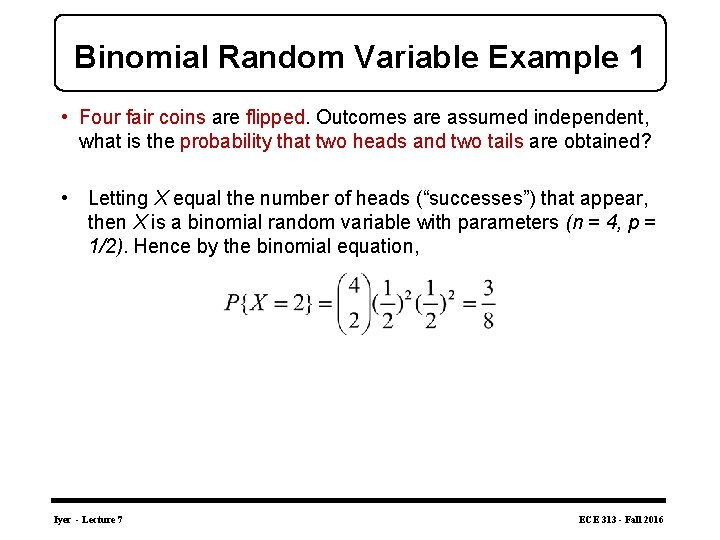
Binomial Random Variable Example 1 • Four fair coins are flipped. Outcomes are assumed independent, what is the probability that two heads and two tails are obtained? • Letting X equal the number of heads (“successes”) that appear, then X is a binomial random variable with parameters (n = 4, p = 1/2). Hence by the binomial equation, Iyer - Lecture 7 ECE 313 - Fall 2016
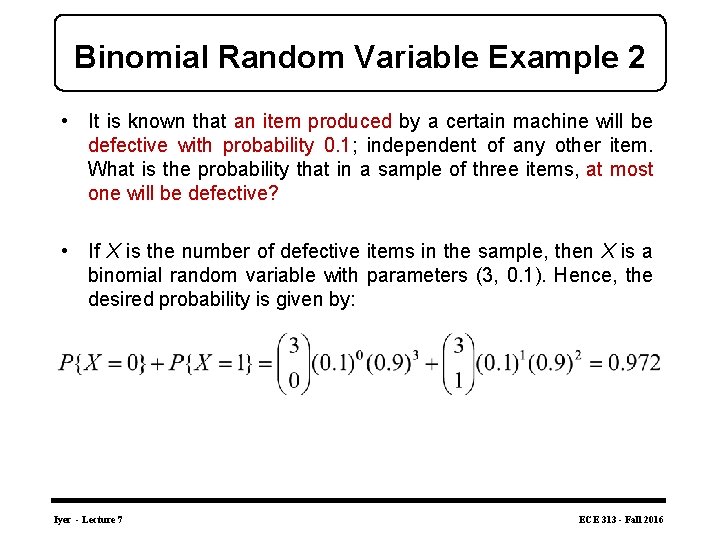
Binomial Random Variable Example 2 • It is known that an item produced by a certain machine will be defective with probability 0. 1; independent of any other item. What is the probability that in a sample of three items, at most one will be defective? • If X is the number of defective items in the sample, then X is a binomial random variable with parameters (3, 0. 1). Hence, the desired probability is given by: Iyer - Lecture 7 ECE 313 - Fall 2016
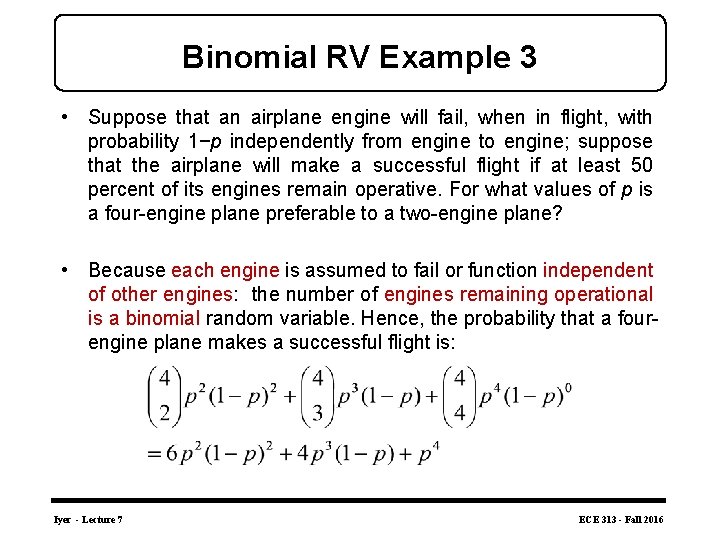
Binomial RV Example 3 • Suppose that an airplane engine will fail, when in flight, with probability 1−p independently from engine to engine; suppose that the airplane will make a successful flight if at least 50 percent of its engines remain operative. For what values of p is a four-engine plane preferable to a two-engine plane? • Because each engine is assumed to fail or function independent of other engines: the number of engines remaining operational is a binomial random variable. Hence, the probability that a fourengine plane makes a successful flight is: Iyer - Lecture 7 ECE 313 - Fall 2016
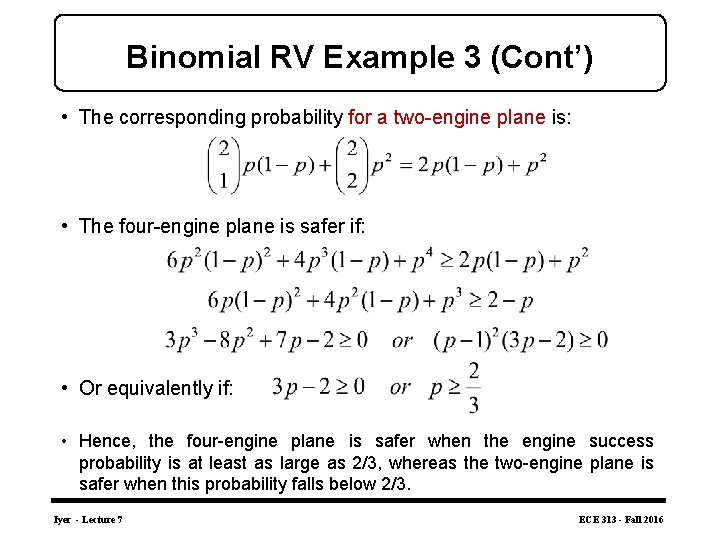
Binomial RV Example 3 (Cont’) • The corresponding probability for a two-engine plane is: • The four-engine plane is safer if: • Or equivalently if: • Hence, the four-engine plane is safer when the engine success probability is at least as large as 2/3, whereas the two-engine plane is safer when this probability falls below 2/3. Iyer - Lecture 7 ECE 313 - Fall 2016
Geometric Distribution Examples 3. Consider a repeat loop • repeat S until B • The number of tries until B (success) (i. e. includes B) is reached will be a geometrically distributed random variable with parameter p. Iyer - Lecture 7 ECE 313 - Fall 2016
Geometric Distribution: Examples • Some Examples where the geometric distribution occurs 1. The probability the ith item on a production line is defective is given by the geometric pmf. 2. The pmf of the random variable denoting the number of time slices needed to complete the execution of a job Iyer - Lecture 7 ECE 313 - Fall 2016
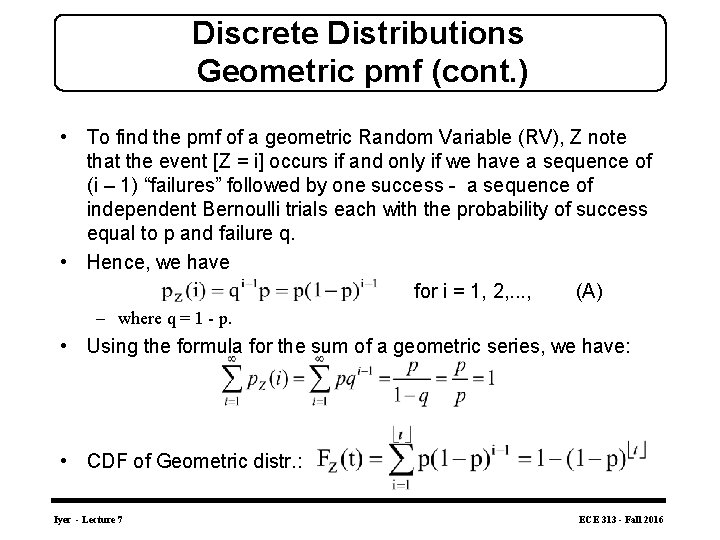
Discrete Distributions Geometric pmf (cont. ) • To find the pmf of a geometric Random Variable (RV), Z note that the event [Z = i] occurs if and only if we have a sequence of (i – 1) “failures” followed by one success - a sequence of independent Bernoulli trials each with the probability of success equal to p and failure q. • Hence, we have for i = 1, 2, . . . , (A) – where q = 1 - p. • Using the formula for the sum of a geometric series, we have: • CDF of Geometric distr. : Iyer - Lecture 7 ECE 313 - Fall 2016
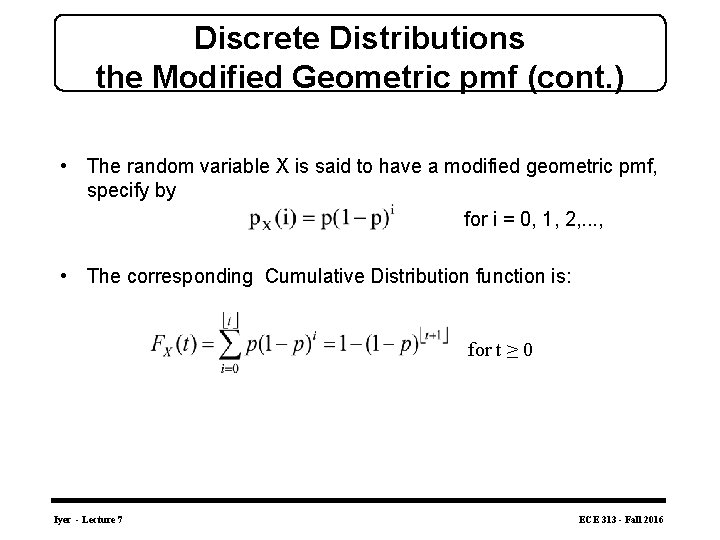
Discrete Distributions the Modified Geometric pmf (cont. ) • The random variable X is said to have a modified geometric pmf, specify by for i = 0, 1, 2, . . . , • The corresponding Cumulative Distribution function is: for t ≥ 0 Iyer - Lecture 7 ECE 313 - Fall 2016
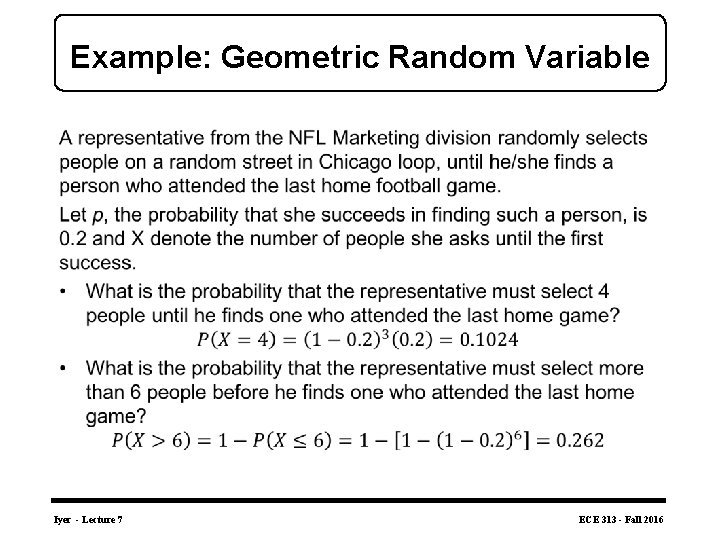
Example: Geometric Random Variable • Iyer - Lecture 7 ECE 313 - Fall 2016
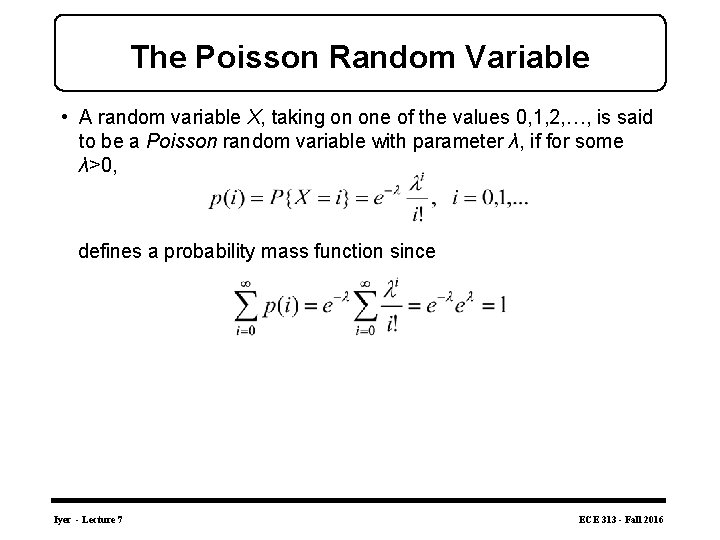
The Poisson Random Variable • A random variable X, taking on one of the values 0, 1, 2, …, is said to be a Poisson random variable with parameter λ, if for some λ>0, defines a probability mass function since Iyer - Lecture 7 ECE 313 - Fall 2016
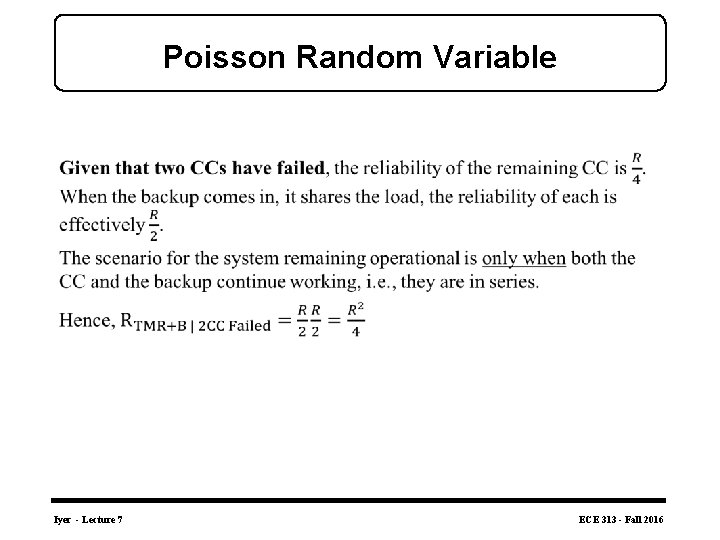
Poisson Random Variable • Iyer - Lecture 7 ECE 313 - Fall 2016
- Slides: 50