
DISCOVERY The invention of the microscope changed the
- Slides: 69
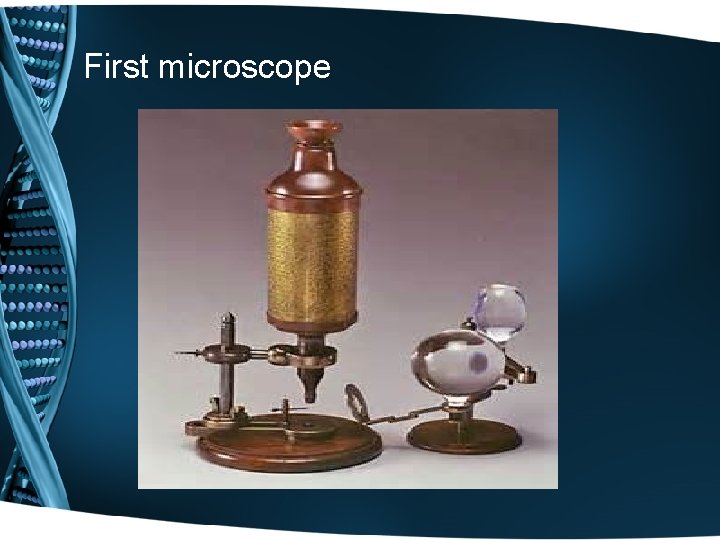
DISCOVERY • The invention of the microscope changed the world view of science forever. • In the mid 1600’s Robert Hooke put a microscope together and viewed the cells of a cork. • Leeuwenhooke inspired by Hooke improved his microscope and viewed living organisms.
First microscope
microscopes • Light microscope - light passes through one or more lenses to produce an enlarged image of a specimen. Can magnify up to 2, 000 X. Can view living organisms. • Stains and fluorescent dyes can be added to show specific structures in the cell. • Optical techniques can show image in 3 D and computer processing can follow movements of cell parts and materials in and out of the cell. • Image is sharp when 0. 2 µm
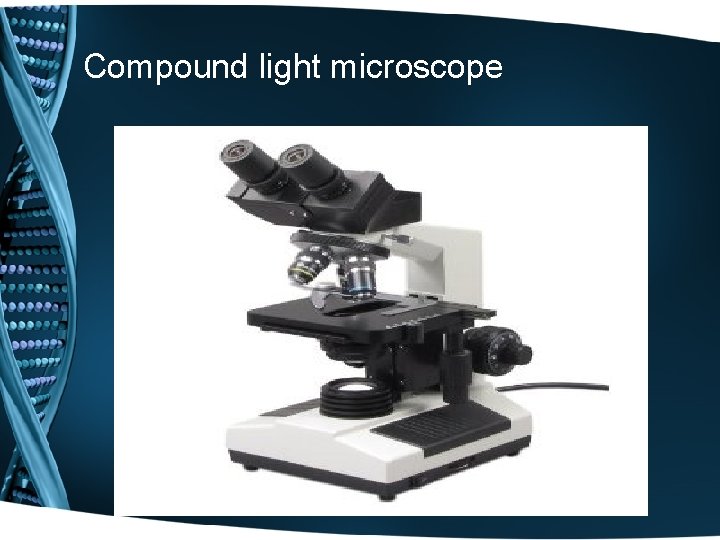
Compound light microscope
Your compound Light microscope • Ocular lens 10 X • Low Power 4 X multiply 10 X ocular Total magnification is 40 X • Medium is 10 X multiply 10 X Total magnification is 100 X • High Power 40 X multiply 10 X Total magnification is 400 X
Microscope • Magnification increases the size of an object. • As the magnification increases your field of view decreases. • Resolution increases the ability to see details of the speci. men
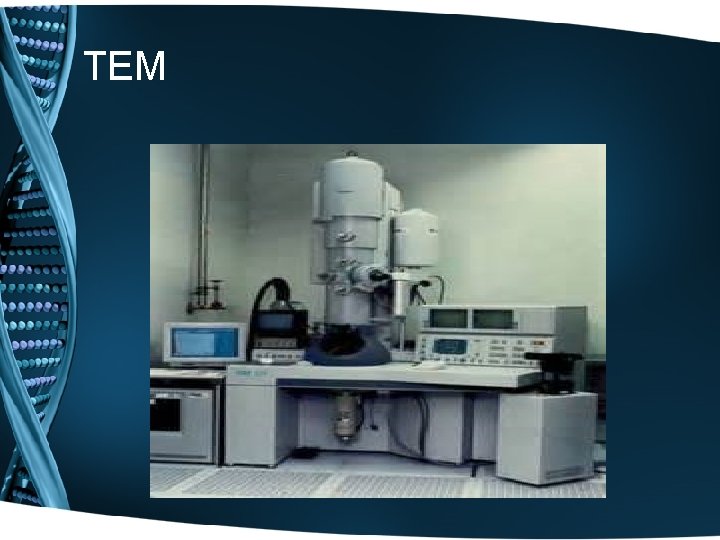
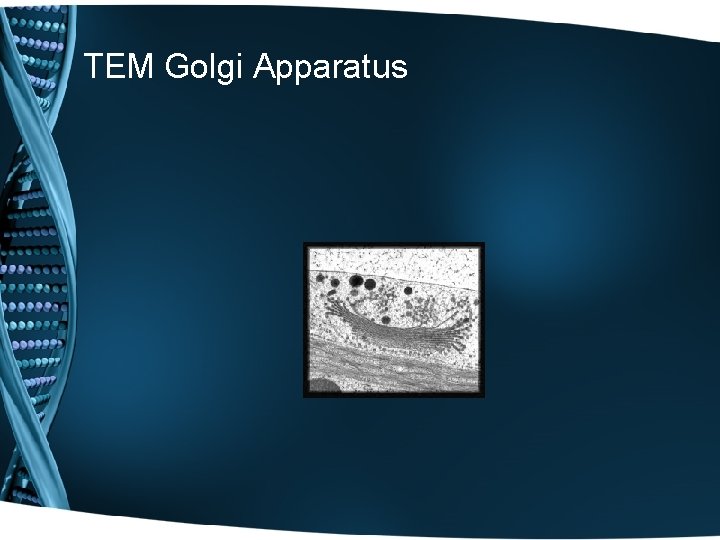
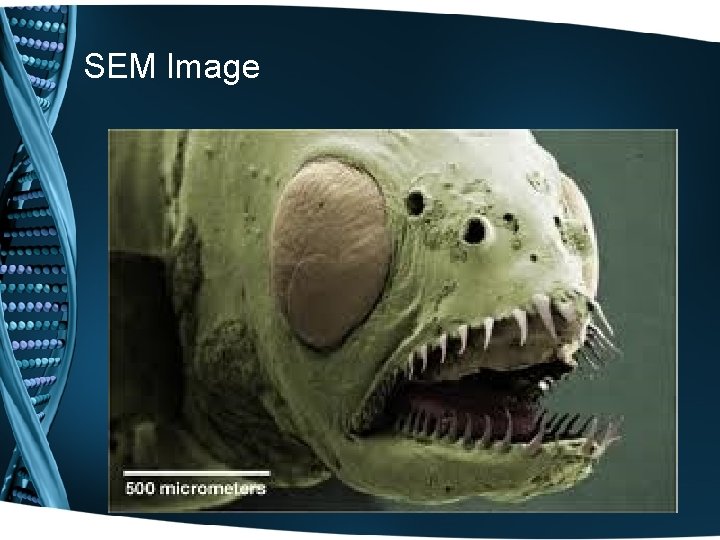
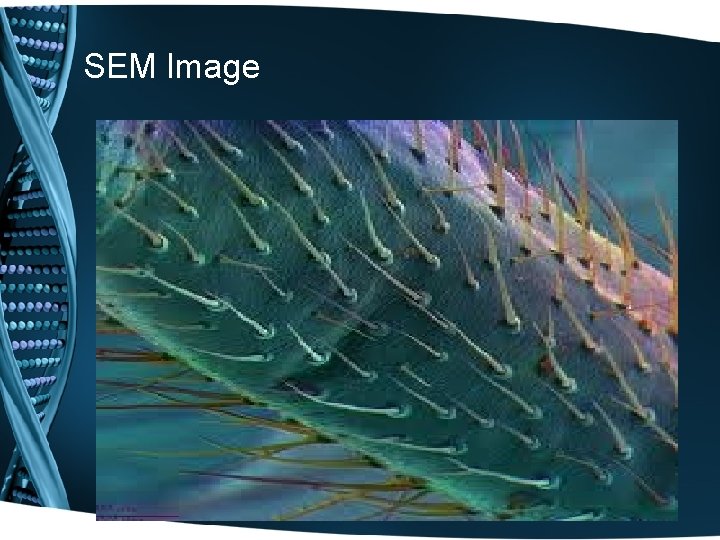
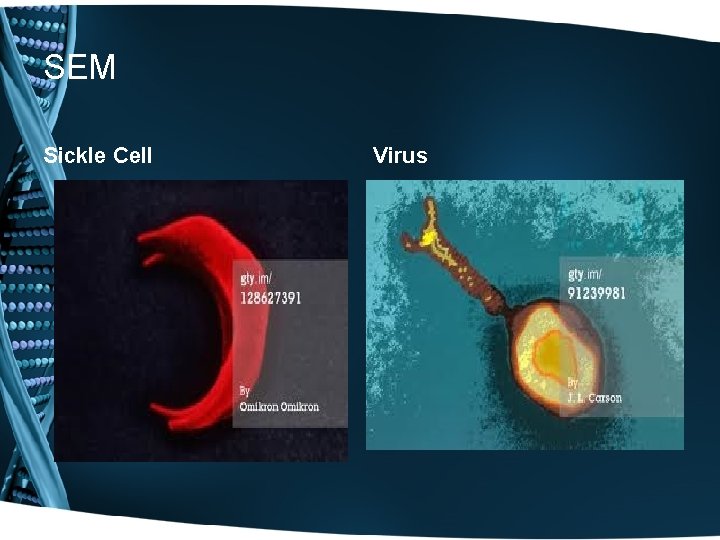
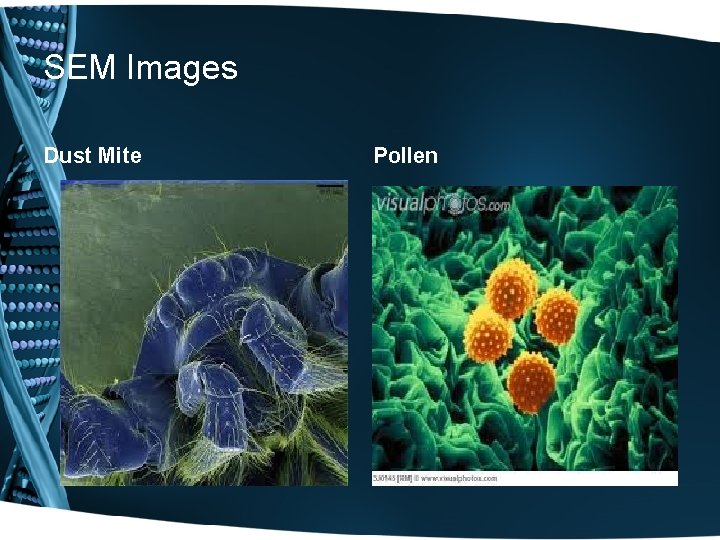
• Electron microscope- Forms an image of a specimen using a beam of electrons rather than light. Can magnify up to 200, 000 X. Must be done in a vacuum. Living organisms can not survive in a vacuum. • TEM-Transmission electron microscope shines a beam of electrons through a thin specimen. • SEM-Scanning tunneling microscope runs a pencil like beam of electrons back and forth across the surface of the specimen which produce dramatic three dimensional images.
TEM
TEM Golgi Apparatus
SEM Image
SEM Image
SEM Sickle Cell Virus
SEM Images Dust Mite Pollen
Cell Theory • Hooke and Leeuwenhooke recorded all that they saw. • Schleiden, Swann, & Virchow further studied cells and proposed The Cell Theory. Page 55.
Cell Theory 1. All living organisms are composed of one or more cells. 2. Cells are the basic structure and organization of all living organisms. 3. Cells come from previously existing cells, with cells passing copies of their genetic material on to their daughter cells.
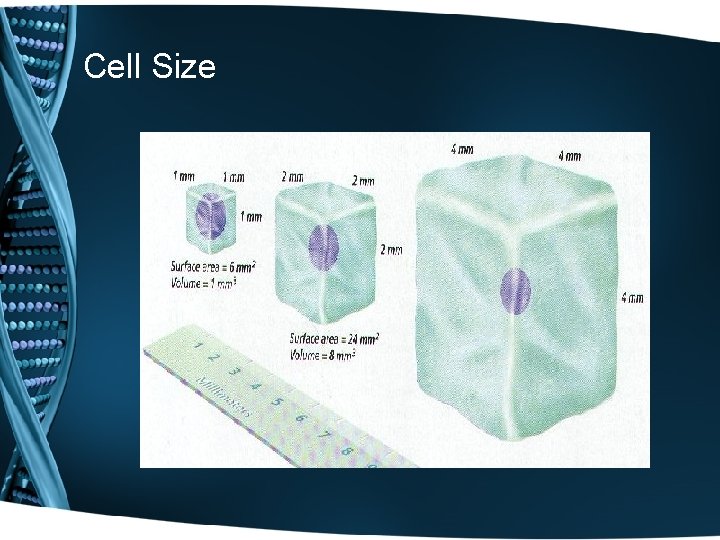
Cell Size • A cells size is limited by the ratio of their outer surface and their inner volume. • As cells increase their volume (the stuff inside) Their out membrane stretches (like blowing up a balloon). • Too much volume – Can burst the cell. – Reduce transport across the outer membrane.
Cell Size
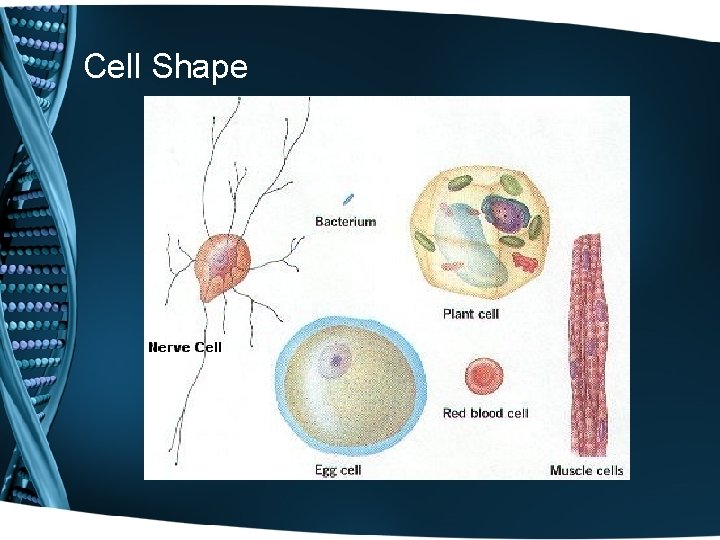
Cell Shape • Cells can vary in shape depending on their function • All cells contain organelles which are similar in function to human internal organs. – The cell membrane surrounds and protects the cell.
Cell Shape
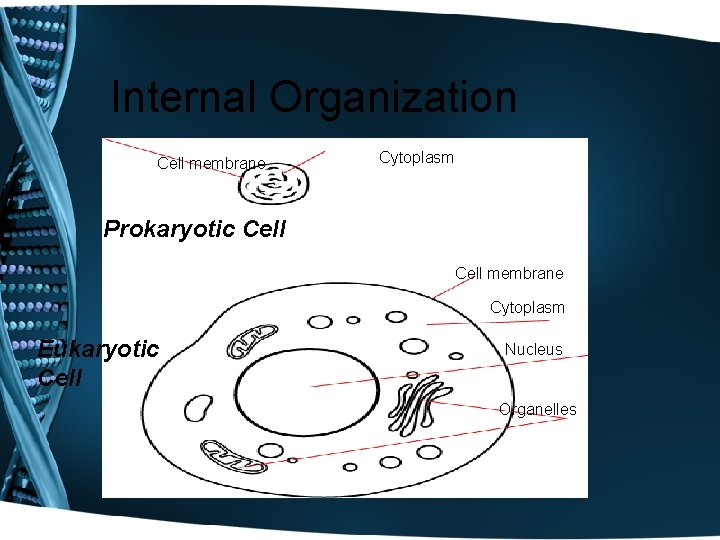
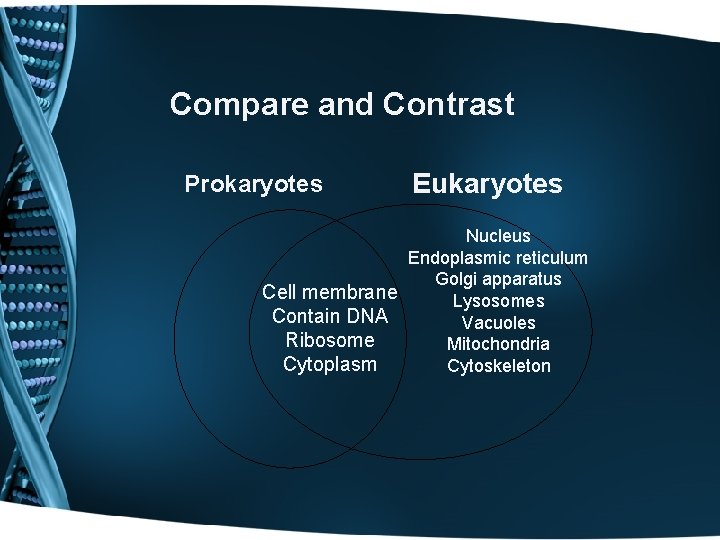
Two Types of Cells • Eukaryotic – Membrane bound nucleus that houses all of the cells genetic material – Many membrane bound organelles (p. 58). • Prokaryotic – No Membrane bound nucleus - the cells genetic material floats randomly in the cell – Many organelles NOT bound by a membrane – Have a cell wall surrounding the cell membrane
Internal Organization Cell membrane Cytoplasm Prokaryotic Cell membrane Cytoplasm Eukaryotic Cell Nucleus Organelles
Compare and Contrast Prokaryotes Eukaryotes Nucleus Endoplasmic reticulum Golgi apparatus Cell membrane Lysosomes Contain DNA Vacuoles Ribosome Mitochondria Cytoplasm Cytoskeleton
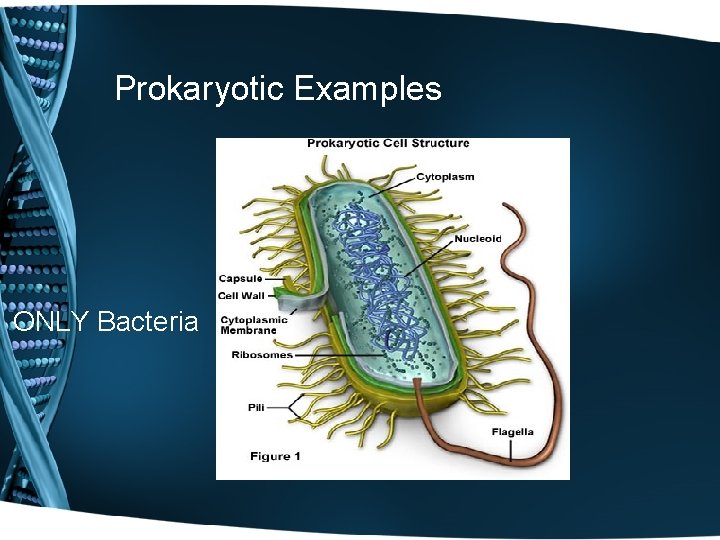
Prokaryotic Examples ONLY Bacteria
Prokaryotes • Cell wall in a bacterial cell is typical made from a carbohydrate-protein complex called peptoglycan or similar substance. • Cytoplasm and cytoskeleton • Do not contain a nucleus DNA is circular and DNA area is called nucleoid • Some bacteria contain plasmids DNA that are independent of the main DNA. Bacteria can exchange these. Ex. Plasmid may express allow a bacteria to express an ability like make a sugar outer coating. • Have ribosomes • Cilia and flagella for movement.
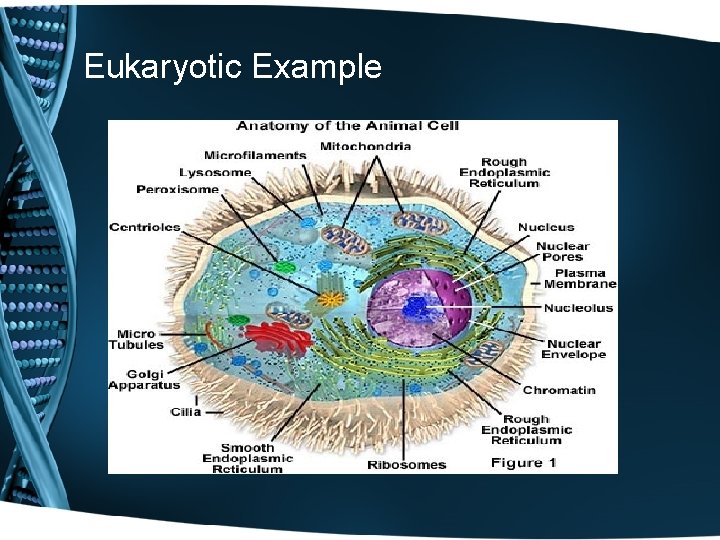
Eukaryotic Example
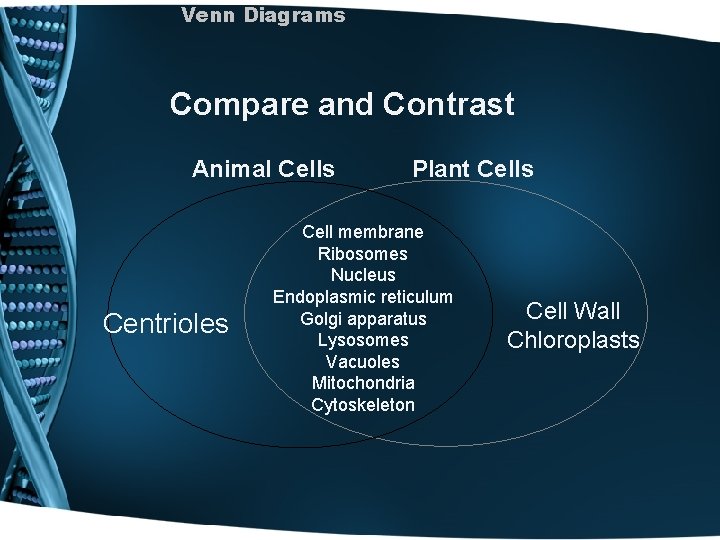
Venn Diagrams Compare and Contrast Animal Cells Centrioles Plant Cells Cell membrane Ribosomes Nucleus Endoplasmic reticulum Golgi apparatus Lysosomes Vacuoles Mitochondria Cytoskeleton Cell Wall Chloroplasts
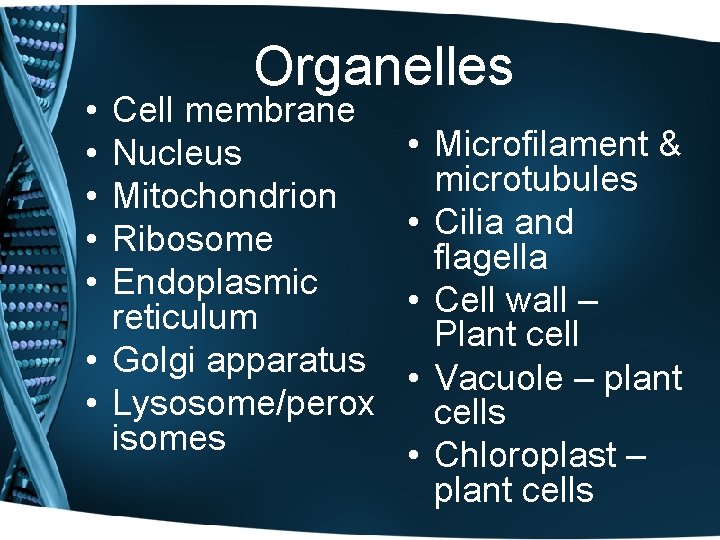
• • • Organelles Cell membrane Nucleus Mitochondrion Ribosome Endoplasmic reticulum • Golgi apparatus • Lysosome/perox isomes • Microfilament & microtubules • Cilia and flagella • Cell wall – Plant cell • Vacuole – plant cells • Chloroplast – plant cells
Check Point 1. What is the importance of a surface area to volume ratio? 2. Compare the structure of a eukaryotic cell with a prokaryotic cell? 3. When Hooke first used the word cell, did the intend to have it apply to living material? Explain. 4. Name two structures that all cells have.
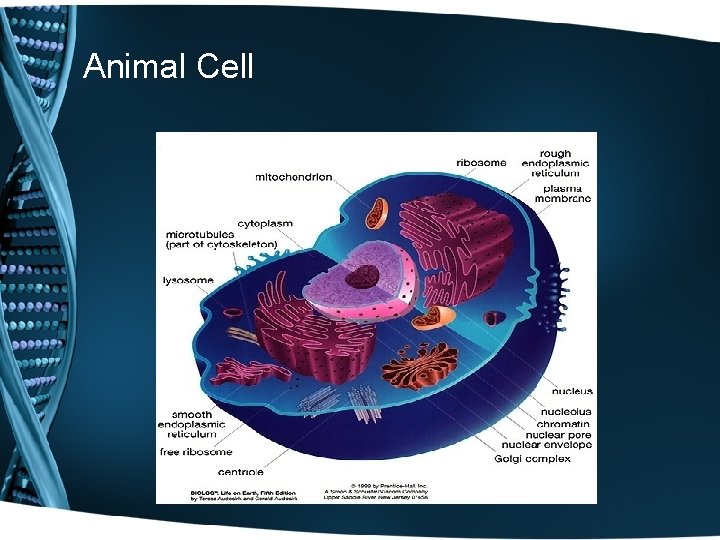
Animal Cell
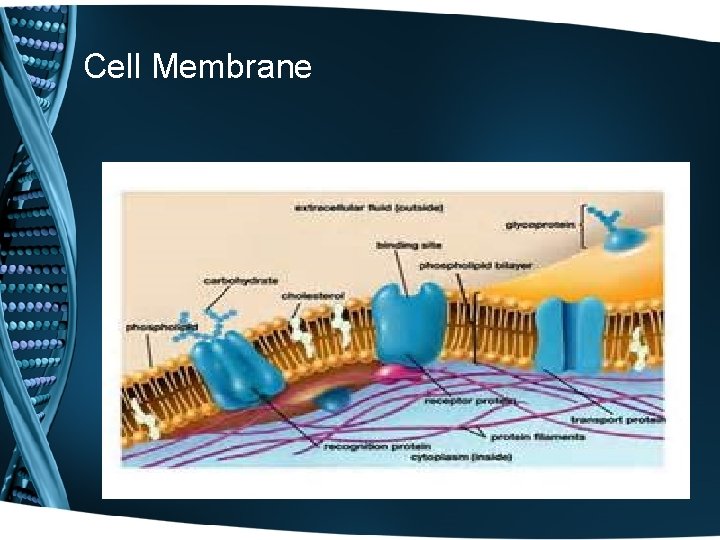
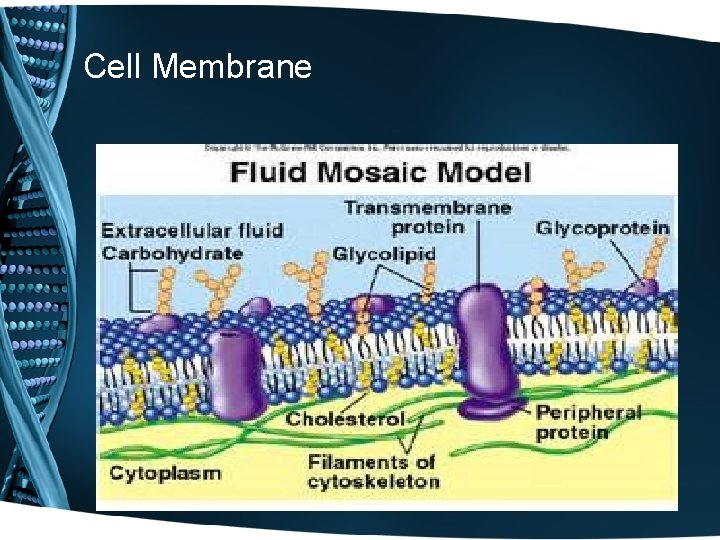
Cell membrane Fluid Mosaic Model Proposed in 1972 by Singer • Selectively permeable & pliable membrane • Membrane lipids – Phospholipids – polar head and nonpolar tails. The polar head are hydrophilic and the non-polar tails are hydrophobic – Steroid (cholesterol) is located between the tails of the phospholipids
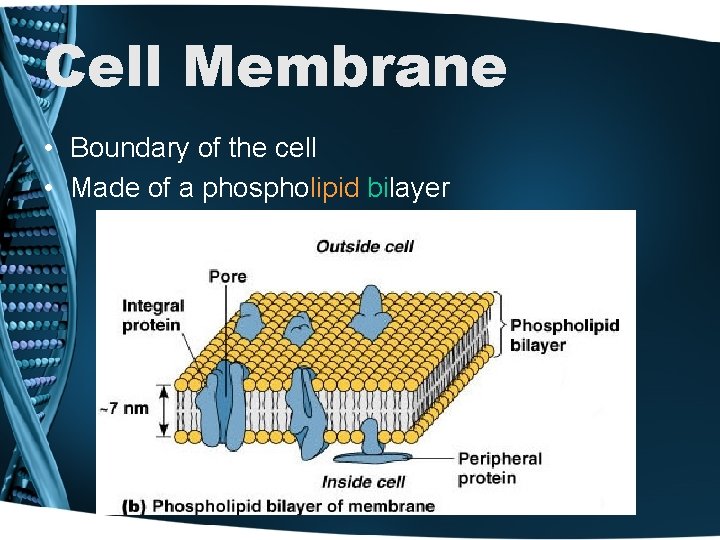
Cell Membrane • Proteins embedded in cell membrane –Peripheral – external peripheral proteins have a carbohydrate attached –Integral – in between the phospholipids; can form channels to allow transport in and out of the cell
Cell Membrane • Boundary of the cell • Made of a phospholipid bilayer
Cell Membrane
Cell Membrane
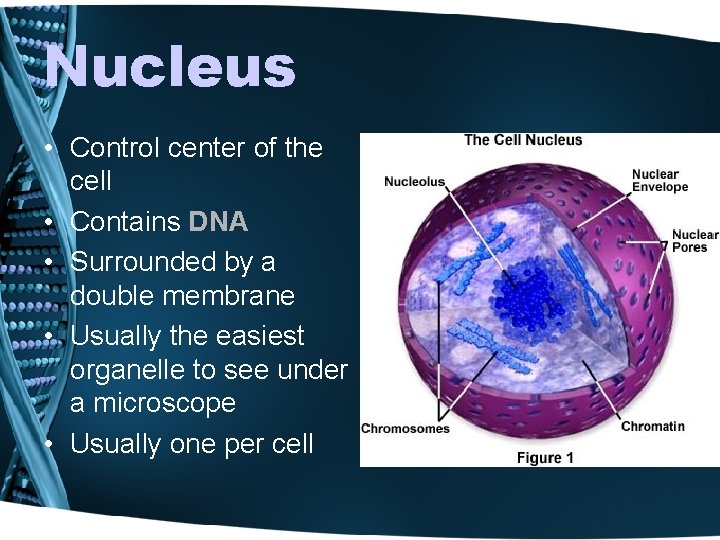
Nucleus • Is surrounded by the nuclear matrix which is a stiff membrane • There is an inner membrane called a nuclear envelope • Chromatin (a combination of DNA and protein) is inside the nucleus. The chromatin coils and becomes chromosomes when the cell is ready to divide.
Nucleus • Nucleus stores genetic information • Is where RNA is copied from DNA • Nuclear pores allow RNA to travel out of the nucleus. • Contains the nucleolus where ribosome's are made.
Nucleus • Control center of the cell • Contains DNA • Surrounded by a double membrane • Usually the easiest organelle to see under a microscope • Usually one per cell
Ribosome • • • Most abundant in the cell No outer membrane Is made up of a protein and RNA Are made in the nucleus Can be free floating (remain in cell)or attached to endoplasmic reticulum (for export). • Make proteins • Found in all cells
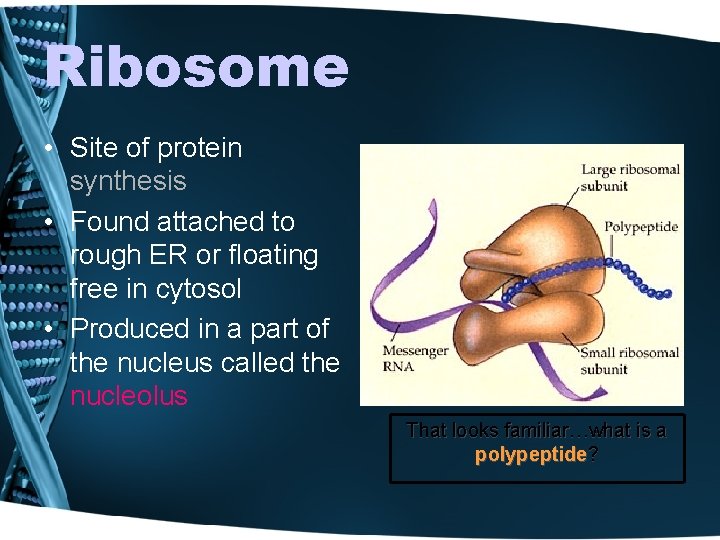
Ribosome • Site of protein synthesis • Found attached to rough ER or floating free in cytosol • Produced in a part of the nucleus called the nucleolus That looks familiar…what is a polypeptide?
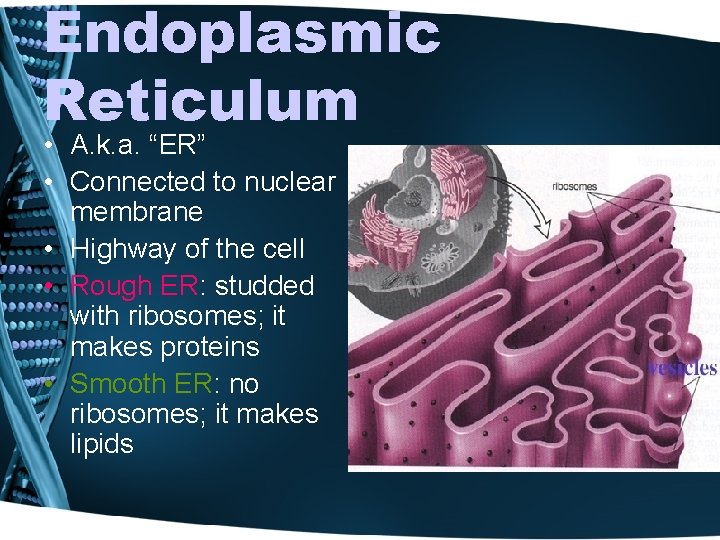
Endoplasmic reticulum (ER) • Highway of tubes and sacs by which molecules move around the cell • Has a membrane • Two types – Rough – is covered in ribosomes is found in cells that make many proteins – Smooth – helps make steroids, regulates calcium in muscles, and breaks down toxins in the liver
Endoplasmic Reticulum • A. k. a. “ER” • Connected to nuclear membrane • Highway of the cell • Rough ER: studded with ribosomes; it makes proteins • Smooth ER: no ribosomes; it makes lipids
Golgi Apparatus • Processing, packaging and secretion center • Is a system of tubes and sacs • Enzymes that are in the Golgi attach carbohydrates and lipids to the proteins. • Make cell membrane components or the cell. • Packages for distribution lysosomes.
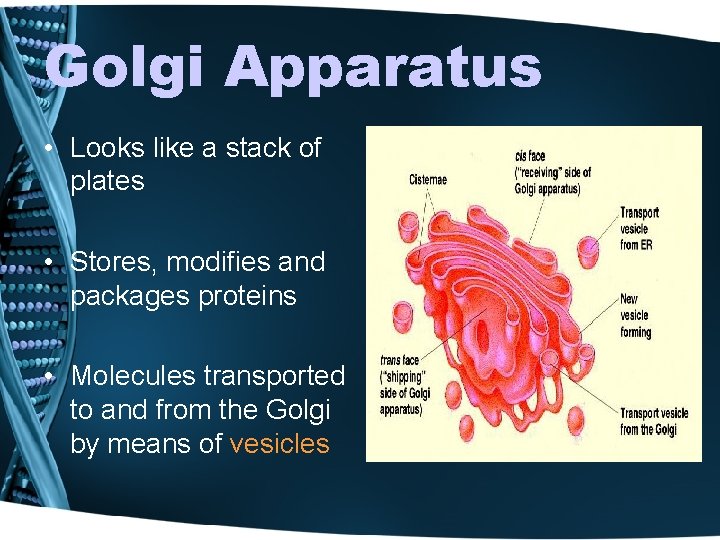
Golgi Apparatus • Looks like a stack of plates • Stores, modifies and packages proteins • Molecules transported to and from the Golgi by means of vesicles
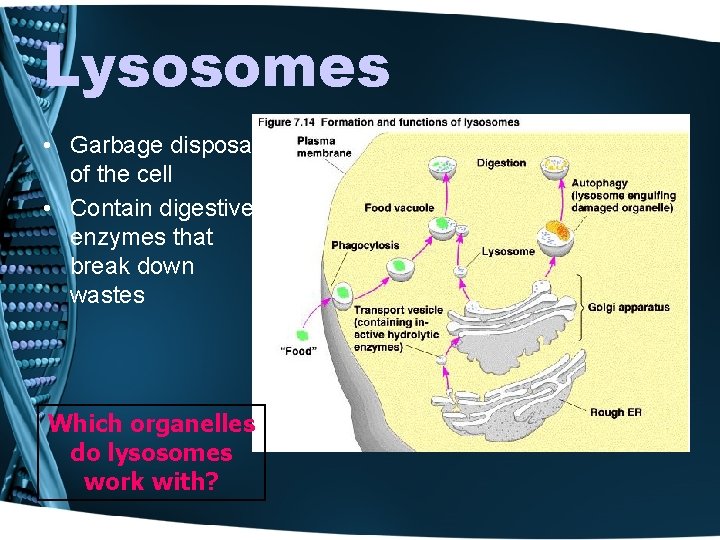
Lysosomes • Spherical organelles that contain hydrolytic enzymes which digest proteins, nucleic acids, lipids and carbohydrates. • This allows lysosomes to recycle cell parts. • Lysosmoes remain in the cell.
Lysosomes • Garbage disposal of the cell • Contain digestive enzymes that break down wastes Which organelles do lysosomes work with?
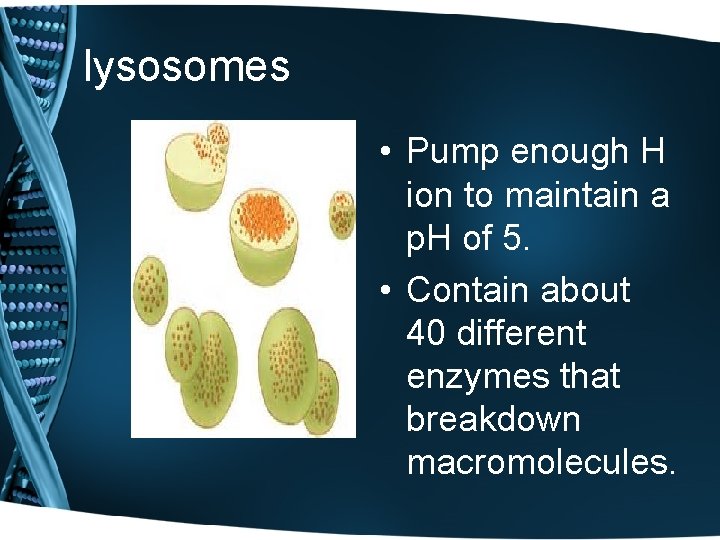
lysosomes • Pump enough H ion to maintain a p. H of 5. • Contain about 40 different enzymes that breakdown macromolecules.
Peroxisomes • Globular organelles found in almost all eukaryotes but many different types place where oxidation reactions take place. • ex. Breaks down Hydrogen peroxide. • ex. Brake down of ethanol • ex. Breakdown of fatty acids
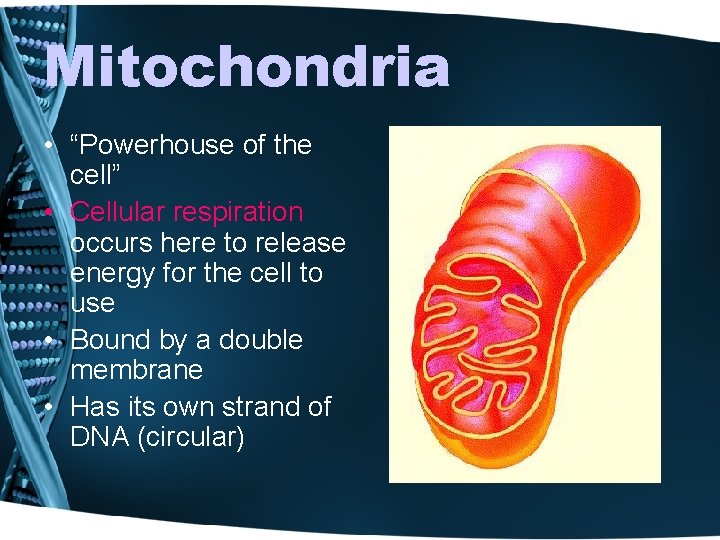
Mitochondria • Change organic compounds to energy called adenosine triphosphate (ATP) • Has two membranes – Inner membrane called cristae which increases the surface area so more compounds can be converted to ATP. – Outer membrane protects and allows transport. • Has its own DNA and can reproduce to make more mitochondria
Mitochondria • “Powerhouse of the cell” • Cellular respiration occurs here to release energy for the cell to use • Bound by a double membrane • Has its own strand of DNA (circular)
Cilia and Flagella • Both organelles are on the exterior of the cell • Assist with movement • Cilia – many short hair-like structures that beat in unison to cause movement • Flagellum – one long tail-like structure that whips to cause movement
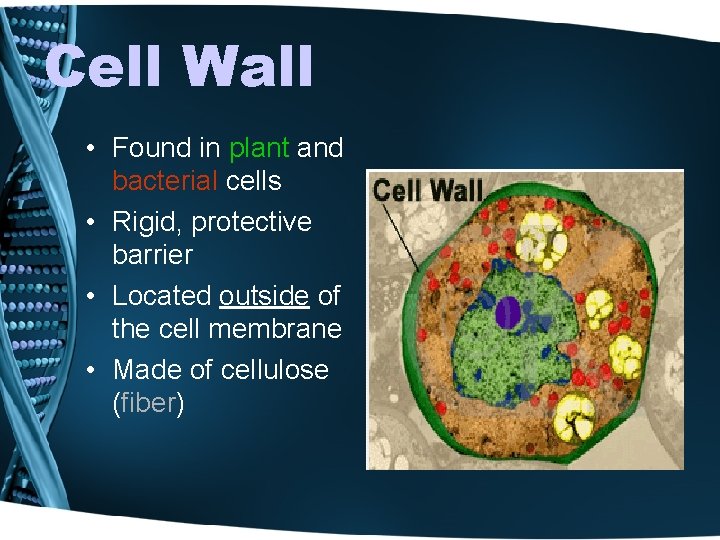
Cell Wall • Cell wall found in fungi, algae, bacteria, archea, and plants. Animal cells, and protists do not • Rigid outer wall of a plant cell • Cell growth is limited by the size of the cell wall
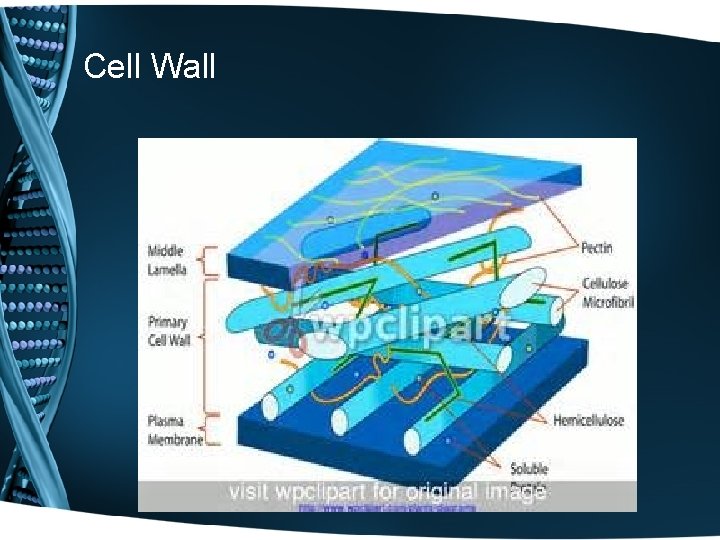
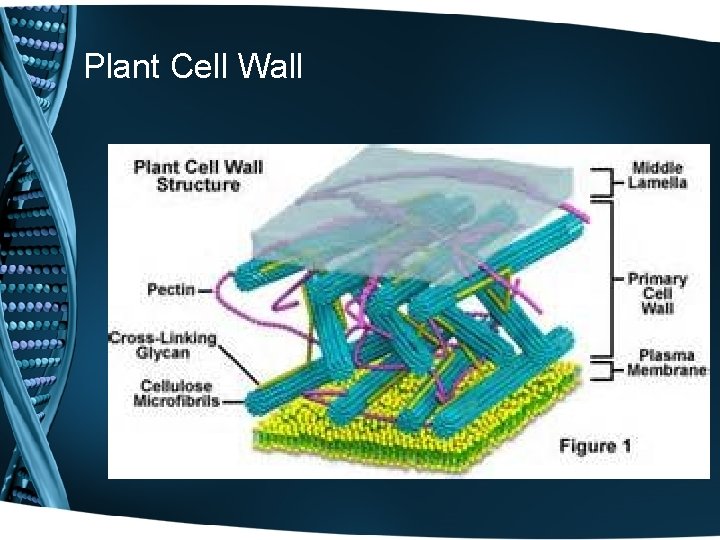
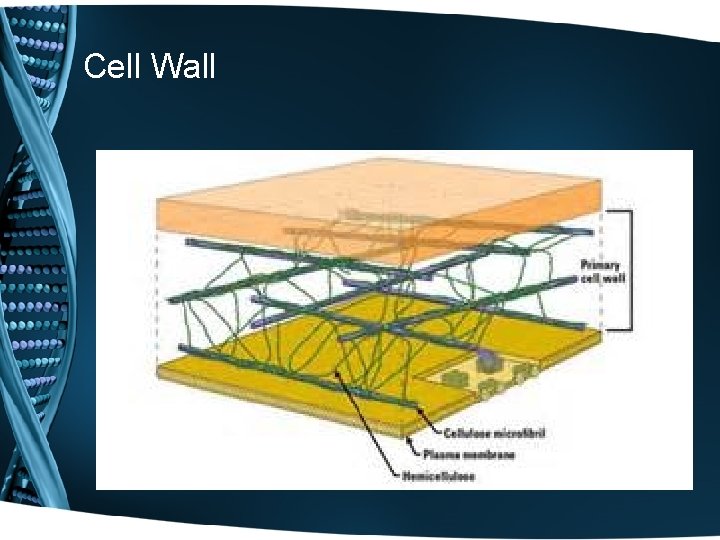
Cell Wall • Plants cell wall is generally composed of cellulose • Lignin and cellulose combine to form the bark what we refer to as wood. • Fungi cell wall is mainly chitin • Bacteria is mainly peptoglycan
Cell Wall • Found in plant and bacterial cells • Rigid, protective barrier • Located outside of the cell membrane • Made of cellulose (fiber)
Cell Wall
Plant Cell Wall
Cell Wall
Vacuoles • Common in plant cells • Store enzymes and metabolic waste • May be extremely large
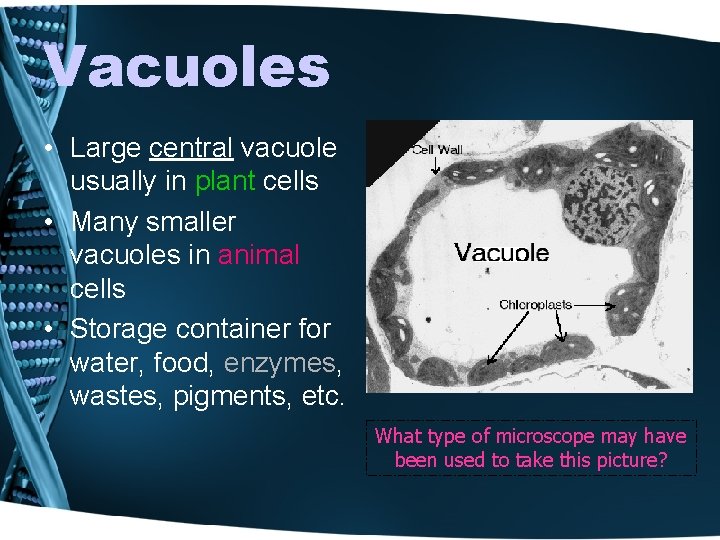
Vacuoles • Large central vacuole usually in plant cells • Many smaller vacuoles in animal cells • Storage container for water, food, enzymes, wastes, pigments, etc. What type of microscope may have been used to take this picture?
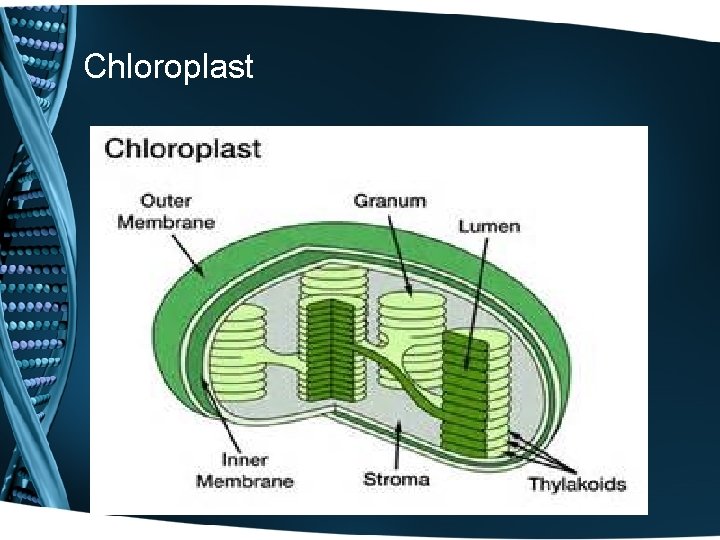
Chloroplasts • Are surrounded by two membranes • Contain DNA • May store starches and fats or contain pigments used to absorb light for photosynthesis • A chloroplast is a plastid – Contains thylakoids which convert lights energy into usable energy for the plant
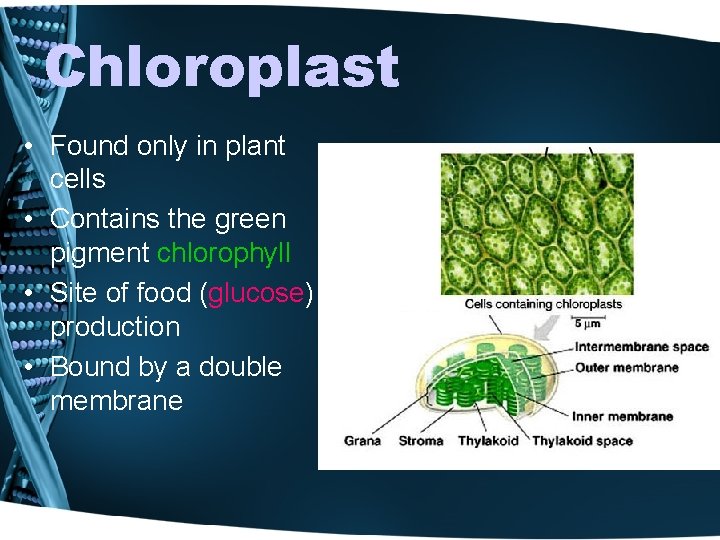
Chloroplast • Found only in plant cells • Contains the green pigment chlorophyll • Site of food (glucose) production • Bound by a double membrane
Chloroplast
Endosymbiotic Theory • Several key organelles of eukaryotes originated as symbioses between separate single-celled organisms. According to this theory, mitochondria and plastids ( chloroplasts), and possibly other organelles, represent formerly free-living bacteria that were taken inside another cell as an endosymbiont.
• Molecular and biochemical evidence suggest that the mitochondrion developed from proteobacteria (in particular, Rickettsiales or close relatives) and the chloroplast from cyanobacteria. • This theory is a partial explanation of the evolution of eukaryotic cells from prokaryotic cells.
Cytoplasm and Cytoskeleton • Cytoplasm is a semi fluid material. • Organelles do not float freely but are supported by a cytoskeleton.
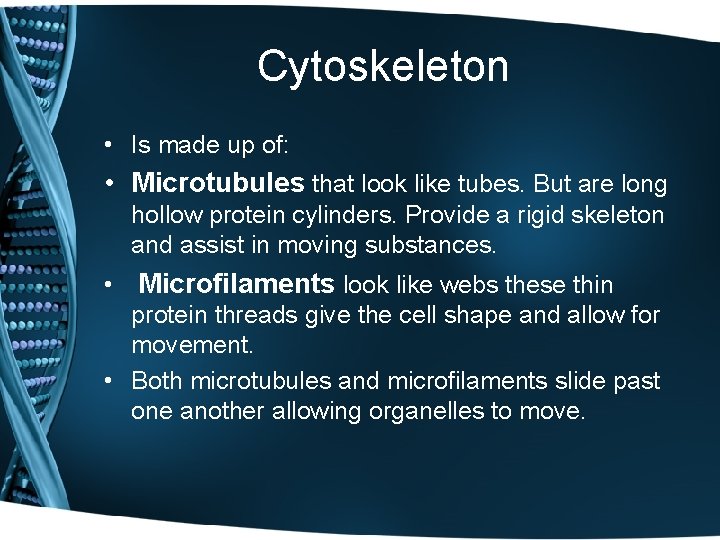
Cytoskeleton • Is made up of: • Microtubules that look like tubes. But are long hollow protein cylinders. Provide a rigid skeleton and assist in moving substances. • Microfilaments look like webs these thin protein threads give the cell shape and allow for movement. • Both microtubules and microfilaments slide past one another allowing organelles to move.
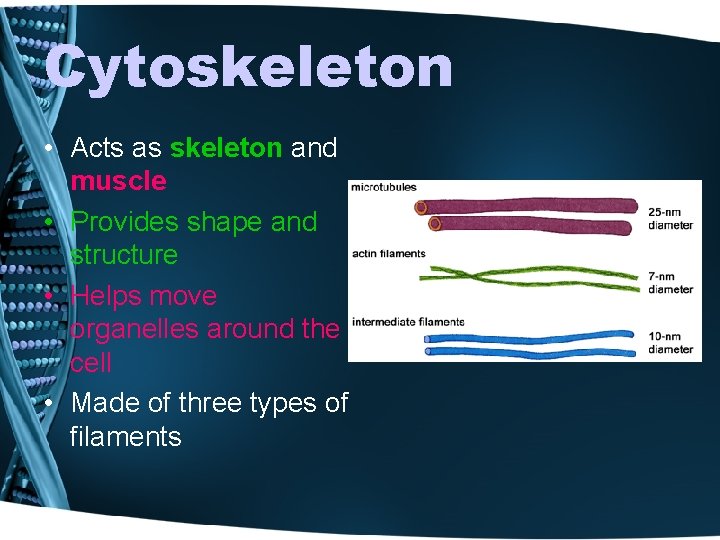
Cytoskeleton • Acts as skeleton and muscle • Provides shape and structure • Helps move organelles around the cell • Made of three types of filaments
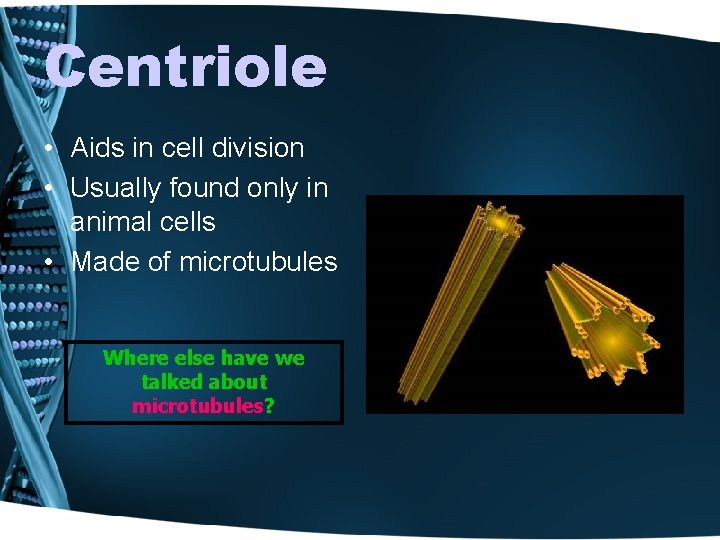
Centriole • Aids in cell division • Usually found only in animal cells • Made of microtubules Where else have we talked about microtubules?
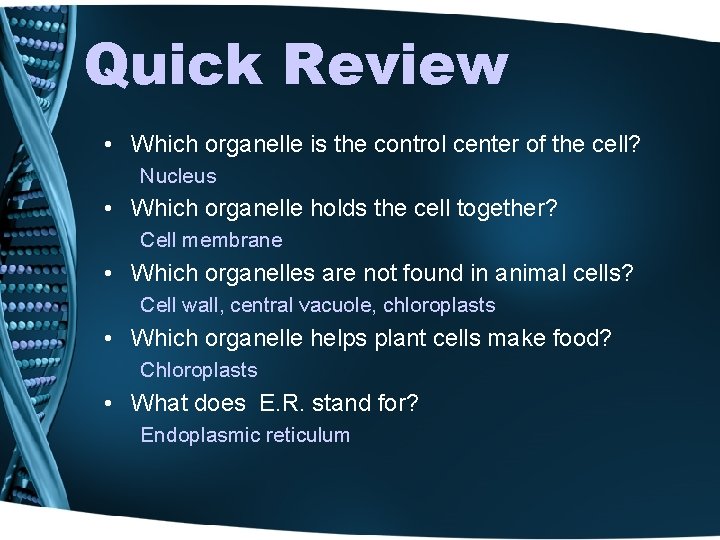
Quick Review • Which organelle is the control center of the cell? Nucleus • Which organelle holds the cell together? Cell membrane • Which organelles are not found in animal cells? Cell wall, central vacuole, chloroplasts • Which organelle helps plant cells make food? Chloroplasts • What does E. R. stand for? Endoplasmic reticulum