
DISCOVERY LEARNING Teaching methods 1 Presented by George
DISCOVERY LEARNING Teaching methods 1 Presented by: George Kfoury
AFTER WATCHING THE VIDEO ANSWER THE FOLLOWING QUESTIONS ON THE BUTCHER PAPER What is discovery learning? What is the role of the teacher? How is a Discovery Learning lesson structured? Why has Discovery method became such a popular approach in learning? Is discovery learning effective?
WHAT IS DISCOVERY LEARNING? • It is an Inquiry-based process that focuses on learning through experience. • Learning is done by seeking for solutions and answers. • The learner is an active participant.
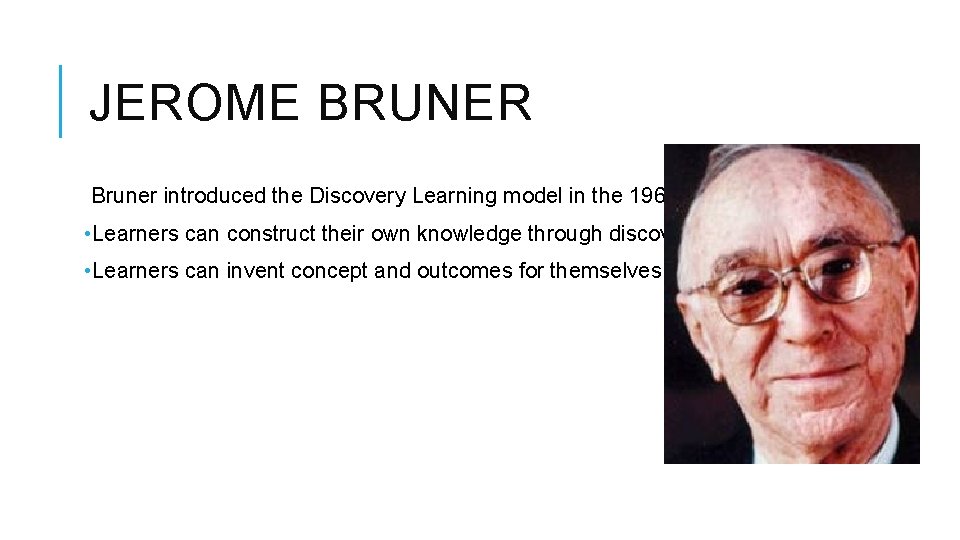
JEROME BRUNER Bruner introduced the Discovery Learning model in the 1960’s: • Learners can construct their own knowledge through discovery. • Learners can invent concept and outcomes for themselves
MODES OF REPRESENTATION Enactive Representation q 0 -1 years q. Action based information stored in memory Iconic Representation q 1 -6 years q. Image based information where information is stored in the form of images to accompany verbal information Symbolic Representation q 7 years and on q. Language based representation where information is stored as a symbol.
PRINCIPLES OF DISCOVERY LEARNING 1. Problem Solving. 2. Learner Management 3. Integrating and Connecting. 4. Information Analysis and Interpretation. 5. Failure and Feedback.
PRINCIPLE 1: PROBLEM SOLVING. • Instructors should guide and motivate learners to seek for solutions by combining existing and newly acquired information and simplifying knowledge. • Learners are the driving force behind learning, take an active role and establish broader applications for skills through activities that encourage risks, problem-solving and probing.
PRINCIPLE 2: LEARNER MANAGEMENT. • Instructors should allow participants to work either alone or with others, and learn at their own pace. • This flexibility makes learning the exact opposite of a static sequencing of lessons and activities, relieves learners from unnecessary stress, and makes them feel they own learning.
PRINCIPLE 3: INTEGRATING AND CONNECTING. • Instructors should teach learners how to combine prior knowledge with new. • Encourage them to connect to the real world. • Familiar scenarios become the basis of new information, encouraging learners to extend what they know and invent something new.
PRINCIPLE 4: INFORMATION ANALYSIS AND INTERPRETATION. • Discovery learning is process-oriented and not content-oriented. • Learners learn to analyze and interpret the acquired information, rather than memorize the correct answer.
PRINCIPLE 5: FAILURE AND FEEDBACK. • Learning doesn’t only occur when we find the right answers. It also occurs through failure. • Discovery learning does not focus on finding the right end result, but the new things we discover in the process. • The instructor provides feedback, since without it learning is incomplete.
WAYS TO INCORPORATE DISCOVERY LEARNING IN THE CLASSROOM q. Warms-up q. Student questions q. Examples and non-examples q. Class discussion q. Set induction q. Solving problems q. Socratic questions q. Appropriate laboratory Exercises q. Suitable class demonstration q. Individualized study assignment
ADVANTAGES • Active engagement. • Promotes motivation. • Promotes ownership of learning. • The development of creativity and problem solving skills. • A tailored learning experience.
DISADVANTAGES • Time consuming. • Difficulties for slow learners. • Requires proper training for teachers. • Expected benefits do not show up in regular achievement test.
IN CONCLUSION… • Bruner believed that students learn best through discovery and a spiraled curriculum. • He said that knowing is a process rather than the accumulated knowledge as acquired in textbooks • Bruner believed that we should instruct students to use the tools, instruments, and technologies available to them to unlock their potential
- Slides: 15