
DISCOVERY AND REUSE OF SCHOLARLY LITERATURE IDENTIFYING INFORMATION
- Slides: 21
DISCOVERY AND RE-USE OF SCHOLARLY LITERATURE IDENTIFYING INFORMATION SOURCES Research 4 Life is a public-private partnership of five programmes:
Outline ● Identifying relevant information ● Level of information ● Refining results ● Primary, secondary, and tertiary sources ● Academic versus popular information ● Types of Information resources ● Access tools ● Evaluating information resources ● Summary This work is licensed under Creative Commons Attribution-Share. Alike 4. 0 International (CC BY-SA 4. 0) v 1. 1 November 2020
Learning objectives ● Identify relevant sources of information ● Distinguish different types of information resources ● Become familiar with criteria to evaluate information resources
Identifying relevant information There are various tools & services that can be used by researchers for online research. Information managers assist researchers in; identifying different types of sources ii. evaluating the originality of the sources; iii. advising which tools and resources to use; iv. employing search techniques to retrieve the best search results v. evaluating the information sources. i.
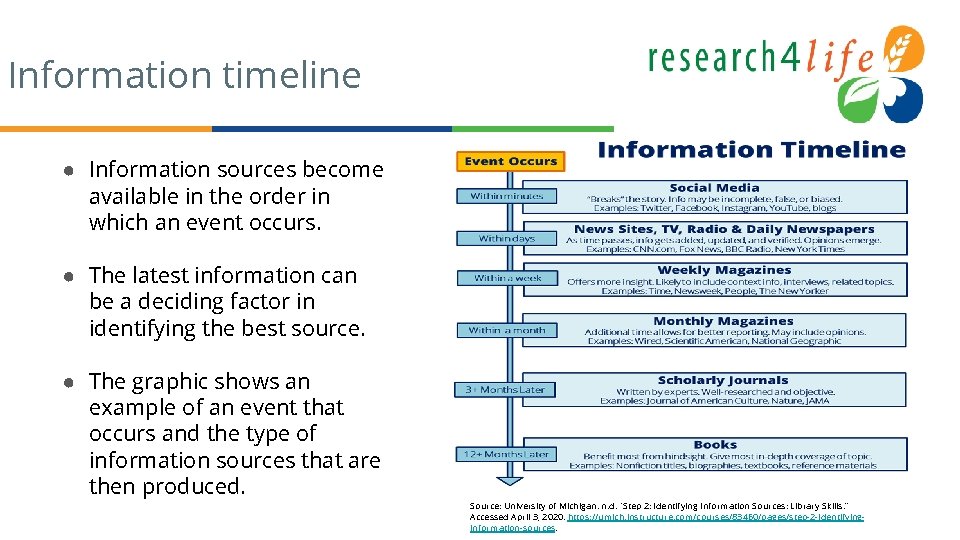
Information timeline ● Information sources become available in the order in which an event occurs. ● The latest information can be a deciding factor in identifying the best source. ● The graphic shows an example of an event that occurs and the type of information sources that are then produced. Source: University of Michigan. n. d. “Step 2: Identifying Information Sources: Library Skills. ” Accessed April 3, 2020. https: //umich. instructure. com/courses/83460/pages/step-2 -identifyinginformation-sources.
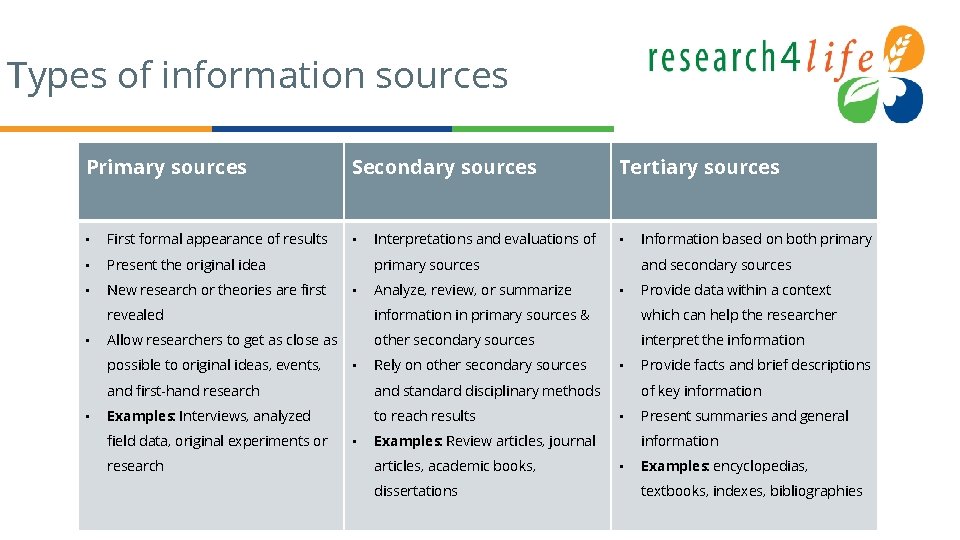
Types of information sources Primary sources • First formal appearance of results • Present the original idea • New research or theories are first • • Interpretations and evaluations of Tertiary sources • primary sources • Analyze, review, or summarize Information based on both primary and secondary sources • Provide data within a context revealed information in primary sources & which can help the researcher Allow researchers to get as close as other secondary sources interpret the information possible to original ideas, events, • Secondary sources • Rely on other secondary sources and first-hand research and standard disciplinary methods Examples: Interviews, analyzed to reach results field data, original experiments or research • • of key information • Examples: Review articles, journal articles, academic books, dissertations Provide facts and brief descriptions Present summaries and general information • Examples: encyclopedias, textbooks, indexes, bibliographies
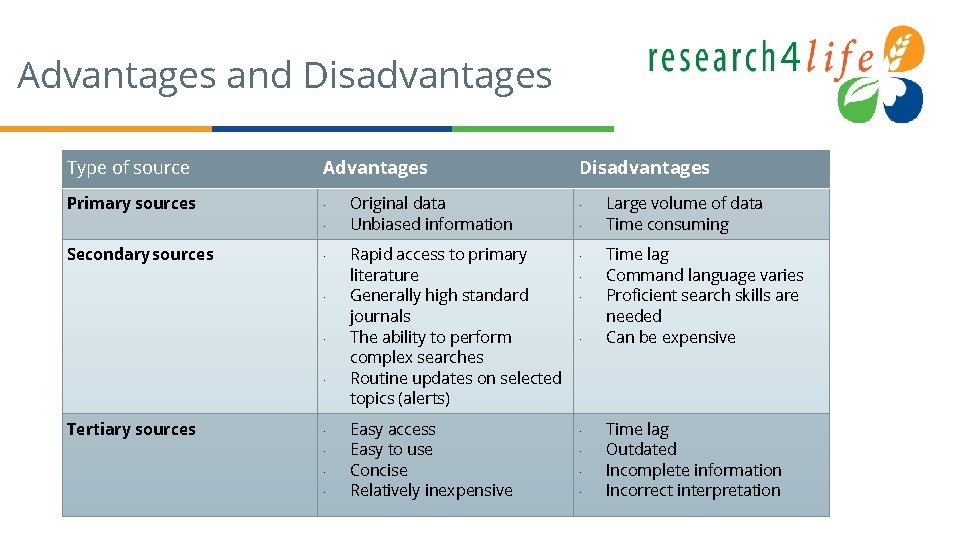
Advantages and Disadvantages Type of source Advantages Primary sources ∙ ∙ Secondary sources ∙ ∙ Tertiary sources ∙ ∙ Original data Unbiased information Rapid access to primary literature Generally high standard journals The ability to perform complex searches Routine updates on selected topics (alerts) Easy access Easy to use Concise Relatively inexpensive Disadvantages ∙ ∙ ∙ ∙ ∙ Large volume of data Time consuming Time lag Command language varies Proficient search skills are needed Can be expensive Time lag Outdated Incomplete information Incorrect interpretation
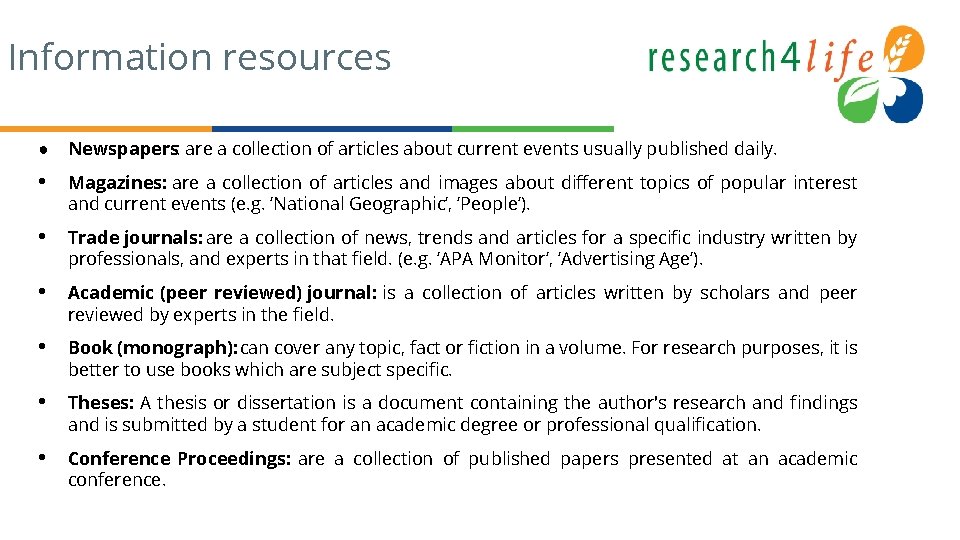
Information resources ● Newspapers: are a collection of articles about current events usually published daily. • Magazines: are a collection of articles and images about different topics of popular interest and current events (e. g. ‘National Geographic’, ‘People’). • Trade journals: are a collection of news, trends and articles for a specific industry written by professionals, and experts in that field. (e. g. ‘APA Monitor’, ‘Advertising Age’). • Academic (peer reviewed) journal: is a collection of articles written by scholars and peer reviewed by experts in the field. • Book (monograph): can cover any topic, fact or fiction in a volume. For research purposes, it is better to use books which are subject specific. • Theses: A thesis or dissertation is a document containing the author's research and findings and is submitted by a student for an academic degree or professional qualification. • Conference Proceedings: are a collection of published papers presented at an academic conference.
Information resources cont. • Reference materials: refer to encyclopedias, dictionaries and thesauri. They are a collection of short factual entries written by different contributors. • Report (working, technical): is a separately published record of research findings, research in progress or other technical findings, usually classified with a report number and sometimes a grant number assigned by the funding agency. • Patent: is a government authority or license giving a right or title for a set period of time, and the sole right to make, use or sell an invention. • Web sites: are a set of related web pages typically served from a single web domain. All publicly accessible websites collectively constitute the World Wide Web.
What is an information access tool? When starting a research project, it is important to know; a. Where to find information, b. What type of resources are offered in what kind of access service and platform. ● These services and platforms are called access tools. They are utilized to locate different types of information resources. ● Please note, not all access tools are free of charge!!! ● Always check your library for subscribed collections and tools available in your institution.
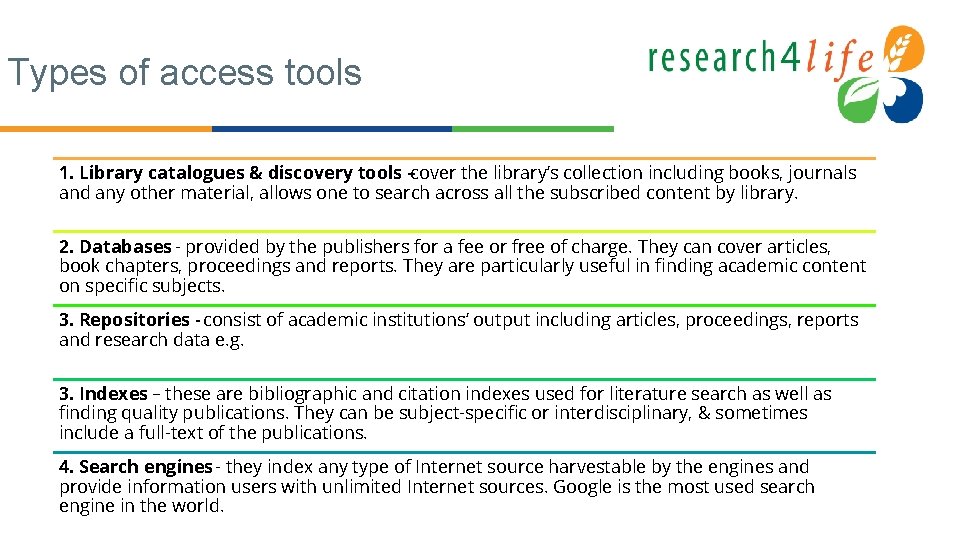
Types of access tools 1. Library catalogues & discovery tools –cover the library’s collection including books, journals and any other material, allows one to search across all the subscribed content by library. 2. Databases - provided by the publishers for a fee or free of charge. They can cover articles, book chapters, proceedings and reports. They are particularly useful in finding academic content on specific subjects. 3. Repositories - consist of academic institutions’ output including articles, proceedings, reports and research data e. g. 3. Indexes – these are bibliographic and citation indexes used for literature search as well as finding quality publications. They can be subject-specific or interdisciplinary, & sometimes include a full-text of the publications. 4. Search engines - they index any type of Internet source harvestable by the engines and provide information users with unlimited Internet sources. Google is the most used search engine in the world.
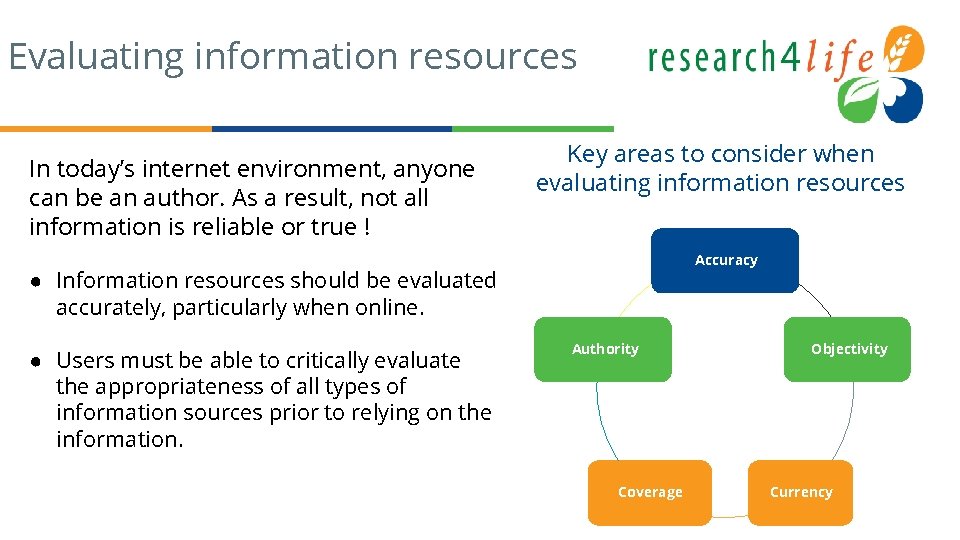
Evaluating information resources In today’s internet environment, anyone can be an author. As a result, not all information is reliable or true ! Key areas to consider when evaluating information resources Accuracy ● Information resources should be evaluated accurately, particularly when online. ● Users must be able to critically evaluate the appropriateness of all types of information sources prior to relying on the information. Authority Coverage Objectivity Currency
1. Authority ● Who is the author? ● Is the author affiliated to a reputable university or organization? ● What is the author's educational background or experience? ● What is their area of expertise? ● Has the author published in academic or peer reviewed publications? ● Does the author/Web Master provide contact information?
2. Accuracy ● Is the information provided based on proven facts? ● Is it published in an academic or peer-reviewed publication? ● Can you find when it was last updated? ● Is there an editor or someone who verifies/checks the information? ● Is the page free of spelling mistakes or other obvious problems?
3. Objectivity ● How objective is the information? ● What do you know about who is publishing the information? ● Is there a political, social or commercial agenda? ● Does the information try to inform or persuade in an inappropriate way? ● How balanced is the presentation in opposing perspectives? ● What is the tone of language used (angry, sarcastic, emotive, objective)?
4. Coverage. ● Does the information covered meet your information needs? ● Is the coverage basic or comprehensive? ● Is there an "About Us" link that explains subject coverage? ● Is the information relevant to your topic? ● Does this page have information that is not found elsewhere? ● How in-depth is the material?
5. Currency ● When was the information published? ● When was the web site last updated? ● Is timeliness important for your information needs? ● Are the links up to date and do they point to existing pages?
Summary ● This lesson introduced types of information sources based on their originality, variety of information tools and resources, and methods to evaluate retrieved resources.
References and useful resources ● Baricz, C. 2020. Comparative Literature Research Guide: Welcome. In: Yale University Library [online]. [Cited 2 October 2020]. https: //guides. library. yale. edu/c. php? g=964120&p=6964388 ● Becksford, L. 2020. Research Guides: Getting Started with Academic Research: Developing a Topic. In: Virgina Tech University Libraries [online]. [Cited 2 October 2020]. https: //guides. lib. vt. edu/gettingstarted/topic ● Cook, R. 2019. Step 2: Identifying Information Sources: Library Skills. In: University of Michigan Library [online]. [Cited 2 October 2020]. https: //umich. instructure. com/courses/83460/pages/step-2 identifying-information-sources ● Ohio State University Libraries, T. &. 2015. Primary, Secondary & Tertiary Sources. Choosing & Using Sources: A Guide to Academic Research, p. The Ohio State University. (also available at https: //ohiostate. pressbooks. pub/choosingsources/chapter/primary-secondary-tertiary-sources/). ● Ohio State University Libraries & University. 2015. Choosing & Using Sources: A Guide to Academic Research. The Ohio State University. (also available at https: //ohiostate. pressbooks. pub/choosingsources/).
You are invited to; ● Visit us at www. research 4 life. org ● Contact us at r 4 l@research 4 life. org ● Find out about other training materials [www. research 4 life. org/training] ● Subscribe to Research 4 Life newsletter [www. research 4 life. org/newsletter] ● Check out Research 4 Life videos [https: //bit. ly/2 w 3 CU 5 C] ● Follow us on Twitter @r 4 lpartnership and Facebook @R 4 Lpartnership
For more information on Research 4 Life www. research 4 life. org r 4 l@research 4 life. org Research 4 Life is a public-private partnership of five programmes: