
Discovering New Antibiotics In The Soil The Small
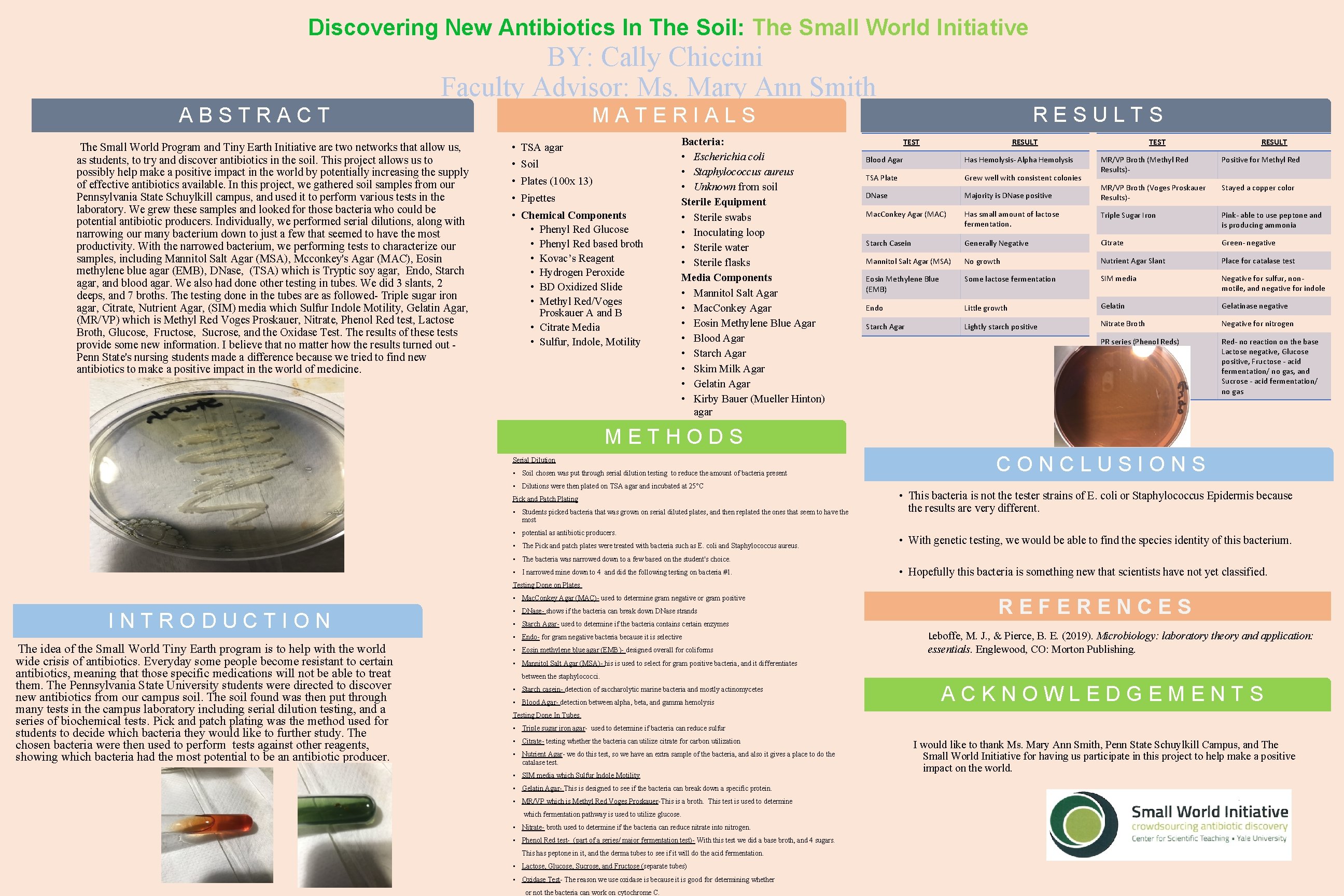
Discovering New Antibiotics In The Soil: The Small World Initiative BY: Cally Chiccini Faculty Advisor: Ms. Mary Ann Smith The Small World Program and Tiny Earth Initiative are two networks that allow us, as students, to try and discover antibiotics in the soil. This project allows us to possibly help make a positive impact in the world by potentially increasing the supply of effective antibiotics available. In this project, we gathered soil samples from our Pennsylvania State Schuylkill campus, and used it to perform various tests in the laboratory. We grew these samples and looked for those bacteria who could be potential antibiotic producers. Individually, we performed serial dilutions, along with narrowing our many bacterium down to just a few that seemed to have the most productivity. With the narrowed bacterium, we performing tests to characterize our samples, including Mannitol Salt Agar (MSA), Mcconkey's Agar (MAC), Eosin methylene blue agar (EMB), DNase, (TSA) which is Tryptic soy agar, Endo, Starch agar, and blood agar. We also had done other testing in tubes. We did 3 slants, 2 deeps, and 7 broths. The testing done in the tubes are as followed- Triple sugar iron agar, Citrate, Nutrient Agar, (SIM) media which Sulfur Indole Motility, Gelatin Agar, (MR/VP) which is Methyl Red Voges Proskauer, Nitrate, Phenol Red test, Lactose Broth, Glucose, Fructose, Sucrose, and the Oxidase Test. The results of these tests provide some new information. I believe that no matter how the results turned out Penn State's nursing students made a difference because we tried to find new antibiotics to make a positive impact in the world of medicine. RESULTS MATERIALS ABSTRACT • TSA agar • Soil • Plates (100 x 13) • Pipettes • Chemical Components • Phenyl Red Glucose • Phenyl Red based broth • Kovac’s Reagent • Hydrogen Peroxide • BD Oxidized Slide • Methyl Red/Voges Proskauer A and B • Citrate Media • Sulfur, Indole, Motility Bacteria: • Escherichia coli • Staphylococcus aureus • Unknown from soil Sterile Equipment • Sterile swabs • Inoculating loop • Sterile water • Sterile flasks Media Components • Mannitol Salt Agar • Mac. Conkey Agar • Eosin Methylene Blue Agar • Blood Agar • Starch Agar • Skim Milk Agar • Gelatin Agar • Kirby Bauer (Mueller Hinton) agar TEST RESULT MR/VP Broth (Methyl Red Results)- Positive for Methyl Red Majority is DNase positive MR/VP Broth (Voges Proskauer Results)- Stayed a copper color Mac. Conkey Agar (MAC) Has small amount of lactose fermentation. Triple Sugar Iron Pink- able to use peptone and is producing ammonia Starch Casein Generally Negative Citrate Green- negative Mannitol Salt Agar (MSA) No growth Nutrient Agar Slant Place for catalase test Eosin Methylene Blue (EMB) Some lactose fermentation SIM media Negative for sulfur, nonmotile, and negative for indole Endo Little growth Gelatinase negative Starch Agar Lightly starch positive Nitrate Broth Negative for nitrogen PR series (Phenol Reds) Red- no reaction on the base Lactose negative, Glucose positive, Fructose - acid fermentation/ no gas, and Sucrose - acid fermentation/ no gas Blood Agar Has Hemolysis- Alpha Hemolysis TSA Plate Grew well with consistent colonies DNase METHODS Serial Dilution • Soil chosen was put through serial dilution testing to reduce the amount of bacteria present • Dilutions were then plated on TSA agar and incubated at 25°C Pick and Patch Plating • Students picked bacteria that was grown on serial diluted plates, and then replated the ones that seem to have the most • potential as antibiotic producers. • The Pick and patch plates were treated with bacteria such as E. coli and Staphylococcus aureus. CONCLUSIONS • This bacteria is not the tester strains of E. coli or Staphylococcus Epidermis because the results are very different. • With genetic testing, we would be able to find the species identity of this bacterium. • The bacteria was narrowed down to a few based on the student's choice. • I narrowed mine down to 4 and did the following testing on bacteria #1. • Hopefully this bacteria is something new that scientists have not yet classified. Testing Done on Plates • Mac. Conkey Agar (MAC)- used to determine gram negative or gram positive INTRODUCTION • DNase- shows if the bacteria can break down DNase strands • Starch Agar- used to determine if the bacteria contains certain enzymes • Endo- for gram negative bacteria because it is selective The idea of the Small World Tiny Earth program is to help with the world wide crisis of antibiotics. Everyday some people become resistant to certain antibiotics, meaning that those specific medications will not be able to treat them. The Pennsylvania State University students were directed to discover new antibiotics from our campus soil. The soil found was then put through many tests in the campus laboratory including serial dilution testing, and a series of biochemical tests. Pick and patch plating was the method used for students to decide which bacteria they would like to further study. The chosen bacteria were then used to perform tests against other reagents, showing which bacteria had the most potential to be an antibiotic producer. REFERENCES • Eosin methylene blue agar (EMB)- designed overall for coliforms Leboffe, M. J. , & Pierce, B. E. (2019). Microbiology: laboratory theory and application: essentials. Englewood, CO: Morton Publishing. • Mannitol Salt Agar (MSA)- his is used to select for gram positive bacteria, and it differentiates between the staphylococci. • Starch casein- detection of saccharolytic marine bacteria and mostly actinomycetes • Blood Agar- detection between alpha, beta, and gamma hemolysis ACKNOWLEDGEMENTS Testing Done In Tubes • Triple sugar iron agar- used to determine if bacteria can reduce sulfur • Citrate- testing whether the bacteria can utilize citrate for carbon utilization • Nutrient Agar- we do this test, so we have an extra sample of the bacteria, and also it gives a place to do the catalase test. • SIM media which Sulfur Indole Motility • Gelatin Agar- This is designed to see if the bacteria can break down a specific protein. • MR/VP which is Methyl Red Voges Proskauer-This is a broth. This test is used to determine which fermentation pathway is used to utilize glucose. • Nitrate- broth used to determine if the bacteria can reduce nitrate into nitrogen. • Phenol Red test- (part of a series/ major fermentation test)- With this test we did a base broth, and 4 sugars. This has peptone in it, and the derma tubes to see if it will do the acid fermentation. • Lactose, Glucose, Sucrose, and Fructose (separate tubes) • Oxidase Test- The reason we use oxidase is because it is good for determining whether or not the bacteria can work on cytochrome C. I would like to thank Ms. Mary Ann Smith, Penn State Schuylkill Campus, and The Small World Initiative for having us participate in this project to help make a positive impact on the world.
- Slides: 1