
Discovering DNA Structure and Replication A collaborative effort
Discovering DNA: Structure and Replication
A collaborative effort! n n The discovery of DNA resulted from the combination of contributions from several scientists. Each conducted experiments that provided different pieces of information needed to solve the puzzle of the role and structure of DNA.
Good things happen when you’re not looking……. n Griffith’s Experiment 1928 – Frederick Griffith conducted experiments with mice to study the effects of pneumonia bacteria. n Griffith isolated two strains of pneumonia bacteria – one caused the lung disease (pneumonia) and the other did not. n
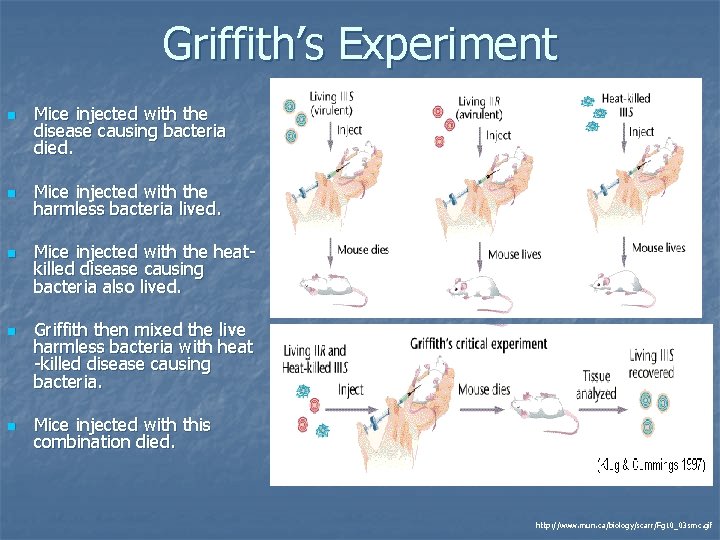
Griffith’s Experiment n n n Mice injected with the disease causing bacteria died. Mice injected with the harmless bacteria lived. Mice injected with the heatkilled disease causing bacteria also lived. Griffith then mixed the live harmless bacteria with heat -killed disease causing bacteria. Mice injected with this combination died. http: //www. mun. ca/biology/scarr/Fg 10_03 smc. gif
n n Based on his results, Griffith hypothesized that when the harmless and heat-killed bacteria where mixed, some factor was exchanged between them, making the live harmless bacteria deadly. Transformation – process in which one strain of bacteria is changed by the gene(s) of another bacteria

Avery modifies Griffith’s experiment. n n In 1943, Avery, with fellow scientists, conducted an experiment similar to Griffith’s, except they used enzymes to selectively destroy molecules one at a time. When they injected harmless bacteria with only lipids, carbs, or proteins: transformation did not occur. When they used the nucleic acids (DNA): transformation did occur, the bacteria became lethal. This helped to determine that DNA stores and transmits genetic information. http: //www. synapses. co. uk/genetics/avery 1. gif
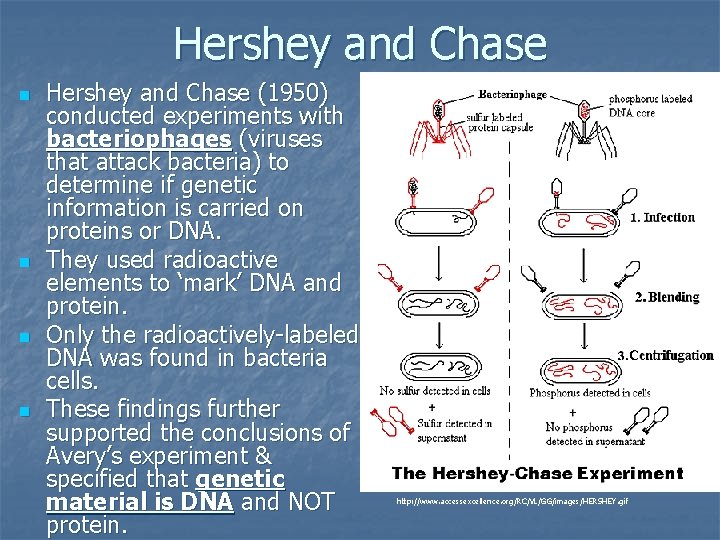
Hershey and Chase n n Hershey and Chase (1950) conducted experiments with bacteriophages (viruses that attack bacteria) to determine if genetic information is carried on proteins or DNA. They used radioactive elements to ‘mark’ DNA and protein. Only the radioactively-labeled DNA was found in bacteria cells. These findings further supported the conclusions of Avery’s experiment & specified that genetic material is DNA and NOT protein. http: //www. accessexcellence. org/RC/VL/GG/images/HERSHEY. gif
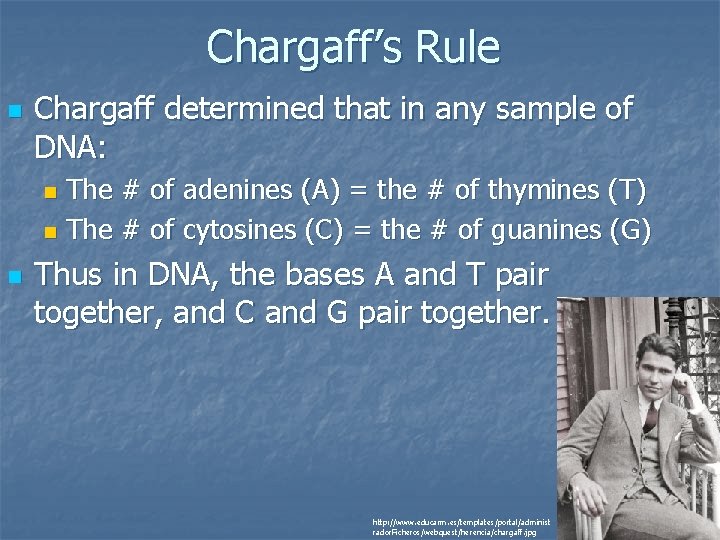
Chargaff’s Rule n Chargaff determined that in any sample of DNA: The # of adenines (A) = the # of thymines (T) n The # of cytosines (C) = the # of guanines (G) n n Thus in DNA, the bases A and T pair together, and C and G pair together. http: //www. educarm. es/templates/portal/administ rador. Ficheros/webquest/herencia/chargaff. jpg

Rosalind Franklin n . Franklin used x-ray diffraction to create pictures of DNA’s molecular structure http: //www. safarikscience. org/biologyhome/7_dna/6_xray_diffraction. jpg
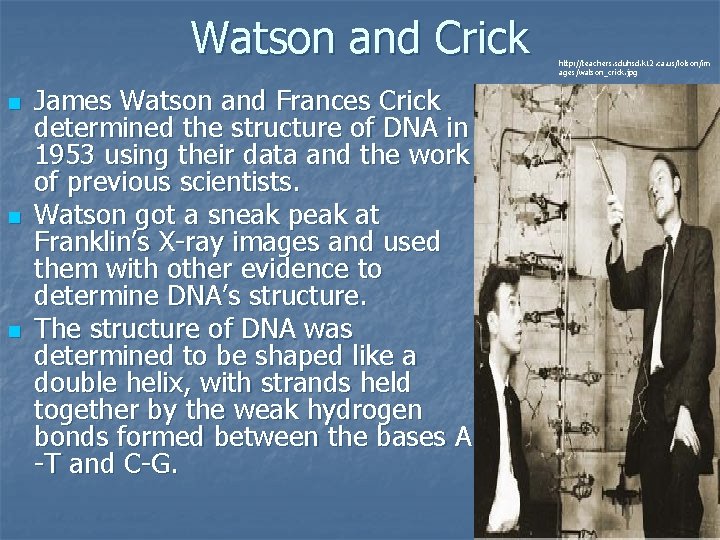
Watson and Crick n n n James Watson and Frances Crick determined the structure of DNA in 1953 using their data and the work of previous scientists. Watson got a sneak peak at Franklin’s X-ray images and used them with other evidence to determine DNA’s structure. The structure of DNA was determined to be shaped like a double helix, with strands held together by the weak hydrogen bonds formed between the bases A -T and C-G. http: //teachers. sduhsd. k 12. ca. us/lolson/im ages/watson_crick. jpg
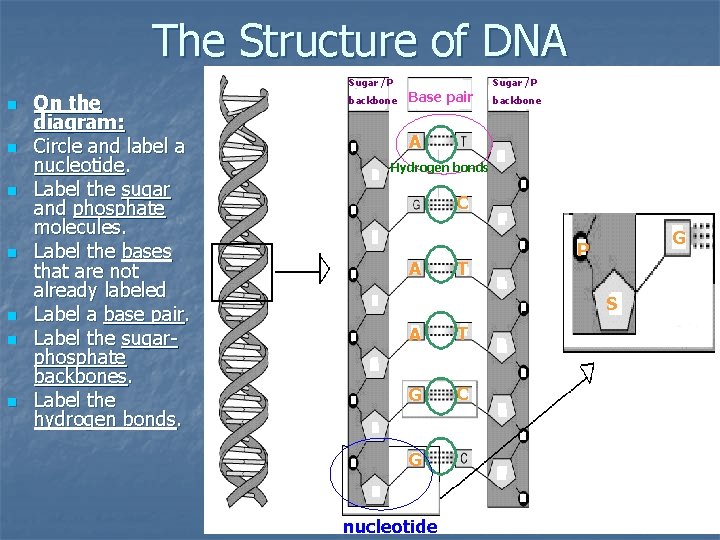
The Structure of DNA Sugar /P n n n n On the diagram: Circle and label a nucleotide. Label the sugar and phosphate molecules. Label the bases that are not already labeled Label a base pair. Label the sugarphosphate backbones. Label the hydrogen bonds. backbone Base pair Sugar /P backbone A Hydrogen bonds C A T G P S A T G C G nucleotide
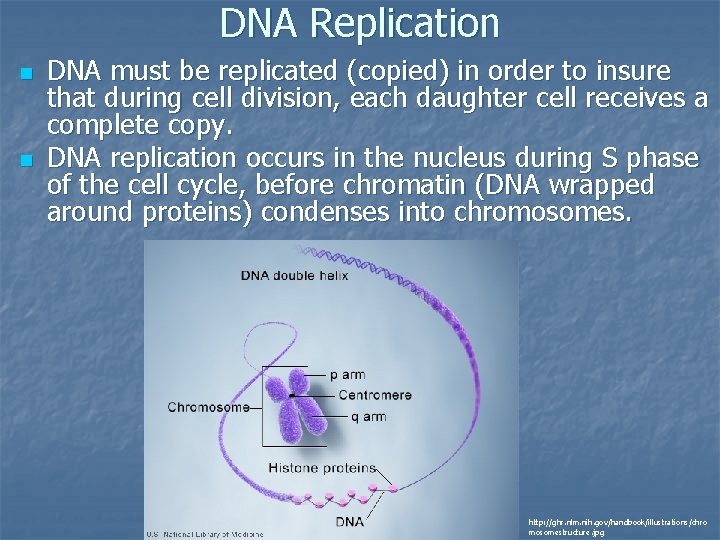
DNA Replication n n DNA must be replicated (copied) in order to insure that during cell division, each daughter cell receives a complete copy. DNA replication occurs in the nucleus during S phase of the cell cycle, before chromatin (DNA wrapped around proteins) condenses into chromosomes. http: //ghr. nlm. nih. gov/handbook/illustrations/chro mosomestructure. jpg
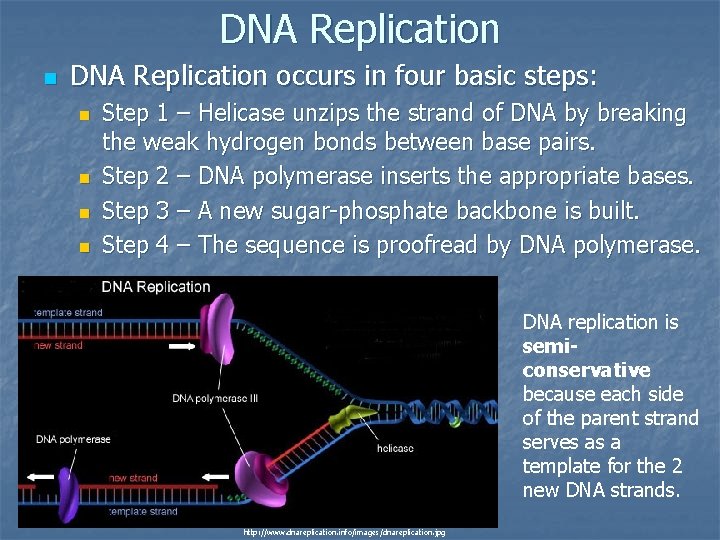
DNA Replication n DNA Replication occurs in four basic steps: n n Step 1 – Helicase unzips the strand of DNA by breaking the weak hydrogen bonds between base pairs. Step 2 – DNA polymerase inserts the appropriate bases. Step 3 – A new sugar-phosphate backbone is built. Step 4 – The sequence is proofread by DNA polymerase. DNA replication is semiconservative because each side of the parent strand serves as a template for the 2 new DNA strands. http: //www. dnareplication. info/images/dnareplication. jpg
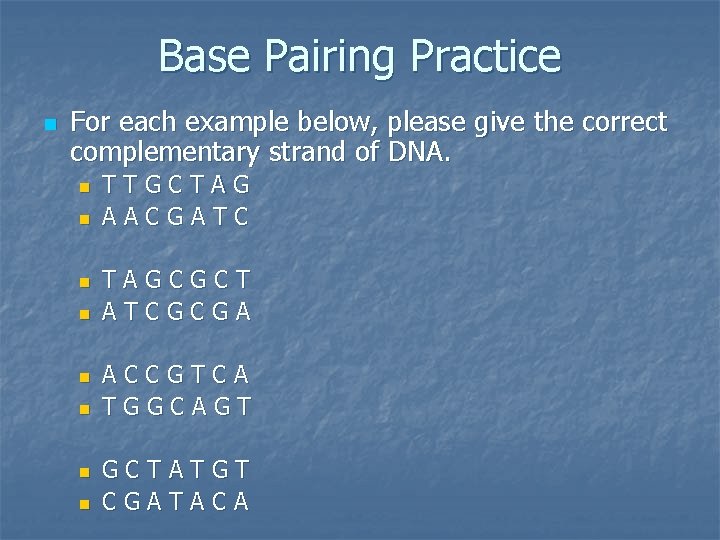
Base Pairing Practice n For each example below, please give the correct complementary strand of DNA. n n n n TTGCTAG AACGATC TAGCGCT ATCGCGA ACCGTCA TGGCAGT GCTATGT CGATACA
- Slides: 14