
Discovering Cells are the basic unit of structure
Discovering Cells are the basic unit of structure and function of all living things
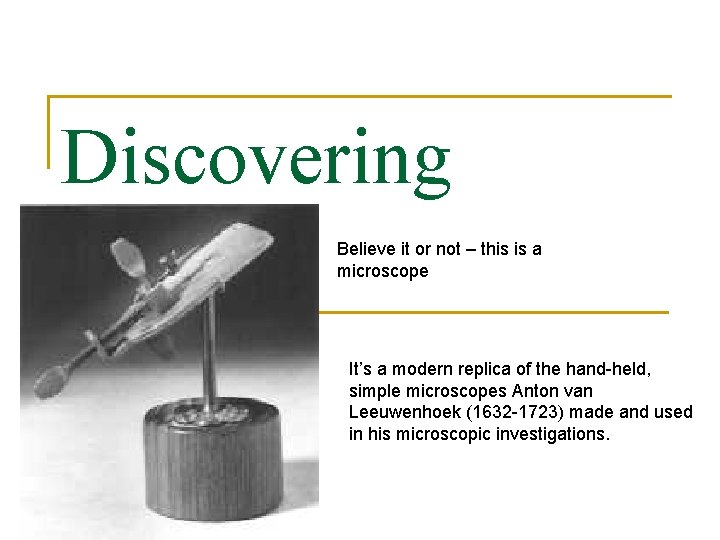
Discovering Cells Believe it or not – this is a microscope It’s a modern replica of the hand-held, simple microscopes Anton van Leeuwenhoek (1632 -1723) made and used in his microscopic investigations.
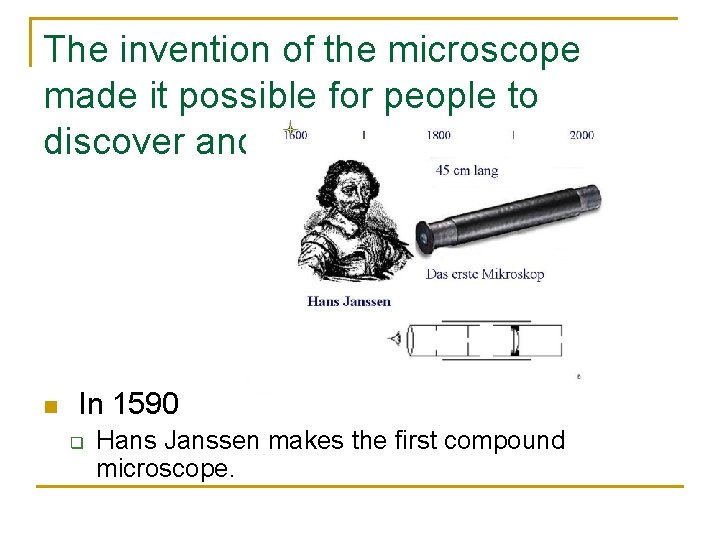
The invention of the microscope made it possible for people to discover and learn about cells. n In 1590 q Hans Janssen makes the first compound microscope.
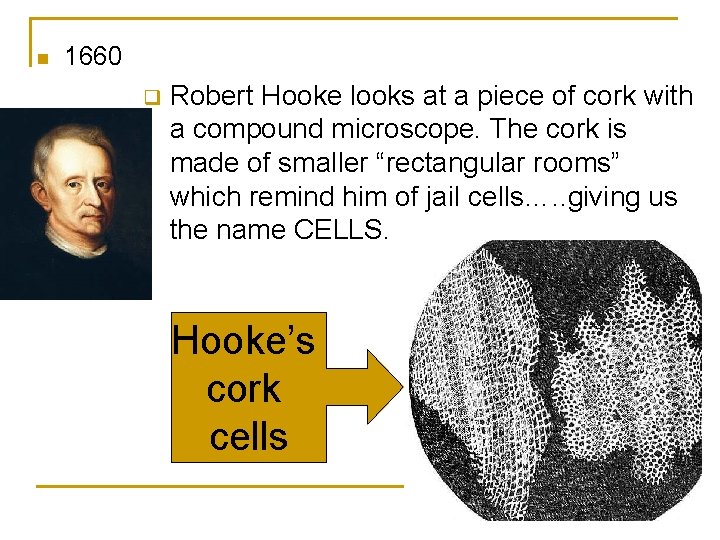
n 1660 q Robert Hooke looks at a piece of cork with a compound microscope. The cork is made of smaller “rectangular rooms” which remind him of jail cells…. . giving us the name CELLS. Hooke’s cork cells
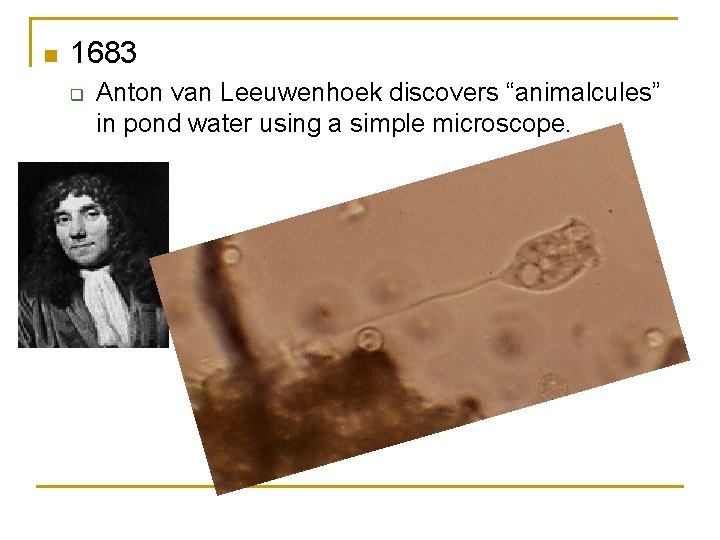
n 1683 q Anton van Leeuwenhoek discovers “animalcules” in pond water using a simple microscope.
The Cell Theory n The observations and conclusions of Robert Hooke, Anton Von Leeuwenhoek, Matthias Schleiden, Theodor Schwann and Rudolf Virchow led to the development of the CELL THEORY which states: q q q All living things are composed of cells Cells are the basic unit of structure and function in living things All cells are produced from other cells
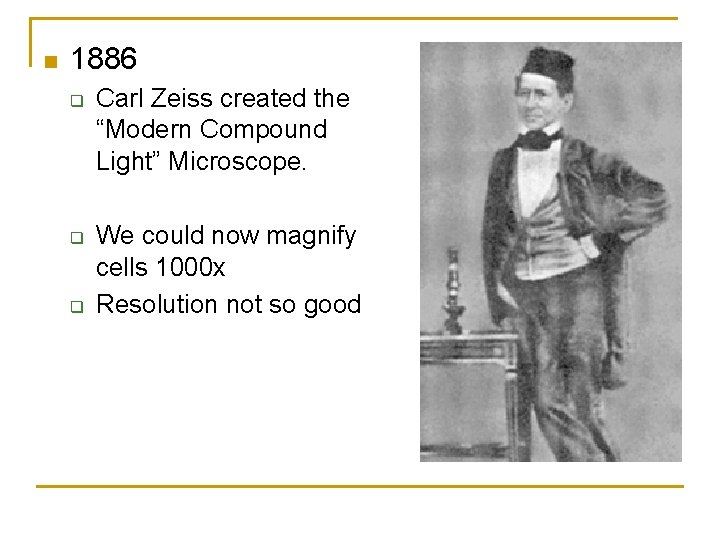
n 1886 q q q Carl Zeiss created the “Modern Compound Light” Microscope. We could now magnify cells 1000 x Resolution not so good
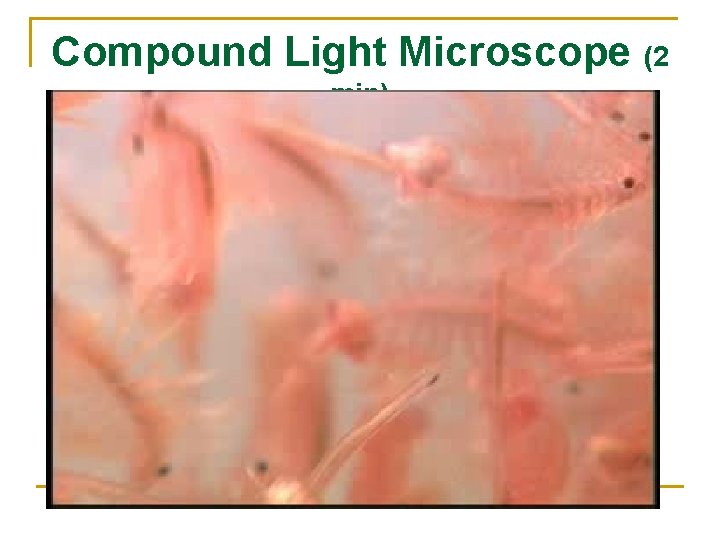
Compound Light Microscope (2 min)
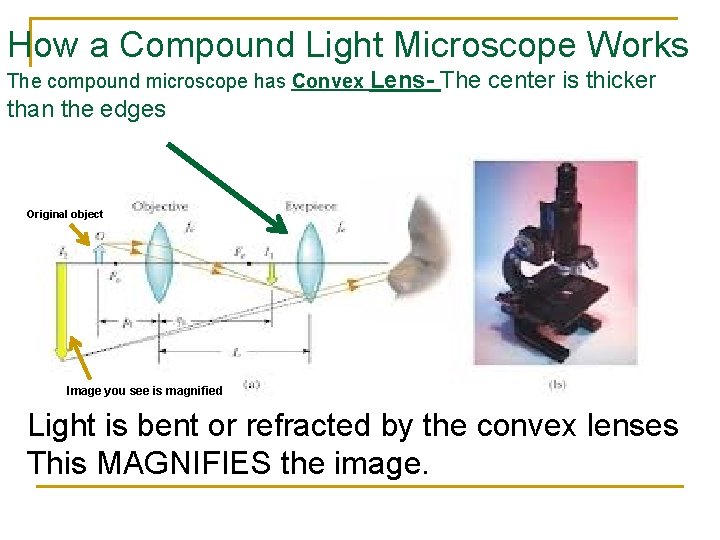
How a Compound Light Microscope Works The compound microscope has Convex Lens- The center is thicker than the edges Original object Image you see is magnified Light is bent or refracted by the convex lenses This MAGNIFIES the image.

Magnification vs. Resolution Magnification – making things look larger than the are. Resolution – The ability to clearly see parts of an object – SHARPNESS/CLARITY
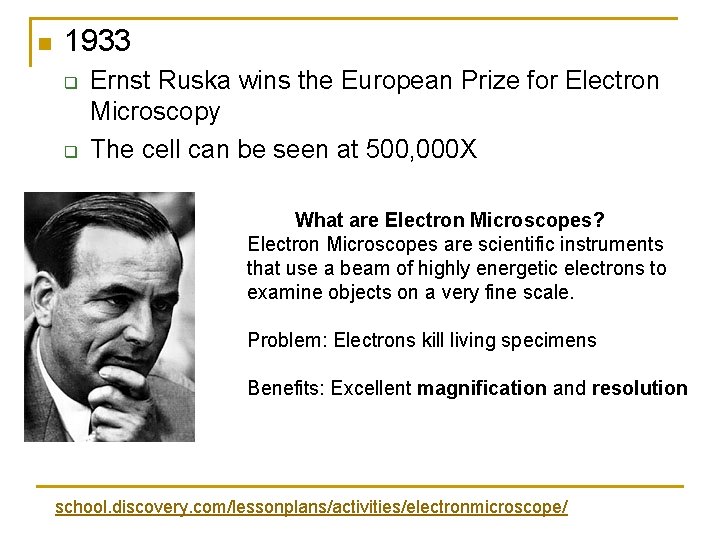
n 1933 q q Ernst Ruska wins the European Prize for Electron Microscopy The cell can be seen at 500, 000 X What are Electron Microscopes? Electron Microscopes are scientific instruments that use a beam of highly energetic electrons to examine objects on a very fine scale. Problem: Electrons kill living specimens Benefits: Excellent magnification and resolution school. discovery. com/lessonplans/activities/electronmicroscope/
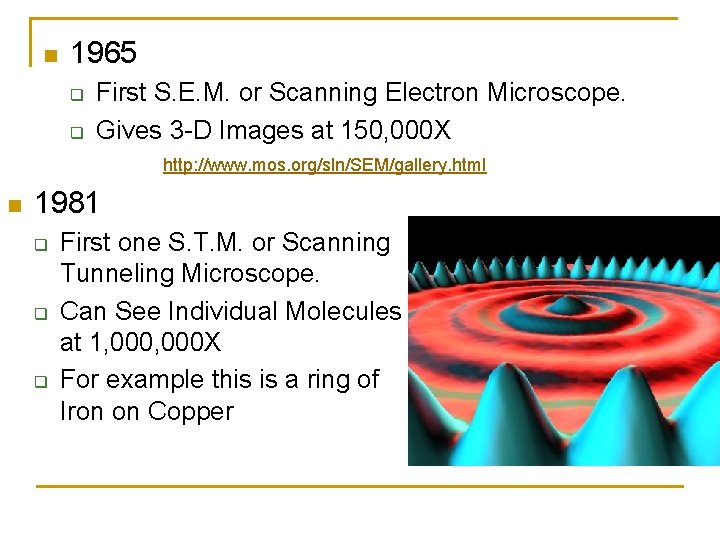
n 1965 q q First S. E. M. or Scanning Electron Microscope. Gives 3 -D Images at 150, 000 X http: //www. mos. org/sln/SEM/gallery. html n 1981 q q q First one S. T. M. or Scanning Tunneling Microscope. Can See Individual Molecules at 1, 000 X For example this is a ring of Iron on Copper
Electron Microscopes (3 min)
Brief History of Cells (5 min)
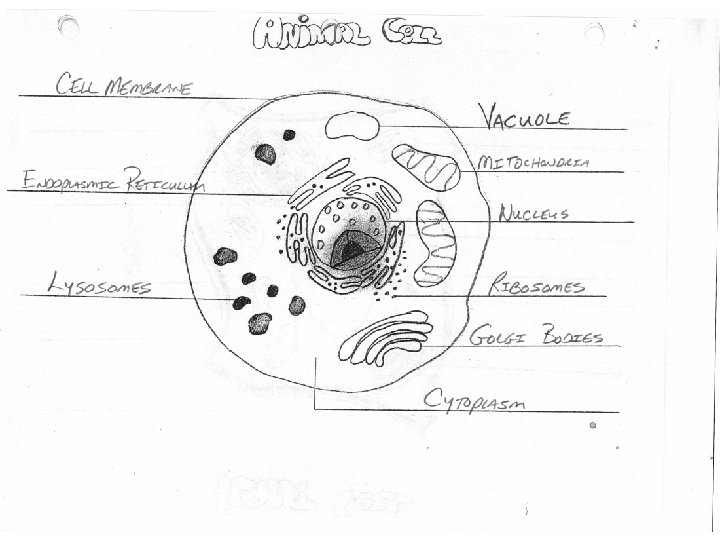
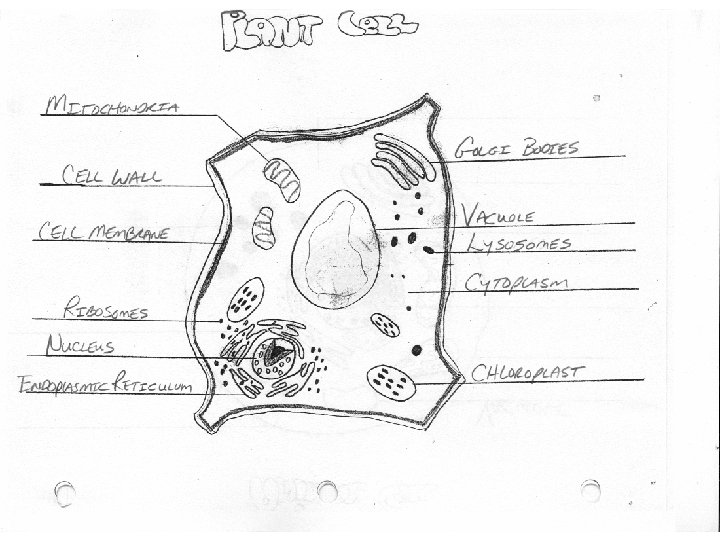
Cell Organelles n. Cell organelles are tiny cell structures inside a cell that carry out specific functions within the cell
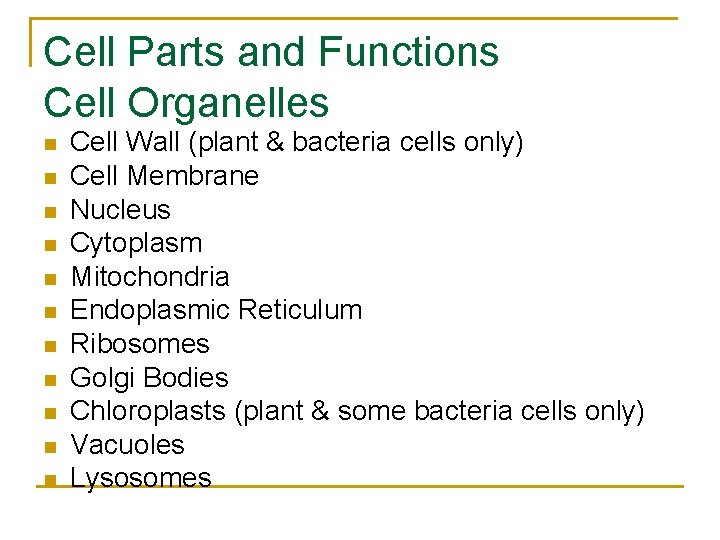
Cell Parts and Functions Cell Organelles n n n Cell Wall (plant & bacteria cells only) Cell Membrane Nucleus Cytoplasm Mitochondria Endoplasmic Reticulum Ribosomes Golgi Bodies Chloroplasts (plant & some bacteria cells only) Vacuoles Lysosomes

Cell Part Function Plant/Animal/Both Plasma (Cell) Membrane The outer lining of the cell. Acts like a doorman by Both controlling what molecules pass in and go out of the cell. Ribosome Found on the endoplasmic reticulum and floating in Both the cytoplasm. With instructions from the nucleus, the ribosomes make PROTIENS for the cell. Mitochondria Powerhouse of the cell. Produces energy rich Both molecules called ATP which fuels most of the cells actions. Nucleus Golgi Apparatus Cytoplasm Like a mayor in a city, the nucleus directs the activities of the cell. The nucleus also holds DNA which dictates the proteins the cell will make. Both Like a packing plant, the golgi apparatus groups, Both packages and ships molecules around the cell and to other cells The fluid that fills the cell. Helps to keep the cell’s shape and contains free floating molecules that ribosomes need to make proteins Both
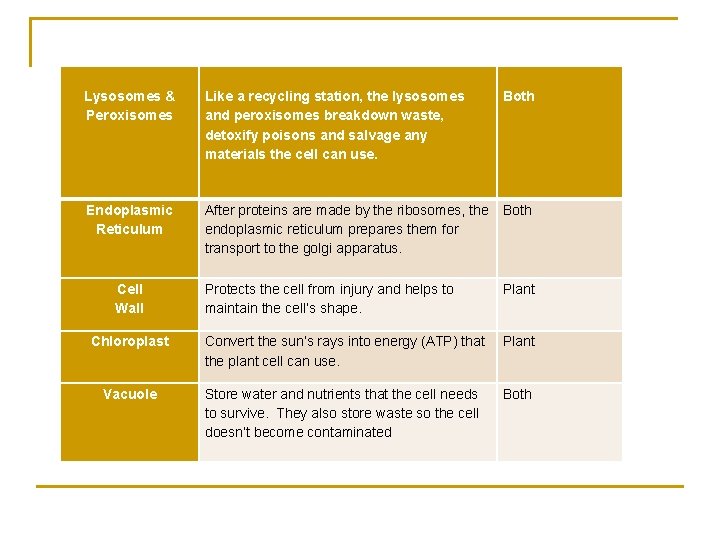
Lysosomes & Peroxisomes Like a recycling station, the lysosomes and peroxisomes breakdown waste, detoxify poisons and salvage any materials the cell can use. Both Endoplasmic Reticulum After proteins are made by the ribosomes, the endoplasmic reticulum prepares them for transport to the golgi apparatus. Both Protects the cell from injury and helps to maintain the cell’s shape. Plant Chloroplast Convert the sun’s rays into energy (ATP) that the plant cell can use. Plant Vacuole Store water and nutrients that the cell needs to survive. They also store waste so the cell doesn’t become contaminated Both Cell Wall
Bill Nye Cell Video – Review of Cells (22 min) n http: //www. youtube. com/watch? v=X 6 N 82 No 4 Nz 8
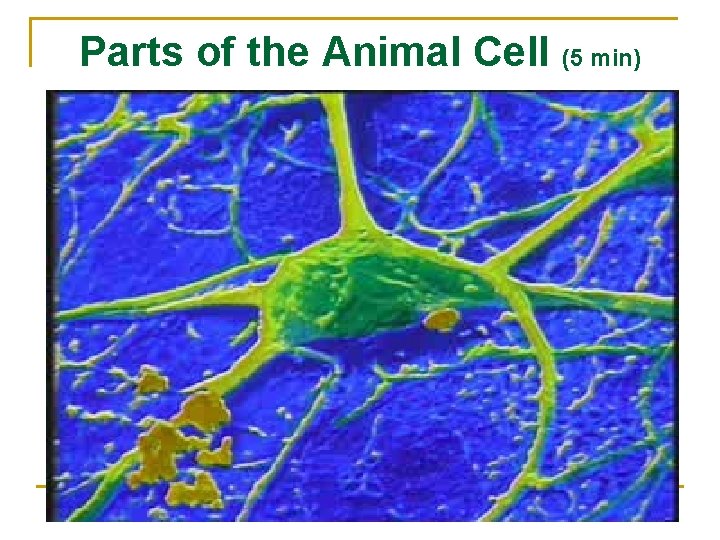
Parts of the Animal Cell (5 min)
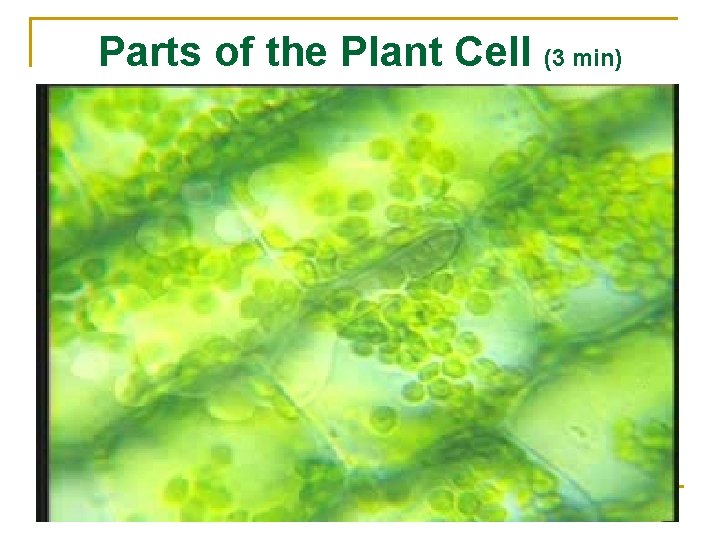
Parts of the Plant Cell (3 min)
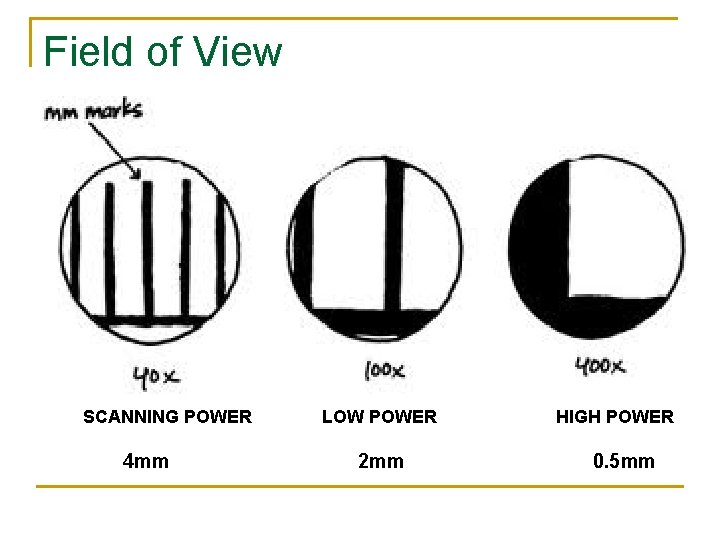
Field of View SCANNING POWER LOW POWER HIGH POWER 4 mm 2 mm 0. 5 mm
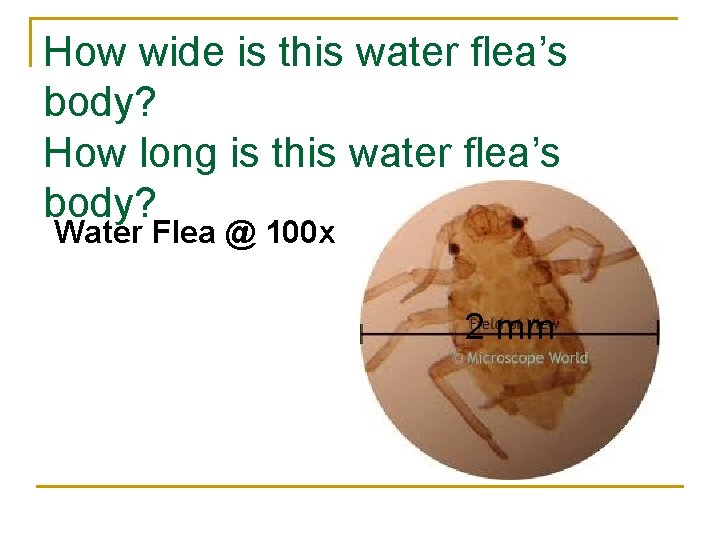
How wide is this water flea’s body? How long is this water flea’s body? Water Flea @ 100 x 2 mm
Chemical Compounds in Cells n Elements- there are over 100 different kinds of elements q n n Atoms- the smallest unit of an element Compounds- chemical combinations of elements q n Examples are H(hydrogen), O(oxygen), He(helium), Na(sodium) Examples are H 2 O(water), Na. Cl(salt), C 6 H 12 O 6(sugar) Molecules- the smallest unit of a compound
Organic vs Inorganic Compounds n n n Organic compounds contain carbon Carbohydrates, lipids, proteins, and nucleic acids are organic compounds Carbohydratesq q q Contain C, H, O Are sugars and starches Produced and stored by plants Examples are potatoes, rice, bread Carbohydrates are found in cell walls and cell membranes and are an energy source
Organic Compounds (continued) n Proteinsq q q Contain C, H, O, and N Foods high in protein are meat, eggs, fish, beans Are used for growth and repair of cells Are made of combinations of 20 different amino acids Enzymes- a type of protein that speeds up chemical reactions in living things
Organic Compounds (continued) n Lipidsq q q Contain C, H, O are fats, oils, waxes foods high in lipids are oils, meats, dairy products Are stored by cells for later use Cholesterol- an important lipid that forms cell membranes, produced in the liver, too much clogs blood vessels
Organic Compounds (continued) n Nucleic Acidsq q q n Contain C, H, O, N, P Contain instructions that cells need to carry out life processes 2 kindsn DNA- deoxyribonucleic acid, is the genetic information n RNA- ribonucleic acid, for the production of proteins Water- is an inorganic compound that A. Cells need for chemical reactions B. to give the cell shape C. To regulate the temperature of the cell D. To carry material in and out of the cell
The Cell In Its Environment n Cell Membraneq q Is selectively permeable - allows some substances in, usually small molecules can pass through, large molecules cannot 3 ways substances move in/out of a cell n n n Diffusion Osmosis Active Transport
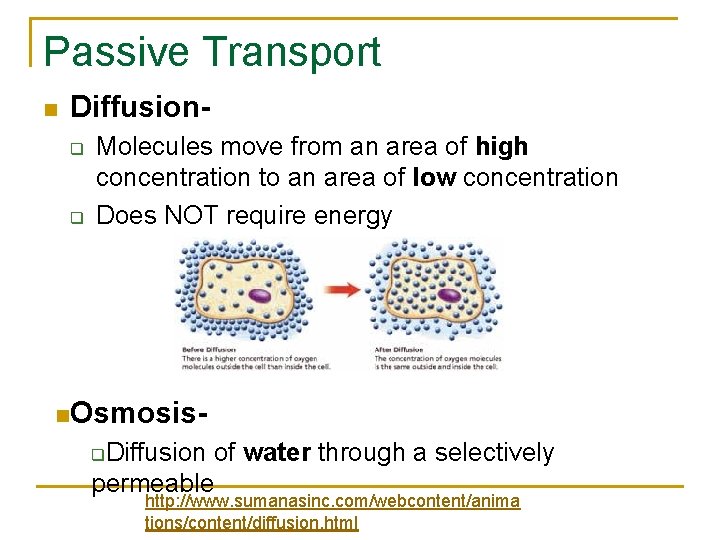
Passive Transport n Diffusionq q Molecules move from an area of high concentration to an area of low concentration Does NOT require energy n. Osmosis- Diffusion of water through a selectively permeable q http: //www. sumanasinc. com/webcontent/anima tions/content/diffusion. html
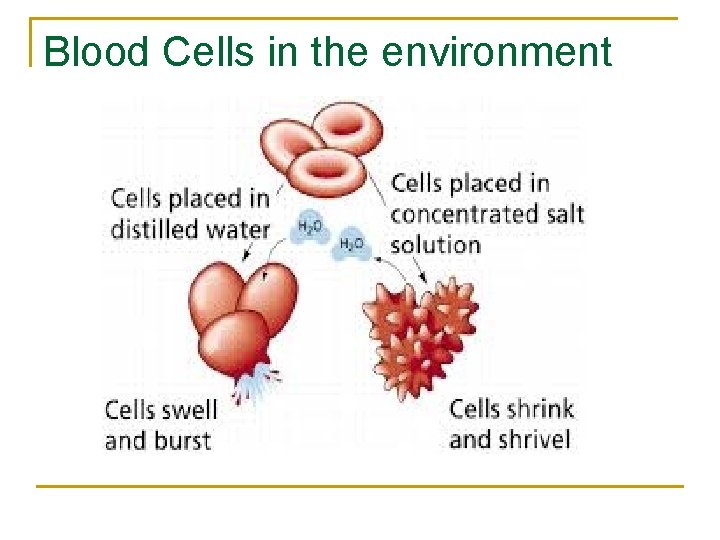
Blood Cells in the environment
Active Transport n n Materials move from an area of low concentration to an area of high concentration Requires energy Engulfing a particle is an example Transport proteins are used in the cell membrane https: //www. youtube. com/wat ch? v=pv. Oz 4 V 699 gk https: //www. youtube. com /watch? v=GFCcnxg. XOh Y
Cell Size n Cells are small becauseq q n n Materials need to reach all parts of the cell Wastes need to be removed from the cell The larger the cell, the longer it takes for substances to move through it When a cell reaches a certain size, it divides
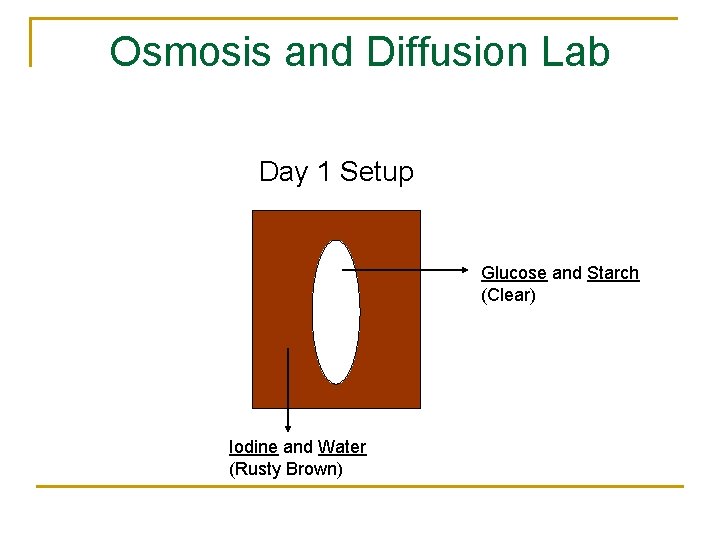
Osmosis and Diffusion Lab Day 1 Setup Glucose and Starch (Clear) Iodine and Water (Rusty Brown)
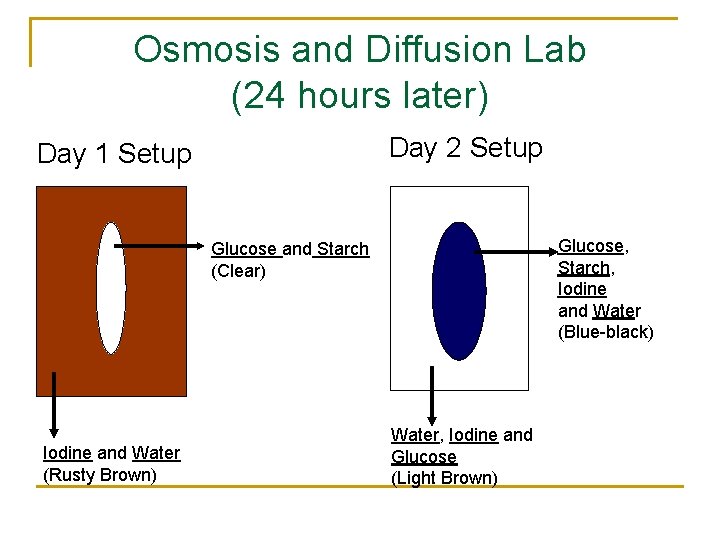
Osmosis and Diffusion Lab (24 hours later) Day 2 Setup Day 1 Setup Glucose, Starch, Iodine and Water (Blue-black) Glucose and Starch (Clear) Iodine and Water (Rusty Brown) Water, Iodine and Glucose (Light Brown)
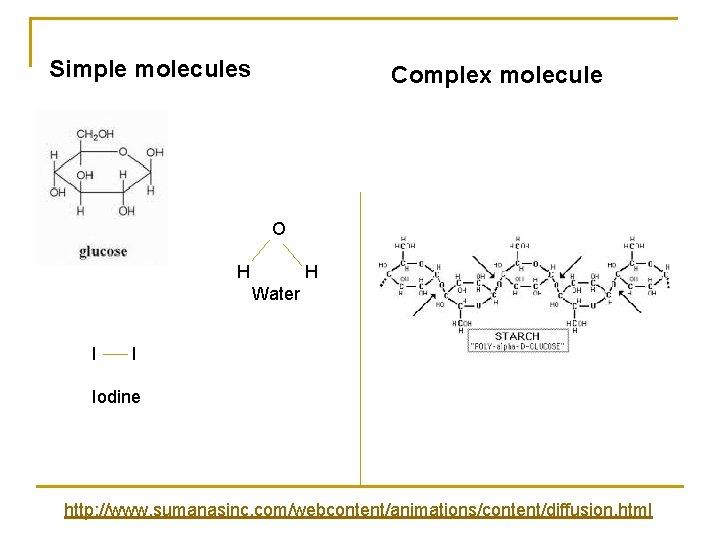
Simple molecules Complex molecule O H H Water I I Iodine http: //www. sumanasinc. com/webcontent/animations/content/diffusion. html
Osmosis and Diffusion Lab Results and Analysis 1. What happened to the iodine? Some iodine diffused into the cell and turned the starch blue-black. 2. What happened to the starch? All the starch stayed in the cell. 3. What happened to the glucose? Some glucose diffused out of the cell. Turned test strip a different color. 4. What materials have diffused through the membrane? Glucose, water and Iodine.
Osmosis and Diffusion Lab Results and Analysis Why could they diffuse? Because the molecules of glucose, water and iodine are small enough to fit through the pores in the membrane. n 5. How was this proven? Glucose……. . We used the test strip Water………. . We see the cell got fatter Iodine………. . We observed the cell changing to blue-black 6. What substance did not diffuse through the membrane? The starch……. maybe because it is a bigger molecule.
Osmosis and Diffusion Lab Conclusions n In this lab we were able to see the results of osmosis and diffusion occurring in a model cell. Osmosis is the movement of water from areas of high concentration to areas of lower concentration. Diffusion is the movement of substances (other than water) from areas of high concentration to areas of lower concentration. Through osmosis, water moved from outside the cell into the cell. Through diffusion, glucose moved out of the cell and iodine moved into the cell. Starch did not diffuse out of the cell because the molecules are too big to fit through the pores of the cell.
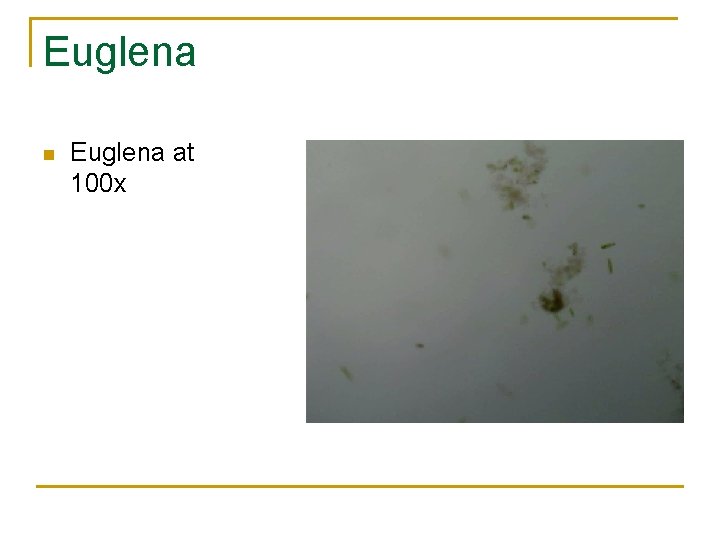
Euglena n Euglena at 100 x
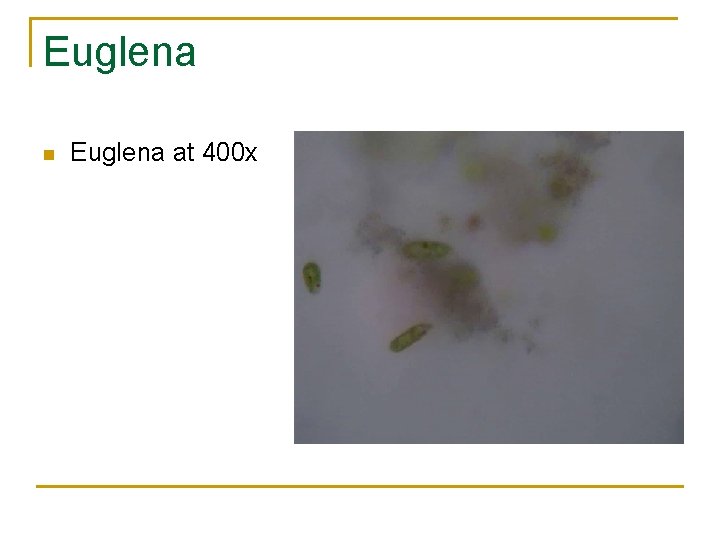
Euglena n Euglena at 400 x
Paramecium n Paramecium Caudatum at 100 x
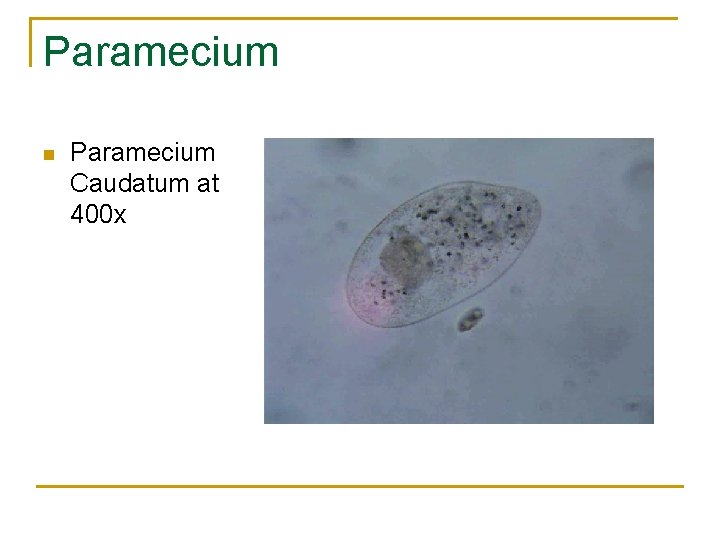
Paramecium n Paramecium Caudatum at 400 x
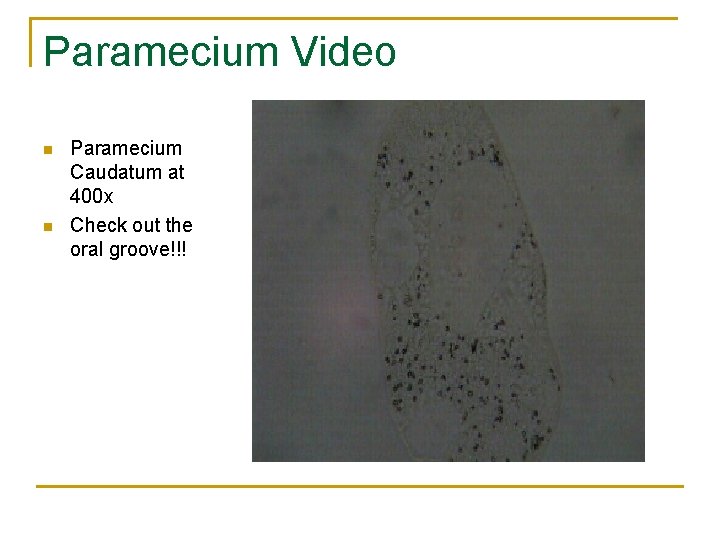
Paramecium Video n n Paramecium Caudatum at 400 x Check out the oral groove!!!
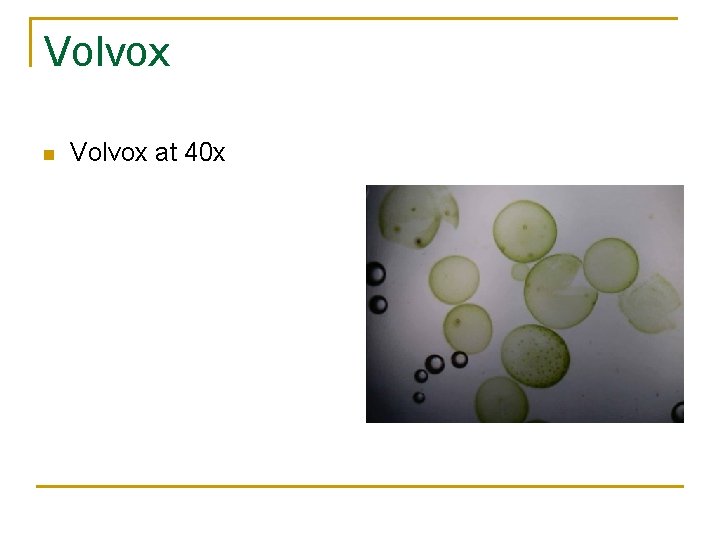
Volvox n Volvox at 40 x
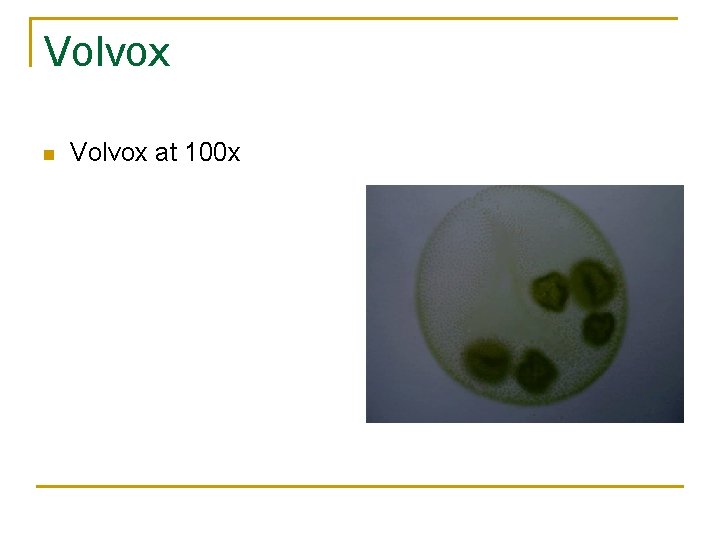
Volvox n Volvox at 100 x
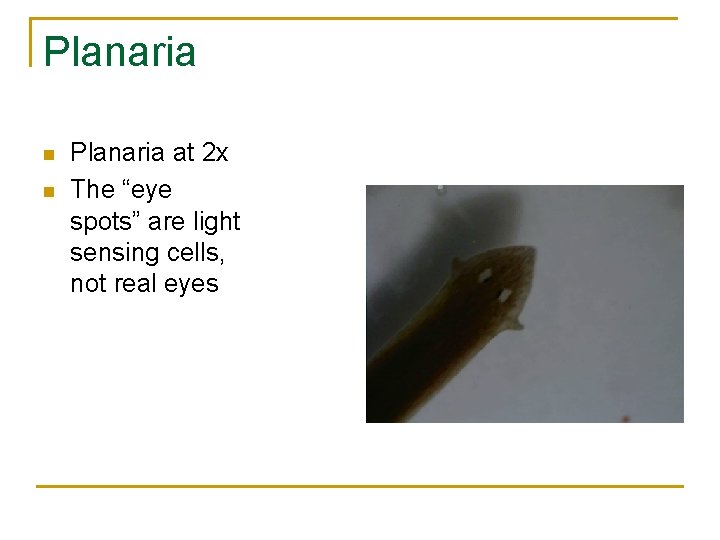
Planaria n n Planaria at 2 x The “eye spots” are light sensing cells, not real eyes

- Slides: 50