
Discovering and exploring the new world Alan Barr
Discovering and exploring the new world Alan Barr • Why we’re looking for new particles • Making dark matter in the lab • My work: discovering and understanding new particles • ATLAS semiconductor tracker upgrade • Grand objectives 23 rd October 2006 Alan Barr 1
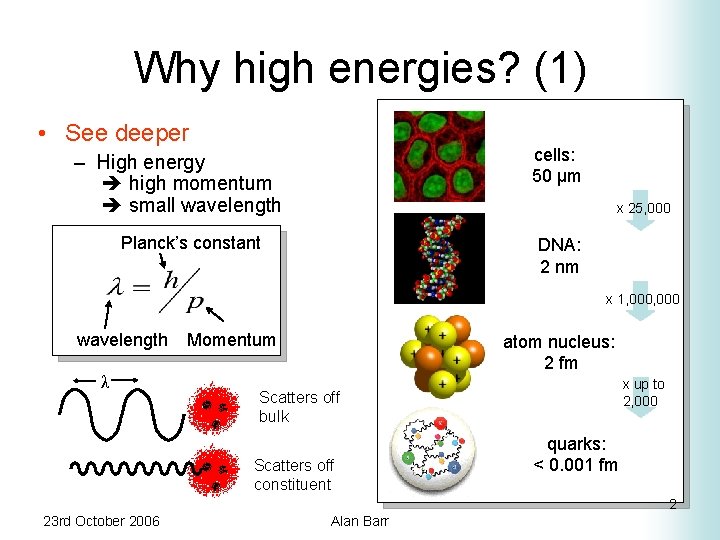
Why high energies? (1) • See deeper cells: 50 μm – High energy high momentum small wavelength x 25, 000 Planck’s constant DNA: 2 nm x 1, 000 wavelength λ Momentum atom nucleus: 2 fm x up to 2, 000 Scatters off bulk Scatters off constituent quarks: < 0. 001 fm 2 23 rd October 2006 Alan Barr
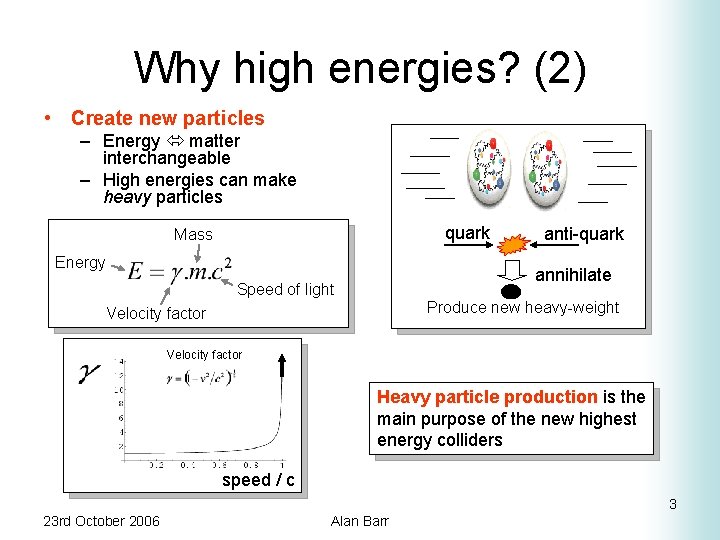
Why high energies? (2) • Create new particles – Energy matter interchangeable – High energies can make heavy particles quark Mass Energy anti-quark annihilate Speed of light Produce new heavy-weight Velocity factor Heavy particle production is the main purpose of the new highest energy colliders speed / c 3 23 rd October 2006 Alan Barr
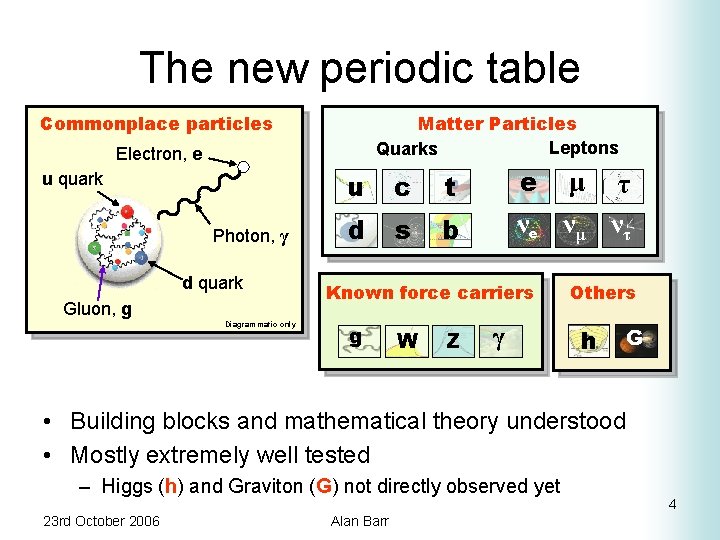
The new periodic table Matter Particles Leptons Quarks Commonplace particles Electron, e u quark Photon, γ d quark Gluon, g Diagrammatic only u c t e d s b νe νμ Known force carriers g W Z γ μ τ ντ Others h G • Building blocks and mathematical theory understood • Mostly extremely well tested – Higgs (h) and Graviton (G) not directly observed yet 23 rd October 2006 Alan Barr 4
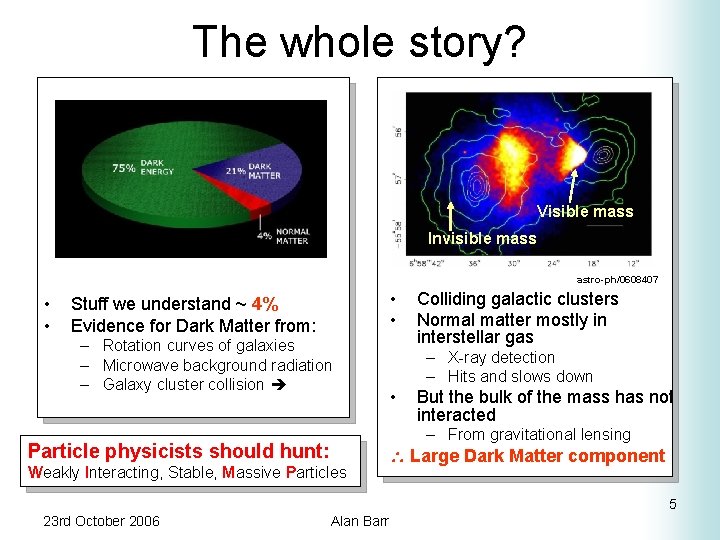
The whole story? Visible mass Invisible mass astro-ph/0608407 • • Stuff we understand ~ 4% Evidence for Dark Matter from: – Rotation curves of galaxies – Microwave background radiation – Galaxy cluster collision Colliding galactic clusters Normal matter mostly in interstellar gas – X-ray detection – Hits and slows down • But the bulk of the mass has not interacted – From gravitational lensing Particle physicists should hunt: Weakly Interacting, Stable, Massive Particles Large Dark Matter component 5 23 rd October 2006 Alan Barr
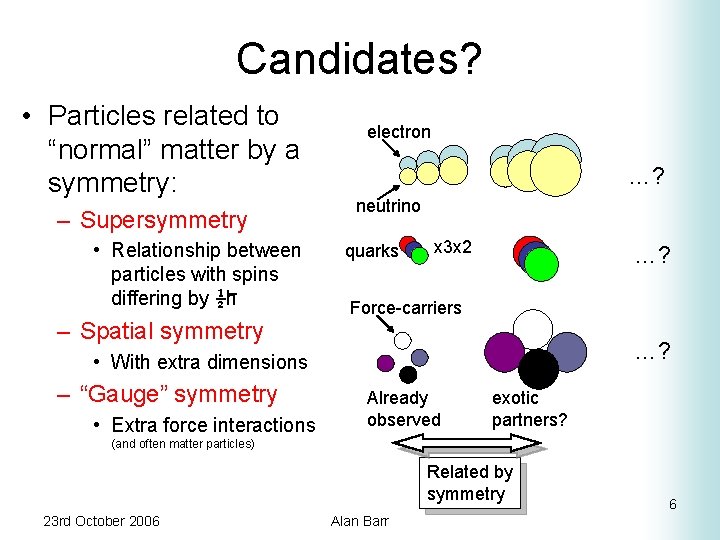
Candidates? • Particles related to “normal” matter by a symmetry: – Supersymmetry • Relationship between particles with_spins differing by ½h – Spatial symmetry electron …? neutrino quarks x 3 x 2 …? Force-carriers …? • With extra dimensions – “Gauge” symmetry • Extra force interactions Already observed exotic partners? (and often matter particles) Related by symmetry 23 rd October 2006 Alan Barr 6
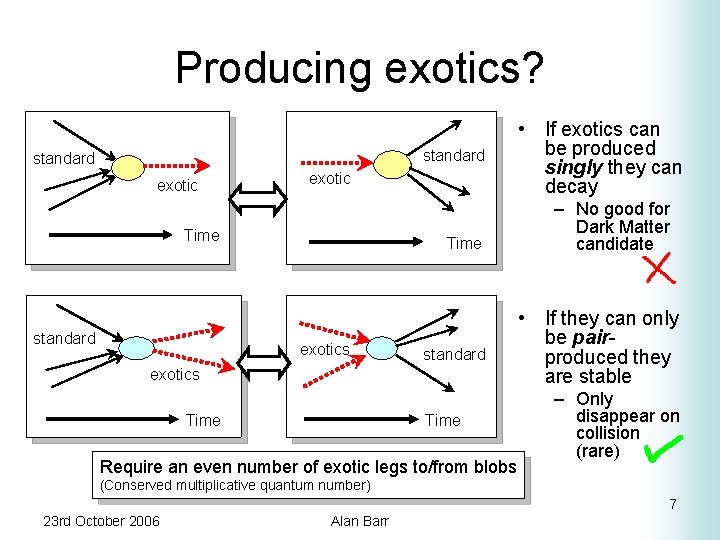
Producing exotics? standard exotic Time standard Time exotics standard exotics Time Require an even number of exotic legs to/from blobs • If exotics can be produced singly they can decay – No good for Dark Matter candidate • If they can only be pairproduced they are stable – Only disappear on collision (rare) (Conserved multiplicative quantum number) 7 23 rd October 2006 Alan Barr
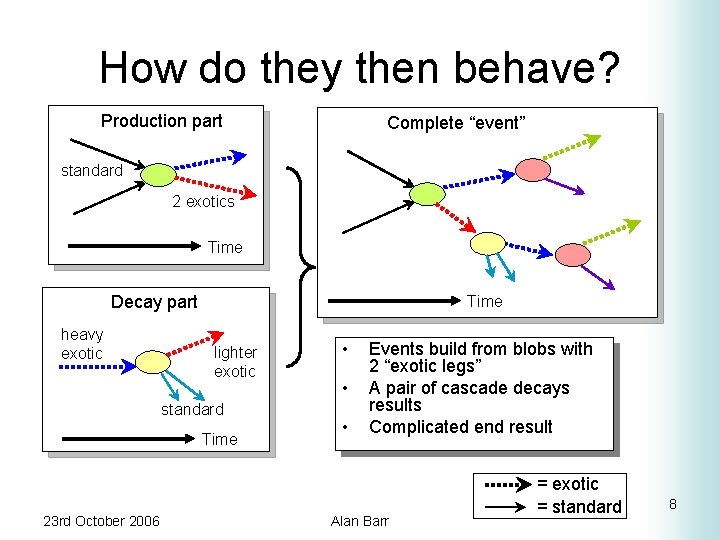
How do they then behave? Production part Complete “event” standard 2 exotics Time Decay part heavy exotic Time lighter exotic standard Time 23 rd October 2006 • • • Events build from blobs with 2 “exotic legs” A pair of cascade decays results Complicated end result Alan Barr = exotic = standard 8
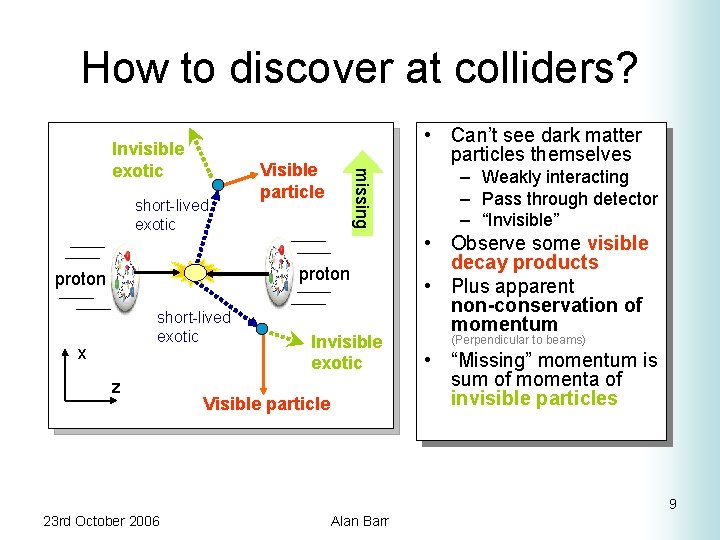
How to discover at colliders? short-lived exotic • Can’t see dark matter particles themselves Visible particle missing Invisible exotic proton short-lived exotic x z Invisible exotic Visible particle – Weakly interacting – Pass through detector – “Invisible” • Observe some visible decay products • Plus apparent non-conservation of momentum (Perpendicular to beams) • “Missing” momentum is sum of momenta of invisible particles 9 23 rd October 2006 Alan Barr
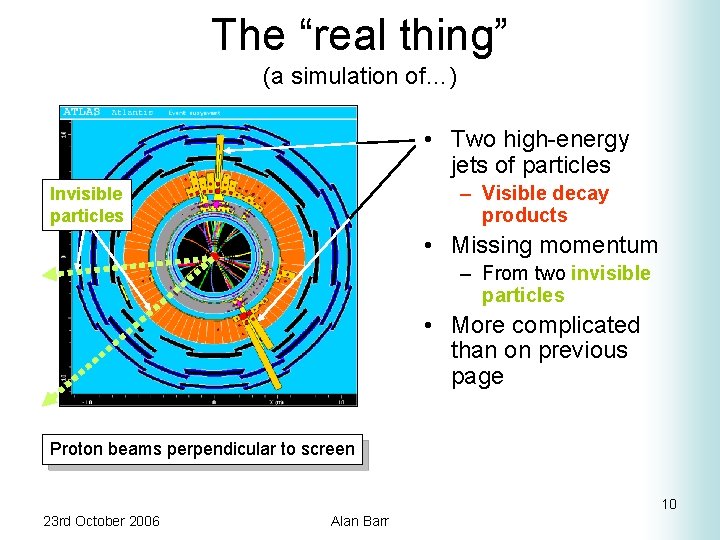
The “real thing” (a simulation of…) • Two high-energy jets of particles – Visible decay products Invisible particles • Missing momentum – From two invisible particles • More complicated than on previous page Proton beams perpendicular to screen 10 23 rd October 2006 Alan Barr
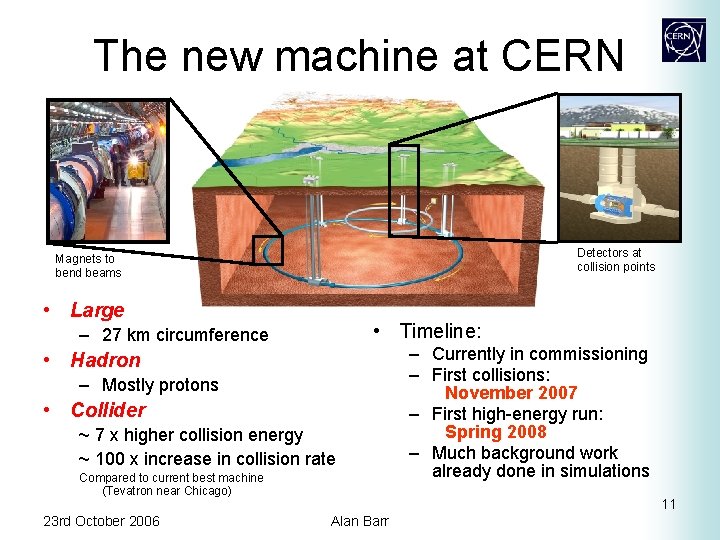
The new machine at CERN Detectors at collision points Magnets to bend beams • Large • Timeline: – 27 km circumference • Hadron – Mostly protons • Collider ~ 7 x higher collision energy ~ 100 x increase in collision rate Compared to current best machine (Tevatron near Chicago) 23 rd October 2006 – Currently in commissioning – First collisions: November 2007 – First high-energy run: Spring 2008 – Much background work already done in simulations 11 Alan Barr
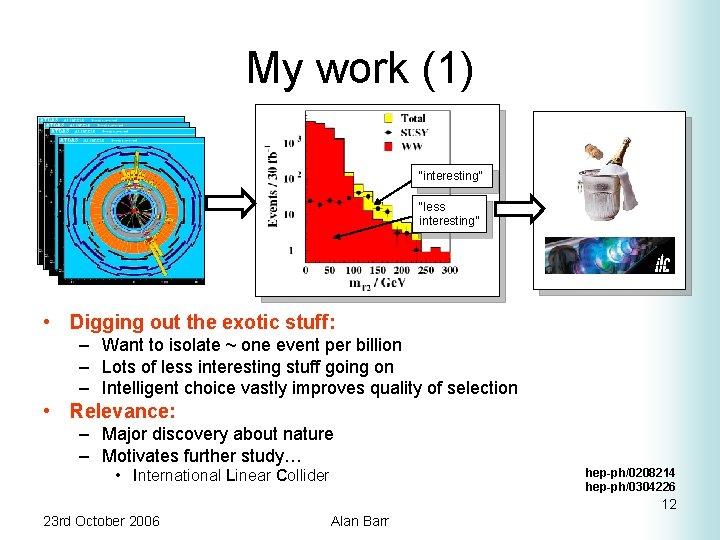
My work (1) “interesting” “less interesting” • Digging out the exotic stuff: – Want to isolate ~ one event per billion – Lots of less interesting stuff going on – Intelligent choice vastly improves quality of selection • Relevance: – Major discovery about nature – Motivates further study… hep-ph/0208214 hep-ph/0304226 • International Linear Collider 12 23 rd October 2006 Alan Barr
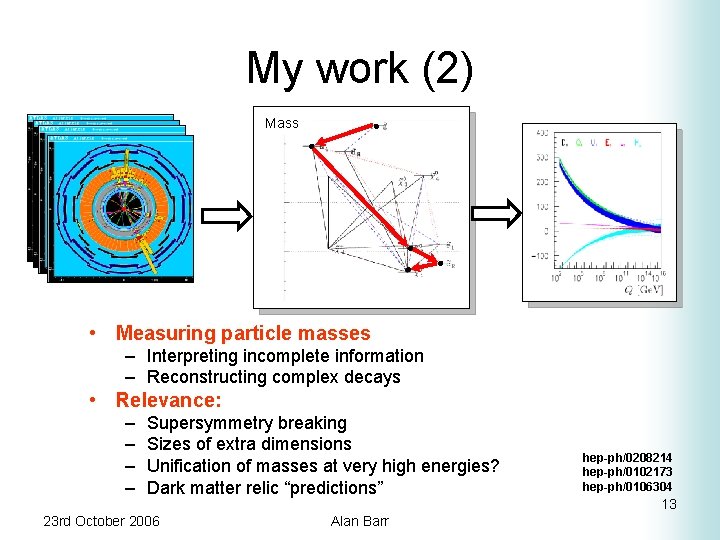
My work (2) Mass • Measuring particle masses – Interpreting incomplete information – Reconstructing complex decays • Relevance: – – Supersymmetry breaking Sizes of extra dimensions Unification of masses at very high energies? Dark matter relic “predictions” 23 rd October 2006 Alan Barr hep-ph/0208214 hep-ph/0102173 hep-ph/0106304 13
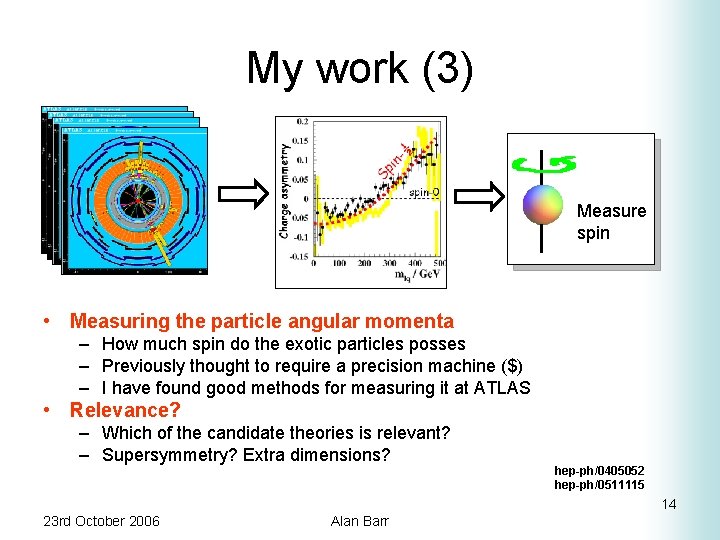
My work (3) Measure spin • Measuring the particle angular momenta – How much spin do the exotic particles posses – Previously thought to require a precision machine ($) – I have found good methods for measuring it at ATLAS • Relevance? – Which of the candidate theories is relevant? – Supersymmetry? Extra dimensions? hep-ph/0405052 hep-ph/0511115 14 23 rd October 2006 Alan Barr
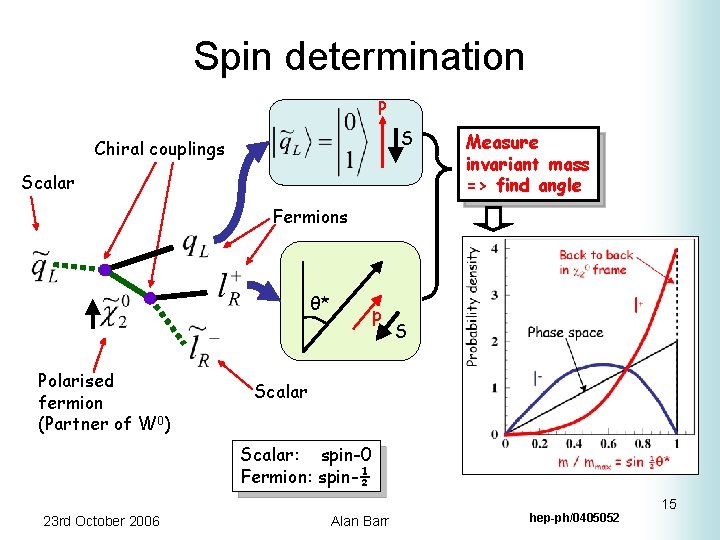
Spin determination P S Chiral couplings Scalar Measure invariant mass => find angle Fermions θ* Polarised fermion (Partner of W 0) p S Scalar: spin-0 Fermion: spin-½ 23 rd October 2006 Alan Barr hep-ph/0405052 15
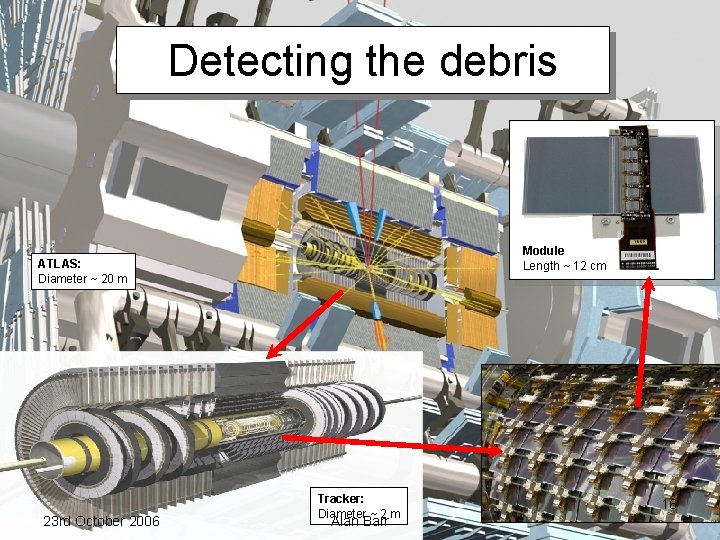
Detecting the debris Module Length ~ 12 cm ATLAS: Diameter ~ 20 m 23 rd October 2006 Tracker: Diameter ~ 2 m Alan Barr 16
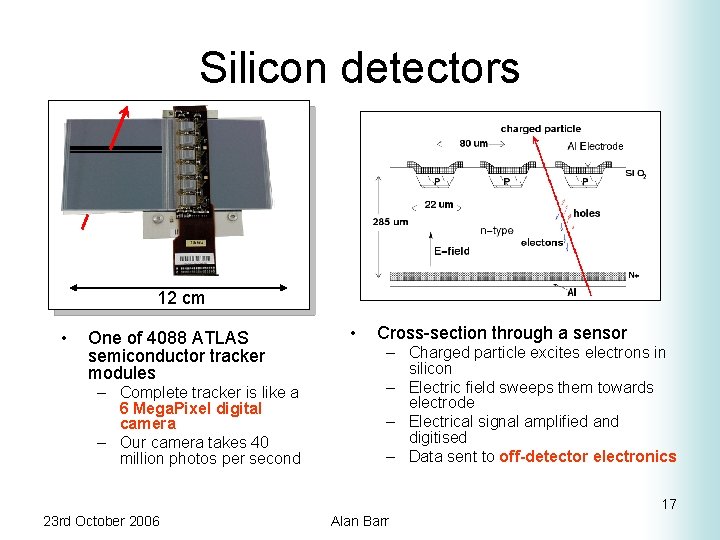
Silicon detectors 12 cm • One of 4088 ATLAS semiconductor tracker modules – Complete tracker is like a 6 Mega. Pixel digital camera – Our camera takes 40 million photos per second • Cross-section through a sensor – Charged particle excites electrons in silicon – Electric field sweeps them towards electrode – Electrical signal amplified and digitised – Data sent to off-detector electronics 17 23 rd October 2006 Alan Barr
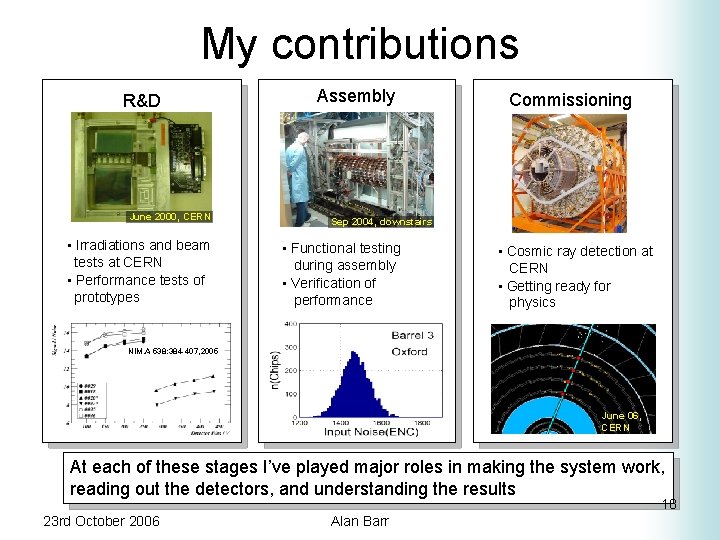
My contributions R&D June 2000, CERN • Irradiations and beam tests at CERN • Performance tests of prototypes Assembly Commissioning Sep 2004, downstairs • Functional testing during assembly • Verification of performance • Cosmic ray detection at CERN • Getting ready for physics • NIM. A 538: 384 -407, 2005 June 06, CERN At each of these stages I’ve played major roles in making the system work, reading out the detectors, and understanding the results 18 23 rd October 2006 Alan Barr
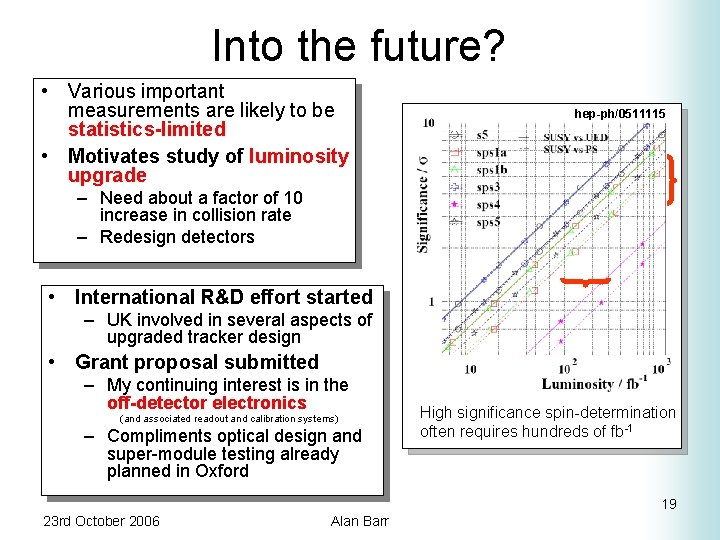
Into the future? • Various important measurements are likely to be statistics-limited • Motivates study of luminosity upgrade hep-ph/0511115 – Need about a factor of 10 increase in collision rate – Redesign detectors • International R&D effort started – UK involved in several aspects of upgraded tracker design • Grant proposal submitted – My continuing interest is in the off-detector electronics (and associated readout and calibration systems) – Compliments optical design and super-module testing already planned in Oxford High significance spin-determination often requires hundreds of fb-1 19 23 rd October 2006 Alan Barr
Grand Objectives • Discover new particles – Focus on Dark Matter-motivated signals • Extract maximum information about them – What type of particles are these? – What can they us about: • New symmetries of nature? • Dark Matter? • Higher-scale physics? (Unification …) • Upgrade tracker for high luminosity – Construct UK demonstrator prototype in Oxford 20 23 rd October 2006 Alan Barr
- Slides: 20