
Discover How Metrics Drive Revenue Cycle Performance Change






- Slides: 71
Discover How Metrics Drive Revenue Cycle Performance & Change Behavior Adding Value to the Revenue Cycle NE Ohio HFMA/Western Reserve AAHAM Revenue Cycle Event February 21, 2013
Ohio. Health Revenue Cycle l l l Ohio. Health -Largest healthcare system in Central Ohio Comprised of five (5) hospitals supported by a consolidated revenue cycle operation: Riverside Methodist Hospital, Grant Medical Center, Doctors Hospital, Dublin Methodist Hospital, Grady Memorial Hospital Revenue Cycle organizational structure includes all of patient access services, health information management and consolidated business office operations Revenue Cycle part of the finance division vertical Revenue Cycle is responsible for collections of approx $2 B annually
Ohio. Health Revenue Cycle Ø Revenue Cycle Awards: l l l 2010 HFMA MAP Award Winner 2012 HBI Revenue Cycle Award Winner
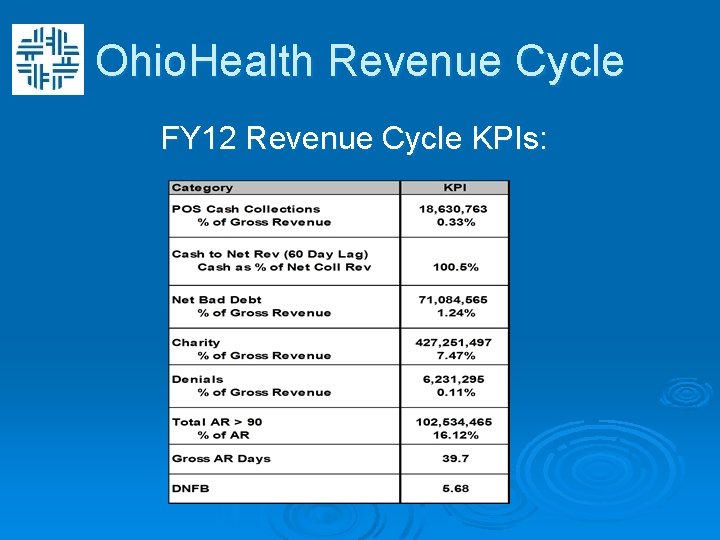
Ohio. Health Revenue Cycle FY 12 Revenue Cycle KPIs:
Key Objectives Ø Integrating KPIs into Performance Improvement for the Revenue Cycle Ø Creating an environment for process improvement Ø Using resources to support process improvement Ø Celebrating success in the revenue cycle Ø Case Study: Ohio. Health Denial Reduction Initiative
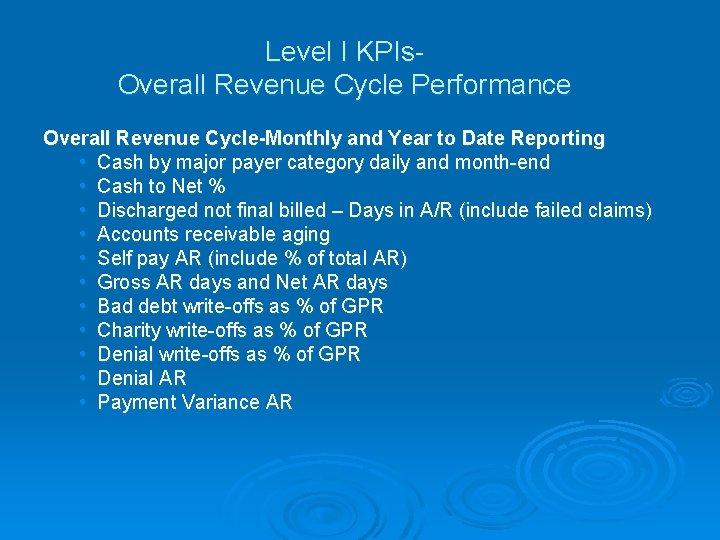
Level I KPIs. Overall Revenue Cycle Performance Overall Revenue Cycle-Monthly and Year to Date Reporting • Cash by major payer category daily and month-end • Cash to Net % • Discharged not final billed – Days in A/R (include failed claims) • Accounts receivable aging • Self pay AR (include % of total AR) • Gross AR days and Net AR days • Bad debt write-offs as % of GPR • Charity write-offs as % of GPR • Denial AR • Payment Variance AR
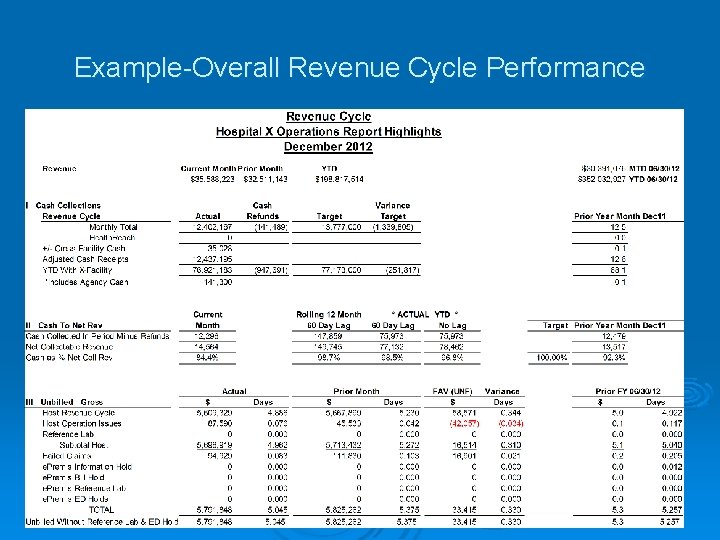
Example-Overall Revenue Cycle Performance
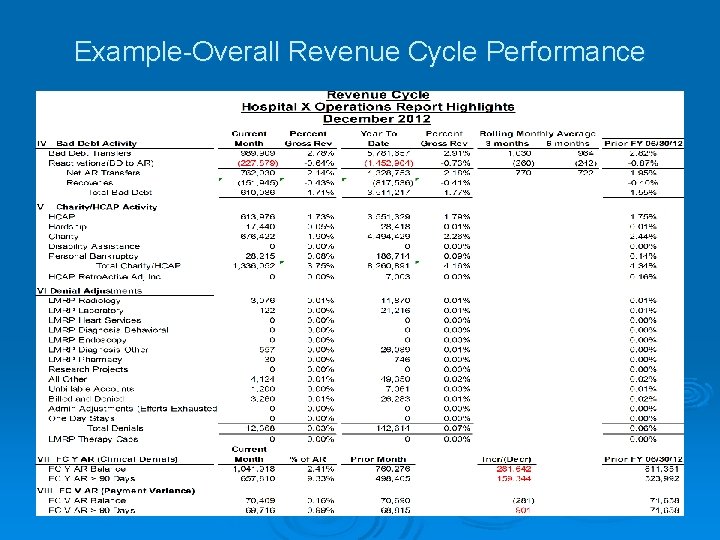
Example-Overall Revenue Cycle Performance
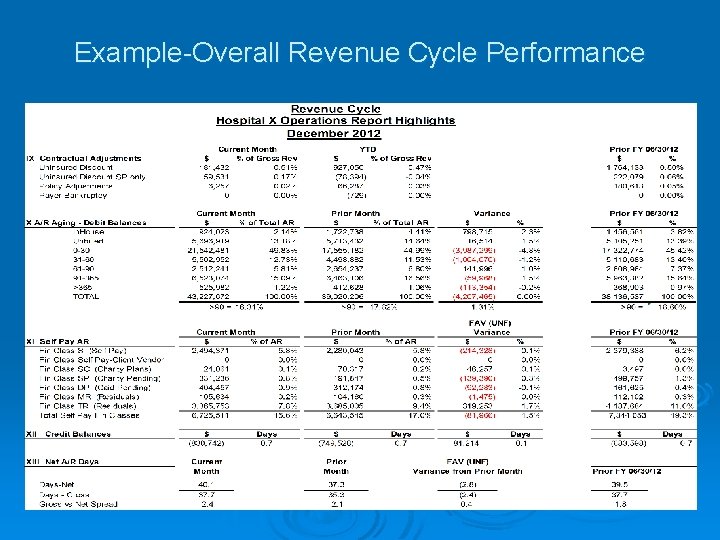
Example-Overall Revenue Cycle Performance
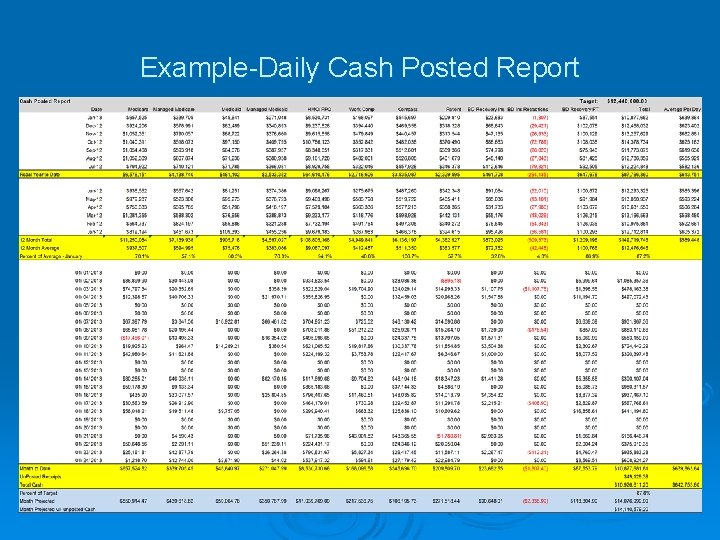
Example-Daily Cash Posted Report
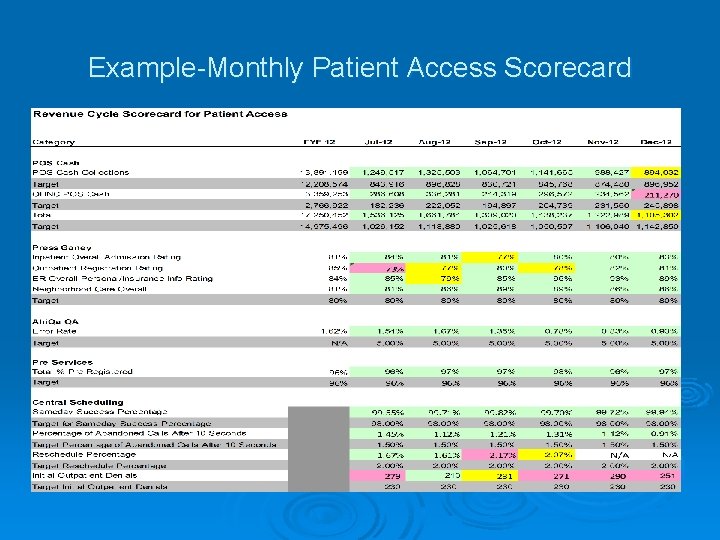
Level II KPIs. Departmental Performance Patient Access Services (PAS) – Monthly Scorecard • Point of Service collections • Press Ganey (customer service) Inpatient and Outpatient • Registration Error Rate (%) • Pre-registration of scheduled procedures (%) • Central Scheduling - % of calls answered < 10 seconds • Central Scheduling - % of calls answered > 40 seconds
Example-Monthly Patient Access Scorecard
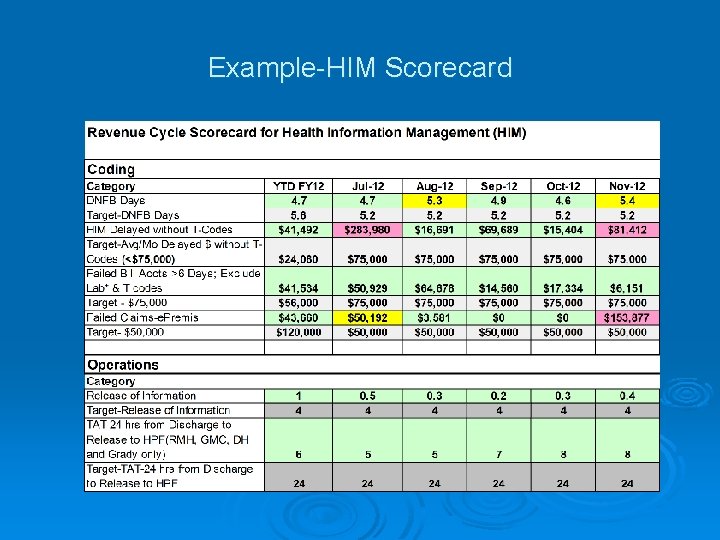
Level II KPIs– Departmental Performance Health Information Management (HIM) – Monthly scorecard • • • $ delayed in HIM Failed Bill accounts > 6 days Combined DNFB days (including failed claims) Transcription turnaround time Clinical chart turnaround time RAC Data
Example-HIM Scorecard
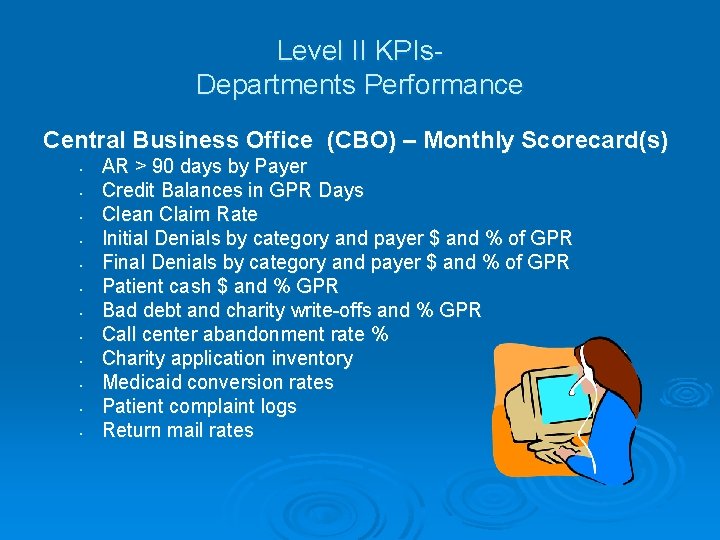
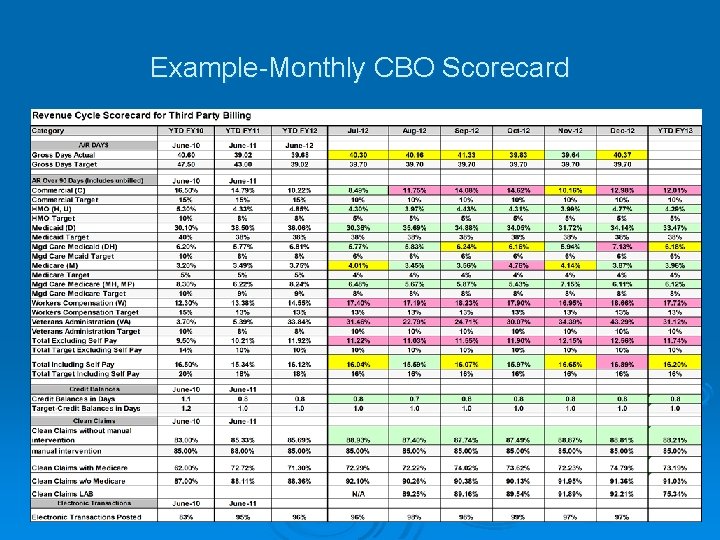
Level II KPIs. Departments Performance Central Business Office (CBO) – Monthly Scorecard(s) • • • AR > 90 days by Payer Credit Balances in GPR Days Clean Claim Rate Initial Denials by category and payer $ and % of GPR Final Denials by category and payer $ and % of GPR Patient cash $ and % GPR Bad debt and charity write-offs and % GPR Call center abandonment rate % Charity application inventory Medicaid conversion rates Patient complaint logs Return mail rates
Example-Monthly CBO Scorecard
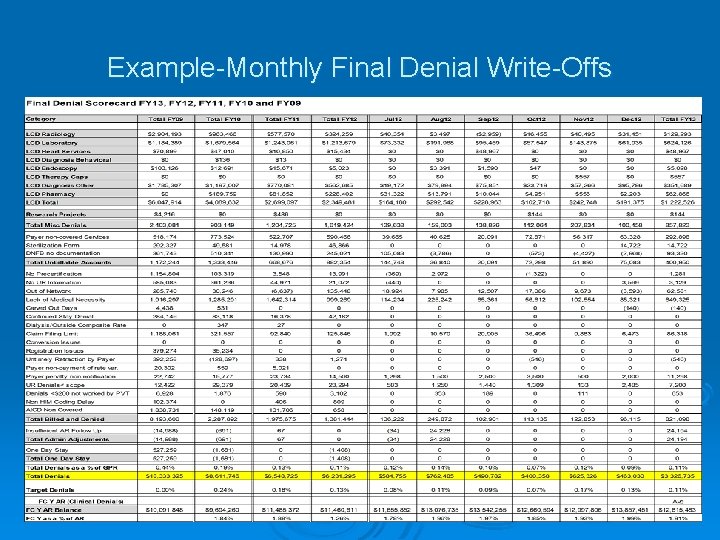
Example-Monthly Final Denial Write-Offs
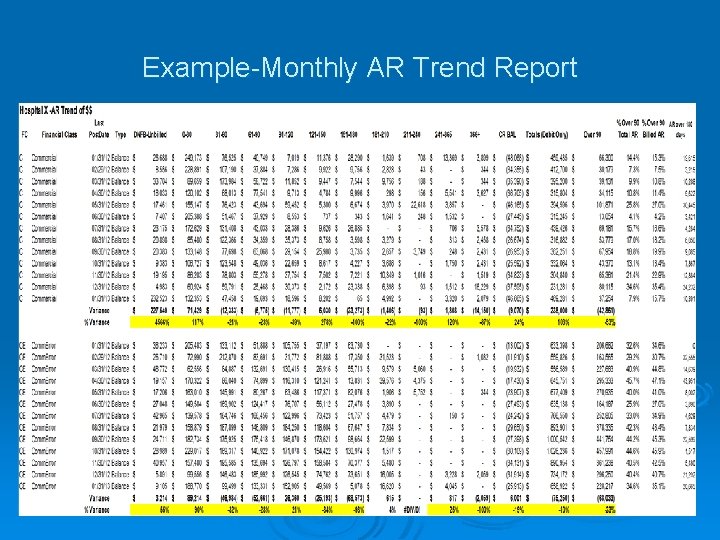
Example-Monthly AR Trend Report
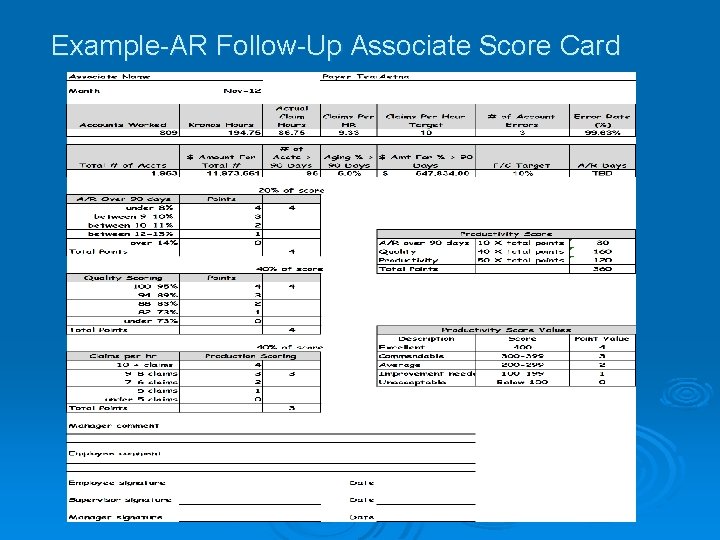
Level III KPIs – Associate Performance • • PAS - individual productivity and quality scores; POS collections per associate HIM – coding quality and productivity; imaging quality and productivity CBO – individual agings; payer collections; productivity and quality monitoring CBO Customer Call Center – telephony statistics including abandonment rates, hold times, collections
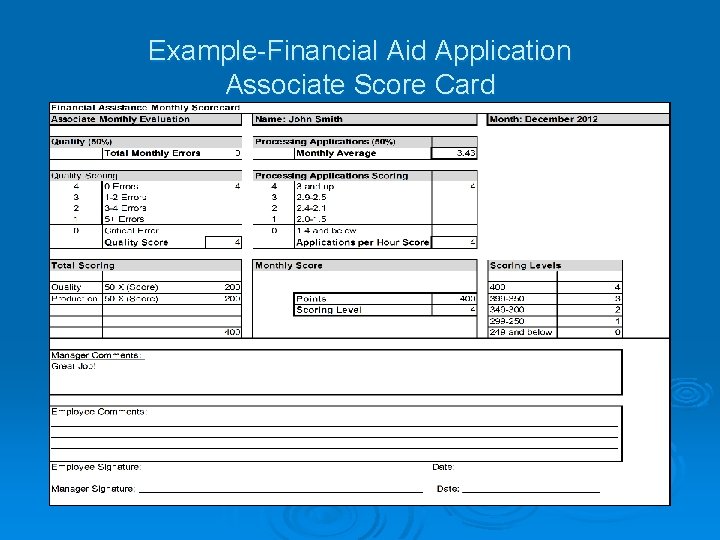
Example-Financial Aid Application Associate Score Card
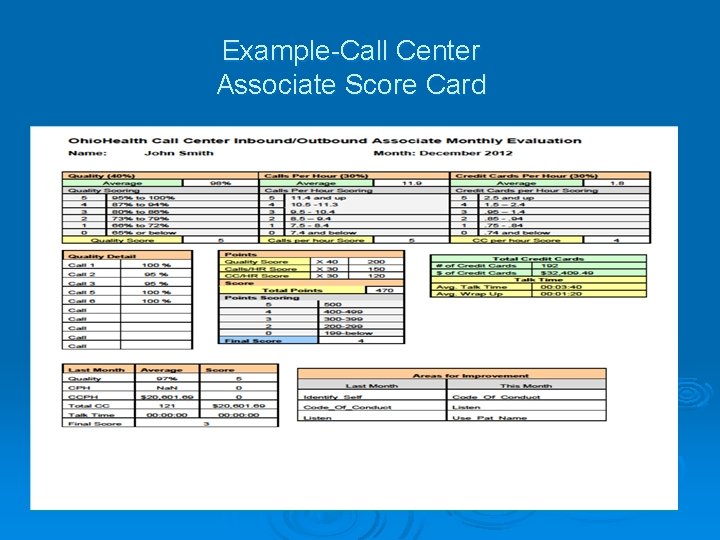
Example-Call Center Associate Score Card
Example-AR Follow-Up Associate Score Card
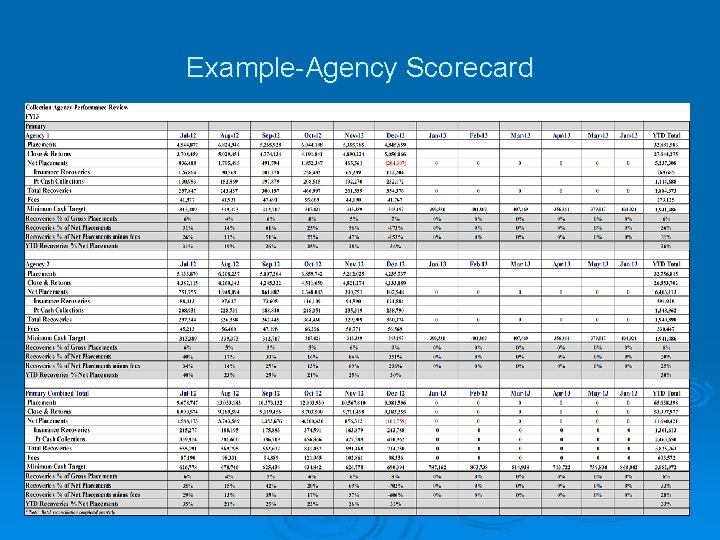
Level III KPIs. Business Partner Scorecard Business Partner– Monthly Scorecard(s): • Payers • Bad Debt Agencies • Medicaid Eligibility Vendor • Estate Vendor • Motor Vehicle Vendor • Transcription Vendor • Denial Vendor
Example-Agency Scorecard
Environment to Support Process Improvement Organizational Structure: • • Patient Access/HIM/Consolidated Business Office report to Revenue Cycle Vice President Revenue Cycle reports to CFO Revenue cycle leadership and management team – on the same train! Key result: Common goals, targets and initiatives
Environment to Support Process Improvement Communications: • • Revenue cycle leaders meet monthly with facility CFOs, controllers, net revenue team to review key indicators, identify opportunities for improvement and develop and report action plans Key result: Critical conversations around performance, opportunities and action plans among all leaders to (1) understanding of issues (2) action plans (3) monitoring of progress (4) issue resolution
Resources to Support Process Improvement Resources: • • • Develop a team of fulltime analysts (system and financial) who can extract data from the HIS and other critical systems, create data bases to manipulate data, and develop standardized reporting and comparative analyses (Don’t rely solely on an AR manager to create reports - they won’t have time to manage their operation!) Select ancillary systems such as AR workflow, registration QA, imaging workflow, etc. which provides easy to use analytical tools to create reports and comparative analysis; review the reports Hold all managers and staff accountable for success! Build goals and targets into the management performance appraisal
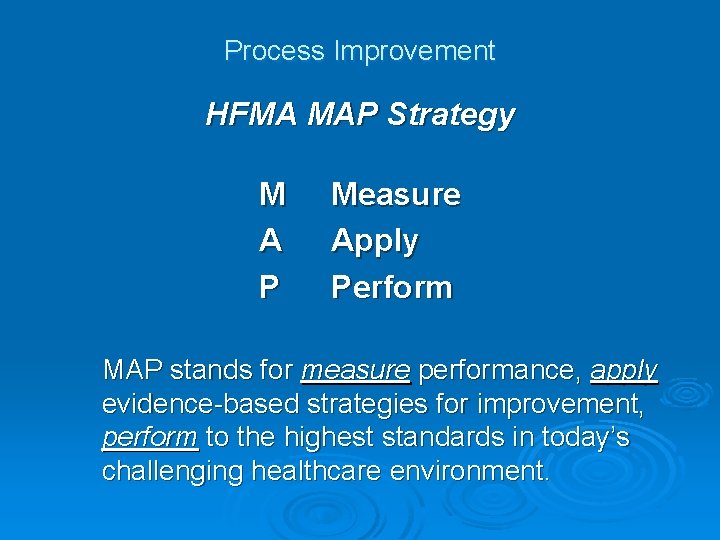
Process Improvement HFMA MAP Strategy M A P Measure Apply Perform MAP stands for measure performance, apply evidence-based strategies for improvement, perform to the highest standards in today’s challenging healthcare environment.
Process Improvement Measure: • • • Establish internal KPIs - know where you are Research literature (HFMA/HARA/MAP) for current benchmarks Utilize not only benchmarking but internal trend data to identify and document ongoing improvements
Process Improvement Apply: • • Review data results Identify opportunities Develop targets and goals Make it a “stretch” goal but achievable
Process Improvement Perform: • • • Develop action teams (combination of finance, revenue cycle and clinical and departmental representation) Identify processes contributing to obstacles Collaborate on solutions Measure performance at least monthly against benchmarks Hold teams accountable “Make it happen!”
Celebrate your Successes Recognition of all successes along the way! l l l l “Thank you” notes Recognition in newsletter(s) – photos/articles Recognition in meetings Hand-written notes w/ thank you Contests/prizes/gift cards “Right Choice Awards” Management bonuses based upon goal achievement
Ohio. Health Case Study Denial Reduction 33
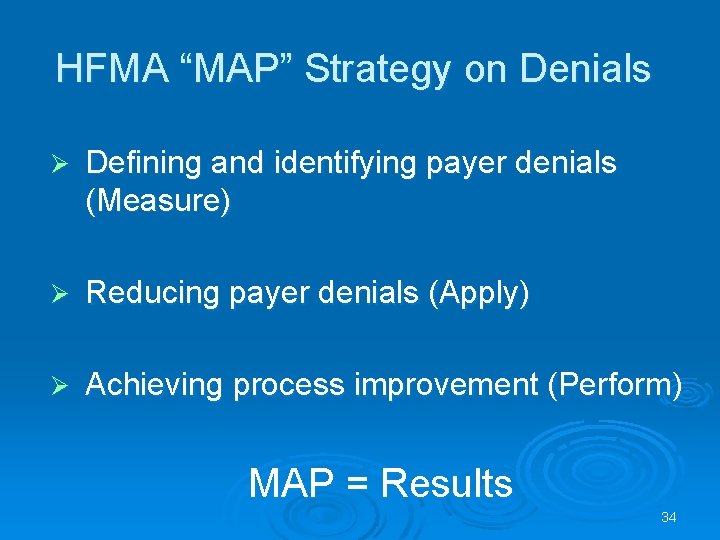
HFMA “MAP” Strategy on Denials Ø Defining and identifying payer denials (Measure) Ø Reducing payer denials (Apply) Ø Achieving process improvement (Perform) MAP = Results 34
Defining and Identifying Payer Denials (Measure) 35
Definitions Ø What is a payer denial or delay? l Payment was expected by the service provider but was not received from the payer. Additional action must be taken by the provider in order to receive payment from payer. Additional action does not always guarantee payment. Ø Initial Denial: l Pre-action initial denial Ø Final Denial: l Post action final write-off i. e. claim has been appealed and denial upheld by payer Ø Payer Delay: l Request for information before payment can be received from payer 36
Denial Examples Payer Denials: l l l No authorization No notification No pre-cert Not Medically Necessary Pre-Existing Condition Experimental Non-Covered General technical billing errors i. e. Incorrect Subscriber ID, missing info on UB format, etc… Timely Filing Benefits Exhausted Out of Network 37
Delay Examples Payer Delays: l l l Medical record request Itemized statement request Coordination of benefit to determine primary payer vs secondary payer 38
Identify Ø Critical step towards resolution Ø Quantification of data tells story and changes behavior; first step is to identify and then quantify Ø Very complicated but can be achieved Ø Manual identification Ø Electronic identification 39
Manual Identification Ø Posting from paper remittance advice/explanation of benefits (EOB) Ø Identification through follow-up process Ø Inefficient and ineffective Ø Opportunity for error 40
Electronic Identification HIPAA: Ø Ø The Health Insurance Portability and Accountability Act (HIPAA) was passed on August 21, 1996. Among other things, it included rules covering administrative simplification, including making healthcare delivery more efficient. Portability of medical coverage for pre-existing conditions was a key provision of the act as was defining the underwriting process for group medical coverage. It also provided standardization of electronic transmittal of billing and claims information. The final version of the HIPAA Privacy regulations were issued in December 2000, and went into effect on April 14, 2001. A two-year "grace" period was included; enforcement of the HIPAA Privacy Rules began on April 14, 2003. The April 14, 2003 deadline is when the penalties can be applied for non-compliance. Note: Ø Ø Administrative Simplification : ) Standardization has taken too long and still has a long way to go! 41
ANSI 835 Ø HIPAA proposed, in part, to standardize and privatize the electronic exchange of information between providers and payers. Ø ANSI 835 is the American National Standards Institutes (ANSI) Health Care Claims Payment and Remittances Advice Format. This format outlines the first all electronic standard for health care claims. The format handles health care claims in a way that follows HIPAA regulations. Prior to the creation and implementation of 835, there were hundreds of different electronic remittance formats in use. HIPAA requires the use of 835 or an equivalent. Ø ANSI, ANSI…… Linking ANSI Standards to Denial Management 42
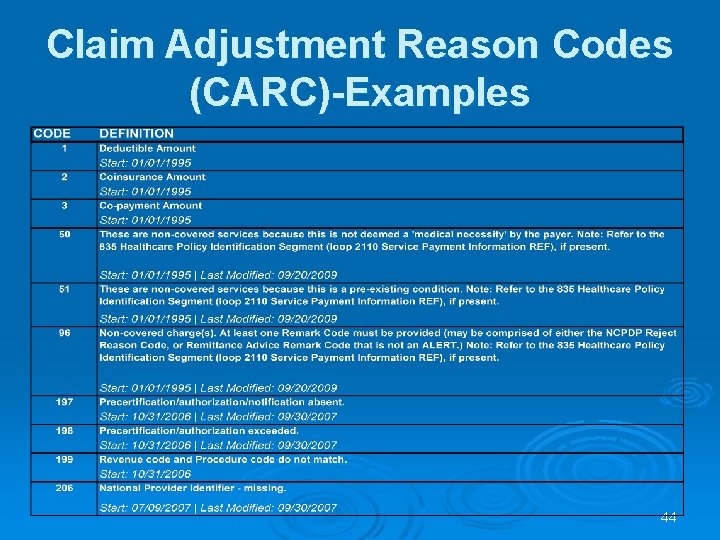
Claim Adjustment Reason Codes (CARC) X 12 N 835 Health Care Claim Adjustment Reason Codes: Ø Ø Ø A national code maintenance committee maintains the health care Claim Adjustment Reason Codes (CARCs). Over 200 Current Codes The Committee meets at the beginning of each X 12 trimester meeting (January/February, June and September/October) and makes decisions about additions, modifications, and retirement of existing reason codes. The updated list is posted 3 times a year around early November, March, and July. The list is available at http: //www. wpc-edi. com/codes 43
Claim Adjustment Reason Codes (CARC)-Examples 44
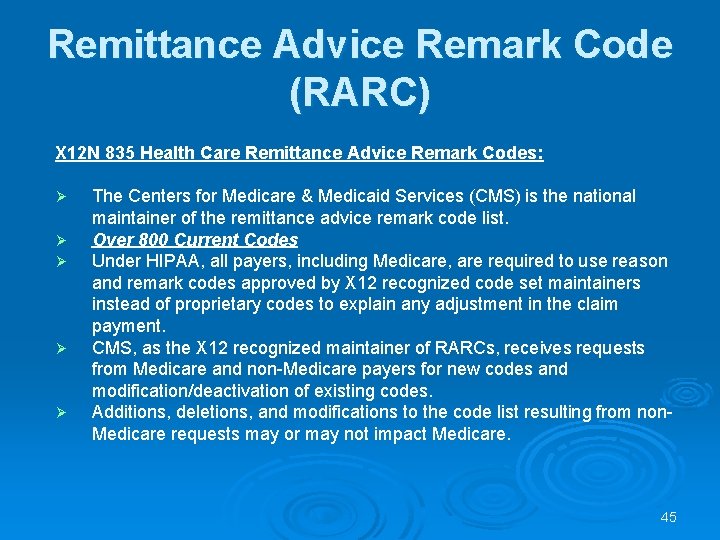
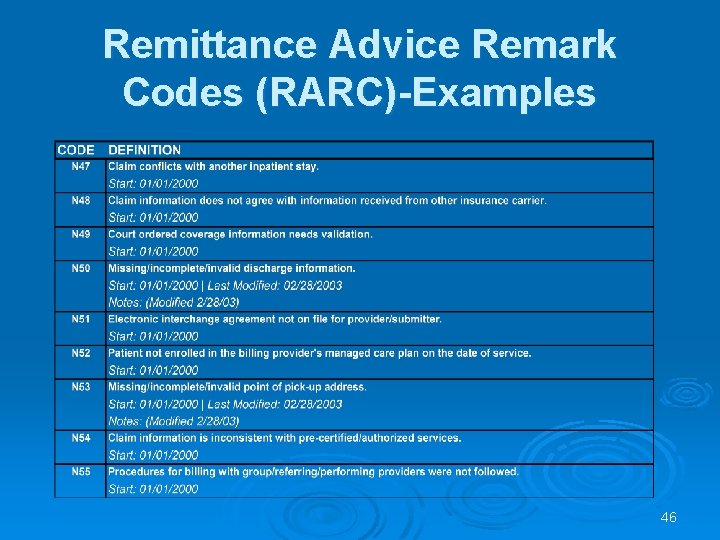
Remittance Advice Remark Code (RARC) X 12 N 835 Health Care Remittance Advice Remark Codes: Ø Ø Ø The Centers for Medicare & Medicaid Services (CMS) is the national maintainer of the remittance advice remark code list. Over 800 Current Codes Under HIPAA, all payers, including Medicare, are required to use reason and remark codes approved by X 12 recognized code set maintainers instead of proprietary codes to explain any adjustment in the claim payment. CMS, as the X 12 recognized maintainer of RARCs, receives requests from Medicare and non-Medicare payers for new codes and modification/deactivation of existing codes. Additions, deletions, and modifications to the code list resulting from non. Medicare requests may or may not impact Medicare. 45
Remittance Advice Remark Codes (RARC)-Examples 46
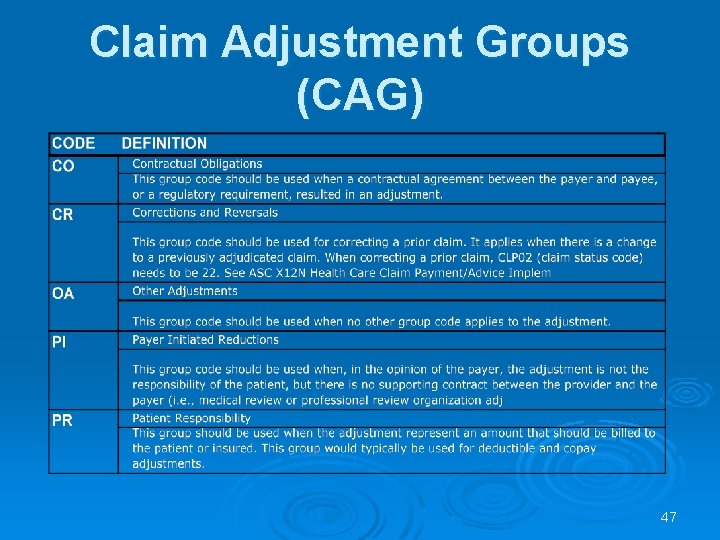
Claim Adjustment Groups (CAG) 47
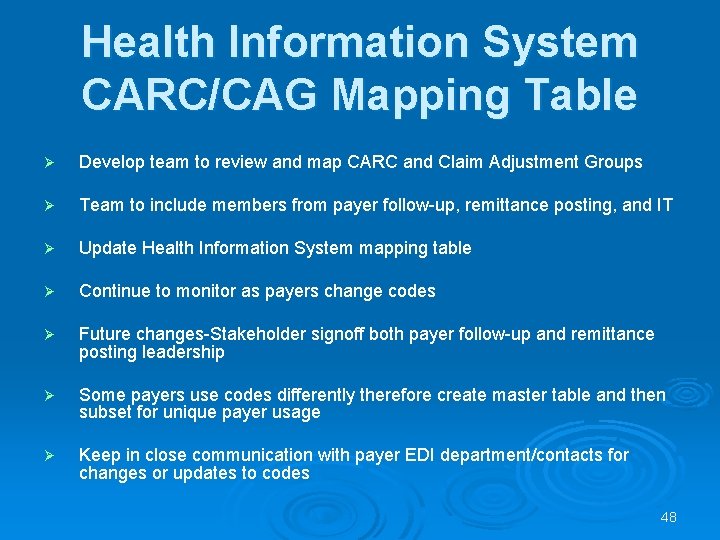
Health Information System CARC/CAG Mapping Table Ø Develop team to review and map CARC and Claim Adjustment Groups Ø Team to include members from payer follow-up, remittance posting, and IT Ø Update Health Information System mapping table Ø Continue to monitor as payers change codes Ø Future changes-Stakeholder signoff both payer follow-up and remittance posting leadership Ø Some payers use codes differently therefore create master table and then subset for unique payer usage Ø Keep in close communication with payer EDI department/contacts for changes or updates to codes 48
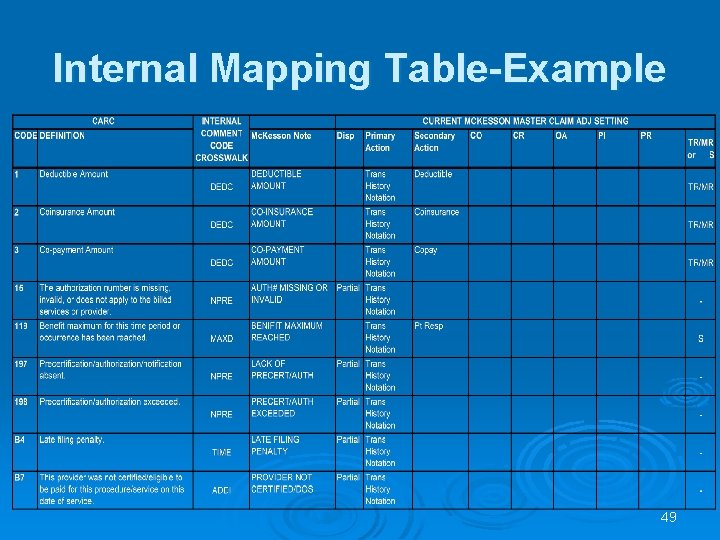
Internal Mapping Table-Example 49
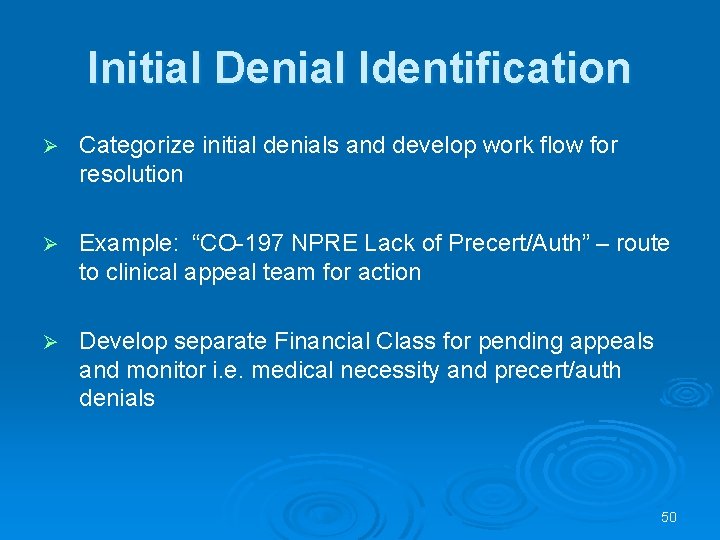
Initial Denial Identification Ø Categorize initial denials and develop work flow for resolution Ø Example: “CO-197 NPRE Lack of Precert/Auth” – route to clinical appeal team for action Ø Develop separate Financial Class for pending appeals and monitor i. e. medical necessity and precert/auth denials 50
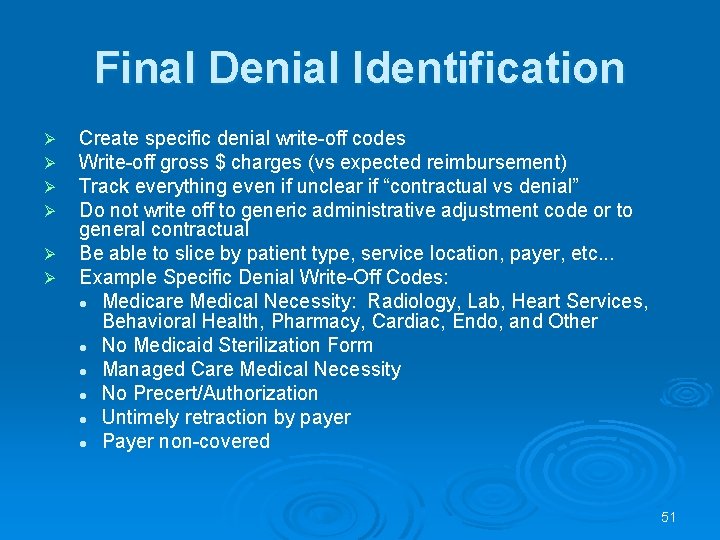
Final Denial Identification Ø Ø Ø Create specific denial write-off codes Write-off gross $ charges (vs expected reimbursement) Track everything even if unclear if “contractual vs denial” Do not write off to generic administrative adjustment code or to general contractual Be able to slice by patient type, service location, payer, etc. . . Example Specific Denial Write-Off Codes: l Medicare Medical Necessity: Radiology, Lab, Heart Services, Behavioral Health, Pharmacy, Cardiac, Endo, and Other l No Medicaid Sterilization Form l Managed Care Medical Necessity l No Precert/Authorization l Untimely retraction by payer l Payer non-covered 51
Reducing Payer Denials (Apply) 52
Reducing Denials Ø Quantify and Communicate Ø Leadership and Associate Accountability Ø Payer Accountability Ø Process Improvement 53
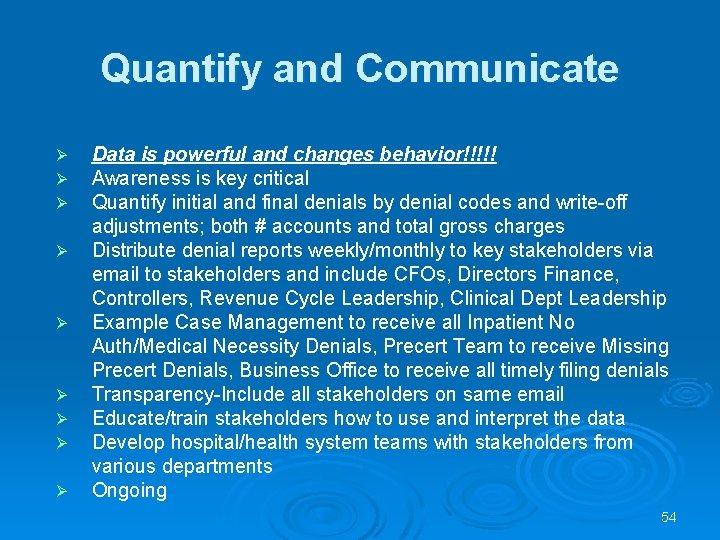
Quantify and Communicate Ø Ø Ø Ø Ø Data is powerful and changes behavior!!!!! Awareness is key critical Quantify initial and final denials by denial codes and write-off adjustments; both # accounts and total gross charges Distribute denial reports weekly/monthly to key stakeholders via email to stakeholders and include CFOs, Directors Finance, Controllers, Revenue Cycle Leadership, Clinical Dept Leadership Example Case Management to receive all Inpatient No Auth/Medical Necessity Denials, Precert Team to receive Missing Precert Denials, Business Office to receive all timely filing denials Transparency-Include all stakeholders on same email Educate/train stakeholders how to use and interpret the data Develop hospital/health system teams with stakeholders from various departments Ongoing 54
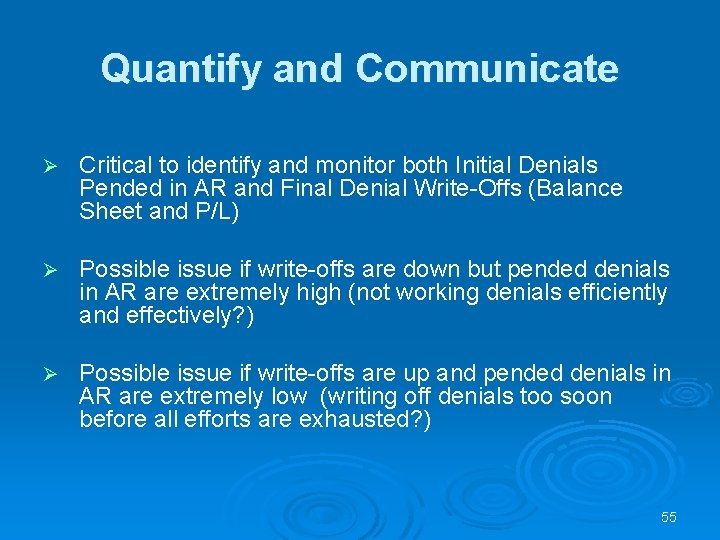
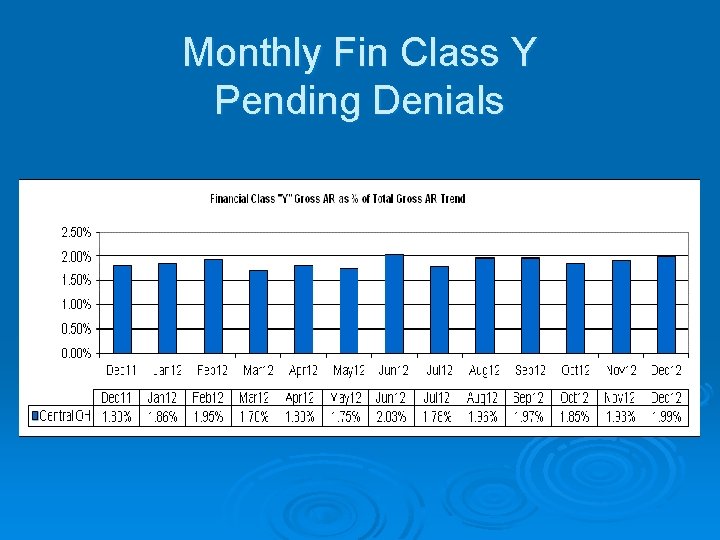
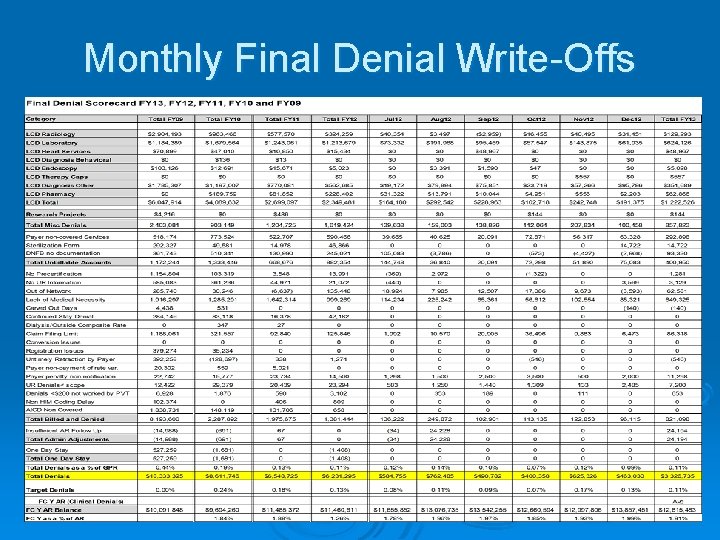
Quantify and Communicate Ø Critical to identify and monitor both Initial Denials Pended in AR and Final Denial Write-Offs (Balance Sheet and P/L) Ø Possible issue if write-offs are down but pended denials in AR are extremely high (not working denials efficiently and effectively? ) Ø Possible issue if write-offs are up and pended denials in AR are extremely low (writing off denials too soon before all efforts are exhausted? ) 55
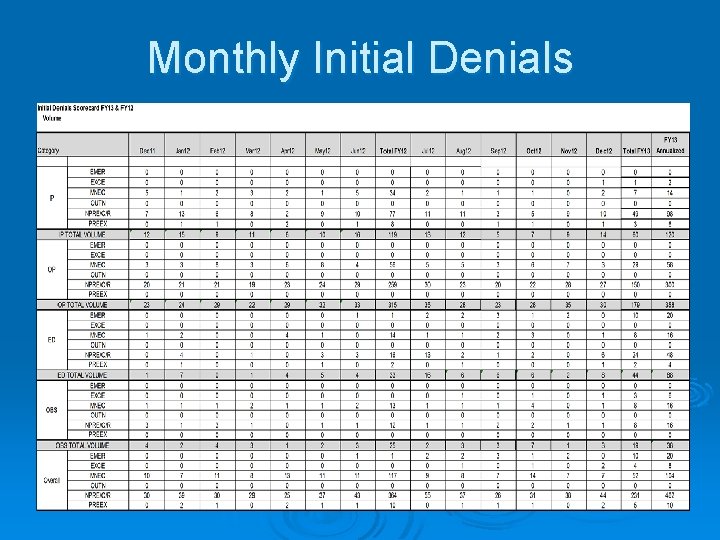
Monthly Initial Denials
Monthly Fin Class Y Pending Denials
Monthly Final Denial Write-Offs
Leadership and Associate Accountability Ø Ø Ø Incorporate target reductions into joint senior leadership accountabilities; example CFO and VP Revenue Cycle Incorporate target reductions into all levels of leadership in Revenue Cycle Management (Patient Access, Health Information Management and Business Office), applicable Clinical Areas and Case Management Incorporate target reductions into associate level accountabilities Overall target reduction for Health System as a whole not individual hospitals Target to be established by using external benchmarks or historical hospital/health system data Industry standard Denials Write-Offs 2 -4% Gross Revenue (Source Unknown) 59
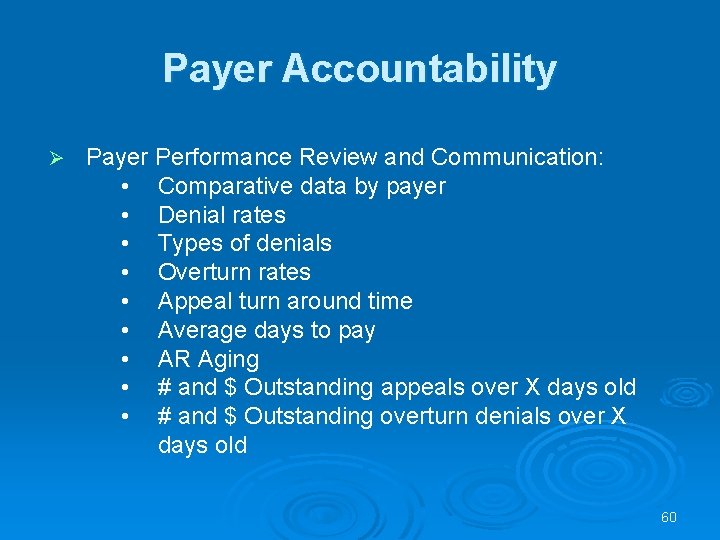
Payer Accountability Ø Payer Performance Review and Communication: • Comparative data by payer • Denial rates • Types of denials • Overturn rates • Appeal turn around time • Average days to pay • AR Aging • # and $ Outstanding appeals over X days old • # and $ Outstanding overturn denials over X days old 60
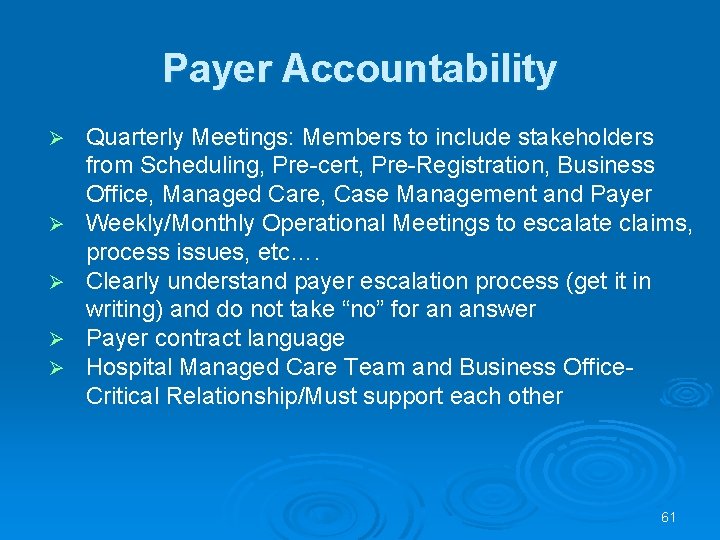
Payer Accountability Ø Ø Ø Quarterly Meetings: Members to include stakeholders from Scheduling, Pre-cert, Pre-Registration, Business Office, Managed Care, Case Management and Payer Weekly/Monthly Operational Meetings to escalate claims, process issues, etc…. Clearly understand payer escalation process (get it in writing) and do not take “no” for an answer Payer contract language Hospital Managed Care Team and Business Office. Critical Relationship/Must support each other 61
Process Improvement (Perform) 62
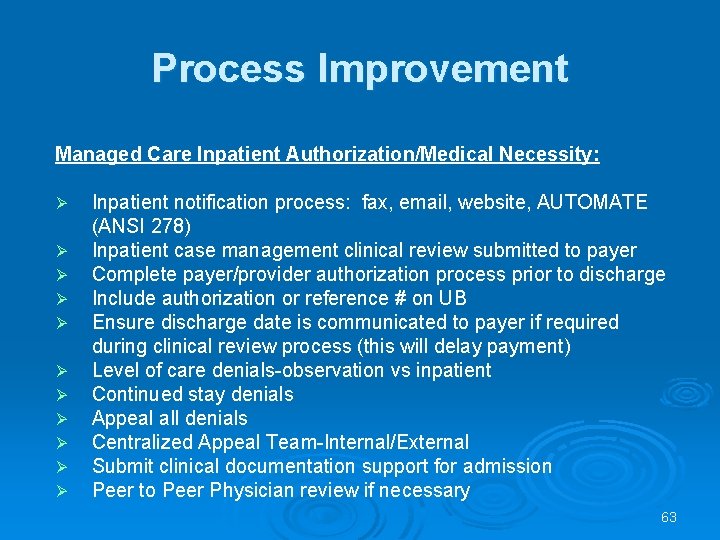
Process Improvement Managed Care Inpatient Authorization/Medical Necessity: Ø Ø Ø Inpatient notification process: fax, email, website, AUTOMATE (ANSI 278) Inpatient case management clinical review submitted to payer Complete payer/provider authorization process prior to discharge Include authorization or reference # on UB Ensure discharge date is communicated to payer if required during clinical review process (this will delay payment) Level of care denials-observation vs inpatient Continued stay denials Appeal all denials Centralized Appeal Team-Internal/External Submit clinical documentation support for admission Peer to Peer Physician review if necessary 63
Process Improvement Managed Care Outpatient Precert/Medical Necessity: Ø Ø Ø Ø Ø Require precert for all elective scheduled procedures Order should support “Reason for Test” Use payers to assist with enforcing policy with physician offices; provide list of physician offices for follow-up Educate physician offices on payer required precert process and how to document “reason for test” Provide physician offices with payer training “tool kit” Establish process for Radiology Dept to notify Precert Dept if original ordered procedure is changed; necessary to obtain precert for revised procedure Centralized Appeal Team-Internal/External Appeal all denials Submit clinical documentation for reason for test; obtain from ordering physician office 64
Process Improvement Timely Filing Denials: Ø Ø Ø Ø Ø Payers have time limits for claim submission; typically 12 months Payers have time limits for appeals Develop payer matrix of time limits for staff and appeal team Critical to obtain correct insurance info the first time during registration process Implement real time registration QA system including scoring and grade assignment by registrar; incorporate into QA and staff evaluation process Address delays and denials timely Develop internal escalation policy for claim follow-up team Payer retractions; if past timely filing-appeal Coordination of benefits-get patient involved 65
Process Improvement Medicare Outpatient Medical Necessity: Ø Ø Advanced Beneficiary Notice (ABN) process; CMS regulation to notify patient prior to service if service might be non-covered due to lack of medical necessity; provider cannot bill patient for noncovered service unless ABN signed by patient prior to service; GA modifier must be included on HCPCS code of non-covered procedure if ABN obtained ABN Software system ABN screening at time of scheduling, registration and backend claim edit system Follow-up with physician office for applicable diagnosis “Reason for Test” if data fails screening and is non-covered 66
Process Improvement Medicare Outpatient Medical Necessity: (Continued) Ø Ø Ø Very complicated process however brings discipline to obtain diagnosis to support “Reason for Test” Medical records to code “Reason for Test” not just result of test Medical record “second review” process Emergency room; ABN is typically not allowed due to EMTALA however opportunity to review protocol and improve documentation Focus initial process improvement on high $ write-offs i. e. Radiology Remember to track write-offs by specific service area (radiology, cardiology, pharmacy, lab, rehab and other 67
Results Ø Ohio. Health reduced denials from. 44% ($18 M) of Gross Revenue FY 09 to. 11% Gross Revenue FY 12 ($6 M); Overall reduced denials by $12 M in gross write-offs Ø Ohio. Health recognized in Modern Healthcare January 31, 2011 “No Denying the Problem” Ø Ohio. Health 2010 Prism Award Finalist-Cross Functional System Denial Team 68
Conclusion Ø Metrics drive performance and change behavior when supported by structure and accountability Ø HFMA MAP: Measure, Apply and Perform Ø Don’t forget to celebrate and thank those that made the results possible 69
Contact Info Margaret Schuler, Ohio. Health Revenue Cycle Administrator Ø Phone: 614 -544 -6427 Ø Email: mschule 2@ohiohealth. com Ø 70
QUESTIONS