
Discourse and narrative analysis Concepts and methodology Hanne
- Slides: 36
Discourse and narrative analysis: Concepts and methodology Hanne Svarstad Norwegian Institute for Nature Research (NINA) hanne. svarstad@nina. no EKOSIASA workshop, 23 -25 May 2008, Bagamoyo 1
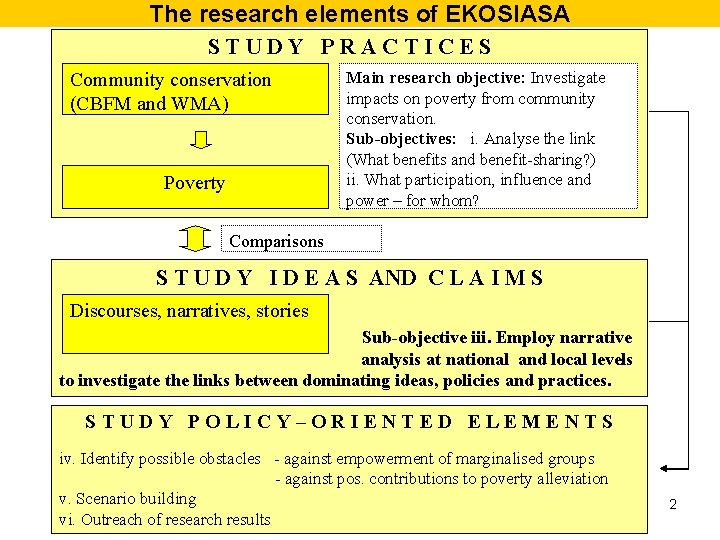
The research elements of EKOSIASA STUDY PRACTICES Community conservation (CBFM and WMA) Poverty Main research objective: Investigate impacts on poverty from community conservation. Sub-objectives: i. Analyse the link (What benefits and benefit-sharing? ) ii. What participation, influence and power – for whom? Comparisons S T U D Y I D E A S AND C L A I M S Discourses, narratives, stories Sub-objective iii. Employ narrative analysis at national and local levels to investigate the links between dominating ideas, policies and practices. STUDY POLICY–ORIENTED ELEMENTS iv. Identify possible obstacles - against empowerment of marginalised groups - against pos. contributions to poverty alleviation v. Scenario building vi. Outreach of research results 2
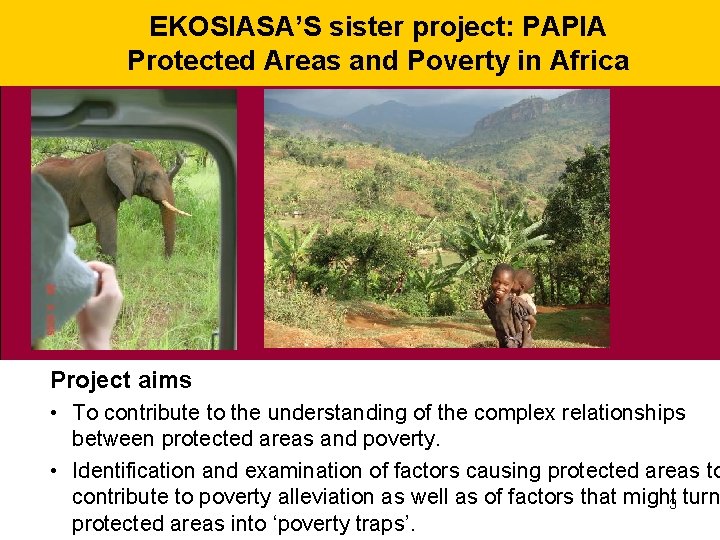
EKOSIASA’S sister project: PAPIA Protected Areas and Poverty in Africa Project aims • To contribute to the understanding of the complex relationships between protected areas and poverty. • Identification and examination of factors causing protected areas to contribute to poverty alleviation as well as of factors that might 3 turn protected areas into ‘poverty traps’.
EKOSIASA’S sister project: PAPIA Protected Areas and Poverty in Africa • 4 cases of national parks in Uganda and Tanzana. 4
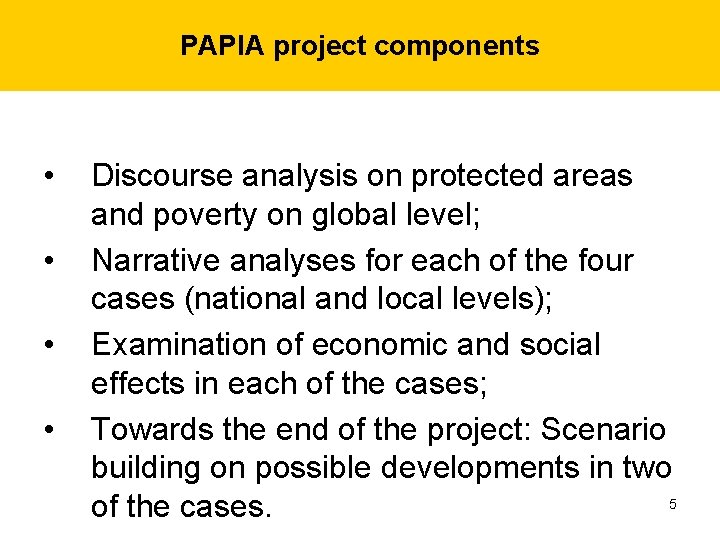
PAPIA project components • • Discourse analysis on protected areas and poverty on global level; Narrative analyses for each of the four cases (national and local levels); Examination of economic and social effects in each of the cases; Towards the end of the project: Scenario building on possible developments in two 5 of the cases.
What is ”discourse”? 6
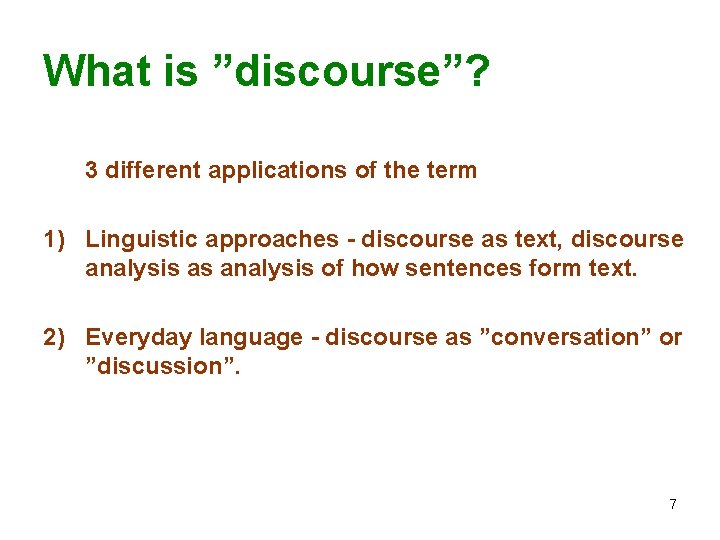
What is ”discourse”? 3 different applications of the term 1) Linguistic approaches - discourse as text, discourse analysis as analysis of how sentences form text. 2) Everyday language - discourse as ”conversation” or ”discussion”. 7
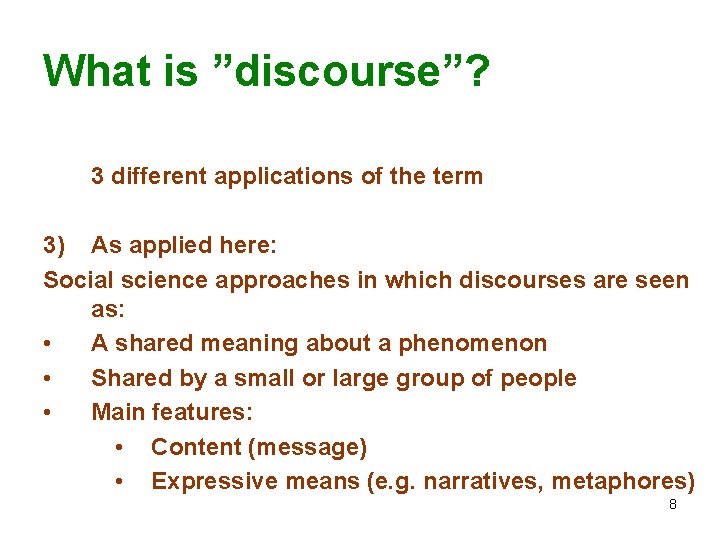
What is ”discourse”? 3 different applications of the term 3) As applied here: Social science approaches in which discourses are seen as: • A shared meaning about a phenomenon • Shared by a small or large group of people • Main features: • Content (message) • Expressive means (e. g. narratives, metaphores) 8
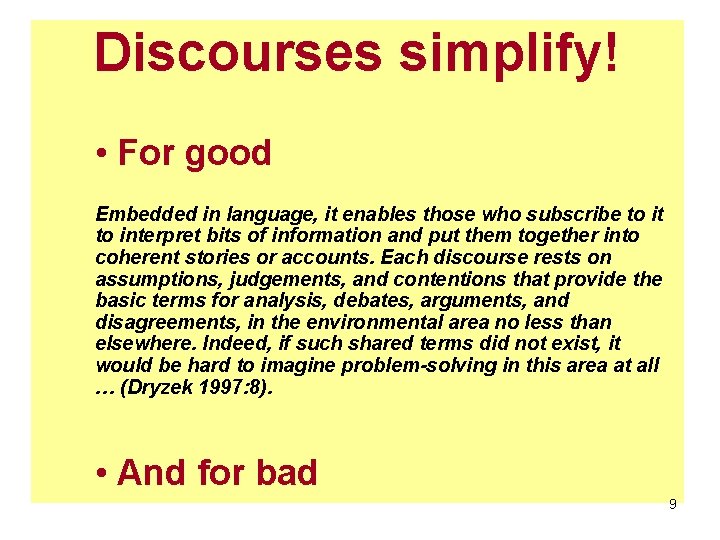
Discourses simplify! • For good Embedded in language, it enables those who subscribe to it to interpret bits of information and put them together into coherent stories or accounts. Each discourse rests on assumptions, judgements, and contentions that provide the basic terms for analysis, debates, arguments, and disagreements, in the environmental area no less than elsewhere. Indeed, if such shared terms did not exist, it would be hard to imagine problem-solving in this area at all … (Dryzek 1997: 8). • And for bad 9
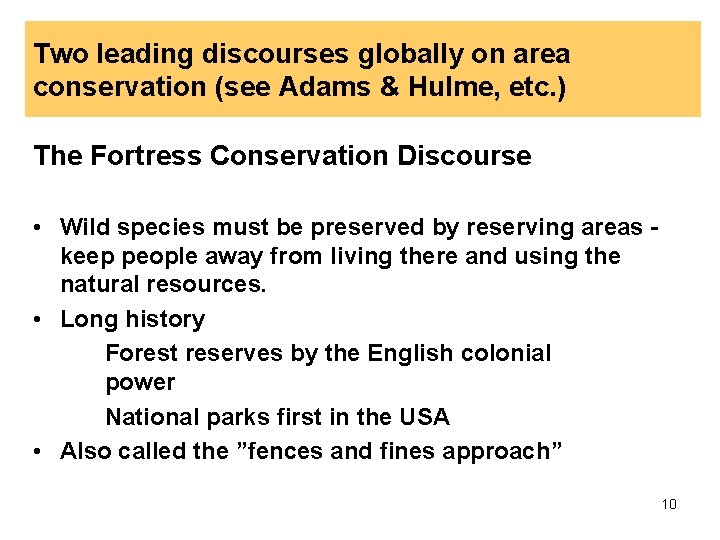
Two leading discourses globally on area conservation (see Adams & Hulme, etc. ) The Fortress Conservation Discourse • Wild species must be preserved by reserving areas keep people away from living there and using the natural resources. • Long history Forest reserves by the English colonial power National parks first in the USA • Also called the ”fences and fines approach” 10
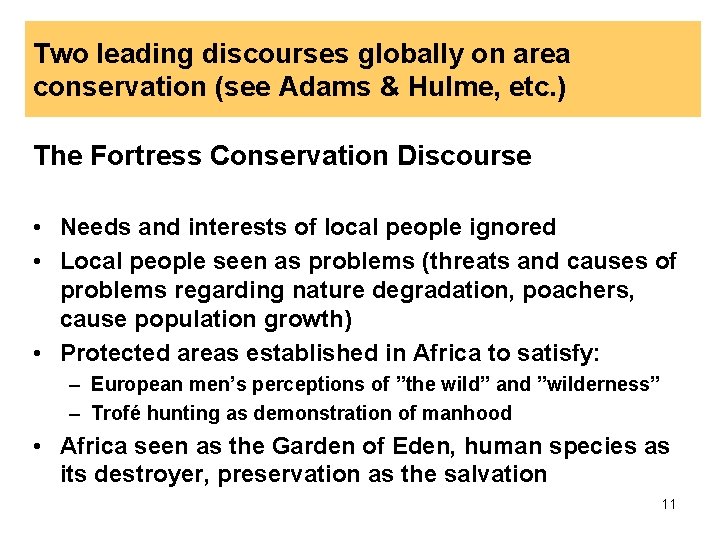
Two leading discourses globally on area conservation (see Adams & Hulme, etc. ) The Fortress Conservation Discourse • Needs and interests of local people ignored • Local people seen as problems (threats and causes of problems regarding nature degradation, poachers, cause population growth) • Protected areas established in Africa to satisfy: – European men’s perceptions of ”the wild” and ”wilderness” – Trofé hunting as demonstration of manhood • Africa seen as the Garden of Eden, human species as its destroyer, preservation as the salvation 11
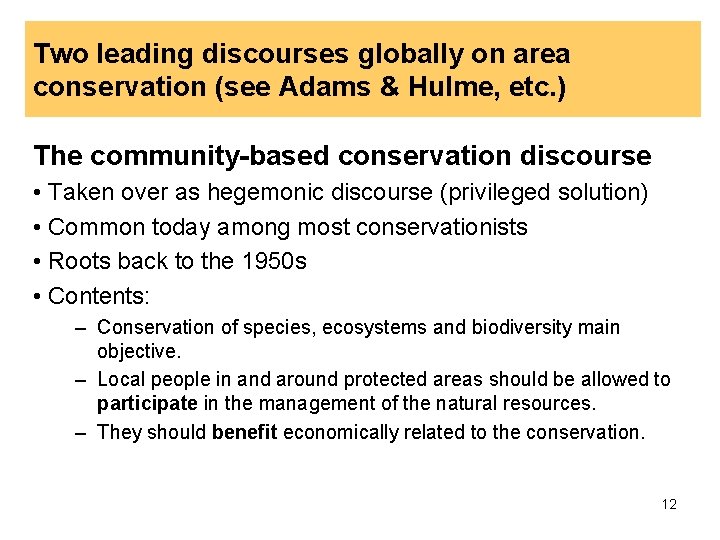
Two leading discourses globally on area conservation (see Adams & Hulme, etc. ) The community-based conservation discourse • Taken over as hegemonic discourse (privileged solution) • Common today among most conservationists • Roots back to the 1950 s • Contents: – Conservation of species, ecosystems and biodiversity main objective. – Local people in and around protected areas should be allowed to participate in the management of the natural resources. – They should benefit economically related to the conservation. 12
Two leading discourses globally on area conservation (see Adams & Hulme, etc. ) The community-based conservation discourse • Important actors in the production of this discourse: * Conservation biologists * Environmental NGOs * Development partners (donors) * Governmental and inter-governmental bodies * Sometimes: Speak with ”two tongues” 13
Two leading discourses globally on area conservation (see Adams & Hulme, etc. ) Reasons for the success of the community-based conservation discourse: 1. It equates conservation with sustainable development notifying human needs. As in the Brundtland Commission’s report and beyond. 2. Its emphasis on ”community” been trendy since the late 1980 s. A vague, idealistic, romantic and powerful concept. A neo-populist idea supporting the traditional against the modern. 3. In line with a shift in dominating discourse of development: Against ”top down”, ”technocratic”, ”blueprint”. 14
Two leading discourses globally on area conservation (see Adams & Hulme, etc. ) Reasons for the success of the community-based conservation discourse: 4. Renewed interest in the 1980 s in the market and economic insentives for development - Conservation based on economic arguments - Less state, more local decision-making 5. Biological reason - Species cannot be sustained on small preservation ”islands”, therefore pivotal to make local people partners in conservation. 15
Two leading discourses globally on area conservation (see Adams & Hulme, etc. ) Reasons for the success of the community-based conservation discourse: 6. Rapid transfer and acceptance of the discourse expecially in parts of the world in which exogenous ideas about ”what to do” hold the greatest influence ): Aid dependent countries. See points from Hoben 1995 (Adams & Hulme: 19). [7. Increased weight on ”local” and ”traditonal” knowledge. ] 16
Two leading discourses globally on area conservation (see Adams & Hulme, etc. ) According to Hutton et al. (2005): The fortress conservation discourse is on its way back again! 17
National discourses on a topic can deviate from global discourses on the same. 18
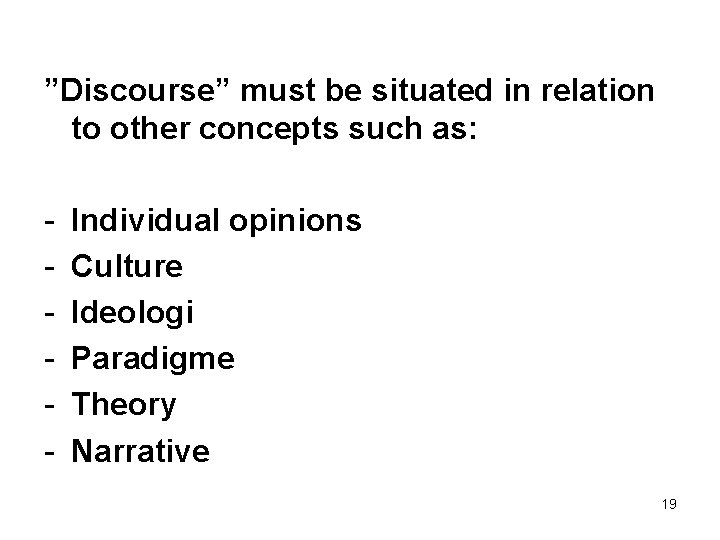
”Discourse” must be situated in relation to other concepts such as: - Individual opinions Culture Ideologi Paradigme Theory Narrative 19
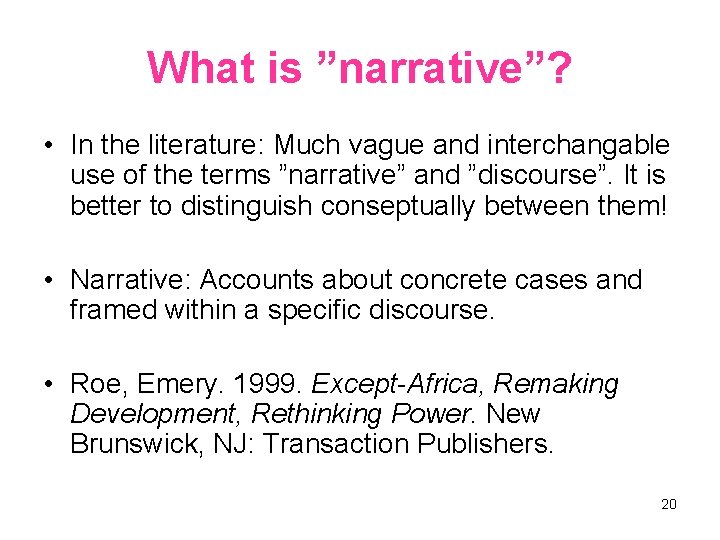
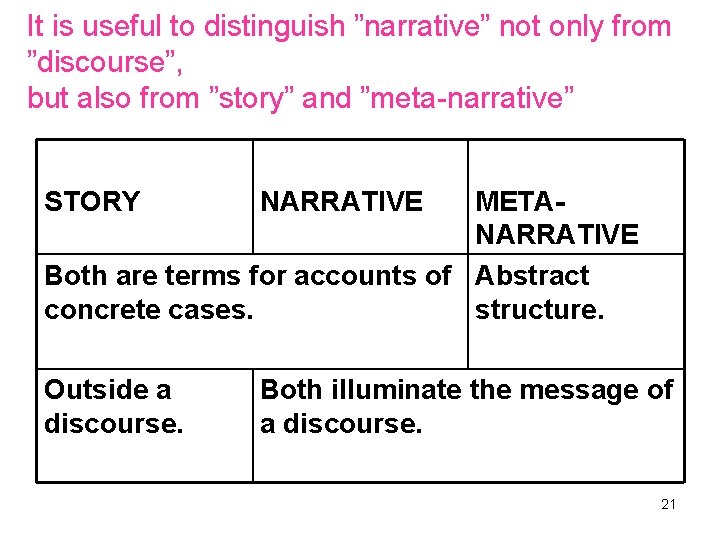
What is ”narrative”? • In the literature: Much vague and interchangable use of the terms ”narrative” and ”discourse”. It is better to distinguish conseptually between them! • Narrative: Accounts about concrete cases and framed within a specific discourse. • Roe, Emery. 1999. Except-Africa, Remaking Development, Rethinking Power. New Brunswick, NJ: Transaction Publishers. 20
It is useful to distinguish ”narrative” not only from ”discourse”, but also from ”story” and ”meta-narrative” STORY NARRATIVE METANARRATIVE Both are terms for accounts of Abstract concrete cases. structure. Outside a discourse. Both illuminate the message of a discourse. 21
The community-based conservation discourse • There are quite a few examples of cases used as ”success stories” (narratives) • These are often made by involved parties in the projects – thus, no critical distance 22
In EKOSIASA we can critically examine claims from discourses and narratives in comparison to the project’s own investigations of the practices. 23
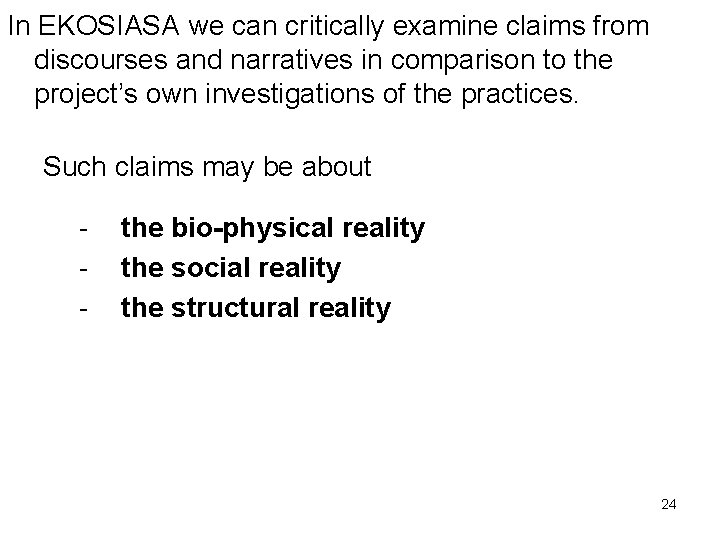
In EKOSIASA we can critically examine claims from discourses and narratives in comparison to the project’s own investigations of the practices. Such claims may be about - the bio-physical reality the social reality the structural reality 24
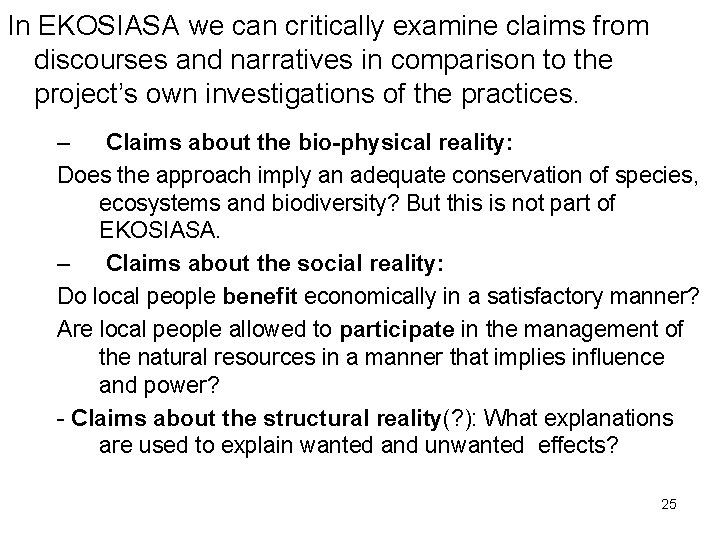
In EKOSIASA we can critically examine claims from discourses and narratives in comparison to the project’s own investigations of the practices. – Claims about the bio-physical reality: Does the approach imply an adequate conservation of species, ecosystems and biodiversity? But this is not part of EKOSIASA. – Claims about the social reality: Do local people benefit economically in a satisfactory manner? Are local people allowed to participate in the management of the natural resources in a manner that implies influence and power? - Claims about the structural reality(? ): What explanations are used to explain wanted and unwanted effects? 25
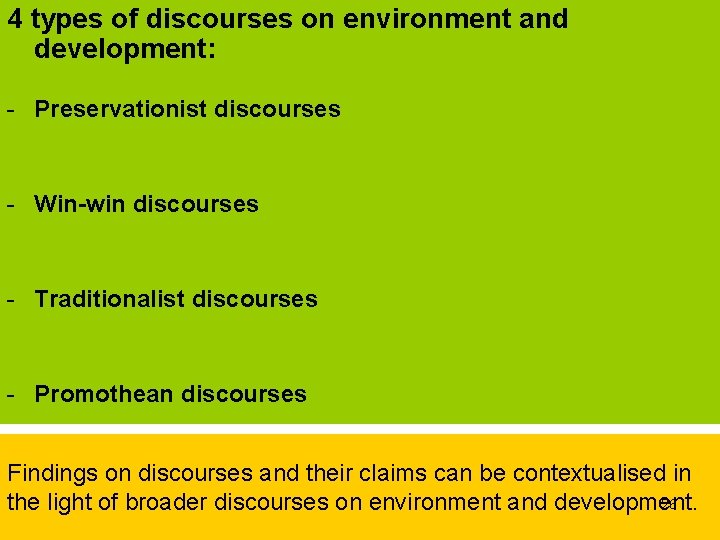
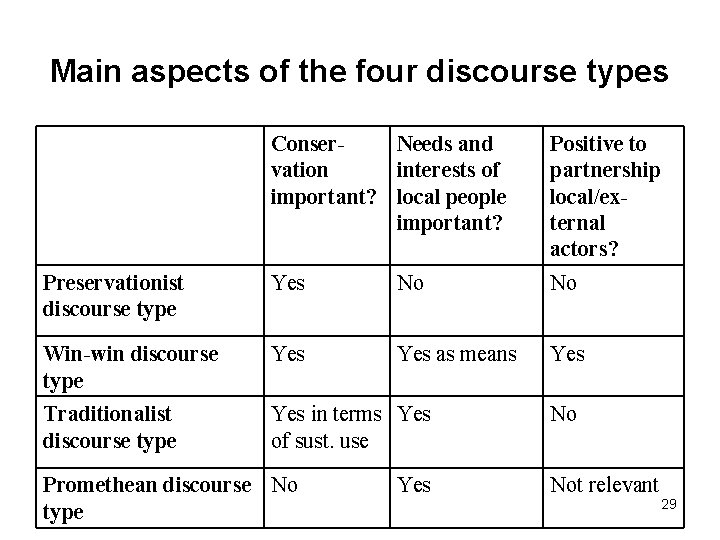
4 types of discourses on environment and development: - Preservationist discourses - Win-win discourses - Traditionalist discourses - Promothean discourses Findings on discourses and their claims can be contextualised in 26 the light of broader discourses on environment and development.
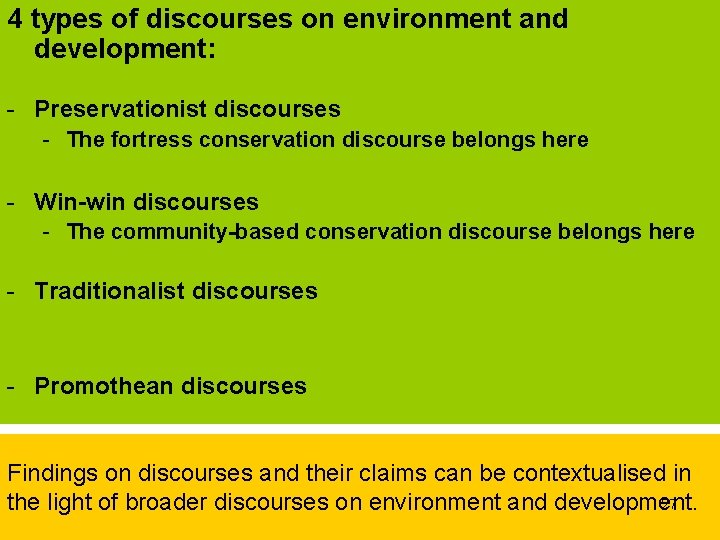
4 types of discourses on environment and development: - Preservationist discourses - The fortress conservation discourse belongs here - Win-win discourses - The community-based conservation discourse belongs here - Traditionalist discourses - Promothean discourses Findings on discourses and their claims can be contextualised in 27 the light of broader discourses on environment and development.
4 types of discourses on environment and development: - Preservationist discourses - The fortress conservation discourse belongs here - Win-win discourses - The community-based conservation discourse belongs here - Traditionalist discourses - Promothean discourses Findings on discourses and their claims can be contextualised in 28 the light of broader discourses on environment and development.
Main aspects of the four discourse types Conser. Needs and vation interests of important? local people important? Positive to partnership local/external actors? Preservationist discourse type Yes No No Win-win discourse type Yes as means Yes Traditionalist discourse type Yes in terms Yes of sust. use Promethean discourse No type Yes No Not relevant 29
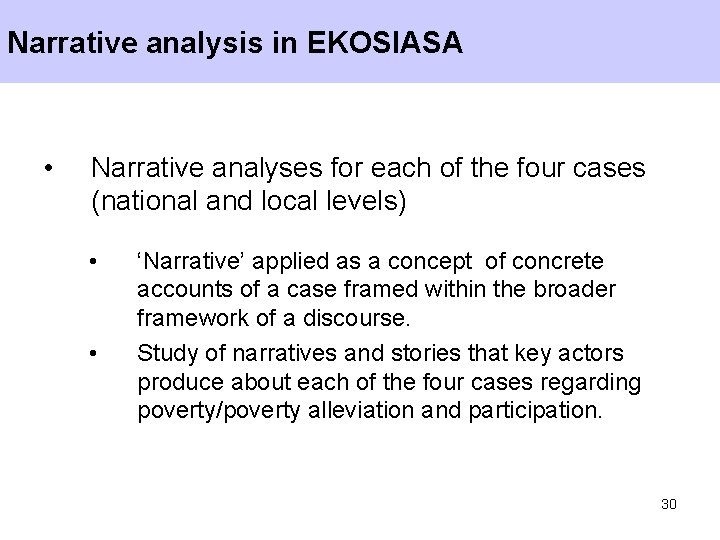
Narrative analysis in EKOSIASA • Narrative analyses for each of the four cases (national and local levels) • • ‘Narrative’ applied as a concept of concrete accounts of a case framed within the broader framework of a discourse. Study of narratives and stories that key actors produce about each of the four cases regarding poverty/poverty alleviation and participation. 30
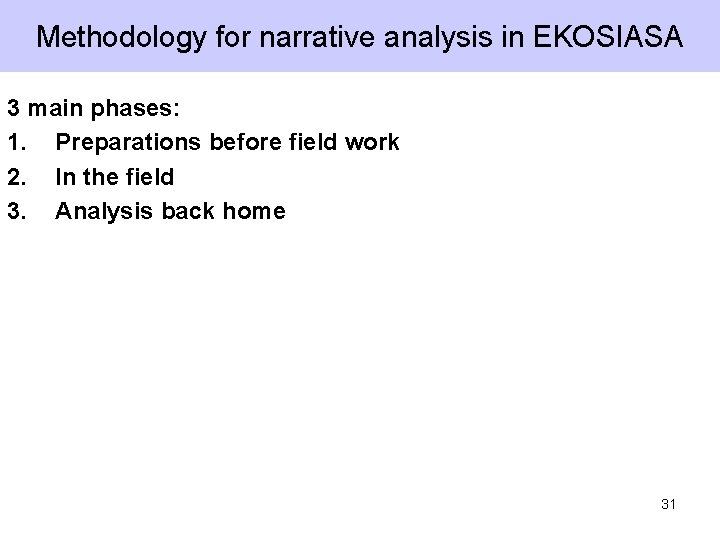
Methodology for narrative analysis in EKOSIASA 3 main phases: 1. Preparations before field work 2. In the field 3. Analysis back home 31
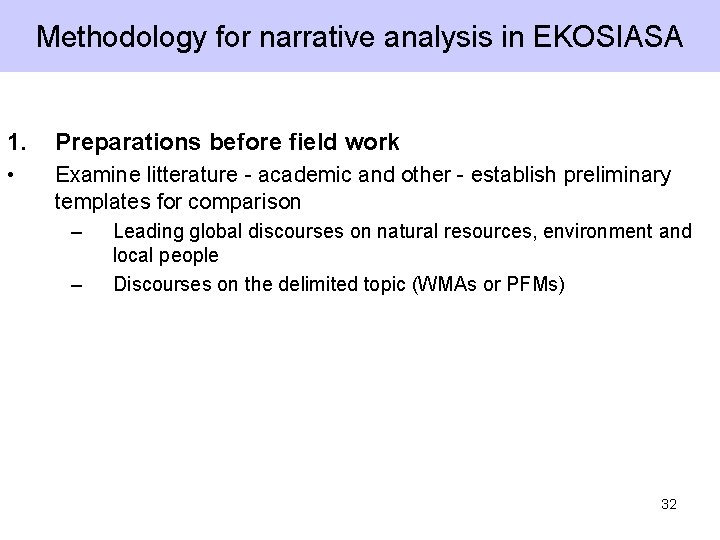
Methodology for narrative analysis in EKOSIASA 1. Preparations before field work • Examine litterature - academic and other - establish preliminary templates for comparison – – Leading global discourses on natural resources, environment and local people Discourses on the delimited topic (WMAs or PFMs) 32
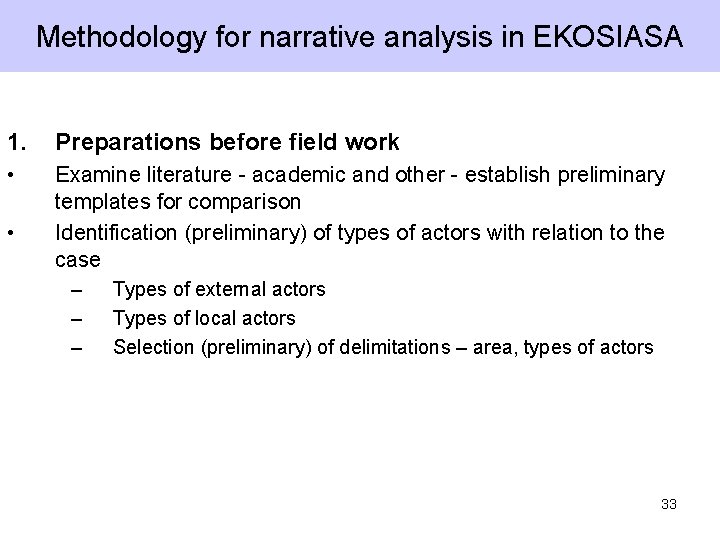
Methodology for narrative analysis in EKOSIASA 1. Preparations before field work • Examine literature - academic and other - establish preliminary templates for comparison Identification (preliminary) of types of actors with relation to the case • – – – Types of external actors Types of local actors Selection (preliminary) of delimitations – area, types of actors 33
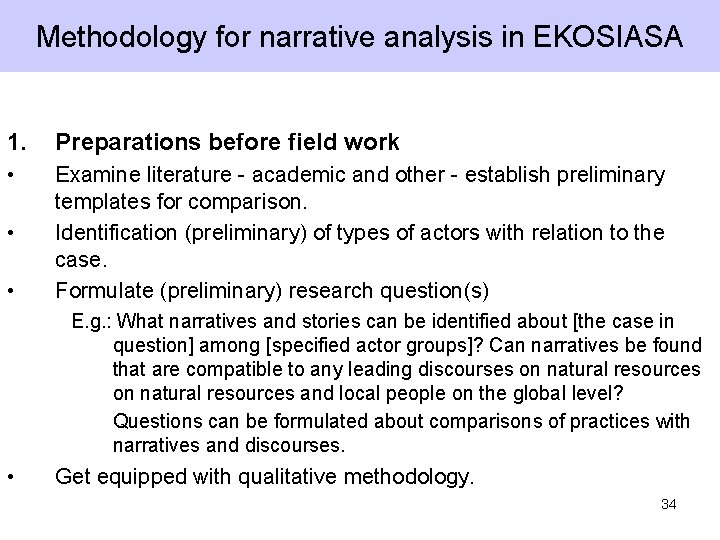
Methodology for narrative analysis in EKOSIASA 1. Preparations before field work • Examine literature - academic and other - establish preliminary templates for comparison. Identification (preliminary) of types of actors with relation to the case. Formulate (preliminary) research question(s) • • E. g. : What narratives and stories can be identified about [the case in question] among [specified actor groups]? Can narratives be found that are compatible to any leading discourses on natural resources and local people on the global level? Questions can be formulated about comparisons of practices with narratives and discourses. • Get equipped with qualitative methodology. 34
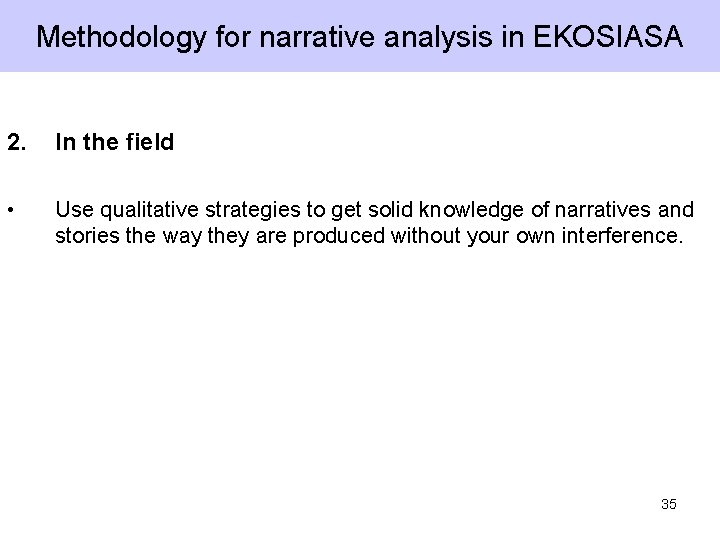
Methodology for narrative analysis in EKOSIASA 2. In the field • Use qualitative strategies to get solid knowledge of narratives and stories the way they are produced without your own interference. 35
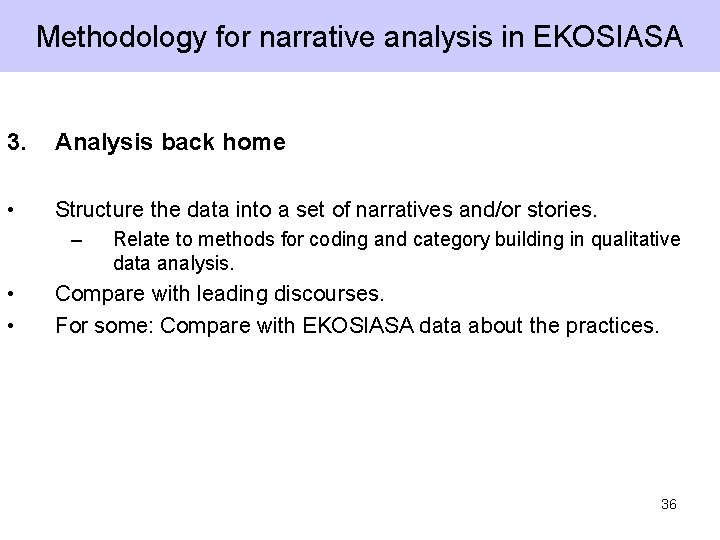
Methodology for narrative analysis in EKOSIASA 3. Analysis back home • Structure the data into a set of narratives and/or stories. – • • Relate to methods for coding and category building in qualitative data analysis. Compare with leading discourses. For some: Compare with EKOSIASA data about the practices. 36