
Disconnect handle failure on hazardous location motor starter
- Slides: 4
Disconnect handle failure on hazardous location motor starter June 21 2010
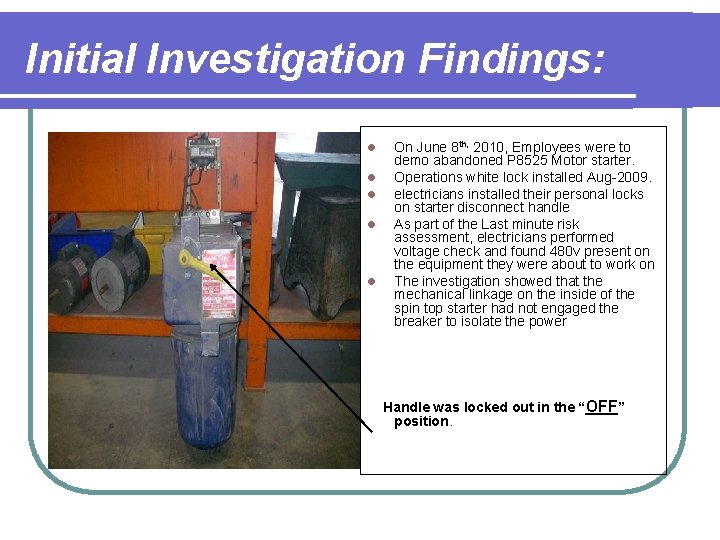
Initial Investigation Findings: l l l On June 8 th, 2010, Employees were to demo abandoned P 8525 Motor starter. Operations white lock installed Aug-2009. electricians installed their personal locks on starter disconnect handle As part of the Last minute risk assessment, electricians performed voltage check and found 480 v present on the equipment they were about to work on The investigation showed that the mechanical linkage on the inside of the spin top starter had not engaged the breaker to isolate the power Handle was locked out in the “OFF” position.
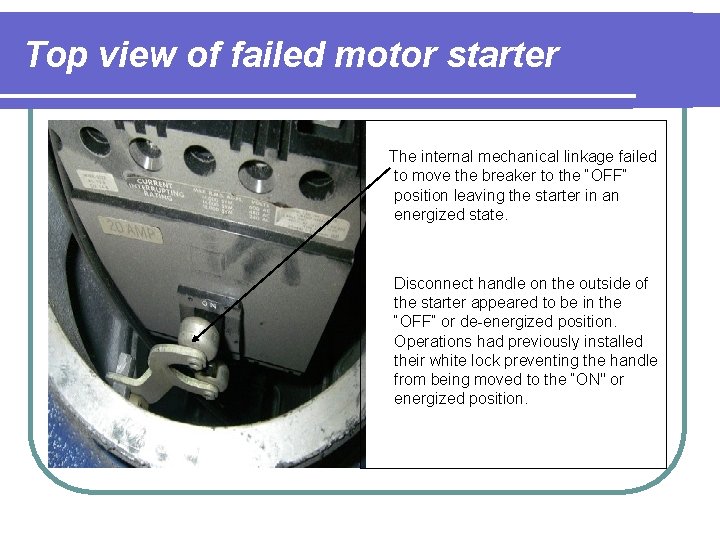
Top view of failed motor starter The internal mechanical linkage failed to move the breaker to the “OFF” position leaving the starter in an energized state. Disconnect handle on the outside of the starter appeared to be in the “OFF” or de-energized position. Operations had previously installed their white lock preventing the handle from being moved to the “ON" or energized position.
Lessons Learned l l l Perform an Last minute risk assesment. This is an ongoing process, use the knowledge you and your work crew have gained to continually modify your scope as hazards arise. Individual work crews must be present during testing and verification with an electrical meter to ensure that the electrical equipment is isolated (performed by a qualified electrician). Re-enforce the need to follow all of the safe work practices that you have learned as a trades person and follow all of the Client/Contractor procedures allowing for safe work to be carried out. l Always use the LOCK OUT, TAG OUT & TRY method while performing energy isolation. Verify and communicate to the Permit Issuer that you are going to try the equipment, l Talking with your partner/co-workers to consider different approaches to the job. If what you are about to do does not feel right then it probably isn’t. l