
Disclosure of Unanticipated Adverse Outcomes The Art of

- Slides: 27
Disclosure of Unanticipated Adverse Outcomes: The Art of Facilitating Compassionate Conversations MD-DC SHRM Educational Session September 10, 2009, Columbia, MD Presented by Carole Houk & Leigh Ana Amerson Carole Houk International, LLC
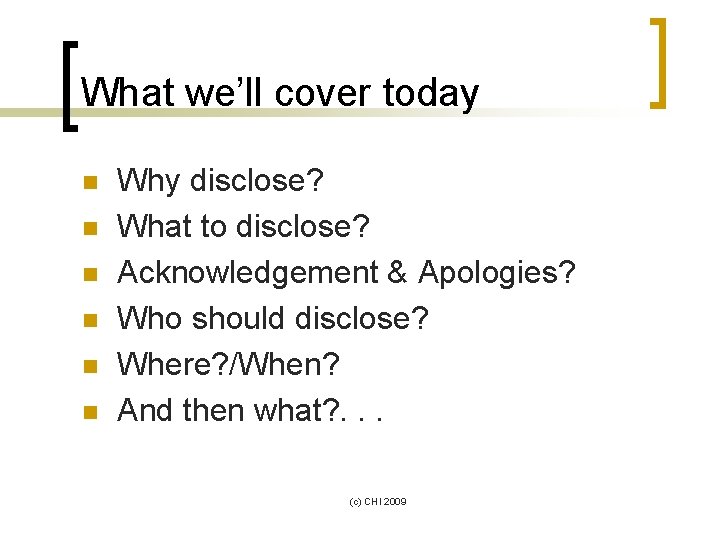
What we’ll cover today n n n Why disclose? What to disclose? Acknowledgement & Apologies? Who should disclose? Where? /When? And then what? . . . (c) CHI 2009
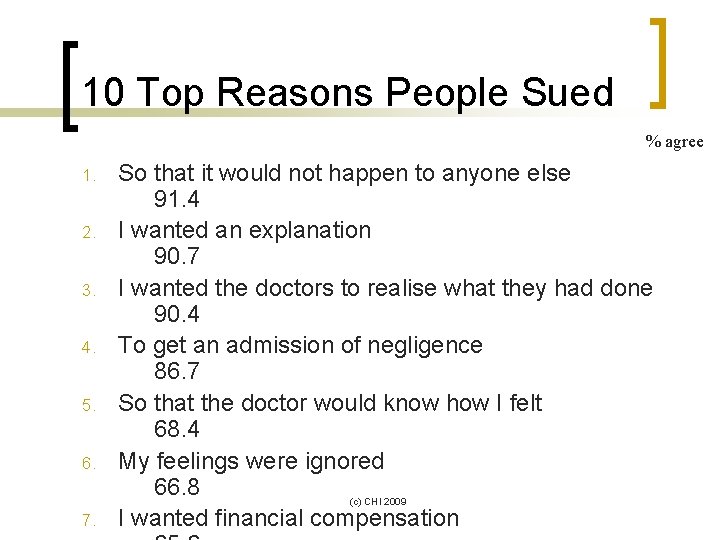
10 Top Reasons People Sued % agree 1. 2. 3. 4. 5. 6. 7. So that it would not happen to anyone else 91. 4 I wanted an explanation 90. 7 I wanted the doctors to realise what they had done 90. 4 To get an admission of negligence 86. 7 So that the doctor would know how I felt 68. 4 My feelings were ignored 66. 8 (c) CHI 2009 I wanted financial compensation
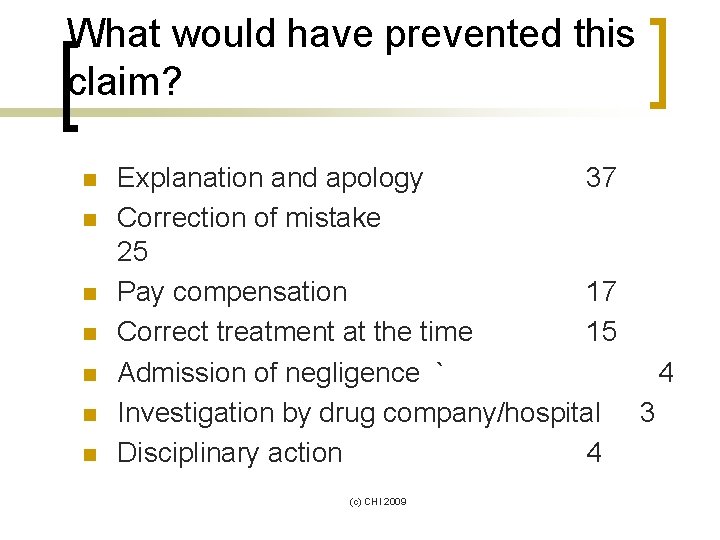
What would have prevented this claim? n n n n Explanation and apology 37 Correction of mistake 25 Pay compensation 17 Correct treatment at the time 15 Admission of negligence ` 4 Investigation by drug company/hospital 3 Disciplinary action 4 (c) CHI 2009
Why disclose? n n n Patient has a right to transparency Caregivers have no legal or moral authority to withhold information Not knowing results in anger, resentment and loss of trust It’s the right thing to do To prevent “double wounding” the patient (c) CHI 2009
Why is it so difficult to disclose? n n n Admitting a mistake is not easy Patients feel angry and afraid Providers feel guilty and alone Don’t know what to say Fear of litigation Lawyers/insurers said not to (c) CHI 2009
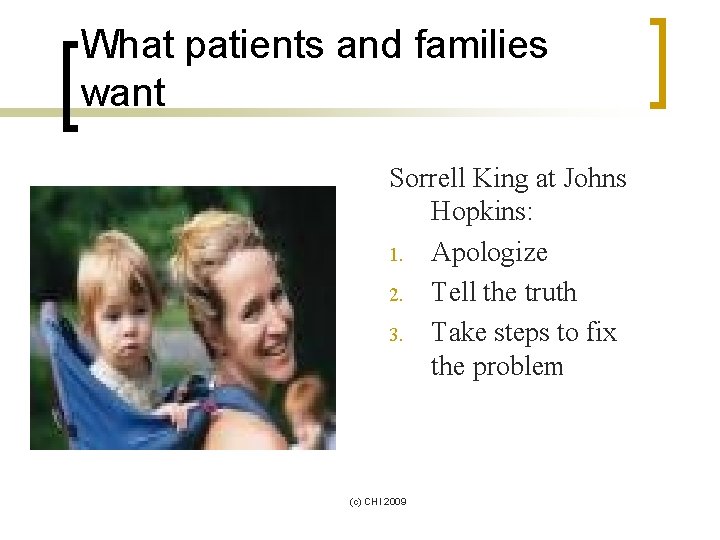
What patients and families want Sorrell King at Johns Hopkins: 1. Apologize 2. Tell the truth 3. Take steps to fix the problem (c) CHI 2009
What should be disclosed Unanticipated Adverse Outcomes Errors Near Misses
Patient’s and Provider’s Perceptions n n n Believing the patient’s own assessment of how they are affirms their dignity and makes them feel valued as a human being All loss arouses grief, and the loss of health, vitality, strength, control that occurs in illness or unexpected adverse outcomes causes considerable grief An unexpected outcome may not be life threatening yet still be quality of (c) CHI 2009
What not to share n n Don’t share inaccurate information Don’t share confidential results from Peer Reviews Don’t share Root Cause Analyses or other protected information under the Quality umbrella unless hospital embraces full disclosure Don’t cast blame or speculate (c) CHI 2009
Acknowledgements and Apologies “When a person injures another, whether on purpose or by accident, the respectful course is for the injurer to apologize. Failing to apologize can itself be a second form of injury. ” Jonathan R. Cohen
Acknowledge, and apologize when warranted n n It’s always appropriate to acknowledge a patient and/or family’s suffering Not acknowledging someone’s pain and suffering causes relational separation and a feeling of abandonment Don’t confuse acknowledgements with admissions of liability, i. e. full apologies Apologize when appropriate, i. e. , when there is a clear error (c) CHI 2009
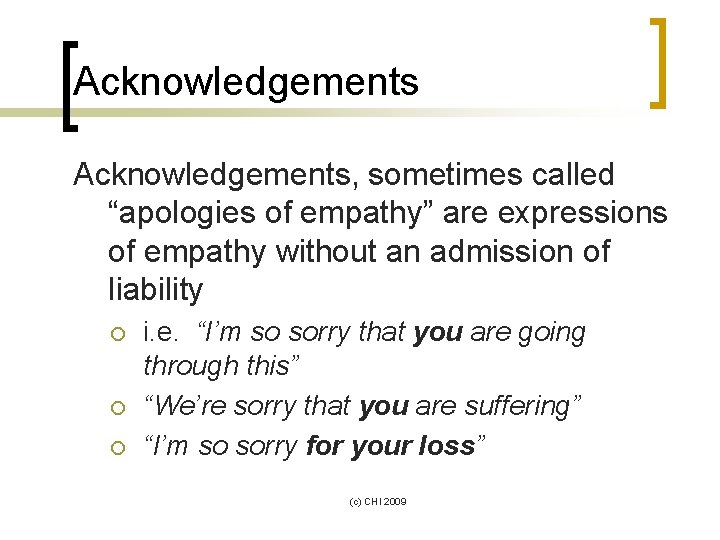
Acknowledgements, sometimes called “apologies of empathy” are expressions of empathy without an admission of liability ¡ ¡ ¡ i. e. “I’m so sorry that you are going through this” “We’re sorry that you are suffering” “I’m so sorry for your loss” (c) CHI 2009
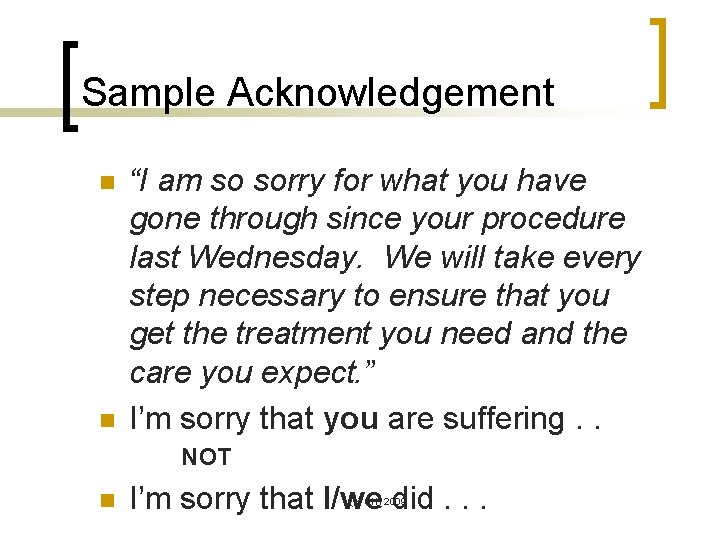
Sample Acknowledgement n n “I am so sorry for what you have gone through since your procedure last Wednesday. We will take every step necessary to ensure that you get the treatment you need and the care you expect. ” I’m sorry that you are suffering. . NOT n I’m sorry that I/we did. . . (c) CHI 2009
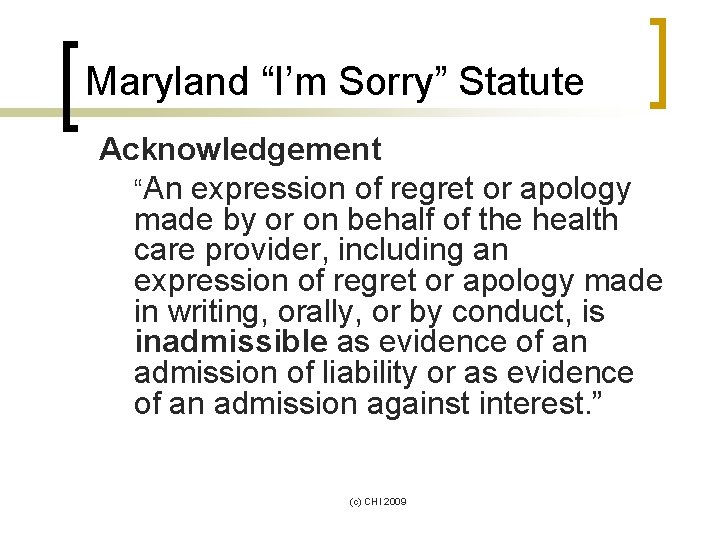
Maryland “I’m Sorry” Statute Acknowledgement “An expression of regret or apology made by or on behalf of the health care provider, including an expression of regret or apology made in writing, orally, or by conduct, is inadmissible as evidence of an admission of liability or as evidence of an admission against interest. ” (c) CHI 2009
Who should disclose “The only meaningful apology you are going to get is from me. I’m sorry. ” “I’m afraid that isn’t meaningful. ” Film clip, A Civil Action
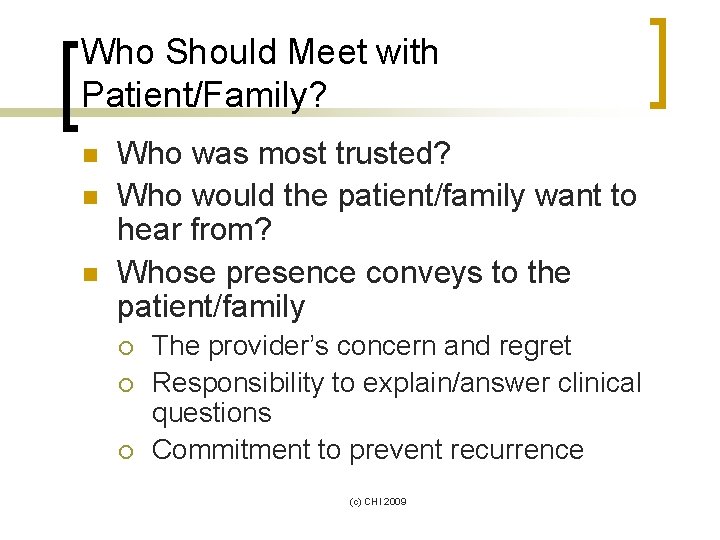
Who Should Meet with Patient/Family? n n n Who was most trusted? Who would the patient/family want to hear from? Whose presence conveys to the patient/family ¡ ¡ ¡ The provider’s concern and regret Responsibility to explain/answer clinical questions Commitment to prevent recurrence (c) CHI 2009
Coaching the provider “Virtually every practitioner knows the sickening realization of a bad mistake. ” Dr. Albert Wu
Coaching the Provider n n n Listen with empathy Offer general acknowledgement of provider’s difficult position Request an explanation of the situation, and the relationship of the outcome to the episode of care Ask for clarification of any information that is not clear from the medical record What questions to consider when coaching the provider? (c) CHI 2009
Tone of voice matters n n n Recent study looked at whether surgeon’s tone of voice during routine office visits provided a clue to malpractice history Dominant tone of voice=higher propensity for lawsuits Profiled in Malcolm Gladwell’s Blink Ambady, et al, Surgery, 2002. (c) CHI 2009
Thin Slicing Dominance n n n Dominance is conveyed in deep, loud, moderately fast, unaccented, and clearly articulated speech May communicate an imperious & overbearing manner, lack of empathy and understanding, and perhaps indifference Anxiety in physician’s voice tone may be heard as conveying seriousness, attentiveness, and concern for the patient’s well-being and future health (c) CHI 2009
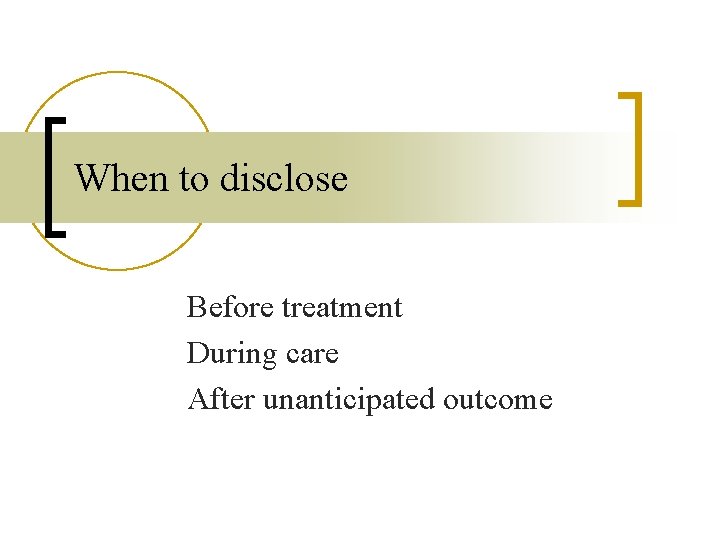
When to disclose Before treatment During care After unanticipated outcome
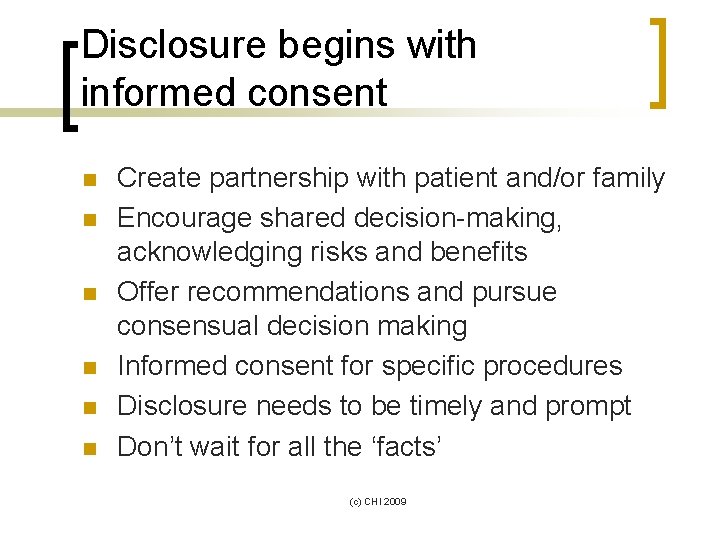
Disclosure begins with informed consent n n n Create partnership with patient and/or family Encourage shared decision-making, acknowledging risks and benefits Offer recommendations and pursue consensual decision making Informed consent for specific procedures Disclosure needs to be timely and prompt Don’t wait for all the ‘facts’ (c) CHI 2009
Where to disclose Select an appropriate setting
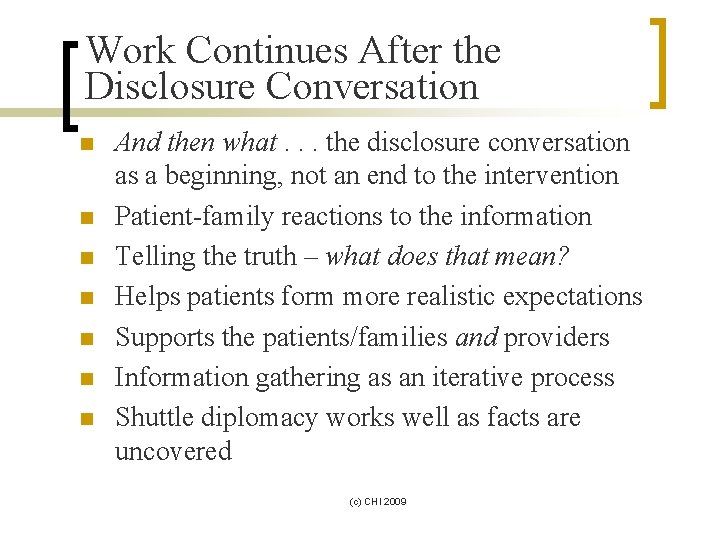
Work Continues After the Disclosure Conversation n n n And then what. . . the disclosure conversation as a beginning, not an end to the intervention Patient-family reactions to the information Telling the truth – what does that mean? Helps patients form more realistic expectations Supports the patients/families and providers Information gathering as an iterative process Shuttle diplomacy works well as facts are uncovered (c) CHI 2009
Final Thoughts n n n Your genuine intention rather than your exact words are key to acceptance by the patient Speak from your heart – these are very difficult conversations Remember you are part of a team – consult your team members for advice, support and coordination (c) CHI 2009
What questions do you have? For more information, please contact: Carole Houk, Principal Carole Houk International, LLC www. chi-resolutions. com chouk@chi-resolutions. com 703 -578 -0570 (c) CHI 2009