
Disclosing environmental and sustainability practices and initiatives in
Disclosing environmental and sustainability practices and initiatives in the annual reporting process of property investment organisations: Evidence from Malaysia Ainoriza Mohd Aini Prof. Sarah Sayce School of Surveying & Planning, Kingston University London ERES * MILAN * 23 -26 JUNE 2010
The Agenda Introduction Research Methodology Findings + Discussion Conclusion
Introduction • Previously, behaving responsibly is seen as harming the investment performances. • But now, ignoring Environmental, Social & Governance issues can be very risky. • Increasing awareness of the importance of Socially Responsible Investment (SRI). • Previously SRI have been focusing on equity but lately have been applied to other asset classes including property.
SRPI Definition • Sustainable and Responsible Property Investment can be defined as. . “maximizing the positive effects and minimizing the negative effects of property ownership, management and development, on society and the natural environment in a way that is consistent with investor goals and fiduciary responsibilities. ” (Pivo & Mc. Namara, 2008) 1 1 In Pivo & Mc. Namara (2005, p. 129), used the term Socially Responsible Property Investment
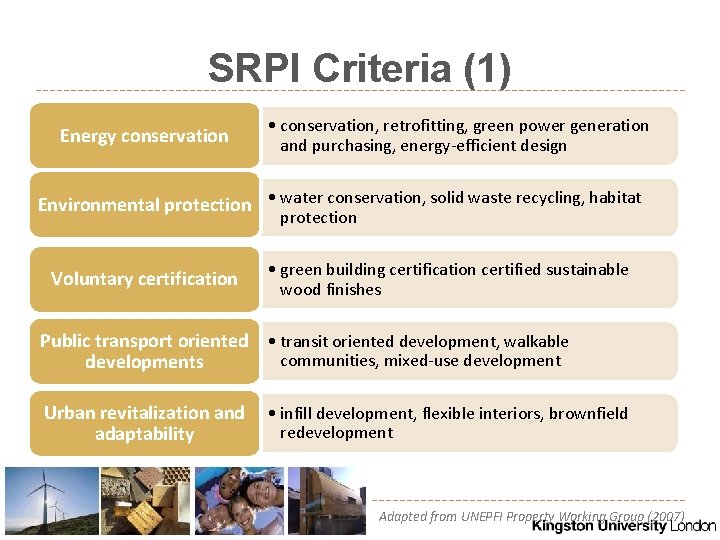
SRPI Criteria (1) Energy conservation • conservation, retrofitting, green power generation and purchasing, energy-efficient design Environmental protection • water conservation, solid waste recycling, habitat protection Voluntary certification • green building certification certified sustainable wood finishes Public transport oriented • transit oriented development, walkable communities, mixed-use developments Urban revitalization and adaptability • infill development, flexible interiors, brownfield redevelopment Adapted from UNEPFI Property Working Group (2007)
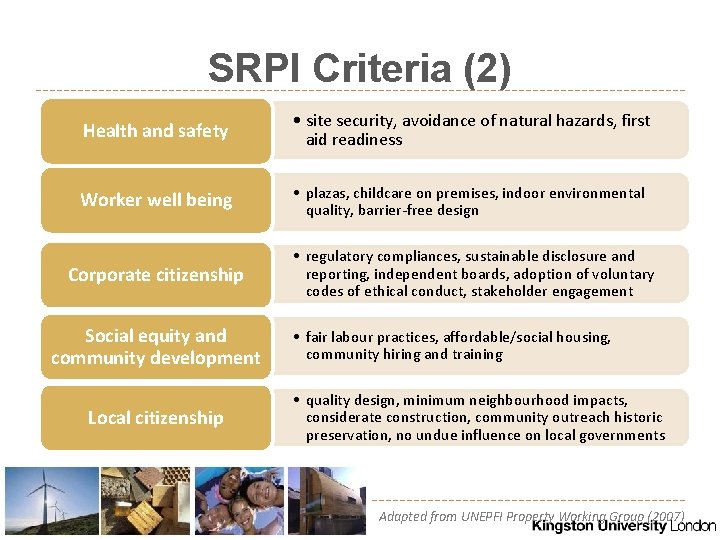
SRPI Criteria (2) Health and safety • site security, avoidance of natural hazards, first aid readiness Worker well being • plazas, childcare on premises, indoor environmental quality, barrier-free design Corporate citizenship Social equity and community development Local citizenship • regulatory compliances, sustainable disclosure and reporting, independent boards, adoption of voluntary codes of ethical conduct, stakeholder engagement • fair labour practices, affordable/social housing, community hiring and training • quality design, minimum neighbourhood impacts, considerate construction, community outreach historic preservation, no undue influence on local governments Adapted from UNEPFI Property Working Group (2007)

Sustainable & responsible property investment • SRPI has made significant progress in the property industry. • ESG are now included in property ownership, management & development. • Real estate companies and trust have been listed in indices. Eg: Dow Jones sustainability world index • Dedicated sustainability property funds have been launched in the US, UK, Australia & Germany.
• Literature surrounding environmental and sustainability initiatives in property investment is concentrated in more mature economies. • Property agenda has been dominated by ‘green’ concerns rather than social aspects. - Pivo (2008) top criteria for investors are energy efficiency, public transport, daylight and natural ventilation. • . . . What about developing countries? What are the agenda in Malaysia?
Previous research? • Newell and Manaf (2008) - significance of sustainability practices by the Malaysian property companies. • No other attempt has been made to investigate the responsible and sustainability practices and initiatives in property investment organisations in Malaysia. • This paper seeks to contribute to the existing literature by reviewing the disclosure of those activities in property investment organisation using publicly available company literature.
The Objective More specifically, the objective of this present study is to elicit the answer of the following issues: the extent to which disclosure of environmental and sustainability practices and initiatives in the annual reporting process of property investors in Malaysia. the current practices contributing to SRPI among property investors in Malaysia; the environmental and social issues concern property investors in Malaysia; and their actions with regards to their property portfolio.

The Malaysian Scenario • Malaysia faces specific environmental problems : deforestation which has caused loss of biodiversity, erosion and pollution. • Malaysia is also not excluded from confronting the challenges of the growing needs of energy. • Carbon emissions in Malaysia have increased by 221 percent since 1990, the highest growth rate among the world‘s top emitters (United Nation Development Programme, 2007).
The Malaysian Scenario • Awareness of social issues: affordable housing needs, fair labour, workers safety and well-being, access for the disabled as well indigenous people rights has been growing. • At this point, it is important to understand how property investment communities reacted to these issues and their action against their portfolio.
Social Responsibility & Sustainability Reporting • Disclosure of CSR and sustainability information has been mandated by a number of governments throughout the world including Malaysia. • In 2007, The Prime Minister of Malaysia announced that all companies listed on the Malaysia stock exchange would be required to disclose information on CSR activities in their annual financial report. • As minimum, public listed companies are required to include a CSR statement in their annual reports, however there is no restriction to the content.
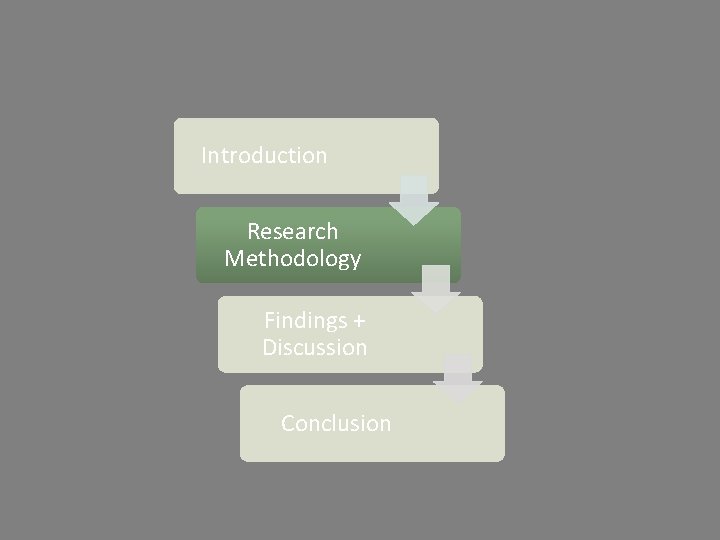
Introduction Research Methodology Findings + Discussion Conclusion
Methodology Content Analysis of publicly available company literature § Annual Reports & stand alone CSR /Sustainability reports (if published) from year 2007 -2009 § Annual reports are more than just a statutory documents § Primary communication vehicles for company environmental reporting.
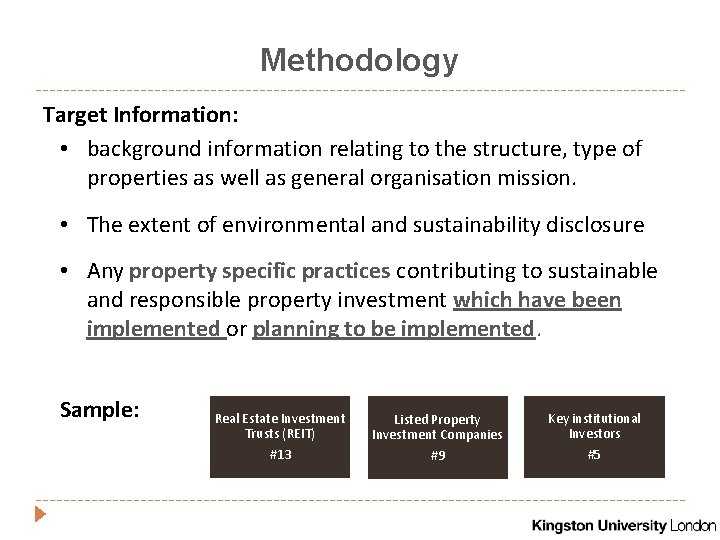
Methodology Target Information: • background information relating to the structure, type of properties as well as general organisation mission. • The extent of environmental and sustainability disclosure • Any property specific practices contributing to sustainable and responsible property investment which have been implemented or planning to be implemented. Sample: Real Estate Investment Trusts (REIT) Listed Property Investment Companies Key institutional Investors #13 #9 #5
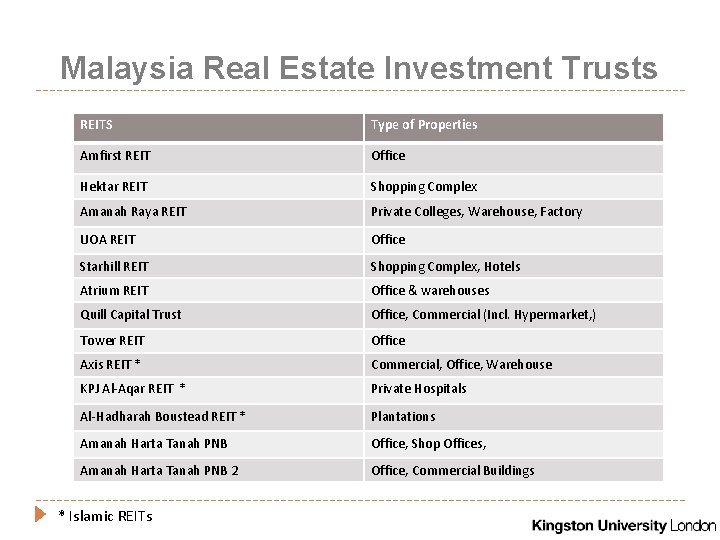
Malaysia Real Estate Investment Trusts REITS Type of Properties Amfirst REIT Office Hektar REIT Shopping Complex Amanah Raya REIT Private Colleges, Warehouse, Factory UOA REIT Office Starhill REIT Shopping Complex, Hotels Atrium REIT Office & warehouses Quill Capital Trust Office, Commercial (Incl. Hypermarket, ) Tower REIT Office Axis REIT * Commercial, Office, Warehouse KPJ Al-Aqar REIT * Private Hospitals Al-Hadharah Boustead REIT * Plantations Amanah Harta Tanah PNB Office, Shop Offices, Amanah Harta Tanah PNB 2 Office, Commercial Buildings * Islamic REITs
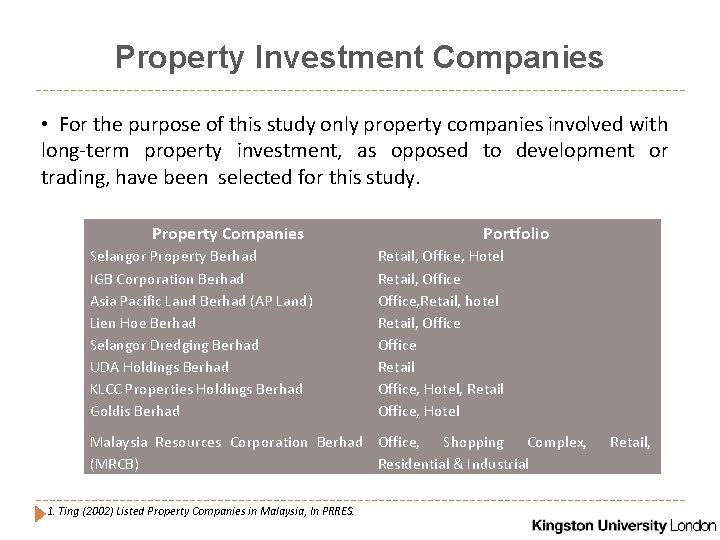
Property Investment Companies • For the purpose of this study only property companies involved with long-term property investment, as opposed to development or trading, have been selected for this study. Property Companies Selangor Property Berhad IGB Corporation Berhad Asia Pacific Land Berhad (AP Land) Lien Hoe Berhad Selangor Dredging Berhad UDA Holdings Berhad KLCC Properties Holdings Berhad Goldis Berhad Portfolio Retail, Office, Hotel Retail, Office, Retail, hotel Retail, Office Retail Office, Hotel, Retail Office, Hotel Malaysia Resources Corporation Berhad Office, Shopping Complex, (MRCB) Residential & Industrial 1. Ting (2002) Listed Property Companies in Malaysia, In PRRES. Retail,
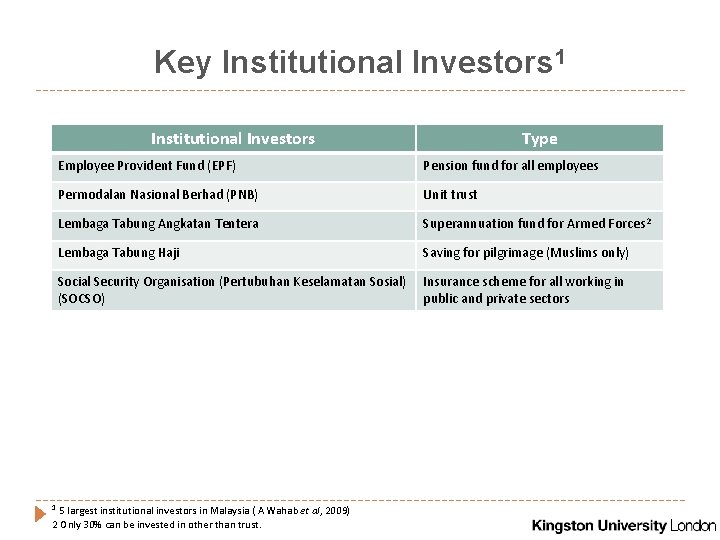
Key Institutional Investors 1 Type Employee Provident Fund (EPF) Pension fund for all employees Permodalan Nasional Berhad (PNB) Unit trust Lembaga Tabung Angkatan Tentera Superannuation fund for Armed Forces 2 Lembaga Tabung Haji Saving for pilgrimage (Muslims only) Social Security Organisation (Pertubuhan Keselamatan Sosial) (SOCSO) Insurance scheme for all working in public and private sectors 5 largest institutional investors in Malaysia ( A Wahab et al, 2009) 2 Only 30% can be invested in other than trust.
Introduction Research Methodology Findings + Discussion Conclusion
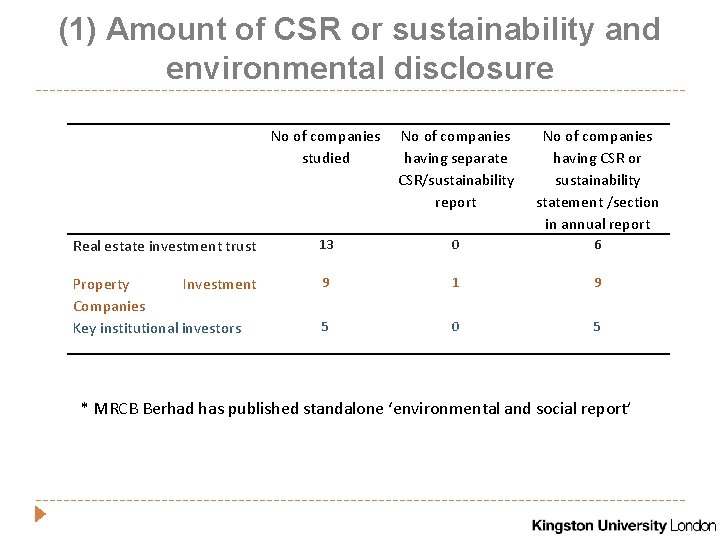
(1) Amount of CSR or sustainability and environmental disclosure No of companies studied No of companies having separate CSR/sustainability report No of companies having CSR or sustainability statement /section in annual report Real estate investment trust 13 0 6 Property Investment Companies Key institutional investors 9 1 9 5 0 5 * MRCB Berhad has published standalone ‘environmental and social report’
(2) Disclosure of sustainable and responsible investment practices Annual reports were assessed against: • UNEPFI (2007) 10 Elements of RPI. • any other forms of good practices including corporate philanthropy were also examined.
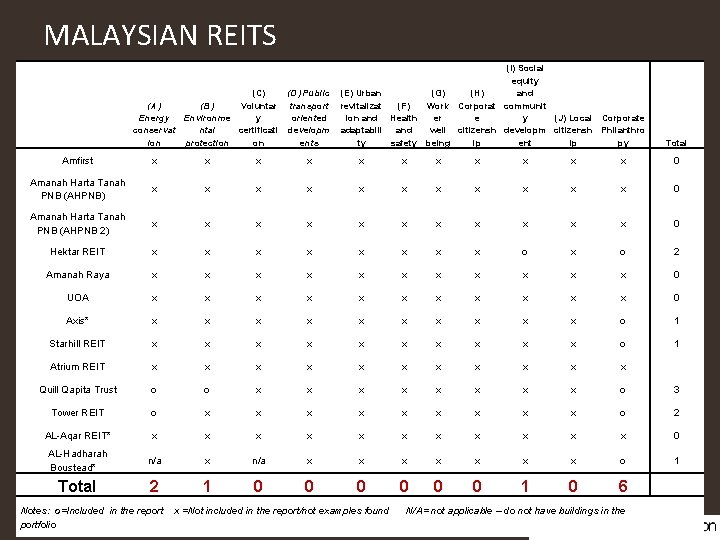
MALAYSIAN REITS (C) Voluntar (A) (B) Energy Environme y conservat ntal certificati ion protection on (D) Public transport oriented developm ents (I) Social equity (E) Urban (G) (H) and revitalizat Work Corporat communit (F) ion and Health er e (J) Local Corporate y adaptabili and well citizensh developm citizensh Philanthro ty safety being ip ip py ent Total Amfirst x x x 0 Amanah Harta Tanah PNB (AHPNB) x x x 0 Amanah Harta Tanah PNB (AHPNB 2) x x x 0 Hektar REIT x x x x o x o 2 Amanah Raya x x x 0 UOA x x x 0 Axis* x x x x x o 1 Starhill REIT x x x x x o 1 Atrium REIT x x x Quill Qapita Trust o o x x x x o 3 Tower REIT o x x x x x o 2 AL-Aqar REIT* x x x 0 AL-Hadharah Boustead* n/a x x x x o 1 Total 2 1 0 0 0 1 0 6 Notes: o=Included in the reportfolio x =Not included in the report/not examples found N/A= not applicable – do not have buildings in the
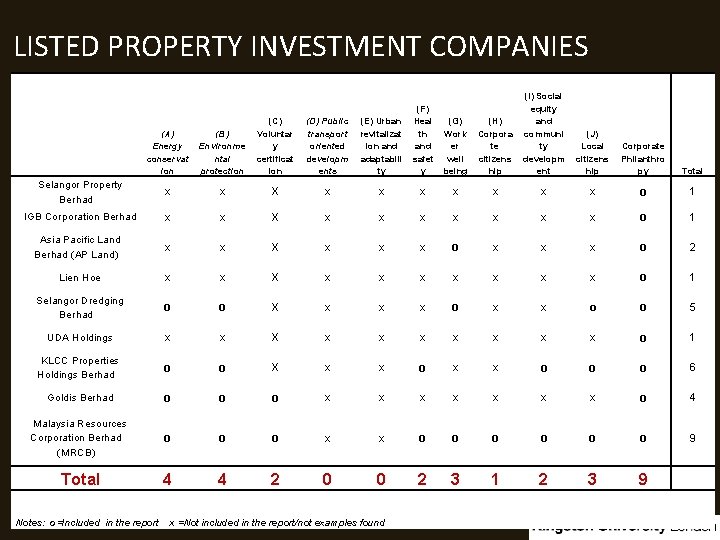
LISTED PROPERTY INVESTMENT COMPANIES (H) Corpora te citizens hip (I) Social equity and communi ty developm ent (J) Local citizens hip Corporate Philanthro py Total (A) Energy conservat ion (B) Environme ntal protection (C) Voluntar y certificat ion (D) Public transport oriented developm ents (E) Urban revitalizat ion and adaptabili ty (F) Heal th and safet y Selangor Property Berhad x x X x x x x o 1 IGB Corporation Berhad x x X x x x x o 1 Asia Pacific Land Berhad (AP Land) x x X x x x o 2 Lien Hoe x x X x x x x o 1 Selangor Dredging Berhad o o X x x x o o 5 UDA Holdings x x X x x x x o 1 KLCC Properties Holdings Berhad o o X x x o o o 6 Goldis Berhad o o o x x x x o 4 Malaysia Resources Corporation Berhad (MRCB) o o o x x o o o 9 Total 4 4 2 0 0 2 3 1 2 3 9 Notes: o=Included in the report x =Not included in the report/not examples found (G) Work er well being
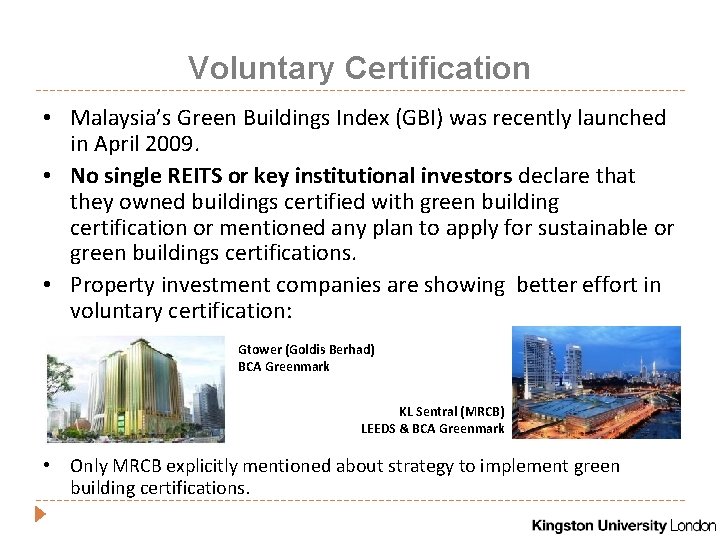
Voluntary Certification • Malaysia’s Green Buildings Index (GBI) was recently launched in April 2009. • No single REITS or key institutional investors declare that they owned buildings certified with green building certification or mentioned any plan to apply for sustainable or green buildings certifications. • Property investment companies are showing better effort in voluntary certification: Gtower (Goldis Berhad) BCA Greenmark KL Sentral (MRCB) LEEDS & BCA Greenmark • Only MRCB explicitly mentioned about strategy to implement green building certifications.
Corporate philanthropy • 6 REITS involved in corporate philanthropy i. e: contribution to education and social welfare: (YTL, Tower, Quill, Al-Hadharah, Axis, Hektar ) • All listed property investment companies and all key institutional investors are involved in corporate philanthropy • In the form of: cash donation, contribution to education eg: providing scholarships and practical training and social welfare. • Why report on corporate philanthropy: - activities to enhance their corporate image (Zulkifli & Amran, 2006) - quantifiable and easier to implement and to report (Mohd Yusof, 2008). - tax deduction (Amran, Ling & Sofri, 2007).
Conclusion § Environmental and sustainability disclosure is deplorably low across the property investment sector. § Evidence some of the Malaysian REITs and property investment companies are beginning to adopt sustainability practices § Next Stage: In-depth investigation § The Malaysian sustainability agenda is skewed more to notion of corporate philanthropy than environmental issues, which is in fairly sharp contrast to the approach of many developed countries where the property agenda has been dominated by ‘green’ concerns rather than social aspects of sustainability.

THANK YOU a. mohdaini@kingston. ac. uk School of Surveying & Planning Faculty of Art, Design & Architecture Kingston University London Acknowledgement: Producing. Leaders. Since 1905
- Slides: 29