
Disclaimer The views expressed are those of the
- Slides: 21
Disclaimer The views expressed are those of the authors and do not reflect the official policy or position of the Uniformed Services University of the Health Sciences, the Department of Defense, or the United States Government.
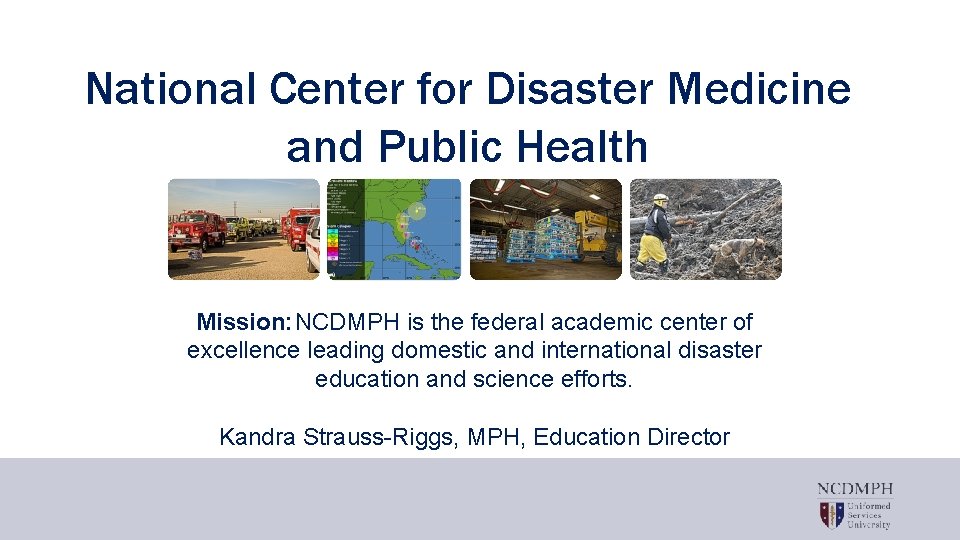
National Center for Disaster Medicine and Public Health Mission: NCDMPH is the federal academic center of excellence leading domestic and international disaster education and science efforts. Kandra Strauss-Riggs, MPH, Education Director
Origin Story Founded in 2008 under Homeland Security Presidential Directive 21 to be “…an academic center of excellence in disaster medicine and public health…”, and “…shall lead Federal efforts to develop and propagate core curricula, training, and research related to medicine and public health in disasters. ”
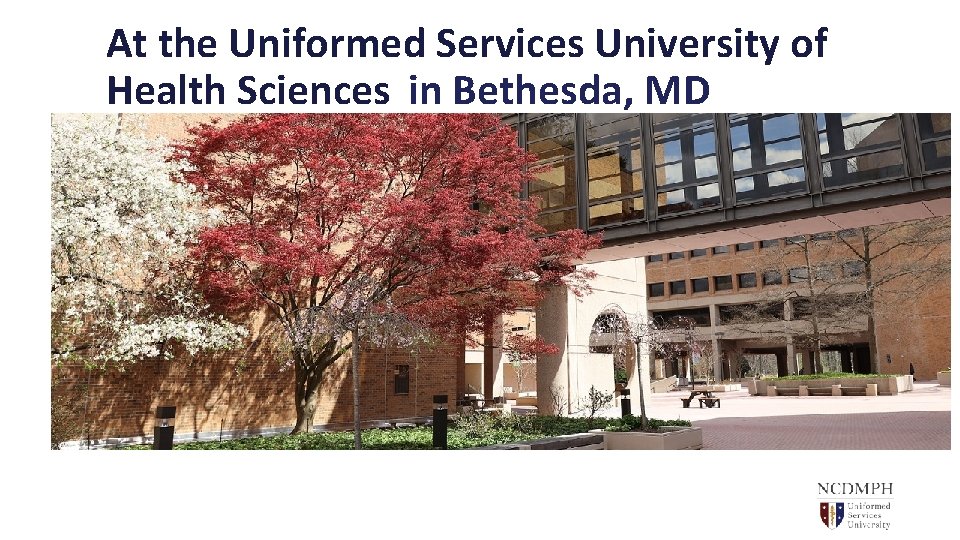
At the Uniformed Services University of Health Sciences in Bethesda, MD
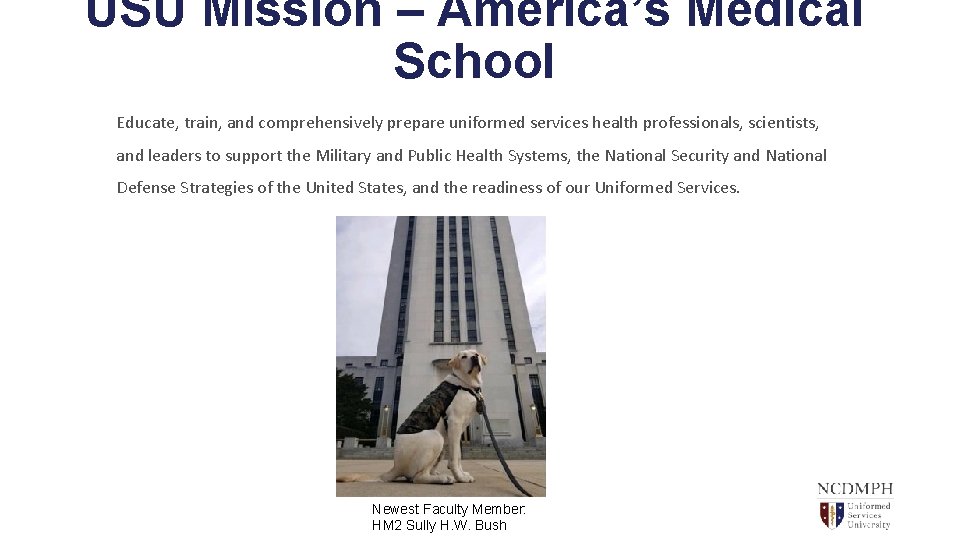
USU Mission – America’s Medical School Educate, train, and comprehensively prepare uniformed services health professionals, scientists, and leaders to support the Military and Public Health Systems, the National Security and National Defense Strategies of the United States, and the readiness of our Uniformed Services. Newest Faculty Member: HM 2 Sully H. W. Bush
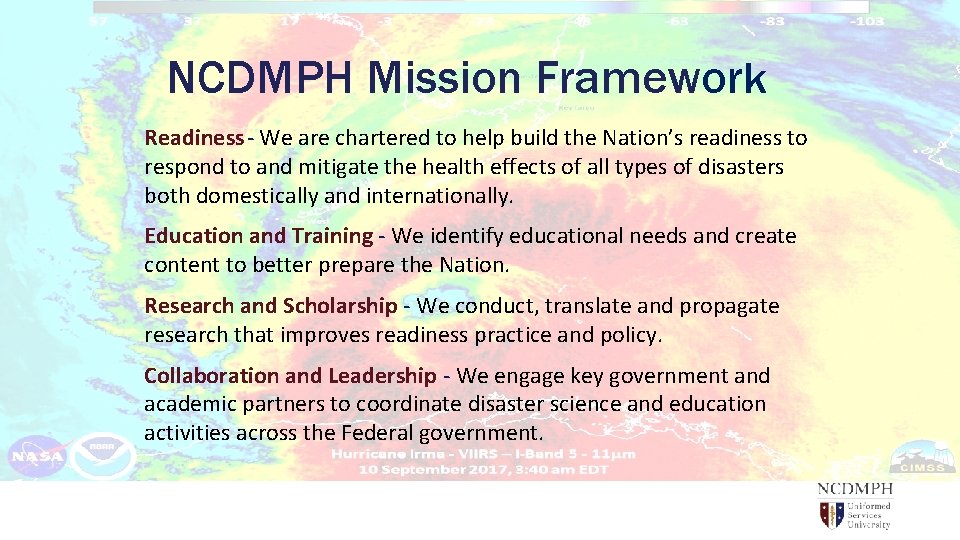
NCDMPH Mission Framework Readiness- We are chartered to help build the Nation’s readiness to respond to and mitigate the health effects of all types of disasters both domestically and internationally. Education and Training - We identify educational needs and create content to better prepare the Nation. Research and Scholarship - We conduct, translate and propagate research that improves readiness practice and policy. Collaboration and Leadership - We engage key government and academic partners to coordinate disaster science and education activities across the Federal government.
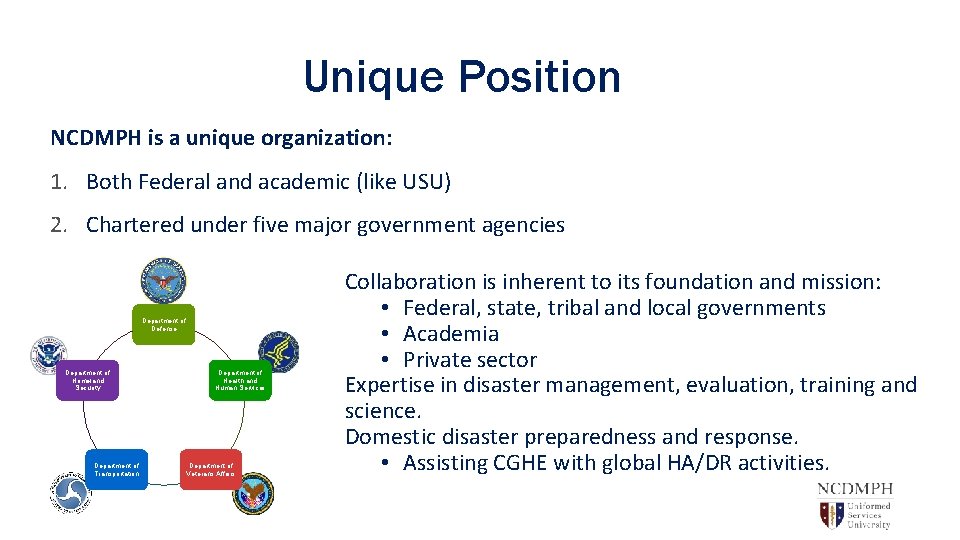
Unique Position NCDMPH is a unique organization: 1. Both Federal and academic (like USU) 2. Chartered under five major government agencies Department of Defense Department of Homeland Security Department of Transportation Department of Health and Human Services Department of Veterans Affairs Collaboration is inherent to its foundation and mission: • Federal, state, tribal and local governments • Academia • Private sector Expertise in disaster management, evaluation, training and science. Domestic disaster preparedness and response. • Assisting CGHE with global HA/DR activities.
Recent Collaborations • Inter-agency Working Group on Health Care System Preparedness • Stop the Bleed Education Consortium • American College of Emergency Physicians High Threat Emergency Casualty Care Task Force • National Academies of Science, Engineering & Medicine (NASEM, formerly IOM) Forum on Medical and Public Health Preparedness for Catastrophic Events • Navy War College, Brown University, Harvard Humanitarian Initiative, U. N. OCHA – Civilian-Military Humanitarian Assistance • EMS Agenda for the Future 2050 • NIST Hurricane Maria Recovery Project • Johns Hopkins Applied Physics Lab Healthcare Systems Modeling
Recent Research • Current state of disaster science funding: Disaster research funded by the US government (2011 -2016) characterized for the disciplines of engineering, emergency management, medicine, public health and social sciences. • Review of publicly available online disaster education courses • Currently available Humanitarian Assistance Disaster Response courses • Stop the Bleed: Translating military knowledge to civilian healthcare setting, testing retention and different modalities
Education Review Courses were identified from 4 course inventories: 1) National Library of Medicine Disaster Lit; 2) TRAIN National Learning Network; 3) FEMA National Preparedness Course; and 4) Preparedness and Emergency Response Learning Centers. An online search was performed using 30 disaster-related key words.
Education Review Preliminary Findings • 3, 662 trainings identified • Half of all trainings focused on three of 37 disaster capabilities and 38% of all courses was related to CBRNE (3 times that of natural hazards). • The educational approach was entirely knowledgebased for all courses and 99. 6% were designed to impart only lower levels of learning.
HA/DR Education Review Aim: Identify DOD training courses and educational opportunities that could be matched with disaster medicine and public health competencies and adult education theories. • 196 courses meeting inclusion criteria from across the Service branches and the Joint community of the DOD. • The findings yield evidence of clear gaps in education and training opportunities, including a lack of topics dealing with core public health and medical HA/DR competencies.
Gap Identified • Many courses available related to disaster medicine and public health • Formal curriculum does not focus on disaster medicine and public health • No course existed that is competency based for a wide range of health professionals
Core Competencies for Disaster Medicine and Public Health • Published in 2012 in the Disaster Medicine and Public Health Preparedness (DMPHP) journal • 11 core competencies (and 36 subcompetencies) identified as the common or "core" competencies that could be reasonably expected of all potential Emergency Support Function #8 health system responders
Core Competencies, Continued • Developed to address the education and training needs of all health professionals who may respond in a disaster • Collaboratively generated with subject matter experts from a variety of professional backgrounds • ASPPH and CDC developed public health preparedness competencies with these as part of the foundation
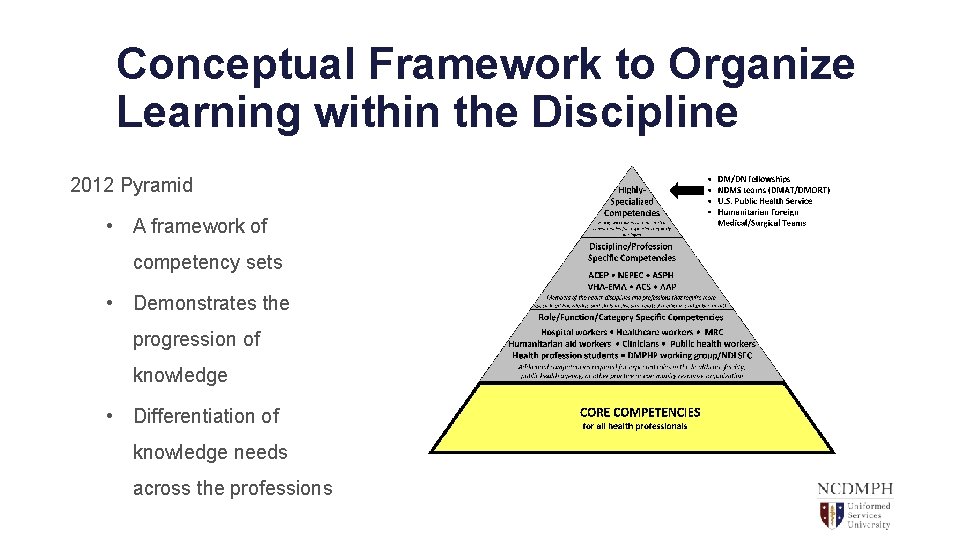
Conceptual Framework to Organize Learning within the Discipline 2012 Pyramid • A framework of competency sets • Demonstrates the progression of knowledge • Differentiation of knowledge needs across the professions
Core Curriculum Objectives • Demonstrate key skills required appropriate to the learner’s role to reduce morbidity and mortality in a disaster • Develop a personal to-do list to enhance one’s professional knowledge and skills in disaster medicine and public health • Identify key sources of information for additional learning to increase one’s professional knowledge and skills
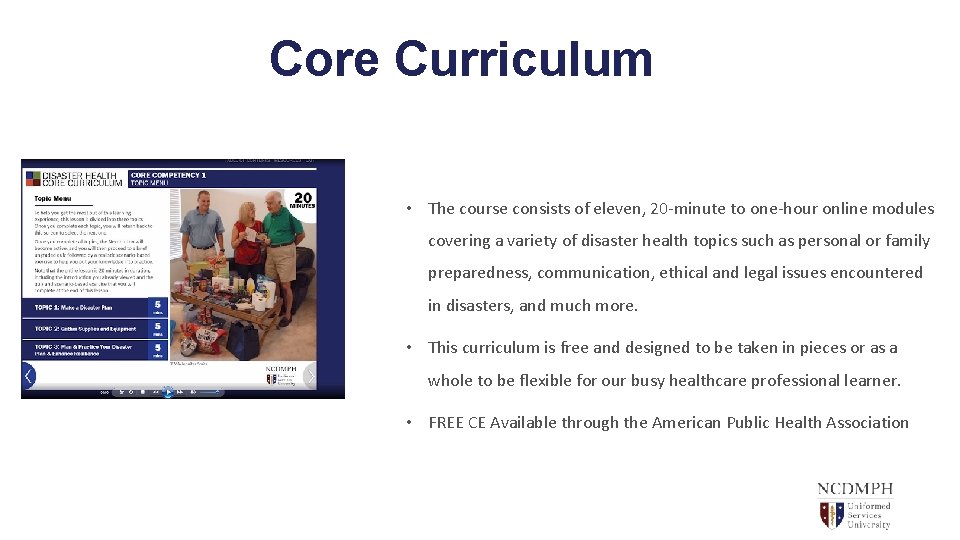
Core Curriculum • The course consists of eleven, 20 -minute to one-hour online modules covering a variety of disaster health topics such as personal or family preparedness, communication, ethical and legal issues encountered in disasters, and much more. • This curriculum is free and designed to be taken in pieces or as a whole to be flexible for our busy healthcare professional learner. • FREE CE Available through the American Public Health Association
Core Curriculum Introduction https: //www. youtube. com/watch? v=h. P_C 0_7 l. EXY&feature=youtu. be
Discussion Questions • How would you implement the core curriculum course in your coalition or workplace? • What are two facilitators for implementation? • What are two barriers to implementation in your setting? • How would you encourage your colleagues/coalition to take this online course?
Questions? https: //www. usuhs. edu/ncdmph https: //www. facebook. co m/NCDMPH 1/ @NCDMPH National Center for Disaster Medicine and Public Health