
Disciplined Agile Delivery The Foundation for Scaling AgileScrum




- Slides: 69
Disciplined Agile Delivery: The Foundation for Scaling Agile/Scrum Scott W. Ambler Senior Consulting Partner scott [at] scottambler. com @scottwambler Disciplined Agile Delivery
Feel free to ask questions at any time © Scott Ambler + Associates 2
Agenda • Disciplined Agile Delivery (DAD) – – – A Disciplined Agile Manifesto Foundations of DAD The DAD Lifecycle Goal Driven, Not Prescriptive DAD Roles and Teams • Scaling DAD – What it Means to Scale – Scaling Agile in Practice – Agile Practices that Support Scaling • Parting Thoughts © Scott Ambler + Associates 3
Part 1 Disciplined Agile Delivery (DAD) © Scott Ambler + Associates 4
Exercise: What Are You Doing on Agile Projects? • Organize into teams of 5 -8 people • Take a few minutes to introduce yourselves to one another • For 10 minutes, discuss within the team: – – What agile projects have you been on? What was different compared with non-agile ones? What was the same? What types of activities you do to initiate the project and how long did it take? (e. g. Did you do any initial modeling or planning? Did you need to get provide estimates go get funding? Other activities? ) – What activities did you do during construction? (e. g. How did you approach documentation? Planning? Testing? ) – What did you need to do to deploy/release your solution into production? How long did it take? • Someone needs to be a spokesperson for your team • A spokesperson will share a few key learnings with the larger group © Scott Ambler + Associates 5
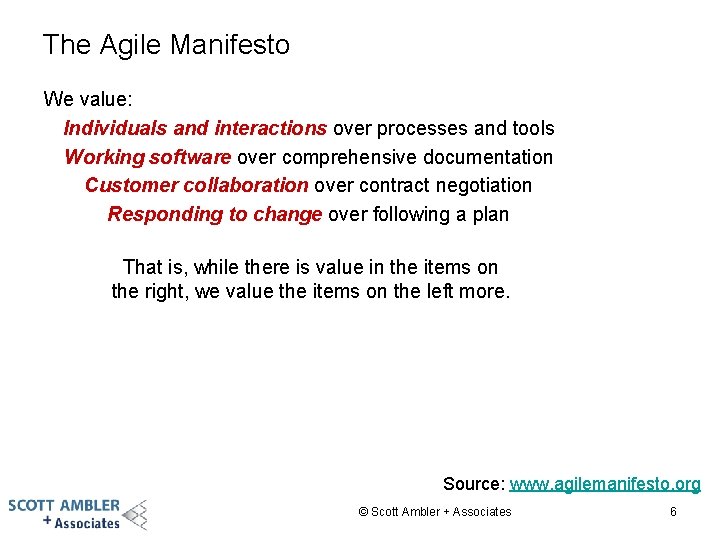
The Agile Manifesto We value: Individuals and interactions over processes and tools Working software over comprehensive documentation Customer collaboration over contract negotiation Responding to change over following a plan That is, while there is value in the items on the right, we value the items on the left more. Source: www. agilemanifesto. org © Scott Ambler + Associates 6
But… DAD Extends Agile Thinking Solutions, not just software Stakeholders, not just customers The organizational ecosystem, not just development teams © Scott Ambler + Associates 7
So… A Disciplined Agile Manifesto? We value: Individuals and interactions over processes and tools Working solutions over comprehensive documentation Stakeholder collaboration over contract negotiation Responding to change over following a plan That is, while there is value in the items on the right, we value the items on the left more. © Scott Ambler + Associates 8
DAD Principles – Extending the Twelve Principles of Agile Software (www. agilealliance. org) 1. Our highest priority is to satisfy the stakeholder through early and continuous delivery of valuable solutions. 2. Welcome changing requirements, even late in the solution delivery lifecycle. Agile processes harness change for the customer's competitive advantage. 3. Deliver working solutions frequently, from a couple of weeks to a couple of months, with a preference to the shorter time scale. 4. Stakeholders and developers must work together daily throughout the project. 5. Build projects around motivated individuals. Give them the environment and support they need, and trust them to get the job done. 6. The most efficient and effective method of conveying information to and within a delivery team is face-to-face conversation. 7. Quantified business value is the primary measure of progress. 8. Agile processes promote sustainable delivery. The sponsors, developers, and users should be able to maintain a constant pace indefinitely. © Scott Ambler + Associates 9
DAD Principles – Extending the Twelve Principles of Agile Software (www. agilealliance. org) cont. 9. Continuous attention to technical excellence and good design enhances agility. 10. Simplicity – the art of maximizing the amount of work not done – is essential. 11. The best architectures, requirements, and designs emerge from selforganizing teams. 12. At regular intervals, the team reflects on how to become more effective, then tunes and adjusts its behavior accordingly. 13. Leverage and evolve the assets within your organizational ecosystem, and collaborate with the people responsible for those assets to do so. 14. Visualize workflow to help achieve a smooth flow of delivery while keeping work in progress to a minimum. 15. The organizational ecosystem must evolve to reflect and enhance the efforts of agile teams, yet be sufficiently flexible to still support nonagile or hybrid teams © Scott Ambler + Associates 10
Exercise: Questioning Agile Claims • • Get back into your teams Choose three interesting claims from the following list – – • For 10 minutes discuss the three claims as a group How true is each claim? Is anything being glossed over? Reword each claim as “Existing claim although XYZ” – For example, “Development professionals know what to do” becomes “Development professionals know what to do although they aren’t process experts and may not know all options available to them” Claims: – – – Requirements evolve throughout the lifecycle Simple designs are best Teams should be self-organizing Delivery teams don’t need prescriptive process definitions Development professionals should validate their own work to the best of their ability – Disciplined agile teams work in an iterative manner • A spokesperson should be prepared to share a few key learnings with the larger group © Scott Ambler + Associates 11
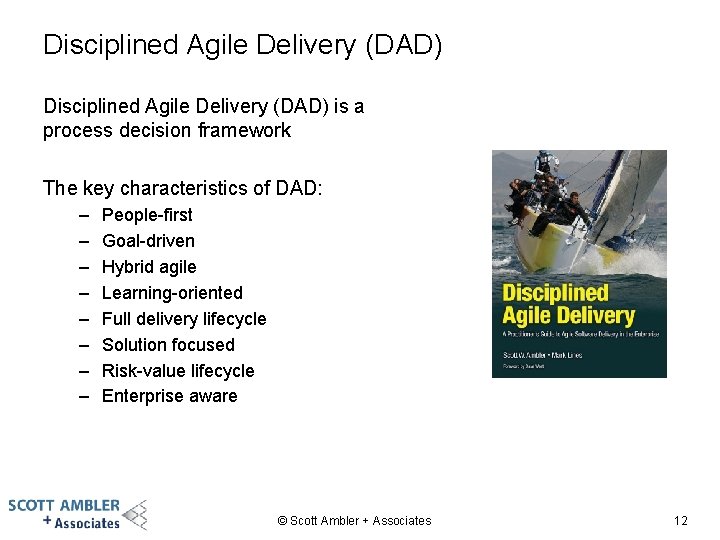
Disciplined Agile Delivery (DAD) is a process decision framework The key characteristics of DAD: – – – – People-first Goal-driven Hybrid agile Learning-oriented Full delivery lifecycle Solution focused Risk-value lifecycle Enterprise aware © Scott Ambler + Associates 12
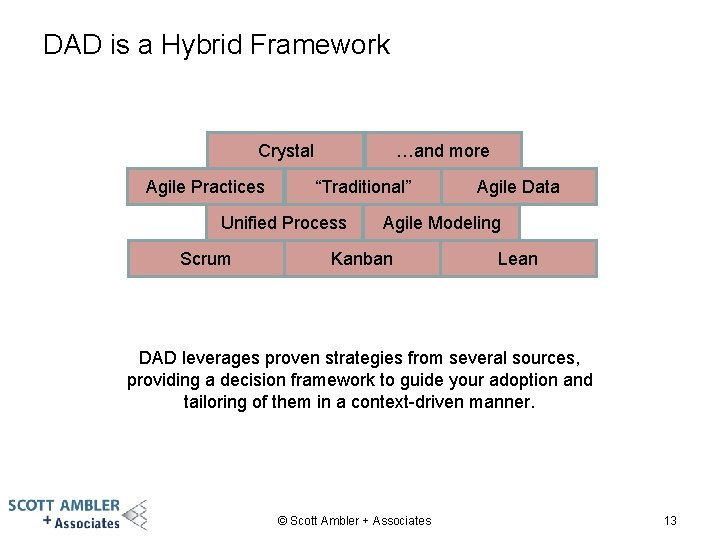
DAD is a Hybrid Framework Crystal Agile Practices …and more “Traditional” Unified Process Scrum Agile Data Agile Modeling Kanban Lean DAD leverages proven strategies from several sources, providing a decision framework to guide your adoption and tailoring of them in a context-driven manner. © Scott Ambler + Associates 13
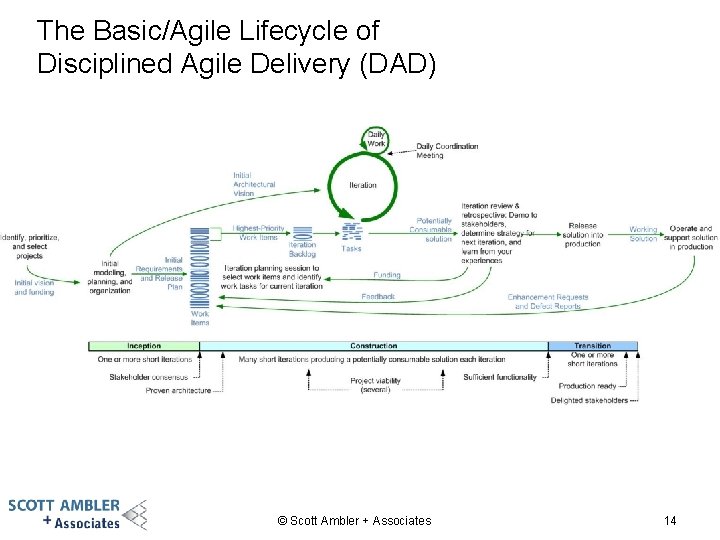
The Basic/Agile Lifecycle of Disciplined Agile Delivery (DAD) © Scott Ambler + Associates 14
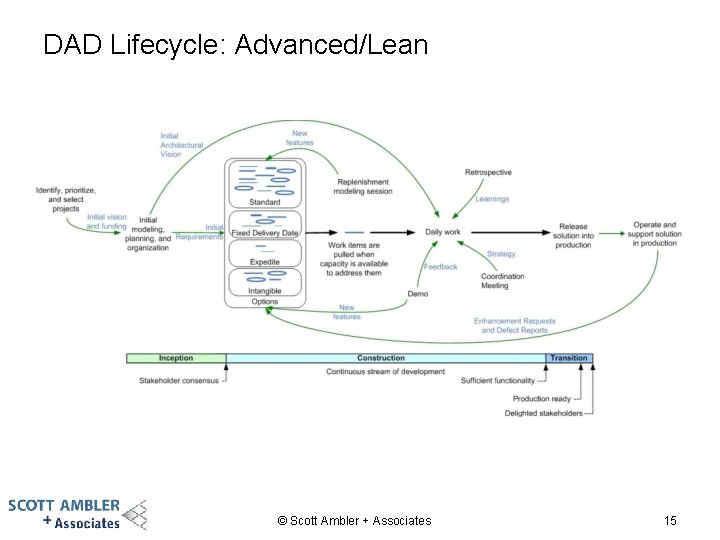
DAD Lifecycle: Advanced/Lean © Scott Ambler + Associates 15
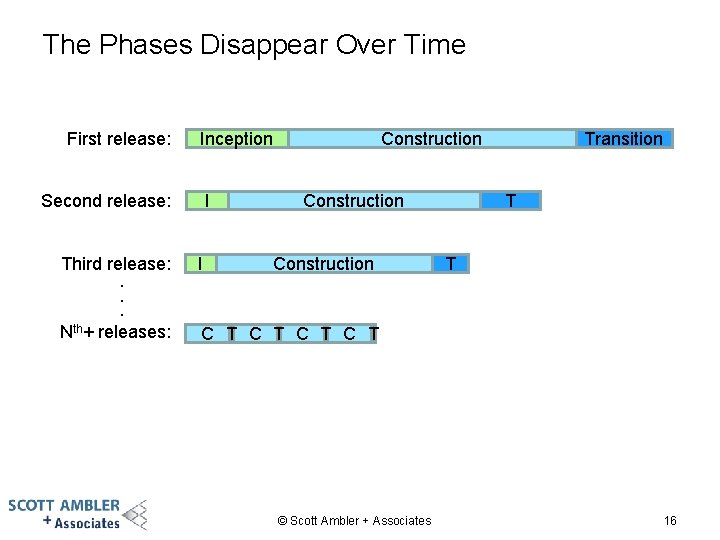
The Phases Disappear Over Time First release: Inception Second release: Third release: I I Construction Transition T T . . . Nth+ releases: C T C T © Scott Ambler + Associates 16
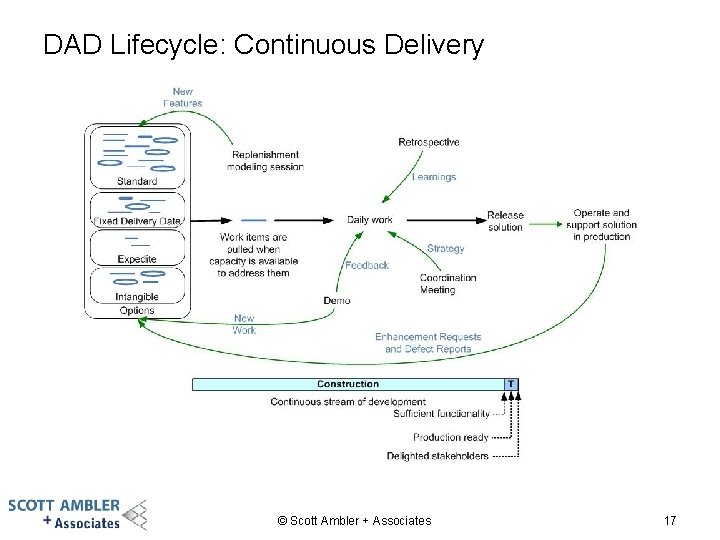
DAD Lifecycle: Continuous Delivery © Scott Ambler + Associates 17
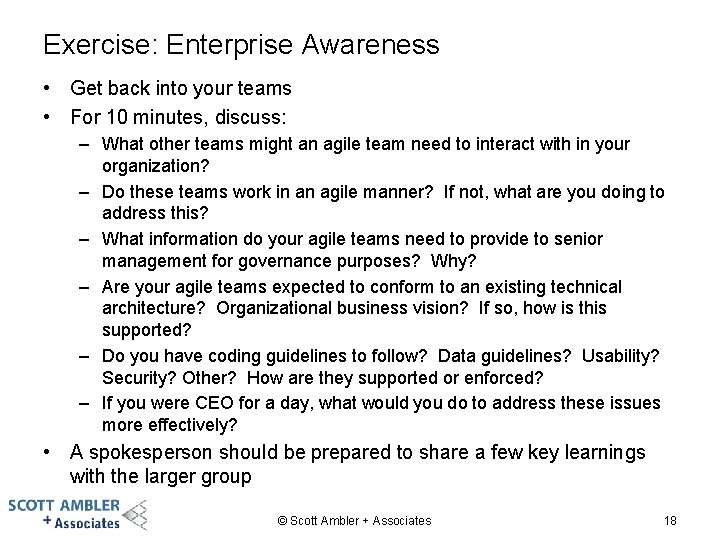
Exercise: Enterprise Awareness • Get back into your teams • For 10 minutes, discuss: – What other teams might an agile team need to interact with in your organization? – Do these teams work in an agile manner? If not, what are you doing to address this? – What information do your agile teams need to provide to senior management for governance purposes? Why? – Are your agile teams expected to conform to an existing technical architecture? Organizational business vision? If so, how is this supported? – Do you have coding guidelines to follow? Data guidelines? Usability? Security? Other? How are they supported or enforced? – If you were CEO for a day, what would you do to address these issues more effectively? • A spokesperson should be prepared to share a few key learnings with the larger group © Scott Ambler + Associates 18
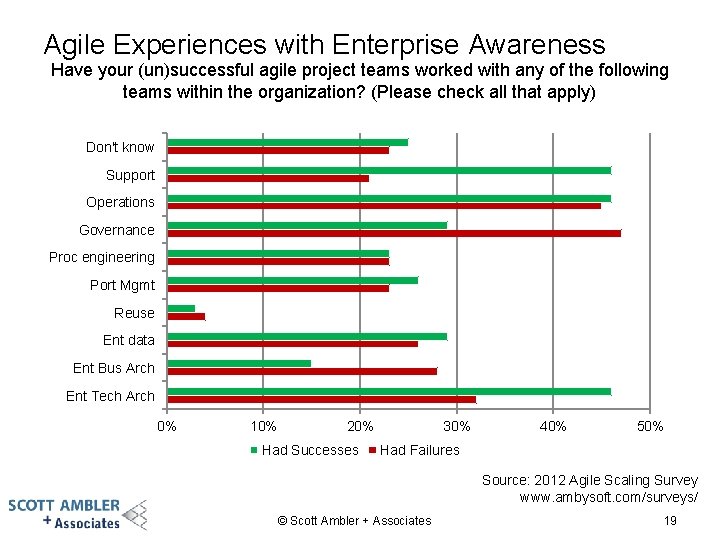
Agile Experiences with Enterprise Awareness Have your (un)successful agile project teams worked with any of the following teams within the organization? (Please check all that apply) Don't know Support Operations Governance Proc engineering Port Mgmt Reuse Ent data Ent Bus Arch Ent Tech Arch 0% 10% 20% Had Successes 30% 40% 50% Had Failures Source: 2012 Agile Scaling Survey www. ambysoft. com/surveys/ © Scott Ambler + Associates 19
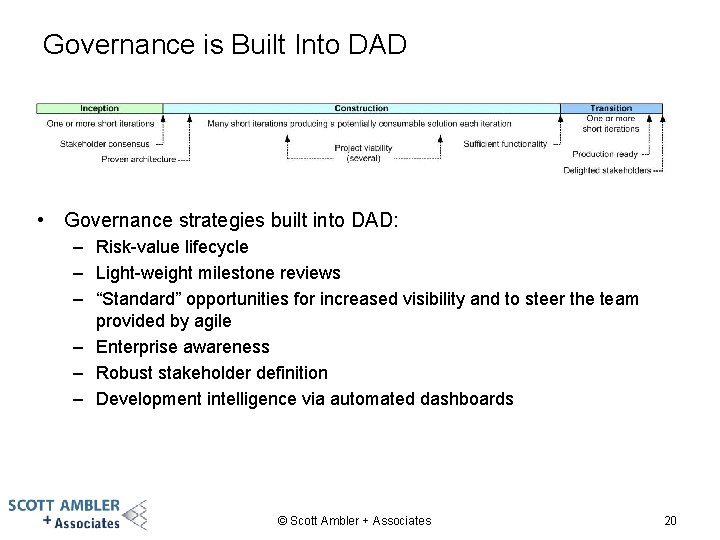
Governance is Built Into DAD • Governance strategies built into DAD: – Risk-value lifecycle – Light-weight milestone reviews – “Standard” opportunities for increased visibility and to steer the team provided by agile – Enterprise awareness – Robust stakeholder definition – Development intelligence via automated dashboards © Scott Ambler + Associates 20
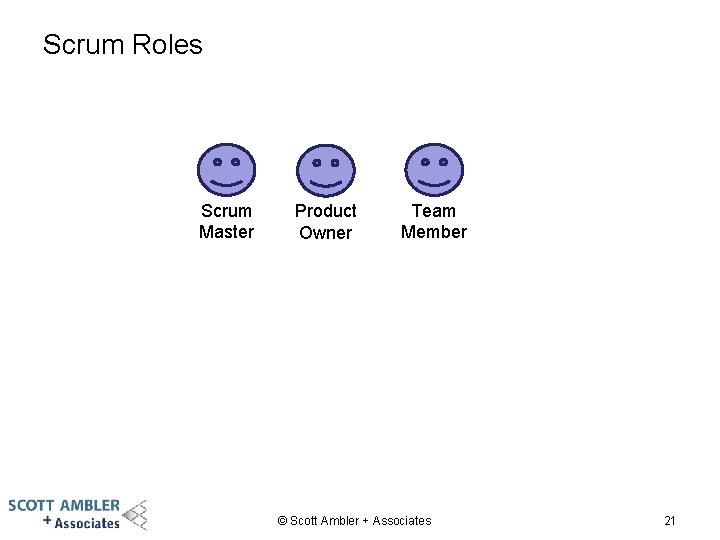
Scrum Roles Scrum Master Product Owner Team Member © Scott Ambler + Associates 21
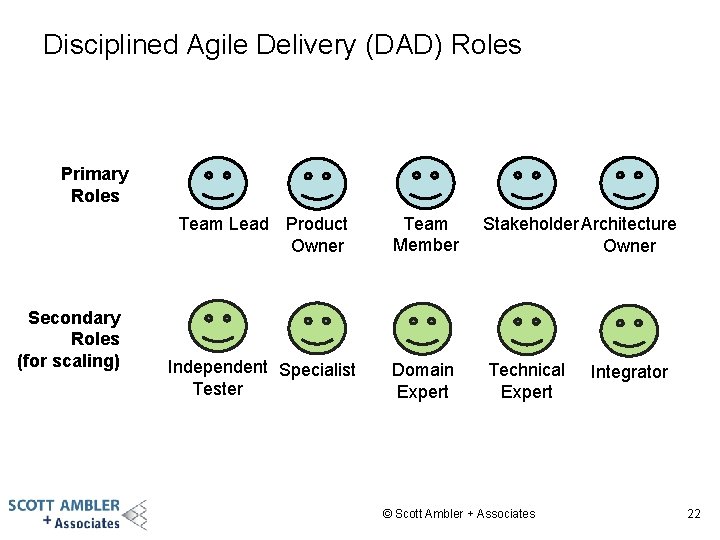
Disciplined Agile Delivery (DAD) Roles Primary Roles Secondary Roles (for scaling) Team Lead Product Owner Team Member Independent Specialist Tester Domain Expert Stakeholder Architecture Owner Technical Expert © Scott Ambler + Associates Integrator 22
Exercise: Transitioning to DAD Roles • Get back into your teams • Choose two of the following “traditional” roles: – – – Business analyst Project manager QA professional Database administrator Tester • For five minutes, discuss: – Of the DAD roles previously described, which one(s) are the most likely ones for a person in each role to move to? – What strengths do they bring to that role? – What challenges will they face? • A spokesperson should be prepared to share a few key learnings with the larger group © Scott Ambler + Associates 23
Forming DAD Teams Effective teams follow the 4 th and 5 th principles of the Agile Manifesto: – Stakeholders and developers must work together daily throughout the project – Build projects around motivated individuals. Give them the environment and support they need, and trust them to get the job done © Scott Ambler + Associates 24
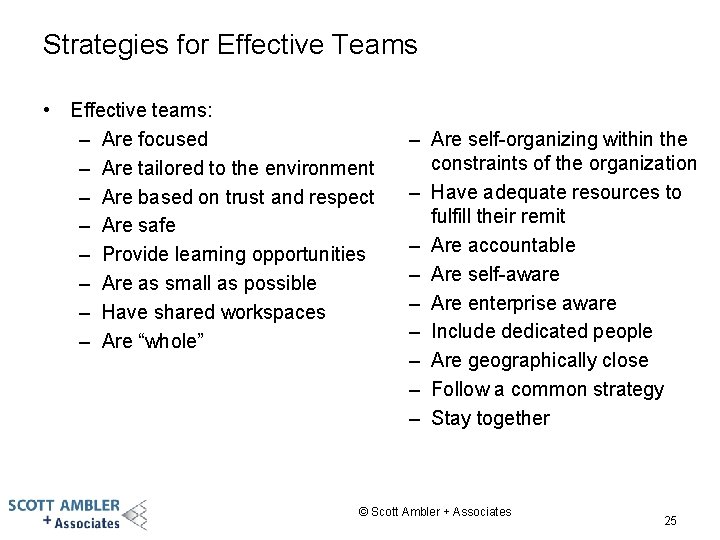
Strategies for Effective Teams • Effective teams: – Are focused – Are tailored to the environment – Are based on trust and respect – Are safe – Provide learning opportunities – Are as small as possible – Have shared workspaces – Are “whole” – Are self-organizing within the constraints of the organization – Have adequate resources to fulfill their remit – Are accountable – Are self-aware – Are enterprise aware – Include dedicated people – Are geographically close – Follow a common strategy – Stay together © Scott Ambler + Associates 25
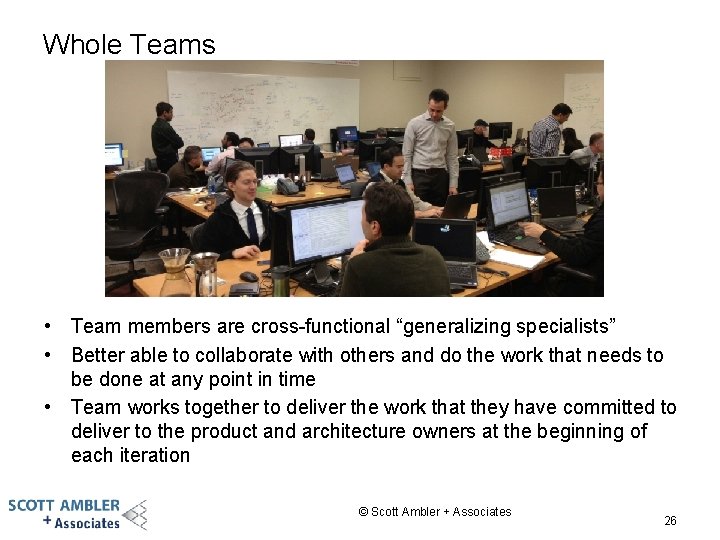
Whole Teams • Team members are cross-functional “generalizing specialists” • Better able to collaborate with others and do the work that needs to be done at any point in time • Team works together to deliver the work that they have committed to deliver to the product and architecture owners at the beginning of each iteration © Scott Ambler + Associates 26
Exercise: Agile teaming challenges • Get back into your teams • Take 10 minutes to discuss within the team: – What challenges does your organization face when forming agile teams? – What experiences have you had with forming small, medium, and large project teams? How did things differ? – What experiences have you had organizing project teams with different levels of geographic distribution? Everyone in the same work room? Everyone on same floor? Same building? Same city? Same country? Global? • A spokesperson should be prepared to share a few key learnings with the larger group © Scott Ambler + Associates 27
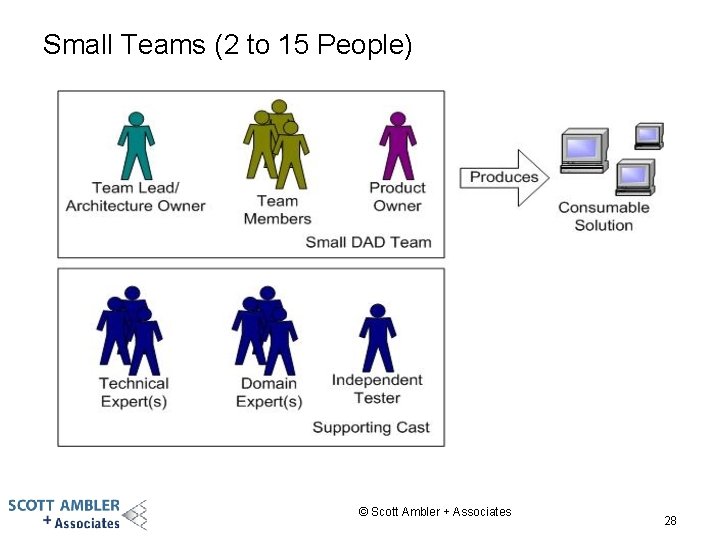
Small Teams (2 to 15 People) © Scott Ambler + Associates 28
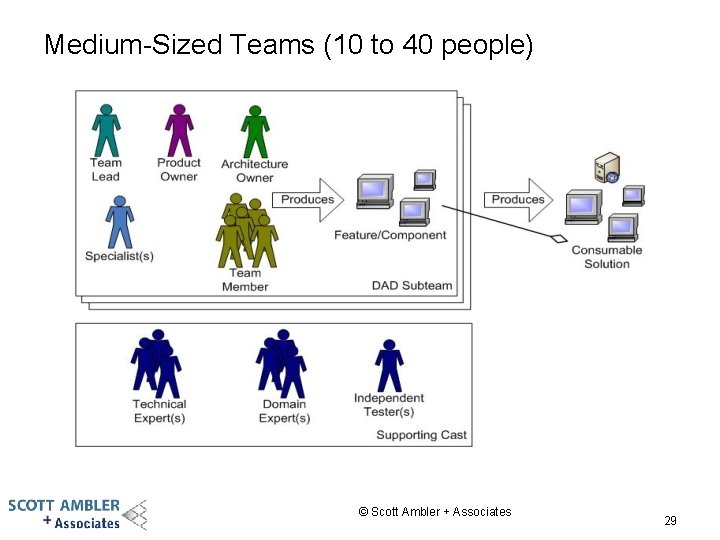
Medium-Sized Teams (10 to 40 people) © Scott Ambler + Associates 29
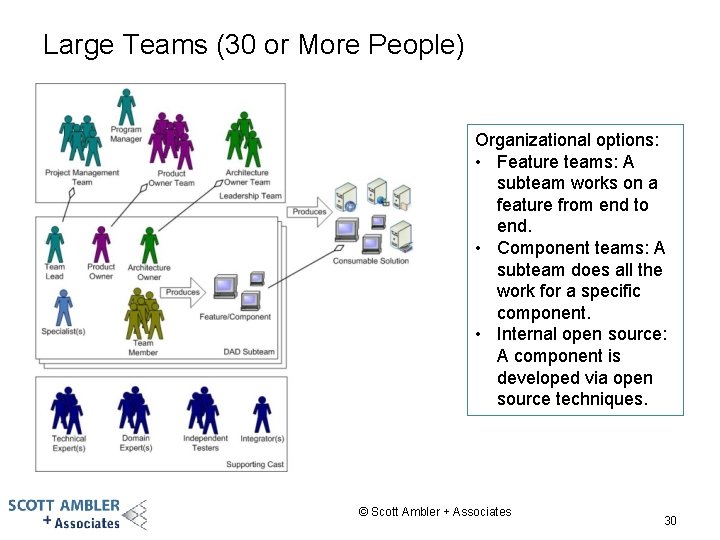
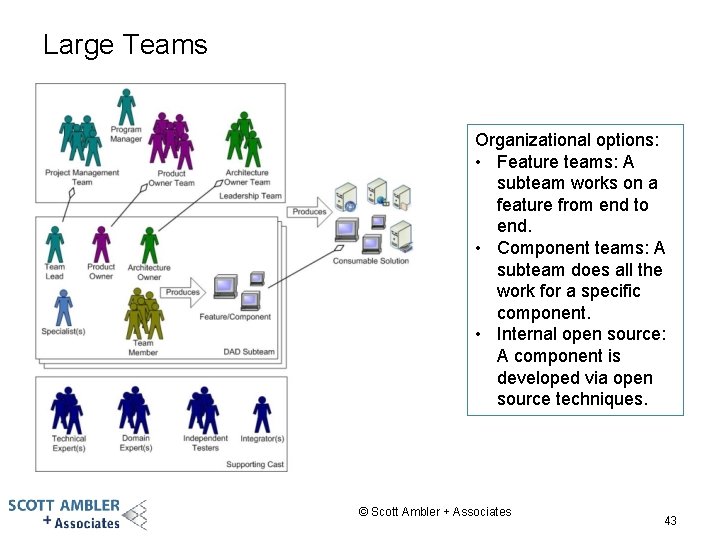
Large Teams (30 or More People) Organizational options: • Feature teams: A subteam works on a feature from end to end. • Component teams: A subteam does all the work for a specific component. • Internal open source: A component is developed via open source techniques. © Scott Ambler + Associates 30
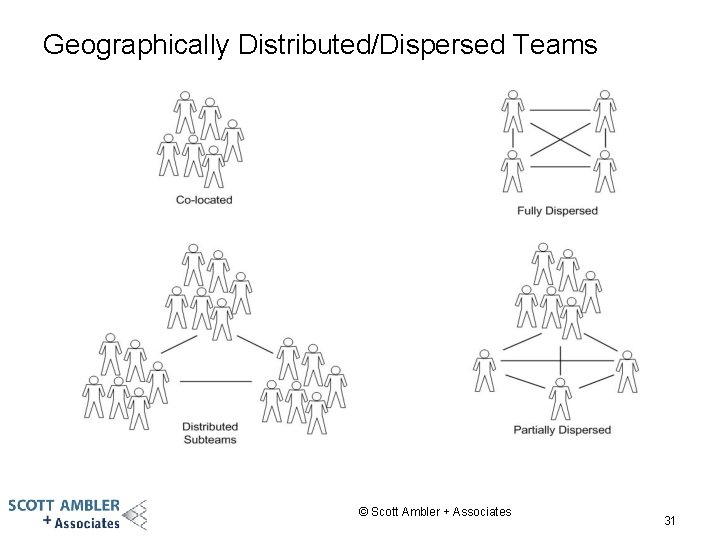
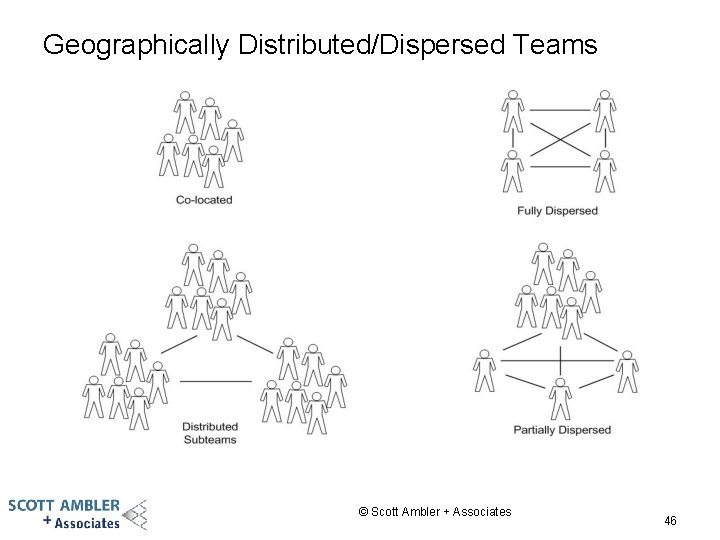
Geographically Distributed/Dispersed Teams © Scott Ambler + Associates 31
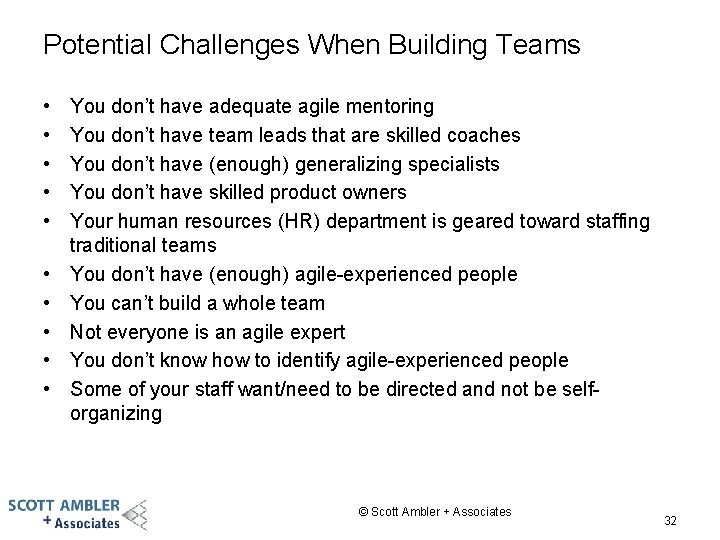
Potential Challenges When Building Teams • • • You don’t have adequate agile mentoring You don’t have team leads that are skilled coaches You don’t have (enough) generalizing specialists You don’t have skilled product owners Your human resources (HR) department is geared toward staffing traditional teams You don’t have (enough) agile-experienced people You can’t build a whole team Not everyone is an agile expert You don’t know how to identify agile-experienced people Some of your staff want/need to be directed and not be selforganizing © Scott Ambler + Associates 32
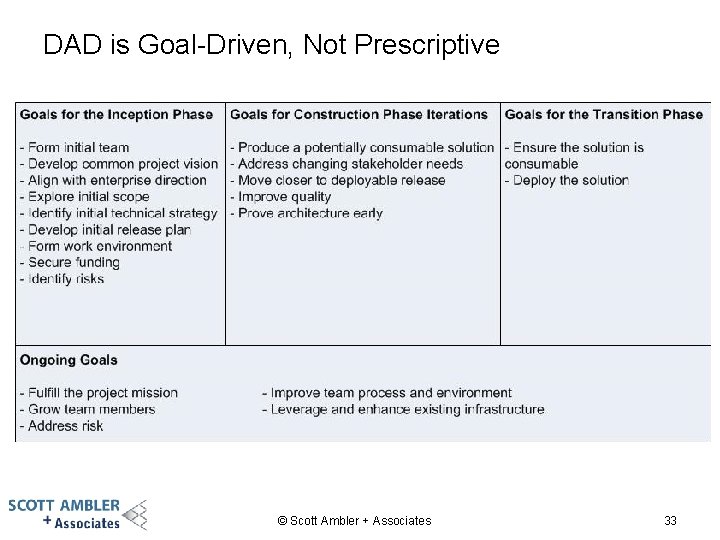
DAD is Goal-Driven, Not Prescriptive © Scott Ambler + Associates 33
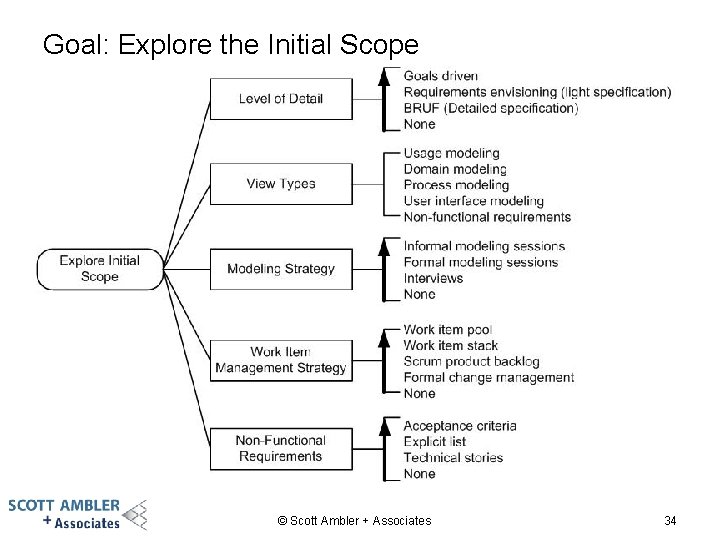
Goal: Explore the Initial Scope © Scott Ambler + Associates 34
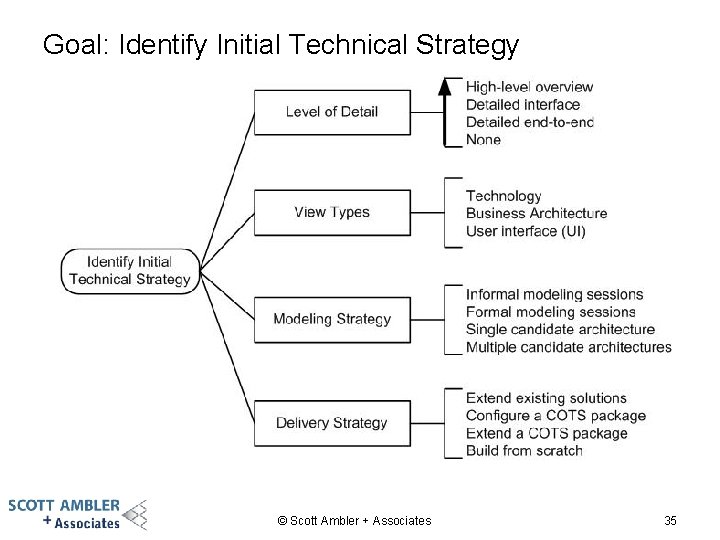
Goal: Identify Initial Technical Strategy © Scott Ambler + Associates 35
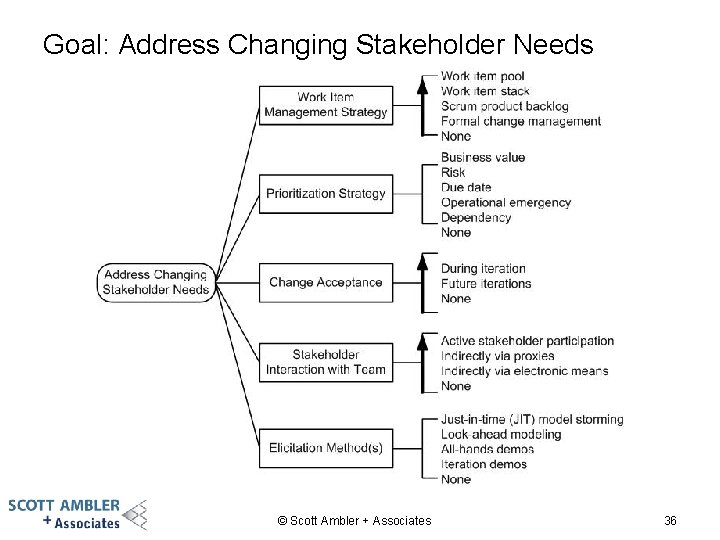
Goal: Address Changing Stakeholder Needs © Scott Ambler + Associates 36
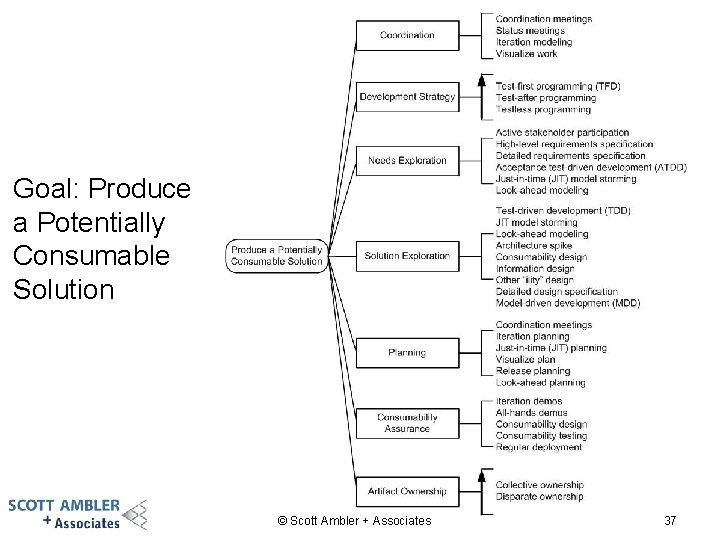
Goal: Produce a Potentially Consumable Solution © Scott Ambler + Associates 37
Exercise: Tailoring Factors • Get back into your smaller teams • Take 10 minutes to discuss within the team: § Considering the goal diagrams on the previous slide, what factors would you decide how to tailor your approach? § Where possible, discuss actual agile projects and compare the differences in situations that you faced • A spokesperson will share a few key learnings with the larger group © Scott Ambler + Associates 38
Part 2 Scaling DAD © Scott Ambler + Associates 39
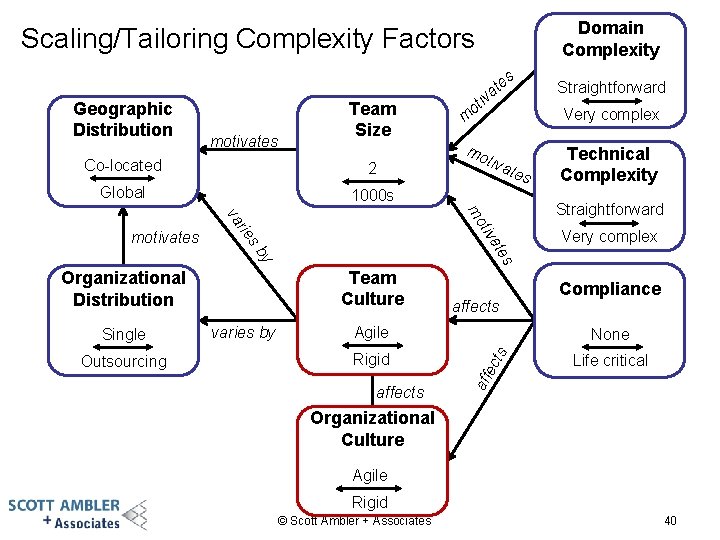
Domain Complexity Scaling/Tailoring Complexity Factors s motivates Team Size Co-located 2 Global 1000 s tes varies by Technical Complexity Straightforward Very complex tes y Outsourcing tiva va sb Team Culture Organizational Distribution Single mo Straightforward Very complex ti mo rie va motivates o m affects Agile Rigid affects Compliance None aff ec ts Geographic Distribution tiv e at Life critical Organizational Culture Agile Rigid © Scott Ambler + Associates 40
Exercise: Exploring the Initial Scope • Get back into your smaller teams • Goal: § In 10 min create a project profile focused on exploring the initial scope • Instructions: § Identify the team member(s) who have been involved with an agile team where some initial requirements elicitation occurred. If there are several, quickly discuss each project and choose the one most interesting to you § Describe how the team approached initial requirements elicitation – How much effort was it? What artifacts were created? Who was involved? How was the output used by the team? How were the requirements validated? § Describe the project, considering the complexity factors described previously § What are the advantages and disadvantages of what the team did? Think short term and long term. • A spokesperson will share a few key learnings with the larger group © Scott Ambler + Associates 41
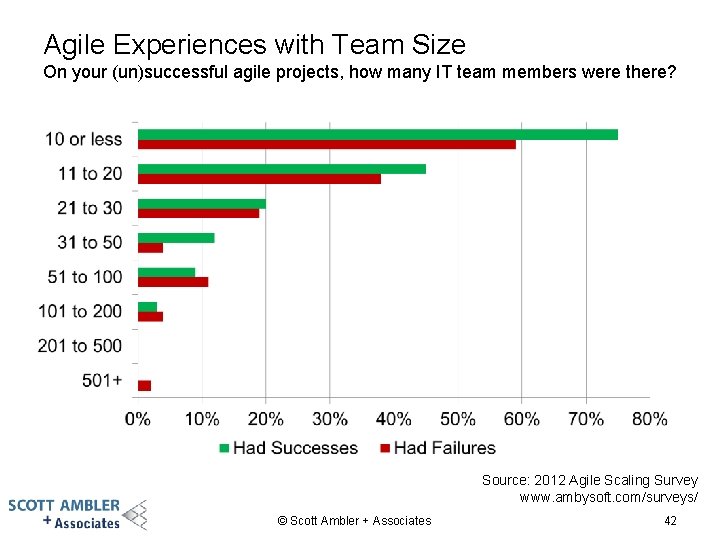
Agile Experiences with Team Size On your (un)successful agile projects, how many IT team members were there? Source: 2012 Agile Scaling Survey www. ambysoft. com/surveys/ © Scott Ambler + Associates 42
Large Teams Organizational options: • Feature teams: A subteam works on a feature from end to end. • Component teams: A subteam does all the work for a specific component. • Internal open source: A component is developed via open source techniques. © Scott Ambler + Associates 43
Exercise: Large Team Organization • Get back into your smaller teams • Instructions: – Take 10 minutes to discuss the feature team, component team, and internal open source organizational strategies – What are the advantages and disadvantages of each? – What do you need to do to make each strategy work? During Inception, Construction, and Transition? – How would each strategy affect the goals of Identify an Initial Technical Strategy and Produce a Potentially Consumable Solution • A spokesperson will share a few key learnings with the larger group © Scott Ambler + Associates 44
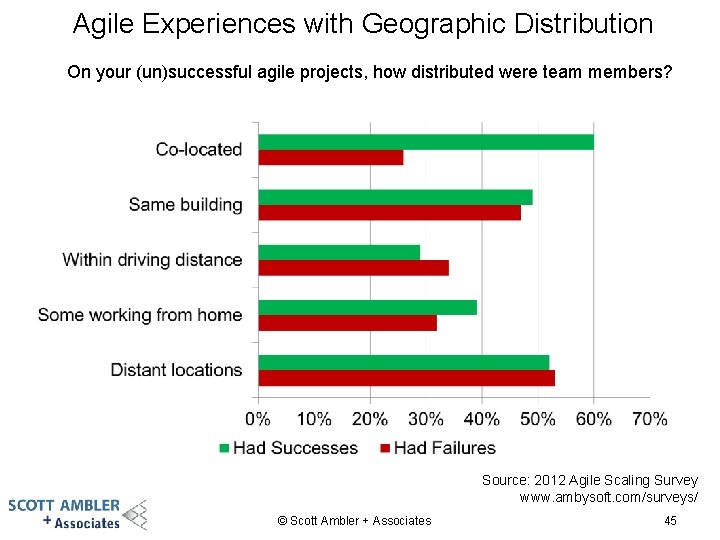
Agile Experiences with Geographic Distribution On your (un)successful agile projects, how distributed were team members? Source: 2012 Agile Scaling Survey www. ambysoft. com/surveys/ © Scott Ambler + Associates 45
Geographically Distributed/Dispersed Teams © Scott Ambler + Associates 46
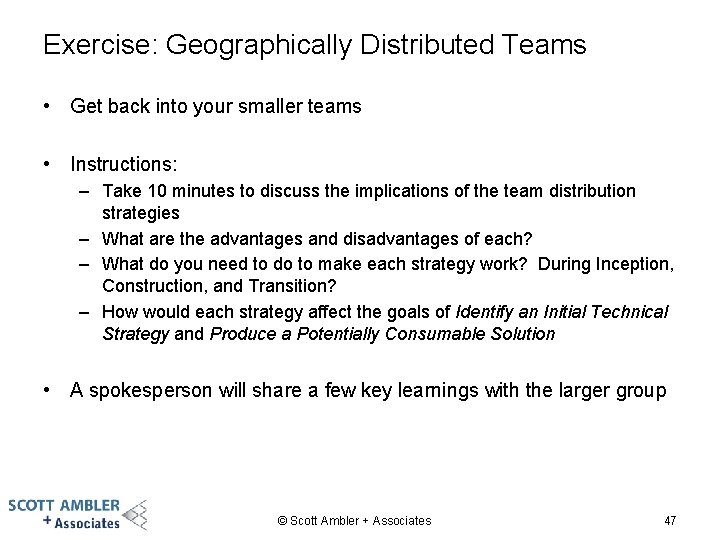
Exercise: Geographically Distributed Teams • Get back into your smaller teams • Instructions: – Take 10 minutes to discuss the implications of the team distribution strategies – What are the advantages and disadvantages of each? – What do you need to do to make each strategy work? During Inception, Construction, and Transition? – How would each strategy affect the goals of Identify an Initial Technical Strategy and Produce a Potentially Consumable Solution • A spokesperson will share a few key learnings with the larger group © Scott Ambler + Associates 47
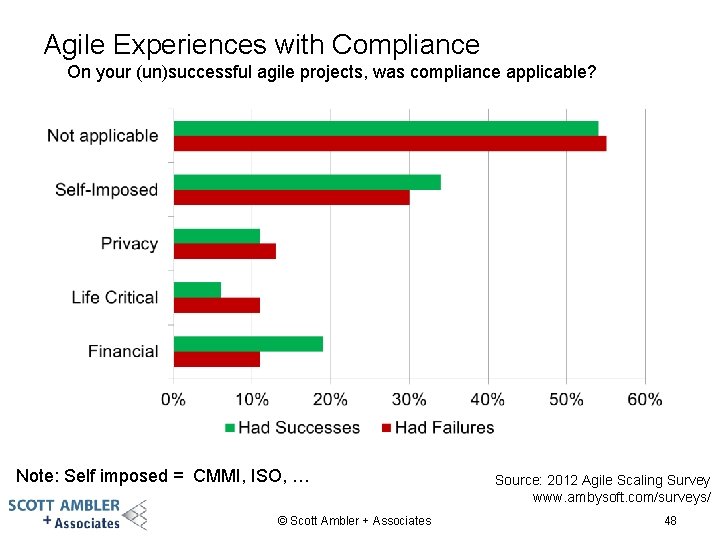
Agile Experiences with Compliance On your (un)successful agile projects, was compliance applicable? Note: Self imposed = CMMI, ISO, … © Scott Ambler + Associates Source: 2012 Agile Scaling Survey www. ambysoft. com/surveys/ 48
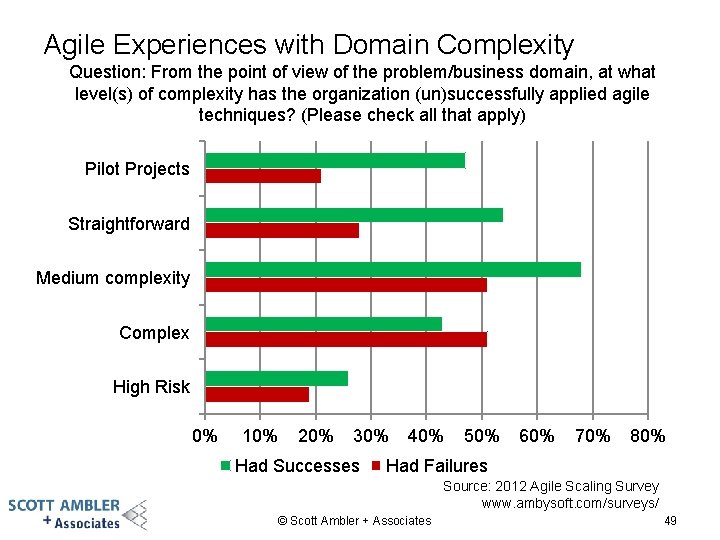
Agile Experiences with Domain Complexity Question: From the point of view of the problem/business domain, at what level(s) of complexity has the organization (un)successfully applied agile techniques? (Please check all that apply) Pilot Projects Straightforward Medium complexity Complex High Risk 0% 10% 20% 30% Had Successes 40% 50% 60% 70% 80% Had Failures Source: 2012 Agile Scaling Survey www. ambysoft. com/surveys/ © Scott Ambler + Associates 49
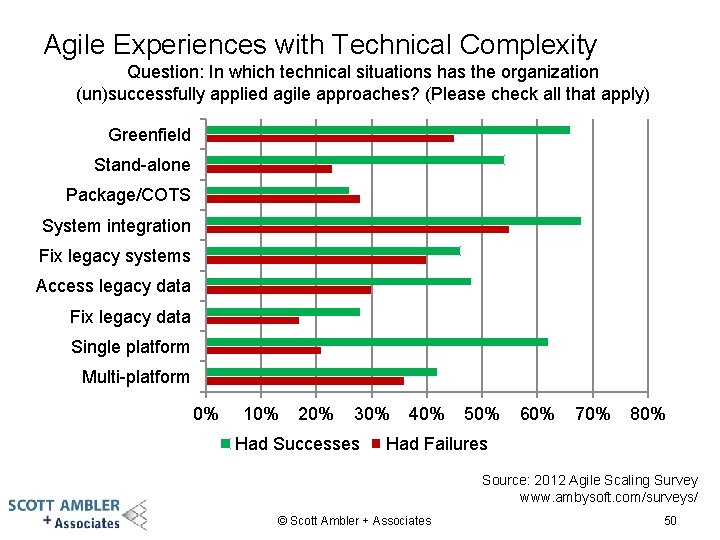
Agile Experiences with Technical Complexity Question: In which technical situations has the organization (un)successfully applied agile approaches? (Please check all that apply) Greenfield Stand-alone Package/COTS System integration Fix legacy systems Access legacy data Fix legacy data Single platform Multi-platform 0% 10% 20% 30% Had Successes 40% 50% 60% 70% 80% Had Failures Source: 2012 Agile Scaling Survey www. ambysoft. com/surveys/ © Scott Ambler + Associates 50
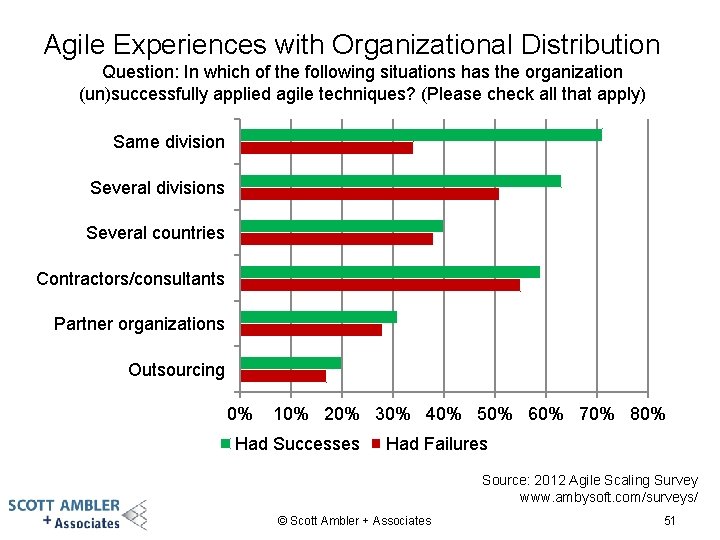
Agile Experiences with Organizational Distribution Question: In which of the following situations has the organization (un)successfully applied agile techniques? (Please check all that apply) Same division Several divisions Several countries Contractors/consultants Partner organizations Outsourcing 0% 10% 20% 30% 40% 50% 60% 70% 80% Had Successes Had Failures Source: 2012 Agile Scaling Survey www. ambysoft. com/surveys/ © Scott Ambler + Associates 51
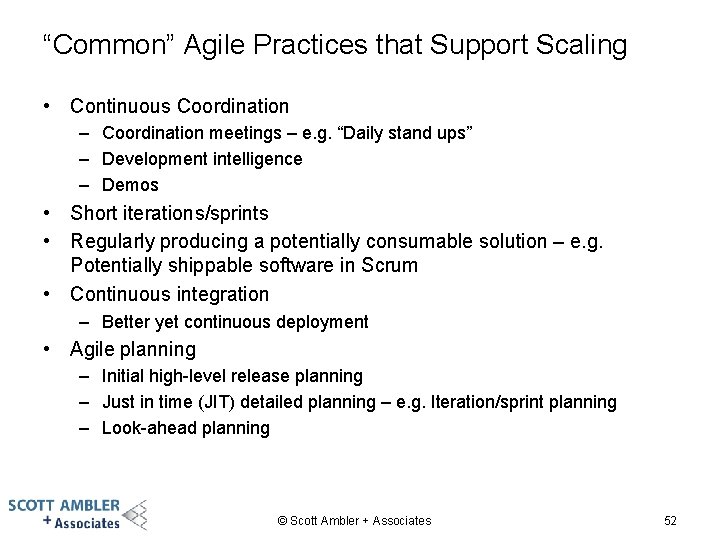
“Common” Agile Practices that Support Scaling • Continuous Coordination – Coordination meetings – e. g. “Daily stand ups” – Development intelligence – Demos • Short iterations/sprints • Regularly producing a potentially consumable solution – e. g. Potentially shippable software in Scrum • Continuous integration – Better yet continuous deployment • Agile planning – Initial high-level release planning – Just in time (JIT) detailed planning – e. g. Iteration/sprint planning – Look-ahead planning © Scott Ambler + Associates 52
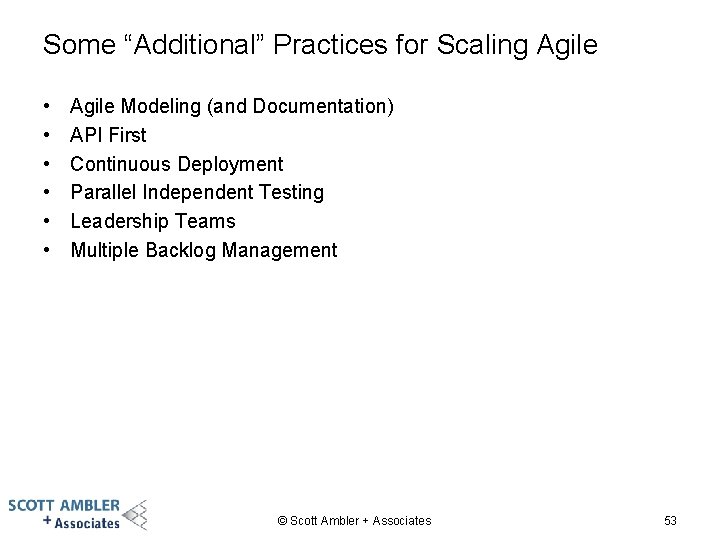
Some “Additional” Practices for Scaling Agile • • • Agile Modeling (and Documentation) API First Continuous Deployment Parallel Independent Testing Leadership Teams Multiple Backlog Management © Scott Ambler + Associates 53
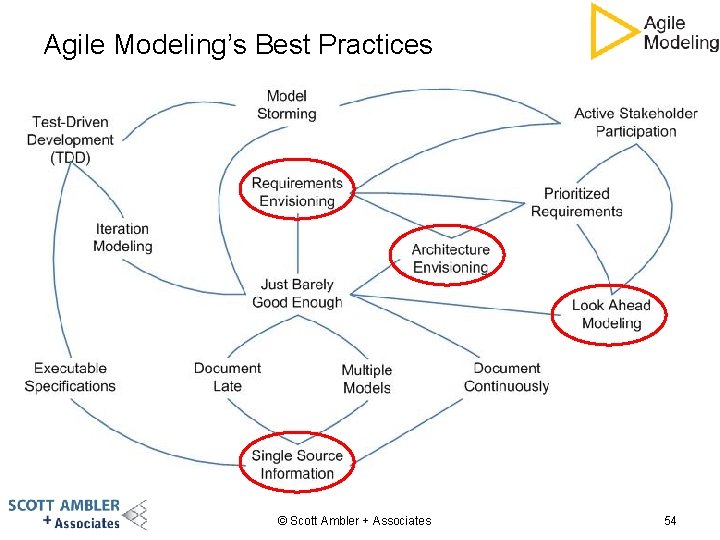
Agile Modeling’s Best Practices © Scott Ambler + Associates 54
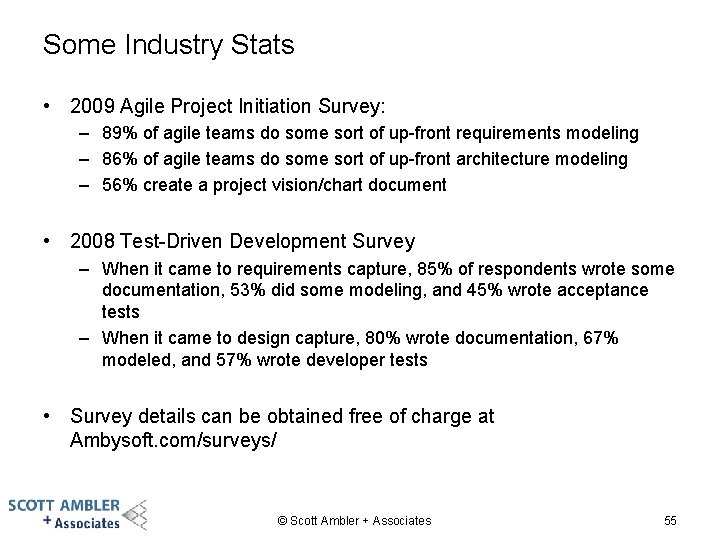
Some Industry Stats • 2009 Agile Project Initiation Survey: – 89% of agile teams do some sort of up-front requirements modeling – 86% of agile teams do some sort of up-front architecture modeling – 56% create a project vision/chart document • 2008 Test-Driven Development Survey – When it came to requirements capture, 85% of respondents wrote some documentation, 53% did some modeling, and 45% wrote acceptance tests – When it came to design capture, 80% wrote documentation, 67% modeled, and 57% wrote developer tests • Survey details can be obtained free of charge at Ambysoft. com/surveys/ © Scott Ambler + Associates 55
API First • When there are many people developing a shared set of components you should invest time at the beginning of the project to identify the components and define the interfaces to those components – “Component” is used to indicate any shared technical resource such as a set of web services, a shared data source, a programming library, a framework, and so on – Many teams will choose to write the interface stubs and tests at this time so that they have something to integrate • Effectively a rigorous application of Agile Model’s Architecture Envisioning and Just Barely Good Enough practices • API First is a practice of The Eclipse Way • Also known as Contract Model in Agile Modeling © Scott Ambler + Associates 56
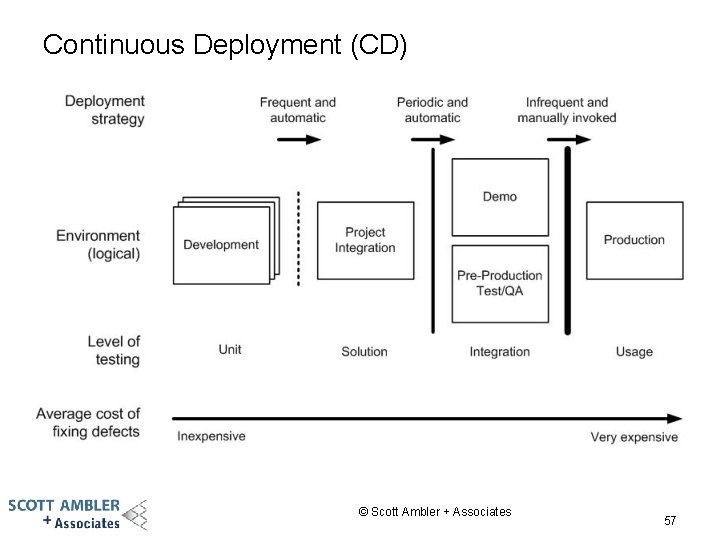
Continuous Deployment (CD) © Scott Ambler + Associates 57
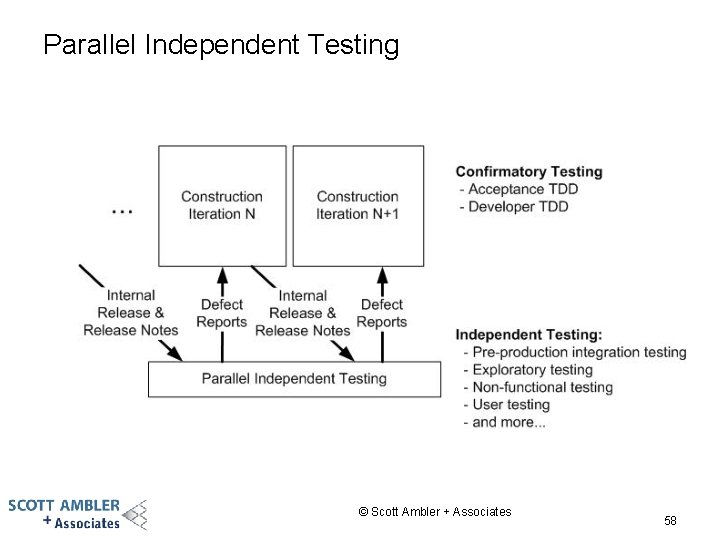
Parallel Independent Testing © Scott Ambler + Associates 58
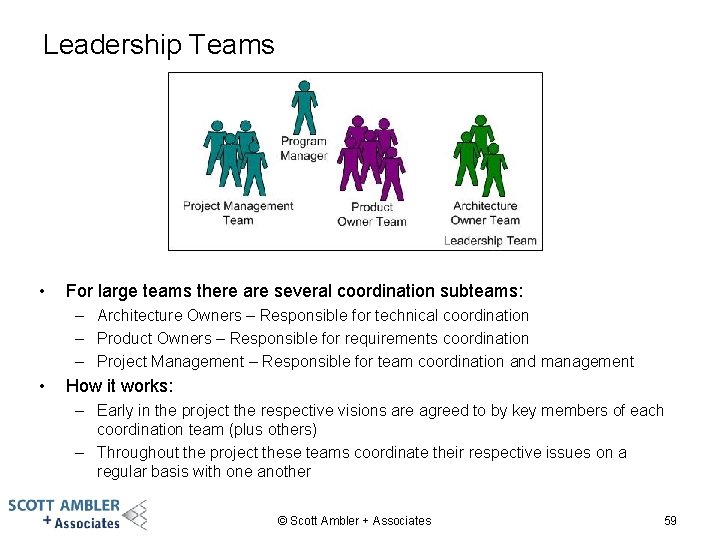
Leadership Teams • For large teams there are several coordination subteams: – Architecture Owners – Responsible for technical coordination – Product Owners – Responsible for requirements coordination – Project Management – Responsible for team coordination and management • How it works: – Early in the project the respective visions are agreed to by key members of each coordination team (plus others) – Throughout the project these teams coordinate their respective issues on a regular basis with one another © Scott Ambler + Associates 59
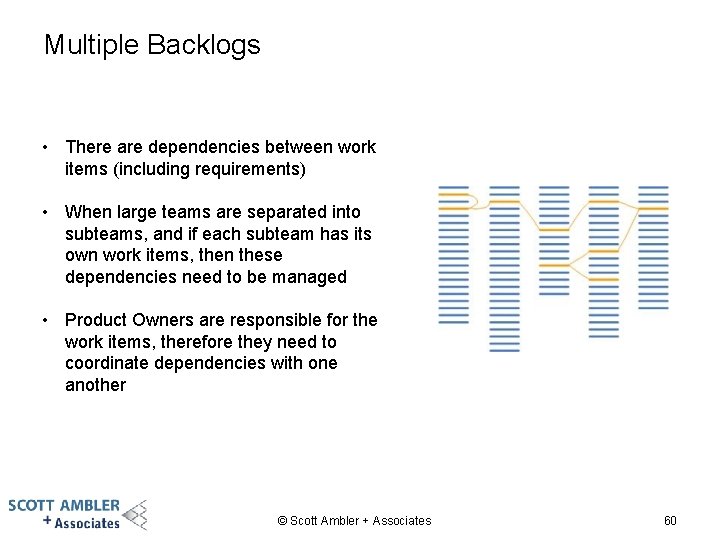
Multiple Backlogs • There are dependencies between work items (including requirements) • When large teams are separated into subteams, and if each subteam has its own work items, then these dependencies need to be managed • Product Owners are responsible for the work items, therefore they need to coordinate dependencies with one another © Scott Ambler + Associates 60
Exercise: Process Tailoring #1 • • • Get back into your smaller teams Goal: Develop a process strategy for a new project team Instructions: – Take 10 minutes to identify how you would approach Inception, Construction, and Transition for the given project scenario Scenario: – Your organization is new to agile but has recently hired 3 disciplined agile coaches and invested in some disciplined agile training – People within your organization are fairly specialized in traditional roles such as business analysis, programmer, tester, and so on – Your business stakeholders insist on being presented with a description of what you will develop, a +/- 10% cost estimate, and a month-based delivery date (e. g. June 2013) before they will fund development – Your first project will have eight developers co-located in a single room – Your stakeholders are in different buildings in the same city as your developers – Your operations team only has experience with traditional release processes A spokesperson will describe your approach with the larger group © Scott Ambler + Associates 61
Exercise: Process Tailoring #2 • • • Get back into your smaller teams Goal: Develop a process strategy for a new project team Instructions: Take 10 minutes to work through the given project scenario Scenario: – Your organization has recently merged with an equal sized competitor in another country. Each organization has an IT group with about 20 developers. There an additional 5 people who work from home around the globe. – Both organizations are very experienced with small team, co-located agile development – Your organization has also recently contracted with an Indian outsourcing firm to take over system integration, security, and performance testing – International legislation requires IT development teams to document their work and provide full traceability throughout the lifecycle – Your project will be to integrate the systems of your two organizations. There is some overlap between systems, each organization has some unique systems, and there are significant differences in source data. The systems range in age from 2 years to 30 years old, running on different platforms. Some systems have full regression test suites, some have partial suites, and some have manual test cases. – This project is the largest one your organization has ever taken on, with an estimated 30 people required for the team A spokesperson will share a few key learnings with the larger group © Scott Ambler + Associates 62
© Scott Ambler + Associates 63
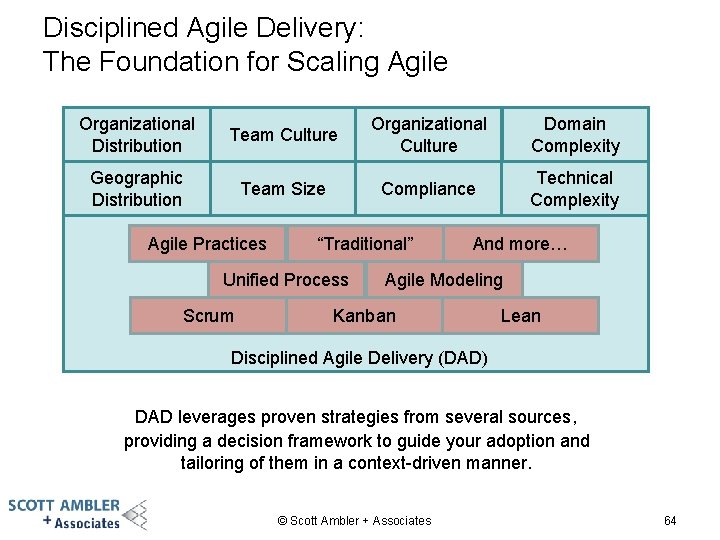
Disciplined Agile Delivery: The Foundation for Scaling Agile Organizational Distribution Team Culture Organizational Culture Domain Complexity Geographic Distribution Team Size Compliance Technical Complexity Agile Practices “Traditional” Unified Process Scrum And more… Agile Modeling Kanban Lean Disciplined Agile Delivery (DAD) DAD leverages proven strategies from several sources, providing a decision framework to guide your adoption and tailoring of them in a context-driven manner. © Scott Ambler + Associates 64
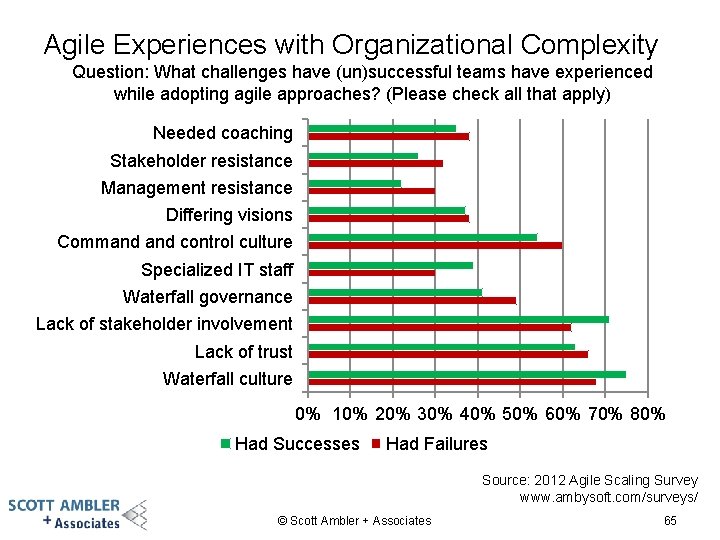
Agile Experiences with Organizational Complexity Question: What challenges have (un)successful teams have experienced while adopting agile approaches? (Please check all that apply) Needed coaching Stakeholder resistance Management resistance Differing visions Command control culture Specialized IT staff Waterfall governance Lack of stakeholder involvement Lack of trust Waterfall culture 0% 10% 20% 30% 40% 50% 60% 70% 80% Had Successes Had Failures Source: 2012 Agile Scaling Survey www. ambysoft. com/surveys/ © Scott Ambler + Associates 65
Exercise: What Have You Learned? • Individually, on a sheet of paper, answer the following questions: – What three new things have you learned about agile delivery in general? – What three new things have you learned about scaling agile approaches? – What improvements in the way you approach agile project will you try to adopt when you’re back at work? – What still puzzles you? © Scott Ambler + Associates 66
A Disciplined Ending…. Please… – Take the opportunity to thank your teammates – we all learned together – Fill out the workshop evaluation form(s) – Turn in the evaluation(s) to the instructor © Scott Ambler + Associates 67
Thank You! scott [at] scottambler. com @scottwambler Disciplined Agile Delivery Agile. Modeling. com Agile. Data. org Ambysoft. com Disciplined. Agile. Delivery. com Enterprise. Unified. Process. com Scott. Ambler. com © Scott Ambler + Associates 68
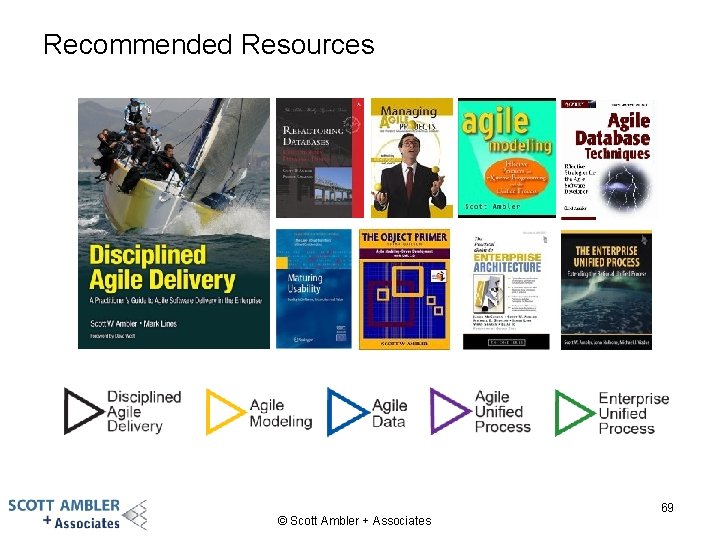
Recommended Resources © Scott Ambler + Associates 69