
Discipline in the Public Service Jacqueline Bonnici Assistant
Discipline in the Public Service Jacqueline Bonnici Assistant Director (PSC) March 2017 Charmaine Busato Assistant Director (Standards and Integrity) P&SD
Directive 11 and the appended manual The concept of delegation of authority to exercise of discipline An overview of the disciplinary measures as set out in the new PSC Disciplinary Regulations, 2017 2
The powers and duties of a Disciplinary Board The Disciplinary Board hearing The functions of the Departmental Representative Retention and disposal of records of disciplinary cases Reporting of disciplinary cases to PSC and P&SD 3
Directive 11 and the appended Manual are: issued by the Principal Permanent Secretary in accordance with article 4(3) of the PAA, and public officers are bound to comply with the provisions therein, by law. Government’s official documents which regulate the exercise of discipline in the Public Service. 4
Failure on the part of a public officer to fulfil any obligations which emerge from these documents, constitutes misconduct in terms of the Disciplinary Regulations. The Manual may be updated from time to time, and public officers are expected to adhere to the provisions of the most recent version. 5
The new PSC Disciplinary Regulations, 2017, build on the concept of devolution of disciplinary powers, introduced by the previous Regulations of 1999. The current safeguards are being strengthened to increase accountability and transparency. 6
Safeguards, including PSC control, are necessary to achieve a balance between the devolution of disciplinary powers with the rights of the officer charged, and ensure: Ø consistency and uniformity of treatment Ø right of appeal Ø the right of the officer charged to be adequately assisted Ø an impartial Disciplinary Board 7
In this delegated scenario, the PSC is the regulator of the disciplinary proceedings, and has the duty to: issue directives concerning the interpretation and operation of the PSC Disciplinary Regulations to heads of department and Disciplinary Boards; enquire into the exercise of disciplinary control to heads of department. 8
Other functions of the PSC in terms of the Disciplinary Regulations are to: approve an extension of time-frames give an interpretation of the regulations or a ruling on a given situation decide whether or not to suspend an officer for precautionary reasons give an oral hearing in disciplinary cases when charges were considered as potentially leading to dismissal, and decide on the penalty to be imposed, if any consider appeals concerning a disciplinary decision by the head of department 9
Where it emerges that the head of department: has abused his delegated authority; or has failed to exercise proper disciplinary control; or did not comply with any PSC ruling or directive; the Commission shall recommend to the Prime Minister that the delegation of authority is withdrawn and that disciplinary action be taken [regulation 3(5)]. 10
If the Commission is satisfied that a public officer or board, performing functions under the Disciplinary Regulations has: failed to comply with any PSC ruling or directive; or failed to observe, or perform satisfactorily, any functions, as required by the Disciplinary Regulations; it shall report the matter to the Prime Minister with a recommendation for disciplinary action to be taken against defaulters, and may remove any member of the Standing Disciplinary Panel. 11
A public officer is liable to disciplinary action for misconduct which includes: unprofessional or unethical behaviour; disrespectful behaviour to colleagues, superior officers or members of the public; neglect or dereliction of duty. 12
Prior to resorting to disciplinary action in terms of the Disciplinary Regulations, supervisory officers, at all levels, have the duty and power to direct employees under their responsibility regarding proper conduct, and to admonish such officer, verbally or in writing, for minor misconduct as an administrative measure. 13
Procedure for written admonishments Within 5 working days from the date a supervisory officer becomes aware of an alleged misconduct, s/he shall inform, in writing, the officer concerned of the intent to issue a written admonishment. The officer concerned is given the opportunity to exculpate himself/herself within 5 working days from such notification. 14
Procedure for written admonishments (cont’d) The supervisory officer shall administer the written admonishment if, in his/her opinion, the officer concerned did not exculpate himself/herself. A written admonishment is kept in the officer’s personal file for 6 months, in a sealed envelope. 15
Procedure for written admonishments (cont’d) The supervisory officer who issued the admonishment shall ensure that the admonishment is removed from the officer’s personal file, and destroyed upon the lapse of 6 months No other record shall be kept. 16
If an officer has been admonished in writing twice in a period of 6 months, a supervisory officer shall: not resort to admonishing the officer concerned; report the matter to the Head of Department. 17
regulations (1) why new address anomalies or ambiguities incorporate previous PSC rulings which have become regular practices simplify procedures by a further devolution of power and eliminating unnecessary or duplicate procedures 18
regulations (2) why new increase safeguards for fairness and transparency by: Ø introducing new time-frames Ø giving a possibility of submitting representations at all stages of the disciplinary process increase effectiveness employee well-being 19
Criminal offences (1) Action following the institution of criminal proceedings When a public officer allegedly commits an offence which may be of a criminal nature, the Head of Department shall consult the Attorney General as to whether or not a prosecution should be instituted [regulation 13(1)]. If the Attorney General advises to resort to disciplinary action instead of a prosecution, the charges against the officer shall be approved by the Attorney General. If criminal proceedings (not concerning a contravention) are instituted against a public officer, the Commissioner of Police shall report the matter to the respective Head of Department. 20
Criminal offences (2) Action following the institution of criminal proceedings (cont) If a public officer is arraigned in Court or is being investigated by the police, the Head of Department reports the matter to the PSC, and recommends whether or not the officer should be suspended for precautionary purposes, giving reasons to justify his opinion. Such a report should be copied to the officer concerned [regulation 13(3)]. No disciplinary action may be taken against the officer concerned, upon any grounds arising from the criminal charge, until the conclusion of criminal proceedings in court and the outcome of any appeal. The Head of Department may, however, suspend the officer on half pay pending the approval of precautionary suspension by the Prime Minister, acting on the recommendation of the PSC [regulation 13(4)]. 21
Criminal offences (3) If the officer is acquitted by the Court If the Court acquits an officer of a criminal charge, s/he shall not be punished on any charge of which s/he has been acquitted by the Court. However, the head of department may still consider it necessary to institute disciplinary proceedings against the officer on any other charge arising from his conduct. In such cases, within 5 working days from when the Head of Department becomes aware of the final court judgement, s/he shall refer the proposed statement of charges to the Attorney General for approval [regulation 14(2)]. An acquittal shall be invariably referred to the PSC by the Head of Department, recommending where applicable, whether the precautionary should be lifted, giving reasons [regulation 14(3)]. If no disciplinary action is taken, the officer shall be refunded the half salary withheld during the precautionary suspension (if applicable). 22
Criminal offences (4) If the officer is found guilty of a criminal charge, the Head of Department shall refer the findings of the Court to the PSC to decide on any penalty to be imposed. The PSC informs the officer of the proposed penalty, if any, and allows the officer to make representations [regulation 15(2)]. After considering any representations received from the officer, the PSC makes a recommendation to the Prime Minister as to the penalty to be imposed, if any. 23
Summary suspension On grounds of alleged misconduct, or for the purpose of carrying out investigations into an alleged offence, a head of department may summarily suspend an officer for a maximum of 8 working days [regulation 10(1)]. During the period of summary suspension an officer shall have his salary withheld. If a head a department fails to initiate disciplinary proceedings in terms of regulation 17 or 25 within this period, the officer has the right to report back to work and receive the full amount of salary withheld. No record of the summary suspension shall be kept. If disciplinary action is taken against a summarily suspended officer and s/he is: Ø found guilty, the period of summary suspension is taken into account when determining the penalty to be imposed; Ø acquitted, the full amount of salary withheld shall be refunded. 24
Forced leave When a public officer: Ø is being investigated or has been arrested by the police in connection with a criminal investigation; or Ø is being investigated in connection with a disciplinary offence, the Head of Department may direct the officer to avail himself/herself of vacation leave for a maximum of 100 hours, and the officer shall comply [regulation 11]. If the investigation does not result in any further action against the officer concerned, or is acquitted of any charges brought against him or her, the forced vacation leave taken will be restored to the officer’s annual vacation leave entitlement. 25
Precautionary suspension (1) Circumstances calling for precautionary suspension A Head of Department may consider it necessary and in the public interest that a public officer be suspended for precautionary purposes from the exercise of the powers and functions of his/her office: on grounds of a serious disciplinary offence, and/or if further investigation is necessary to establish whether disciplinary or criminal proceedings are warranted; or when the officer is to be arraigned in Court or is being investigated or has been arrested by the Police in connection with a criminal offence. 26
Precautionary suspension (2) Recommendation of precautionary suspension Whenever, the head of department considers it necessary that a public officer be suspended for precautionary purposes, s/he shall make his recommendation to the PSC on the prescribed template, giving reasons to justify his/her opinion. The Head of Department may also recommend to the PSC, if appropriate, that the officer may be assigned alternative duties instead of resorting to precautionary suspension, giving details. The report submitted by the Head of Department to the PSC shall be copied to the officer undergoing criminal proceedings. Pending the Prime Minister’s decision, acting on the recommendation of the PSC, whether or not to suspend the officer concerned, the Head of Department may suspend the officer for precautionary purposes. 27
Precautionary suspension (3) Action if precautionary suspension is not approved If an officer’s precautionary suspension is not recommended by the PSC, the Head of Department shall recall the officer for duty immediately and any salary withheld shall be refunded. The Head of Department shall immediately communicate to the officer concerned any decisions concerning his/her precautionary suspension. 28
Precautionary suspension (4) Action if precautionary suspension is approved An officer who is suspended for precautionary purposes: • receives half his/her salary, unless the PSC, after consulting with the Head of the Public Service, approves a higher proportion of the salary; • who ceases to be a public officer before any charges are instituted against him/her, shall be refunded the salary withheld during the period of precautionary suspension; • who ceases to be a public officer after proceedings have been instituted against him/her but before these are concluded, shall not be refunded any salary unless s/he is acquitted of all charges. 29
Precautionary suspension (5) Action if precautionary suspension is approved (cont) In the case of an officer under precautionary suspension, who is subsequently acquitted, the PSC after considering any remarks made by the Head of Department, may recommend to the Prime Minister that the precautionary suspension be lifted and the salary withheld be refunded. In the case of an officer under precautionary suspension, who is subsequently found guilty, the PSC may recommend that the precautionary suspension be lifted and a proportion of the salary withheld be refunded, unless the penalty is dismissal, in which case the officer forfeits all the salary withheld during the period of precautionary suspension. 30
Precautionary suspension (6) Other conditions of precautionary suspension The refund or forfeiture of salary is made on the recommendation of the PSC. No salary shall be due to an officer during the period of preventive custody, whether s/he is subsequently acquitted or found guilty of the charges brought against him/her. An officer under precautionary suspension shall not be allowed access to any official premises identified by the Head of Department, or in any way add to or remove any official document, instrument, or any other matter. An officer who is under precautionary suspension in connection with a criminal offence shall seek the permission of the Head of Department if s/he wishes to travel outside the Schengen area. The Head of Department shall consult the Commissioner of Police before granting such permission. A suspended officer in connection with a criminal offence who fails to seek such permission shall be liable to disciplinary action potentially leading to dismissal. 31
The Head of Department (1) Who is empowered to exercise disciplinary control? For the purpose of the PSC Disciplinary Regulations, a head of department, who is empowered with, and responsible for, the exercise of discipline, is defined as: a Permanent Secretary, Director General, or Director; any other public officer or authority to whom power to exercise disciplinary control has been delegated in accordance with article 110 of the Constitution. When disciplinary action is taken against a Director or other officer to whom authority to exercise discipline has been delegated, the Principal Permanent Secretary assumes the role of a Head of Department, or delegates such power to a Permanent Secretary [regulation 8(1)]. 32
The Head of Department (2) Who is empowered to exercise disciplinary control? If a Head of Department considers it inadvisable for justified reasons to become involved in disciplinary action against a public officer, the role of the Head of Department is exercised by the respective Permanent Secretary. When the Head of Department is a Permanent Secretary, s/he shall consult with the Head of the Public Service, who may in turn take such action as a Head of Department is empowered to take under the Disciplinary Regulations, or delegate such power to another Permanent Secretary. When the public officer against whom disciplinary action is to be taken is serving in an entity, the Permanent Secretary supervising that entity shall take such action as a Head of Department is empowered to take under the Disciplinary Regulations, unless a senior officer within the entity is empowered to take disciplinary action against the public officer through an instrument of delegation [regulation 9]. 33
Offences to be reported without delay (1) A supervisory officer shall report to the Head of Department, in writing including e-mail, any misconduct by an officer under his/her responsibility by not later than 5 working days after s/he becomes aware of the offence [regulation 5]. A failure on the part of the supervisory officer to report such misconduct within the stipulated time-frame does not invalidate disciplinary action for this misconduct taken by the Head of Department in terms of regulation 17. 34
Offences to be reported without delay (2) An officer who has been a victim of an offence allegedly committed by another public officer is entitled to file a formal complaint in writing with the Head of Department of the officer allegedly committing the offence by not later than 6 months from the date the alleged offence was committed. The Head of Department shall request a preliminary investigation which shall be concluded within 15 working days from the date the complaint was received. Depending on the outcome of the investigation, the Head of Department shall determine whether to institute disciplinary action against the officer concerned in terms of regulation 17. 35
Commencement of disciplinary proceedings (1) Issuing the statement of charges not later than 30 working days from the date the alleged offence comes to the notice of the head of department, or not later than 90 working days from the date a report made in terms of the Inquiries Act is signed; the head of department shall prepare a written statement of charges against the officer concerned. The time-frames indicated above may be extended by the PSC for justified reasons [regulation 37]. No action in respect of a minor offence may be taken if the incident occurred earlier than 12 months from the date it comes to the notice of the Head of Department. 36
Commencement of disciplinary proceedings (2) Issuing the statement of charges (cont) The statement of charges shall notify the officer charged: of the specific particulars of the offence; whether the charges constitute a minor or serious offence, and whether the offence could lead to dismissal; that s/he is allowed 10 working days from the date the statement of charges is received [importance of recorded delivery], to make a written submission to the head of department, stating any grounds to exculpate himself/herself. 37
Commencement of disciplinary proceedings (3) A correction to the statement of charges may be made by the Head of Department, by means of a note in writing, at any time during the proceedings, provided that the correction does not alter the substance of the charges. A decrease in the categorisation of the charges, for serious to minor, made by the Head of Department for justifiable reasons. If the charge had originally been considered as potentially leading to dismissal, a decrease in categorisation requires the approval of the PSC. 38
Commencement of disciplinary proceedings (3) Decision whether or not to institute disciplinary proceedings If after considering the officer’s reply, the Head of Department is satisfied that the officer has exculpated himself/herself, s/he shall so inform the officer and all documents related to the case shall be destroyed 2 months later. If the officer admits to the charge, the Head of Department shall communicate to the officer charged his/her decision on the penalty. If the officer does not reply within 10 working days, or if in the opinion of the Head of Department, does not exculpate himself/herself, the Head of Department shall refer the case to a Disciplinary Board appointed in terms of regulation 18 of the PSC Disciplinary Regulations, within 10 working days from the reply by the officer charged or from the date such a reply was due. The letter to the Disciplinary Board shall be copied to the officer charged. 39
The Disciplinary Board (1) A Disciplinary Board shall be: composed of 3 persons, who may be serving public officers or members of the Standing Disciplinary Panel of the respective Ministry; impartial and not connected with the disciplinary case or the officer charged as indicated in section 5. 3. 4 of the Manual. The Chairperson shall be: a serving public officer, performing duties within the same Ministry; not less than two salary scales above the officer charged and not below salary scale 10; at least an Assistant Director or in an analogous grade if the alleged offence has been considered as potentially leading to dismissal; in a salary scale not below that of the officer charged if the latter is in salary scale 3 or higher. 40
The Disciplinary Board (2) The Members, if not part of the SDP, shall be: performing duties within the same Ministry; at least one salary scale above the officer charged; in a salary scale not below that of the officer charged if the latter is in salary scale 3 or higher. Where no officers within the respective Ministry satisfy the set criteria, the Permanent Secretary shall seek the assistance of the Head of the Public Service, or his/her official delegate, to appoint a Disciplinary Board. 41
The Disciplinary Board (3) Objections to the composition of the Disciplinary Board The officer charged may submit a petition to the Head of Department before the start of the hearing if s/he considers that the Chairperson and / or any member of the Board are in any way prejudiced against him/her. In such a case, disciplinary proceedings shall be suspended pending the decision of the Head of Department. If the Head of Department accepts the petition, s/he shall appoint a new Disciplinary Board or make appropriate changes to its composition, and the officer charged shall be informed accordingly. If, on the other hand, the Head of Department does not accept the petition, s/he shall so inform the officer charged, who shall have the right to refer his/her petition to the respective Permanent Secretary within five (5) working days from the date s/he is so informed. The decision of the Permanent Secretary shall be final. 42
The Disciplinary Board (4) Time-frame for the conclusion of a case A Disciplinary Board shall conclude the case and communicate its findings to the Head of Department and to the officer charged within thirty (30) working days from the date the case was referred to it. This time-frame may be extended by the Head of Department for a maximum of a further thirty (30) working days. If in the opinion of the Head of Department, serious and justifiable reasons exist which preclude the Disciplinary Board from submitting a report on its findings within the time-frames, s/he shall refer the matter to the PSC for its direction [regulation 19(5)]. 43


The functions of the Disciplinary Board are to: investigate the case; establish the facts; communicate the facts to the Head of Department and the officer charged. The Disciplinary Board may also: Regulate its own procedure, and Seek the opinion and direction of the PSC when questions of procedure or interpretation of the PSC Disciplinary Regulations arise.
The Disciplinary Board shall: Ascertain that its composition conforms to regulation 18 of the Disciplinary Regulations. Take an oath before a Commissioner of Oaths. Check that the statement of charges conforms to the requirements of regulations 17(1)(a) and (b).
Verify that the time-limits stipulated in regulation 17 have been respected, as follows: in the case of minor offences only, no action is to be taken on cases which occur 12 months before they come to the notice of the Head of Department; that the charge was issued within 30 working days from the date that the alleged offence came to the notice of the Head of Department or from the date of the signing of the report of a Board of Inquiry, as the case may be; that the Head referred the case to the Disciplinary Board within 10 working days from the date of the officer’s reply (if the officer replied and the Head did not consider that s/he has exculpated himself/herself) or from the date the reply was due.
During its preliminary meeting, the Disciplinary Board shall: examine and become familiar with the documents received from the Head of Department related to the case. verify that the Board is in possession of all relevant documents. prepare a concise statement, to be read and presented during the first hearing of the Board, on the circumstances which led the Head of Department to issue the charge.
Prior to the hearing, the Board shall obtain the Service and Leave Record Sheet(GP 47) of the officer charged. The Service and Leave Record Sheet should: be complete in every respect as indicated at the back of the form; be duly signed by an officer not below the grade of principal; include the current salary scale of the officer charged.
All the correspondence of the Disciplinary Board must: Be sent by the chairperson. Be issued on an official letterhead of the Department or from his/her official e-mail account. Correspondence informing the Head of Department and the officer charged of the time and place of the first hearing should be received by both parties at least 10 working days in advance.
Choose date which is convenient for both parties. The letter addressed to the officer charged is to be sent by registered or electronic mail or by hand, provided that proof of delivery is retained.
The Board should send correspondence to the Head of Department, requesting: the home address of the officer charged; the name of the person representing the officer, if any; the name of the Departmental representative; the list of witnesses appearing on behalf of both parties together with an indication of the relevance of their evidence.
The Board should send a notification to the officer charged, informing him/her: of the date, time and place of the first sitting; the members of the disciplinary board; the procedure to be followed.
After the Head of Department provides the necessary information to the Board, the Board sends communication addressed to all witnesses, summoning them to appear before the Board to give evidence on the appointed date.

The Board should invariably ensure that: the hearing is held in private; witnesses are not allowed to be present unless they are giving evidence; the Chairperson and the two members are present for all sittings held; the officer charged is given full opportunity to defend himself/herself and allowed to be present during the hearing of the case and when any advice or evidence is given before the Disciplinary Board;
The officer charged and the Head of Department may be assisted by a person or persons of their choice; The date and time of any subsequent hearing, following the first hearing, shall be determined by the Disciplinary Board in consultation with the Head of Department and the officer charged during the hearing in progress.
If the officer charged raises objections regarding the composition of the Disciplinary Board: the hearing is suspended pending the decision of the Head of Department or the Permanent Secretary. Records of the proceedings of the hearing are kept, including: a statement of all persons present during the hearing; a transcript of the evidence of all sessions held. Details of a disciplinary case may not be disclosed except as required by the Disciplinary Regulations.
The officer charged shall be entitled to: Have access to all documentary evidence to be used against him/her; Be allowed 10 working days to consider such evidence and to reply thereto. Any documentary evidence produced after the start of the hearing shall not be used against the officer unless the officer has been given access to the evidence and given a maximum of 5 working days to consider the additional evidence and reply thereto.
Be given an adequate opportunity to make his/her defence; Be assisted by a person/s of his/her choice to prepare and present his/her case and at every stage of any hearing before the Disciplinary Board; Be informed in writing of the decision on any charge and the penalty, if any, to be imposed, as soon as possible.
Notification of any matter concerning a case of discipline shall be considered as discharged if the notification is: delivered to the home address as given by the officer to the department; given directly to the officer answering the charges; delivered by any other means including electronic means, provided that proof of delivery is retained.
When an officer facing charges refuses to accept or does not collect such notification The officer’s entitlement to such notification shall be considered as having been discharged, provided that proof of attempted delivery or of the officer’s failure to collect the notification is retained.
The alleged victim of a disciplinary offence shall, be entitled to: be present at every stage of any disciplinary proceedings; be accompanied by a person of his/her choice; have the same right as the officer charged to: access documentary evidence; access the findings of the Disciplinary Board; know the final decision taken by the Head of Department or the PSC, concerning the guilt or otherwise of the officer charged and the penalty, if any, imposed upon him/her.
The following conditions apply to the victim: s/he shall be the first witness to be called to give evidence before the Disciplinary Board; s/he shall not be entitled to cross-examine witnesses or otherwise intervene in the proceedings.
The Head of Department has the right to: be present at every stage of any hearing before a Disciplinary Board; be represented by any person of his/her choice, at every stage of any hearing before a Disciplinary Board.
At the start of the first hearing, the chairperson of the Board shall read out: the charge to the officer charged; a concise statement of the circumstances which led the Head of Department to issue the charge.
The Disciplinary Board has the authority to: administer an oath to witnesses; direct that any evidence be confirmed by an affidavit; summon any person to give evidence or to produce a relevant document, in accordance with the PSC General Regulations; seek expert advice.
All witnesses may be cross-examined by: the officer charged or his/her representative; the Chairperson; the members of the Board; the Head of Department / Departmental Representative. No leading questions may be asked.
The witnesses shall be heard in the following sequence: the victim (if s/he chooses to testify); the Head of Department (if s/he chooses to testify); the witnesses of the Head of Department; the officer charged (if s/he chooses to testify); the witnesses appearing on behalf of the officer charged, produced in support of his/her case.
An officer cannot be penalized for failing to appear before the Disciplinary Board. If either party fails to appear at a hearing, and the Board is satisfied that adequate notice of the hearing was given, the Disciplinary Board may proceed, if it is of the opinion that it ought to proceed with the case.
If witnesses who are not public officers fail to appear before the Board without a valid reason, the Board may seek the advice of the Attorney General for action to be taken under the Inquiries Act. Public officers who are summoned as witnesses but fail to appear for the hearing without an explanation shall be liable to disciplinary action.
A witness giving evidence cannot be penalised in any way for giving a substantially different testimony from any written statement he had made. When it appears that a witness may be somehow involved in the case, the Chairperson should remind the witness of his/her right to refuse to answer questions which might incriminate him/her.
If, during the hearing, the Board is of the opinion that the evidence indicates other breach of discipline the Board should: suspend the hearing; report the matter to the Head of Department and to the officer charged. Any evidence produced after the hearing of the case has started shall not be used against the officer unless s/he has: been supplied with a copy of such evidence or given access to it, been given a maximum of five (5) working days to consider the additional evidence and reply thereto.
Time frames The Disciplinary Board must adhere to the following time limits to conclude its investigation: thirty (30) working days to conclude investigations and communicate findings from the date the case is referred to it; an extension of thirty (30) working days given by the Head of Department on good cause being shown; if the extension is insufficient to conclude investigations the Head of Department shall refer the matter to the PSC for direction.
The report This report should consist of: a summary of those parts of the evidence that the Board considers relevant; the findings of the investigation on material questions of fact; a statement whether or not, in the Board’s opinion, the officer charged is guilty of committing the offence and a brief statement justifying such opinion; details concerning any matter which alleviates or aggravates the gravity of the case.
The report should not include any recommendation as to the penalty to be imposed. Before submitting the report, the Board shall communicate its conclusions verbally to the Head of Department and to the officer charged during a final session held for the purpose. The Board shall then submit its findings to both parties, together with appropriate covering letters. The documents relevant to the case shall be consigned to the Head of department

The duties of a Departmental Representative include: representing the Head of Department before a Disciplinary Board; familiarising himself / herself with the case before it starts; the Departmental Representative may be assisted by a legal advisor.
The Departmental Representative prepares for a case by: ensuring that s/he is well-briefed on the case under investigation by the Head of Department or other officers, as the case may be; being aware of the evidence in support of the charge; knowing the identity of all witnesses appearing for the Department, as well as produced by the officer charged, and the relevance of their evidence; being familiar with any documents that are to be presented as evidence; obtaining written statements from public officers who could be asked to give evidence before the Board, in order to ascertain the details of the case.
The Departmental Representative may cross-examine all witnesses, whether they have been summoned by the Head of Department or by the officer charged.
Disclosure of grounds for additional charges (1) When evidence pertaining to a disciplinary case discloses other prima facie related misconduct on the part of the officer charged, the Head of Department shall determine whether or not to proceed against the officer. Disciplinary proceedings for the additional misconduct shall be made in accordance with regulation 17 of the Disciplinary Regulations [regulation 21]. 84
Disclosure of grounds for additional charges (2) In the light of the additional charges, the Head of Department may increase the level of the seriousness ascribed to the original case. If the level of gravity of the offence is increased to one potentially leading to dismissal, the composition of the Disciplinary shall be adjusted accordingly. Unless recomposed, the Disciplinary Board shall continue to hear the case for both statements of charges, and shall allow both parties to present witnesses in connection with the additional charges. 85
Disclosure of grounds for additional charges (3) When evidence pertaining to a disciplinary case discloses other misconduct on the part of the officer charged, not related to the original case, the Head of Department shall proceed against the officer in accordance with regulation 17 of the Disciplinary Regulations. 86
Following presentation of the findings by the DB (1) [regulation 23] When the charges do not lead to dismissal a) The officer charged may submit written representations to the Head of Department, or ask for an appointment to make oral representations to the Head of Department, within ten (10) working days from the date the findings of the Disciplinary Board were communicated to him/her. b) After considering any representations, or if an officer admits to a charge or fails to submit any representations, the Head of Department shall communicate to the officer charged his/her decision as to whether or not s/he accepts the Board’s findings, and on the penalty to be imposed, if any, within ten (10) working days from the date such representations reach him/her. 87
Following presentation of the findings by the DB(2) [regulation 23] When the charges do not lead to dismissal (cont) c) If, through the findings of the Disciplinary Board, it results that the offence was not of a serious nature, contrary to that specified in the statement of charges, the Head of Department may award a lesser penalty than that applicable for serious offences, provided that a note is entered in the records of the case, stating the reasons why s/he accepted the findings of the Board and consequently awarded a lesser penalty. A broad categorisation of offences and corresponding penalties are listed in the Schedule of offences and penalties appended to the PSC Disciplinary Regulations, 2017 [regulation 26]. 88
Following presentation of the findings by the DB(3) [regulation 23] When the charges may lead to dismissal A copy of the Disciplinary Board report is to be referred to the PSC by the Head of Department, within five (5) working days from the date of receipt of the report. If, after considering the report and the circumstances of the case, the Head of Department is of the view that the offence merits a lesser penalty than dismissal, s/he shall enclose the reasons which led him/her to reconsider the gravity of the original charge. 89
Following presentation of the findings by the DB(4) [regulation 23] When the charges may lead to dismissal (cont) In giving consideration to the Board’s findings and to the submission by the Head of Department, if any, the PSC may give an opportunity to the officer charged and to the Head of Department to make oral representations. After considering the findings of the Board and the representations submitted, the PSC shall make its recommendation to the Prime Minister, both as to the guilt or otherwise of the officer charged and as to the penalty imposed, if any. 90
Appeal by the officer charged (1) [regulations 27 - 28] A public officer has the right to submit an appeal with the PSC to contest a finding of guilt and any related penalty imposed by the Head of Department following disciplinary action taken in terms of regulation 17. An appeal can also be submitted if the officer can prove that, in the course of disciplinary proceedings against him/her, there was a gross disregard of the Disciplinary Regulations which prejudiced his/her interests. A penalty imposed by a Head of Department shall not be put into effect before the lapse of at least ten (10) working days from the date the officer was informed of such penalty. If an appeal is lodged, the penalty shall not be put into effect pending the outcome of the appeal [regulation 28]. The officer shall copy his/her appeal to the Head of Department, who shall within five (5) working days, transmit to the PSC the relevant documentation related to the case, including the Disciplinary Board report. 91
Appeal by the officer charged (2) [regulation 27] If the PSC is of the opinion that an appeal merits consideration, it shall give an opportunity to the officer charged and to the Head of Department to make oral representations. The PSC, after considering the grounds for appeal, the record of the disciplinary proceedings, and any oral representations, shall recommend to the Prime Minister either that the decision of the Head of Department be confirmed, or that such decision be amended or revoked. Upon approval of its recommendation, the PSC shall inform the appellant of the outcome of the appeal. 92
Appeal by the Head of Department (1) [regulation 29] A Head of Department may submit an appeal to the PSC if s/he: is dissatisfied with the disciplinary proceedings against an officer or the findings of a Disciplinary Board; or can prove that gross disregard of the Disciplinary Regulations prejudiced his case. The Head of Department shall submit his/her appeal and the grounds therefor, in writing to the Executive Secretary (PSC), and copied to the officer concerned, within ten (10) working days from the date the findings of the Disciplinary Board were communicated to him/her and to the officer concerned. 93
Appeal by the Head of Department (2) [regulation 29] If the PSC is of the opinion that the appeal merits consideration, it shall give an opportunity to the officer charged and to the Head of Department to make oral representations. The PSC, after considering the grounds for appeal, shall make a recommendation to the Prime Minister as to the guilt or otherwise of the officer charged with respect to each of the charges brought against him/her, and the penalty to be imposed, if any. 94
The penalties that may be awarded by a Head of Department are written warning, suspension without pay, and a warning of dismissal valid for a maximum of four (4) years. The demotion or dismissal of a public officer is invariably approved by the Prime Minister on the recommendation of the PSC. 95
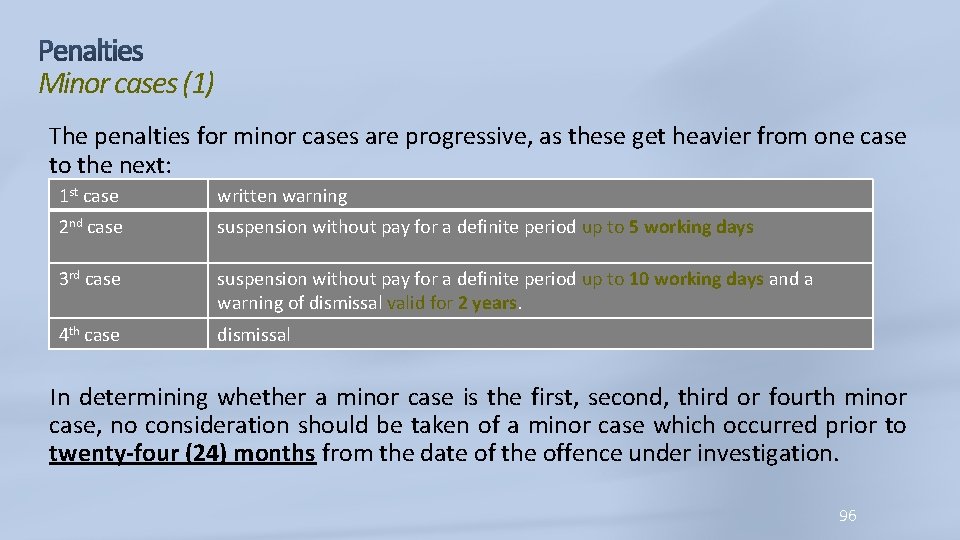
Minor cases (1) The penalties for minor cases are progressive, as these get heavier from one case to the next: 1 st case written warning 2 nd case suspension without pay for a definite period up to 5 working days 3 rd case suspension without pay for a definite period up to 10 working days and a warning of dismissal valid for 2 years. 4 th case dismissal In determining whether a minor case is the first, second, third or fourth minor case, no consideration should be taken of a minor case which occurred prior to twenty-four (24) months from the date of the offence under investigation. 96
Minor cases (2) A written warning given as a penalty for a first minor case is valid for twelve (12) months. Thus, a written warning which was given prior to twelve (12) months from the date of the offence under investigation should not be taken into consideration if no other offence is committed during that period. Dismissal as a result of a minor case is only possible if the most recent offence is committed while the officer is under a warning of dismissal, arising from a previous minor case, whether or not the most recent offence is the fourth minor case. 97
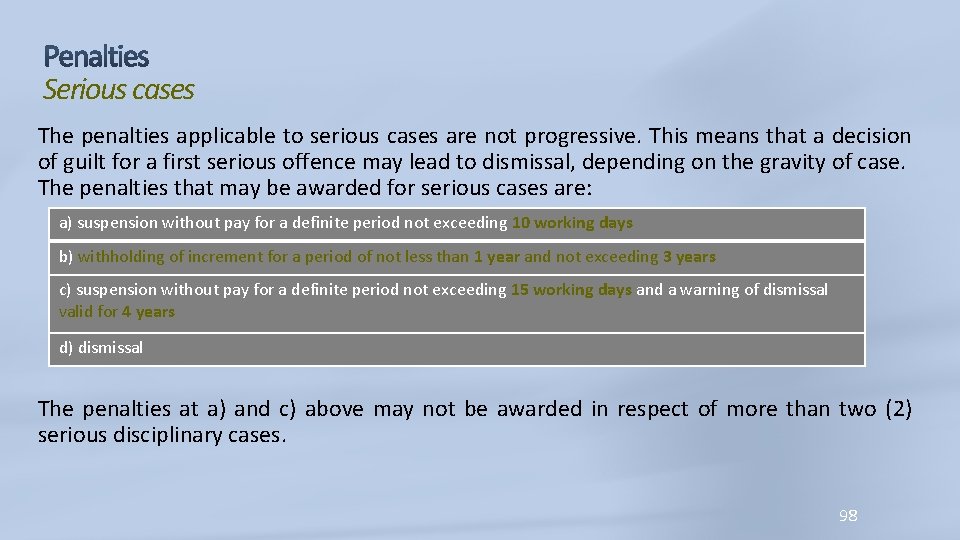
Serious cases The penalties applicable to serious cases are not progressive. This means that a decision of guilt for a first serious offence may lead to dismissal, depending on the gravity of case. The penalties that may be awarded for serious cases are: a) suspension without pay for a definite period not exceeding 10 working days b) withholding of increment for a period of not less than 1 year and not exceeding 3 years c) suspension without pay for a definite period not exceeding 15 working days and a warning of dismissal valid for 4 years d) dismissal The penalties at a) and c) above may not be awarded in respect of more than two (2) serious disciplinary cases. 98
imposed on the recommendation of the PSC As an alternative to dismissal, the PSC may recommend the demotion of a public officer to a lower grade or position. In cases of conviction by the Court, the Commission may recommend to the Prime Minister other penalties in addition to, or instead of, those set out in the Schedule for offences and penalties, as appended to the Disciplinary Regulations. 99
possibility of waiver (1) When, in a case of guilt for a serious offence, the Head of Department considers that the officer concerned would benefit from an opportunity for rehabilitation, s/he shall proceed as follows: decide on the penalty to be imposed but refrain from informing the officer concerned; refer the case to the PSC with a justification as to why the officer would benefit if professional support is sought. 100
possibility of waiver (2) If the PSC accepts such a recommendation, it shall inform the Head of Department that if the officer agrees to seek professional support within ten (10) working days from the of receipt of such notification, the penalty is to be held in abeyance. The Head of Department shall inform the officer concerned of the PSC’s decision, and if the officer agrees with this decision, the Head of Department will be kept informed of the officer’s progress, and for such purposes, a report shall be provided by the entity concerned. 101
possibility of waiver (3) The same provisions apply also to cases where the officer charged was informed that the charges, if proved, could lead to his/her dismissal, if the PSC considers that the officer concerned would benefit from an opportunity for rehabilitation. In cases where the officer was suspended for precautionary purposes, the PSC shall make its recommendation to the Prime Minister for the precautionary suspension to be lifted, without prejudice to the forfeiture of the salary withheld during the period under precautionary suspension. The PSC is to be kept informed of the progress being made by the officer concerned, and for such purposes, a report shall be provided by the entity concerned. 102
possibility of waiver (4) In both circumstances, if the officer is willing to seek professional support and follow the recommended rehabilitation programme, any penalty decided upon by the Head of Department or the PSC shall be held in abeyance until successful completion of the rehabilitation programme. The PSC shall then decide as to whether the penalty shall be put into effect or otherwise. If an officer refuses to seek professional assistance, or does not successfully complete a rehabilitation programme, the penalty originally decided upon by the Head of Department or the Commission, as applicable, shall be imposed. 103
grounds The appointment of a public officer may be terminated under the PSC Disciplinary Regulations, 2017, for the following reasons: absence without leave; or on dismissal or removal in consequence of criminal or disciplinary proceedings, on the recommendation of the PSC. 104
absence without leave [regulation 32] When a public officer is absent without leave for ten (10) consecutive working days, the following procedure shall apply: a) The officer concerned shall be considered as having resigned from the Public Service with effect from the eleventh working day of unauthorised absence. b) On the eleventh day, the Head of Department shall notify the officer concerned of: the effective date when s/he is being considered as resigned; and any liability due by the officer concerned to pay Government. c) If an officer reports for duty before the date of notification by the Head of Department, or before the period of ten (10) working days expires, s/he is to be allowed to resume duty but shall be liable to disciplinary action by the Head of Department in accordance with the Disciplinary Regulations. 105
absence without leave [regulation 32] Appeal a) An officer may submit an appeal to the PSC within ten (10) working days, starting from the day after s/he receives the notification from the Head of Department, setting out the reasons why s/he considers that the decision taken by the Head of Department is unjust. b) In giving consideration to the appeal, the PSC seeks the views of the Head of Department, and may give the officer concerned and the Head of Department the opportunity to make oral representations. c) If the PSC upholds an appeal : it shall annul the decision of the Head of Department by means of a recommendation to the Prime Minister; the officer concerned shall not resume duties unless and until the PSC upholds the appeal; the officer concerned shall not become entitled to the payment of salary for any period of unauthorised absence or for the time taken by the PSC to hear the appeal. 106
When an officer undergoing disciplinary proceedings ceases to be a public officer before the conclusion of such proceedings, the following procedure shall apply: a) The Head of Department asks the officer charged to state in writing, within ten (10) working days, whether s/he wishes to continue with, or suspend, the disciplinary proceedings against him/her. 107
b) If the officer opts to continue with the proceedings and s/he is eventually found: not guilty, but the officer had been suspended for precautionary purposes in connection with these proceedings, the Head of Department shall inform the PSC of these circumstances so that action is taken to refund the salary withheld during the period of precautionary suspension; 108
guilty, no penalty shall be imposed but a record of the findings of the Disciplinary Board is entered in the officer’s record of service. If this person subsequently rejoins the Public Service, the Head of Department, responsible for the officer in his/her new capacity, shall within three (3) months from the date the officer rejoined the Public Service, make a recommendation to the PSC as to whether or not disciplinary proceedings should be resumed with a view to impose an appropriate penalty. 109
c) If the officer opts to have his/her case suspended, or does not state his/her preferred option within the stipulated time-frame, the case is suspended and a note entered in the officer’s record of service stating that at the time of leaving the Public Service, the officer had a pending disciplinary case. d) If this person subsequently rejoins the Public Service, the Head of Department, responsible for the officer in his/her new capacity, shall within three (3) months from the date the officer rejoined the Public Service, make a recommendation to the PSC as to whether or not disciplinary proceedings should be resumed. 110
When an officer undergoing criminal proceedings ceases to be a public officer before the conclusion of such proceedings, or these have been concluded but the PSC has not yet proceeded in accordance with regulation 15 of the Disciplinary Regulations, no further action may be taken. However, the Head of Department shall ensure that a record of the Court judgement is entered in the officer’s record of service. If the officer was under precautionary suspension in connection with criminal proceedings and s/he is eventually acquitted by the Court, the Head of Department shall inform the PSC of these circumstances so that action is taken to refund the salary withheld. 111
Disciplinary proceedings which have been initiated under the Disciplinary Regulations 1999 shall be continued and completed in accordance with the respective regulations, provided that the applicable provisions on disciplinary penalties shall be those most favourable to the officer charged. 112

Open a departmental disciplinary file (yellow cover). All correspondence relating to that particular case shall be inserted in file. The reference number of the discipline file shall be the same as that of the personal file of the officer concerned, preceded by the letters “DISC”. Correspondence issued by the Dept. regarding the case shall also bear as reference the abbreviated name of the Department, as well as the part number, if any, indicating the number of the disciplinary case. (e. g. DISC/OPM/P&SD/123/II.
The file of a pending disciplinary case: shall not be attached to the personal file of the officer concerned; its movement shall be handled with the strictest confidentiality; no reference should be made on the minute sheet of the personal file; a note shall be attached to the officer’s personal file indicating that there is a pending disciplinary case. This note shall: be placed on the left-hand side, on top of the last minute-sheet; be removed and destroyed when the disciplinary case is concluded.
The note shall contain: the officer’s ID number and discipline file number; the type of the pending disciplinary case, whether it is a minor or serious disciplinary case; or a criminal case; a warning to delete this note when the disciplinary case is concluded.
While the disciplinary case is still pending, no reference to the case shall be made: on the minute sheet of the personal file; in the Personal Record Sheet (GP 46); in the Service and Leave Record (GP 47) of the officer concerned.
On the conclusion of a disciplinary case the discipline file shall: be sealed in an envelope by the officer responsible for HR and signed along the flap of the sealed envelope; be attached to the officer’s personal file; be retained in the HR Unit of the Department; only be opened or referred to an officer performing duties outside the HR Unit with the authorisation of the Head of Department of the disciplined officer, or of his/her delegate on such matters, or of an officer acting on his/her behalf.
If the officer is acquitted of the charge/s brought against him/her: the discipline file shall be kept in sealed envelope and attached to the employee’s main personal file for 2 months; if no appeal is lodged with the PSC by the Head of Department, the file is to be detached from the main personal file and destroyed after 2 months; During those 2 months the officer responsible for HR should ensure that the personal file does not leave HR premises, unless specifically authorized by the Head of Department. no reference to the case shall be made in the minute sheet of the personal file, in the Personal Record Sheet (GP 46) and in the Service and Leave Record (GP 47) of the officer concerned.
If the officer is found guilty of the charge issued against him/her; the sealed disciplinary file shall remain attached to the personal file; an entry shall be made of the outcome of the disciplinary case in the minute sheet of the personal file, in the Personal Record Sheet (GP 46) and in the Service and Leave Record (GP 47) of the officer concerned; if the penalty is a written warning such entry shall be made in pencil and erased after twelve (12) months.
Information related to the Public Service Commission Disciplinary Regulations 2017 is collected in three categories: Regulations 14 – 16 (Criminal cases); Regulation 17 (Minor disciplinary cases); Regulation 17 (Serious disciplinary cases).
Directors responsible for people management are required to: collect the completed forms from the Departments and Entities falling within their Ministry and send them to the PSC and P&SD; send two (2) sets in a calendar year (1 January to 30 June and 1 July to 31 December); Returns (including nil returns) are to be sent within one (1) month from the end of the reporting period.
In cases dealt with under regulations 14 -16 (Criminal offences): a completed return form is to be sent for each individual case instituted by the Police in the Criminal Court against a public officer; the return should also be submitted when the court case is concluded from all stages.
In cases dealt with under regulation 17 (Minor disciplinary cases) and regulation 17 (Serious disciplinary cases): a completed return form is to be sent for each individual case when a Disciplinary Board is appointed; when a case is concluded from the Department’s end; when, the commencement and conclusion of a case fall within the same six (6) month period only one return for that individual case needs to be completed and submitted.
Disciplinary cases are considered as concluded from the Department’s end either when: the Head of Department decides on the case in terms of regulation 23(1) (where the case cannot lead to dismissal) or; when the Head of Department refers the case to the PSC in terms of regulation 23(2)(a) (where the case could lead to dismissal).
The new forms are to be used for the new PSC Regulations. Updated forms for disciplinary cases initiated under the 1999 Disciplinary Regulations are still required.

- Slides: 128